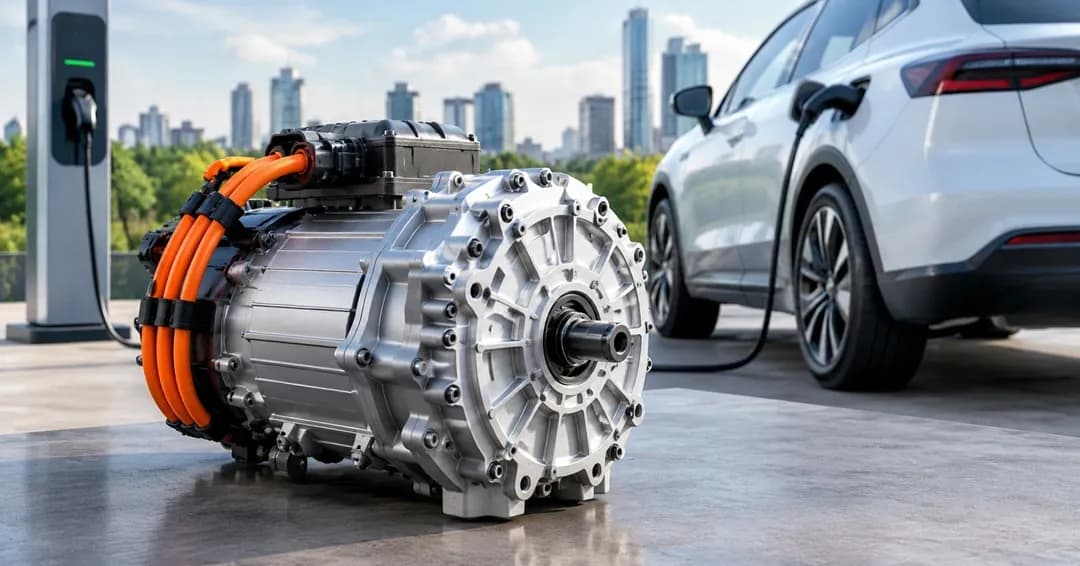
The global EV traction motor market is expanding as automakers adopt integrated e-axles, compact drivetrain architectures, and advanced propulsion technologies. Rising electric vehicle production, improved motor efficiency, power electronics innovation, and manufacturing optimization are creating opportunities for suppliers developing scalable, reliable, and space-efficient electric drive systems across passenger and commercial vehicle segments.
Knowledge Sourcing Intelligence published its latest analysis of the Global EV Traction Motor Market, projecting growth from USD 10.9 billion in 2026 to USD 20.6 billion by 2031, registering a CAGR of 13.6%. The need for compact, integrated electric drivetrain systems drives market growth. Integrated e-axles are creating opportunities for traction motor suppliers by consolidating propulsion components into compact systems. Recent developments from automotive suppliers highlight growing investment in integrated drive modules, modular electric axles, and scalable drivetrain technologies.
Market Overview
The Global EV Traction Motor Market is expanding as automakers increase electric vehicle production and invest in propulsion technologies that balance performance, efficiency, and manufacturing costs. Integrated e-axles combine traction motors with components such as inverters and reduction gearboxes, offering a consolidated approach to drivetrain design.
Increasing demand for passenger cars and commercial vehicles is supporting market expansion. Integrated systems can simplify vehicle assembly and standardize drivetrain configurations across selected platforms. However, adoption depends on vehicle specifications, thermal management, reliability, serviceability, and production economics.
Integrated E-Axles Support Compact Drivetrain Design
By consolidating propulsion components into a single assembly, integrated e-axles can simplify mechanical and electrical connections while reducing packaging requirements. This gives vehicle designers greater flexibility when allocating space for batteries, passenger cabins, and other systems.
Integration also presents engineering challenges, including heat management, component durability, and maintenance requirements. Suppliers are developing electric drive units that combine motor engineering, power electronics, transmission design, and cooling technologies. Their ability to balance compact dimensions, reliable performance, and cost will influence adoption across vehicle categories.
Request a free sample copy or view the report summary: EV Traction Motor Market Report
Key Growth Drivers
Rising Electric Vehicle Production
Increasing adoption of battery electric vehicles (BEVs) expands demand for traction motors and associated propulsion components. Automakers need scalable solutions that accommodate different vehicle segments while meeting performance and cost targets. Integrated e-axles can support standardized drivetrain configurations across selected platforms.
Demand for Space-Efficient Vehicle Architectures
Manufacturers must balance battery capacity, cabin space, weight distribution, and drivetrain packaging. Compact electric drive units can improve packaging flexibility, particularly in smaller passenger cars and dedicated electric vehicle platforms.
Advances in Motor and Power Electronics Technology
Developments in motor design, inverter efficiency, control systems, and cooling technologies are enhancing drivetrain performance. Higher power density can help deliver required output within tighter packaging constraints, although results depend on effective integration of mechanical and electrical components.
Manufacturing Scale and Cost Optimization
Integrated drive systems can streamline assembly and reduce component integration work. Potential cost advantages depend on production volumes, sourcing strategies, maintenance requirements, and the architecture selected by each automaker.
Latest Industry Developments
February 2026 – BorgWarner: BorgWarner secured a contract to supply an 800-volt integrated drive module and generator module with a dual inverter for a North American automaker's range-extended electric trucks and SUVs. Production is scheduled to begin in 2029, highlighting demand for compact, high-performance propulsion systems.
September 2025 – Schaeffler: Schaeffler showcased its modular EMR4 electric axle drive at IAA MOBILITY 2025. The system integrates a motor, power electronics, and transmission within a compact housing, with configurable components to accommodate different vehicle requirements.
June 2025 – ZF: ZF introduced its SELECT electric drive platform for passenger cars, featuring an 800-volt system and modular configurations designed to improve scalability, simplify integration, and accommodate different power requirements.
April 2025 – ZF: ZF secured an order to supply several thousand AxTrax 2 electric axles for zero-emission intercity buses in India, demonstrating the application of integrated electric axle technology beyond passenger vehicles.
Regional Outlook
Asia-Pacific is an important region because of its EV manufacturing base, automotive supply chains, and investment in electrification. China, Japan, South Korea, and India offer opportunities for drivetrain suppliers, with demand shaped by vehicle production and local sourcing strategies. North America and Europe also present opportunities as automakers develop EV platforms and strengthen supplier relationships.
Competitive Landscape
The market includes automotive suppliers and electric drivetrain specialists offering standalone traction motors, integrated e-axles, and complete electric drive units. Competition centers on efficiency, power density, reliability, manufacturing capabilities, and relationships with original equipment manufacturers (OEMs).
Recent developments from BorgWarner, Schaeffler, and ZF illustrate competing approaches to integration, modularity, and application-specific design. Suppliers with expertise across motors, inverters, transmissions, and thermal management may be better positioned to meet demand for integrated solutions.
Analyst Perspective
“Integrated e-axles are becoming an important consideration in electric drivetrain development as automakers seek to optimize packaging, performance, and manufacturing costs. Their commercial potential will depend on delivering measurable system-level benefits across different vehicle platforms. Suppliers that combine traction motor expertise with integrated drive system capabilities may be positioned to address evolving OEM requirements as adoption of EVs expands.”
What The Study Covers
The Global EV Traction Motor Market Report provides market estimates and forecasts for 2026–2031, growth drivers and restraints, technology and application analysis, regional insights, competitive assessments, company profiles, and developments in product launches, partnerships, and investments.
Have questions?
More Press Releases
Global EV Battery Enclosures Market to Reach USD 20.4 Billion by 2031 as EV Production and Lightweight Enclosure Demand Accelerate
The global EV battery enclosures market is expanding as rising EV production, lightweighting, structural battery architectures, and integrated thermal management increase enclosure requirements. The market is projected to reach USD 20.4 billion by 2031. Asia Pacific remains the leading manufacturing region.
How Samsung Medison, Philips, and Carestream’s Recent Diagnostic Imaging Innovations Could Drive Growth: The Medical/Diagnostic Imaging Market Is Anticipated to Reach USD 60.7 Billion by 2031
Diagnostic imaging companies are advancing AI-assisted ultrasound and X-ray technologies to improve image quality, automate measurements, streamline workflows, and support faster examinations. Samsung Medison, Philips, and Carestream have introduced new solutions featuring AI-enabled analysis, enhanced visualization, single-transducer functionality, automated exposure control, noise reduction, and connected clinical capabilities.
How Lincotek’s SportLinc FDA Clearance Could Impact the Sports Medicine Market, Expected to Reach USD 9.45 Billion by 2031
Lincotek Medical announced FDA 510(k) clearance for its SportLinc Syndesmosis Device in April 2026, adding a cleared option for stabilizing syndesmotic ankle trauma. The sterile, single-use implant uses an ultra-high-molecular-weight polyethylene (UHMWPE) suture tensioned between two low-profile titanium alloy buttons, and is offered to OEM partners for private labeling. The clearance adds another fixation option for sports-related ankle injuries, where implant design, surgical handling, and stabilization requirements influence product selection. According to Knowledge Sourcing Intelligence (KSI), the global sports medicine market is projected to grow at a CAGR of 6.25%, reaching USD 9.45 billion in 2031 from USD 6.98 billion in 2026.