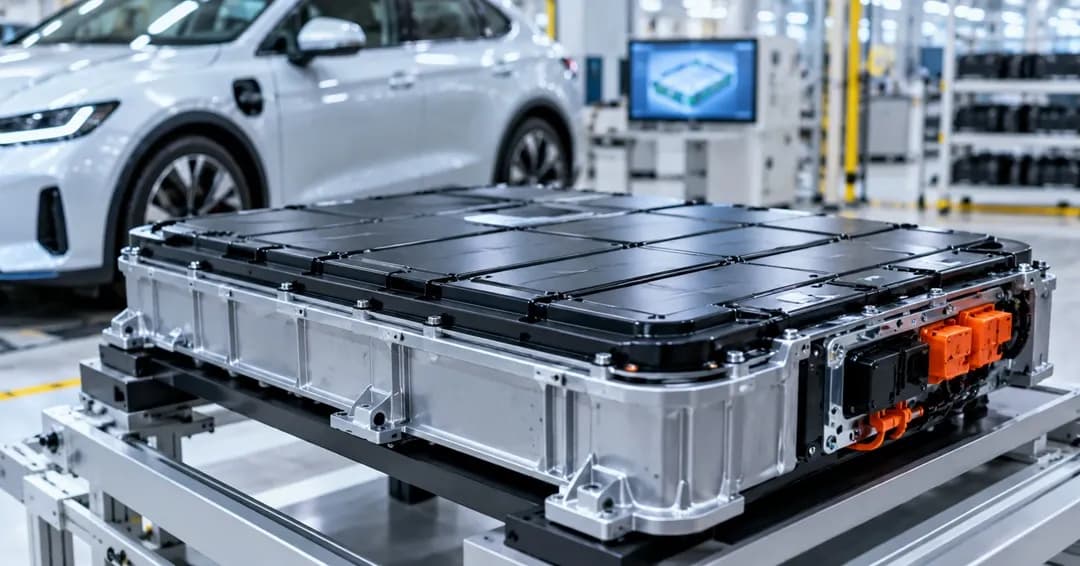
The global EV battery enclosures market is expanding as rising EV production, lightweighting, structural battery architectures, and integrated thermal management increase enclosure requirements. The market is projected to reach USD 20.4 billion by 2031. Asia Pacific remains the leading manufacturing region.
Rising electric vehicle production, lightweighting requirements, structural battery architectures, and integrated thermal-management systems are increasing demand for advanced battery enclosure solutions worldwide.
Knowledge Sourcing Intelligence released its latest analysis of the Global EV Battery Enclosures Market, forecasting the market to increase from USD 11.6 billion in 2026 to USD 20.4 billion by 2031, growing at a 12.0% CAGR during the forecast period.
Expanding production of electric vehicles (EVs), increasing battery-pack volumes, demand for lightweight and high-strength components, and the integration of structural, thermal-management, sealing, and safety functions into battery enclosure systems are the major factors driving market growth.
As vehicle platforms and battery architectures evolve, enclosures are increasingly moving beyond conventional protective housings to perform multiple structural and functional roles within the battery system. This transition creates opportunities across steel, aluminium, composite, and hybrid enclosure technologies and encourages suppliers to improve manufacturing efficiency and platform-level integration.
EV Production Expands Demand for Battery Enclosures
The expansion of electric vehicle production is directly driving growth of the addressable market for battery enclosure systems. Each traction battery requires a mechanically robust and environmentally protected housing that meets stringent requirements for crash protection, sealing, thermal management, grounding, and underbody protection.
According to the International Energy Agency (IEA), global electric-car production reached nearly 22 million units in 2025, with China accounting for nearly three-quarters of global output, reinforcing Asia Pacific's importance to the battery enclosure supply chain.
Ongoing expansion of EV production across China, Europe, North America, and emerging manufacturing markets is encouraging enclosure suppliers to implement production capabilities close to vehicle and battery assembly facilities. Increasing platform diversity is also creating demand for scalable enclosure architectures that can support different battery configurations while maintaining structural and manufacturing performance.
Lightweighting Drives Material Innovation
Vehicle manufacturers are increasingly seeking to reduce vehicle mass without compromising battery protection, crash performance, durability, or production economics. Consequently, material selection has become a central consideration in battery enclosure development.
Aluminium provides a strong lightweighting proposition and can support extruded, stamped, cast, and fabricated enclosure designs. Steel remains highly competitive where crash performance, material cost, high-volume stamping, and established automotive manufacturing processes are important. The KSI analysis indicates that Magna's aluminium enclosure designs can be approximately 20% lighter than comparable steel designs, while steel provides cost and manufacturing advantages.
Composite and hybrid architectures are also gaining attention where manufacturers seek electrical isolation, corrosion resistance, lower mass, and greater component integration. This is creating a multi-material competitive environment in which the selection of enclosure material is increasingly driven by specific vehicle platform requirements rather than lightweighting alone.
In March 2025, Novelis, Shape Corp., and Metalsa announced a collaboration to develop aluminium roll-form-intensive EV battery-tray concepts focused on design, quality, weight, and manufacturing efficiency.
Battery Enclosures Take on Greater Structural and Thermal Functions
The development of cell-to-pack and structural battery architectures is increasing the functional requirements placed on battery enclosure systems.
Traditional housings primarily protected battery cells and high-voltage components. Newer vehicle architectures increasingly require battery enclosures to perform multiple functions, including supporting structural loads, absorbing and distributing crash forces, accommodating cooling interfaces, maintaining sealing, and enhancing protection against thermal propagation.
The engineering complexity and value content of battery enclosures are increasing, encouraging suppliers to develop integrated enclosure systems rather than supplying individual trays, covers, or structural components.
In June 2026, Kautex secured a new business award for its Pentatonic battery enclosure solution for a leading automotive OEM. The program includes the complete enclosure system, comprising the top cover, bottom tray, and thermal-management solution, and is designed for a multi-vehicle platform. Production is planned to be localized in North America from 2028.
The rising integration of structural and thermal functions is expected to drive demand for enclosure platforms that combine several battery-system requirements in a single architecture.
Request a free sample copy or view the report summary: EV Battery Enclosures Market Report
Manufacturing Innovation Improves Enclosure Efficiency
Manufacturing efficiency is becoming an important competitive factor as automakers and suppliers seek to reduce part counts, joining operations, assembly time, and production costs while maintaining enclosure performance.
Traditional battery housings can require multiple components and numerous joining operations. Advanced forming and molding technologies are being developed to reduce these requirements and improve dimensional consistency and sealing performance.
Magna's OptiForm battery enclosure uses a deep-draw stamping approach to create a near-rectangular enclosure with integrated end sections. Magna states that the design can provide up to 10% more usable battery space while streamlining manufacturing.
The development represents a broader transition toward one-piece, reduced-weld enclosure architectures. These approaches could become increasingly relevant as EV manufacturers scale production and seek to improve manufacturing economics without reducing battery-pack functionality.
Recent Industry Developments
Developments in integrated enclosure systems, lightweight materials, advanced forming, lower-carbon materials, and regional manufacturing influence the competitive environment.
June 2026 - Kautex: Kautex secured a new business award for its Pentatonic battery enclosure solution for a leading automotive OEM. The program includes the top cover, bottom tray, and thermal-management solution for a multi-vehicle platform, with North American production planned from 2028.
March 2026 - Magna: Magna detailed its OptiForm battery enclosure, a one-piece deep-drawn design intended to address manufacturing inefficiencies associated with conventional multi-piece battery housings. The company states that the approach can increase usable battery space by up to 10%.
February 2026 - thyssenkrupp Steel: thyssenkrupp Steel announced that it would supply bluemint recycled steel to BMW Group from 2026 for applications including the battery housing of the BMW iX3. The company states that the material maintains conventional steel properties while providing verified CO? savings.
March 2025 - Novelis, Shape Corp., and Metalsa: The companies announced a collaboration to develop aluminium roll-form-intensive EV battery-tray concepts combining advanced alloy development, roll forming, and precision assembly.
Asia Pacific Leads EV Battery Enclosure Manufacturing
Asia Pacific represents the most important production region for EV battery enclosures, supported by its concentration of electric vehicle manufacturing, battery production, automotive supply chains, metals processing, and component manufacturing.
China is the region's largest production base and accounted for nearly three-quarters of global electric-car production in 2025. Japan and South Korea contribute established capabilities in automotive engineering, battery technology, advanced materials, and manufacturing. India is also developing as an important EV manufacturing and localization market.
The high concentration of vehicle and battery production allows enclosure manufacturers to establish facilities close to OEM and battery assembly plants. This is particularly relevant for large-format battery enclosures, where transportation costs and supply-chain coordination can influence manufacturing decisions.
KSI forecasts Asia Pacific to remain the largest enclosure manufacturing base through 2031, while North America and Europe continue to develop localized EV and battery supply chains.
North America Expands Localized Enclosure Production
North America is developing additional opportunities as automakers and battery manufacturers expand regional production capacity.
Localized battery and vehicle manufacturing is propelling enclosure suppliers to establish regional production capabilities and integrated supply arrangements. Recent supplier investments, including Kautex's planned North American production program, showcase this broader localization trend.
Regional manufacturing can reduce logistics requirements for large battery components while allowing suppliers to align enclosure production with vehicle-platform launches and battery assembly operations.
Competitive Landscape
The Global EV Battery Enclosures Market includes Magna International Inc., Gestamp Automocion S.A., Kautex Textron GmbH & Co. KG, Benteler International AG, and Minth Group Limited, among other industry participants.
Competition is increasingly extending beyond supplying individual materials or structural components. Key areas of differentiation include:
Lightweight and high-strength enclosure design
Structural battery integration
Thermal-management integration
Crash and thermal-propagation protection
Advanced forming and joining technologies
Composite and hybrid material systems
Manufacturing efficiency and automation
Platform-level engineering and validation
Regionalized production capabilities
The competitive environment is therefore moving toward complete enclosure-system solutions. Suppliers who integrate structural, thermal, safety, sealing, and manufacturing functions can capture greater value within vehicle programs and develop closer relationships with OEMs.
The KSI analysis also identifies Magna, Kautex, Gestamp, Benteler, Minth Group, Nemak, thyssenkrupp, Novelis, and Constellium among companies participating across different parts of the enclosure value chain.
Analyst Perspective
“The EV battery enclosure is evolving from a conventional protective housing into a multifunctional component of the electric vehicle platform. Rising EV production is expanding underlying unit demand, while lightweighting, structural battery architectures, thermal management, and manufacturing efficiency are increasing the technical requirements placed on enclosure suppliers. This evolution is creating opportunities across steel, aluminium, composite, and hybrid technologies and is expected to accelerate demand for integrated enclosure solutions.”
Market Segmentation
Segment | Subsegments |
|---|---|
Material | Steel, Aluminium, Composite, Hybrid, Other Materials |
Vehicle Type | Passenger Battery Electric Vehicles, Plug-in Hybrid Electric Vehicles, Commercial Electric Vehicles, Other Electric Vehicles |
Enclosure Architecture | Conventional Multi-Piece Enclosures, One-Piece / Reduced-Weld Enclosures, Cell-to-Pack and Structural Pack Enclosures, Hybrid Enclosure Architectures |
Manufacturing Process | Stamping and Welding, Extrusion and Fabrication, Casting, Compression / Injection Molding, Other Processes |
Geography | North America, South America, Europe, Middle East and Africa, Asia Pacific |
About the Global EV Battery Enclosures Market Report
The Global EV Battery Enclosures Market Report from Knowledge Sourcing Intelligence analyzes market size, forecasts, market dynamics, technology developments, regional trends, and competitive activity through 2031.
The study covers:
Market size and forecast through 2031
Key market growth drivers and restraints
Material-level analysis
Vehicle-type analysis
Enclosure architecture analysis
Manufacturing process analysis
Regional and country-level insights
Lightweighting and material trends
Structural battery architecture developments
Thermal-management and safety trends
Competitive landscape and company profiles
Product and technology developments
Partnerships, investments, and expansion activity
Report at a Glance
Report Information | Details |
Report Title | Global EV Battery Enclosures Market |
Forecast Period | 2026–2031 |
Market Size, 2026 | USD 11.6 Billion |
Market Size, 2031 | USD 20.4 Billion |
CAGR | 12.0% |
Key Segments | Material, Vehicle Type, Enclosure Architecture, Manufacturing Process |
Key Regions | North America, South America, Europe, Middle East and Africa, Asia Pacific |
Key Companies | Magna International Inc., Gestamp Automocion S.A., Kautex Textron GmbH & Co. KG, Benteler International AG, Minth Group Limited |
Garuav Singh
ContributorHave questions?
More Press Releases
How Potensic's Atom 3 Launch Could Impact the Consumer Drones Market, Expected to Reach USD 21.4 Billion by 2031
Potensic brought its ATOM 3 camera drone to IFA 2026 in Berlin, returning to the show for a third consecutive year to showcase the sub-249-gram drone under the theme “SEE BEYOND.” The ATOM 3 combines a 1/1.3-inch sensor and 48mm dual-focal camera with 4K/60fps HDR video, AI Follow 2.0 subject tracking, and up to 16km of video transmission, positioning it within the lightweight consumer camera-drone segment alongside competing entry-level models. According to Knowledge Sourcing Intelligence (KSI), the global consumer drones market is expected to reach USD 12.0 billion by 2026 and is forecast to reach USD 21.4 billion by 2031.
How Sonos, JBL, and 1MORE’s Latest Audio Launches Will Impact the Home Audio Equipment Market, Expected to Reach USD 46.1 Billion by 2031
Sonos, JBL, and 1MORE are advancing home and personal audio with connected ecosystems, Dolby Atmos, AI-powered sound optimization, adaptive noise cancellation, spatial audio, and longer battery life. Their 2026 launches reflect demand for immersive wireless listening, supporting growth in the Home Audio Equipment Market toward USD 46.1 billion by 2031.
How Reliance's Bombay Creamery Launch Will Shake Up the Global Ice Cream Market, Expected to Reach USD 98.3 Billion by 2031
Reliance Consumer Products Limited (RCPL) has launched Bombay Creamery, an accessible-premium dairy ice cream brand made with real dairy cream and priced from as low as Rs 10, marking its dedicated entry into India's ice cream category. The launch, supported by the nationwide network of Reliance and a brisk marketing move, puts RCPL in the competition of some established brand names like Amul, Kwality Wall's, Mother Dairy, Vadilal and global brands like Magnum, Baskin-Robbins etc. The shift is a reflection of the premiumisation and innovation trends outlined in a new report by Knowledge Sourcing Intelligence, according to which the global ice cream market is worth USD 74.9 billion by 2026, and USD 98.3 billion by 2031.