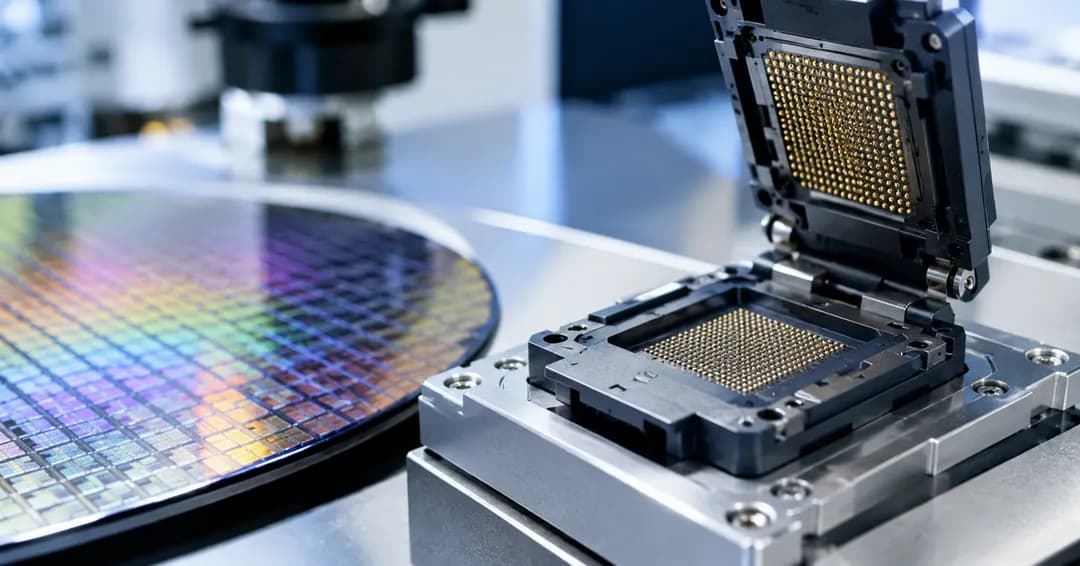
The semiconductor test socket market is expanding as AI processors, high-performance computing, advanced packaging, and high-speed memory increase testing requirements. Growing semiconductor complexity is driving demand for reliable electrical contacts, improved signal integrity, and thermal management. Automotive electronics and power semiconductors are further creating opportunities for specialized test socket technologies.
Knowledge Sourcing Intelligence (KSI) has published its latest analysis of the Semiconductor Test Socket Market, projecting growth from USD 1.90 billion in 2026 to USD 3.55 billion by 2032, at a compound annual growth rate (CAGR) of 11.0%. AI processors, advanced packaging, and high-performance computing increase testing requirements, driving market growth.
Semiconductor test sockets provide temporary electrical connections between packaged chips and automated test equipment. They support functional and electrical testing during production and validation, enabling manufacturers to evaluate device performance and identify potential defects.
As semiconductor architectures become increasingly complex, testing interfaces must support higher contact densities, faster signal transmission, greater power delivery, and precise thermal management. AI accelerators, graphics processing units (GPUs), and high-performance computing (HPC) processors are intensifying these requirements because of their demanding electrical and thermal characteristics.
Advanced packaging technologies, including chiplets and multi-die integration, further increase the need for specialized socket designs that deliver reliable electrical contact, precise alignment, and repeatable test results. These developments are creating opportunities for suppliers capable of addressing the evolving requirements of semiconductor manufacturers.
Key Market Growth Drivers
AI and high-performance computing expansion
The growing deployment of AI accelerators and HPC processors is increasing demand for test sockets that accommodate dense contact arrays, high-speed signals, and elevated power requirements. Reliable electrical contact and effective thermal control are essential for maintaining testing accuracy under demanding operating conditions.
Advanced packaging and chip complexity
Chiplets, system-in-package designs, and multi-die architectures introduce more demanding alignment and electrical-contact requirements. Socket manufacturers are developing customized contact technologies to support diverse package configurations while maintaining consistent performance and durability.
Memory and high-speed semiconductor testing
Growing demand for high-bandwidth memory (HBM), DRAM, networking devices, and storage controllers is strengthening the need for reliable signal integrity and controlled electrical characteristics. Spring-probe, coaxial, and elastomer sockets address different requirements across memory, high-speed digital, and radio-frequency testing applications.
Automotive and power semiconductor demand
Electric vehicles, industrial electronics, and data-center power infrastructure are supporting demand for testing power-management integrated circuits and silicon carbide and gallium nitride devices. These applications require dependable electrical connections and testing capabilities suited to demanding current and voltage conditions.
Request a free sample copy or view the report summary: Semiconductor Test Socket Market Report
Industry Developments
Recent product announcements and test-platform orders illustrate how semiconductor test-interface requirements are evolving alongside AI and high-performance computing.
August 2026: DediProg introduced its UltraConduct rubber-pin test socket for AI and HPC chip testing, combining pressure-conductive rubber and pogo-pin contact technologies.
May 2026: DediProg announced a DDR5 module test socket using pressure-conductive silicone rubber, designed to support high-speed signal transmission and protect memory ICs.
March–April 2026: Cohu announced additional Eclipse test-platform orders for next-generation AI and HPC processors, highlighting demand for advanced thermal control and high-performance semiconductor testing.
Market Segmentation and Regional Outlook
The report examines the market by contact technology, test stage, device application, package type, performance requirement, and geography. Contact technologies include spring-probe, elastomer, Kelvin-contact, coaxial, cantilever, stamped-contact, and hybrid sockets.
Applications include AI and HPC processors, logic devices, DRAM and HBM, storage controllers, RF components, automotive and power semiconductors, and MEMS and sensors. The study also assesses engineering and validation testing, final production testing, burn-in and reliability testing, system-level testing, and failure analysis.
Package coverage includes ball grid array (BGA), land grid array (LGA), quad flat no-lead (QFN), wafer-level, fan-out, and advanced multi-chip configurations, subject to the report's defined scope.
Asia-Pacific represents a key regional market, supported by its concentration of outsourced semiconductor assembly and test providers, memory manufacturers, foundries, and advanced packaging facilities. Taiwan, South Korea, Japan, China, Malaysia, Singapore, and the Philippines contribute to the region's semiconductor manufacturing and testing ecosystem.
North America benefits from its role in AI processor development and semiconductor test technology, while Europe contributes through automotive electronics, industrial semiconductors, and power-device applications.
Competitive Landscape
Companies covered in the report include Cohu, Smiths Interconnect, ISC, LEENO Industrial, Yamaichi Electronics, Enplas, Ironwood Electronics, Johnstech, TSE, Yokowo, Sensata Technologies, WinWay Technology, Ardent Concepts, Aries Electronics, and Plastronics.
Competition centres on contact durability, signal integrity, thermal management, design customization, and compatibility with increasingly complex semiconductor packages. Suppliers are developing specialized interfaces to address evolving requirements across computing, memory, automotive, and power semiconductor applications. The relevance of each company depends on its product portfolio and the report's definition of the test socket market.
Analyst Perspective
“The market’s growth will depend on how effectively test socket suppliers address the electrical and thermal demands of AI processors, HBM, and advanced packaging. Suppliers combining contact reliability, signal integrity, and customization capabilities will be better positioned to capture emerging opportunities.”
About the Report
The Semiconductor Test Socket Market report provides market estimates and forecasts through 2032, alongside analysis of growth drivers, opportunities, contact technologies, device applications, regional trends, market segmentation, and competitive positioning. It offers insights for semiconductor manufacturers, test-interface suppliers, investors, and industry stakeholders assessing developments in semiconductor testing.
Have questions?
More Press Releases
How Samsung Medison, Philips, and Carestream’s Recent Diagnostic Imaging Innovations Could Drive Growth: The Medical/Diagnostic Imaging Market Is Anticipated to Reach USD 60.7 Billion by 2031
Diagnostic imaging companies are advancing AI-assisted ultrasound and X-ray technologies to improve image quality, automate measurements, streamline workflows, and support faster examinations. Samsung Medison, Philips, and Carestream have introduced new solutions featuring AI-enabled analysis, enhanced visualization, single-transducer functionality, automated exposure control, noise reduction, and connected clinical capabilities.
How Lincotek’s SportLinc FDA Clearance Could Impact the Sports Medicine Market, Expected to Reach USD 9.45 Billion by 2031
Lincotek Medical announced FDA 510(k) clearance for its SportLinc Syndesmosis Device in April 2026, adding a cleared option for stabilizing syndesmotic ankle trauma. The sterile, single-use implant uses an ultra-high-molecular-weight polyethylene (UHMWPE) suture tensioned between two low-profile titanium alloy buttons, and is offered to OEM partners for private labeling. The clearance adds another fixation option for sports-related ankle injuries, where implant design, surgical handling, and stabilization requirements influence product selection. According to Knowledge Sourcing Intelligence (KSI), the global sports medicine market is projected to grow at a CAGR of 6.25%, reaching USD 9.45 billion in 2031 from USD 6.98 billion in 2026.
X-Ray Inspection Systems Market to Cross USD 1.98 Billion by 2031, Driven by Product Launches from Rigaku, 3DX-RAY, and Eagle
X-ray inspection technology is advancing through higher-resolution 3D imaging, intelligent material identification, and faster inline inspection. Recent launches from Rigaku, 3DX-RAY, and Eagle Product Inspection demonstrate expanding applications across electronics, batteries, food production, security, and manufacturing, supporting more detailed defect detection, quality control, and non-destructive inspection.