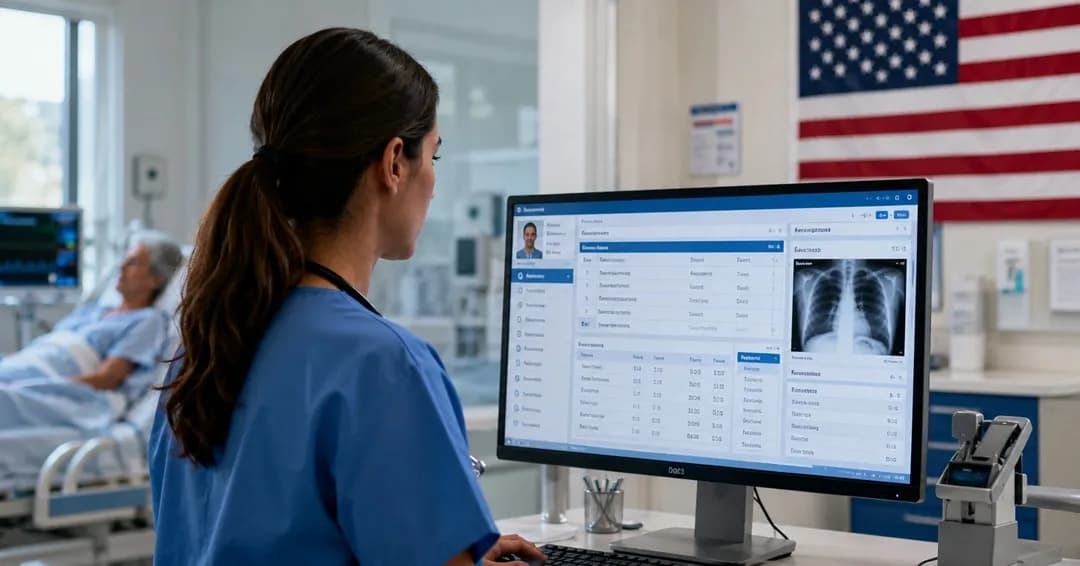
The United States is accelerating digital health record adoption through strong government support, interoperability initiatives, AI integration, and chronic care management programs. Widespread EHR implementation, regulatory frameworks, and investments from healthcare providers and technology companies are improving patient engagement, healthcare access, data sharing, clinical efficiency, and overall care outcomes nationwide.
The ongoing digitalization has provided a new framework for the healthcare sector to streamline its clinical workflows. The growing transition towards optimal solutions that address the structural inefficiencies in having access to patients’ medical records has bolstered the demand for digital health records.
US has become one of the largest testing markets for electronic health records, standing at the forefront of technological adoption with constant investment in innovations that supports digital health ecosystem. High chronic diseases and inpatient frequency in the country has accelerated the need for an enhanced patient engagement system in the US.
Efforts to Bridge the Gap Between Patients and Service Access
The fragmented structure of the US healthcare system is flagged with complexities that limit access to necessary medical history and other patient records, thereby disrupting the diagnosis, testing, and monitoring behavior pattern for Americans, including for federally recognized tribes. Authorities like the U.S. Department of Human and Health Service in their FY26 budget have granted financial assistance of US$191 million to IHS (Indian Health Service) to improve its overall EHR transition for Alaska Native & American Indian (AL/AI).
Witnessing the implementation of various initiatives to meet the growing digital trends has provided new opportunities to explore in country’s healthcare sector. Policies like the “Cures Act” that aims to bolster the technical infrastructure to streamline healthcare interoperability, and “Trusted Exchange Framework and Common Agreement (TEFCA)” that provides a framework for electronic health information sharing between QHIN (Qualified Health Information Network) within the US are shaping the market landscape.
Various research studies indicates that rapid digitalization has provided a foundation for various opportunities to improve patient access and healthcare information exchange. Hence, according to the “American Hospital Association Information Technology Survey” and CDC’s “National Electronic Health Record Survey (NEHRS)”, nearly 91% of physicians and 99% of hospitals in the United States have adopted a certified EHR system, with the majority maintaining the basic digital health records infrastructure.
Ongoing Focus to Improve Chronic Care
Chronic conditions in the United States are taking a toll on the country’s overall healthcare spending, with nearly 90% or US$4.9 trillion in total annual healthcare spending incurred on patients with mental health or chronic conditions. To optimize such large spending via connected medical platforms that acknowledge the bottlenecks overlooked in traditional patient care approaches further lowers the barriers between patients and licensed healthcare providers.
Digital records have provided self-guided tools for patients that, besides addressing their milder needs, also assist in commercializing healthcare technology, including digital therapeutics, remote monitoring devices, and integrated patient engagement platforms. CDC (Centers for Disease Control) investments in models like ACCESS (Advancing Chronic Care with Effective, Scalable Solutions) that support technology-supported care options driven by EHR datasets has enabled patients to manage their chronic conditions.
As telehealth platforms, remote monitoring devices, AI-assisted diagnostics and integrated patient engagement systems are no longer niche experiments, various initiatives such as launching of a patient-centric healthcare system by the Center for Medicare & Medicaid Services (CMS)” have been undertaken to shift healthcare focus from hospital-centered care toward distributed care. The tools offer a connected digital health system supporting digital data access and check-ins.
Technology Convergence and AI Impact on Digital Health Records
AI-adoption is booming in the United States with progressive patent filing and billions of investments are being done to improve technological infrastructure. This has offered a significant edge in adopting new technological trends that comply with its healthcare standards. And as the “AI Action Plan” is in motion, the development of tools focusing on data-driven health care innovation has picked up pace in the United States.
Moreover, the federal framework prioritizing integrating AI models in healthcare systems for predictive analytics and clinical decision support has also improved the overall scope of AI-adoption within digital health records. Hence, research studies indicate nearly 80% of US hospitals have invested in EHR developed AI for analysing predictive health trajectories for inpatients, identifying high-risk outpatients, simplifying billing and scheduling.
FDA's evolving stance on adopting digital tools, including enforcement discretion in certain pilots, shows its willingness to adapt such futuristic concepts to maintain an overall equilibrium in patient care and monitoring. This balance matters, as over-regulation stifles innovation; under-regulation risks harm. America's market-driven approach, for all its flaws, has encouraged experimentation that more centralized systems sometimes lack.
Regulations & Investment Environment
Regulation & Act | Authority | Impact on Digital Health Records |
Cures ACT | U.S Department of Health and Human Services (HHS) | Will bolster the development of a secure framework in compliance with state or federal laws for secure access to electronic health information. |
Trusted Exchange Framework and Common Agreement (TEFCA) | Office of National Coordinator for Health and Information Technology (ONC) | Provides a nationwide framework for health information sharing amongst healthcare providers, public health agencies, patients, and payers. |
HTI-1 Final Rule | Office of National Coordinator for Health and Information Technology (ONC) | Outlined requirements for the AI and predictive model adoption in providing data-driven electronic health information to clinicians, thereby exercising responsible AI usage. |
HITECH Act | U.S Department of Health and Human Services (HHS) | Offer a strategic framework and guidelines that assist in the development of health information technology, thereby expanding the scope of digital health records platforms deployment. |
Adoption Criteria: Progress with Friction
Strategic efforts implemented to enhance chronic disease management, followed by the regulatory push to promote digital platforms, have played an integral role in driving the digital health records adoption in patient care. Likewise, various ONC programs providing quick healthcare interoperability services have further expanded the adoption scope, with research studies indicating that nearly 93% of non-federal acute care hospitals share patient information with providers outside the organization.
Additionally, digital health records have also provided an effective alternative to address major issues like a lack of healthcare staff in hospitals. With strategic investment, including the development of the HHS Health IT alignment TA resource center, expanding the digital infrastructure is projected to improve the overall digital health records platforms development. Similarly, investments in building predictive decision support intervention tools to integrate AI-biases in ONC Health IT further support various model development to analyse different biases.
The recent integration of USCDI v3 (United States Core Data for Interoperability Version 3) in the ONC’s HTI-1 regulation has emphasized promoting public health data interoperability and identifying any inequities via offering complete patient characteristics data to healthcare providers, patients, and other associated users.
Progress in friction remains minimal, as concerned authorities are determined to curb the health data blocking practices by issuing an active enforcement stance against healthcare entities accountable for such blockage. For instance, the U.S Department of Health and Human Services (HHS) under the “Cure Act” had directed ASTP/ONC (Assistant Secretary for Technology Policy/Office of the National Coordinator for Health IT) and OIG (HHS Office of Inspector General) to address the information blockage incidence to prevent future violations.
Competitive Landscape: Innovation Meets Scale
The list of companies present in the digital health records files is characterized by a mix of established companies that have showcased their ability to integrate technological sophistication with patient records & medical history. Below are profiles of notable U.S.-focused companies shaping the digital health records space.
Epic System Corporation
Headquartered in Verona, Wisconsin, is serving America's health systems through its innovative software solutions, and its EHR platform goes far beyond record-keeping. For instance, the “MyChart” patient portal enables individuals to view results, message providers, schedule visits, and manage prescriptions seamlessly. Additionally, with telehealth modules embedded within the systems, Epic System further offers virtual care that acts as a natural extension rather than a bolt-on feature.
Epic's strength lies in interoperability efforts and integrating its tools, helping systems in identifying at-risk groups proactively with AI algorithms that further comply with the federal TEFCA program guidelines. Hospitals using it report smoother care coordination, especially across networks. Verona's location in the Midwest reflects a deliberate distance from coastal tech bubbles, fostering a focus on reliability for complex enterprises. The company's closed-yet-evolving ecosystem draws criticism for dominance, but its deep integration has undeniably reduced errors and improved data flow in places where fragmentation once ruled.
NextGen Healthcare
NextGen Healthcare has evolved from Quality Systems, Inc., with a big push into ambulatory digital health records. The company's EHR software matches are suitable for various medical areas and physician groups, including cardiology, internal medicine, sleep medicine, and community health centers. It emphasizes developing cloud-based EHR solutions that integrate practice management, patient engagement, and revenue cycle in a single platform. NextGen Enterprise Ambulatory EHR stands out for its single-database design, configurability for specialties like orthopedics or ophthalmology, and analytics for population health.
Features like customizable workflows and interoperability help practices manage value-based contracts common in the US. Development focused on flexibility practices can scale without ripping out systems. In cities like Irvine and through national reach, they've addressed real-world burdens like administrative overload, letting providers focus on outcomes. Forming strategic tie-ups with US healthcare centers and hospitals, such as Advanced Heart Group, has formed one of the key strategies for NextGen to improve its EHR platform’s “NextGen Enterprise EHR” adoption in enhancing patients’ experience.
Meditech
Meditech has targeted hospitals and health systems through its intelligent EHR platform “Expanse”, which features an adaptive algorithm offering secure cloud-hosting. Hence, its platform further supports AI-driven workflows and spans post-acute care, acute, and ambulatory, thereby prioritizing interoperability in compliance with TEFCA regulations, connecting various healthcare facilities across states. Featuring a web-based design accessible via mobiles and other connected devices, Expanse provides an intuitive interface shaped by clinician input.
The company has formed strategic collaborations with online payment platform providers, namely Waystar Technologies Inc., which has further enabled MediTech to leverage Waystar’s healthcare payment technology in its digital health records platform, thereby amplifying its high-quality patient care in the United States.
Athenahealth
Built athenaOne as an AI-native and cloud platform for ambulatory practices, Athenahealth offers a digital health records platform, athenaClinicals (EHR), athenaCollector (revenue cycle), and athenaCommunicator (engagement). The company’s recent innovations included ambient AI documentation that cuts note-taking time significantly. Their model embeds services with software, tackling billing complexities that plague US practices. Serving physicians nationwide, it leverages network insights for better claims and population management. Development leaned into relieving administrative pain, key to a fee-for-service to value-based transition. Subtle strength: the "cure complexity" ethos resonates where insurance hurdles and regulations slow care.
Strategic Outlook
As the digital environment is expanding in the United States, fueled by the rapid high-speed bandwidth expansion, the user’s shift towards easy data access and highly convenient services is witnessing significant growth. With ONC’s strategic digital policies laying the foundation for the US healthcare system, it will further simplify interoperability across federal and local community health centers.
With strategic government maneuvers and investment being in action to comply with the changing technological shift, the US healthcare system is set to witness a positive uplift in such directions, with a major focus on enhancing patients’ experience. For instance, in September 2025, the investment announcement of US$218 million made by New York’s governor prioritized the development of an advanced electronic health records system, thereby improving overall patients’ experience in nearly 24 inpatient psychiatric centers across NY.
Future Outlook: Shaping the Medical Records System in the United States
The US government, through its strategic policies and regulations, has established a blueprint supporting healthcare information exchange. And the ongoing digital shift, followed by the “HHS Data Strategy” implemented to amplify human service interoperability, is anticipated to improve the overall patient care scenario in the United States.
In the U.S., the market trajectory depends on factors like:
Optimal cost in digital platform development for healthcare information exchange
Regulatory compliance and presence of bottleneck block information exchange
Frequency of adoption and investment in AI-centric models that support predictive analytics
The frequency of technological shifts supporting the transition from on-premise hardware to cloud-based SaaS platforms further lowers the entry cost.
Various well-established tech-giants operating in such a field have invested in improving their digital health record platforms, which has further improved the overall market competitiveness. For instance, in August 2025, Oracle introduced its electronic health records featuring AI-driven conversational and contextual features. The platform further simplifies clinicians' workflows by reducing the time limit for having access to information, including patients’ current medication.
Have questions?
More Thought Articles
How EV Charger Manufacturers Can Capitalize on India’s Home Charging Revolution
India’s residential EV charging opportunity is expanding as policy support, EV adoption, and private parking infrastructure develop. Manufacturers can capture value beyond AC chargers through installation, smart charging, load management, solar integration, software, and after-sales services. Housing societies, automakers, and property developers offer scalable routes to residential charging customers.
Second-Life EV Battery Market in India: What Is Driving Demand from Manufacturers?
India’s second-life EV battery market is gaining relevance as electric vehicle adoption expands and batteries retain useful capacity after automotive service. Growing stationary-storage demand, battery data, refurbishment capabilities, EPR obligations, and critical-mineral policies are encouraging manufacturers to extend battery value through reuse before eventual recycling within India’s emerging circular battery ecosystem.
The Rise of Locally Manufactured Battery Separators in India’s EV Ecosystem
India’s battery industry is progressing from pack assembly toward domestic cell and material manufacturing, creating opportunities for lithium-ion battery separators. Policy support, ACC capacity expansion and R&D initiatives are strengthening the ecosystem. However, technical complexity, manufacturing yields, qualification requirements and economics mean localisation will likely advance gradually through coatings, testing and finishing.