India's growing EV market is creating opportunities for second-life EV batteries in stationary energy storage. Supported by battery waste regulations, renewable energy expansion, and circular economy goals, refurbished batteries can reduce costs, improve resource efficiency, and strengthen India's energy storage ecosystem while creating new business opportunities in diagnostics, refurbishment, and recycling.
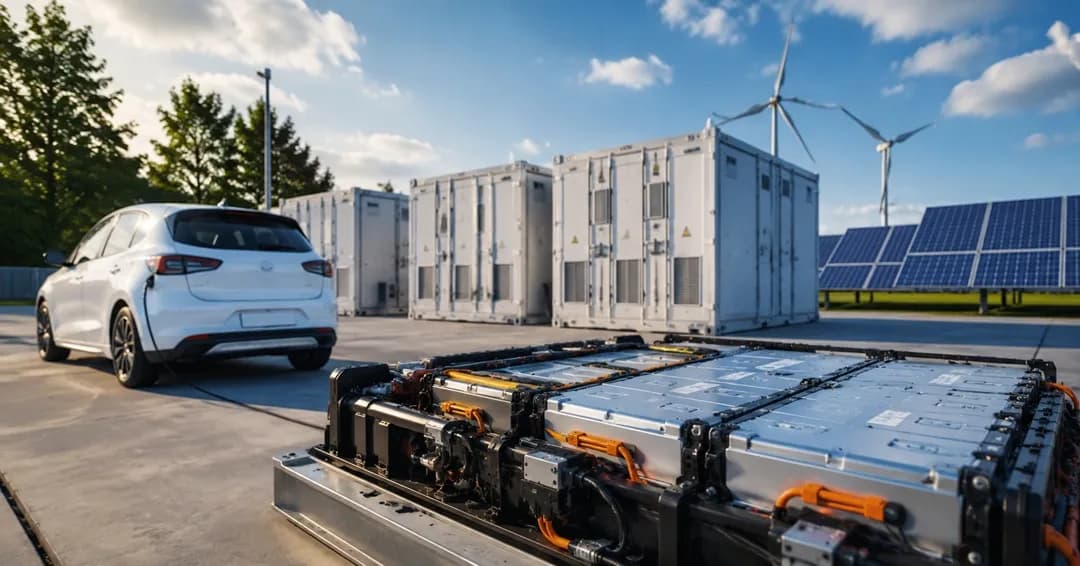
India's electric vehicle (EV) market has reached a stage where attention is beginning to shift beyond vehicle sales and charging infrastructure. A quieter but equally significant discussion is emerging around what happens after an EV battery reaches the end of its automotive life. Contrary to popular perception, a battery that no longer delivers the performance required for mobility is rarely "dead." Most lithium-ion batteries retired from electric vehicles still retain around 70–80% of their original capacity, making them suitable for less demanding stationary energy storage applications.
This realization is gradually reshaping the economics of battery ownership. Instead of viewing retired EV batteries as waste awaiting recycling, manufacturers, utilities, renewable energy developers, and technology startups increasingly see them as valuable assets capable of serving a second purpose. For India, where renewable energy deployment is accelerating while affordable energy storage remains a major challenge, second-life batteries could bridge two critical objectives simultaneously: reducing battery waste and expanding access to economical storage solutions.
The opportunity extends beyond environmental benefits. It introduces an entirely new value chain encompassing battery diagnostics, refurbishment, software-based health assessment, repurposing, integration, and lifecycle management. As India's EV fleet expands over the coming decade, this secondary market could evolve into an important segment of the country's broader energy storage ecosystem.
Recent policy developments have further strengthened this opportunity. The Battery Waste Management Rules, 2022, which became operational through subsequent implementation guidelines, introduced Extended Producer Responsibility (EPR) for battery producers and established a structured framework for battery collection, refurbishment, recycling, and material recovery. These measures are expected to improve the availability of end-of-life batteries while encouraging responsible second-life applications before recycling.
Why Second-Life Batteries Matter
The useful life of an EV battery is determined by the performance expectations of the vehicle rather than the battery's absolute ability to store electricity. Automotive applications demand high power output, rapid charging capability, and predictable driving range. Once battery capacity declines below roughly 70–80% of its original level, vehicle performance begins to suffer, making replacement economically sensible despite the battery remaining operational.
Stationary energy storage presents a very different operating environment. Systems designed for renewable integration, commercial backup power, telecom infrastructure, or residential energy storage generally experience lower discharge rates and more stable operating conditions. Batteries that are no longer ideal for transportation often perform adequately in these applications for several additional years.
This distinction fundamentally changes how battery value is measured. Instead of extracting value from a single use cycle, manufacturers can potentially extend battery utilization across multiple stages before recycling valuable materials such as lithium, nickel, cobalt, copper, and graphite.
From a resource efficiency perspective, this represents a significant improvement. Battery manufacturing remains one of the most resource-intensive stages of EV production. Extending operational life delays recycling requirements while maximizing the return on the energy, minerals, and manufacturing investments already embedded within the battery.
Second-life applications can also help reduce the overall lifecycle cost of batteries by spreading their economic value across multiple use phases before critical minerals are recovered through recycling. This supports circular economy objectives while reducing demand for newly manufactured storage systems in applications where peak battery performance is not essential.
India's EV Expansion is Creating Tomorrow's Second-Life Supply
India's current market for second-life batteries remains relatively small, largely because the country's large-scale EV adoption is still in its early growth phase. Most electric passenger cars sold during the past five to seven years continue operating within their first battery lifecycle. Nevertheless, the foundation for a sizable secondary battery market is already being established.
Government incentives under initiatives such as FAME, production-linked incentive (PLI) schemes for advanced chemistry cells, and state-level EV policies have accelerated vehicle adoption across multiple categories. While electric passenger vehicles receive significant public attention, much of India's battery volume growth is actually occurring in electric two-wheelers, three-wheelers, buses, and commercial fleets.
The Government of India's Production Linked Incentive (PLI) Scheme for Advanced Chemistry Cell (ACC) Battery Storage has also accelerated domestic battery manufacturing capacity, with multiple beneficiaries progressing toward commercial production. Greater local cell manufacturing is expected to strengthen future availability of batteries for both first-life and second-life applications while supporting domestic value addition.
Commercial fleets deserve particular attention because their batteries experience intensive daily usage. Ride-hailing vehicles, logistics fleets, public transport buses, and last-mile delivery vehicles accumulate charging cycles much faster than privately owned passenger cars. As a result, these batteries are likely to enter second-life applications earlier than batteries from personal vehicles.
This creates an interesting market dynamic. The first substantial wave of second-life battery availability in India may originate not from luxury passenger EVs, as seen in some developed markets, but from commercial mobility operators seeking cost-efficient battery replacement strategies.
Battery retirement, therefore, should not be viewed as an endpoint. Rather, it becomes a transition into another commercial market with different performance requirements and revenue opportunities.
Industry observers also expect electric buses, fleet operators, and commercial three-wheelers to become among the earliest large-scale sources of second-life batteries because of their comparatively high annual utilisation and faster battery replacement cycles.
Renewable Energy is Strengthening the Business Case
India's renewable energy ambitions are expanding at an unprecedented pace. Solar and wind installations continue to increase, but renewable generation remains inherently variable. Electricity production depends on sunlight, wind availability, seasonal conditions, and geographic factors that rarely align perfectly with consumption patterns.
Energy storage addresses this imbalance by storing excess generation and releasing electricity during periods of higher demand or reduced renewable output.
However, the economics of storage remain challenging. Brand-new lithium-ion battery systems account for a substantial share of project costs, affecting the financial viability of many distributed energy projects. Second-life batteries offer an alternative pathway by reducing upfront capital expenditure while delivering sufficient performance for applications where absolute energy density is less critical.
For commercial and industrial facilities, the calculation is straightforward. If refurbished battery systems can provide reliable backup power, improve solar self-consumption, or reduce peak electricity demand at a lower cost than new batteries, adoption becomes commercially attractive rather than environmentally symbolic.
This cost advantage is particularly relevant for India's price-sensitive energy market, where investment decisions are often driven by lifecycle economics instead of technological novelty.
India's growing deployment of battery energy storage systems (BESS) alongside renewable energy projects further strengthens the long-term case for second-life batteries. Although utility-scale projects generally favour new battery systems, refurbished batteries can provide a cost-effective alternative for distributed commercial, institutional, and community-scale storage applications where performance requirements are comparatively moderate.
Building a New Value Chain Around Battery Repurposing
The commercial potential of second-life batteries extends well beyond the batteries themselves. An entirely new ecosystem is beginning to take shape, bringing together vehicle manufacturers, battery management system (BMS) developers, energy storage integrators, recyclers, software companies, utilities, and renewable energy developers.
Repurposing a battery is far more sophisticated than simply removing it from an electric vehicle and connecting it to an energy storage system. Each battery pack has experienced a unique operating history shaped by charging habits, ambient temperatures, driving patterns, and maintenance practices. Two batteries manufactured on the same day may exhibit very different levels of degradation after several years of service.
This variability makes battery assessment one of the most valuable stages of the second-life process.
Advanced diagnostic tools are increasingly capable of estimating a battery's remaining useful life, internal resistance, thermal stability, and usable capacity without dismantling every cell. Artificial intelligence and digital monitoring systems are also beginning to support predictive health analysis, allowing operators to determine which batteries are suitable for refurbishment, which require partial module replacement, and which should move directly to recycling.
The growing adoption of cloud-connected battery management systems (BMS) and digital battery passports is expected to improve battery traceability, enabling more accurate health assessments and facilitating safer second-life deployment. Battery passport initiatives being developed globally could also influence future practices in India as battery supply chains become increasingly interconnected.
As the industry matures, battery diagnostics may become as commercially important as battery manufacturing itself. The ability to accurately classify batteries will directly influence resale value, project reliability, financing decisions, and customer confidence.
Another emerging business opportunity lies in battery standardization. Today's EV market consists of multiple battery chemistries, pack designs, voltage architectures, and communication protocols. Integrating batteries from different manufacturers into stationary systems can become technically complex and expensive.
Companies capable of developing flexible battery management platforms that accommodate mixed battery configurations are likely to occupy an influential position within the evolving energy storage market.
Standardized battery testing procedures, communication protocols, and interoperability frameworks will become increasingly important as battery refurbishment expands commercially. Greater standardization can reduce integration costs while improving system safety and operational reliability.
Economics Will Ultimately Decide Market Adoption
While sustainability often dominates public discussions, investment decisions are generally guided by economics. Second-life batteries will only gain widespread acceptance if they consistently deliver meaningful cost advantages without compromising operational reliability.
Several factors support this proposition.
The largest cost component of a stationary battery storage project is usually the battery pack itself. Reusing batteries that have already completed their automotive lifecycle can significantly reduce procurement costs, improving project returns for commercial users.
This advantage becomes particularly meaningful in applications where space and weight are less restrictive than in electric vehicles. A solar farm or factory backup system does not require the compact energy density expected in passenger cars. Instead, operators prioritize lifecycle cost, reliability, maintenance requirements, and expected operating years.
However, lower acquisition costs alone do not guarantee financial success.
Repurposing involves transportation, battery testing, module replacement, software integration, thermal management upgrades, certification, installation, and long-term monitoring. These additional activities create costs that vary considerably depending on battery condition and application.
The financial equation therefore depends on efficient processing. If refurbishment becomes overly labor-intensive or inconsistent, the cost advantage over new batteries narrows rapidly.
India's comparatively lower engineering and manufacturing costs may provide an advantage here. Companies capable of industrializing battery refurbishment rather than treating it as a customized engineering exercise could achieve attractive economies of scale over time.
The emergence of standardized refurbishment facilities may therefore become one of the defining characteristics of India's second-life battery industry.
Battery warranties, performance guarantees, and service contracts are also expected to play a greater role in commercial adoption. Buyers are more likely to invest in refurbished battery systems when suppliers can demonstrate predictable performance through standardized testing and long-term monitoring.
As battery refurbishment volumes increase, economies of scale are expected to reduce inspection, testing, and integration costs, further improving the commercial viability of second-life battery systems.
Where Second-Life Batteries Can Create Immediate Value
Although large utility-scale storage projects attract considerable attention, the earliest commercial opportunities are likely to emerge in smaller, decentralized applications where performance requirements are less demanding.
Commercial buildings with rooftop solar installations represent a logical starting point. Many facilities generate excess electricity during daylight hours but continue purchasing grid power during evening peak demand. Battery storage enables a larger share of solar generation to be consumed internally, improving project economics.
Industrial facilities present another compelling use case. Manufacturing plants often experience expensive peak demand charges and occasional power quality issues. Second-life battery systems can help smooth electricity consumption, provide short-duration backup power, and improve operational resilience without requiring premium-priced storage technology.
Telecommunication infrastructure also offers considerable potential. India operates hundreds of thousands of telecom towers, many located in regions where grid reliability remains inconsistent. Battery-based energy storage has long been a core requirement for maintaining uninterrupted communication services. Lower-cost second-life batteries could gradually replace aging lead-acid systems in selected applications, provided reliability standards are consistently met.
Microgrids serving rural communities represent another promising area. Renewable energy combined with repurposed battery storage can provide dependable electricity in locations where diesel generators remain the primary backup option. While second-life batteries may not eliminate diesel entirely, they can reduce fuel consumption, operating costs, and maintenance requirements.
Even public infrastructure, including schools, healthcare facilities, municipal buildings, and community energy systems, could become meaningful users as battery refurbishment technologies mature.
Rather than relying on a single dominant application, India's market is likely to develop through multiple medium-sized opportunities across diverse sectors.
Emerging applications may also include EV charging stations equipped with battery energy storage systems, where refurbished batteries can help reduce peak electricity demand, improve charging reliability, and support integration with onsite renewable energy generation.
Data centres, warehouses, cold storage facilities, and logistics parks are also expected to evaluate second-life battery systems for backup power and energy optimisation as distributed energy storage becomes more widely adopted.
Potential Deployment of Second-Life EV Batteries Across Key Stationary Applications in India
 Challenges Cannot Be Ignored
Despite the optimism surrounding second-life batteries, several structural barriers remain.
The first concerns quality assurance. Buyers need confidence that refurbished batteries will perform safely over several years. Unlike new batteries manufactured under standardized conditions, second-life batteries originate from diverse operating environments, making performance consistency more difficult to guarantee.
Certification standards therefore become essential.
India is gradually strengthening its regulatory framework for battery safety and recycling. However, dedicated technical standards covering battery testing, grading, refurbishment, transportation, and certification for second-life applications are still evolving. Establishing uniform standards will be essential for improving market confidence and enabling wider commercial deployment.
Battery traceability presents another challenge. Without comprehensive digital records documenting charging history, temperature exposure, maintenance events, and usage patterns, accurately estimating remaining battery life becomes significantly more difficult.
Original equipment manufacturers (OEMs) possess much of this operational data through battery management systems. However, determining how this information can be securely shared with refurbishment companies while protecting intellectual property remains an unresolved industry issue.
The adoption of digital battery passports and secure battery data-sharing frameworks could address this challenge by providing verified lifecycle information while protecting commercially sensitive data. Such systems are gaining momentum globally and could support India's long-term circular battery ecosystem.
Insurance and financing also deserve attention. Financial institutions generally favor assets with predictable performance histories. As long as second-life batteries remain relatively unfamiliar, lenders may assign higher risk premiums to projects using refurbished systems.
This is likely to change only after sufficient operational data demonstrates long-term reliability under Indian climatic and grid conditions.
Thermal management remains another important consideration, particularly in India, where high ambient temperatures can accelerate battery degradation. Repurposed battery systems require effective cooling, continuous monitoring, and appropriate fire safety measures to ensure safe long-term operation.
Finally, recycling infrastructure must evolve alongside second-life deployment. Not every battery should be repurposed, and delaying recycling indefinitely is neither practical nor environmentally desirable. A balanced circular economy requires clear decision pathways determining when batteries should enter second-life applications and when material recovery offers greater economic and environmental value.
The industry's long-term success will therefore depend not on maximizing battery reuse at all costs, but on placing each battery in the application where it delivers the greatest overall value before ultimately entering the recycling stream.
In practice, only batteries that satisfy predefined technical, safety, and economic criteria should be considered for refurbishment. Batteries that fail these assessments should proceed directly to environmentally compliant recycling to maximize material recovery and minimize operational risks.
Policy Support Will Determine the Pace of Market Development
Technology alone will not establish a thriving second-life battery industry. The regulatory environment must evolve in parallel, providing clarity on ownership, safety, transportation, testing standards, liability, and end-of-life responsibilities.
India has already taken important steps by introducing battery waste management regulations that emphasize extended producer responsibility (EPR) and environmentally sound recycling.
The Battery Waste Management Rules, 2022, require producers to collect and recycle waste batteries under the Extended Producer Responsibility (EPR) framework. Although the regulations primarily focus on collection and recycling, they also create a structured ecosystem that can support battery refurbishment and second-life applications before final recycling, provided safety and regulatory requirements are met.
The next phase will likely require policies that explicitly recognize battery repurposing as an integral part of the circular economy rather than treating every retired battery as immediate waste.
Standardized testing and certification will be particularly important. Buyers need confidence that a refurbished battery system has undergone rigorous health assessment and can deliver predictable performance over its remaining operational life. Industry-wide certification protocols would reduce uncertainty, improve financing prospects, and encourage broader commercial adoption.
Another area where policy can make a measurable difference is data transparency. Modern battery management systems generate extensive information throughout a battery's automotive life, including charging cycles, operating temperatures, depth of discharge, and fault history. Subject to appropriate cybersecurity and privacy safeguards, selective access to this information could significantly improve the accuracy of battery health assessments. Better data leads to better valuation, more reliable refurbishment decisions, and lower operational risk.
Government procurement could also become an important catalyst. Public buildings, rural electrification initiatives, municipal infrastructure, and community renewable energy projects offer practical settings where certified second-life battery systems can be deployed at scale. Such projects would not only create demand but also generate operational data that helps build market confidence.
Future policy measures may also encourage battery traceability, digital lifecycle documentation, and standardized refurbishment practices, helping integrate second-life batteries into India's broader circular economy and energy transition objectives.
Investment is Moving Beyond Battery Manufacturing
Much of India's recent investment in the battery sector has focused on cell manufacturing, gigafactory development, and domestic supply chains. Those investments remain essential, but they represent only one part of a much broader opportunity.
As battery retirement volumes increase, investors are beginning to recognize opportunities in businesses that extend battery value rather than produce new cells. Battery diagnostics, refurbishment facilities, software platforms, asset monitoring, predictive maintenance, battery leasing, logistics, and recycling are gradually emerging as distinct commercial segments.
This shift reflects a broader change in thinking. Instead of viewing batteries as one-time products, companies increasingly regard them as long-life assets capable of generating value across multiple stages. Revenue may come first from automotive applications, then from stationary storage, and finally from the recovery of valuable raw materials at the end of the battery's usable life.
Such a lifecycle approach has implications for financing as well. Investors generally favor business models that diversify revenue streams and reduce dependence on a single market cycle. Companies participating across multiple stages of the battery value chain may therefore be better positioned to withstand fluctuations in raw material prices or changes in EV demand.
For startups, the opportunity may lie less in competing with established battery manufacturers and more in solving operational challenges. Affordable diagnostic technologies, digital battery passports, fleet monitoring software, thermal management systems, and standardized refurbishment processes are all areas where innovation can create competitive advantages without requiring massive capital investments.
Investment activity is also expanding into battery recycling facilities capable of recovering lithium, nickel, cobalt, graphite, copper, and other critical materials. Stronger integration between refurbishment and recycling businesses is expected to improve resource efficiency while supporting domestic supply chains for critical battery materials.
Companies offering software-enabled battery asset management, predictive analytics, and lifecycle optimisation services are also expected to benefit as battery ownership models become increasingly data driven.
The Road Ahead
India is unlikely to replicate the second-life battery market of Europe, China, or North America exactly. The country's vehicle mix, electricity demand patterns, climate, infrastructure, and cost sensitivities are fundamentally different. These differences may ultimately become an advantage.
The rapid growth of electric two-wheelers, three-wheelers, buses, and commercial fleets creates a diverse pipeline of batteries with varying capacities and use histories. Combined with expanding renewable energy deployment and increasing demand for distributed storage, this provides conditions that are well suited to battery repurposing.
At the same time, India's growing investments in battery manufacturing, recycling infrastructure, and Battery Energy Storage Systems (BESS) are creating a more integrated ecosystem capable of supporting batteries throughout their lifecycle. As these industries mature together, opportunities for refurbishment and second-life deployment are expected to expand.
Nevertheless, success will depend on disciplined execution rather than optimistic projections. Safety cannot be compromised in pursuit of lower costs. Refurbishment quality must remain consistent. Performance guarantees need to be credible, and recycling should remain the final destination for batteries that no longer deliver reliable service.
The availability of trained technicians, standardized inspection procedures, automated battery diagnostics, and digital lifecycle records will become increasingly important for scaling refurbishment operations while maintaining consistent quality.
Market participants that invest early in standardized testing, digital traceability, system integration, and lifecycle management are likely to establish stronger competitive positions as battery retirement volumes increase over the next decade.
Collaboration between automobile manufacturers, battery suppliers, renewable energy developers, utilities, recyclers, research institutions, and policymakers will also be essential for developing commercially viable second-life business models. Shared standards and industry partnerships can help accelerate commercialization while ensuring safe deployment.
Although the first wave of retired EV batteries in India is expected to originate primarily from commercial fleets, the supply of second-life batteries is likely to diversify as electric passenger vehicle adoption continues to grow over the coming decade. This expanding battery pool will support a wider range of stationary storage applications across residential, commercial, industrial, and public infrastructure projects.
Conclusion
Second-life EV batteries represent more than a cost-saving alternative to new energy storage systems. They signal a broader shift toward maximizing the productive life of valuable industrial assets before recovering critical materials through recycling. For India, this approach aligns with multiple national priorities, including resource efficiency, renewable energy integration, domestic manufacturing, and reduced dependence on imported raw materials.
The market is still in its formative years, and significant challenges remain. Technical standardization, certification frameworks, financing models, and supply chain coordination all require further development. Yet these are typical characteristics of an industry moving from experimentation to commercialization rather than signs of a weak business case.
Over the coming years, the conversation is likely to evolve from whether second-life batteries are viable to how they can be deployed at scale while maintaining safety, reliability, and economic value.
The pace of commercialization will depend not only on technological progress but also on continued policy support, industry collaboration, reliable certification systems, and growing investor confidence in refurbished battery assets. Improvements in battery traceability, digital monitoring, and standardized refurbishment processes are expected to reduce operational uncertainty and encourage wider adoption.
Companies that understand this transition early and build capabilities across diagnostics, refurbishment, software, integration, and recycling will be better positioned to shape India's next phase of energy storage growth.
Viewed through this broader lens, a retired EV battery is not the end of a product's journey. It is the beginning of a new commercial role, supporting an energy system that increasingly values efficiency, flexibility, and circular resource use alongside technological progress.
As India's EV fleet expands and renewable energy deployment accelerates, second-life batteries have the potential to become an increasingly important component of the country's circular energy economy. Rather than replacing new battery technologies, they are expected to complement them by providing cost-effective storage solutions for applications where moderate performance, affordability, and resource efficiency are the primary priorities.
Need specialized data cuts or competitive intelligence?
Our analyst team provides bespoke market sizing, supplier audits, and country-level feasibility reports tailored to your enterprise roadmap.
Speak With an Industry Analyst →Ask an Industry Analyst
Have questions regarding this briefing or market projections? Inquire with our sector lead.
Related Thought Articles
View All →
How Indian Automakers Are Leveraging Compact EV Platforms to Reduce Vehicle Costs
Sep 4, 2026
Why EV Inverters Could Become the New Battleground for India’s Automotive Electronics Industry
Sep 3, 2026
From Data Centers to EV Charging: Where Low-Voltage DC Distribution Is Making an Impact
Sep 2, 2026
How EV Charger Manufacturers Can Capitalize on India’s Home Charging Revolution
Sep 1, 2026
Second-Life EV Battery Market in India: What Is Driving Demand from Manufacturers?
Aug 27, 2026More Thought Articles
The Rise of Locally Manufactured Battery Separators in India’s EV Ecosystem
India’s battery industry is progressing from pack assembly toward domestic cell and material manufacturing, creating opportunities for lithium-ion battery separators. Policy support, ACC capacity expansion and R&D initiatives are strengthening the ecosystem. However, technical complexity, manufacturing yields, qualification requirements and economics mean localisation will likely advance gradually through coatings, testing and finishing.
Why Hub Motors Are Becoming a Game Changer for India’s Electric Two-Wheeler Manufacturers
India’s electric two-wheeler market is increasingly prioritizing cost, efficiency, localization, and reliability. Hub motors are gaining relevance for commuter, fleet, and urban scooters because their simpler drivetrain architecture can reduce mechanical complexity and maintenance exposure. However, mid-drive systems will remain important for premium and performance-focused electric two-wheelers, supporting differentiated applications.
How Advanced Battery Thermal Management Is Transforming Cold-Weather EV Performance in India
Advanced battery thermal management is becoming increasingly important for India's EV market as vehicles operate across diverse temperature conditions. Adaptive heating, cooling, preconditioning, liquid thermal systems and intelligent software can improve range consistency, charging performance and battery durability, helping automakers deliver reliable, cost-effective EV performance across regions and vehicle segments.