India's EV drivetrain market is rapidly evolving through localization, integrated propulsion technologies, software-driven innovation, and government support. Leading companies such as Sona Comstar, Bosch India, Tata AutoComp, and Bharat Forge are strengthening domestic manufacturing while expanding exports, positioning India as an increasingly competitive global hub for electric vehicle drivetrain systems.
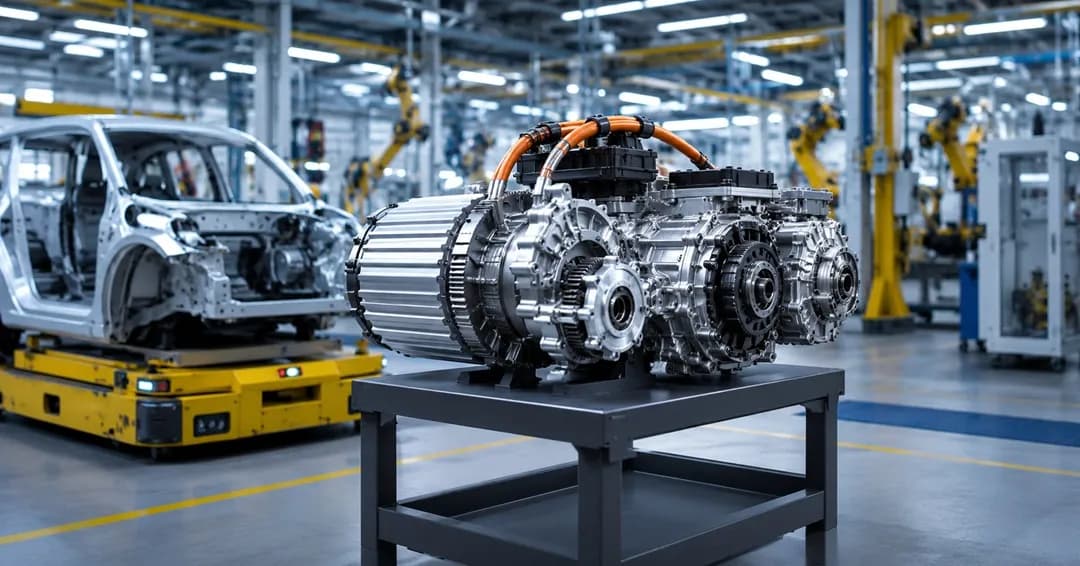
India's electric vehicle (EV) industry has reached a point where discussions are no longer centered solely on vehicle sales or charging infrastructure. Increasingly, attention has shifted toward the technologies that determine how efficiently an electric vehicle performs on the road. Among these, the drivetrain has emerged as one of the most strategically important systems. It combines the electric motor, transmission, power electronics, differential, and associated control systems into a package that directly influences efficiency, acceleration, reliability, and vehicle cost. As manufacturers strive to improve range while keeping vehicles affordable, drivetrain innovation has become one of the strongest competitive differentiators in the Indian automotive sector.
Unlike conventional internal combustion engine vehicles, where mechanical optimization has evolved over decades, electric drivetrains continue to undergo rapid engineering refinement. Manufacturers are experimenting with integrated e-axles, high-efficiency permanent magnet motors, permanent magnet-free motor technologies for selected applications, silicon carbide (SiC)-based inverters, lightweight transmission assemblies, and advanced thermal management systems. These developments are gradually changing supplier relationships as well. Companies that were once known primarily for gears, axles, or forged components are repositioning themselves as providers of complete electric propulsion systems.
India presents a unique environment for drivetrain development. The country remains one of the world's most cost-sensitive automotive markets, where engineering decisions are rarely driven by performance alone. Every component must balance efficiency, durability, localization, and affordability. Consequently, Indian suppliers have developed a reputation for designing products that deliver competitive performance without relying on expensive manufacturing processes or imported assemblies. This capability has become particularly valuable as global automakers seek diversified supply chains beyond traditional manufacturing hubs.
The evolution of India's EV drivetrain ecosystem is also closely linked with broader industrial policy. Production-Linked Incentive (PLI) schemes for advanced automotive technologies, the PM E-DRIVE Scheme introduced in 2024 to support electric mobility adoption, and initiatives promoting domestic manufacturing and electronics production have encouraged companies to establish localized supply chains for motors, controllers, and powertrain components. While batteries continue to attract the largest share of public attention, drivetrain manufacturing has quietly emerged as a strategically important segment within India's automotive component industry.
Another notable feature of the Indian market is the diversity of vehicle categories undergoing electrification. Unlike several mature markets where passenger cars dominate early EV adoption, India's transition is being driven simultaneously by electric two-wheelers, three-wheelers, commercial vehicles, buses, and passenger cars. Each segment requires distinct drivetrain architectures. Electric scooters prioritize compact motors with high energy efficiency, commercial vehicles demand higher torque and durability, while passenger vehicles increasingly require integrated drive units capable of balancing performance with extended driving range.
This diversity has encouraged suppliers to develop modular platforms rather than vehicle-specific solutions. Companies capable of adapting core drivetrain technologies across multiple vehicle categories are securing stronger competitive positions than those focused on a single application. As production volumes rise, modular engineering also offers manufacturing economies that improve profitability without compromising customization.
Market Context
India's electric drivetrain market is progressing through a phase that can best be described as industrial maturation rather than early experimentation. Five years ago, many vehicle manufacturers depended heavily on imported motors, controllers, and transmission assemblies. Today, localization has become a central business objective. Domestic manufacturing is no longer viewed simply as a cost-reduction exercise; it has become an essential strategy for improving supply chain resilience, shortening product development cycles, and meeting government localization requirements under initiatives such as the Auto PLI Scheme and domestic value-addition programmes.
Several structural factors explain this transition.
First, electric vehicle production volumes have increased sufficiently to justify domestic investment in specialized manufacturing facilities. Higher production allows suppliers to amortize investments in automated motor winding, precision machining, electronics assembly, and testing infrastructure over larger output volumes. As scale improves, localized production becomes economically competitive against imports.
Second, Indian automotive suppliers have leveraged decades of experience in precision engineering. Companies historically focused on transmission systems, forged components, bearings, and mechanical assemblies have successfully adapted their expertise toward electric propulsion. Rather than building entirely new industrial capabilities from scratch, many manufacturers have evolved existing competencies to meet the requirements of electrified mobility.
Third, global technology partnerships have accelerated capability development. Collaborations between Indian manufacturers and international drivetrain specialists have enabled faster adoption of advanced motor technologies, power electronics, and software integration. Instead of independently developing every subsystem, several companies have chosen joint ventures, technology licensing arrangements, or strategic engineering partnerships that reduce commercialization timelines while maintaining domestic production.
One important characteristic of India's drivetrain market is that innovation is increasingly occurring at the system level rather than the component level. Early electric vehicles often combined motors, inverters, reduction gears, and controllers from multiple suppliers, creating integration challenges and reducing efficiency. Manufacturers now favor integrated drive units that combine several components into compact assemblies. These systems reduce weight, simplify vehicle architecture, improve energy efficiency, and lower manufacturing complexity.
Software is becoming equally important. Modern drivetrain performance depends not only on mechanical engineering but also on sophisticated control algorithms that optimize torque delivery, regenerative braking, thermal management, functional safety, and energy consumption. Consequently, software capabilities are beginning to influence supplier competitiveness almost as much as traditional manufacturing expertise.
The supply chain itself is also becoming more specialized. Instead of relying on vertically integrated production models, manufacturers increasingly collaborate with dedicated suppliers for magnets, semiconductor devices, motor laminations, precision castings, electronic control units, embedded software, and power semiconductor packaging. This specialization allows companies to focus investments where they possess genuine technical advantages while relying on ecosystem partners for complementary capabilities.
Industry Dynamics
Perhaps the most defining feature of India's EV drivetrain industry is that competition is no longer based solely on manufacturing capacity. The market increasingly rewards engineering integration, localization capability, software expertise, compliance with evolving safety and quality standards, and long-term strategic partnerships with vehicle manufacturers.
Established automotive component companies possess significant advantages because they already maintain relationships with nearly every major OEM operating in India. Their existing quality systems, manufacturing infrastructure, supplier networks, and financial resources provide a relatively smooth pathway into electric mobility. However, legacy experience alone is insufficient. Success increasingly depends on how effectively these firms transition from supplying mechanical assemblies to delivering intelligent electric propulsion solutions.
At the same time, newer entrants have introduced fresh competition by focusing exclusively on electric technologies. Without legacy manufacturing constraints, these companies often move faster in developing compact motors, integrated e-axles, and digitally controlled propulsion systems. Their presence has encouraged larger incumbents to accelerate research and development spending while expanding partnerships with global technology providers.
Another emerging dynamic is export orientation. Several Indian drivetrain manufacturers are no longer producing solely for domestic vehicle programs. As multinational OEMs diversify global supply chains, India is gradually becoming a manufacturing base for electric drivetrain components supplied to Europe, North America, and Southeast Asia. Growing exports of automotive components and increasing localisation by global suppliers are reinforcing this trend.
The next phase of competition is likely to revolve around efficiency gains rather than simple production expansion. Improvements of even one or two percentage points in drivetrain efficiency can translate into meaningful increases in driving range, reduced battery requirements, and lower vehicle costs. Consequently, companies investing in advanced motor materials, silicon carbide power electronics, integrated drive units, intelligent control software, and manufacturing automation are expected to shape the competitive landscape over the remainder of this decade.
From an industry analyst's perspective, India's EV drivetrain sector has moved beyond proving its viability. The more significant question now is which manufacturers can consistently combine engineering innovation with manufacturing scale and commercial execution. Those capable of integrating these capabilities are increasingly positioning themselves as competitive suppliers for both domestic and international EV programmes, supported by India's expanding automotive manufacturing ecosystem.
Company Analysis: The Businesses Defining India's EV Drivetrain Landscape
India's EV drivetrain ecosystem has developed into a competitive mix of legacy automotive suppliers, diversified engineering firms, and technology-led specialists. While vehicle manufacturers often receive greater public attention, the companies supplying motors, reduction gears, e-axles, power electronics, differentials, and integrated drive units are steadily becoming the backbone of the country's electric mobility ambitions.
Unlike the conventional automotive supply chain, leadership in the EV drivetrain market is not determined solely by production scale. The strongest players are those capable of integrating mechanical engineering with electronics, software, precision manufacturing, and localization. Several companies have also positioned India as an export base, using domestic manufacturing to serve global EV programs.
Comparative Overview of Leading Companies
Company | Core EV Drivetrain Expertise | Competitive Strength | Strategic Position |
Sona BLW Precision Forgings (Sona Comstar) | Differential gears, traction motors, integrated drive units, e-axles | Global EV-focused portfolio with strong export presence | Technology leader in passenger vehicle drivetrains |
Bosch India | Electric motors, power electronics, integrated propulsion systems | Extensive R&D capabilities and OEM relationships | Premium technology supplier with broad vehicle coverage |
Tata AutoComp Systems | Integrated e-drivetrain systems, battery integration, transmission assemblies | Strong Tata Group ecosystem and localization | Major domestic system integrator |
Bharat Forge | Forged drivetrain components, e-axles, lightweight structural systems | Manufacturing scale and advanced metallurgy | Rapidly expanding EV component supplier |
ZF India | Electric axle systems, transmissions, commercial EV drivetrains | Global technology transfer and commercial vehicle expertise | Strong presence in buses and heavy-duty vehicles |
Schaeffler India | Bearings, hybrid modules, electric axle components | High-precision engineering and efficiency optimization | Specialist in drivetrain efficiency solutions |
Nidec India | Electric traction motors | High-volume motor manufacturing expertise | Key supplier for two- and three-wheelers |
Valeo India | Electric propulsion systems, thermal integration, power electronics | Global EV technology portfolio | Focused on integrated mobility solutions |
Dana India | e-Propulsion systems, axles, drivetrain assemblies | Commercial vehicle specialization | Growing presence in electric utility vehicles |
Sterling Tools (through EV subsidiaries) | Motor control systems and drivetrain electronics | Electronics manufacturing capabilities | Emerging domestic electronics-driven player |
Sona Comstar: Building an Export-Oriented EV Powerhouse
Few Indian automotive component companies have embraced electrification as aggressively as Sona Comstar. While many traditional suppliers have diversified gradually into electric mobility, Sona Comstar has strategically repositioned itself around EV technologies. Today, the company reports that battery electric vehicle (BEV)-related programmes account for a significant share of its order book, with customers spanning North America, Europe, China, India, and other global markets.
Its competitive advantage lies in engineering complete propulsion subsystems rather than supplying isolated mechanical components. The company's portfolio spans differential assemblies, traction motors, integrated drive units, precision gears, and differential gears designed specifically for electric vehicles. This integrated approach aligns well with the industry's shift toward compact e-axle architectures.
An equally important strength is customer diversification. Rather than relying heavily on one domestic OEM, Sona Comstar serves multiple global manufacturers, reducing exposure to fluctuations in any single market. That international footprint also enables continuous investment in advanced manufacturing technologies that benefit its Indian operations. The company has also continued to expand its global technology capabilities through strategic acquisitions and investments supporting electric mobility.
Bosch India: Leveraging Global Technology for Local Manufacturing
Bosch's role in India's EV drivetrain market extends well beyond supplying individual components. The company brings decades of expertise in vehicle electronics, motor control, sensors, and software integration, enabling it to deliver highly sophisticated propulsion systems.
Unlike several domestic competitors that have entered electrification from mechanical engineering backgrounds, Bosch approaches drivetrain development from a systems engineering perspective. Motor efficiency, inverter performance, thermal management, regenerative braking, and software calibration are engineered simultaneously rather than independently.
Bosch also benefits from longstanding relationships with virtually every major automobile manufacturer operating in India. These partnerships simplify product validation and accelerate deployment of new drivetrain technologies.
Although Bosch generally competes in the premium technology segment, increasing localization efforts are gradually making its solutions more accessible for mass-market electric vehicles. Bosch has also expanded its Indian engineering and software capabilities to support electrification, vehicle electronics, and software-defined mobility solutions for both domestic and global customers.
Tata AutoComp Systems: Integrating India's EV Ecosystem
Tata AutoComp occupies a distinctive position because it operates within one of India's largest automotive ecosystems. Its close collaboration with Tata Motors has allowed the company to develop drivetrain technologies alongside vehicle platforms instead of treating them as standalone components.
The company has steadily expanded beyond traditional automotive parts into electric drive modules, transmission assemblies, power electronics, battery pack integration, and complete propulsion systems.
Strategic partnerships with international technology firms have accelerated capability development while supporting domestic manufacturing. The company has continued expanding its e-mobility portfolio through collaborations in battery systems, electric drive technologies, and advanced automotive electronics.
Perhaps its greatest strength lies in localization. Tata AutoComp has consistently prioritized domestic sourcing, allowing OEMs to reduce import dependency while improving cost competitiveness.
As Indian passenger EV production scales further, vertically integrated suppliers such as Tata AutoComp are likely to play an increasingly influential role.
Bharat Forge: Translating Metallurgical Expertise into Electric Mobility
Bharat Forge has spent decades establishing itself as a global leader in forged automotive components. Rather than viewing electrification as a disruption, the company has treated it as an opportunity to apply advanced metallurgy and precision engineering to entirely new product categories.
Its investments now extend into lightweight chassis systems, electric axle components, structural assemblies, and drivetrain hardware designed specifically for battery electric vehicles. In recent years, Bharat Forge has broadened its EV portfolio through investments in electric mobility technologies, lightweight engineering, and advanced manufacturing capabilities serving both domestic and export markets.
One notable advantage is manufacturing flexibility. Existing forging infrastructure, combined with investments in precision machining and automation, allows Bharat Forge to scale production relatively quickly as EV demand increases.
While software-centric companies often dominate discussions around electric mobility, robust mechanical engineering remains equally essential. Bharat Forge's evolution demonstrates that traditional manufacturing expertise continues to hold considerable strategic value.
ZF India: Strength in Commercial Electric Mobility
Passenger cars attract considerable media attention, but commercial vehicles represent one of the most promising opportunities for electric drivetrain suppliers. This is where ZF India maintains a particularly strong competitive position.
Leveraging technologies developed by its global parent, ZF supplies electric axle systems, commercial vehicle transmissions, and propulsion solutions for buses and medium-duty trucks. Fleet operators typically prioritize durability, efficiency, and lifecycle costs over outright performance, areas where ZF's engineering capabilities are especially well established.
As state transport undertakings and logistics operators expand electric fleets, ZF's experience in heavy-duty mobility is likely to become increasingly valuable. ZF has also continued developing integrated e-mobility solutions, including electric axle technologies and advanced software for commercial vehicle applications.
Schaeffler India: Improving Efficiency Rather Than Reinventing Drivetrains
Schaeffler approaches electrification from a different perspective. Instead of focusing exclusively on complete propulsion systems, the company concentrates on making existing drivetrains more efficient.
Its expertise in bearings, precision motion technologies, transmission components, and electric axle modules helps manufacturers reduce friction losses while improving reliability. In electric vehicles, even marginal improvements in drivetrain efficiency can translate into measurable gains in driving range.
The company's strategy reflects an important industry trend. Future competitiveness will not depend solely on producing larger motors but on optimizing every rotating component throughout the propulsion system. Schaeffler has also strengthened its e-mobility portfolio through dedicated electric axle, bearing, and motion technology solutions supporting next-generation electric vehicles.
Nidec India: Scaling Electric Motor Manufacturing
Electric motors remain the heart of every EV drivetrain, making motor specialists increasingly important within the supply chain. Nidec has leveraged decades of experience in electric motor manufacturing to establish a meaningful presence in India's EV ecosystem.
Its products are particularly well suited to two-wheelers and three-wheelers, segments that continue to account for a significant share of India's electric vehicle volumes. High-volume manufacturing, consistent quality, and continuous efficiency improvements provide Nidec with significant competitive advantages.
As domestic production expands, demand for localized motor manufacturing is expected to rise considerably, positioning companies like Nidec for sustained growth. Nidec has continued investing in traction motor technologies and localized production to support India's expanding electric two-wheeler and light EV segments.
Valeo India: Bringing Global Electrification Experience
Valeo has steadily expanded its electric mobility portfolio by combining propulsion systems with advanced electronics and thermal management technologies.
Rather than competing primarily on manufacturing scale, the company differentiates itself through integrated engineering. Efficient drivetrain performance increasingly depends on seamless interaction between motors, inverters, cooling systems, and vehicle control software. Valeo's multidisciplinary capabilities allow it to address these requirements through coordinated system design.
Its international experience also enables rapid adaptation of technologies already validated in mature EV markets. The company continues to support Indian OEMs with electrification technologies spanning electric drive systems, thermal management, and power electronics.
Dana India: Focusing on Utility and Commercial Applications
Dana has concentrated much of its electrification strategy on commercial vehicles, off-highway equipment, and utility applications. These segments often require robust drivetrain architectures capable of operating under demanding duty cycles.
Its portfolio includes electric axles, propulsion systems, and drivetrain assemblies engineered for reliability rather than maximum acceleration. This positioning complements India's growing demand for electric logistics vehicles, municipal fleets, and industrial transport equipment.
Although Dana maintains a lower public profile than some competitors, its specialization provides a defensible niche within the broader drivetrain market. Dana continues to expand its Spicer Electrified™ portfolio globally while supporting electrified commercial and off-highway vehicle programmes in India and other markets.
Sterling Tools: Expanding from Precision Manufacturing into EV Electronics
Sterling Tools illustrates how established component manufacturers are adapting to electrification through strategic diversification. Historically known for precision fasteners, the company has expanded into EV electronics and motor control technologies through dedicated subsidiaries and partnerships.
This transition reflects a broader shift occurring across India's automotive supply chain. As electric drivetrains become increasingly software-driven, electronics manufacturing capabilities are becoming just as important as traditional machining expertise.
While Sterling remains smaller than several multinational competitors, its investments suggest an ambition to become a meaningful participant in India's rapidly evolving electric propulsion ecosystem. The company has further strengthened its EV strategy through its electronics business, supporting the manufacture of motor control units and other power electronics for electric vehicles.
Taken together, these companies represent different approaches to the same opportunity. Some lead through manufacturing scale, others through software integration, precision engineering, or global technology partnerships. Yet a common theme connects them all: the future of India's EV drivetrain market will not be defined by individual components but by companies capable of delivering integrated, efficient, and locally manufactured propulsion systems at commercial scale.
Competitive Outlook
India's EV drivetrain market is entering a more demanding phase of competition. The initial challenge was proving that electric propulsion could be commercially viable across multiple vehicle categories. That hurdle has largely been crossed. The next stage is likely to be defined by operational efficiency, intellectual property, manufacturing scale, and the ability to deliver integrated solutions rather than individual components.
A noticeable shift is already underway. Vehicle manufacturers increasingly prefer suppliers capable of providing complete electric drive modules instead of sourcing motors, controllers, gearboxes, and software separately. This reduces engineering complexity, shortens vehicle development cycles, and simplifies after-sales support. As a result, companies with strong systems integration capabilities are expected to gain market share over suppliers that specialize in only one component.
At the same time, price competition is becoming more disciplined. During the early years of India's EV industry, aggressive pricing was often used to secure market entry. However, as manufacturers focus on profitability, supplier selection is increasingly based on lifecycle value rather than procurement cost alone. Factors such as drivetrain efficiency, thermal performance, warranty reliability, software updates, functional safety, and long-term serviceability now carry greater commercial importance.
Another competitive trend is the growing significance of exports. Several Indian suppliers have demonstrated that locally developed drivetrain technologies can meet international quality standards. As global automotive manufacturers diversify their sourcing strategies, India is gradually emerging as a manufacturing base for precision gears, electric motors, differential assemblies, and integrated drive units. This trend is supported by continued growth in India's automotive component exports and increasing localization by multinational OEMs and Tier-1 suppliers.
Strategic collaborations are also expected to accelerate. Few companies possess deep expertise across electric motors, power electronics, embedded software, advanced materials, and manufacturing automation simultaneously. Partnerships between domestic manufacturers and global technology providers are likely to remain an important route for acquiring advanced capabilities while shortening product development timelines. Collaborations covering semiconductor technologies, advanced motor design, battery integration, and software-defined vehicle platforms are expected to become increasingly common as OEM requirements evolve.
Future Trends Shaping the Industry
Several technological and commercial trends are expected to influence the direction of India's EV drivetrain industry over the remainder of the decade.
One of the most significant developments is the adoption of integrated e-axles. Instead of assembling separate motors, gearboxes, and controllers, manufacturers are increasingly combining these functions into compact drive units. Integrated architectures reduce vehicle weight, simplify installation, improve efficiency, and lower assembly costs. As production volumes increase, this approach is expected to become the preferred drivetrain configuration across passenger vehicles and light commercial fleets.
Software-defined propulsion systems represent another important shift. Modern electric drivetrains are becoming increasingly dependent on intelligent control algorithms that optimize torque distribution, regenerative braking, thermal management, battery utilization, predictive diagnostics, and over-the-air software updates. Software improvements can enhance drivetrain performance even after a vehicle has entered service, creating new opportunities for suppliers with strong electronics and embedded systems expertise.
Localization will continue to shape investment decisions. Although India has significantly reduced dependence on imported drivetrain components, certain high-value materials, rare-earth permanent magnets, and semiconductor devices are still sourced internationally. Government incentives supporting advanced manufacturing, coupled with rising domestic demand, are likely to encourage further investment in motor manufacturing, controller electronics, and precision engineering facilities.
Material innovation should not be overlooked either. Lightweight alloys, high-performance magnetic materials, improved bearing technologies, advanced cooling systems, silicon carbide (SiC)-based power electronics, and improved insulation materials are expected to play increasingly important roles in improving drivetrain efficiency. While these improvements may appear incremental individually, their cumulative impact on vehicle range and energy consumption can be substantial.
Equally important is the expansion of electrification beyond passenger vehicles. Electric buses, delivery vans, construction equipment, agricultural machinery, and off-highway vehicles represent significant long-term opportunities. These applications require highly durable propulsion systems capable of operating under demanding conditions, creating attractive growth prospects for suppliers with expertise in heavy-duty drivetrain engineering. Government support for electric buses and commercial fleet electrification is expected to strengthen demand for drivetrain technologies designed for higher-duty operating cycles.
Analyst Perspective
From an industry analyst's perspective, India's EV drivetrain sector is no longer simply benefiting from the country's expanding electric vehicle market. It is beginning to establish an independent competitive identity within the global automotive supply chain.
One characteristic stands out across the leading manufacturers: successful companies are investing in capabilities rather than products alone. The industry is steadily moving away from component-centric competition toward platform-centric development, where electric motors, inverters, reduction gears, thermal systems, and software are engineered as a unified propulsion solution.
Another observation is that traditional automotive suppliers have adapted more effectively than many initially expected. Companies with decades of experience in precision machining, forging, bearings, and transmission systems have leveraged their manufacturing strengths to enter electric mobility without abandoning their core competencies. Rather than becoming obsolete, many legacy firms have evolved into technologically sophisticated EV suppliers.
However, the competitive landscape is unlikely to remain static. Electronics companies, semiconductor specialists, software developers, and even battery manufacturers are gradually entering areas that were once dominated by mechanical engineering firms. Future market leadership will therefore depend on multidisciplinary capabilities rather than expertise in any single technology.
Perhaps the most significant opportunity lies beyond India's domestic market. As global automakers seek geographically diversified supply chains, Indian manufacturers that combine engineering excellence with cost-effective production stand to benefit considerably. Those capable of consistently meeting international quality standards, complying with evolving global regulatory and sustainability requirements, may find that exports become as strategically important as domestic demand.
Conclusion
India's electric vehicle drivetrain market has evolved from an emerging supplier ecosystem into one of the country's most strategically important automotive technology segments. Growth is no longer driven solely by increasing EV sales but by the industry's ability to design, manufacture, and continuously improve the systems that determine vehicle performance, efficiency, and reliability.
Companies such as Sona Comstar, Bosch India, Tata AutoComp, Bharat Forge, ZF India, Schaeffler India, Nidec India, Valeo India, Dana India, and several emerging domestic specialists are each contributing in different ways to this transformation. Some lead through advanced engineering, others through manufacturing scale, export capability, localization, or systems integration. Together, they represent a rapidly maturing industrial base capable of supporting India's long-term electrification goals.
The next phase of competition is expected to be less about entering the market and more about defining its technological direction. Suppliers that successfully combine innovation, software intelligence, efficient manufacturing, and global competitiveness are likely to shape not only India's EV drivetrain industry but also its position within the international electric mobility supply chain. Continued policy support for domestic manufacturing, increasing OEM investment in localized EV production, and sustained advances in power electronics, software integration, and high-efficiency electric drive systems are expected to reinforce this trajectory over the coming years.
Need specialized data cuts or competitive intelligence?
Our analyst team provides bespoke market sizing, supplier audits, and country-level feasibility reports tailored to your enterprise roadmap.
Speak With an Industry Analyst →Ask an Industry Analyst
Have questions regarding this briefing or market projections? Inquire with our sector lead.
Related Thought Articles
View All →
How Indian Automakers Are Leveraging Compact EV Platforms to Reduce Vehicle Costs
Sep 4, 2026
Why EV Inverters Could Become the New Battleground for India’s Automotive Electronics Industry
Sep 3, 2026
From Data Centers to EV Charging: Where Low-Voltage DC Distribution Is Making an Impact
Sep 2, 2026
How EV Charger Manufacturers Can Capitalize on India’s Home Charging Revolution
Sep 1, 2026
Second-Life EV Battery Market in India: What Is Driving Demand from Manufacturers?
Aug 27, 2026More Thought Articles
The Rise of Locally Manufactured Battery Separators in India’s EV Ecosystem
India’s battery industry is progressing from pack assembly toward domestic cell and material manufacturing, creating opportunities for lithium-ion battery separators. Policy support, ACC capacity expansion and R&D initiatives are strengthening the ecosystem. However, technical complexity, manufacturing yields, qualification requirements and economics mean localisation will likely advance gradually through coatings, testing and finishing.
Why Hub Motors Are Becoming a Game Changer for India’s Electric Two-Wheeler Manufacturers
India’s electric two-wheeler market is increasingly prioritizing cost, efficiency, localization, and reliability. Hub motors are gaining relevance for commuter, fleet, and urban scooters because their simpler drivetrain architecture can reduce mechanical complexity and maintenance exposure. However, mid-drive systems will remain important for premium and performance-focused electric two-wheelers, supporting differentiated applications.
How Advanced Battery Thermal Management Is Transforming Cold-Weather EV Performance in India
Advanced battery thermal management is becoming increasingly important for India's EV market as vehicles operate across diverse temperature conditions. Adaptive heating, cooling, preconditioning, liquid thermal systems and intelligent software can improve range consistency, charging performance and battery durability, helping automakers deliver reliable, cost-effective EV performance across regions and vehicle segments.