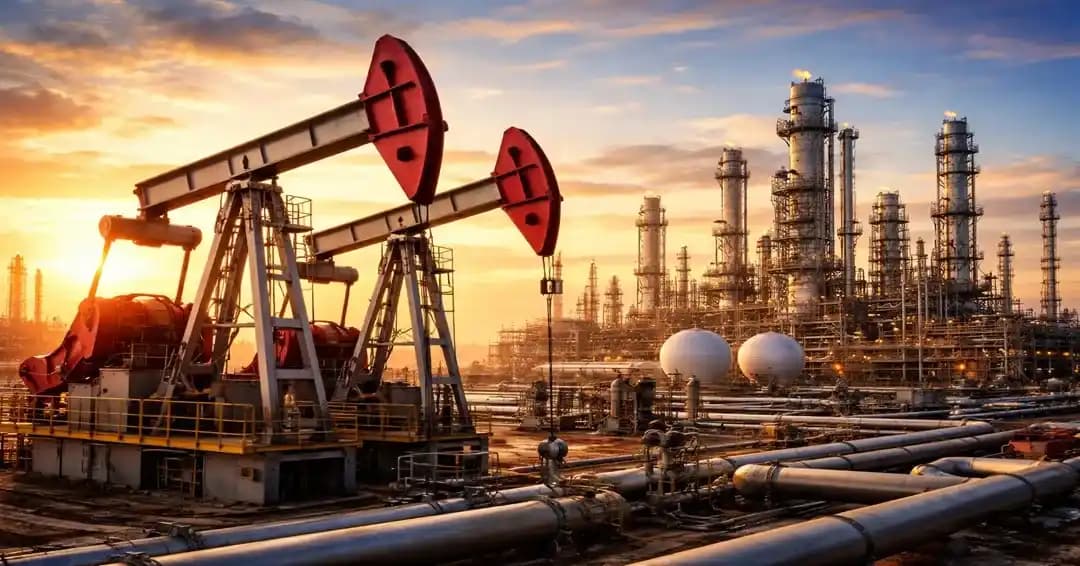
Global oil markets face disruption from geopolitical conflicts, supply shortages, and price volatility, while technological advances and new investments in offshore and onshore drilling create strategic growth opportunities for industry players.
The world oil and gas industry is at a critical juncture in 2026, driven by unprecedented production, technological developments in the extraction of oil, and the geopolitical events that have affected the market. The military operations in the Middle East, which were initiated on February 28, 2026, by U.S.-Israel strikes on Iranian oil facilities, along with the Persian Gulf disruption, represent the most severe disturbance in the recent oil market history. The Strait of Hormuz, which is responsible for the transport of 20 percent of the world's exports of LNG, has experienced a near-complete halt in operations due to this situation. In addition, this has led to a reduction in the production of oil by 8 to 10 million barrels per day in March, refinery closures that have surpassed 3 million barrels per day, and the decline of the Brent crude price, which was at $120 per barrel before reducing to $92 as per the International Energy Agency (IEA).
The market conditions in 2026, as per the IEA, are expected to create a surplus as the worldwide production of oil is expected to rise by 1.1 million barrels per day from non-OPEC+ countries, while demand growth decreases to 640 thousand barrels per day year on year in 2026, which is down by 210 thousand barrels per day from February 2026. The January 2026 inventory total reaches 8,210 million barrels, which indicates high storage levels. However, the ongoing interruptions in the supply chain and refinery outages are creating a short-term shortage in refined products such as LPG. The U.S. Energy Information Administration (EIA) Short-Term Energy Outlook projects global liquid fuels production at 107.0 mb/d and consumption at 105.2 mb/d in 2026, with Brent averaging $79 per barrel as disruptions ease and inventories build by 1.9 mb/d.
Drilling sites present valuable chances for companies and financial backers because of the present market circumstances, which enable them to expand their drilling operations through both offshore and onshore drilling activities. The development of new drilling fluids and oilfield chemicals, combined with hydraulic fracturing advancements, has resulted in reduced operational costs, which also enhance recovery efficiency, while the oil and gas exploration industry shifts its focus toward more stable basins. Investors are starting to put more money into high-return projects, which include Guyana, Brazil, and other emerging markets, despite their current practice of making cautious investments. This article offers a comprehensive overview of strategies for success through capitalizing on new drilling opportunities and supportive government approval amid war-induced shortages, structural surpluses, and price shortages.
Global Oil & Gas Production Landscape
The global oil production witnessed significant growth in 2025 before the 2026 disruption; the oil and gas sector remains heavily concentrated in some of the main producing countries globally. Additionally, as per the US EIA data, OPEC member nations alone consist of about 35 percent of the world's crude oil production, and exports from these countries account for about 50% of the total oil trade, which reinforces their dominance in the global supply chains.
Further, the United States remains the dominating producer, while Middle East countries contribute significantly to the conventional crude oil production, and Brazil's substantial rise in growth of offshore drilling activities offers an emerging opportunity. Below are the top 10 oil-producing countries based on the IEA Oil Market Report published in March 2026.
Top 10 Oil-Producing Locations
Rank | Country | Production (Million Barrels per Day) | ||
Dec 2025 | Jan 2026 | Feb 2026 | ||
1 | United States | 21.36 | 20.57 | 21.01 |
2 | Saudi Arabia | 9.71 | 10.30 | 10.40 |
3 | Russia | 10.95 | 10.62 | 9.91 |
4 | Canada | 6.79 | 6.50 | 6.53 |
5 | Iraq | 4.34 | 4.34 | 4.50 |
6 | China | 4.28 | 4.43 | 4.44 |
7 | Brazil | 4.12 | 4.05 | 4.14 |
8 | UAE | 3.64 | 3.61 | 3.64 |
9 | Iran | 3.45 | 3.45 | 3.59 |
10 | Kuwait | 2.54 | 2.60 | 2.54 |
World Total | 107.74 | 106.49 | 106.87 | |
These production locations include onshore production locations such as the United States Permian and Russian fields, which depend on hydraulic fracturing and onshore drilling fields for tight reservoirs, while offshore drilling locations include Brazil and the UAE. Furthermore, offshore location development projects are increasingly critical with the transformation in 2026 due to geopolitical disruptions.
Offshore Drilling: High-Potential Frontiers
Offshore drilling facilities and reserves are becoming a considerable part of the global supply chain in the near future. Meanwhile, onshore drilling fluids and hydraulic fracturing remain a dominant part of the oil and gas exploration, especially in the North American countries like the United States, which utilizes advanced drilling fluids. Additionally, hydraulic fracturing is prominent in regions like the Permian Basin, Eagle Ford, and Bakken basins, which utilize unconventional oilfields for extraction.
The offshore drilling fields provide large-scale reserves with increased production potential, strategic energy security; however, they demand high capital investment, advanced drilling fields, and specialized rigs for operating in harsh environments.
Offshore megaprojects such as Marjan and Berri are planned to offer 550 thousand barrels per day of combined production onstream. Moreover, the Arabian heavy crude oil grades are reporting a rise from 2026 onwards, with commissioning of about 6 million barrels per day from the Zuluf central offshore facilities. Moreover, the UAE plans to increase its global crude oil production capacity by adding more than 720 thousand barrels per day by 2030. The country also focuses on growing its natural gas liquid capacity by 260 thousand barrel per day by 2030.
Additionally, other regions like Brazil and Guyana are heavily investing in promoting their deepwater explorations due to the decrease in onshore reserves. For instance, in September 2025, ExxonMobil announced approval of the Hammerhead offshore development located in Guyana. It is the seventh development project in the Stabroek block, with production anticipated to begin in 2029. The project plans to add about 150,000 barrels per day via a new FPSO while increasing the total installed capacity to 1.5 million barrels per day on the Stabroek block. It is backed by US$6.8 billion in funding.
Seventh offshore project in Stabroek block- Guyana
Parameter | Detail |
Project Name | Hammerhead development |
Approval | Received government regulatory clearance; final investment decision confirmed. |
Production Start | Targeted for 2029 |
Infrastructure | Utilizes a Floating Production Storage and Offloading (FPSO) vessel and includes 18 wells (production + injection). |
Cumulative Impact | Brings total installed capacity in the Stabroek block to 1.5 million barrels per day |
Investment | US$6.8 billion, contributing to Guyana’s growing economy. |
Moreover, ExxonMobil announced that Guyana’s Stabroek Block reached a new height with daily oil production of 900,000 barrels per day as of November 2025. In addition to this, Brazil's pre-salt offshore region also supports the offshore production growth. The Petrobras’ 2025-2029 business plan reported an allocation of about USD 77 billion total for the Exploration & Production segment, from which about USD 7.9 billion investments are in exploration.
Geopolitical Challenges: Wars, Shortages, and Price Volatility
Geopolitical tensions are a major factor in market volatility, with ongoing conflict involving Iran, the United States, and Israel resulting in a severe disruption of the global oil supply chain. Along with the Russia-Ukraine conflict, which has been ongoing since 2022, countries like Europe have imposed sanctions on the Russian oil and gas fleet vessels, along with continuously tightening the sanctions as of February 2026, along with United States which took direct action against the country by sanctioning its two largest oil companies, Rosneft and Lukoil and their subsidiaries which is about three dozen in October 2025, curtailing the country’s output from western region. However, Russia redirected its exports to Asia, especially in India, China, and Turkey.
Furthermore, the far larger 2026 Middle East conflict is escalating, which has decreased the previous shocks with the sharp increase in crude oil prices globally due to military actions and the halt of the petroleum shipments through the Strait of Hormuz, along with the shutdown of some Middle East oil production locations. According to the data from the Short-Term Energy Outlook by the US EIA released in March 2026, the Brent crude oil price has increased by 50% from the beginning of the year to 9 March 2026, with $94 per barrel. As the production cuts by about 10 million barrels per day across the Gulf countries, as per the IEA report 2026.
Additionally, it forecasted that Brent crude oil cost will remain at about $95 per barrel in the coming two months, falling to less than $80 per barrel in Q3 2026 and about $70 per barrel by the end of 2026. It is assumed that the Strait of Hormuz will slowly resume its operations and gradually shut down the production of oil in the Middle East regions. Further, the Center for Global Development (CGD) stated that the oil price is expected to grow to about $100 per barrel in the coming month from $60 per barrel at the start of 2026, which is a surge of about 50 percent.
Notably, the decrease in the liquefied natural gas (LNG) shipments through the Strait of Hormuz has resulted in a rise in the natural gas prices in the Asian and European regions, while the United States natural gas prices are expected to be unaffected by this. The natural gas prices globally are expected to be around $3.76 per million British thermal Units (BTU) in 2026, which is expected to rise to around $3.85 per million BTU by 2027. The table shows the projected change in the prices of crude oil, gasoline, and natural gas amid the war conditions. The shortages are substantial in refined products, highlighting the need to diversify drilling portfolios. It also creates prospects for new explorations in other regions, such as Latin America, Africa, and North America, to balance the global supply chain.
Crude Oil, Gasoline, and Natural Gas Prices
2024 | 2025 | 2026 | 2027 | |
|---|---|---|---|---|
Brent crude oil (dollars per barrel) | 81 | 69 | 79 | 64 |
Gasoline retail price | 3.13 | 3.10 | 3.34 | 3.18 |
Natural gas spot price (dollars per million BTU) | 2.19 | 3.53 | 3.76 | 3.85 |
Amid rising geopolitical instability and supply chain disruption, the Strategic Petroleum Reserves (SPR) are becoming a critical tool for stabilizing the global oil market. The system was established for providing emergency crude oil stocks for safeguarding global stability, together with shielding countries against an energy crisis. It is maintained by major economies such as the United States, Japan, China, South Korea, holding the largest reserves, along with other countries that have smaller reserves, like India and Israel, among other nations.
On March 11, 2026, the U.S. Department of Energy and IEA announced the emergency oil stock release for stabilizing global oil markets. The United States announced the initiation of an emergency exchange from the SPR and authorized the release of more than 172 million barrels to mitigate the oil supply shortages and decrease the price volatility. Meanwhile, the IEA coordinated with its 32 member countries and announced the release of the largest emergency oil stock of 400 million barrels.
Besides the oil supply disruption, the global oil and gas sector is becoming vulnerable to shocks in LNG infrastructure, especially in Qatar, which is one of the world's largest LNG exporters. The state-owned entity, QatarEnergy, is the world’s second-largest LNG exporter with the massive export facilities at the Ras Laffan Industrial Complex. The company reported on March 18, 2026, that the complex sustained extensive damage after a missile attack by Iran, while the UAE also reportedly shut its gas facilities after the interception of missiles on 19 March 2026. This could lead to a sharp rise in LNG prices, along with increasing reliance on alternative suppliers such as Australia and the United States, and South East Asia.
New Investments and Capital Requirements
The oil and gas sector demands continuous capital investment to maintain production, replace the declining fields, develop new resources, and meet an increase in global demand. The table below from the IEA report 2026 shows the consistently increasing demand for oil and gas industry products worldwide despite the ongoing war in the Middle East.
Global Demand by Products, in Thousand barrels per day
2019 | 2024 | 2025 | 2026 | |
|---|---|---|---|---|
LPG & Ethane | 13,211 | 14,985 | 15,250 | 15,403 |
Naphtha | 6,690 | 7,192 | 7,191 | 7,403 |
Motor Gasoline | 26,928 | 27,452 | 27,788 | 27,908 |
Jet Fuel & Kerosene | 7,865 | 7,534 | 7,763 | 7,879 |
Gas/Diesel Oil | 28,747 | 28,661 | 28,926 | 20,053 |
Residual Fuel Oil | 6,225 | 6,486 | 6,293 | 6,246 |
Other Products | 11,110 | 10,999 | 10,909 | 10,876 |
Total Products | 100,777 | 103,309 | 104,122 | 104,766 |
Additionally, major international players are announcing disciplined capital expenditure plans and investment that is focused on high-return upstream projects, downstream/ midstream operations expansion, along with achieving increased structural efficiencies. These capital expenditures in oil and natural gas megaprojects in diverse regions will promote the oil and gas sector expansion, together with aligning with the long-term energy security goals globally.
ExxonMobil
In January 2026, the company released ‘ExxonMobil Announces 2025 Results’, which reported the company’s cash capital expenditure of $29.0 billion, which is inclusive of the acquisition of $2.6 billion, along with $28.4 billion for the plants, property, and equipment. Besides, the company guided a cash capital expenditure of $27 to $29 billion in 2026, with $28 to $32 billion from 2027 to 2030. This investment includes long-term avenues in the upstream projects, which include Guyana and Permian, while also maintaining a strategy to reduce the reinvestment rates.
Chevron Corporation
In December 2025, under “Chevron Announces 2026 Capex Budget,” the company reported its plan to invest $18-$19 billion in 2026 in capital expenditure, with the low end of the long-term guidance being around $18 to $ 21 billion for 2026. Additionally, in 2025, the company invested in the expansion and discoveries of shale and assets in the Permian Basin and sanctioned the project in Australia and Guyana. The company’s one-year reserve replacement ratio in 2025 was 158 percent. The company's upstream operation data reported a rise in crude oil production from 1,560 barrels per day in 2024 to 1,827 barrels per day in 2025, with major countries being: the United States at 49.6%, followed by Kazakhstan and Guyana at 23.2%, and 6.5%, respectively, while Nigeria and the Partitioned Zone were reported for 5% and 3.6%, respectively.
BP
BP’s February 2026 Q4/FY 2025 results, along with the Annual Report 2025, confirmed that the company invested capital expenditure of $14.5 billion in 2025. Along with this, the company reported 2026 guidance, which includes upstream production operations with total capital expenditure of $13 to $13.5 billion for the first half of 2026. The company has a strong focus on investing in a distinctive deep pool of oil and gas sector potential.
Saudi Aramco
The March 2026 “Aramco announces fourth quarter and full-year 2025 results” states capital investment of $52.2 billion in 2025. Additionally, the company's 2026 guidance is $50 to $55 billion. The key upstream projects which were delivered by the company in 2025 include Marjan crude oil increment, Berri crude oil increment and water injection, Tanajib gas plant, and Jafurah gas production initiation. This has increased the liquid and gas capacity. The plans include an increase of about 80% in the sales of gas production capacity by 2030 compared to 2021 levels.
TotalEnergies
The TotalEnergies Strategy & Outlook September 2025 and February 2026 results reaffirm 2025 net capital expenditure of $17.1 billion within $17–17.5 billion guidance. 2026 guidance lowered about $16 billion net, while $15–17 billion annually during the period of 2027 to 2030. The company's 2026 objective includes accretive growth of 5% energy production from high-margin oil, and it sanctioned LNG and gas projects, including the Rio Grande project. The company's LNG sales grew by 10 percent in 2025 in comparison to last year, which aligns with the rise in its production.
The Refining Sector: Major Facilities and Crude Processing
The refining sector is a critical player in the conversion of crude oil into usable products; the major refineries globally include Jamnagar refinery, which is located in India and is a part of Reliance Industries and processes diverse crude oil, from light shale oil to heavy crudes, and is the world’s largest refinery with a capacity of 955,000 barrels per day.
Additionally, it is followed by the Paraguayan refining complex, which is located in Venezuela and is operated by PDVSA with a refining capacity of 955,000 barrels per day, and the Ulsan Refinery, which is operated by SK Energy and is located in South Korea with a refining capacity of 840,000 barrels per day. The table below lists the top ten major refineries globally, along with their location and company, and their refining capacities:
Top Major Refineries, 2025
Refinery Name | Company | Location | Capacity (Barrels/day) | |
|---|---|---|---|---|
1 | Jamnagar Refinery Complex | Reliance Industries | India (Gujarat) | 1,400,000 |
2 | Paraguana Refining Complex | PDVSA | Venezuela | 955,000 |
3 | Ulsan Refinery | SK Energy | South Korea | 840,000 |
4 | Ruwais Refinery | ADNOC | UAE | 817,000 |
5 | Yeosu Refinery | GS Caltex | South Korea | 744,000 |
6 | Port Arthur Refinery | Motiva Enterprises | United States (Texas) | 740,000 |
7 | Onsan Refinery | S-Oil | South Korea | 669,000 |
8 | Galveston Bay Refinery | Marathon Petroleum | United States (Texas) | 665,000 |
9 | Jurong Island Refinery | ExxonMobil | Singapore | 592,000 |
10 | Ras Tanura Refinery | Saudi Aramco | Saudi Arabia | 550,000 |
The United States Gulf Coast refineries, including facilities from Corpus Christi, Texas, to Pascagoula, among others, are complex refineries processing heavy sour crudes such as those from the Middle East and Venezuela alongside domestic light sweet shale oil. For instance, its HF Sinclair works in processing more than 100,00 barrel per day of crude oil as of March 2026. Meanwhile, the European and Asian processing facilities operate in a growing integration of petrochemical and related products.
Opportunities for Capitalizing: Strategies for Investors and Operators
The oil and gas sector is entering a phase that requires strategic realignment to maintain production and supply despite the conflicts and global energy transition, as oil remains a critical element in diverse sectors such as petrochemical, transportation, and industrial applications. Key strategies that operators should adopt for this sector are:
Decreasing dependency on geopolitically sensitive regions and diversification of supply sources
Long-term investment in production stable drilling, i.e., Offshore Drilling
Integrating Advanced technologies for the improvement of efficiency, along with a decrease in cost
Addressing the refined product shortage by expanding the refining capacity
Deploying advanced onshore drilling fluid and hydraulic fracturing technologies
Investing in oilfield chemical innovation
Aligning with the sustainability mandates and environmental regulations to reduce long-term costs.
Additionally, operators should focus on securing long-term offtake together with increasing their storage capacity amid shortage situations to outperform the other competitors. Along with this, investors, private equity, and national oil companies are actively investing in the deployment of capital.
Conclusion
To capitalize on the emerging opportunities in the exploration of oil and gas, a strategic combination of the three aspects is necessary. The rising significance of offshore drilling, onshore drilling fluids, and drilling fluids is transforming the industry. Though geopolitical conflicts and supply constraints may act as impediments, they are, in fact, creating market avenues that may emerge as a result of the exploration of the resources. Companies that are investing in offshore drilling expansion and diversification of supply chain will be positioned to leverage the market volatility.
Have questions?
More Thought Articles
From Data Centers to EV Charging: Where Low-Voltage DC Distribution Is Making an Impact
Low-voltage DC distribution is gaining relevance as AI data centers, EV charging hubs, solar systems, and battery storage increase demand for efficient power architectures. The article examines 800 VDC standardization, conversion losses, protection challenges, and greenfield opportunities, highlighting why hybrid AC/DC systems could become increasingly important across high-power infrastructure applications.
How EV Charger Manufacturers Can Capitalize on India’s Home Charging Revolution
India’s residential EV charging opportunity is expanding as policy support, EV adoption, and private parking infrastructure develop. Manufacturers can capture value beyond AC chargers through installation, smart charging, load management, solar integration, software, and after-sales services. Housing societies, automakers, and property developers offer scalable routes to residential charging customers.
Second-Life EV Battery Market in India: What Is Driving Demand from Manufacturers?
India’s second-life EV battery market is gaining relevance as electric vehicle adoption expands and batteries retain useful capacity after automotive service. Growing stationary-storage demand, battery data, refurbishment capabilities, EPR obligations, and critical-mineral policies are encouraging manufacturers to extend battery value through reuse before eventual recycling within India’s emerging circular battery ecosystem.