
Grain storage is evolving into smart, data-driven infrastructure, ensuring food security. Leading innovators combine scale, durability, and AI-based monitoring to improve efficiency, resilience, and grain quality across global agricultural supply chains.
The global grain silo and storage market is far more than a collection of corrugated steel cylinders dotting the rural horizon. It is, in fact, the central nervous system of global food security. As the world moves toward a projected market valuation of USD 2.37 billion by 2031, growing at a steady CAGR of 4.7% from its 2026 baseline of USD 1.88 billion, we are witnessing a fundamental shift in how commodities are handled. We have moved past the era where a silo was simply a passive container designed to keep rain off the wheat. Currently, these structures are active participants in the value chain, integrating IoT sensors, automated aeration systems, and structural engineering that rivals high-rise architecture. The industry is currently grappling with the dual pressures of increasing urbanization, which forces storage closer to transport hubs, and the volatile climate patterns that make post-harvest preservation more difficult than ever. This transformation is being spearheaded by a mix of legacy agricultural giants and specialized engineering firms that are redefining the "bin" as a "smart asset."
Access sample report or view details: https://www.knowledge-sourcing.com/report/grain-silo-and-storage-market/request
Industry Definition and Value Chain Position
To understand the grain storage sector, one must view it as the vital "buffer" in the agricultural midstream. In the global value chain, this industry sits firmly between the upstream production (the farm gate) and the downstream processing (milling, ethanol production, and animal feed). Without sophisticated storage, the global food supply would be subject to extreme seasonality and devastating waste. The core function of this sector is "temporal arbitrage", holding grain from the moment of harvest, when supply is high and prices are low, until it is needed by the market.
The process begins with the input of raw, often high-moisture grain directly from the field. The storage ecosystem then performs a series of critical functions: cleaning to remove dockage, drying to prevent fungal growth, and finally, long-term containment where temperature and CO2 levels are monitored with surgical precision. This is a critical bottleneck; if storage capacity fails or is inefficient, the entire upstream investment in seeds, fertilizers, and labor is nullified. In emerging economies, post-harvest loss remains one of the greatest threats to GDP, often reaching 30% due to poor storage. In developed markets, the focus has shifted toward preservation of quality and identity preservation (IP), ensuring that a specific strain of non-GMO corn, for example, remains uncontaminated throughout its stay in the silo. As we look at the leaders in this space, it becomes clear that the "product" isn't just the steel; it is the environment created inside it.
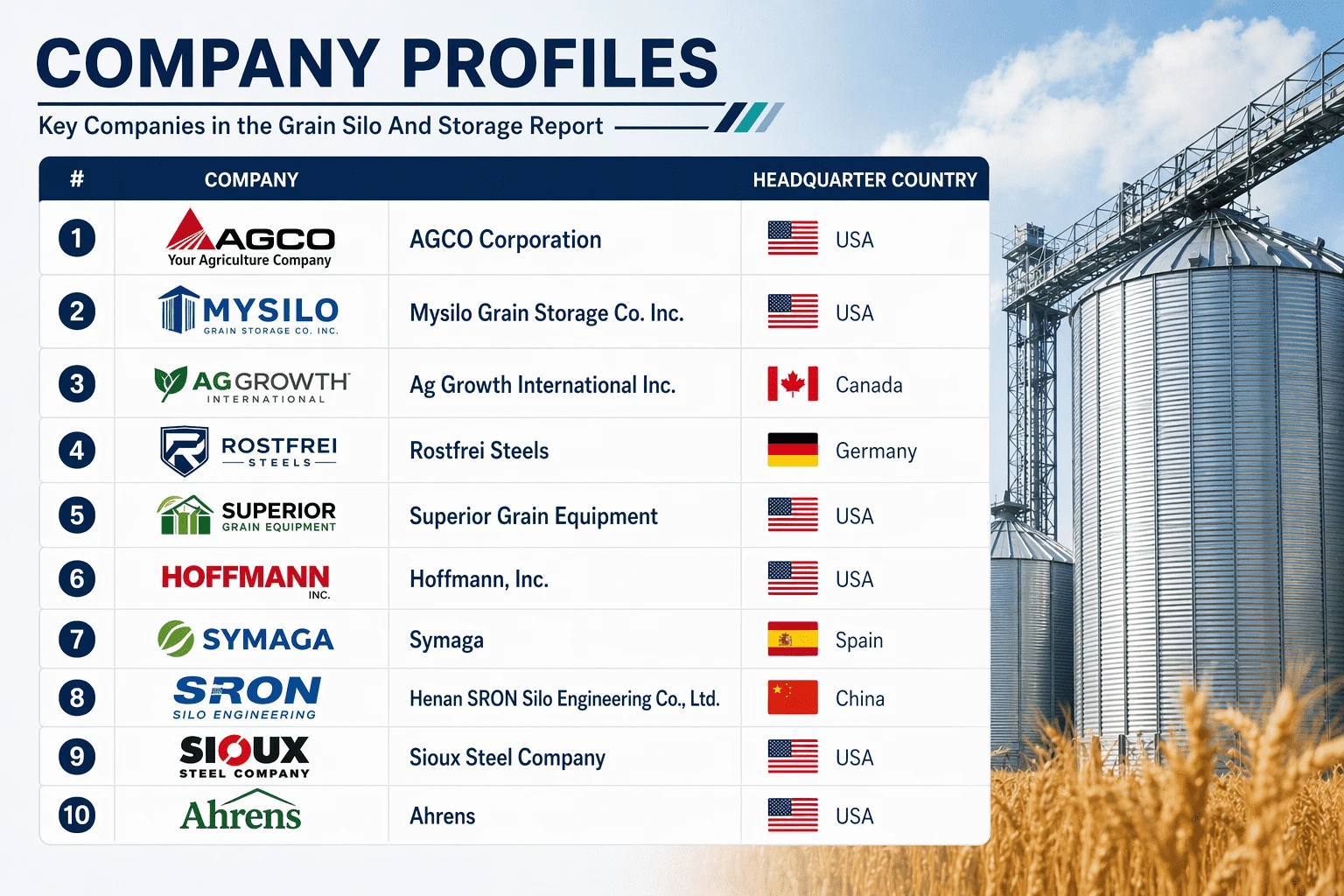
1. AGCO Corporation
AGCO, primarily through its GSI (Grain Systems Manufacturing) brand, has moved from being a simple equipment provider to a high-tech systems integrator. What makes them strategically distinct is their "whole-farm" approach. They don't just sell you a silo; they sell you a connected ecosystem where the combine harvester communicates with the grain dryer. It is observed that AGCO has successfully navigated the transition from mechanical engineering to digital agronomy. They understand that the modern farmer is essentially a data manager who happens to grow corn. By integrating their Fuse technologies into grain storage, they’ve reduced the "human error" factor in aeration, a leading cause of grain spoilage. Their global footprint allows them to pilot massive commercial projects in the Brazilian Cerrado while maintaining a dominant share in the US Midwest.
Product | Developments | Country |
GSI Professional Grade Silos | Integration of GrainVis storage monitoring technology | USA |
2. Mysilo Grain Storage Co. Inc.
Based in Turkey, Mysilo has become a formidable disruptor in the EMEA region. Their strategic advantage lies in their agility and their mastery of high-tensile steel applications. While some Western manufacturers have struggled with rising logistical costs, Mysilo has used its geographic location at the crossroads of Europe and Asia to dominate emerging markets. They have been particularly aggressive in adopting 600g/m² galvanized coatings as a standard, which is significantly higher than many industry peers. This focus on longevity in harsh environments, like the humid coastal regions of North Africa, has earned them a reputation for "over-engineering" in the best possible way. They aren't just selling storage; they are selling a hedge against corrosion.
Product | Developments | Country |
Flat Bottom and Hopper Silos | Implementation of robotic welding for structural integrity | Turkey |
3. AGI (Ag Growth International Inc.)
AGI is perhaps the most aggressive consolidator in the industry. Their strategy has been to acquire best-in-breed specialized companies, like Westeel for bins or Tramco for conveyors, and knit them into a single global powerhouse. What sets AGI apart today is their "AGI SureTrack" platform. They have realized that the real value in 2024 and beyond is not the steel, but the data inside the steel. By providing real-time moisture sensing and market transparency tools, they allow a facility manager to know exactly when to sell based on the condition of the grain. They’ve essentially turned a silo into a financial trading floor. From an analyst's perspective, AGI is the company most likely to turn the grain storage business into a "Software as a Service" (SaaS) model.
Product | Developments | Country |
Westeel Series Silos | Expansion of the AGI SureTrack IoT ecosystem | Canada |
4. Rostfrei Steels
Rostfrei has carved out a unique niche by focusing on the "Zincalume" technology, a combination of zinc and aluminum that offers superior heat reflection and corrosion resistance compared to traditional galvanization. Strategically, they have positioned themselves as the go-to provider for liquid and dry bulk storage in the Asia-Pacific region. Their approach to modularity is particularly interesting; their tanks are designed for rapid deployment in areas where traditional construction infrastructure might be lacking. This "Lego-block" style of industrial assembly has made them a favorite for rapid-response food security projects in developing nations. They are proving that the materials science of the silo wall is just as important as the sensors inside.
Product | Developments | Country |
Glass-Fused-to-Steel Tanks | Advanced liquid and grain hybrid storage solutions | India |
5. Superior Grain Equipment
Superior is a company that lives up to its name through a focus on structural heavy-lifting. While others chase the "smart" trend, Superior has doubled down on the "strong" trend. Their silos are known for having some of the highest wind and snow load ratings in the industry. This is a critical distinction as extreme weather events become more common. For a farmer in the Dakotas or the Canadian prairies, the priority isn't an app on their phone; it's knowing their 50,000-bushel investment won't collapse during a blizzard. Their "Superior 1000" series features a roof design that is arguably the most robust in the commercial market. They represent the "Iron Age" of grain storage, refined for the 21st century.
Product | Developments | Country |
Excel Series Commercial Silos | Patented roof design for extreme environmental loads | USA |
6. Hoffmann, Inc.
Hoffmann is the outlier in this list because they specialize in concrete. While steel silos dominate the landscape due to their lower initial cost, concrete silos are the "eternal" solution for massive commercial terminals. Hoffmann’s strategic distinctiveness lies in its "slipform" construction technique, which allows it to pour massive, seamless concrete structures in a matter of days. From an analytical standpoint, concrete silos offer superior thermal mass, keeping grain temperatures stable without the massive energy costs of constant aeration. Hoffmann is the firm you call when you are building a 100-year infrastructure project at a major port. They are the bedrock of the world's largest grain export hubs.
Product | Developments | Country |
Slipform Concrete Silos | Advanced chimney and stack integration for terminal facilities | USA |
7. Symaga
Based in Spain, Symaga is a volume leader that has mastered the art of the "Mega-Project." They are currently one of the largest manufacturers of galvanized steel silos worldwide. Their strategic edge is their massive production capacity; they can fulfill orders for multi-million-ton storage complexes that smaller firms simply cannot handle. The most impressive part about Symaga is its investment in R&D regarding the "discharge" phase. They have optimized the hopper geometries to ensure that grain flows out without bridging or clumping, a common failure point in large-scale storage. They are the backbone of many of the largest flour mills and breweries in Europe and the Middle East.
Product | Developments | Country |
SBH (Hopper) and SFS (Flat) Silos | New Z-600 galvanization coating lines | Spain |
8. Henan SRON Silo Engineering Co., Ltd.
SRON represents the rise of Chinese engineering in the global agricultural sector. They aren't just selling bins; they are selling "EPC" (Engineering, Procurement, and Construction) turnkey solutions. Their strategic distinction is their ability to handle the entire project lifecycle from soil testing and foundation design to the final commissioning of the grain handling system. In many Belt and Road Initiative countries, SRON has become the default partner for national grain reserve projects. They have successfully bridged the gap between low-cost manufacturing and high-level engineering. Their systems often include integrated dust suppression and explosion-proof technologies, which are becoming mandatory in many jurisdictions.
Product | Developments | Country |
Turnkey Grain Terminal Systems | Integration of intelligent ventilation and fumigation systems | China |
9. Sioux Steel Company
Sioux Steel is a family-owned legacy that has maintained relevance through specialized innovation. Their most significant contribution to the industry is likely the "Daay Bin Paddle Sweep." Cleaning out the bottom of a silo is traditionally one of the most dangerous jobs in farming, often leading to entrapment accidents. Sioux Steel’s focus on safety-driven engineering has made it a favourite among operations that prioritize ESG (Environmental, Social, and Governance) standards. Their silos often feature "Pro-Tec" pond liners and specialized roof vents that prevent the vacuum-collapse issues that plague less sophisticated bins. They prove that in a world of giants, the "safety-first" niche is incredibly resilient.
Product | Developments | Country |
Pro·Tec Buildings and Grain Bins | Zero-entry bin sweep technology for operator safety | USA |
10. Ahrens
Ahrens, an Australian titan, understands the unique challenges of the Southern Hemisphere. Their silos are built to withstand some of the most intense UV radiation and heat fluctuations on the planet. Strategically, Ahrens has dominated the "sealed storage" market. In Australia, where pests can decimate a crop in weeks, the ability to hermetically seal a silo for fumigation is a non-negotiable requirement. Ahrens’ silos are often fully welded rather than bolted, providing a level of airtightness that bolt-together silos struggle to match. They are a masterclass in adapting global storage principles to local environmental extremes.
Product | Developments | Country |
Transportable and Built-in-Place Silos | High-pressure gas-sealed silos for pest eradication | Australia |
Analysis of Technological Trends
The shift from 1.88 billion to 2.37 billion USD is not merely a result of more grain being grown; it is a result of the sophistication of that grain. We are seeing a move toward "Condition-Based Monitoring" (CBM). In the past, a farmer would walk up the side of a silo and smell the vents to see if the grain was "going off." Today, that same farmer receives an alert on their smartwatch because a CO2 sensor at the bottom of the bin detected the metabolic respiration of mold before it was even visible.
Another trend is the "Energy Neutral" silo. Aeration fans are huge consumers of electricity. The next generation of storage infrastructure is integrating solar arrays on silo roofs and using AI-driven weather forecasting to turn on fans only when the ambient humidity and temperature are optimal. This reduces the carbon footprint of the storage facility. It is increasingly important for large food processors like Nestlé or Cargill, who are under pressure to de-carbonize their supply chains.
The Macroeconomic Impact
Why does this USD 2.37 billion market matter Because the "Storage-to-Use" ratio is the primary indicator of global price stability. When storage infrastructure is robust, the world can weather a bad harvest in one region by drawing down reserves stored elsewhere. The companies listed above are the architects of this stability. In the next decade, a surge in "Public-Private Partnerships" (PPPs) in the grain storage space, particularly in Southeast Asia and Sub-Saharan Africa, is expected. Governments are realizing that building roads is useless if the grain rots at the railhead because there isn't a modern silo to put it in.
The competitive dynamics are also shifting. We are seeing an "arms race" in galvanization and coating technologies. As the cost of steel remains volatile, the ability to use thinner, high-tensile steels that are protected by superior coatings is the key to maintaining margins. This is where companies like Symaga and Mysilo have excelled. Meanwhile, North American players like AGCO and AGI are betting that the software layer will be the real profit driver. They aren't just selling steel; they are selling the "peace of mind" that the grain is as high-quality on the day it leaves the silo as it was on the day it entered.
Conclusion
The trajectory of the grain silo and storage market is one of increasing complexity and indispensable value. As the market expands toward USD 2.37 billion by 2031, the focus will remain on minimizing loss through smarter, more resilient infrastructure. The leaders in this space are no longer just metal fabricators; they are environmental managers and data scientists who ensure that the global food supply remains stable in an increasingly unstable world. In the end, the humble grain silo has become the most important bank on the planet, one that stores calories instead of currency.
Have questions?
More Thought Articles
How EV Charger Manufacturers Can Capitalize on India’s Home Charging Revolution
India’s residential EV charging opportunity is expanding as policy support, EV adoption, and private parking infrastructure develop. Manufacturers can capture value beyond AC chargers through installation, smart charging, load management, solar integration, software, and after-sales services. Housing societies, automakers, and property developers offer scalable routes to residential charging customers.
Second-Life EV Battery Market in India: What Is Driving Demand from Manufacturers?
India’s second-life EV battery market is gaining relevance as electric vehicle adoption expands and batteries retain useful capacity after automotive service. Growing stationary-storage demand, battery data, refurbishment capabilities, EPR obligations, and critical-mineral policies are encouraging manufacturers to extend battery value through reuse before eventual recycling within India’s emerging circular battery ecosystem.
The Rise of Locally Manufactured Battery Separators in India’s EV Ecosystem
India’s battery industry is progressing from pack assembly toward domestic cell and material manufacturing, creating opportunities for lithium-ion battery separators. Policy support, ACC capacity expansion and R&D initiatives are strengthening the ecosystem. However, technical complexity, manufacturing yields, qualification requirements and economics mean localisation will likely advance gradually through coatings, testing and finishing.