
Precision medicine diagnostics are transforming healthcare into a proactive, data-driven system by linking molecular insights to targeted treatments. Driven by advances in sequencing, AI, and companion diagnostics, the sector is becoming central to clinical decision-making, enabling cost-effective, personalized therapies while reshaping industry dynamics, value chains, and the future of global healthcare delivery.
The global healthcare paradigm is undergoing a fundamental shift from a "one-size-fits-all" reactive model to a proactive, molecularly-driven discipline. Precision medicine diagnostics represent the technical engine of this transition, moving beyond simple symptomatic observation to interrogate the specific genetic, epigenetic, and proteomic drivers of disease. As we look toward a market projected to reach USD 122.6 billion by 2031, we aren’t just looking at better lab equipment; we are witnessing the industrialization of personalized biology. The sector acts as the critical bridge between raw genomic data and actionable clinical decisions.
Traditionally, diagnostics were viewed as a secondary cost center in healthcare, but they have now evolved into the primary gatekeeper for high-value therapeutics, particularly in oncology, rare diseases, and neurology. This transformation is being catalyzed by the maturation of Next-Generation Sequencing (NGS), the integration of AI-driven bioinformatics, and a regulatory environment that increasingly demands companion diagnostics (CDx) for drug approval. Global demand is accelerating as healthcare systems realize that paying for a precise diagnostic upfront is exponentially cheaper than paying for a failed six-month course of non-targeted chemotherapy.
Industry Definition & Value Chain Position
Precision medicine diagnostics encompass the technologies and methodologies used to identify specific biomarkers, such as genomic sequences, protein expressions, or chemical metabolites, that predict a patient’s response to a particular treatment or their risk of developing a condition. In the broader healthcare value chain, this sector sits at the "Midstream-Strategic" junction. Upstream, we have the raw biological inputs and the basic research into the human genome. Downstream, we have the pharmaceutical giants and the clinicians who administer treatment. The diagnostics industry processes the upstream data into the downstream "instruction manual." Without these diagnostic solutions, the multi-billion-dollar pipelines of targeted therapies (like CAR-T cell therapies or PARP inhibitors) would be functionally useless, as clinicians would have no way to identify the eligible patient population.
The process involves a sophisticated flow: sample collection (often moving toward non-invasive liquid biopsies), library preparation, high-throughput sequencing or digital PCR analysis, and finally, the bioinformatic interpretation that translates "GTCA" strings into a "Yes/No" clinical report. This industry is the ultimate enabler; it removes the guesswork from the medical equation. Its criticality cannot be overstated; it is the bottleneck of modern medicine. If the diagnostic fails or lacks sensitivity, the entire value of the subsequent therapy is lost. As we move deeper into the 2020s, the value chain is consolidating, with diagnostic firms increasingly entering risk-sharing agreements with pharma companies, ensuring that the "test" and the "cure" are developed as a single, inseparable unit.
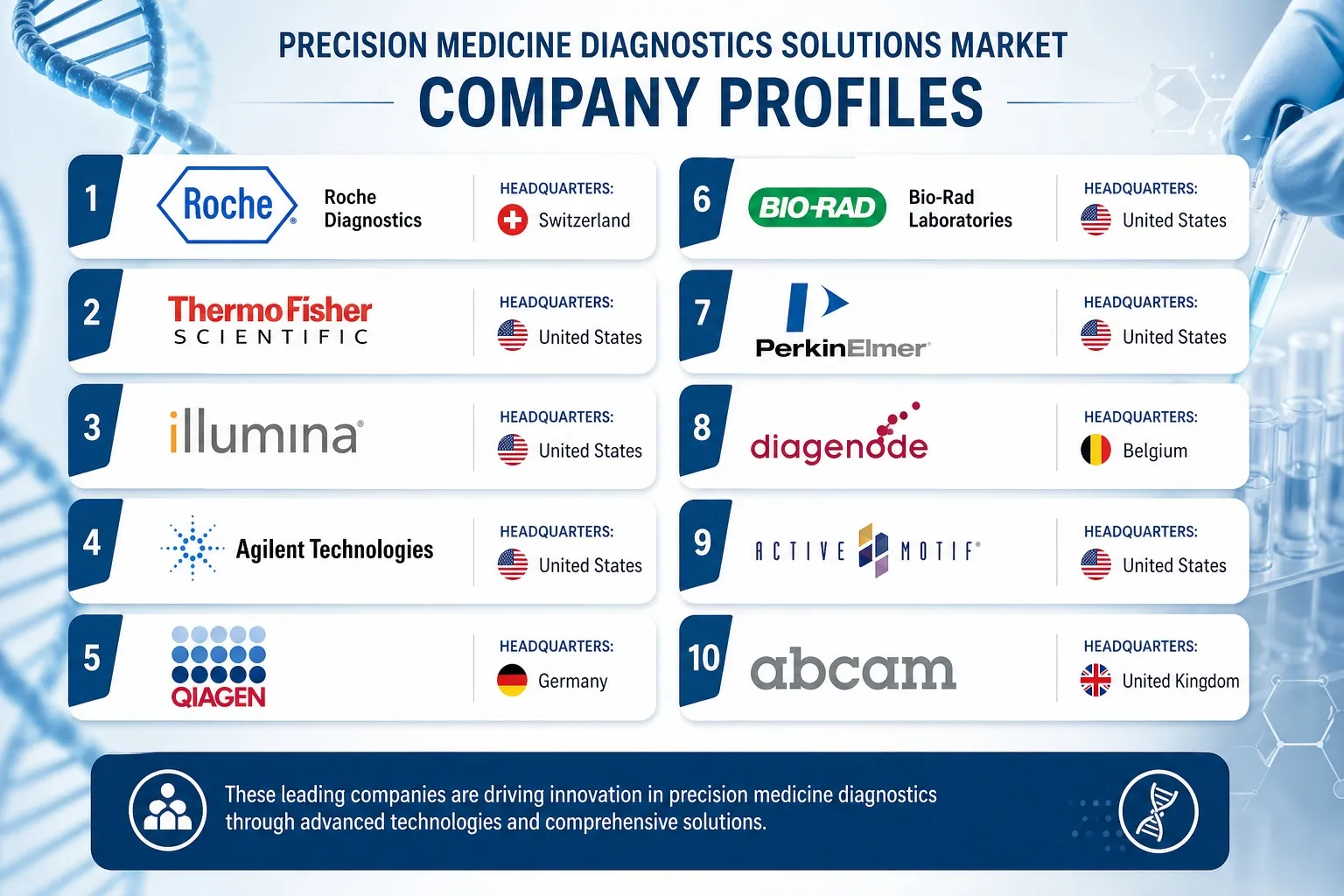
1. Roche Diagnostics
Roche occupies a unique position as the only global entity that effectively marries a massive pharmaceutical division with an equally dominant diagnostics arm. This internal synergy allows them to pioneer the "Companion Diagnostic" model with more agility than almost anyone else. While others are trying to find partners, Roche often is the partner. Their strategy focuses on total laboratory automation and the integration of digital pathology. They aren't just selling a sequencer; they are selling a holistic ecosystem where data flows from a tissue slide into a cloud-based decision support tool. Their dominance in oncology is particularly notable, where their assays define the standard of care for HER2 testing and PD-L1 expression. Roche’s real strength lies in its ability to scale; they take complex molecular assays and make them robust enough for high-volume hospital labs, not just specialized research centers. This "democratization of complexity" is what keeps their market share insulated against smaller, nimbler startups.
Product | Developments | Country |
cobas® EGFR Mutation Test v2 | Launched the NVIDIA AI factory to accelerate new diagnostic solutions. | Switzerland |
2. Thermo Fisher Scientific
Thermo Fisher is essentially the "infrastructure provider" of the precision medicine world. If the industry is a gold rush, Thermo Fisher is the premier shovel-seller, but they also own the assay rights. Their Ion Torrent platform remains a formidable competitor to Illumina, particularly in clinical settings where "speed to result" and smaller batch sizes are more critical than massive data throughput. Strategically, Thermo Fisher has been on an aggressive acquisition spree, absorbing specialty diagnostic firms to ensure they have a footprint in every conceivable niche, from proteomics to clinical mass spectrometry. Their focus on "Clinical Next-Generation Sequencing" (NGS) is tailored for the community hospital, aiming to make molecular profiling a routine part of local care rather than a high-end luxury. Thermo is the ultimate "utility" play; their diversified portfolio makes them nearly immune to the failure of any single drug trial or diagnostic trend.
Product | Developments | Country |
Oncomine™ Precision Assay | Introduced LDT for monitoring anti-rejection medication in transplant patients. | USA |
3. Illumina
Illumina is the name synonymous with the genomic revolution. They own the lion's share of the sequencing market, and for a good reason: their chemistry has consistently driven the cost of sequencing down faster than Moore’s Law. However, Illumina is currently in a state of strategic pivot. After the regulatory complications regarding the Grail acquisition, they are refocusing on their core instrument business, specifically the NovaSeq X series. Their goal is to make the $100 genome a reality, which would transition NGS from a "selective diagnostic" to a "population health" tool. Illumina’s influence is so pervasive that most other companies on this list actually build their diagnostic "kits" to run on Illumina machines. This creates a powerful network effect. From an analyst’s view, Illumina’s future depends on whether it can successfully transition from being a hardware company to a data-insights company, leveraging the massive amounts of genomic data passing through its flow cells.
Product | Developments | Country |
TruSight™ Oncology 500 (TSO 500) | Partnered with D3b to analyze 100,000 pediatric whole genomes. | USA |
4. Agilent Technologies
Agilent transitioned from its Hewlett-Packard roots into a life sciences powerhouse with a very specific focus: reliability and precision in the "wet lab." While they lack the sequencing hype of Illumina, they are the undisputed leaders in tissue diagnostics and IHC (Immunohistochemistry) through their Dako brand. Agilent’s strategy is built on the realization that even in the age of genomics, the "tissue slide" remains the bedrock of pathology. They are bridging the gap by integrating digital imaging with molecular analysis. Their "Resolution Bioscience" acquisition also signaled a serious commitment to liquid biopsy, moving them into the non-invasive monitoring space. Agilent’s machines are the workhorses of the industry; they might not be the flashiest, but they are the most trusted for high-stakes regulatory approvals in the companion diagnostic space.
Product | Developments | Country |
SureSelect Cancer CGP Assay | Launched ADS 2 software for automated diagnostic data workflows. | USA |
5. QIAGEN
QIAGEN is the "Sample to Insight" specialist. They have carved out a massive niche by mastering the most annoying part of diagnostics: sample preparation. Before you can sequence DNA, you have to extract it, and QIAGEN is the gold standard for that process. However, they have evolved far beyond just kits and buffers. Their NeuMoDx and QIAstat-Dx platforms are pushing precision medicine into the "syndromic testing" space, where a doctor can test for 20 different pathogens or mutations simultaneously at the point of care. QIAGEN’s strategic brilliance lies in its "platform agnostic" approach, providing the essential chemistry that makes everyone else’s hardware work. They are also heavily invested in the "liquid biopsy" movement, providing the specialized tools needed to capture rare circulating tumor cells.
Product | Developments | Country |
therascreen® KRAS RGQ PCR Kit | Acquired Genoox to enhance clinical genomics with AI software. | Netherlands |
6. Bio-Rad Laboratories
Bio-Rad is a fascinating case of a company that dominated a "legacy" technology, Droplet Digital PCR (ddPCR), and turned it into a modern precision medicine essential. While NGS is great for looking at the "whole picture," ddPCR is unparalleled for finding a "needle in a haystack." This makes Bio-Rad the leader in Minimal Residual Disease (MRD) monitoring. After a patient has surgery or chemo, clinicians use Bio-Rad’s tech to see if a tiny fraction of cancer DNA remains. This is arguably the fastest-growing sub-sector of precision diagnostics. Bio-Rad doesn’t try to be everything to everyone; they focus on absolute quantification. As "monitoring" becomes as important as "initial diagnosis," Bio-Rad’s role in the oncology lifecycle will only deepen.
Product | Developments | Country |
QX600™ Droplet Digital™ PCR System | Launched QX700 Droplet Digital PCR System for multiplexed analysis. | USA |
7. PerkinElmer (Revvity)
Recently rebranded and refocused, the entity formerly known in the diagnostics space as PerkinElmer (now Revvity) has shed its legacy industrial businesses to become a pure-play health science company. Their focus is heavily weighted toward neonatal screening and specialized genomics. They are the quiet giants of the "earliest possible" precision medicine, identifying genetic disorders in newborns before symptoms even appear. Beyond that, their imaging and automated liquid handling systems are essential for high-throughput screening in drug discovery. Revvity represents the "high-end" of the diagnostic market, focusing on complex, specialized assays that require significant technical expertise to run. Their recent shift suggests a bet on the "Omics" convergence, where genomics, proteomics, and metabolomics meet.
Product | Developments | Country |
Vanadis® NIPT System | Launched Signals BioDesign for high-throughput biologic research workflows. | USA |
8. Diagenode
Diagenode, a part of Hologic, is a specialist in the "epigenetics" of precision medicine. While most of the industry looks at the DNA sequence itself, Diagenode looks at the "switches" that turn those genes on and off (methylation, chromatin profiling). This is the next frontier. We are discovering that many diseases aren't caused by a "broken" gene, but by a gene that is "switched off." Diagenode provides the shearing and automation tools that make epigenetic research possible at scale. They are the "expert’s expert" in the field. As we move toward more complex diagnostics that incorporate gene expression patterns, Diagenode’s niche expertise is becoming increasingly mainstream. They represent the "Deep Tech" end of the diagnostics spectrum.
Product | Developments | Country |
Megaruptor® 3 | Launched new RNA-sequencing kits compatible with MGI DNBSEQ sequencers. | Belgium |
9. Active Motif
Active Motif is another powerhouse in the epigenetic space, specifically focusing on how the structure of the genome influences disease. Their role in precision medicine is more centered on the "discovery" end of the diagnostic pipeline. They provide the services and kits that pharmaceutical companies use to identify new biomarkers. If a company wants to understand why a certain drug only works in patients with a specific "chromatin signature," they call Active Motif. They are strategically positioned as the "R&D partner of choice" for the next generation of targeted therapies. Their transition toward offering more "end-to-end" services, where they handle the entire epigenetic analysis for a client, mirrors the broader industry trend toward "Insights-as-a-Service."
Product | Developments | Country |
AbFlex® Recombinant Antibodies | Active Motif launched a specialized service for Single-Cell ATAC-seq, providing unprecedented resolution for tumor heterogeneity studies. | USA |
10. Abcam
Abcam is the king of the "reagent" world, recently acquired by Danaher. In precision medicine, the diagnostic is only as good as the antibody used to detect the protein. Abcam’s massive library of highly validated recombinant antibodies is the "software" that runs on the "hardware" of companies like Roche or Agilent. Their strategy has been to move away from "research-only" tools and toward "IVD-grade" (In-Vitro Diagnostic) reagents. This is a critical distinction; clinical-grade antibodies require much higher levels of consistency and regulatory documentation. By becoming the primary supplier of the "ingredients" for diagnostic kits, Abcam (under Danaher) is essentially taxing the entire growth of the proteomic diagnostic market.
Product | Developments | Country |
RabMAb® Recombinant Antibodies | Joined LIGAND-AI project to advance AI-driven diagnostic antibody discovery. | UK |
Analytical Outlook: 2026 and Beyond
As we approach 2026, the definition of a "diagnostic company" is blurring. Are they tech companies? Are they chemical companies? Are they data brokers? The answer is "all of the above." The winners will be the ones who successfully navigate the "Last Mile" of precision medicine, the transition from a lab report to a doctor’s prescription.
Right now, there are too many players with slightly different techniques for catching circulating tumor DNA. The market will likely settle on two or three dominant standards, much like how the industry settled on Illumina for sequencing. Furthermore, the rise of "Proteomics" (the study of proteins) will likely challenge the "Genomics-First" mindset. DNA is the "blueprint," but proteins are the "machinery" actually doing the work. Companies like Revvity and Abcam are perfectly positioned for this "Proteomic Pivot."
Ultimately, the 13.5% CAGR is a conservative estimate if we consider the potential for "Population Genomics", where every citizen is sequenced at birth. If precision medicine diagnostics move from "cancer only" to "everyday wellness," the USD 122.6 billion target for 2031 might actually be an undershoot. We are moving toward a world where your "Diagnostic Profile" is as common as your blood type, and the ten companies listed here are the architects of that reality. They aren't just measuring health; they are defining the new parameters of human longevity through the lens of molecular precision.
The shift toward "Value-Based Care" will be the ultimate judge. If these diagnostics can prove they reduce hospital readmissions and prevent the use of ineffective, toxic drugs, they will become the most valuable assets in the global healthcare economy. The era of "guessing" in medicine is coming to a close, replaced by a digital, molecular, and highly profitable certainty.
Have questions?
More Thought Articles
From Data Centers to EV Charging: Where Low-Voltage DC Distribution Is Making an Impact
Low-voltage DC distribution is gaining relevance as AI data centers, EV charging hubs, solar systems, and battery storage increase demand for efficient power architectures. The article examines 800 VDC standardization, conversion losses, protection challenges, and greenfield opportunities, highlighting why hybrid AC/DC systems could become increasingly important across high-power infrastructure applications.
How EV Charger Manufacturers Can Capitalize on India’s Home Charging Revolution
India’s residential EV charging opportunity is expanding as policy support, EV adoption, and private parking infrastructure develop. Manufacturers can capture value beyond AC chargers through installation, smart charging, load management, solar integration, software, and after-sales services. Housing societies, automakers, and property developers offer scalable routes to residential charging customers.
Second-Life EV Battery Market in India: What Is Driving Demand from Manufacturers?
India’s second-life EV battery market is gaining relevance as electric vehicle adoption expands and batteries retain useful capacity after automotive service. Growing stationary-storage demand, battery data, refurbishment capabilities, EPR obligations, and critical-mineral policies are encouraging manufacturers to extend battery value through reuse before eventual recycling within India’s emerging circular battery ecosystem.