
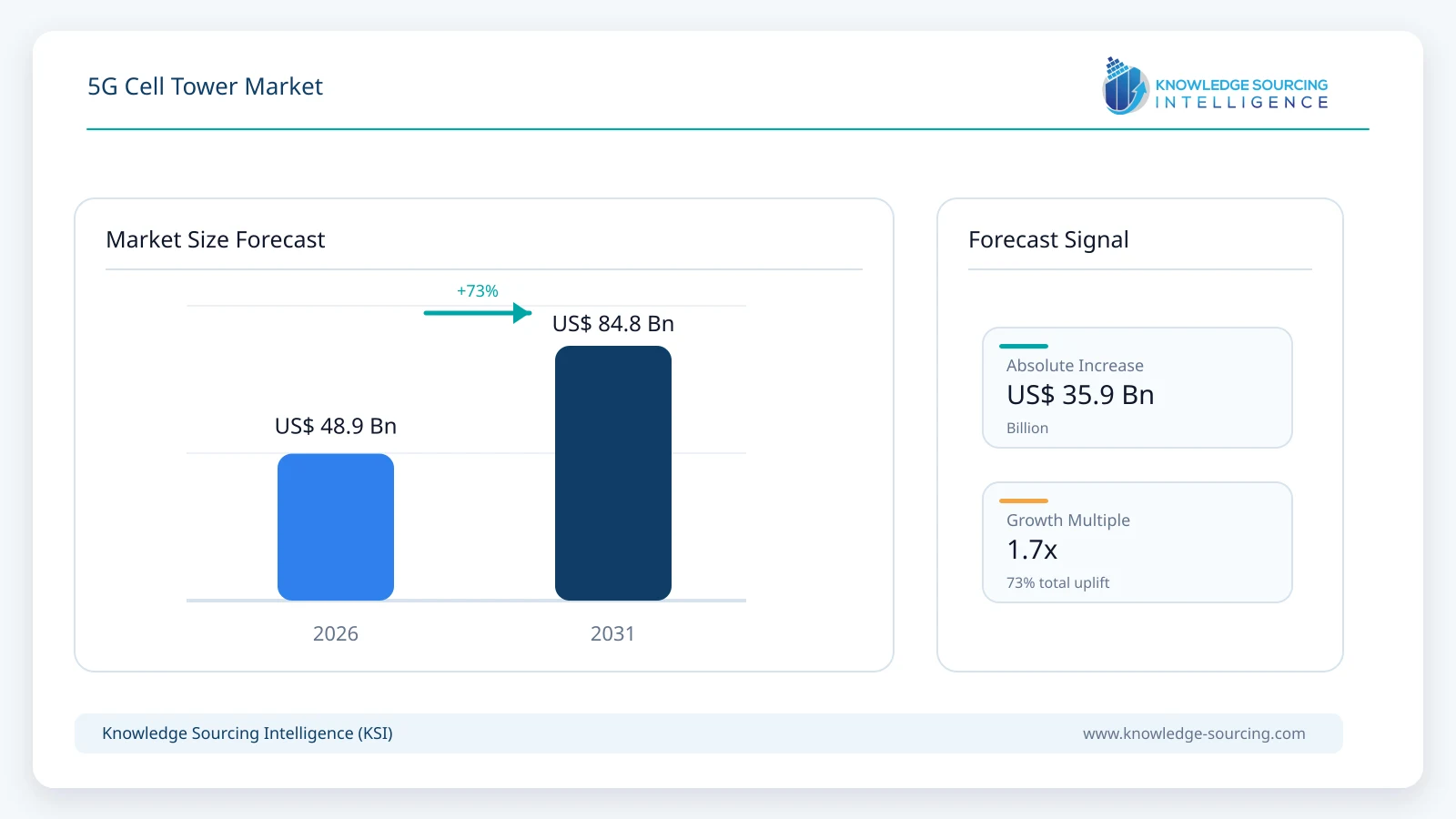
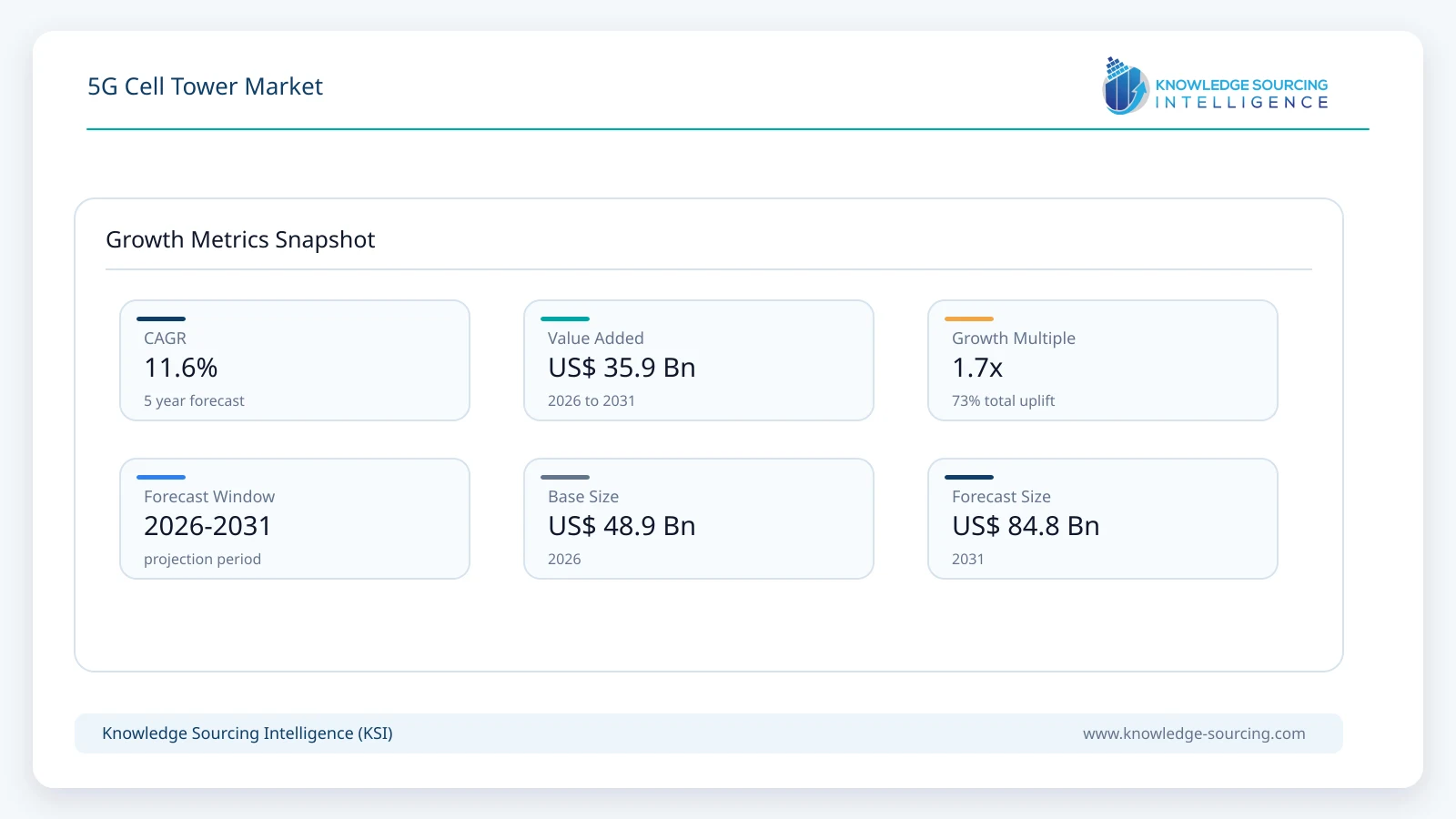
The 5G Cell Tower Market is forecast to grow at a CAGR of 11.6%, reaching USD 84.8 billion in 2031 from USD 48.9 billion in 2026.
Highlights:
- 1Macro cell towers account for an estimated 45.6% of market revenue in 2026, supported by their continued role in wide-area coverage and mid-band spectrum deployment.
- 2Tower upgradation represents approximately 38.9% of market revenue in 2026, as operators increasingly add radios, antennas, structural capacity and power systems to existing sites rather than relying only on greenfield towers.
- 3Telecom operators account for an estimated 67.8% of market demand in 2026, with tower companies and enterprise or government networks forming the balance.
- 4Asia Pacific represents approximately 60.5% of global market revenue in 2026, primarily because of China’s exceptionally large 5G site base and continued deployment across India, Japan, South Korea and Southeast Asia.
- 55.15 million 5G base stations by July 2026China had , while India had 562,971 5G BTSs by June 2026, demonstrating the scale at which the two largest Asian deployment programs continue to expand.
- 66.4 billion by 2031Global 5G subscriptions are forecast to reach , increasing the requirement for network densification and capacity upgrades even where basic population coverage is already high.
- 7The market is gradually shifting from first-wave coverage deployment toward small cells, additional tenancy, 5G Standalone capacity, 5G-Advanced upgrades and higher-capacity urban and transport corridors.
The market covers physical infrastructure supporting 5G radio access deployment, including macro cell towers, small-cell sites, distributed antenna infrastructure and supporting tower equipment. It also includes new tower construction, tower upgrades, managed site services and associated power solutions. The scope excludes standalone radio access equipment revenue where no tower, site, passive infrastructure or related deployment service is involved.
Market Overview
The 5G cell tower market is entering a different phase from the initial rollout cycle. Between 2019 and 2025, a large part of global investment focused on achieving basic 5G population coverage by placing new radios and antennas on existing macro towers and constructing additional sites where required. By 2026, several major markets have already achieved broad 5G coverage, but this does not reduce infrastructure requirements. Instead, investment is shifting toward capacity densification, higher-order MIMO configurations, additional mid-band coverage, small cells, indoor systems, and upgrades required to support 5G Standalone and 5G-Advanced services.
China provides the clearest example of this transition. The country had 4.84 million 5G base stations at the end of 2025 and increased the total to approximately 5.15 million by July 2026. More than 330 Chinese cities already have 5G-Advanced coverage, while the government has indicated continued investment in next-generation communications infrastructure. This means growth increasingly comes from upgrading a very large installed base rather than only expanding first-time coverage.
India is following a different but equally important trajectory. More than 562,000 5G BTSs had been installed by June 2026, compared with approximately 141,000 in March 2023. 5G is now available in virtually all districts, so infrastructure spending is beginning to move beyond geographic rollout toward capacity, rural coverage, fixed wireless access and service quality.
Tower-company operating data also shows that mobile-network densification continues after headline coverage targets are achieved. Cellnex reported 4.9% organic growth in points of presence during the first half of 2026, supported by both new colocations and build-to-suit deployments. SBA Communications built 109 towers during the second quarter of 2026 and continued spending on tower augmentations and site construction. These trends indicate that mature markets still require physical infrastructure additions as traffic and spectrum utilization increase.
Market Drivers
Mid-band spectrum is creating sustained demand for tower densification
The technical characteristics of mid-band 5G spectrum are one of the most important infrastructure drivers. Bands around 2.5 GHz to 4 GHz provide substantially greater capacity than low-band spectrum but generally require denser site grids to maintain comparable coverage. Operators therefore need additional antennas, radios and in some cases new tower or rooftop locations as more traffic shifts onto mid-band networks.
This effect remains important even in countries where 5G population coverage exceeds 90%. Coverage statistics do not indicate whether sufficient capacity exists in high-traffic districts, transport corridors or dense suburban areas. As subscriber adoption and data consumption rise, operators need to increase sector capacity and reduce cell loading. Tower companies benefit through additional tenant equipment, structural modifications and build-to-suit requirements rather than relying only on greenfield site count.
5G subscriptions and traffic continue to outgrow the installed capacity base
Ericsson expects global 5G subscriptions to increase from around 3.3 billion in mid-2026 to 6.4 billion by the end of 2031. 5G networks are also expected to carry a much larger proportion of mobile traffic by the end of the forecast period. This directly affects cell-site requirements because spectrum and software improvements alone cannot indefinitely absorb increasing user traffic.
The market therefore has a recurring capacity cycle. Initial coverage establishes the network footprint, higher subscriber penetration increases utilization, and operators subsequently add sectors, spectrum bands, MIMO capability or additional cell sites. This makes tower and site-upgrade demand more durable than a simple one-time 5G rollout model would suggest.
5G Fixed Wireless Access is increasing localized network loading
Fixed Wireless Access places different demands on mobile infrastructure from conventional smartphone usage because residential broadband connections generate sustained data traffic from fixed locations. Ericsson forecasts approximately 350 million FWA connections on mobile networks globally by 2031.
Markets such as India illustrate how quickly this can become relevant. Reliance Jio and Bharti Airtel already have millions of 5G fixed-wireless subscribers, increasing localized evening and household traffic on the radio network. Higher FWA penetration supports additional tower upgrades, sector capacity and small-cell deployment where operators need to protect mobile quality while serving home broadband customers.
5G-Advanced is extending the investment cycle of existing sites
The progression toward 5G-Advanced means operators can continue investing in existing towers even after conventional 5G deployment reaches maturity. China already reports 5G-A coverage across more than 330 cities, while its next five-year communications plans include substantial upgrades to current networks.
5G-Advanced introduces higher-order carrier aggregation, improved uplink capability, enhanced Massive MIMO and support for more demanding industrial and AI-related use cases. These improvements require additional radio equipment, antenna modernization, higher-capacity backhaul and, in some cases, more power at the cell site. Tower upgradation therefore becomes increasingly important relative to first-time construction in markets with mature 5G footprints.
Infrastructure sharing improves the economics of network expansion
Independent tower companies allow several network operators to share one physical structure while maintaining separate active radio equipment. This reduces duplication of land, civil works, and power infrastructure and can make deployment economically feasible in rural or lower-density areas.
Cellnex’s tenancy ratio increased to 1.63x during the first half of 2026, while SBA continues operating tens of thousands of multi-tenant communication sites internationally. Higher tenancy improves tower-company returns while allowing operators to deploy additional equipment without constructing a dedicated structure for each network.
Market Restraints and Challenges
Mature markets are shifting away from large-scale greenfield construction
5G does not require a completely new tower for every base station. Operators often mount new radios and antennas on existing 4G towers, making tower upgrades and tenancy additions more important than tower-count growth in mature markets. This limits the addressable market for new macro tower construction once geographic coverage is substantially complete.
Crown Castle, for example, owns approximately 40,000 towers across the United States, while much of future network investment involves additional equipment and capacity on existing infrastructure rather than an equivalent expansion in the number of towers.
Site acquisition and permitting can delay densification
The need for denser networks does not automatically translate into fast deployment. Municipal permits, zoning, rights of way, landlord agreements and power connections can delay new sites, particularly in dense urban markets where demand is strongest. Small cells can use street furniture or rooftops, but these deployments often require coordination with multiple municipal and utility authorities.
India has introduced the GatiShakti Sanchar portal and revised Right of Way processes partly to reduce these delays, while other countries continue to simplify permitting. Even with reforms, local approval remains one of the principal differences between theoretical infrastructure demand and actual site deployment.
Tower-company economics are sensitive to operator consolidation
Independent tower companies benefit when several mobile operators colocate equipment on one site. Consolidation among operators can have the opposite effect because duplicated networks may be decommissioned after a merger.
The U.S. tower market has already experienced this dynamic following the T-Mobile and Sprint combination, while tower operators in several emerging markets face similar customer-concentration risks. High reliance on a small number of national mobile operators can therefore create revenue volatility even where overall mobile data demand remains strong.
Energy costs are material in markets with unreliable grids
Tower sites require continuous electrical availability. In markets where grid reliability is limited, operators may need diesel generation, batteries, solar systems or hybrid power solutions. These systems increase capital expenditure and maintenance costs and can represent a substantial component of tower economics.
IHS Towers reported continued power-generation and maintenance costs within its African portfolio during 2026, illustrating the different operating economics between mature grid-connected sites and emerging-market towers requiring greater energy autonomy.
6G creates uncertainty around late-period capital allocation
Initial 6G commercialization is expected around 2030 in several leading markets. However, this should not be interpreted as rendering 5G towers obsolete. Much of the passive tower, power and site infrastructure can support future radio generations, just as existing 4G towers were extensively reused for 5G.
The restraint is primarily timing. Operators may delay certain late-cycle 5G upgrades where they expect them to overlap with future 6G deployment. Conversely, sites with strong structural capacity, fiber backhaul and power can become more valuable precisely because they provide a platform for future generations.
Major Segment Analysis
By Product
Macro cell towers remain the largest product category because wide-area coverage continues to depend on elevated structures supporting low- and mid-band radio equipment. However, the segment grows more slowly than smaller cell formats as mature markets increasingly densify existing macro networks rather than construct an equivalent number of new towers.
Small-cell infrastructure is projected to record approximately 15.7% annual growth through 2031, making it the fastest-growing major product category in the KSI model. Urban capacity, enterprise networks, transport hubs and higher-frequency spectrum all increase the need for smaller sites positioned closer to users.
Distributed antenna systems remain important in airports, stadiums, commercial buildings and other high-density indoor environments. Tower equipment, including structural components, mounting systems, power and related site hardware, continues expanding as operators add radio capacity to existing towers.
By Solution
Tower upgradation remains the largest solution category as operators continue modifying existing structures to accommodate additional antennas, Massive MIMO radios, higher power loads and new frequency bands. The category is projected to remain larger than new-tower construction through 2031 even as greenfield deployment continues in rural and emerging markets.
New tower construction grows more strongly in India, Southeast Asia, Africa and parts of Latin America, where the physical network footprint is still expanding. Managed services and maintenance also gain importance as tower portfolios become larger and technologically more complex.
By Deployment Location
Urban locations remain the largest deployment category because network capacity requirements are concentrated where subscriber density and traffic levels are highest. Urban infrastructure increasingly combines macro towers with rooftop sites, small cells and indoor systems rather than relying on one site type.
Suburban markets continue to require macro-network densification as 5G traffic increases, while rural deployment is more dependent on government coverage programs and infrastructure-sharing economics. Enterprise deployments remain smaller in absolute terms but record faster growth as private 5G networks expand in manufacturing, logistics, mining, ports and healthcare.
By End User
Telecom operators remain the principal source of market demand, but tower infrastructure companies increasingly control the passive assets used by those operators. Build-to-suit agreements allow tower companies to construct sites against long-term operator commitments, while infrastructure-sharing models reduce capital requirements for mobile operators.
Government and enterprise 5G networks remain a smaller end-user category but are becoming more important in industrial and mission-critical applications, particularly where organizations deploy private radio networks rather than rely entirely on public mobile infrastructure.
Regional Analysis
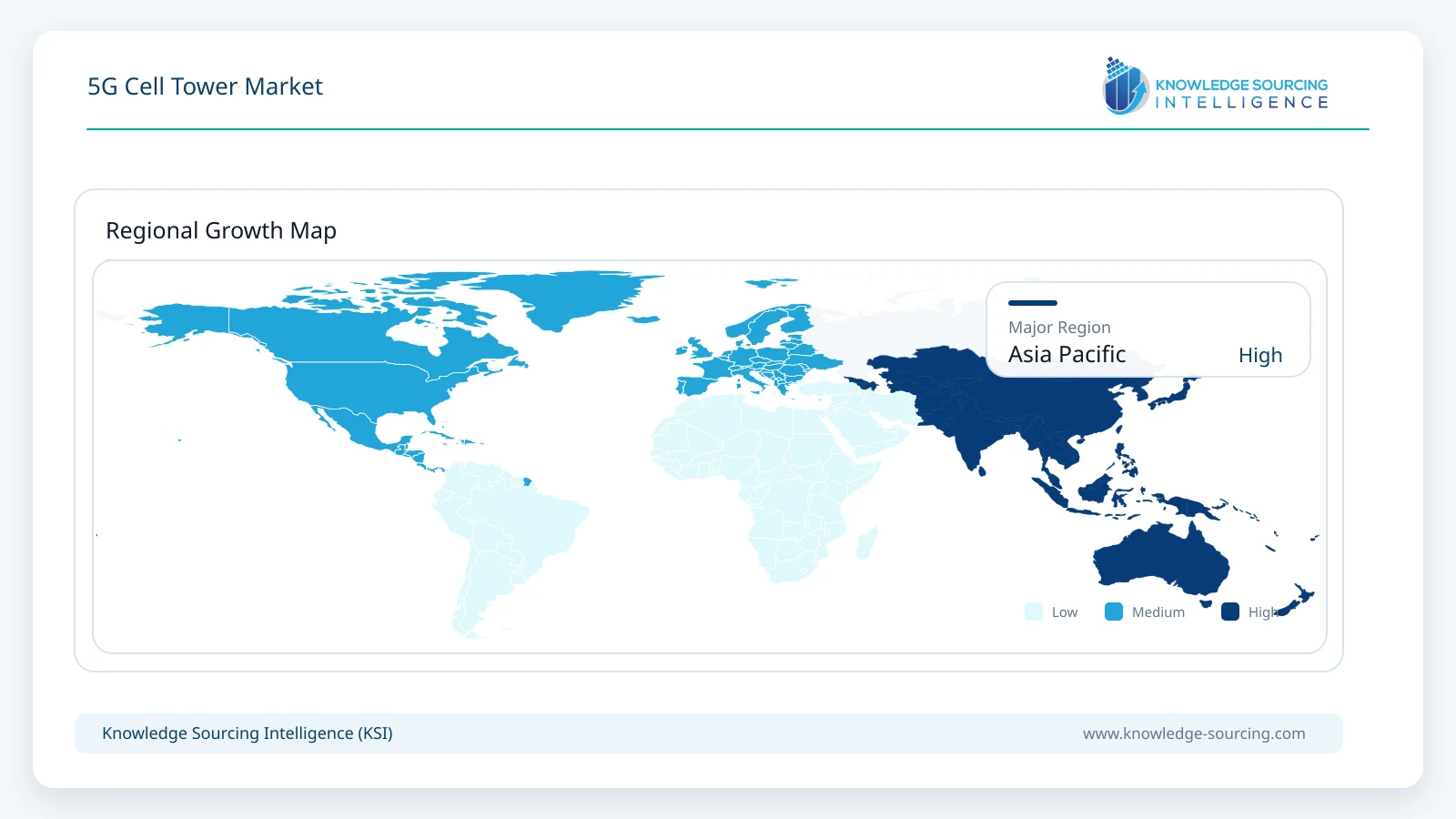
Asia Pacific remains the dominant regional market throughout the forecast period. China’s installed network provides the largest single infrastructure base globally, with more than 5.15 million 5G base stations by July 2026. The next phase emphasizes 5G-A upgrades, coverage enhancement and integration with industrial digitalization.
India provides a second major regional growth engine. The country increased its 5G BTS count from approximately 141,000 in March 2023 to more than 562,000 by June 2026. With basic district coverage largely complete, future investment increasingly shifts toward FWA capacity, rural coverage, additional spectrum and network quality.
Japan and South Korea remain technologically advanced markets where new tower demand is increasingly associated with densification and network modernization rather than first-time national coverage. Southeast Asia represents a more mixed market, with countries such as Indonesia, Malaysia, Thailand and the Philippines continuing to expand physical mobile infrastructure as 5G adoption progresses.
North America remains a large value market because of high tower leasing rates, substantial mid-band deployment and an established independent TowerCo model. Crown Castle operates approximately 40,000 U.S. towers, while SBA operated 46,390 communication sites globally at the end of June 2026. Continued investment centers on additional equipment, network capacity and tenancy rather than rapid expansion of macro tower counts.
Europe continues transitioning from coverage build-out toward densification. Cellnex reported approximately 4.9% organic growth in points of presence during H1 2026, while new build-to-suit agreements continue across its European footprint. Cellnex also estimates that Europe will require substantial mobile-network investment over the next decade to complete 5G coverage, densification and resilience improvements.
Latin America remains an important tower-investment region, particularly Brazil and Mexico. Tower ownership is continuing to consolidate, illustrated by IHS Towers’ August 2026 sale of approximately 9,000 Brazilian and Colombian sites to Macquarie Asset Management.
Africa continues to rely heavily on independent TowerCos because infrastructure sharing can materially improve rural and low-ARPU deployment economics. IHS Towers, Helios Towers and other regional platforms operate extensive portfolios where power systems, maintenance and tenant expansion remain central to network economics.
Technology Outlook
5G-Advanced Site Upgrades
5G-Advanced represents the most immediate technology change affecting tower infrastructure. Existing sites are being upgraded with additional frequency bands, higher-order MIMO, improved uplink performance and greater processing capacity. This extends the useful life of existing tower assets while increasing demand for structural reinforcement, electrical capacity and backhaul.
Small Cells and Neutral-Host Infrastructure
Dense urban areas increasingly require a combination of macro coverage and localized capacity. Neutral-host small-cell systems allow multiple operators to share infrastructure inside buildings, transport hubs and public spaces, improving the economics of densification while reducing duplication.
AI-Assisted Tower Operations and Energy Management
Tower operators are increasingly using remote monitoring, predictive maintenance and automated power management to reduce site visits and energy consumption. These technologies are particularly valuable in large portfolios and emerging markets where power availability and maintenance logistics materially affect operating costs.
Recent Developments
August 2026: IHS Towers completed the sale of its approximately 9,000-site Brazil and Colombia tower portfolio to Macquarie Asset Management, reflecting continued consolidation and capital recycling within independent telecom infrastructure.
August 2026: SBA Communications reported ownership or operation of 46,390 communication sites at the end of June 2026 and constructed 109 additional towers during the second quarter.
July 2026: Cellnex reported 4.9% organic growth in points of presence during the first half of 2026, supported by colocations and build-to-suit deployments. The company also agreed an additional 300-site build-to-suit program with Sunrise in Switzerland beginning in 2027.
June 2026: India’s Department of Telecommunications reported 562,971 5G BTSs installed nationwide as of June 30, 2026, up substantially from 140,623 in March 2023.
May–July 2026: China’s 5G base-station count exceeded 5 million and reached approximately 5.15 million by July, while 5G-A coverage expanded across more than 330 cities.
Competitive Landscape
The market combines independent tower companies, operator-controlled infrastructure platforms and suppliers providing active and supporting infrastructure. China Tower is the largest tower platform by site count and benefits from the scale of China’s 5G deployment. Indus Towers maintains one of the world’s largest shared passive infrastructure portfolios and remains central to India’s continued 5G expansion.
American Tower, Crown Castle and SBA Communications are major North American infrastructure owners, while Cellnex and Vantage Towers have substantial European footprints. Phoenix Tower International and Vertical Bridge continue expanding independent tower portfolios, while edotco, Summit Digitel, Protelindo and EdgePoint Infrastructure have significant positions across Asian markets.
Africa and emerging markets remain important to IHS Towers and Helios Towers, although portfolio ownership is changing through acquisitions and asset sales. Ericsson, Nokia and Samsung participate primarily through the active radio layer but remain relevant because their equipment affects tower loading, antenna configuration and upgrade requirements.
Competition is increasingly based on tenancy growth, access to high-quality sites, power availability, fiber connectivity and the ability to execute build-to-suit programs efficiently. The value of a tower increasingly depends on how much additional 5G and future-generation equipment it can accommodate rather than simply its physical existence.
Analyst View
The central mistake in evaluating the 5G cell tower market is assuming that broad 5G coverage means infrastructure investment is nearing completion. Coverage is only the first stage. As 5G subscriber penetration rises, operators need to add capacity, new frequency bands and additional sites to maintain network quality. Global 5G subscriptions are expected to roughly double again by 2031, which means existing infrastructure must handle substantially more traffic even in countries where 5G already reaches most of the population.
The market is therefore shifting from coverage-driven construction to capacity-driven densification. Macro towers remain essential, but small cells, tower upgrades, additional tenancy and indoor infrastructure grow faster. This favors TowerCos with dense portfolios in high-demand locations because existing sites can generate additional revenue without requiring the same level of land and civil investment as greenfield construction.
China remains the largest determinant of the global market trajectory because its tower and base-station footprint is considerably larger than any other country. However, growth is increasingly coming from 5G-A upgrades rather than simply adding millions of new first-generation 5G sites. India provides a more balanced combination of continued physical network expansion and capacity upgrades, making it one of the most important incremental markets through 2031.
The U.S. and European markets demonstrate why tower count alone should not be used as the growth metric. Mature markets can generate meaningful tower-company revenue growth through colocations, amendments and equipment upgrades even when the total number of macro towers increases slowly. Cellnex’s 2026 point-of-presence growth illustrates this pattern.
5G Cell Tower Market Scope:
| Report Metric | Details |
|---|---|
| Total Market Size in 2026 | USD 48.9 billion |
| Total Market Size in 2031 | USD 84.8 billion |
| Forecast Unit | Billion |
| Growth Rate | 11.6% |
| Study Period | 2021 to 2031 |
| Historical Data | 2021 to 2024 |
| Base Year | 2025 |
| Forecast Period | 2026 – 2031 |
| Segmentation | Product, Solution, Deployment Location, End User |
| Companies |
|
Market Segmentation
By Product
· Macro Cell Towers
· Small Cell Towers
· Distributed Antenna Systems
· Tower Equipment
By Solution
· New-Tower Construction
· Tower Upgradation
· Managed Services & Maintenance
· Power Solutions
By Deployment Location
· Urban
· Suburban
· Rural
· Enterprise & Campus
By End User
· Telecom Operators
· Tower Infrastructure Companies
· Government & Enterprise 5G Networks
By Geography
North America
· United States
· Canada
· Mexico
South America
· Brazil
· Argentina
· Others
Europe
· Germany
· United Kingdom
· France
· Italy
· Spain
· Others
Middle East and Africa
· Saudi Arabia
· UAE
· South Africa
· Nigeria
· Others
Asia Pacific
· China
· India
· Japan
· South Korea
· Indonesia
· Others
Table of Contents
1. EXECUTIVE SUMMARY
2. MARKET SNAPSHOT
2.1. Market Overview
2.2. Market Definition and Scope
2.3. Scope Exclusions
2.4. Market Segmentation
2.5. Key Market Indicators
3. BUSINESS LANDSCAPE
3.1. Market Drivers
3.2. Market Restraints and Challenges
3.3. Market Opportunities
3.4. Spectrum and Network Densification Analysis
3.5. Tower Sharing and Tenancy Economics
3.6. Regulatory and Right-of-Way Environment
3.7. Porter’s Five Forces Analysis
3.8. Strategic Recommendations
4. TECHNOLOGY OUTLOOK
4.1. 5G-Advanced Site Upgrades
4.2. Small Cells and Neutral-Host Infrastructure
4.3. AI-Assisted Tower Operations and Energy Management
5. 5G CELL TOWER MARKET BY PRODUCT
5.1. Introduction
5.2. Macro Cell Towers
5.3. Small Cell Towers
5.4. Distributed Antenna Systems
5.5. Tower Equipment
6. 5G CELL TOWER MARKET BY SOLUTION
6.1. Introduction
6.2. New-Tower Construction
6.3. Tower Upgradation
6.4. Managed Services & Maintenance
6.5. Power Solutions
7. 5G CELL TOWER MARKET BY DEPLOYMENT LOCATION
7.1. Introduction
7.2. Urban
7.3. Suburban
7.4. Rural
7.5. Enterprise & Campus
8. 5G CELL TOWER MARKET BY END USER
8.1. Introduction
8.2. Telecom Operators
8.3. Tower Infrastructure Companies
8.4. Government & Enterprise 5G Networks
9. 5G CELL TOWER MARKET BY GEOGRAPHY
9.1. Introduction
9.2. North America
9.2.1. United States
9.2.2. Canada
9.2.3. Mexico
9.3. South America
9.3.1. Brazil
9.3.2. Argentina
9.3.3. Others
9.4. Europe
9.4.1. Germany
9.4.2. United Kingdom
9.4.3. France
9.4.4. Italy
9.4.5. Spain
9.4.6. Others
9.5. Middle East and Africa
9.5.1. Saudi Arabia
9.5.2. UAE
9.5.3. South Africa
9.5.4. Nigeria
9.5.5. Others
9.6. Asia Pacific
9.6.1. China
9.6.2. India
9.6.3. Japan
9.6.4. South Korea
9.6.5. Indonesia
9.6.6. Others
10. COMPETITIVE ENVIRONMENT AND ANALYSIS
10.1. Competitive Positioning
10.2. Tower Portfolio and Geographic Footprint Analysis
10.3. Tenancy and Build-to-Suit Benchmarking
10.4. Market Share Analysis
10.5. Strategic Transactions and Developments
10.6. Competitive Dashboard
11. COMPANY PROFILES
11.1. China Tower Corporation Limited
11.2. American Tower Corporation
11.3. Indus Towers Limited
11.4. Cellnex Telecom, S.A.
11.5. Crown Castle Inc.
11.6. SBA Communications Corporation
11.7. Vantage Towers AG
11.8. Phoenix Tower International
11.9. Vertical Bridge REIT, LLC
11.10. IHS Towers
11.11. Helios Towers plc
11.12. edotco Group Sdn Bhd
11.13. Summit Digitel Infrastructure
11.14. PT Profesional Telekomunikasi Indonesia (Protelindo)
11.15. EdgePoint Infrastructure
11.16. DigitalBridge Group
11.17. QMC Telecom International
11.18. Highline do Brasil
11.19. Ericsson
11.20. Nokia
12. ANALYST VIEW
13. APPENDIX
13.1. Research Methodology
13.2. Market Estimation and Assumptions
13.3. Definitions and Abbreviations
Navigate
Trusted by the world's leading organizations











