
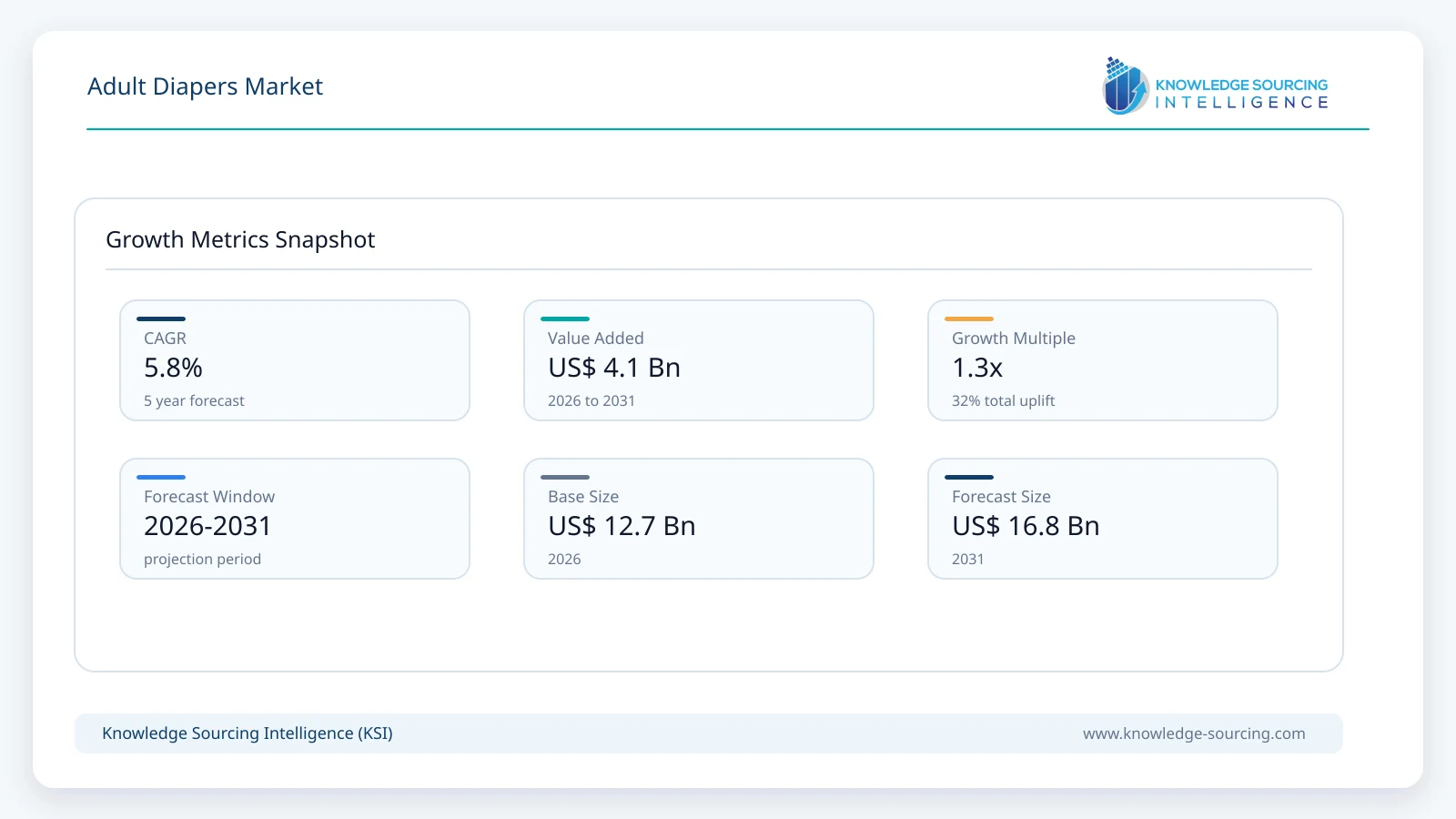
The Adult Diapers Market is expected to grow at a CAGR of 5.8%, reaching a market size of USD 16.8 billion in 2031 from USD 12.7 billion in 2026.
Highlights:
- 1Pad-type products remain a major product family because light-to-moderate leakage protection can be discreet and inexpensive to use.
- 2Pull-on pants are gaining relevance as fit, mobility and underwear-like appearance become product selection criteria.
- 3Institutional care places greater weight on skin condition, changing routines and dependable replenishment than on shelf appearance alone.
- 4Offline retail and clinical distribution remain essential for advice, reimbursement and assisted-care procurement, while online channels gain repeat customers.
- 5Asia Pacific combines mature Japanese demand with expanding access in other ageing markets, while North America retains a substantial high-value base.
- 6Competition increasingly centers on breathable materials, leakage security, skin friction, odor control and manufacturing efficiency.
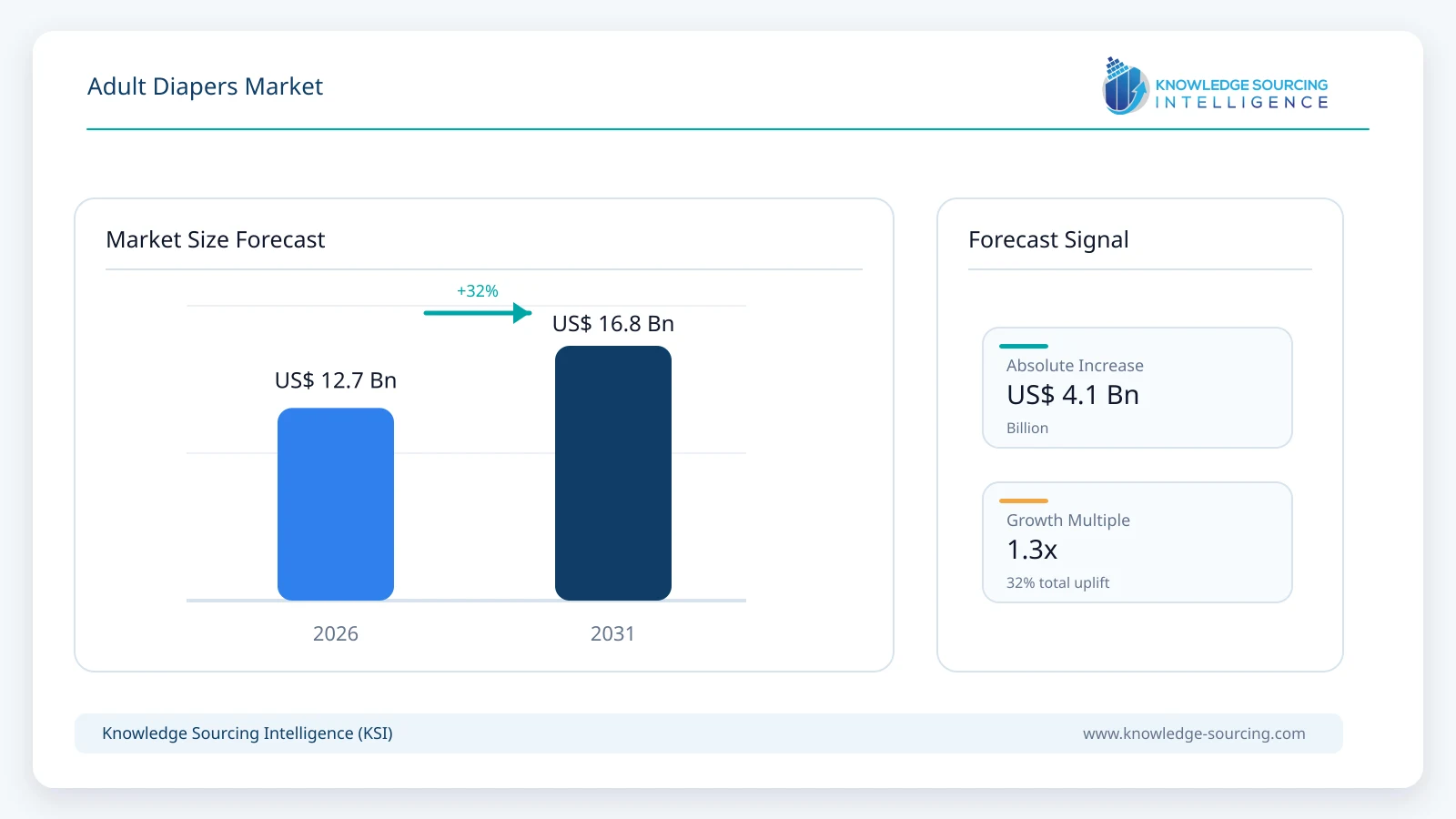
The adult diapers market encompasses finished absorbent products designed to manage adult urinary or fecal leakage. It includes disposable incontinence pads and inserts, tape-fastened briefs, pull-on pants, and other adult absorbent formats supplied through retail and care channels. Product performance depends on the absorbent core, acquisition layers, barrier cuffs, breathable backsheet, and waist or fastening design. Professional buyers additionally examine leakage control, skin outcomes, staff handling time and standardized procurement specifications.
Essity's TENA, Unicharm's Lifree, Kimberly-Clark's Depend and Poise, Ontex's adult-care portfolio and HARTMANN's MoliCare compete across overlapping but not identical care needs. International suppliers face domestic brands, contract manufacturers and retailer-owned labels, particularly in price-sensitive channels. Recurring consumption supports dependable replacement demand, but larger pack sizes, promotional discounting and variable distribution margins influence realized value per unit.
Market Overview
Continence products are selected according to the severity and frequency of leakage, user mobility, and the amount of assistance needed for changing. Discreet pads are typically suited to lighter episodes, while pull-on pants provide more comprehensive protection for people able to dress independently. Tape-fastened briefs are common when caregivers must change an individual in bed or while seated. Product categories therefore reflect distinct care tasks rather than merely different packaging options.
Established manufacturers are refining these differences with targeted engineering. Ontex's Sensitive range, introduced for European care institutions in February 2026, incorporates design features intended to limit irritation. Unicharm introduced Lifree pads in Japan that address skin friction and odor management, while Essity updated parts of its North American TENA ProSkin brief line in early 2026. These initiatives illustrate how leakage performance is increasingly judged alongside skin comfort and care routines.
The supply chain links fluff pulp, superabsorbent polymers, nonwoven fabrics, films and adhesives to high-speed converting operations, brand distribution and institutional contracts. Retail channel economics differ from hospital tenders: consumers may trade up for discretion and comfort, while professional buyers balance product efficacy, changing frequency, staffing and supply reliability. Manufacturers able to deliver dependable sizing and consistent absorption at scale have an advantage when customers evaluate both unit price and cost per care episode.
Market Trends
Comfort-Oriented Designs Move Beyond Maximum Absorbency
The category's performance standard is broadening beyond how much fluid a product can hold. Users also judge how it moves beneath clothing, whether edges remain comfortable, and how quickly the surface feels dry. Manufacturers must control fit and leakage while limiting bulk, which makes the interaction between absorbent materials, topsheet and elastic components commercially important.
Unicharm's 2025 Lifree ultra-thin Premium launch in Japan used a more underwear-like waist construction, reflecting demand among active users who do not identify with conventional care products. The company subsequently introduced a summer-oriented Lifree pant in May 2026, designed to reduce heat and moisture discomfort. Such specialized features encourage product differentiation, although users remain sensitive to price and the need to purchase protection repeatedly.
Skin Health Becomes an Institutional Purchasing Criterion
Hospitals and residential-care providers evaluate continence products partly by their effect on skin condition and staff workload. Leakage, prolonged exposure to moisture, and friction can contribute to discomfort, requiring caregivers to match absorbency and change intervals rather than default to one high-capacity brief for every patient.
Ontex launched Sensitive Pants, Sensitive Slip and Sensitive Form for European healthcare institutions in February 2026, explicitly positioning the range around skin health. Unicharm's April 2026 Lifree pad uses a low-friction structure designed for sensitive skin. These products strengthen suppliers' discussions with professional purchasers, but product-level comfort claims should be assessed under relevant real-world use conditions and do not independently establish a clinical outcome.
Category Boundaries Broaden Toward Discreet and Reusable Protection
Adult continence care now spans very light leakage management, moderate absorbency and high-dependency care. Male guards, shaped pads and underwear-like products address situations previously underserved by bulky briefs. Users with mild symptoms are more likely to compare feel, fit and appearance with everyday clothing than to evaluate heavy-duty absorbency alone.
In March 2026, TENA introduced washable protective boxers for men in the United States, using a built-in absorbent zone for light leaks. Reusable garments should not be treated as one-to-one replacements for heavy disposable care products, yet their entry underscores a strategic move toward earlier-stage category recruitment. Suppliers can broaden their customer base by offering a progression of protection levels, provided product claims remain appropriate for intended leakage severity.
Discreet Online Replenishment Changes Brand Competition
Adult diapers generate repeated household purchases, making package size, delivery cadence and privacy important features of online retail. Digital product information enables consumers to compare absorbency and sizes without discussing sensitive symptoms in a store. Direct distribution can also support recurring orders and customized assortment strategies.
Online growth does not eliminate the role of pharmacy advice or care distributors. Improper size selection can cause leaks and dissatisfaction, while large packs entail high delivery costs relative to their physical value. The best-performing online programs therefore combine clear fit guidance, dependable delivery and predictable pricing rather than relying on promotional discounts alone.
Care Facilities Demand Reliable Supply and Standardized Fit
Institutional purchasers require absorbent care products in steady quantities across several sizes and capacity grades. Stockouts can disrupt shift routines and lead staff to use unsuitable substitutes. The procurement decision therefore considers product availability, traceability, storage footprint, and whether a supplier can support standardized care protocols.
Essity's TENA ProSkin brief upgrades and HARTMANN's range of size- and absorbency-specific MoliCare slips illustrate the importance of matching products to care settings. Tender-based supply can support volume, but contracts often involve price competition, service obligations, and lengthy qualification processes. Brand strength alone is rarely sufficient if a product does not fit clinical workflows and institutional budgets.
Segment Analysis
By Type: Pad Type
Pad-type products represent the largest single product group in the current mix, supported by everyday management of lighter urinary leakage and their use as inserts in assisted care. Their lower bulk and flexible placement offer discretion to active adults, while care facilities use purpose-designed inserts alongside suitable fixation systems or absorbent underwear. TENA, Lifree and multiple regional suppliers maintain broad pad ranges for different capacities and body shapes.
The segment's estimated share is around 39% in 2026, with a gradual shift toward pull-on pants through 2031 as full-coverage products improve fit and comfort. Pads remain highly relevant because they serve recurrent low-severity needs and can be purchased in affordable packs. Growth depends on early category adoption, targeted absorbency and reliable dry-surface performance rather than treating every consumer as a candidate for a higher-capacity garment.
By Distribution Channel: Online
Online sales are expanding from convenience transactions into recurring continence-care purchasing. Consumers with established product preferences can arrange deliveries without repeated store visits, while ecommerce platforms expose niche sizes, light-leak formats and specialist brands beyond the range carried by a local pharmacy. The privacy of home delivery is commercially relevant, but it does not remove the need for accurate fit and absorbency guidance.
Online distribution is estimated to increase from 27% of market value in 2026 toward 38% by 2031 as recurring orders and digital merchandising broaden. Offline outlets remain important for first purchase, clinician recommendation, emergency replenishment and institutional tender supply. Manufacturers that integrate packaging sizes, subscription flexibility and support for product selection are better placed to capture repeat orders without excessive returns or margin erosion.
Market Drivers
Ageing Populations and a Larger Continence-Care User Base
The need for continence products tends to rise where older populations expand and more people live with mobility limitations or chronic conditions. The World Health Organization expects one in six people worldwide to be aged 60 years or over by 2030. This demographic trend increases the potential number of individuals requiring protection during routine activities or supported care, although age alone cannot be used as a direct measure of diaper consumption.
Japan illustrates the maturity of the opportunity: its Statistics Bureau reported that people aged 65 and above represented 29.4% of the population in 2025. Growth in other ageing economies will depend on disposable income, care access and distribution development. Suppliers need ranges for both active adults and high-dependency patients to translate demographic change into sustained purchases.
Product Improvement Encouraging Regular and Earlier Use
User acceptance depends on confidence that a product will prevent leaks without drawing attention under clothing. Thinner absorbent cores, softer materials and improved elastic fit reduce some practical barriers to routine use. Unicharm's Lifree initiatives in Japan demonstrate continued investment in low-friction materials, temperature comfort and movement-friendly underwear construction.
These improvements can increase the likelihood of repeat purchase and broaden demand among people with mild symptoms who might otherwise avoid the category. Product segmentation must remain appropriate to actual needs: a low-profile garment cannot replace a high-absorbency brief for severe incontinence. Brands that communicate this distinction clearly may reduce dissatisfaction and costly switching between products.
Expansion of Home and Long-Term Care
Growing numbers of older people require assistance at home, in nursing facilities and in post-acute care environments. Continence products are recurring consumables in these settings, with purchasing decisions influenced by changing times, infection-control routines, skin care, and whether an individual can participate independently in dressing.
Care providers increasingly assess cost per successful change rather than the sticker price of a pack. A product that leaks less frequently or fits reliably may justify a premium if it reduces laundry and repeat handling. Manufacturers competing for contracts must therefore pair consistent product quality with supply continuity and staff guidance, particularly where reimbursement rates or facility budgets are constrained.
Greater Product Availability Through Digital and Organized Retail
Organized pharmacies, grocery retail and online marketplaces increase access to adult absorbent products beyond hospital procurement. Digital shelves can carry gender-specific and high-absorbency formats that smaller outlets are less able to stock. Clear product selection information and private fulfillment may make an initial purchase easier for users reluctant to discuss symptoms publicly.
Channel expansion is more effective when the product can be purchased repeatedly at a predictable price. Subscription offers and multipacks improve convenience, but platform fees, delivery expenses and promotional spending can narrow supplier margins. Stronger suppliers therefore use coordinated online and offline distribution to reach new users without losing control of brand positioning.
Caregiving Standards and Skin-Protection Priorities
Skin protection has become a more visible purchasing concern for institutions managing repeated changes. Facilities need absorbent products that combine quick fluid acquisition with dryness and appropriate fit. Ontex's 2026 Sensitive portfolio and renewed attention to TENA ProSkin briefs point to direct supplier investment in this aspect of professional care.
The economic effect emerges through procurement and repeat usage rather than a clinical promise for every wearer. Care institutions may favor products with clear capacity grades, breathable materials and handling guidance that staff can implement consistently. Suppliers that support caregiver training and dependable product availability can strengthen contractual relationships, even when healthcare buyers continue to resist higher unit prices.
Market Restraints
Affordability and the Cost of Continuous Consumption
Adult diapers are not a one-time purchase. People with frequent leakage may need several changes daily, making monthly expense sensitive to pack price and household income. In price-conscious markets, consumers may reduce use, select low-cost alternatives or rely on family care arrangements when products are unaffordable.
Manufacturers face a difficult pricing balance because lower-cost formats must still offer acceptable leakage control and skin comfort. Larger multipacks and retailer brands can improve access but compress branded margins. The pressure is strongest where public reimbursement is limited and disposable income cannot support a sustained premium product routine.
Material Costs and Manufacturing Complexity
Absorbent cores use pulp and superabsorbent polymer, while nonwoven fabrics, films, elastic components and adhesives determine fit and comfort. Changes in input prices and energy costs affect producers differently according to sourcing arrangements and plant efficiency. High-speed converting lines also require careful quality control to avoid leakage defects and excessive rejects.
Suppliers may reformulate cores or reduce material weight, but savings cannot come at the expense of performance for heavy-use customers. Producing multiple sizes, protection levels and packaging formats raises planning complexity, particularly for contract manufacturers serving retailer brands. Cost control therefore depends on consistent conversion efficiency as much as on raw-material purchasing.
Fit Problems, Leakage and Product Misuse
A product's nominal absorbency is not sufficient to determine real-life performance. Body shape, mobility, waist design, and correct placement affect the likelihood of gaps and leakage. Poor-fitting products can create discomfort, generate laundry, and prompt users to abandon a brand even when the absorbent material itself performs well.
Manufacturers need more detailed size guidance and clearer separation between pads, pants, and tape-fastened briefs. Professional users also require staff training to avoid choosing excessively bulky products for mild leakage or unsuitable designs for bedridden patients. These service requirements increase selling costs and complicate channel conversion.
Environmental Pressure on Single-Use Absorbent Products
Disposable adult diapers contain mixed absorbent fibers, polymers and films that are difficult to separate after use. Higher consumption increases the volume of hygiene waste handled by households and institutions. Material reduction, responsible sourcing and packaging efficiency are therefore becoming product-development concerns alongside absorption and comfort.
Reusable solutions can serve selected light-leak situations, as TENA's washable men's boxers illustrate, but their suitability depends on leakage level and washing requirements. Conventional disposable protection remains important in high-dependency care. Manufacturers must invest in sustainability improvements without overstating the readiness of large-scale recycling or compromising hygiene performance.
Stigma, Limited Awareness and Uneven Care Access
Continence symptoms can be difficult to discuss, delaying diagnosis or the purchase of appropriate protective products. Consumers may select an unsuitable item based only on price or a familiar package, while rural markets may have limited access to specialist sizes and absorbency levels. Greater retail availability alone does not ensure correct use.
Healthcare practitioners and pharmacists can reduce these barriers through practical product guidance, but staff time and training are not uniformly available. Suppliers investing in education must communicate without implying that absorbent products treat the underlying medical condition. Market penetration consequently varies with social acceptance, healthcare access and purchasing power rather than following ageing trends automatically.
Regional Outlook
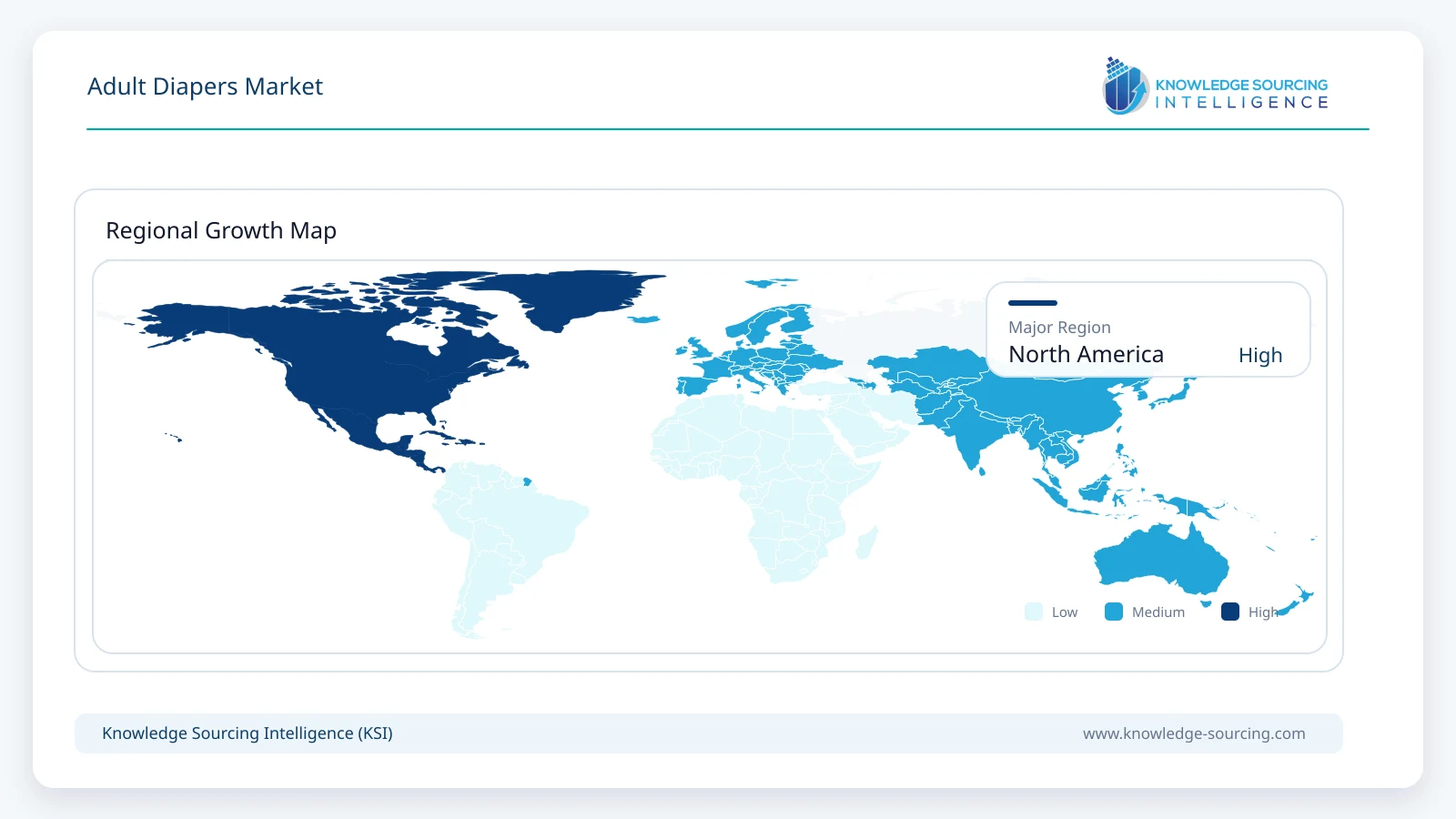
North America: Established High-Value Demand
North America has a mature combination of branded retail products, pharmacy networks and institutional continence-care procurement. The United States contains major retail brands, a developed nursing-care market and broad online distribution. Essity, Kimberly-Clark, HARTMANN and domestic private-label suppliers address differing needs across light bladder leakage, independent-living users and high-dependency settings.
The region is estimated to represent roughly 32% of global value in 2026, supported by consistent spending per user and access to diverse protection formats. Growth is likely to be more measured than in emerging Asian markets because category penetration is already established. Product upgrades, higher-performing premium ranges and online replenishment should remain important sources of value as buyers continue to compare pack costs and care outcomes.
Asia Pacific: Fastest-Growing Regional Opportunity
Asia Pacific combines Japan's established adult-care category with population ageing and rising awareness in China, India and other regional markets. Japan's large older population supports sophisticated ranges for independent living and caregiver-assisted use. Unicharm's Lifree portfolio demonstrates a breadth of functional product differentiation, from low-profile underwear to high-capacity pads and briefs.
The region's estimated revenue share rises from approximately 31% in 2026 to 36% by 2031 as distribution expands and consumers adopt more specialized protection. Growth rates vary widely by country: mature Japan faces population and pricing pressures, while markets with lower current product penetration have greater room to expand. Local manufacturing, price-tiered packs and e-commerce are important to turning demographic demand into sustainable purchases.
Competitive Landscape
Adult incontinence product competition spans multinational hygiene groups, healthcare specialists, regional brand owners and private-label converters. Essity competes through TENA across retail and professional care; Unicharm sells Lifree and other local wellness-care brands; Kimberly-Clark serves North American users through Depend and Poise; Ontex and ABENA supply care-oriented offerings. HARTMANN's MoliCare and Attindas' Attends business compete where clinical credibility and dependable absorbency are important.
Companies differ in their access to retail shelves, professional purchasers and manufacturing scale. Consumer businesses invest in reassuring branding, product visibility and subscriptions, while care suppliers emphasize fitting support, absorbency grades and tender performance. Ontex's 2026 Sensitive launch and Essity's renewed brief specifications illustrate a shift toward reducing friction and moisture discomfort. A product's reported skin benefits require appropriate validation and should not be interpreted as a uniform clinical outcome across all patient groups.
Private-label manufacturing remains influential because pharmacies, supermarkets and institutional distributors can obtain competitive products without maintaining their own hygiene-converting plants. Suppliers face persistent material-cost exposure and need to manage packaging, absorbency levels and regional fit preferences. Competitive advantage depends on product consistency, channel reach and procurement relationships rather than a single global ranking across retail and healthcare markets.
Recent Developments
May 2026: Unicharm introduced a limited-season Lifree ultra-thin pant in Japan with moisture-management features designed for greater comfort in hot weather.
April 2026: Unicharm refreshed packaging across its Lifree pant range in Japan to emphasize independence and everyday use; the change was a brand and pack update, not a new clinical treatment.
April 2026: Unicharm launched a Lifree absorbent pad with low-friction materials for users concerned about skin discomfort; its published comparative performance figures relate to company tests.
March 2026: TENA introduced washable protective boxers for men in the United States, adding a reusable format for light bladder leakage.
February 2026: Ontex launched the Sensitive Pants, Sensitive Slip and Sensitive Form range for European healthcare institutions, with a focus on skin-friendly continence care.
October 2025: Unicharm introduced Lifree Premium ultra-thin underwear-style pants in Japan, using a flexible waist construction intended to improve comfort.
Market Outlook
Through 2031, demand for adult diapers should benefit from ageing populations and broader access to products matched to individual care needs. The most commercially meaningful shift is likely to be an expansion of differentiated fit, skin comfort and protection levels rather than simply heavier absorbent products. Suppliers with broad product architectures can serve users as their mobility and continence requirements change over time.
The market will retain contrasting purchase models. Professional-care providers require standardized fit, dependable supply and acceptable cost per change; independent users respond more strongly to comfort, discretion and easy replenishment. Digital distribution broadens access but will intensify comparisons between brands and retail-owned alternatives. In Asia Pacific, affordability and local assortment will influence uptake; in North America, incremental product improvements and service quality should carry greater weight.
Over the forecast period, margin performance will depend on how effectively manufacturers manage pulp, polymer and nonwoven input costs while continuing to improve product quality. Sustainability investments and reusable formats may expand at the margins of the category, but disposable protection will remain indispensable in many assisted-care situations. Success will favor suppliers that combine credible functional benefits with disciplined manufacturing and channel economics.
Adult Diapers Market Scope:
| Report Metric | Details |
|---|---|
| Total Market Size in 2026 | USD 12.7 billion |
| Total Market Size in 2031 | USD 16.8 billion |
| Forecast Unit | Billion |
| Growth Rate | 5.8% |
| Study Period | 2021 to 2031 |
| Historical Data | 2021 to 2024 |
| Base Year | 2025 |
| Forecast Period | 2026 – 2031 |
| Segmentation | Type, Distribution Channel, Geography |
| Companies |
|
| Customization Scope | 15% Free Customization included with purchase — Request Custom Breakdown → |
| Sample & Data Access | PDF Sample, Excel Databook & Analyst Briefing — Download Free Sample → |
Market Segmentation
By Type
Pad Type
Tape On
Pant Style
Others
By Distribution Channel
Online
Offline
By Geography
North America
United States
Canada
Mexico
South America
Brazil
Argentina
Others
Europe
United Kingdom
Germany
France
Spain
Others
Middle East and Africa
Saudi Arabia
United Arab Emirates
Others
Asia Pacific
China
Japan
India
South Korea
Taiwan
Others
Table of Contents
1. EXECUTIVE SUMMARY
2. MARKET SNAPSHOT
2.1. Market Overview
2.2. Market Definition
2.3. Scope of the Study
2.4. Market Segmentation
3. BUSINESS LANDSCAPE
3.1. Market Drivers
3.1.1. Ageing Populations and a Larger Continence-Care User Base
3.1.2. Product Improvement Encouraging Regular and Earlier Use
3.1.3. Expansion of Home and Long-Term Care
3.1.4. Greater Product Availability Through Digital and Organized Retail
3.1.5. Caregiving Standards and Skin-Protection Priorities
3.2. Market Restraints
3.2.1. Affordability and the Cost of Continuous Consumption
3.2.2. Material Costs and Manufacturing Complexity
3.2.3. Fit Problems, Leakage and Product Misuse
3.2.4. Environmental Pressure on Single-Use Absorbent Products
3.2.5. Stigma, Limited Awareness and Uneven Care Access
3.3. Market Opportunities
3.4. Porter’s Five Forces Analysis
3.5. Industry Value Chain Analysis
3.6. Policies and Regulations
3.7. Strategic Recommendations
4. TECHNOLOGICAL OUTLOOK
4.1. Absorbent Core and Superabsorbent Polymers
4.2. Skin-Contact Nonwovens and Moisture Control
4.3. Fit, Fastening and Leakage Barriers
4.4. Breathable and Lightweight Product Architecture
4.5. Sustainable Materials and End-of-Life Challenges
5. ADULT DIAPERS MARKET BY TYPE
5.1. Introduction
5.2. Pad Type
5.3. Tape On
5.4. Pant Style
5.5. Others
6. ADULT DIAPERS MARKET BY DISTRIBUTION CHANNEL
6.1. Introduction
6.2. Online
6.3. Offline
7. ADULT DIAPERS MARKET BY GEOGRAPHY
7.1. Introduction
7.2. North America
7.2.1. By Country
7.2.1.1. United States
7.2.1.2. Canada
7.2.1.3. Mexico
7.3. South America
7.3.1. By Country
7.3.1.1. Brazil
7.3.1.2. Argentina
7.3.1.3. Others
7.4. Europe
7.4.1. By Country
7.4.1.1. United Kingdom
7.4.1.2. Germany
7.4.1.3. France
7.4.1.4. Spain
7.4.1.5. Others
7.5. Middle East and Africa
7.5.1. By Country
7.5.1.1. Saudi Arabia
7.5.1.2. United Arab Emirates
7.5.1.3. Others
7.6. Asia Pacific
7.6.1. By Country
7.6.1.1. China
7.6.1.2. Japan
7.6.1.3. India
7.6.1.4. South Korea
7.6.1.5. Taiwan
7.6.1.6. Others
8. COMPETITIVE ENVIRONMENT AND ANALYSIS
8.1. Major Players and Strategy Analysis
8.2. Market Share Analysis
8.3. Mergers, Acquisitions, Agreements and Collaborations
8.4. Competitive Dashboard
9. COMPANY PROFILES
9.1. Essity AB
9.2. Unicharm Corporation
9.3. Kimberly-Clark Corporation
9.4. Ontex Group NV
9.5. ABENA A/S
9.6. PAUL HARTMANN AG
9.7. Nobel Hygiene Pvt. Ltd.
9.8. Attindas Hygiene Partners
9.9. The Procter & Gamble Company
9.10. Daio Paper Corporation
9.11. Nippon Paper Industries Co., Ltd.
9.12. Medline Industries, LP
10. APPENDIX
10.1. Currency
10.2. Assumptions
10.3. Base and Forecast Years Timeline
10.4. Key Benefits for Stakeholders
10.5. Research Methodology
10.6. Abbreviations





Frequently asked questions
What is the projected market size of adult diapers by 2031?
The Adult Diapers Market is projected to reach USD 16.8 billion by 2031.
What is the forecasted CAGR for the Adult Diapers Market?
The Adult Diapers Market is expected to grow at a CAGR of 5.8%.
Which product types are prominent in the Adult Diapers Market?
Pad-type products are major; pull-on pants are gaining relevance.
Which regions drive the Adult Diapers Market growth?
Asia Pacific and North America are key growth drivers.
What are key competitive factors in the Adult Diapers Market?
Breathable materials, leakage security, and odor control are key.
Who are the leading companies in the Adult Diapers Market?
Essity, Unicharm, Kimberly-Clark, Ontex, and HARTMANN are leaders.
Cite this report
Knowledge Sourcing Intelligence. (Oct 2026). Adult Diapers Market - Strategic Insights and Forecasts (2026–2031). https://www.knowledge-sourcing.com/report/adult-diapers-market