
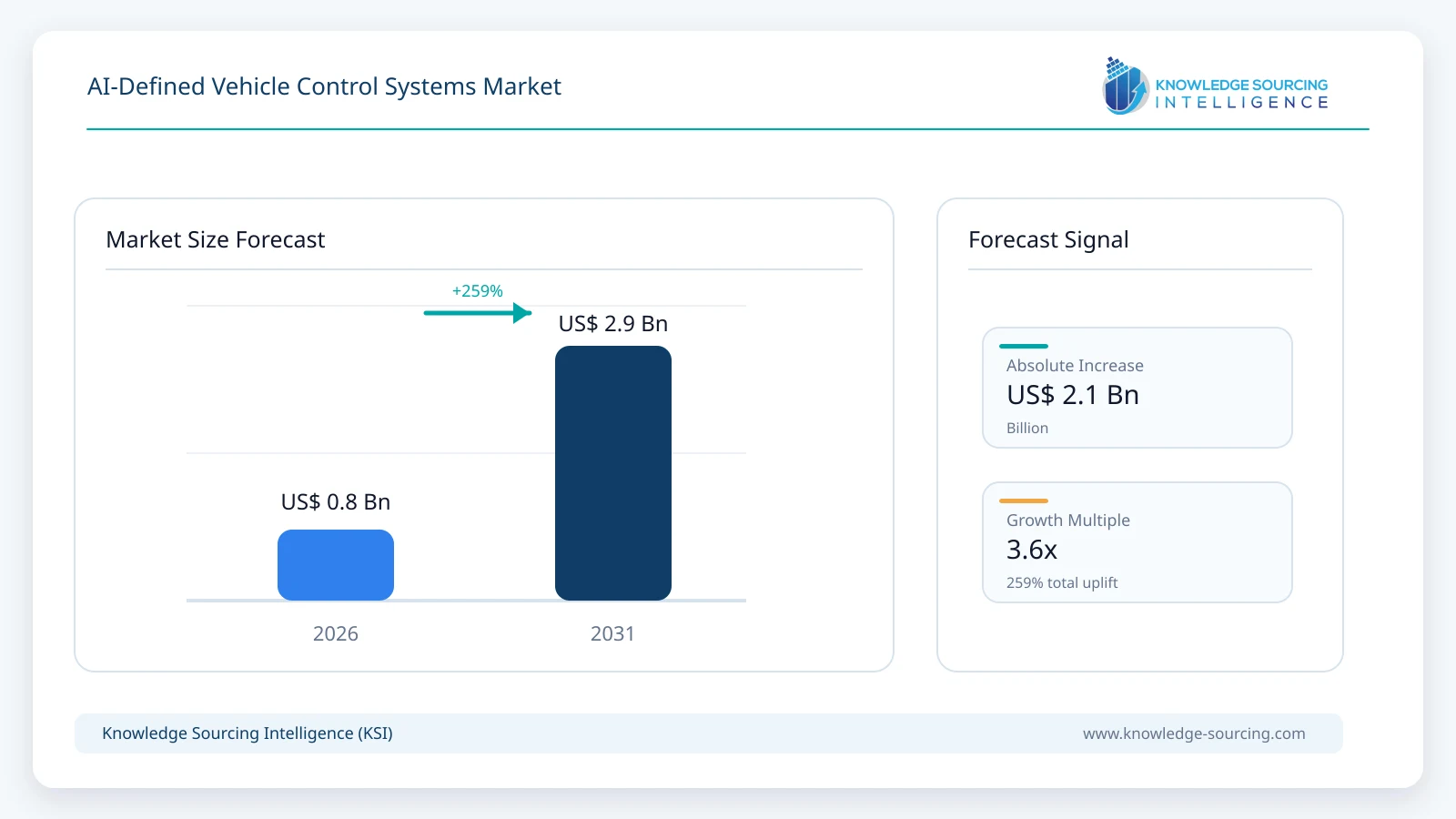
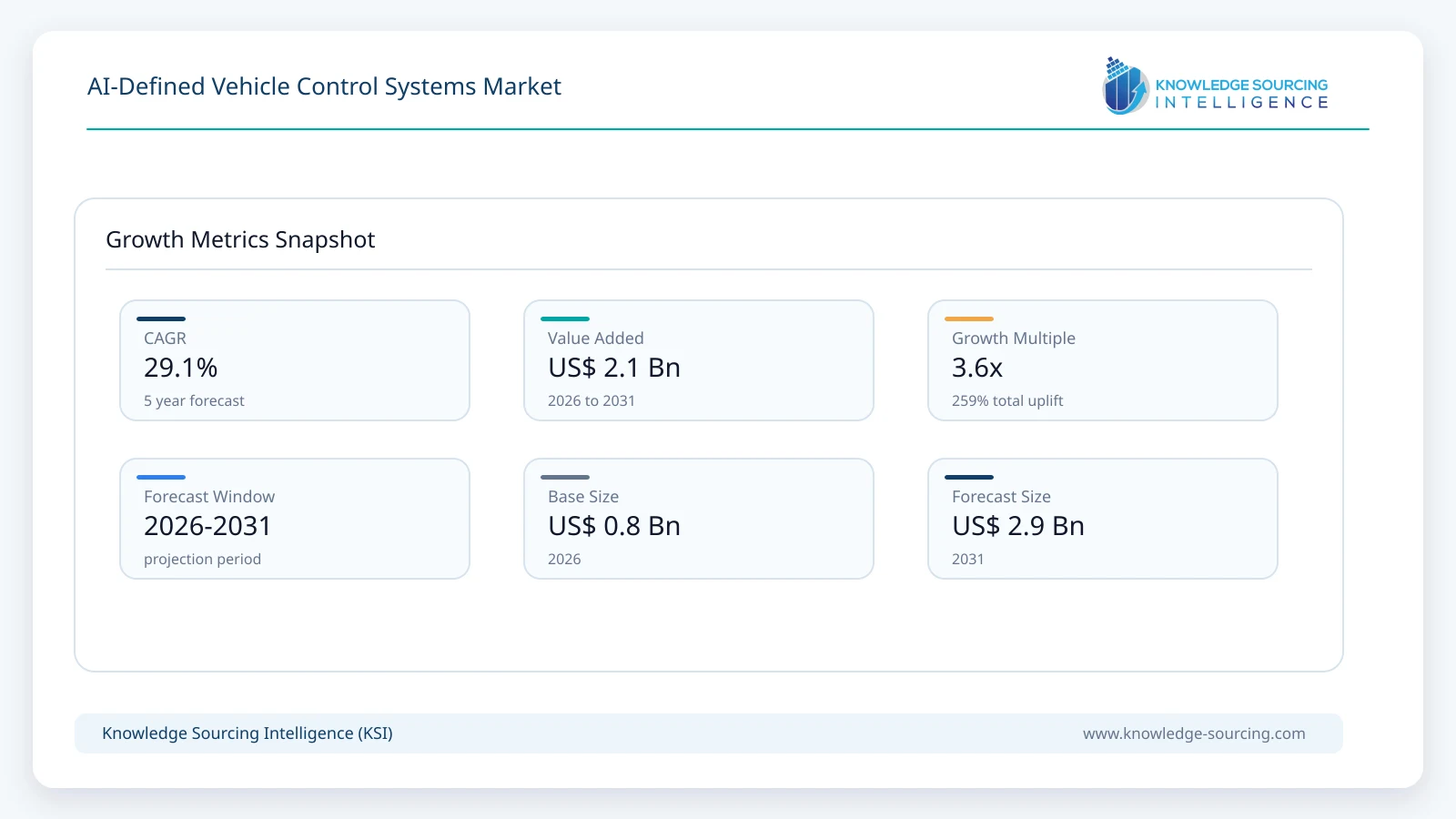
The AI-defined vehicle control systems market is projected to increase from USD 0.82 billion in 2026 to USD 2.94 billion in 2031, registering a CAGR of approximately 29.1% during forecast period.
Highlights:
- 1Coordinated motion and traction functions represent approximately 40% of 2026 market value, reflecting the importance of cross-domain actuator arbitration.
- 2AI-assisted adaptive chassis control is expected to increase from about 29% of market value in 2026 to 31% by 2031.
- 3Centralized and domain-computing architectures account for approximately 58% of 2026 market value as vehicle computers consolidate control functions.
- 4Battery electric vehicles represent approximately 42% of demand in 2026, supported by integrated torque, regeneration and ride-control requirements.
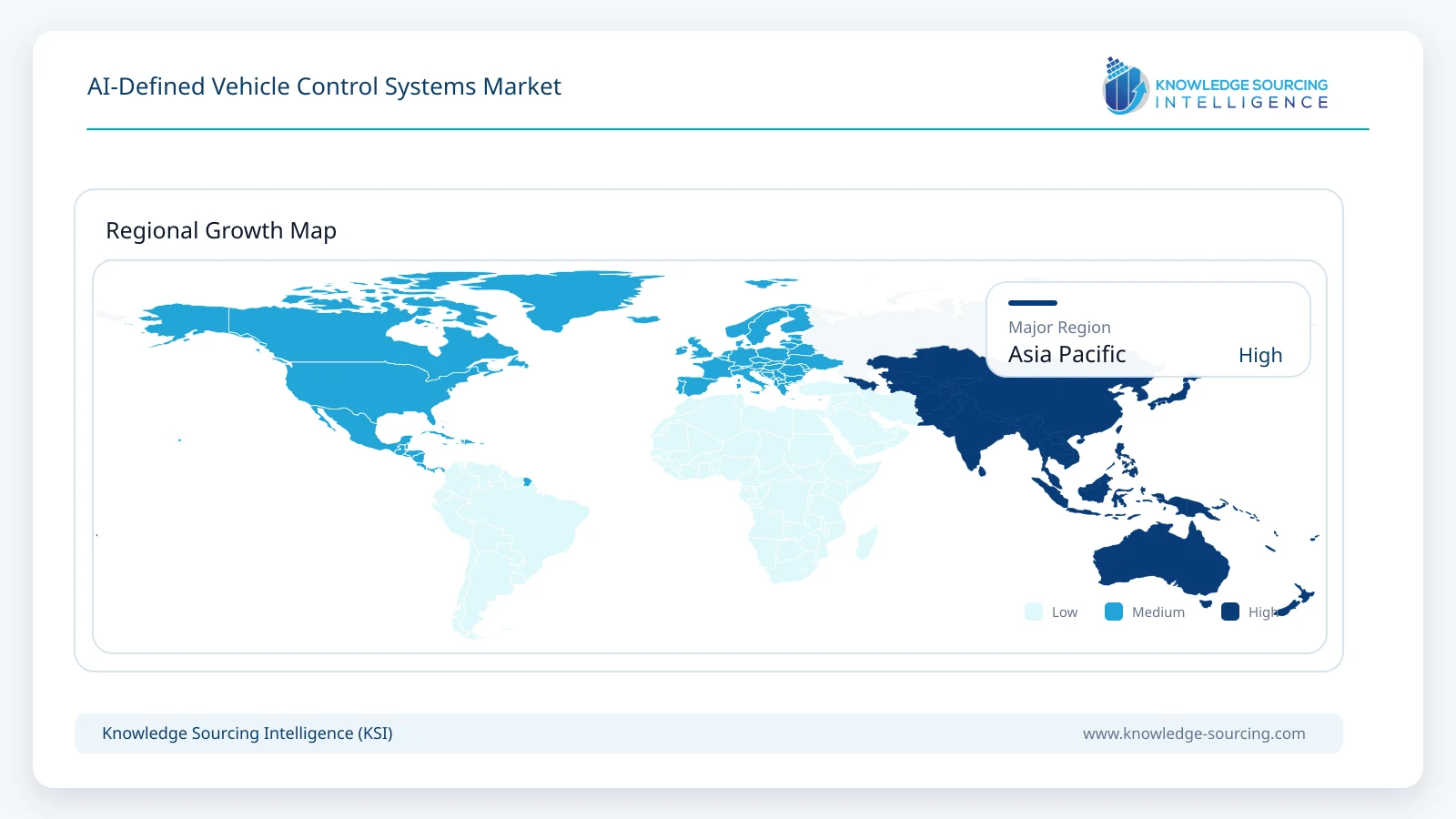
- 5Asia Pacific is the largest regional market in 2026; Europe remains a substantial center of vehicle-motion software engineering.
- 6Commercial adoption requires safety-certified fallback logic, vehicle-specific validation and reliable interfaces between software providers and actuator suppliers.
Cross-domain vehicle control uses real-time sensor data and driver or automated-driving requests to generate coordinated responses from steering, braking, propulsion and suspension. Instead of allowing individual electronic control units to optimize a single subsystem in isolation, a supervisory layer manages competing objectives such as stability, comfort, energy efficiency and driver intent. Predictive algorithms can anticipate operating conditions, but safety-critical commands are still governed by validated control logic, actuator limits and fault-handling requirements.
Bosch’s Vehicle Motion Management software integrates brake, steering, powertrain and suspension responses in all six degrees of freedom. ZF’s cubiX likewise coordinates active and semi-active actuators independently of their original component manufacturer, while HL Mando’s MiCOSA combines longitudinal, lateral and vertical motion functions in a central domain controller. These architectures are commercially significant because they allow OEMs to differentiate driving characteristics through software rather than changing every mechanical component.
Vehicle-level orchestration becomes more relevant as electric motors, regenerative braking, steer-by-wire and actively controlled suspension create additional adjustment points. ZF’s January 2026 AI Road Sense introduction linked learned road-condition recognition with real-time chassis intervention and driver-behavior recognition. Deployment economics depend on repeatable validation across vehicle variants, calibration efficiency and the ability to reuse software modules without creating new safety risks.
Market Trends
Predictive Road-State Inputs Are Becoming Part of Motion Control
ZF introduced AI Road Sense in January 2026 to identify road conditions and adjust chassis response using information from vehicle signals and, in higher configurations, camera and lidar data. The system uses cubiX to coordinate functions such as semi-active damping, with further steer-by-wire and brake-by-wire integration positioned as future extensions. Road-condition awareness shifts part of the control decision earlier in the driving event, where preventive tuning can improve comfort and consistency before large corrective interventions become necessary.
The commercial value lies in applying a better state estimate to several actuators through one supervised control architecture. OEMs must still verify that sensor uncertainty, weather artifacts and incorrect terrain classification cannot bypass deterministic safety restrictions. Suppliers with expertise in both control systems and vehicle sensors are positioned to combine these functions more effectively than providers offering only a standalone learning algorithm.
Portable Software Is Reducing Dependence on Individual Actuator Brands
ZF positions cubiX as a modular platform capable of coordinating actuators supplied by different manufacturers, while Bosch markets centralized motion coordination across brake, steering, propulsion and suspension systems. This reduces the effort required to create consistent driving behavior across vehicles that share an electronic architecture but use different component specifications. Portability is particularly relevant for OEMs managing multiple brands, regional platforms and propulsion configurations.
A common supervisory-control foundation does not eliminate vehicle-specific work. Tire characteristics, axle geometry, brake blending and suspension response require calibration for each platform. Software suppliers that make these variables easier to configure and validate can capture greater engineering value even when the core control application remains reusable.
AI-Assisted Calibration Is Shortening Vehicle Development Cycles
ZF announced its cubiX Tuner in July 2025 as an AI-powered tool for calibrating the interdependence of multiple vehicle actuators. Steering, braking, damping and drive-response settings traditionally require extensive combinations of simulation, proving-ground work and manual tuning. Automated calibration is gaining attention because centralized control increases the number of interacting parameters that engineers must evaluate.
Calibration tools generate early demand for specialized services even before a vehicle platform reaches high-volume production. Over the forecast period, reusable calibration assets may reduce the engineering cost per vehicle program, while shifting supplier revenues toward software libraries, integration packages and validation support.
Electrified Platforms Are Increasing Cross-Domain Control Requirements
Battery electric vehicles combine fast torque response, adjustable regeneration and sophisticated thermal and chassis subsystems, creating more opportunities for coordinated control. Brake-blending decisions can influence energy recovery and stability simultaneously, while traction management can benefit from a predictive understanding of road friction. Hybrid platforms also require coordination between electric machines, combustion engines and mechanical braking systems.
The adoption path will differ between low-cost and premium models. Vehicle manufacturers generally deploy new supervisory functions first where electronic actuators and centralized computing are already available. Cost-effective scaling then depends on standardized interfaces and the ability to retain traditional fail-safe functions on lower-content vehicle variants.
AI-Defined Vehicle Control Systems Market Segment Analysis
By Control Function
Coordinated Motion and Traction Control
Coordinated motion and traction functions represent approximately 40% of 2026 market value. Their position reflects early commercial use of shared control logic across braking, steering, propulsion and chassis, particularly where multiple active actuators are fitted to one platform. Bosch Vehicle Motion Management, ZF cubiX and HL Mando MiCOSA illustrate the supplier approaches that support cross-actuator management.
Adaptive chassis functions are expected to gain share by 2031 as road-state sensing and electronically controlled damping become more tightly integrated. The primary expansion mechanism is additional validated software functionality per equipped vehicle, rather than wholesale replacement of braking or steering controllers.
By E/E Architecture
Centralized and Domain Computing
Centralized and domain-computing deployments account for an estimated 58% of 2026 market value. Integrating more control functions onto a shared high-performance computer reduces communication boundaries and allows coordinated timing across subsystems. Bosch’s motion integration platform specifically addresses time-sensitive powertrain, brake, steering and chassis coordination within new vehicle computing architectures.
Distributed vehicles can still deploy a supervisory coordination layer, especially when software gateways connect existing actuator controllers. However, longer-term growth is stronger for centralized architectures because OEMs can reuse a common computing and middleware foundation across multiple control functions, subject to functional-safety isolation and deterministic performance requirements.
By Vehicle Type and Propulsion
Electrified Passenger Platforms
Passenger cars account for approximately 82% of 2026 demand because premium electric and hybrid passenger programs offer a combination of high production volumes and sophisticated motion actuators. Battery electric models represent about 42% of market revenue, reflecting the role of instantaneous motor torque and regenerative braking in coordinated vehicle response. Premium platforms initially carry more software value per vehicle than conventional passenger models.
Commercial vehicles grow from a smaller base as predictive braking, traction coordination and software-defined chassis functions become relevant to diverse loads, road conditions and fleet operating requirements. ZF expanded its commercial-vehicle motion-control proposition and presented further safety and motion systems in June 2026, although widespread volume adoption remains more gradual than in passenger EV programs.
Market Drivers
Centralized Vehicle Computers Are Enabling Cross-Domain Motion Functions
Bosch’s motion integration platform coordinates powertrain, braking, steering and chassis applications on a vehicle computer designed for safety-sensitive, real-time functions. Consolidating control logic allows vehicle makers to manage actuator interactions without depending entirely on separate subsystem decision-making. The ability to implement coordinated motion functions on a common compute base increases the software content associated with next-generation vehicle architectures.
Migration to centralized electronic architectures also changes how vehicle manufacturers divide engineering responsibilities among safety software, actuator control and middleware suppliers. Suppliers must provide middleware compatibility, scheduling guarantees and fault isolation between software applications. Successful implementations create reusable platforms for multiple vehicle models, improving the economics of supervisory control as production volumes scale.
Software-Configurable Chassis Systems Are Raising Value per Vehicle
ZF’s cubiX and HL Mando’s MiCOSA are built around coordinating physical motion through software, rather than treating steering, suspension and braking as independently tuned components. This allows carmakers to define distinct vehicle responses for driving conditions, performance targets and individual brand characteristics. Additional calibrated modes and coordinated actuator functions increase software engineering content without necessarily adding separate hardware controllers.
The financial attraction is strongest on vehicles already fitted with active dampers, torque-vectoring systems or brake-by-wire components. Control software can improve the use of existing actuators and provide new behavior through calibrated software releases. Supplier competition consequently moves toward functional performance and validated integration capability.
AI Road Assessment Is Improving Predictive Control Inputs
ZF AI Road Sense uses sensor-derived information to assess changes in the driving surface and direct suitable control responses through cubiX. Predictive condition recognition offers more useful input to chassis control than a purely reactive signal from an individual wheel or damper. The technology is particularly relevant to variable-friction routes, off-road situations and high-value comfort applications.
OEM validation will determine how quickly these functions reach broader vehicle ranges, but the supplier value proposition already connects perception, prediction and multi-actuator response. This can support new software licensing and integration work where the information materially improves vehicle-level decisions.
Electric Propulsion Is Increasing Braking and Torque Coordination
Electric propulsion systems respond rapidly to electronic commands and offer multiple options for distributing drive and regenerative-braking torque. Coordinated control is increasingly relevant when traction, energy recovery, vehicle stability and deceleration comfort must be balanced under changing road conditions. Hybrid vehicles add further arbitration requirements between engine torque, electric propulsion and friction braking.
Control integration becomes more important as electrified vehicle variants expand beyond premium models. Programs that standardize supervisory software across several motor and brake configurations can lower repeated engineering effort and support a wider installed base for software updates and optimization functions.
Reusable Calibration Platforms Are Improving Development Economics
ZF’s July 2025 cubiX Tuner introduction highlighted AI-assisted calibration of interactions among steering, braking, drive and suspension actuators. Traditional calibration effort rises rapidly as each new active subsystem adds settings and operating scenarios. Automated tooling is attracting attention because centralized software brings these interactions into a shared development environment.
Vehicle manufacturers still require physical testing and safety sign-off, but software-based tuning can reduce repetitive work and improve consistency across platform variants. Suppliers able to package calibration data and validation workflows with control software are more likely to retain customers across successive vehicle programs.
Market Restraints
Functional-Safety Qualification Limits AI-Controlled Actuator Decisions
Brake, steering and propulsion coordination directly affects vehicle stability and occupant safety, leaving little tolerance for unpredictable control actions. Machine-learned perception or optimization outputs therefore require validated boundaries, diagnostic monitoring and deterministic fallback behavior. OEMs must demonstrate acceptable behavior in foreseeable fault states, unusual friction conditions and sensor failures before deployment.
Qualification becomes more demanding when a supervisory application influences actuators supplied by several companies. Safety-case documentation, responsibility allocation and interface verification add cost and lengthen program approval. Suppliers cannot treat advances in model accuracy as a substitute for system-level vehicle safety validation.
Legacy Vehicle Architectures Complicate Software Integration
Vehicles with distributed electronic control units frequently use proprietary communication protocols, uneven processing capacity and different software update mechanisms. Introducing a centralized decision layer into these architectures can require additional gateways and complex timing analysis. OEMs may prefer incremental coordination features instead of a full platform rewrite when an existing vehicle family is nearing production.
Integration economics depend on the stability of software interfaces and access to actuator calibration details. A portable supervisory platform can reduce dependency on individual components, but compatibility testing remains necessary for every brake, steering and suspension configuration. That limits short-term deployment beyond new electronic-architecture programs.
Sensor Quality and Road-State Uncertainty Restrict Predictive Performance
Road-state classification can be affected by precipitation, snow cover, low light, tire wear and changes in vehicle loading. Incorrect friction estimates or surface interpretations can lead to inappropriate control requests if systems lack robust confidence assessment. AI-based chassis features must fuse multiple sources of information and avoid assuming that a camera observation describes actual tire-road grip.
ZF’s combination of camera and chassis signals illustrates the value of redundant physical measurements. The need for sensor fusion, diagnostics and extensive weather testing increases development expenditure, particularly where suppliers promise automatic adaptation across many road categories.
Multi-Supplier Actuator Interfaces Increase Validation Work
Automakers rarely source every actuator from one company across all vehicle platforms. Differences in brake response, suspension latency, steering control authority and diagnostic messaging can complicate the introduction of a common supervisory-control function. The software must remain stable even when component specifications change through a vehicle program.
System integrators consequently spend considerable time defining command ownership, arbitration priority and fault escalation. These activities can restrict the commercial margin available from a software license and create longer ramp-up periods between an initial demonstration and multi-model production.
Cybersecurity and Software Update Governance Raise Lifecycle Costs
Cross-domain control systems increasingly depend on updateable software, vehicle communication networks and centralized processing. A compromised or incorrectly deployed update can affect functions that were previously isolated in separate control modules. Secure boot, update authentication and rollback capability therefore become essential operating requirements alongside real-time performance.
Lifecycle commitments extend beyond initial vehicle production because automakers must support security patches, calibration compatibility and functional traceability across years of software revisions. Smaller suppliers may face disproportionate compliance and maintenance costs without long-duration OEM contracts.
Regional Outlook
Asia Pacific
Asia Pacific accounts for approximately 36% of market value in 2026 and is expected to extend its lead through 2031. China combines high electrified-vehicle output with rapid experimentation in integrated chassis functions and centralized vehicle computing. Japan and South Korea contribute substantial control-system engineering capabilities, while India is becoming more relevant as vehicle software investment and higher-content platforms expand.
Chinese and Korean vehicle programs are likely to accelerate the transfer of predictive motion functions from flagship models to broader electric-vehicle portfolios. Regional suppliers can differentiate through integration speed and localized vehicle calibration, although export programs still require compatibility with the safety and cybersecurity expectations of destination markets.
Europe
Europe represents approximately 32% of market value in 2026, supported by established motion-control suppliers, premium vehicle engineering and investment in software-defined chassis platforms. Bosch and ZF provide original examples of vehicle-wide coordination, while continental European carmakers have extensive experience qualifying active safety, adaptive damping and sophisticated propulsion-control systems.
European suppliers are positioned to capture a comparatively high share of software development and validation value even when vehicle production occurs elsewhere. Growth depends increasingly on the export of portable control functions to global OEM platforms, with safety engineering and the repeatability of calibration forming important competitive advantages.
Competitive Landscape
Bosch, ZF and HL Mando are among the suppliers with directly relevant multi-actuator vehicle-motion architectures. Bosch combines centralized control software with broad braking, steering and propulsion expertise; ZF couples its cubiX platform with configurable chassis functions and AI-assisted calibration; and HL Mando integrates longitudinal, lateral and vertical chassis dynamics within MiCOSA. The ability to coordinate third-party actuators is an important point of differentiation.
AUMOVIO’s Holistic Motion Control provides another portable software approach, while Valeo, Aptiv, ETAS and Vector participate through embedded software, middleware, integration and development environments. Their positions are not identical: software-platform and tooling providers enable deployment but do not necessarily supply the safety-critical orchestration application. OEM vehicle-program access, functional-safety credentials, software portability and integrated validation remain central to competition. Suppliers that can demonstrate repeatable driving improvements across different hardware configurations have a stronger position in multi-platform nominations, while integration-only providers must compete on development productivity and program support.
Recent Developments
September 2026: Bosch presented vehicle-motion software applications for pickup trucks and large SUVs at Mobility Experience Days, extending the commercial discussion beyond passenger EV platforms to variable-load and off-road use cases.
June 2026: ZF showcased commercial-vehicle safety and motion systems ahead of IAA Transportation, emphasizing configurable integration paths for software-defined trucks rather than a single mandatory architecture.
June 2026: ETAS presented its Vehicle Software Platform Suite enabled by Eclipse S-CORE, a portable software foundation that can reduce cross-platform integration work for vehicle software developers.
May 2026: Hyundai Mobis joined the Eclipse S-CORE project to support common software foundations for software-defined vehicles, reflecting greater supplier investment in reusable automotive software infrastructure.
January 2026: ZF introduced AI Road Sense at CES 2026, using road-condition prediction and vehicle signals to inform cubiX-based chassis actuator responses; the event was a technology launch rather than proof of fleet-wide production deployment.
Market Outlook
AI-assisted cross-domain control will expand as automakers combine predictive road information with centralized brake, steering, propulsion and suspension coordination. The strongest early demand is concentrated in electronically sophisticated passenger vehicles, where suppliers can improve the value of existing actuators through software-driven functions rather than extensive mechanical redesign.
Commercial scale will depend on repeatable safety qualification and portable software architectures. Vehicle makers that standardize actuator interfaces, real-time computing and update governance should be able to deploy coordinated-control features across more models, including cost-sensitive electric vehicles and selected commercial platforms. Software updates may extend the revenue relationship after vehicle launch, but changes to safety-critical behavior will continue to require controlled verification and release procedures.
The market is projected to reach approximately USD 2.94 billion by 2031. Greater software content per equipped vehicle and growing adoption across electrified and centralized platforms support that outlook, while safety validation and system integration are likely to remain the principal constraints on commercialization.
AI-Defined Vehicle Control Systems Market Scope:
| Report Metric | Details |
|---|---|
| Total Market Size in 2026 | USD 0.82 billion |
| Total Market Size in 2031 | USD 2.94 billion |
| Forecast Unit | USD Billion |
| Growth Rate | 29.1% |
| Study Period | 2021 to 2031 |
| Historical Data | 2021 to 2024 |
| Base Year | 2025 |
| Forecast Period | 2026 – 2031 |
| Segmentation | Control Function, Software and Service Component, Vehicle Type, Propulsion, E/E Architecture, AI-Enabled Control Approach, Vehicle Program Tier, Geography |
| Companies |
|
Market Segmentation
By Control Function
Coordinated Motion and Traction Control
AI-Assisted Adaptive Chassis Control
Predictive Braking and Energy Arbitration
Commercial Vehicle Supervisory Control
By Software and Service Component
Embedded Supervisory-Control Software
Engineering, Calibration and Validation
Software Updates and Lifecycle Licenses
By Vehicle Type
Passenger Cars
Light Commercial Vehicles
Medium and Heavy Commercial Vehicles
By Propulsion
Battery Electric Vehicles
Hybrid and Plug-In Hybrid Vehicles
Internal Combustion Vehicles
By E/E Architecture
Centralized and Domain Computing
Distributed Controls with Coordination Layer
By AI-Enabled Control Approach
Predictive Learning with Deterministic Guardrails
Model-Based Control with AI Calibration
Adaptive Policy-Level Supervision
By Vehicle Program Tier
Premium Passenger Vehicles
Mass-Market Electrified Vehicles
Conventional Passenger Vehicles
Commercial Vehicle Platforms
By Geography
North America
United States
Canada
Mexico
South America
Brazil
Argentina
Others
Europe
Germany
United Kingdom
France
Italy
Spain
Others
Middle East and Africa
Saudi Arabia
United Arab Emirates
Israel
South Africa
Others
Asia Pacific
China
India
Japan
South Korea
Indonesia
Thailand
Taiwan
Others
Table of Contents
1. EXECUTIVE SUMMARY
1.1. Market Opportunity and Key Findings
1.2. Market Size and Growth Forecast
1.3. Principal Market Segments and Regional Direction
2. MARKET SNAPSHOT
2.1. Market Overview
2.2. Market Definition
2.3. Scope of the Study
2.4. Market Segmentation
2.5. Base and Forecast Years
3. BUSINESS LANDSCAPE
3.1. Market Drivers
3.1.1. Centralized Vehicle Computers Are Enabling Cross-Domain Motion Functions
3.1.2. Software-Configurable Chassis Systems Are Raising Value per Vehicle
3.1.3. AI Road Assessment Is Improving Predictive Control Inputs
3.1.4. Electric Propulsion Is Increasing Braking and Torque Coordination
3.1.5. Reusable Calibration Platforms Are Improving Development Economics
3.2. Market Restraints
3.2.1. Functional-Safety Qualification Limits AI-Controlled Actuator Decisions
3.2.2. Legacy Vehicle Architectures Complicate Software Integration
3.2.3. Sensor Quality and Road-State Uncertainty Restrict Predictive Performance
3.2.4. Multi-Supplier Actuator Interfaces Increase Validation Work
3.2.5. Cybersecurity and Software Update Governance Raise Lifecycle Costs
3.3. Market Opportunities
3.4. Porter’s Five Forces Analysis
3.5. Industry Value Chain Analysis
3.6. Policies, Standards and Regulations
3.7. Strategic Recommendations
4. TECHNOLOGICAL OUTLOOK
4.1. AI-Assisted Vehicle-State Estimation and Road-Surface Prediction
4.2. Supervisory Control and Multi-Actuator Arbitration
4.3. Model Predictive Control and Deterministic Safety Envelopes
4.4. Centralized Motion Computing and Real-Time Middleware
4.5. Brake-by-Wire, Steer-by-Wire and Adaptive Damping Interfaces
4.6. AI-Based Calibration, Digital Twins and Software Lifecycle
5. AI-DEFINED VEHICLE CONTROL SYSTEMS MARKET BY CONTROL FUNCTION
5.1. Introduction
5.2. Coordinated Motion and Traction Control
5.3. AI-Assisted Adaptive Chassis Control
5.4. Predictive Braking and Energy Arbitration
5.5. Commercial Vehicle Supervisory Control
6. AI-DEFINED VEHICLE CONTROL SYSTEMS MARKET BY SOFTWARE AND SERVICE COMPONENT
6.1. Introduction
6.2. Embedded Supervisory-Control Software
6.3. Engineering, Calibration and Validation
6.4. Software Updates and Lifecycle Licenses
7. AI-DEFINED VEHICLE CONTROL SYSTEMS MARKET BY VEHICLE TYPE
7.1. Introduction
7.2. Passenger Cars
7.3. Light Commercial Vehicles
7.4. Medium and Heavy Commercial Vehicles
8. AI-DEFINED VEHICLE CONTROL SYSTEMS MARKET BY PROPULSION
8.1. Introduction
8.2. Battery Electric Vehicles
8.3. Hybrid and Plug-In Hybrid Vehicles
8.4. Internal Combustion Vehicles
9. AI-DEFINED VEHICLE CONTROL SYSTEMS MARKET BY E/E ARCHITECTURE
9.1. Introduction
9.2. Centralized and Domain Computing
9.3. Distributed Controls with Coordination Layer
10. AI-DEFINED VEHICLE CONTROL SYSTEMS MARKET BY AI-ENABLED CONTROL APPROACH
10.1. Introduction
10.2. Predictive Learning with Deterministic Guardrails
10.3. Model-Based Control with AI Calibration
10.4. Adaptive Policy-Level Supervision
11. AI-DEFINED VEHICLE CONTROL SYSTEMS MARKET BY VEHICLE PROGRAM TIER
11.1. Introduction
11.2. Premium Passenger Vehicles
11.3. Mass-Market Electrified Vehicles
11.4. Conventional Passenger Vehicles
11.5. Commercial Vehicle Platforms
12. AI-DEFINED VEHICLE CONTROL SYSTEMS MARKET BY GEOGRAPHY
12.1. Introduction
12.2. North America
12.2.1. United States
12.2.2. Canada
12.2.3. Mexico
12.3. South America
12.3.1. Brazil
12.3.2. Argentina
12.3.3. Others
12.4. Europe
12.4.1. Germany
12.4.2. United Kingdom
12.4.3. France
12.4.4. Italy
12.4.5. Spain
12.4.6. Others
12.5. Middle East and Africa
12.5.1. Saudi Arabia
12.5.2. United Arab Emirates
12.5.3. Israel
12.5.4. South Africa
12.5.5. Others
12.6. Asia Pacific
12.6.1. China
12.6.2. India
12.6.3. Japan
12.6.4. South Korea
12.6.5. Indonesia
12.6.6. Thailand
12.6.7. Taiwan
12.6.8. Others
13. COMPETITIVE ENVIRONMENT AND ANALYSIS
13.1. Major Players and Strategy Analysis
13.2. Market Share Analysis
13.3. Mergers, Acquisitions, Agreements and Collaborations
13.4. Competitive Dashboard
14. COMPANY PROFILES
14.1. Robert Bosch GmbH
14.2. ZF Friedrichshafen AG
14.3. HL Mando Corporation
14.4. AUMOVIO SE
14.5. Valeo SE
14.6. Aptiv PLC
14.7. Hyundai Mobis Co., Ltd.
14.8. ETAS GmbH
14.9. Vector Informatik GmbH
14.10. Astemo, Ltd.
15. APPENDIX
15.1. Currency
15.2. Assumptions
15.3. Base and Forecast Years Timeline
15.4. Key Benefits for Stakeholders
15.5. Research Methodology
15.6. Abbreviations
Navigate
Trusted by the world's leading organizations











