
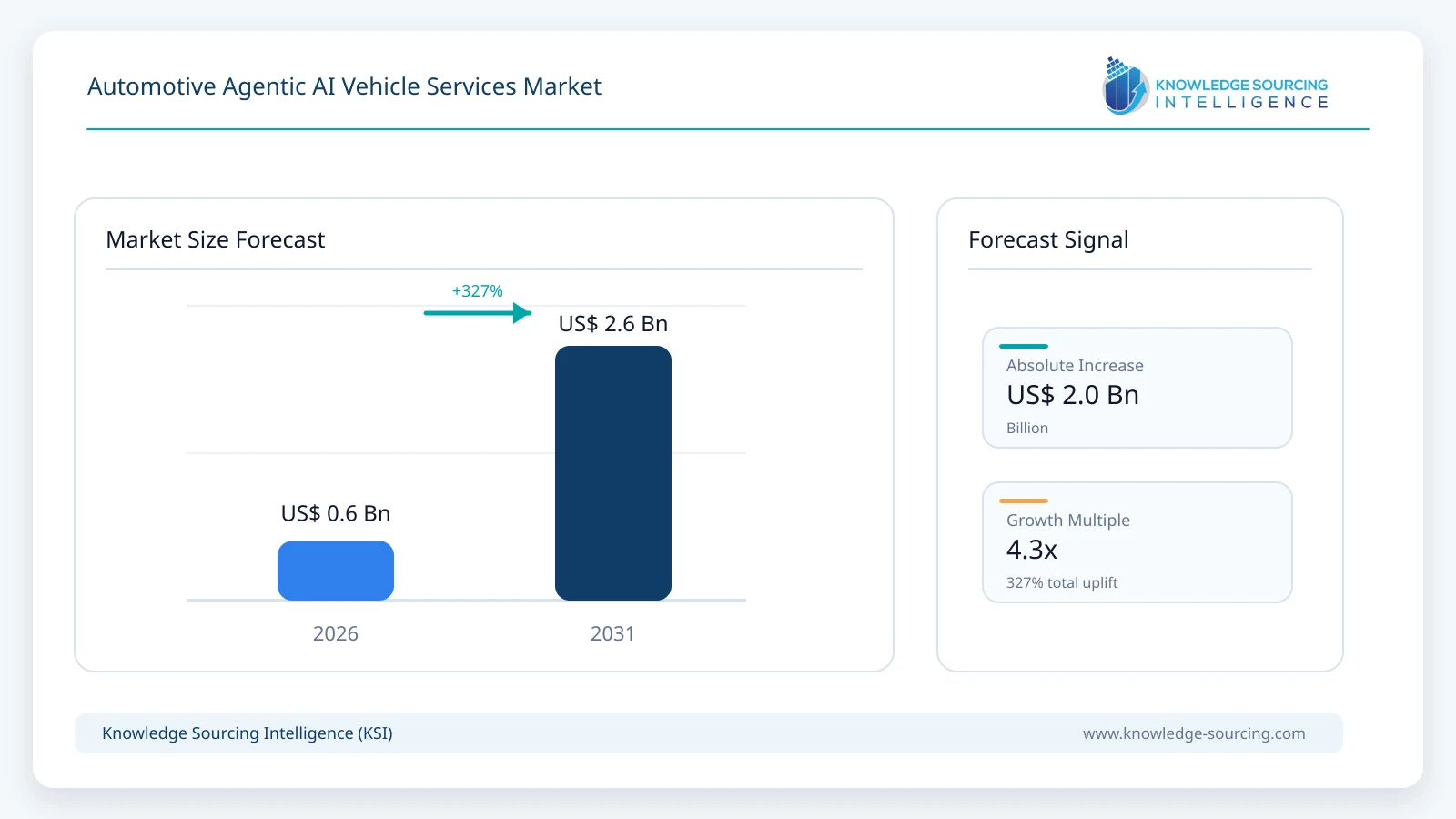
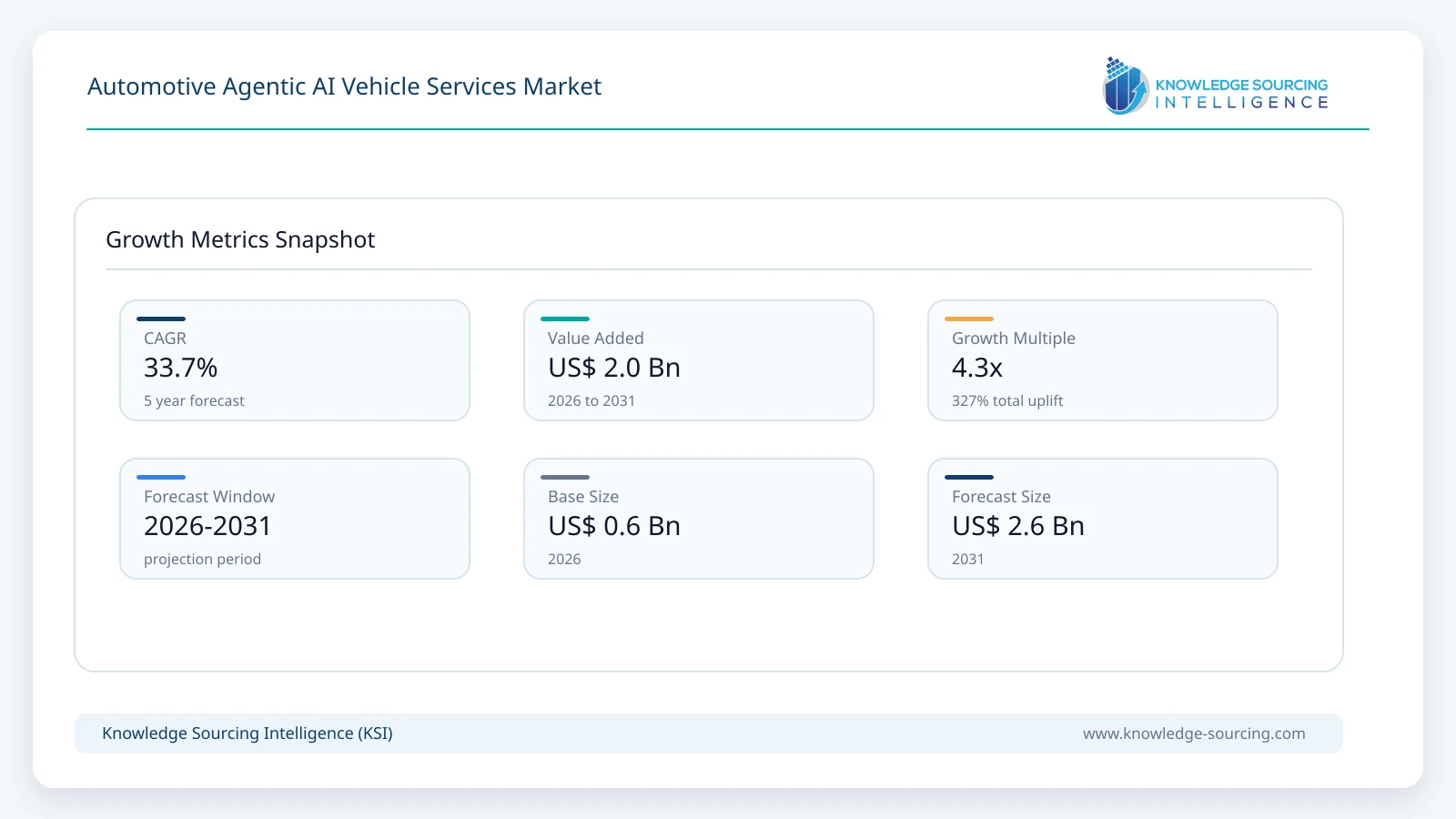
The automotive agentic AI vehicle services market is projected to grow from USD 0.62 billion in 2026 to approximately USD 2.65 billion in 2031, at a CAGR of 33.7% during forecast period.
Highlights:
- 1Journey planning and navigation service agents represent approximately 31% of 2026 revenue, supported by connected mapping and charging-related tasks.
- 2Ownership, diagnostics and maintenance services gain value as vehicle information is connected with service booking and owner accounts.
- 3Hybrid edge-cloud systems account for approximately 56% of 2026 revenue because local vehicle actions require rapid, controlled execution.
- 4Passenger vehicles account for about 91% of 2026 revenue, with commercial and fleet-oriented services gaining share through 2031.
- 5Asia Pacific is the largest regional market; China provides scale while Europe supports premium vehicle-agent commercialization.
- 6Permission management, cybersecurity and recurring inference economics determine how quickly agentic services can move beyond demonstrations.
The market is developing around software and connected services that translate driver or owner intent into bounded actions, such as coordinating a charging stop, arranging maintenance or applying a permitted series of cabin settings. Service execution, rather than natural-language conversation alone, is becoming the distinguishing commercial function.
Cerence AI announced ownership companion and dealer service agents in December 2025, connecting vehicle diagnostics, appointments and customer-service workflows. BMW has added routines that use repeated behavior or user-specified conditions to trigger actions through its Intelligent Personal Assistant. These developments establish a pathway from contextual recommendations toward recurring automotive services without requiring drivers to navigate separate vehicle, mobile and dealership applications.
Vehicle service agents use language understanding, vehicle context and software connectors to complete steps that previously required separate user interactions. A request to visit a destination can involve interpreting the passenger’s intention, examining battery or traffic information, suggesting a route, checking a charging opportunity and presenting an action for approval. Google’s automotive agent and Android car integration work provide an ecosystem for linking conversational requests with navigation and application functions.
BMW’s Alexa+-enhanced Intelligent Personal Assistant and Mercedes-Benz’s MBUX Virtual Assistant extend the role of automotive AI beyond basic command recognition. Mercedes-Benz has also partnered with Liquid AI to strengthen local inference for vehicle functions and contextual interaction. The commercial architecture typically combines a vehicle-facing intent layer with permissioned connectors, service information and deterministic software responsible for actual vehicle actions.
Cerence’s ownership companion and dealer assist offerings connect the in-car experience with maintenance scheduling and dealership systems. An agent can interpret a diagnostic alert, explain a likely service requirement and prepare an appointment, while final decisions remain with the owner and authorized service provider. This creates a lifecycle role for automotive AI across the vehicle, companion application and aftersales channel.
Market Trends
Agentic Services Are Connecting Vehicle Requests to Actionable Workflows
Cerence’s ownership companion links driver questions and vehicle alerts with service recommendations and appointment scheduling. The significance lies in the ability to preserve relevant context between an in-car conversation and a dealership transaction. Automotive brands gain another channel for retaining service relationships after vehicle delivery, provided the handoff is reliable and the service partner receives sufficient information.
BMW’s intelligent routines demonstrate a related shift inside the vehicle, where repeated cabin interactions can become authorized sequences rather than isolated commands. Routine execution is narrower than unrestricted autonomous planning, but provides a practical foundation for agentic applications because user expectations, permitted functions and reversal paths are easier to define.
Hybrid Edge-Cloud Systems Are Becoming the Practical Default
Mercedes-Benz’s April 2026 collaboration with Liquid AI emphasizes embedded models that can support vehicle-specific language and reasoning functions without requiring a continuous cloud connection. Local processing is valuable when an action depends on a vehicle function, a fast response or sensitive context that should remain near the source. Broader information retrieval and third-party transactions continue to benefit from external services.
Automotive platforms increasingly require a router that assigns each request to an embedded model, an external model or a deterministic vehicle function. Integrating those paths adds software complexity but can limit cloud costs and reduce the risk of granting a remote agent excessive authority. Vehicle-grade fallback behavior will become an important requirement for suppliers of reusable agent middleware.
Vehicle Ownership Support Is Extending Beyond the Dashboard
Cerence’s December 2025 service agents are designed for vehicle owners and dealerships rather than only for the cockpit interface. The ownership companion can use vehicle identity, service history and diagnostic context across mobile, messaging and in-car channels. The dealer assist agent addresses booking and customer-service workflows within the retailer environment, creating a potentially continuous service journey.
Cross-channel continuity is commercially valuable when customers move between a vehicle, an owner application and a service appointment. Implementation depends on access to dealer management systems and on consistent identity and consent controls. Software firms with automotive service integrations can capture value that is separate from basic speech recognition or graphical HMI.
Service Ecosystems Are Expanding the Range of Vehicle Tasks
Google’s automotive AI integration connects conversational requests with navigation destinations, search results and application-defined intents. When linked to vehicle state and permitted third-party services, this structure can support multi-step travel planning, charging coordination and information retrieval. Interoperable service connectors are becoming as important as the core language model for expanding task coverage.
Automakers will need to decide which functions remain within branded applications and which can be delegated to external providers. A larger service catalog increases usefulness but also introduces inconsistent data quality, transaction failures and competing customer relationships. Controlled tool access and clear confirmation steps offer a practical route to broader service availability.
Contextual Learning Is Making Repeated Tasks More Useful
BMW announced in May 2026 that its assistant would begin suggesting routines based on everyday usage patterns from July, alongside user-created conditions and actions. Habit-based automation makes vehicle agents useful without requiring an open-ended conversation for every task. It also reduces the need to train drivers on complex menu structures when common settings can be recalled predictably.
Advanced agent services will increasingly combine explicit preferences with route context, driver identity and repeated service interactions. The practical limit is user acceptance: suggestions must remain explainable, dismissible and easy to disable. Systems that over-automate low-value actions may increase driver distraction rather than improve convenience.
Automotive Agentic AI Vehicle Services Market Segment Analysis
By Service Function
Journey Planning and Navigation Agents
Journey-oriented agents represent the largest service-function category because navigation already has a mature base of connected maps, routing and location-based content. A capable assistant can interpret a destination request, consider route context and communicate with authorized navigation services, with charging, parking or travel information added where supported. Google’s Automotive AI Agent and the Gemini integration framework illustrate how external information can be connected with vehicle-facing services.
Journey planning accounts for approximately 31% of 2026 market value. Competitive differentiation depends on reliable multi-step completion, location relevance and simple driver confirmation, rather than generating longer spoken responses. The segment should lose some share as ownership and cross-service workflows mature, despite continuing revenue growth.
By Execution Architecture
Hybrid Edge-Cloud Agents
Hybrid deployments dominate because in-vehicle action execution and external service reasoning have different operating constraints. A driver’s cabin-setting command needs rapid local handling and deterministic limits, while restaurant information or a service appointment may require secure communication with an external provider. BMW, Mercedes-Benz and Cerence each illustrate different combinations of embedded vehicle functions and connected intelligence.
Hybrid edge-cloud agents account for approximately 56% of 2026 revenue and gain share as vehicle compute and model-routing middleware improve. Suppliers able to update AI services without compromising vehicle-function safeguards are positioned to earn a larger share of recurring platform and validation contracts.
By Revenue Layer
Agent Platform and Orchestration Software
Orchestration software is the primary value layer because useful vehicle agents need task planning, policy enforcement, tool invocation, identity handling and stateful workflow management. Service connectors and cloud inference remain important, but those components do not by themselves provide the permissioned execution behavior required in a vehicle. Cerence xUI and Google’s automotive agent services demonstrate different approaches to combining models with automotive use cases.
Agent-platform software accounts for approximately 42% of 2026 market value. Cloud inference and assurance services are expected to gain relative importance as the active vehicle fleet grows and automakers support multiple models, languages and connected-service integrations across long product lifecycles.
Market Drivers
Production Introduction of Automotive Generative AI Assistants
BMW began bringing Alexa+-enhanced natural-language interaction to the iX3 in 2026, while Cerence selected BYD vehicle programs for xUI deployment. These implementations provide the installed software foundation from which more complex service workflows can be offered. Automotive AI is no longer confined to limited demonstration fleets, and model updates can reach vehicles already in customer use.
The installed assistant base reduces the incremental effort needed to connect authorized tasks such as navigation, cabin routines and ownership support. Vehicle manufacturers can introduce new workflows during the product lifecycle, making service attachment and update compatibility more important than the initial voice-interface launch alone.
Growing Demand for Connected Ownership and Aftersales Services
Cerence introduced agents for driver service support and dealer automation that can interpret maintenance needs, help arrange appointments and continue interactions outside the vehicle. Service workflows have measurable value when they reduce missed appointments, help explain vehicle alerts and improve communication with authorized retailers. This provides an automotive-specific application that goes beyond general-purpose text generation.
For automakers, a more continuous relationship with the owner can support retention and the delivery of useful connected services. Successful deployment requires accurate service records and dealer-system integration, so the revenue opportunity favors suppliers that can execute complete workflows rather than provide a stand-alone chatbot.
Expansion of Vehicle Software and API Integration
Modern connected vehicles expose more functions through software interfaces, allowing an assistant to retrieve permitted state information and invoke approved vehicle or service actions. Google’s navigation-intent tools and BMW’s configurable routines show how a controlled software action can replace several manual steps. Domain-specific application programming interfaces also allow suppliers to reuse components across vehicle families.
Standardized connectors reduce the marginal cost of launching additional services and make agent functions easier to maintain after production. The investment remains concentrated in authentication, permissions and vehicle-software integration, which can create durable contracts for automotive software and middleware providers.
Improvement in Embedded Models and Hybrid Inference
Mercedes-Benz’s agreement with Liquid AI targets efficient on-device intelligence for vehicle-focused experiences, while automotive assistant suppliers increasingly combine local models with cloud reasoning. Local inference enables faster handling of selected requests and can protect data that should not leave the vehicle. Cloud processing remains attractive for broad external information and transaction-heavy tasks.
The ability to distribute work between embedded and remote resources improves the economics of recurring agent services. Automakers can reserve expensive model calls for tasks that benefit from them and maintain core vehicle interactions when connectivity is impaired. This balance is especially important for high-frequency everyday workflows.
Premium Vehicle Differentiation and Software Lifecycle Revenue
BMW and Mercedes-Benz use branded AI assistants as part of their wider digital-cockpit propositions, making conversational intelligence and service integration visible to buyers. OEMs can also extend software-defined functionality into existing vehicles through updates, avoiding the need to introduce every new agent capability at a model change. That creates more opportunities to monetize software after the first vehicle sale.
Premium launches establish user expectations for connected service quality, which are likely to influence mainstream vehicles as compute and integration costs fall. Revenue capture will depend on willingness to pay for genuinely useful tasks, with bundled vehicle services remaining an important route for broad adoption.
Market Restraints
Vehicle-Function Safety and Authorization Limits
Agent software that can trigger vehicle functions must operate within explicit permissions and tested execution boundaries. A language model can misunderstand an instruction, hallucinate an available feature or produce an inappropriate sequence of tasks. Vehicle action layers therefore require deterministic checks, user confirmation and safe fallback behavior rather than direct model access to unrestricted controls.
These requirements increase integration and validation effort because every agent capability must be reviewed against the functions it can operate. Some service requests can be completed automatically, while others must stop at a recommendation or require driver approval. Limited action authority constrains the near-term range of fully automated vehicle workflows.
Privacy and Cross-Channel Identity Management
Ownership agents may combine vehicle diagnostics, location history, service records, user identity and mobile-account information. Integrating these data sources can improve service continuity but creates substantial privacy and security obligations. GDPR requirements in Europe and automotive cybersecurity standards make permissions, access control and retention policies central to deployment.
The burden rises when agents pass context between a vehicle, OEM cloud and independent dealership systems. A customer may consent to a service reminder without consenting to unrelated marketing or persistent behavioral tracking. Suppliers need granular permission handling and audit trails to preserve trust.
Recurring Cloud Inference and Service Delivery Costs
Multi-step agent workflows can make several model calls, query external systems and retry operations when service providers fail. These costs recur throughout vehicle ownership rather than only when a software feature is installed. High call volumes and complex language requests may challenge profitability if AI services are bundled without usage controls.
Hybrid models and task-specific small language models can reduce expenditure, but each deployment requires continued optimization as model offerings and cloud prices change. Software vendors must balance response quality against predictable cost per completed task, especially in mass-market vehicles with limited recurring subscription revenue.
Fragmented Dealer and Third-Party Service Interfaces
Maintenance and reservation services often require connections to dealership booking tools, diagnostic databases, payment systems and local partners. Interfaces differ across vehicle brands, countries and retailers, creating inconsistent levels of automation. The ownership-companion proposition can fail if an agent identifies the correct service but cannot reliably confirm a workshop slot.
Broader agent coverage therefore requires ongoing business integration as well as AI development. Regional service catalogs and retailer participation affect the usable features available to each customer, delaying the emergence of a consistent global automotive-service platform.
Consumer Acceptance and Incomplete Task Reliability
Drivers expect a navigation request or maintenance booking to produce the right result with limited distraction. Agents that offer irrelevant suggestions, misunderstand speech or claim to complete actions that remain pending can undermine user confidence. A system may appear conversationally competent while failing the last operational step of the requested service.
Automakers must provide clear task status, straightforward cancellation and familiar manual alternatives. Adoption will depend on measured completion quality and transparent behavior, not simply on more sophisticated language generation. Inconsistent experiences across languages and vehicle software versions can slow rollout.
Regional Outlook
Asia Pacific
Asia Pacific represents approximately 42% of 2026 market value, with Chinese automakers competing on connected cockpit functionality and rapid software deployment. BYD’s selection of Cerence xUI and Geely’s adoption of hybrid agentic AI demonstrate active platform procurement by large regional vehicle manufacturers. China combines software development scale with connected-car distribution, while Japan and South Korea contribute automotive electronics and service integration expertise.
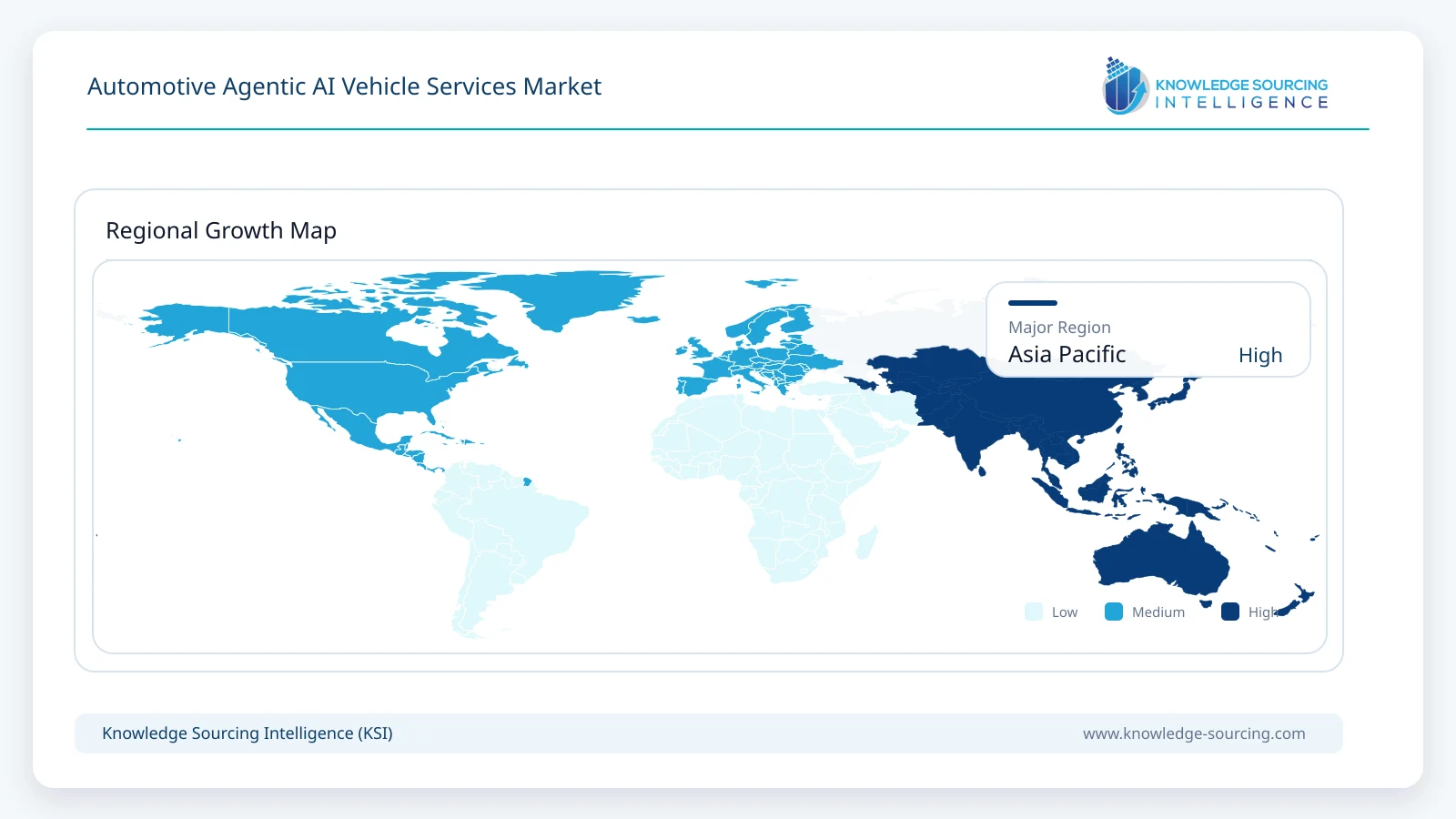
The region’s growth through 2031 will come from expansion into more mainstream vehicles and the localization of service ecosystems. Navigation, commerce and owner-support functions must adapt to regional applications and languages; successful providers will need local tool integrations as well as robust agent software.
Europe
Europe represents approximately 31% of 2026 market value, reflecting premium vehicle software investment and strong demand for controlled vehicle-function integration. BMW’s Alexa+-enhanced assistant and intelligent routines, alongside Mercedes-Benz’s multi-agent MBUX strategy, support higher-value service software in sophisticated vehicle platforms. European OEMs are also active in embedded processing and privacy-conscious AI integration.
Growth depends on extending dependable agent functions into existing vehicle fleets through updates and making owner-service handoffs useful in day-to-day operation. Privacy rules and long vehicle-service lives place substantial emphasis on consent, software support and the ability to update underlying AI models without disrupting approved vehicle functions.
Competitive Landscape
Cerence AI and Google are important software participants because their agent platforms connect natural-language requests with automotive information and services. Cerence combines in-car assistant technology with ownership and dealership agents, while Google connects conversational intelligence with mapping, navigation and application intents. HARMAN, Qualcomm and Visteon participate through in-vehicle software integration and computing platforms that can host agentic functions.
BMW and Mercedes-Benz show how vehicle manufacturers integrate external AI with proprietary vehicle software, identity services and controlled execution policies. Amazon supplies Alexa+ technology to BMW, while Microsoft participates in the broader automotive AI service ecosystem. Competitive differentiation depends increasingly on completed service tasks, reliable connectors, OEM data access, model flexibility and demonstrated privacy and safety controls.
Recent Developments
May 2026: BMW rolled out its next-generation Intelligent Personal Assistant to initial models, with a gradual rollout to further vehicles from the second half of 2026, including suggested actions based on repeated usage and user-defined conditions; this is a bounded automation capability rather than unrestricted autonomous vehicle operation.
April 2026: Mercedes-Benz announced a multi-year partnership with Liquid AI to develop faster, privacy-oriented on-device MBUX assistant experiences in North America, reflecting investment in the local execution layer of connected AI services.
January 2026: Geely Auto selected Cerence xUI for hybrid agentic AI in overseas vehicle programs, including multi-intent understanding and context-aware control, highlighting the importance of localized vehicle software.
January 2026: BMW presented Alexa+-enhanced Intelligent Personal Assistant capabilities for the iX3, bringing conversational context and vehicle functions closer within a single branded interface.
December 2025: Cerence AI introduced ownership companion and dealership-assist agent offerings for vehicle diagnostics, customer support and service booking. The announcement introduced new products, not evidence of fleet-wide deployment.
Market Outlook
Agentic automotive services will expand fastest where existing in-car assistants gain permissioned access to navigation, owner support and routine cabin operations. The combination of vehicle context and connected-service connectors is expected to make supported multi-step tasks more useful than generalized conversation alone. Dedicated agent software will remain closely linked to the expansion of automotive AI HMI but increasingly serve the owner outside the vehicle.
Hybrid edge-cloud delivery should remain the dominant architecture because sensitive vehicle actions and broader service information have different processing requirements. Embedded reasoning, controlled external calls and reliable completion status will be more important than the number of AI models a platform supports. Automakers that maintain stable vehicle interfaces and dealer-service integrations will be better positioned to add new workflows across model generations.
Automotive agent-service revenue is projected to reach approximately USD 2.65 billion by 2031 as vehicle owners adopt multi-step journey, maintenance and connected-service workflows. Higher task completion rates and recurring service integration will support that increase, while cybersecurity, permissions and unresolved monetization continue to influence deployment speed and supplier economics.
Automotive Agentic AI Vehicle Services Market Scope:
| Report Metric | Details |
|---|---|
| Total Market Size in 2026 | USD 0.62 billion |
| Total Market Size in 2031 | USD 2.65 billion |
| Forecast Unit | USD Billion |
| Growth Rate | 33.7% |
| Study Period | 2021 to 2031 |
| Historical Data | 2021 to 2024 |
| Base Year | 2025 |
| Forecast Period | 2026 – 2031 |
| Segmentation | Service Function, Revenue Layer, Interaction Channel, Execution Architecture, Agent Service Maturity, Vehicle Type, Propulsion, Geography |
| Companies |
|
Market Segmentation
By Service Function
Journey Planning and Navigation Service Agents
Ownership, Diagnostics and Maintenance Agents
Vehicle and Cabin Task Orchestration
Connected Commerce and Reservation Services
Fleet and Shared-Mobility Workflow Agents
By Service Revenue Layer
Agent Platform and Orchestration Software
Connector, Workflow and Vehicle Integration
Cloud Inference and Lifecycle Service Revenue
Agent Policy, Testing and Assurance Services
By Interaction Channel
OEM-Embedded Vehicle Assistants
Companion Mobile and Owner Applications
Fleet, Dealer and Mobility Service Portals
By Execution Architecture
Hybrid Edge-Cloud Agents
Cloud-Centric Agents
Predominantly On-Device Agents
By Agent Service Maturity
Bounded Single-Workflow Agents
Coordinated Multi-Service Agents
Proactive Contextual Service Agents
By Vehicle Type
Passenger Vehicles
Light Commercial Vehicles
Medium and Heavy Commercial Vehicles
By Propulsion
Battery Electric Vehicles
Hybrid and Plug-In Hybrid Vehicles
ICE and Other Propulsion Vehicles
By Geography
North America
United States
Canada
Mexico
South America
Brazil
Argentina
Others
Europe
Germany
United Kingdom
France
Italy
Spain
Others
Middle East and Africa
Saudi Arabia
United Arab Emirates
Israel
South Africa
Others
Asia Pacific
China
India
Japan
South Korea
Indonesia
Thailand
Taiwan
Others
Table of Contents
1. EXECUTIVE SUMMARY
1.1. Market Opportunity and Principal Findings
1.2. Market Size and Forecast, 2026–2031
1.3. Key Function and Architecture Findings
1.4. Regional Market Direction
2. MARKET SNAPSHOT
2.1. Market Definition and Overview
2.2. Service and Value Chain Architecture
2.3. Market Size and Historical Context, 2021–2026
2.4. Market Forecast and Growth Analysis, 2026–2031
2.5. Commercialization and Revenue Streams
3. BUSINESS LANDSCAPE
3.1. Market Drivers
3.1.1. Production Introduction of Automotive Generative AI Assistants
3.1.2. Connected Ownership and Aftersales Services
3.1.3. Vehicle Software and API Integration
3.1.4. Embedded Models and Hybrid Inference
3.1.5. Premium Differentiation and Lifecycle Revenue
3.2. Market Restraints
3.2.1. Vehicle-Function Safety and Authorization Limits
3.2.2. Privacy and Cross-Channel Identity Management
3.2.3. Cloud Inference and Service Delivery Costs
3.2.4. Dealer and Third-Party Service Interfaces
3.2.5. Consumer Acceptance and Task Reliability
3.3. Market Opportunities
3.4. Porter’s Five Forces Analysis
3.5. Value Chain and Service Partner Ecosystem
3.6. Pricing, Subscription and API Economics
3.7. Privacy, Cybersecurity and Automotive AI Regulations
3.8. Strategic Recommendations
4. TECHNOLOGICAL OUTLOOK
4.1. Automotive Language Models and Intent Understanding
4.2. Agent Planning and Permissioned Tool Execution
4.3. Vehicle Context and Ownership Data Integration
4.4. Multi-Agent and Multi-Service Orchestration
4.5. Hybrid Edge-Cloud Inference and Model Routing
4.6. Secure Automotive APIs and Transaction Connectors
4.7. Task Assurance, Monitoring and Human Confirmation
4.8. OTA Updates and Model Lifecycle Management
5. AUTOMOTIVE AGENTIC AI VEHICLE SERVICES MARKET BY SERVICE FUNCTION
5.1. Introduction
5.2. Journey Planning and Navigation Service Agents
5.3. Ownership, Diagnostics and Maintenance Agents
5.4. Vehicle and Cabin Task Orchestration
5.5. Connected Commerce and Reservation Services
5.6. Fleet and Shared-Mobility Workflow Agents
6. AUTOMOTIVE AGENTIC AI VEHICLE SERVICES MARKET BY SERVICE REVENUE LAYER
6.1. Introduction
6.2. Agent Platform and Orchestration Software
6.3. Connector, Workflow and Vehicle Integration
6.4. Cloud Inference and Lifecycle Service Revenue
6.5. Agent Policy, Testing and Assurance Services
7. AUTOMOTIVE AGENTIC AI VEHICLE SERVICES MARKET BY INTERACTION CHANNEL
7.1. Introduction
7.2. OEM-Embedded Vehicle Assistants
7.3. Companion Mobile and Owner Applications
7.4. Fleet, Dealer and Mobility Service Portals
8. AUTOMOTIVE AGENTIC AI VEHICLE SERVICES MARKET BY EXECUTION ARCHITECTURE
8.1. Introduction
8.2. Hybrid Edge-Cloud Agents
8.3. Cloud-Centric Agents
8.4. Predominantly On-Device Agents
9. AUTOMOTIVE AGENTIC AI VEHICLE SERVICES MARKET BY AGENT SERVICE MATURITY
9.1. Introduction
9.2. Bounded Single-Workflow Agents
9.3. Coordinated Multi-Service Agents
9.4. Proactive Contextual Service Agents
10. AUTOMOTIVE AGENTIC AI VEHICLE SERVICES MARKET BY VEHICLE TYPE
10.1. Introduction
10.2. Passenger Vehicles
10.3. Light Commercial Vehicles
10.4. Medium and Heavy Commercial Vehicles
11. AUTOMOTIVE AGENTIC AI VEHICLE SERVICES MARKET BY PROPULSION
11.1. Introduction
11.2. Battery Electric Vehicles
11.3. Hybrid and Plug-In Hybrid Vehicles
11.4. ICE and Other Propulsion Vehicles
12. AUTOMOTIVE AGENTIC AI VEHICLE SERVICES MARKET BY GEOGRAPHY
12.1. Introduction
12.2. North America
12.2.1. United States
12.2.2. Canada
12.2.3. Mexico
12.3. South America
12.3.1. Brazil
12.3.2. Argentina
12.3.3. Others
12.4. Europe
12.4.1. Germany
12.4.2. United Kingdom
12.4.3. France
12.4.4. Italy
12.4.5. Spain
12.4.6. Others
12.5. Middle East and Africa
12.5.1. Saudi Arabia
12.5.2. United Arab Emirates
12.5.3. Israel
12.5.4. South Africa
12.5.5. Others
12.6. Asia Pacific
12.6.1. China
12.6.2. India
12.6.3. Japan
12.6.4. South Korea
12.6.5. Indonesia
12.6.6. Thailand
12.6.7. Taiwan
12.6.8. Others
13. COMPETITIVE ENVIRONMENT AND ANALYSIS
13.2. Major Players and Strategy Analysis
13.3. Market Share Analysis
13.4. Mergers, Acquisitions, Agreements and Collaborations
13.5. Competitive Dashboard
13.6. AI Service Ecosystem Partnerships
14. COMPANY PROFILES
14.1. Cerence AI
14.2. Google Cloud
14.3. Qualcomm Technologies
14.4. HARMAN International
14.5. BMW Group
14.6. Mercedes-Benz Group
14.7. Amazon
14.8. Microsoft
14.9. Visteon Corporation
14.10. Geely Auto
14.11. BYD Company Limited
15. APPENDIX
15.1. Currency and Units
15.2. Base and Forecast Years
15.3. Key Benefits for Stakeholders
15.4. Research Methodology
15.5. Abbreviations
Navigate
Trusted by the world's leading organizations











