
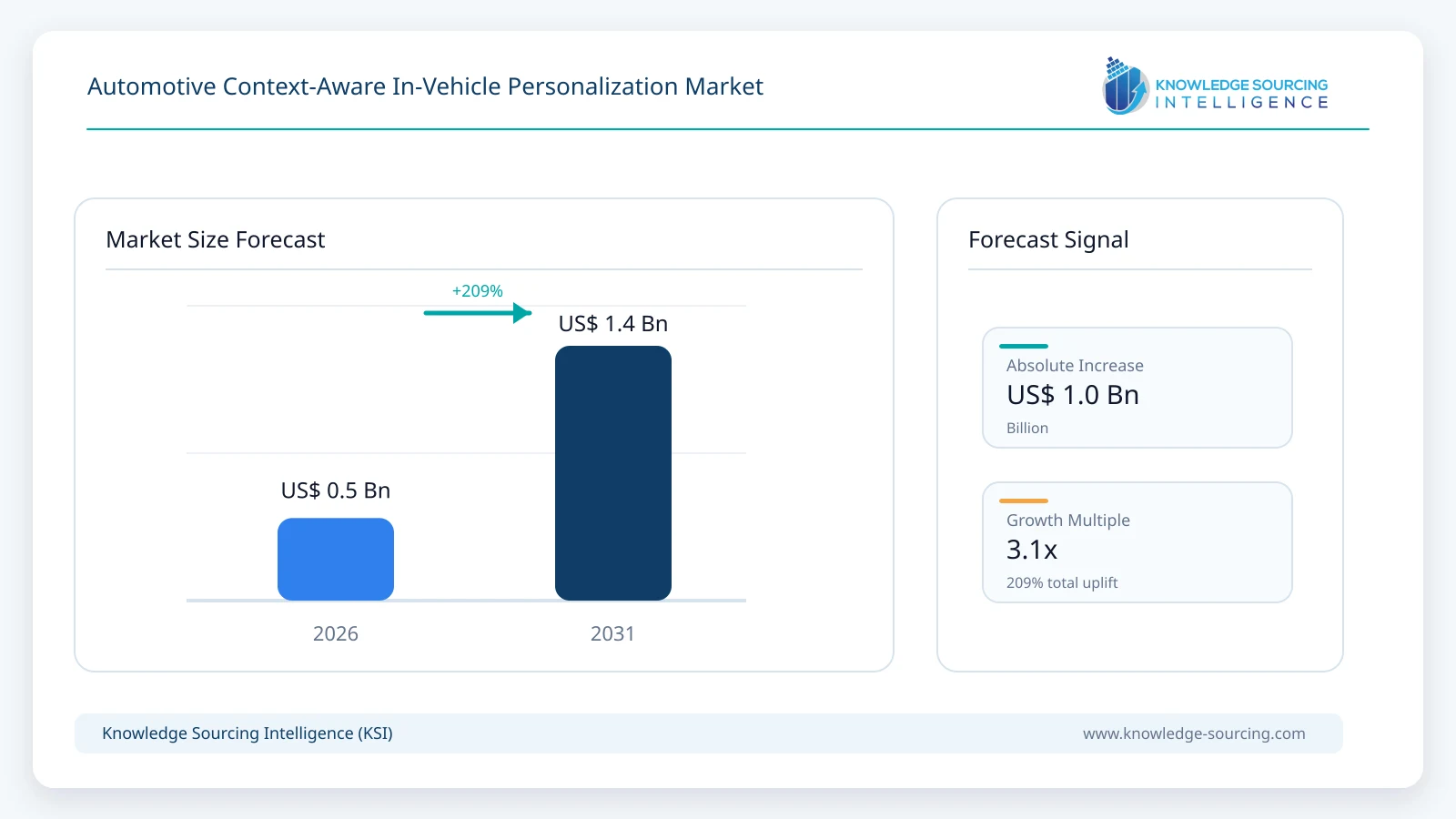
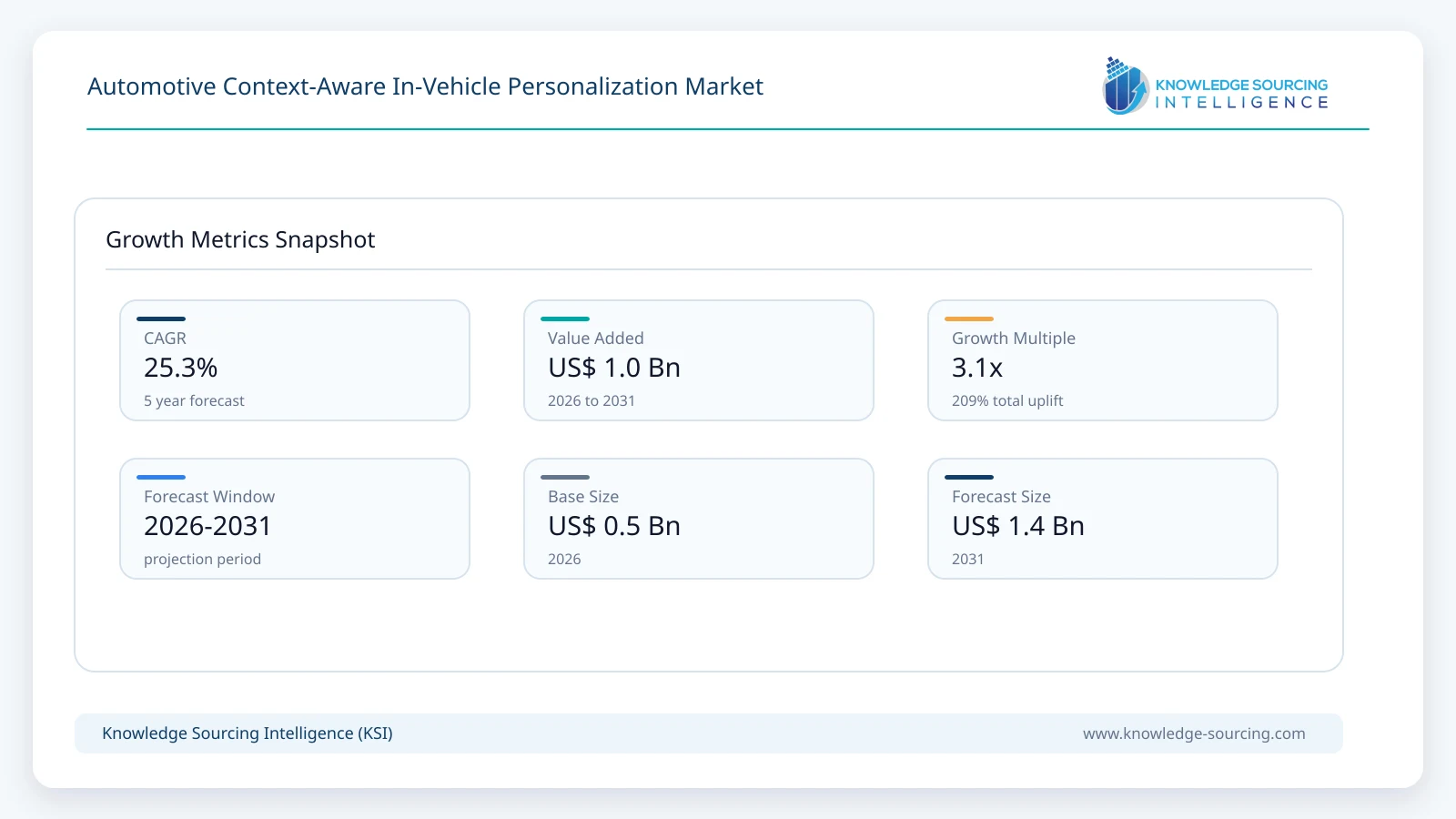
The automotive context-aware in-vehicle personalization market is projected to grow from USD 0.46 billion in 2026 to USD 1.42 billion by 2031, at a CAGR of 25.3% during forecast period.
Highlights:
- 1The global market is estimated at USD 0.46 billion in 2026 and forecast to reach USD 1.42 billion in 2031, at an implied CAGR of 25.3%.
- 2Adaptive comfort and cabin routines account for approximately 27% of 2026 value, while predictive and multi-domain responses gain importance through 2031.
- 3Hybrid edge-cloud implementations represent an estimated 54% of 2026 revenue because local execution is paired with connected preferences and content.
- 4Passenger vehicles dominate current deployment; mid-range vehicle programs take a larger share as software components become reusable.
- 5Asia Pacific leads regional demand, supported by Chinese connected-cabin programs and Japanese and South Korean supplier capabilities.
- 6The commercial test is whether context-aware actions remain relevant, permissioned and easy to override in daily driving.
Context-aware personalization uses information about the current journey, the vehicle and its occupants to adjust an experience at the moment it is useful. A stored driver profile can recall familiar settings, but the context-aware layer considers whether conditions justify a different suggestion or a permitted adjustment. Typical inputs include destination history, driving mode, ambient conditions, occupant location and signals of driver attention. In production programs, the challenge is not simply collecting these inputs; it is deciding which response is appropriate, showing the reason clearly and allowing the occupant to retain control.
The technology now spans several degrees of maturity. BMW Operating System X adds routine suggestions based on regular use, with users able to set conditions and actions themselves. Panasonic Automotive Systems’ cockpit controller for the Mazda CX-5 restores preferences across seating, head-up display and climate functions, establishing a practical profile-linked foundation. HARMAN Ready Care connects occupant-state assessment with possible changes to cabin lighting, audio or thermal settings. LG’s AI Cabin Platform goes further in demonstrations by combining on-device language and vision models for personalized, situation-dependent assistance; its showcase should not be treated as evidence of broad production fitment.
An OEM must decide which vehicle signals may be used, which functions can change automatically and which actions require confirmation. Reusable interfaces can reduce integration work across model lines, but changing cabin hardware, regional language requirements and software versions still demand vehicle-specific calibration. Suppliers therefore compete on dependable execution and program support as much as on the sophistication of their recommendation algorithms.
Market Trends
Learned routines are moving from suggestions to approved actions
Driver behavior becomes more useful to a vehicle system when recurring preferences can be associated with clear conditions. A familiar commute may lead to a preferred navigation destination, while repeated climate adjustments may suggest a configurable routine. BMW’s 2026 Operating System X update allows drivers to create rules defining both conditions and actions; its assistant can also propose routines from usage patterns. This is a more manageable route to adoption than enabling uncontrolled automated changes across the cabin.
OEMs can reuse the same routine engine for several comfort and infotainment functions, reducing the cost of implementing each individual use case. However, an action that is convenient in one season, region or vehicle mode may become distracting in another.
Local context processing is becoming central to response quality
Journey-related recommendations often need access to current vehicle state and must continue working when the mobile network is weak. Edge processing can handle routine triggers, recent preference information and selected sensing inputs with lower communication delay. LG’s CES 2026 AI Cabin Platform demonstrates on-device vision and language processing, while Qualcomm’s cockpit platforms provide the computing capability behind increasingly complex in-car intelligence.
Connected services remain useful for synchronized identities, maps, entertainment and model updates, making a hybrid arrangement attractive for many production architectures. Automakers must determine which data stays in the vehicle and which information is shared with backend services.
Occupant-aware responses are extending beyond the driver
Individual cabins are increasingly expected to accommodate different passengers without treating everyone’s needs as one profile. Cerence’s 2026 Geely program supports distinct acoustic zones and multi-seat interaction, while Visteon has shown cockpit software that combines personalized services with multiple user profiles.
Real-world implementation is more difficult when occupants change seats, share devices or decline identity recognition. A passenger should not be granted access to driver-sensitive vehicle controls simply because the system recognizes a voice.
Context is influencing driver-wellbeing interventions
Driver monitoring information can help select the type and intensity of a cabin response when the driver shows signs of fatigue, distraction or stress. HARMAN Ready Care links driver-state monitoring with potential personalized adjustments to lighting, sound and thermal comfort. Such functionality is distinct from a basic memory seat or standard drowsiness warning because it selects a response according to a changing condition.
Sensing-based personalization needs a clear separation between an optional comfort recommendation and a safety-critical warning. False detections or repeated prompts can reduce confidence quickly.
Open software interfaces are shaping supplier economics
A context engine becomes more valuable when it can communicate reliably with navigation, climate, displays, lighting, seating and audio without a new interface for every model. Centralized cockpits and service-oriented software make more of these functions accessible through controlled application interfaces. Panasonic’s Mazda cockpit deployment demonstrates how common computing can coordinate several driver-facing systems while maintaining a vehicle-specific experience.
Shared interfaces reduce repeated engineering, but common components also make simple recommendation functions easier to reproduce. Supplier differentiation shifts toward calibration, cross-domain behavior, lifecycle reliability and integration with the OEM’s own customer account and data policies.
Automotive Context-Aware In-Vehicle Personalization Market Segment Analysis
By Primary Context Function
Adaptive Comfort and Cabin Routines
Adaptive comfort and cabin routines account for approximately 27% of the modeled 2026 market. This includes software that considers conditions and approved preferences when suggesting or coordinating climate, seating, lighting and related comfort actions. The value lies in context interpretation and integration with existing controllers, not in the base seat, HVAC assembly or lamp hardware. BMW’s learned routine controls provide a practical example of how drivers can approve repeated actions without giving up control of each underlying function.
A broader set of inputs may support more useful routines over the forecast period, particularly where cockpit software can coordinate several cabin services. Reliability remains more important than maximizing the number of automatic actions.
By Context Technology
Predictive Learning and Recommendation Engines
Predictive learning represents approximately 34% of market value in 2026 under the modeled technology allocation. These engines use relevant history and recent signals to estimate when a recommendation or routine may be useful. Context-aware rules remain common, but learning systems can better address changes in destination patterns, individual habits and multimodal inputs where enough data and user permission are available.
Vehicle programs must demonstrate a measurable benefit from added prediction complexity. A frequent but poorly timed suggestion can be less useful than a simple user-defined rule.
By Processing Architecture
Hybrid Edge-Cloud Personalization
Hybrid edge-cloud systems are estimated to represent 54% of 2026 revenue because they combine dependable local decision logic with connected accounts, content and periodically updated software models. Local execution helps maintain immediate vehicle controls when signal coverage changes, while external systems can synchronize selected preferences and support more complex information requests.
Hybrid implementations also create operating responsibilities. Identity data must be handled consistently across devices and vehicles, and updates cannot break routines already approved by the user.
By Vehicle Class
Premium and Luxury Passenger Vehicles
Premium and luxury vehicles generate an estimated 52% of 2026 revenue because they generally have more software-addressable comfort equipment and stronger demand for individualized digital services. High-content cockpit architectures make it easier to coordinate climate zones, driver profiles, information displays and infotainment preferences. Premium OEMs also have greater scope to test advanced routines across a defined set of hardware and software configurations.
Mid-range vehicles are expected to account for a larger share by 2031 as reusable software packages reduce the cost of supporting each model. Volume expansion will depend on keeping context processing efficient and limiting extra sensor content.
Market Drivers
Expansion of Software-Addressable Cabin Functions
Modern cockpit software provides controlled access to a wider set of vehicle functions, including navigation, climate, audio, displays and selected comfort controls. When these functions can be operated through shared interfaces, a personalization engine can coordinate responses instead of modifying each controller independently. Panasonic’s integrated Mazda cockpit illustrates the production hardware and software foundation that supports user-linked settings across several domains.
The addressable software value grows as more vehicle functions can participate in permitted routines. OEMs can amortize the same context-processing logic across several trims and models, making additional use cases commercially viable without redesigning the entire electronics architecture.
Demand for Useful Digital Experiences Beyond Static Profiles
Customers already expect vehicles to remember favorite destinations and cabin settings, but stored profiles do not account for changing journeys or immediate needs. Context-aware functions can recommend the next routine, adjust the timing of information or propose an approved cabin setting based on a repeated pattern. BMW’s learned and user-defined routines represent a production-oriented way to make personalization more useful during ordinary driving.
Where recommendations save effort and remain predictable, OEMs have an opportunity to improve customer satisfaction after delivery. Suppliers benefit from repeatable software content and integration work across model years, although customer acceptance depends on visible value rather than the number of advertised AI functions.
Progress in On-Device AI and Cockpit Processing
New automotive processors support more perception, speech and prediction functions within the vehicle, reducing reliance on remote inference for timely responses. LG’s AI Cabin Platform and Qualcomm’s 2026 Digital Chassis roadmap show the technical direction toward greater local context processing, even where specific demonstrations have not yet reached wide-volume production. On-device capability also allows sensitive signals to be processed without routinely transmitting raw sensor data.
This improves the potential fit for passenger recognition, route-based routines and relevant in-cabin prompts. Hardware capability alone does not guarantee paid personalization content, but it lowers the integration barrier for OEMs that already specify higher-performance cockpit computers for other reasons.
Growing Importance of Occupant-Specific Cabin Services
Front and rear passengers increasingly use different media, voice interfaces and devices within a shared cabin. Cerence’s Geely engagement includes multiple acoustic zones, and Visteon has demonstrated concurrent user profiles on high-performance cockpit systems. These architectures create a route to context-aware services that consider who is requesting a function and which part of the cabin should respond.
Distinct occupant permissions help vehicle manufacturers expand passenger convenience without compromising driver-focused controls. Family vehicles and shared-use models may particularly benefit, provided passenger identification, consent and profile removal are handled reliably between journeys.
Reusable Software Platforms and Lifecycle Improvements
Automakers are seeking software components that can be updated across several vehicle lines while preserving brand-specific interface design. Context engines, preference stores and vehicle-function connectors can be reused when applications share consistent interfaces. This reduces the need to recreate a routine or recommendation service for every infotainment architecture and may make smaller volume vehicle programs commercially feasible.
Suppliers able to maintain functions through operating-system revisions and vehicle-platform changes can capture ongoing software support and integration value. OEMs gain an easier path to introduce and refine features after sale, particularly when feedback shows which recommendations customers actually use.
Market Restraints
Privacy, Consent and Driver-Identity Requirements
Context-aware functions can draw on location histories, account identity, occupant state or recurring daily routines. Customers may value personalization while remaining unwilling to share those inputs across applications or cloud systems. The commercial burden extends beyond initial consent: the vehicle must respect withdrawn permission, handle temporary drivers and avoid exposing one occupant’s preferences to another.
OEMs therefore need data minimization, retention controls and understandable privacy settings across software updates. These requirements increase design and validation effort, and some personalization functions will remain unavailable where the customer does not authorize the required data use.
False Predictions and Unwanted Automated Actions
A recommendation that repeatedly appears at the wrong time can be more irritating than making an adjustment manually. Driving routines also change with seasons, passengers, traffic and temporary travel patterns, so historical behavior is an imperfect predictor of present intent. Unexpected changes to cabin lighting or audio can distract occupants and reduce trust in the wider digital interface.
Vehicle manufacturers must introduce conservative confidence thresholds and require explicit confirmation for higher-impact actions. Field testing needs to track overrides and rejected suggestions, not merely whether the prediction engine technically executed its command.
Fragmented Vehicle Platforms and Control Interfaces
A single personalization routine may depend on several ECUs and software domains with different suppliers, response times and update cycles. An automaker can standardize an infotainment application more easily than the underlying seat, climate and body-control behavior across every model. Legacy vehicle programs may expose fewer controls to a centralized context engine.
Engineering teams must validate each supported combination of software release, hardware option and regional configuration. This adds integration cost and may confine the richer forms of context-aware personalization to newer electrical architectures until common vehicle interfaces become more widely available.
Limited Customer Willingness to Pay for Routine Functions
Drivers may expect personalized comfort, navigation shortcuts and learned preferences as standard conveniences rather than chargeable services. The value of a context-aware function is also difficult for customers to assess before living with it. Premium demonstrations can therefore generate interest without proving that users will accept a recurring subscription for every recommended routine.
OEMs are likely to package much of the software with broader digital-cockpit or comfort offerings. Suppliers face pricing pressure if their content cannot be distinguished from existing user-profile capabilities, and some advanced services may be delayed until automakers establish a credible commercial proposition.
Safety Validation and Long-Term Behavioral Consistency
Adaptive interfaces must preserve clear access to driving information and must never replace mandatory safety alerts with optional personalization. A model update that changes when a prompt appears or which function is activated can affect driver attention and operational consistency. In complex systems, a benign-looking recommendation may involve signals from an ADAS or driver-monitoring function that requires additional safeguards.
OEMs need testing across operating conditions and software versions, together with rollback behavior and traceable release decisions. These obligations can extend program schedules and reduce the pace at which advanced automated interactions move from demonstration to series production.
Regional Outlook
Asia Pacific
Asia Pacific is estimated to account for 45% of market value in 2026, reflecting the pace of connected-cockpit adoption in China and the established electronics supply base in Japan and South Korea. Chinese automakers are commercializing advanced vehicle assistants and multi-seat interaction, as illustrated by Cerence’s Geely and BYD engagements. Panasonic Automotive Systems’ Mazda program provides a separate example of preference-linked integration in a production cockpit. These developments create a practical foundation for more situation-dependent routines and recommendations.
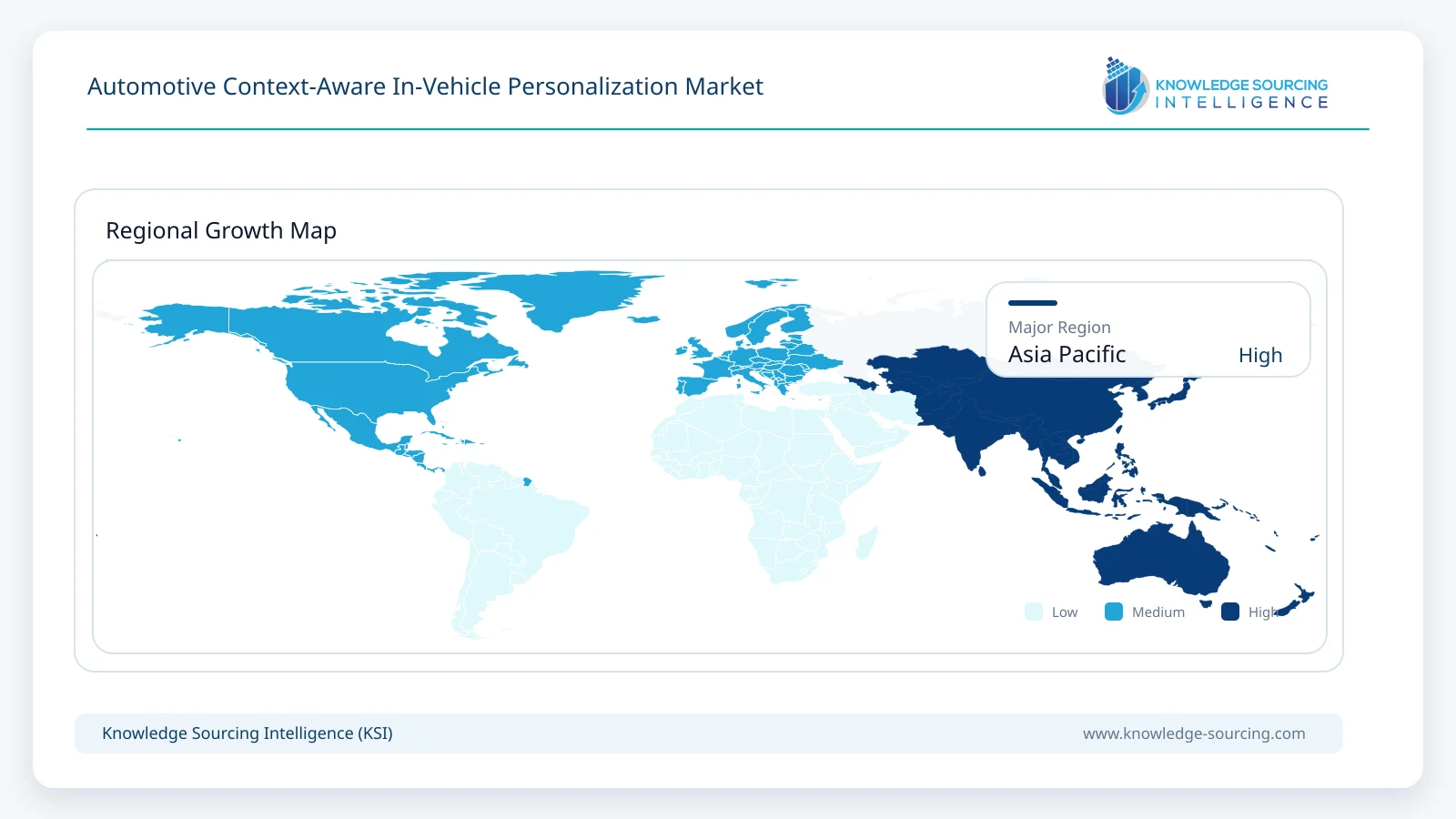
Expansion into mid-range vehicle lines should sustain above-average regional growth through 2031, though localized languages, vehicle platforms and consumer data practices require program-specific engineering. The market opportunity rests on software features that can be reused across large production volumes without forcing each automaker into the same cabin experience.
Europe
Europe represents approximately 27% of 2026 market value, supported by premium vehicle programs and established HMI and comfort-systems engineering. BMW’s learned routines and its broader intelligent assistant demonstrate a shift from simple voice commands and profile recall toward context-sensitive interaction. European brands can combine high-content cabin controls with established customer account systems, giving them a useful base for more adaptive services.
Data permissions, predictable driver interaction and maintenance across long vehicle lifecycles are especially important purchasing criteria. Suppliers must support local execution and clearly defined automation limits while meeting the needs of multiple countries and software configurations. These demands favor providers with automotive validation experience rather than general-purpose recommendation technology alone.
Competitive Landscape
Automotive context-aware personalization is supplied through a combination of OEM software teams, cockpit integrators, conversational AI specialists and cabin-sensing providers. Cerence focuses on vehicle-grade conversational interaction, including Geely and BYD programs, while Panasonic Automotive Systems and Visteon provide integrated cockpit platforms into which preference and context functions can be incorporated. HARMAN connects occupant-monitoring signals with selected cabin responses, and LG demonstrates a more advanced on-device sensing and generative interface architecture. Suppliers operate at different points of the technology stack and should not be compared as though every demonstration represented a complete competing product.
Qualcomm and other processing suppliers enable broader local inference, but high-performance silicon is not itself personalization revenue. Differentiation increasingly depends on how well suppliers control inappropriate prompts, handle multiple occupants and adapt applications across model years without weakening safety or privacy requirements.
Recent Developments
July 2026: Panasonic Automotive Systems announced that Mazda adopted its cockpit domain controller for the all-new CX-5. The system restores driver seat, HUD and climate preferences from profiles, demonstrating an integrated production foundation for personalized responses.
May 2026: BMW detailed new Operating System X routines available from July 2026. The intelligent assistant can suggest routines from repeated use, and owners can define conditions and approved actions.
April 2026: Cerence expanded its BYD collaboration for xUI-powered conversational in-car assistance across selected global vehicles. The program strengthens the vehicle software base for contextual dialogue and user-specific functions.
January 2026: Cerence announced Geely’s selection of xUI for overseas markets, including distinct acoustic zones and multi-seat interaction. This supports occupant-specific interfaces rather than a single shared voice experience.
January 2026: Visteon showcased a Snapdragon Cockpit Elite-based computing platform with cognitoAI Concierge and individual user profiles. The announcement illustrates supplier capabilities, not separately disclosed personalization shipments.
December 2025: LG Electronics announced its AI Cabin Platform for CES 2026, using on-device vision and language models for context-based assistance. The disclosure describes a showcase platform rather than confirmed broad commercial rollout.
Market Outlook
Context-aware in-vehicle personalization is forecast to reach USD 1.42 billion in 2031 as software moves beyond fixed profile restoration toward approved routines, occupant-sensitive responses and more useful travel assistance. Predictive and multi-domain functions should gain share, while straightforward rules remain important because customers want understandable controls.
Asia Pacific is expected to retain the largest regional value pool, while Europe contributes a high-value base of premium vehicle software integration. Suppliers capable of validating recommendations, maintaining data permissions and supporting vehicle-domain interfaces throughout the product lifecycle are likely to win repeat programs.
Automotive Context-Aware In-Vehicle Personalization Market Scope:
| Report Metric | Details |
|---|---|
| Total Market Size in 2026 | USD 0.46 billion |
| Total Market Size in 2031 | USD 1.42 billion |
| Forecast Unit | USD Billion |
| Growth Rate | 25.3% |
| Study Period | 2021 to 2031 |
| Historical Data | 2021 to 2024 |
| Base Year | 2025 |
| Forecast Period | 2026 – 2031 |
| Segmentation | Primary Context Function, Context Technology, Processing Architecture, Revenue Component, Vehicle Class, Vehicle Type, Geography |
| Companies |
|
Market Segmentation
By Primary Context Function
Adaptive Comfort and Cabin Routines
Contextual Navigation and Driver Routines
Occupant Wellbeing Responses
Infotainment and Content Recommendations
Multi-Occupant Context Services
By Context Technology
Identity and Context-Aware Rules
Predictive Learning and Recommendation
Occupant-State and Multimodal Context
Agentic Cross-Domain Response
By Processing Architecture
Edge and On-Device Personalization
Hybrid Edge-Cloud Personalization
Cloud-Centric Context Services
By Revenue Component
Embedded Context Software and Middleware
Integration, Calibration and Validation
Lifecycle and Connected Context Services
By Vehicle Class
Premium and Luxury Vehicles
Mid-Range Passenger Vehicles
Mass-Market and Economy Vehicles
By Vehicle Type
Passenger Vehicles
Light Commercial Vehicles
Medium and Heavy Commercial Vehicles
By Geography
North America
United States
Canada
Mexico
South America
Brazil
Argentina
Others
Europe
Germany
United Kingdom
France
Italy
Spain
Others
Middle East and Africa
United Arab Emirates
Saudi Arabia
Israel
South Africa
Others
Asia Pacific
China
Japan
South Korea
India
Taiwan
Thailand
Indonesia
Others
Table of Contents
1. EXECUTIVE SUMMARY
2. MARKET SNAPSHOT
2.1. Market Overview
2.2. Market Definition
2.3. Market Scope
2.4. Market Segmentation
3. BUSINESS LANDSCAPE
3.1. Market Drivers
3.1.1. Expansion of Software-Addressable Cabin Functions
3.1.2. Demand for Useful Digital Experiences Beyond Static Profiles
3.1.3. Progress in On-Device AI and Cockpit Processing
3.1.4. Growing Importance of Occupant-Specific Cabin Services
3.1.5. Reusable Software Platforms and Lifecycle Improvements
3.2. Market Restraints
3.2.1. Privacy, Consent and Driver-Identity Requirements
3.2.2. False Predictions and Unwanted Automated Actions
3.2.3. Fragmented Vehicle Platforms and Control Interfaces
3.2.4. Limited Customer Willingness to Pay for Routine Functions
3.2.5. Safety Validation and Long-Term Behavioral Consistency
3.3. Market Opportunities
3.4. Porter’s Five Forces Analysis
3.5. Value Chain Analysis
3.6. Policies and Regulations
3.7. Strategic Recommendations
4. TECHNOLOGICAL OUTLOOK
4.1. Occupant Identity and Consent Controls
4.2. Rule-Based Context Engines
4.3. Predictive Learning and Driver Routines
4.4. Occupant-State and Multimodal Inputs
4.5. Cross-Domain Cabin Orchestration
4.6. Edge, Cloud and Hybrid Deployment
5. AUTOMOTIVE CONTEXT-AWARE IN-VEHICLE PERSONALIZATION MARKET BY PRIMARY CONTEXT FUNCTION
5.1. Introduction
5.2. Adaptive Comfort and Cabin Routines
5.3. Contextual Navigation and Driver Routines
5.4. Occupant Wellbeing Responses
5.5. Infotainment and Content Recommendations
5.6. Multi-Occupant Context Services
6. AUTOMOTIVE CONTEXT-AWARE IN-VEHICLE PERSONALIZATION MARKET BY CONTEXT TECHNOLOGY
6.1. Introduction
6.2. Identity and Context-Aware Rules
6.3. Predictive Learning and Recommendation
6.4. Occupant-State and Multimodal Context
6.5. Agentic Cross-Domain Response
7. AUTOMOTIVE CONTEXT-AWARE IN-VEHICLE PERSONALIZATION MARKET BY PROCESSING ARCHITECTURE
7.1. Introduction
7.2. Edge and On-Device Personalization
7.3. Hybrid Edge-Cloud Personalization
7.4. Cloud-Centric Context Services
8. AUTOMOTIVE CONTEXT-AWARE IN-VEHICLE PERSONALIZATION MARKET BY REVENUE COMPONENT
8.1. Introduction
8.2. Embedded Context Software and Middleware
8.3. Integration, Calibration and Validation
8.4. Lifecycle and Connected Context Services
9. AUTOMOTIVE CONTEXT-AWARE IN-VEHICLE PERSONALIZATION MARKET BY VEHICLE CLASS
9.1. Introduction
9.2. Premium and Luxury Vehicles
9.3. Mid-Range Passenger Vehicles
9.4. Mass-Market and Economy Vehicles
10. AUTOMOTIVE CONTEXT-AWARE IN-VEHICLE PERSONALIZATION MARKET BY VEHICLE TYPE
10.1. Introduction
10.2. Passenger Vehicles
10.3. Light Commercial Vehicles
10.4. Medium and Heavy Commercial Vehicles
11. GEOGRAPHICAL SEGMENTATION
11.1. Introduction
11.2. North America
11.2.1. United States
11.2.2. Canada
11.2.3. Mexico
11.3. South America
11.3.1. Brazil
11.3.2. Argentina
11.3.3. Others
11.4. Europe
11.4.1. Germany
11.4.2. United Kingdom
11.4.3. France
11.4.4. Italy
11.4.5. Spain
11.4.6. Others
11.5. Middle East and Africa
11.5.1. United Arab Emirates
11.5.2. Saudi Arabia
11.5.3. Israel
11.5.4. South Africa
11.5.5. Others
11.6. Asia Pacific
11.6.1. China
11.6.2. Japan
11.6.3. South Korea
11.6.4. India
11.6.5. Taiwan
11.6.6. Thailand
11.6.7. Indonesia
11.6.8. Others
12. COMPETITIVE ENVIRONMENT AND ANALYSIS
12.1. Major Players and Strategy
12.2. Market Share Analysis
12.3. Mergers, Acquisitions, Agreements and Collaborations
12.4. Competitive Dashboard
13. COMPANY PROFILES
13.1. Cerence Inc.
13.2. HARMAN International
13.3. Panasonic Automotive Systems Co., Ltd.
13.4. Visteon Corporation
13.5. LG Electronics Vehicle Solution Company
13.6. Qualcomm Technologies, Inc.
13.7. Robert Bosch GmbH
13.8. Aptiv PLC
13.9. ECARX Holdings Inc.
13.10. Yanfeng
14. APPENDIX
14.1. Currency
14.2. Assumptions
14.3. Base and Forecast Years Timeline
14.4. Key Benefits for Stakeholders
14.5. Research Methodology
14.6. Abbreviations
14.7. Data Sources
Navigate
Trusted by the world's leading organizations











