
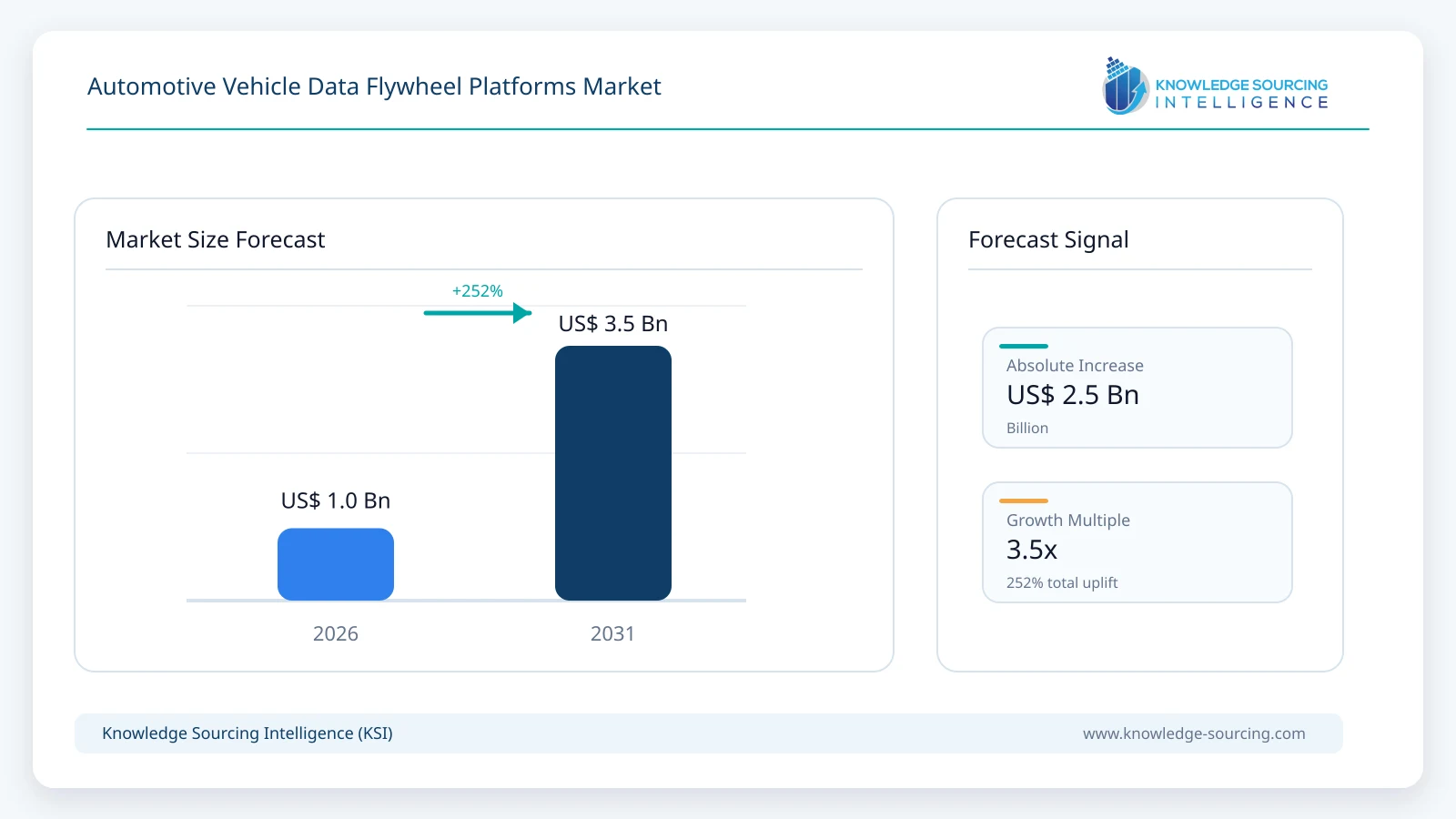
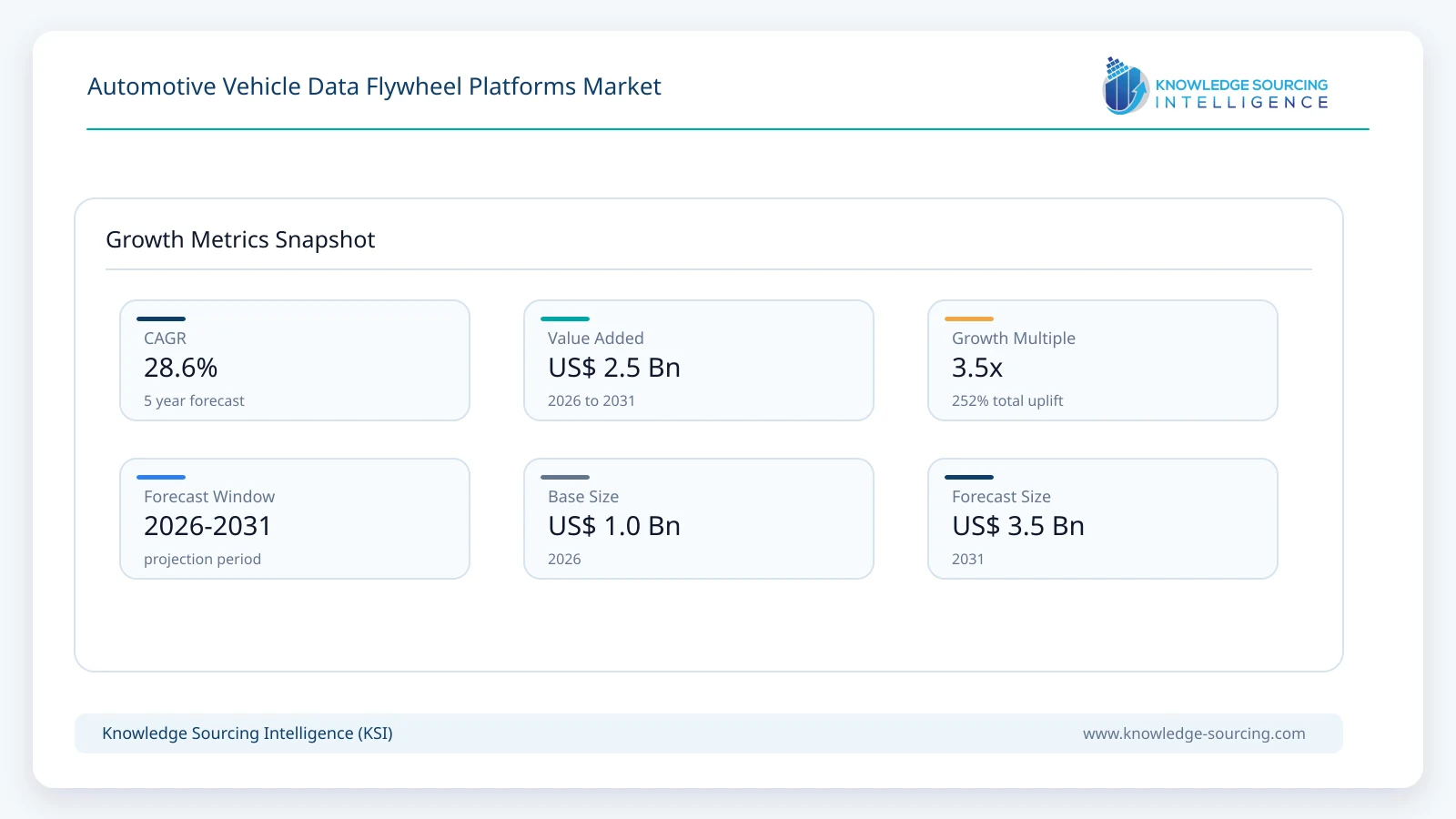
The Automotive Vehicle Data Flywheel Platforms Market is forecast to grow at a CAGR of 28.6%, reaching USD 3.45 billion in 2031 from USD 0.98 billion in 2026.
Highlights:
- 1Global revenue is estimated at USD 0.98 billion in 2026 and projected to reach USD 3.45 billion in 2031.
- 2ADAS and automated-driving development is the largest application group, reflecting the volume and variety of road scenarios that teams must evaluate.
- 3Event selection and data quality are central buying criteria because indiscriminate fleet uploads increase processing costs without proportionate engineering value.
- 4Simulation and scenario evaluation gain share as developers link recorded incidents with repeatable virtual tests.
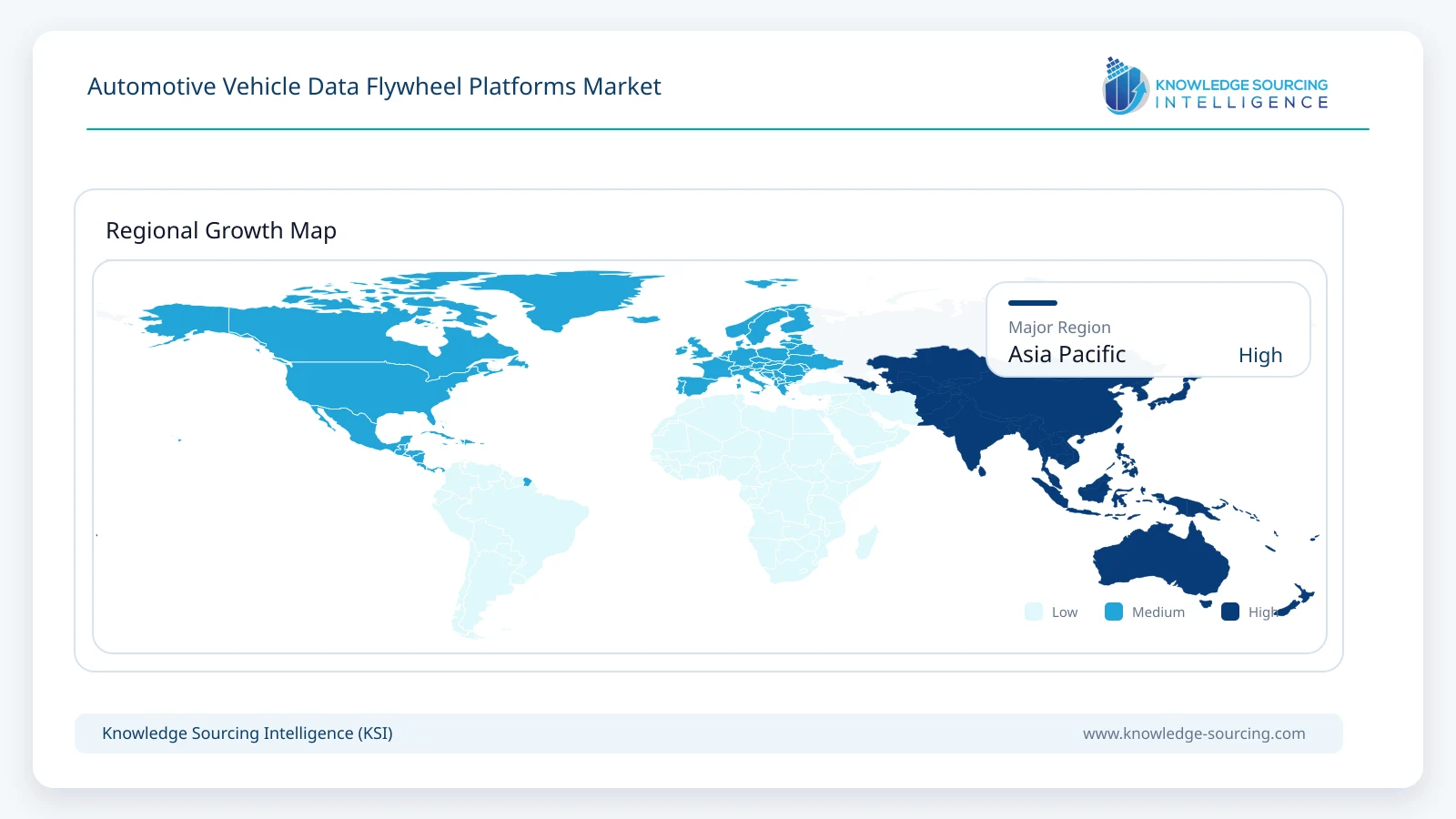
- 5Asia Pacific is the largest regional opportunity, with North America an important center for autonomy platforms and cloud infrastructure.
- 6Customer adoption depends on usable data rights, vehicle software access, traceable model changes and convincing evidence of engineering productivity.
Automakers increasingly need information from vehicles in daily use to improve software behavior after launch. A useful feedback system does more than collect records: it helps engineers find unusual events, check data quality, reconstruct the circumstances, and decide what needs to change in a model, calibration or vehicle function.
Platform providers combine in-vehicle collection policies, cloud data tools, scenario evaluation and engineering workflows. Sonatus supports event-driven vehicle data collection, while Scale AI focuses on curation, labeling and model evaluation. NVIDIA, Applied Intuition and dSPACE offer related development and simulation capabilities. Automotive customers typically integrate these products with their own development systems and data policies, creating demand for specialized engineering and long-term support.
Market Overview
Vehicle software teams use feedback from customer and test fleets to identify performance gaps that cannot be fully anticipated during initial validation. Camera, radar, vehicle-network and diagnostic information can reveal how functions behave in particular traffic, weather or operating conditions. A data flywheel platform makes that information usable by selecting the relevant events, preserving their context and linking each finding to a development task or test case. The same workflow can support better driver-assistance behavior, faster investigation of service issues and more reliable powertrain calibrations.
Vehicle data is increasingly gathered through targeted policies rather than uploading every available signal. Sonatus Collector AI supports event-triggered collection across vehicle systems, and Scale AI offers data curation, annotation, and model evaluation for autonomous-driving development. NVIDIA's Alpamayo tools combine datasets, closed-loop simulation and model-development capabilities. BMW's automated-driving data work on AWS illustrates how vehicle events are processed and made available to engineering teams across several operating regions. These examples show different parts of the feedback cycle rather than a single standardized product architecture.
Automakers generally control the decision to record an event, the permissions attached to it and whether a software change can be released. Platform suppliers provide reusable tooling around collection, processing, simulation and traceability, while cloud companies supply scalable processing and storage. Requirements vary by vehicle program and jurisdiction because sensitive camera footage, location traces and diagnostic records cannot be treated identically. The EU Data Act has also increased attention to connected-vehicle data access, although its rules do not remove other privacy, security, or safety obligations.
Market Trends
Event-driven selection is replacing indiscriminate fleet uploads
Automakers are trying to capture unusual driving and diagnostic events without paying to transmit and store every sensor stream. Selective collection can be triggered by a maneuver, a diagnostic condition, or an engineering campaign, allowing teams to focus on cases likely to change a development decision. Sonatus Collector AI supports changing collection policies without requiring a complete vehicle-software replacement. That approach is particularly relevant when an OEM needs additional measurements from vehicles already in service.
A narrower dataset is only useful if engineers can reproduce the trigger conditions and understand which vehicles supplied the records. Suppliers that help customers change collection policies quickly while retaining reliable context have a stronger proposition than vendors selling storage capacity alone.
Data quality and scenario coverage are becoming engineering priorities
Recorded driving data frequently contains duplicate examples, missing sensor context, or events already well represented in the training set. Curation software helps engineering teams identify gaps in weather, road type, traffic behavior, and vehicle configuration before expensive annotation or model training begins. Scale AI's Automotive Data Engine combines selection, labeling, and evaluation, supporting the recurring work needed to measure whether new data addresses known model weaknesses.
The commercial emphasis is shifting toward datasets that improve test coverage and model performance. A platform that cannot show how its selected data contributes to an engineering outcome faces pressure from less expensive general-purpose tools.
Simulation is connecting fleet events to repeatable validation
Driving incidents identified in recorded data increasingly become virtual test cases, allowing teams to evaluate revised software in controlled conditions. NVIDIA AlpaSim and the broader Alpamayo toolset support closed-loop testing, while dSPACE provides data-replay and sensor-realistic validation systems. These methods allow an issue found on the road to be checked against later software versions without waiting for an identical event to occur again.
Engineering teams still need to establish whether a reconstructed scenario captures the important real-world details. Providers that connect source evidence, scenario fidelity and software-version records are better placed to support formal release decisions than vendors offering isolated virtual test environments.
Vehicle engineering is adopting continuous model feedback
AI-based driving functions require ongoing evaluation because a model can improve one class of events while becoming less reliable in another. A data flywheel supports repeated comparison of production observations, model outputs and validation results. Wayve describes its fleet learning process in terms of collecting driving information, training and evaluating models, and then deploying improved software after safety review. Such feedback can help developers prioritize specific failure patterns instead of retraining indiscriminately.
The same logic is spreading into vehicle diagnostics and electric-powertrain management, although these applications often use lower-bandwidth signals and different success metrics. Suppliers must adapt feedback workflows to the engineering decisions being made rather than assume one autonomous-driving data pipeline fits every domain.
Governance is becoming part of the platform buying decision
Vehicle-generated data can include sensitive location information, cabin imagery and commercially important engineering records. European guidance accompanying the Data Act addresses access rights for relevant connected-vehicle data, while separate privacy and security rules continue to constrain processing. OEMs consequently need consent controls, retention rules, authorization records and regional handling policies throughout collection and analysis, not only at the final export step.
Cloud providers offer managed access controls and scalable data pipelines, but responsibility remains shared with automakers and engineering partners. Platforms that make evidence lineage and controlled access routine can reduce integration effort and increase customer confidence, particularly where the same dataset supports several engineering functions.
Segment Analysis
By Platform Capability: Data Curation and Quality Management
Data curation and quality management represents an estimated 32% of 2026 revenue, making it the largest capability group in 2026. Scale AI's automotive tools address selection, annotation and evaluation, while dSPACE integrates recorded data with verification workflows. Curation is often a recurring requirement because new software releases change which examples are most useful. Its contribution is expected to remain significant even as automated preparation reduces manual work.
By Application Domain: ADAS and Autonomous Driving
ADAS and autonomous-driving programs account for approximately 56% of estimated market value in 2026 and are expected to gain share by 2031. NVIDIA and Applied Intuition provide tools for simulation and evaluation, while Mobileye uses fleet-sourced observations to update road intelligence. Spending varies markedly by program maturity and autonomy ambition, so the commercial opportunity is concentrated in qualified development teams rather than all vehicles equipped with basic driver assistance.
By Revenue Component: Platform Licensing and Data Operations
Platform licenses and managed data operations together account for about two-thirds of estimated 2026 value. Separately billed integration remains substantial where automakers must connect legacy data formats, in-vehicle recorders and existing test infrastructure. Supplier competition therefore depends on how quickly a customer can start using trusted datasets, not merely the breadth of a software feature list.
By Delivery Environment: Hybrid Data and Engineering Platforms
Hybrid deployment represents the largest delivery arrangement because vehicle data crosses in-car systems, engineering labs, private infrastructure, and cloud services. BMW's AWS-backed development workflow illustrates the need to link vehicle collection with centralized engineering resources. Platform providers must accommodate local data restrictions and hardware-in-the-loop testing even where cloud processing becomes the main scaling mechanism.
Market Drivers
Growth in ADAS and automated-driving software programs
Advanced driving functions must operate across varied roads, weather conditions and driver behavior. OEM and autonomy engineering teams rely on recorded scenarios to find weaknesses that are difficult to reproduce in scheduled road testing. That requirement creates spending on event capture, dataset preparation, simulation and model evaluation. Programs built around learning-based software can generate repeated demand for these services as each development cycle exposes new cases.
NVIDIA's 2026 Alpamayo releases and Applied Intuition's physical AI development platform reflect supplier investment in more connected data-to-validation workflows. Broad ADAS installations alone are not sufficient evidence of purchase: the buyer must operate an active feedback and software-improvement process.
Need to reduce the cost of collecting and preparing vehicle data
High-resolution cameras and other sensors create more raw information than an engineering team can afford to transfer and examine continuously. Event-triggered collection and automated curation help direct processing resources toward useful conditions. Sonatus's collection policies and Scale AI's selection tools are examples of solutions intended to avoid unnecessary data movement and repeated manual classification.
The purchasing case depends on measurable reductions in storage, annotation or investigation time. Suppliers able to demonstrate that balance can win recurring contracts because data costs accumulate throughout vehicle production and software support.
Pressure to investigate field issues after vehicle launch
Vehicles in service reveal failures that may occur only in particular climates, driving patterns or software combinations. Engineers need trustworthy event histories and software-version information to distinguish a widespread defect from an isolated incident. Data flywheel workflows allow these findings to inform revised tests and, where appropriate, future calibrations or software releases.
The commercial value extends beyond automated driving. Sonatus describes a data-to-calibration workflow for EV efficiency, showing how collected measurements can lead to targeted improvements. Buyers will prefer platforms that preserve the connection between the observed issue and the engineering change.
Expansion of simulation and virtual validation capability
Automotive validation teams cannot depend on physical testing to reproduce every rare traffic event. Recorded fleet data can be converted into replay runs or realistic simulated scenes for repeated comparison of software revisions. dSPACE and NVIDIA offer complementary approaches to these tasks, while specialist engineering groups increasingly use mixed physical and virtual validation environments.
Simulation is especially valuable when the team can rerun a difficult event against several candidates and retain the results for release approval. Demand therefore supports a combination of data management, scenario quality checks and engineering integration rather than a simulation engine alone.
OEM investment in shared data infrastructure and AI workflows
Large manufacturers are consolidating scattered vehicle information into governed platforms that engineering teams can reuse. BMW's Cloud Data Hub and Connected AI Platform illustrate investment in common infrastructure for data access and model workflows. Reuse matters because ADAS, diagnostics and software quality teams often need overlapping vehicle and software context but different measures of success.
Shared infrastructure can reduce duplicate pipelines while increasing the value of common metadata, access controls and processing tools. Platform contracts are more defensible when suppliers can connect the data assets to repeated decisions and releases rather than one-off analytics projects.
Market Restraints
Privacy, consent and regional restrictions on vehicle data
Location traces, camera recordings and other vehicle information can involve personal data or sensitive operating details. Collection policies must match permissions, retention schedules and legal rules in the relevant market. The EU Data Act addresses access to certain connected-product data, but it does not displace privacy legislation or remove safety and security constraints on how records are handled.
Different requirements across Europe, China and other major markets complicate shared international data pipelines. Suppliers that lack reliable governance functions can be excluded before their model-development tools are evaluated.
High processing and annotation costs for rich sensor records
Multi-camera and radar recordings can consume substantial network, storage and computing resources, particularly when engineers retain many software and sensor versions. Detailed annotations and careful quality review add further costs. Even an established data platform can become expensive if collection policies capture too much routine information or if records are repeatedly processed without improving an engineering decision.
Customers consequently scrutinize the value of selected datasets and may limit the number of active campaigns. These economics restrain adoption among smaller vehicle software programs that do not yet need complex scenario coverage.
Difficulty integrating different vehicle and sensor architectures
Vehicle fleets often contain several generations of electronic architecture, processor capability, network design and sensor packages. Data collected from one model may not include the same signals or timing information as another. Engineering software must preserve these differences so that a model or calibration change is tested against compatible hardware and vehicle configurations.
Supplier onboarding can require substantial decoding, recorder adaptation and release-system integration before the flywheel produces repeatable results. Open interfaces reduce some friction, but they do not eliminate the need for vehicle-specific engineering knowledge or reliable metadata.
Uncertain transferability of simulated and selected scenarios
A reconstructed or generated driving scene does not automatically reproduce the physical conditions that made the original event difficult. Sensor noise, unusual human behavior and differences in road surfaces may materially affect results. Models that perform well on an overrepresented dataset can still fail when encountering a new operating environment.
Automotive customers therefore need independent checks of coverage, scenario realism and model regression. This reduces the likelihood that a single platform replaces existing road testing or established verification processes.
Lengthy procurement and difficulty proving platform value
Automotive manufacturers commonly purchase data tools within larger cloud, simulation, engineering or software-development contracts. A specialist platform must demonstrate how its capabilities differ from tooling already available through a preferred cloud provider or internal system. Security reviews, intellectual-property controls and responsibility for safety evidence can delay supplier selection.
Program budgets can also change as an autonomy project moves from research to production or reduces planned fleet expansion. These pressures can slow standalone platform revenue even as automakers continue investing heavily in software and analytics.
Regional Outlook
Asia Pacific
Asia Pacific accounts for the largest regional market share, supported by substantial vehicle production, fast-moving driver-assistance programs and investment in data-centered vehicle software. China accounts for the largest part of regional demand, with Japan and South Korea also supporting advanced engineering programs. Teams developing automated driving and connected electric vehicles need data collection, model evaluation and vehicle-quality workflows that reflect local roads and customer use.
Regional growth is not simply proportional to vehicle sales. Local cloud arrangements, sensor specifications and language or mapping needs can affect implementation. The region is projected to gain share as a wider set of vehicle programs adopts continuous feedback methods rather than relying only on pre-launch tests.
North America
North America remains an important market for vehicle data flywheel platforms because autonomous-driving developers, cloud companies and software-focused suppliers are concentrated in the United States. NVIDIA, Applied Intuition, Scale AI and major hyperscalers bring together data, simulation and AI-development capabilities used by automotive engineering organizations. Strong demand also comes from commercial fleets and advanced vehicle-quality programs that need evidence from deployed vehicles.
Commercial value is concentrated in long-running engineering programs and platform contracts rather than the total number of vehicles on the road. Suppliers that provide reproducible results, clear cost accounting and practical integration with established engineering systems are likely to retain an advantage as customers consolidate their toolchains.
Competitive Landscape
Competition combines automotive data-platform specialists, autonomous-driving tool providers, simulation companies and hyperscale cloud services. Sonatus concentrates on targeted in-vehicle collection, while Scale AI supplies dataset curation and evaluation services. Applied Intuition provides broader physical AI tooling that links fleet data with simulation and model-development workflows. NVIDIA supplies models, datasets and simulation frameworks that can be integrated into OEM engineering environments. These offerings address overlapping stages of the same cycle, but customers may source them from several providers.
Large cloud suppliers such as AWS, Microsoft and Google Cloud provide processing, storage, data governance and AI infrastructure, often alongside automotive-specific integrators. dSPACE and Siemens contribute recorded-data replay and engineering validation tools, while Mobileye operates a distinctive road-intelligence feedback capability. Published supplier market shares for this narrowly defined platform category are not available.
Recent Developments
July 2026: Applied Intuition launched Dana, bringing tooling, data and development workflows together for physical AI systems, including automotive use cases.
July 2026: Mobileye announced cloud-enhanced ADAS supply for future Stellantis vehicles using REM road intelligence, with selected vehicles expected from 2027.
May 2026: NVIDIA expanded Alpamayo with more advanced reasoning models, closed-loop reinforcement learning and data-based neural reconstruction tools.
April 2026: Sonatus placed Collector AI and related vehicle intelligence software on the SDVerse marketplace, widening OEM and supplier access.
January 2026: NVIDIA introduced the Alpamayo family of AV models, simulation tools and driving datasets for model training and validation.
September 2025: Scale AI expanded its Data Engine for Physical AI, drawing on its autonomous-driving experience in collecting and annotating sensor records.
Market Outlook
Vehicle-data feedback systems are expected to become more widely used as automakers develop software that changes during the vehicle's service life. Data selection, quality checks and virtual evaluation are likely to account for an increasing proportion of value as organizations seek repeatable engineering results from existing fleets.
Customers will continue to combine automotive-specific tools with general cloud and AI infrastructure. Suppliers that preserve vehicle context, data permissions and test traceability across this mix can build durable contracts. Growth will depend less on the number of connected vehicles than on the number of active programs able to convert field information into verified software improvement.
Automotive Vehicle Data Flywheel Platforms Market Scope:
| Report Metric | Details |
|---|---|
| Total Market Size in 2026 | USD 0.98 billion |
| Total Market Size in 2031 | USD 3.45 billion |
| Forecast Unit | USD Billion |
| Growth Rate | 28.6% |
| Study Period | 2021 to 2031 |
| Historical Data | 2021 to 2024 |
| Base Year | 2025 |
| Forecast Period | 2026 – 2031 |
| Segmentation | Platform Capability, Application Domain, Revenue Component, Customer Type |
| Companies |
|
Market Segmentation
By Platform Capability
Fleet Event Capture and Selection
Data Curation and Quality Management
Scenario Evaluation and Simulation
Model Feedback and Performance Monitoring
By Application Domain
ADAS and Autonomous Driving
Vehicle Quality and Diagnostics
EV Powertrain and Battery Performance
Other Vehicle Software Functions
By Revenue Component
Platform Software Licensing
Managed Data Processing and Operations
Engineering Integration and Validation
By Customer Type
Vehicle OEMs
Tier 1 Suppliers
Autonomy Technology Companies
Fleet and Mobility Operators
By Deployment Environment
Hybrid
Cloud
On-Premises
By Geography
North America
USA
Canada
Mexico
South America
Brazil
Argentina
Others
Europe
Germany
UK
France
Italy
Spain
Others
Middle East and Africa
Saudi Arabia
UAE
Israel
South Africa
Others
Asia Pacific
China
Japan
India
South Korea
Australia
Taiwan
Thailand
Indonesia
Others
Table of Contents
1. EXECUTIVE SUMMARY
2. MARKET SNAPSHOT
2.1. Market Overview
2.2. Market Definition
2.3. Scope of Study
2.4. Market Segmentation
3. BUSINESS LANDSCAPE
3.1. Market Drivers
3.1.1. Growth in ADAS and automated-driving software programs
3.1.2. Need to reduce the cost of collecting and preparing vehicle data
3.1.3. Pressure to investigate field issues after vehicle launch
3.1.4. Expansion of simulation and virtual validation capability
3.1.5. OEM investment in shared data infrastructure and AI workflows
3.2. Market Restraints
3.2.1. Privacy, consent and regional restrictions on vehicle data
3.2.2. High processing and annotation costs for rich sensor records
3.2.3. Difficulty integrating different vehicle and sensor architectures
3.2.4. Uncertain transferability of simulated and selected scenarios
3.2.5. Lengthy procurement and difficulty proving platform value
3.3. Market Opportunities
3.4. Porter’s Five Forces Analysis
3.5. Industry Value Chain Analysis
3.6. Policies and Regulations
3.7. Strategic Recommendations
4. TECHNOLOGICAL OUTLOOK
4.1. Event-Based Fleet Data Collection
4.2. Data Selection, Curation and Quality
4.3. Scenario Reconstruction and Simulation
4.4. Model Feedback and Validation
4.5. Data Security and Governance
5. AUTOMOTIVE VEHICLE DATA FLYWHEEL PLATFORMS MARKET BY PLATFORM CAPABILITY
5.1. Introduction
5.2. Fleet Event Capture and Selection
5.3. Data Curation and Quality Management
5.4. Scenario Evaluation and Simulation
5.5. Model Feedback and Performance Monitoring
6. AUTOMOTIVE VEHICLE DATA FLYWHEEL PLATFORMS MARKET BY APPLICATION DOMAIN
6.1. Introduction
6.2. ADAS and Autonomous Driving
6.3. Vehicle Quality and Diagnostics
6.4. EV Powertrain and Battery Performance
6.5. Other Vehicle Software Functions
7. AUTOMOTIVE VEHICLE DATA FLYWHEEL PLATFORMS MARKET BY REVENUE COMPONENT
7.1. Introduction
7.2. Platform Software Licensing
7.3. Managed Data Processing and Operations
7.4. Engineering Integration and Validation
8. AUTOMOTIVE VEHICLE DATA FLYWHEEL PLATFORMS MARKET BY CUSTOMER TYPE
8.1. Introduction
8.2. Vehicle OEMs
8.3. Tier 1 Suppliers
8.4. Autonomy Technology Companies
8.5. Fleet and Mobility Operators
9. AUTOMOTIVE VEHICLE DATA FLYWHEEL PLATFORMS MARKET BY DEPLOYMENT ENVIRONMENT
9.1. Introduction
9.2. Hybrid
9.3. Cloud
9.4. On-Premises
10. AUTOMOTIVE VEHICLE DATA FLYWHEEL PLATFORMS MARKET BY GEOGRAPHY
10.1. Introduction
10.2. North America
10.2.1. USA
10.2.2. Canada
10.2.3. Mexico
10.3. South America
10.3.1. Brazil
10.3.2. Argentina
10.3.3. Others
10.4. Europe
10.4.1. Germany
10.4.2. UK
10.4.3. France
10.4.4. Italy
10.4.5. Spain
10.4.6. Others
10.5. Middle East and Africa
10.5.1. Saudi Arabia
10.5.2. UAE
10.5.3. Israel
10.5.4. South Africa
10.5.5. Others
10.6. Asia Pacific
10.6.1. China
10.6.2. Japan
10.6.3. India
10.6.4. South Korea
10.6.5. Australia
10.6.6. Taiwan
10.6.7. Thailand
10.6.8. Indonesia
10.6.9. Others
11. COMPETITIVE ENVIRONMENT AND ANALYSIS
11.1. Major Players and Strategy Analysis
11.2. Market Share Analysis
11.3. Mergers, Acquisitions, Agreements and Collaborations
11.4. Competitive Dashboard
12. COMPANY PROFILES
12.1. NVIDIA Corporation
12.2. Applied Intuition, Inc.
12.3. Scale AI, Inc.
12.4. Sonatus, Inc.
12.5. Mobileye Global Inc.
12.6. Amazon Web Services, Inc.
12.7. Microsoft Corporation
12.8. Google LLC (Google Cloud)
12.9. dSPACE GmbH
12.10. Siemens AG
12.11. Wayve Technologies Ltd.
13. APPENDIX
13.1. Currency
13.2. Assumptions
13.3. Base and Forecast Years Timeline
13.4. Key Benefits for Stakeholders
13.5. Research Methodology
13.6. Abbreviations
Navigate
Trusted by the world's leading organizations











