
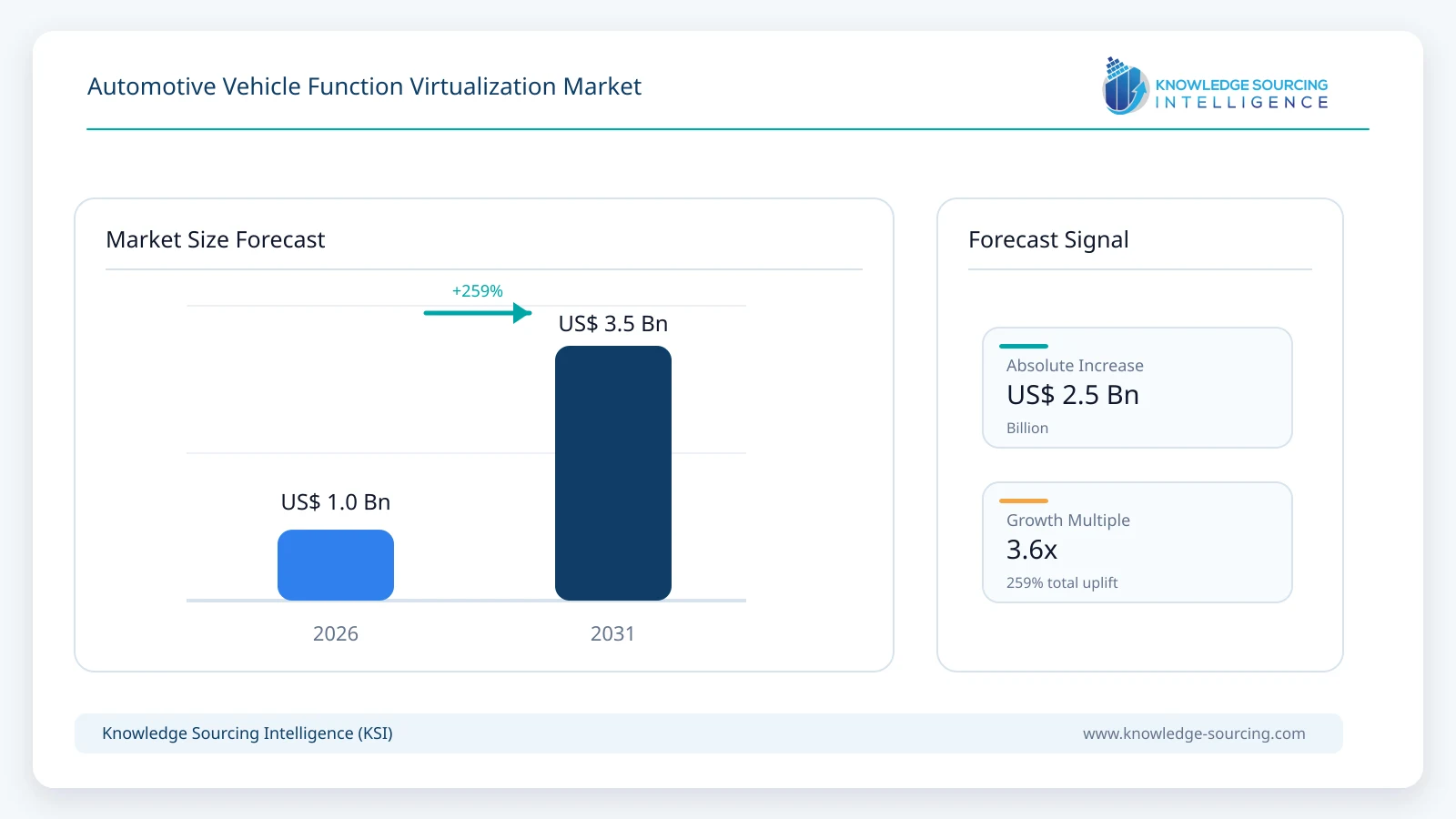
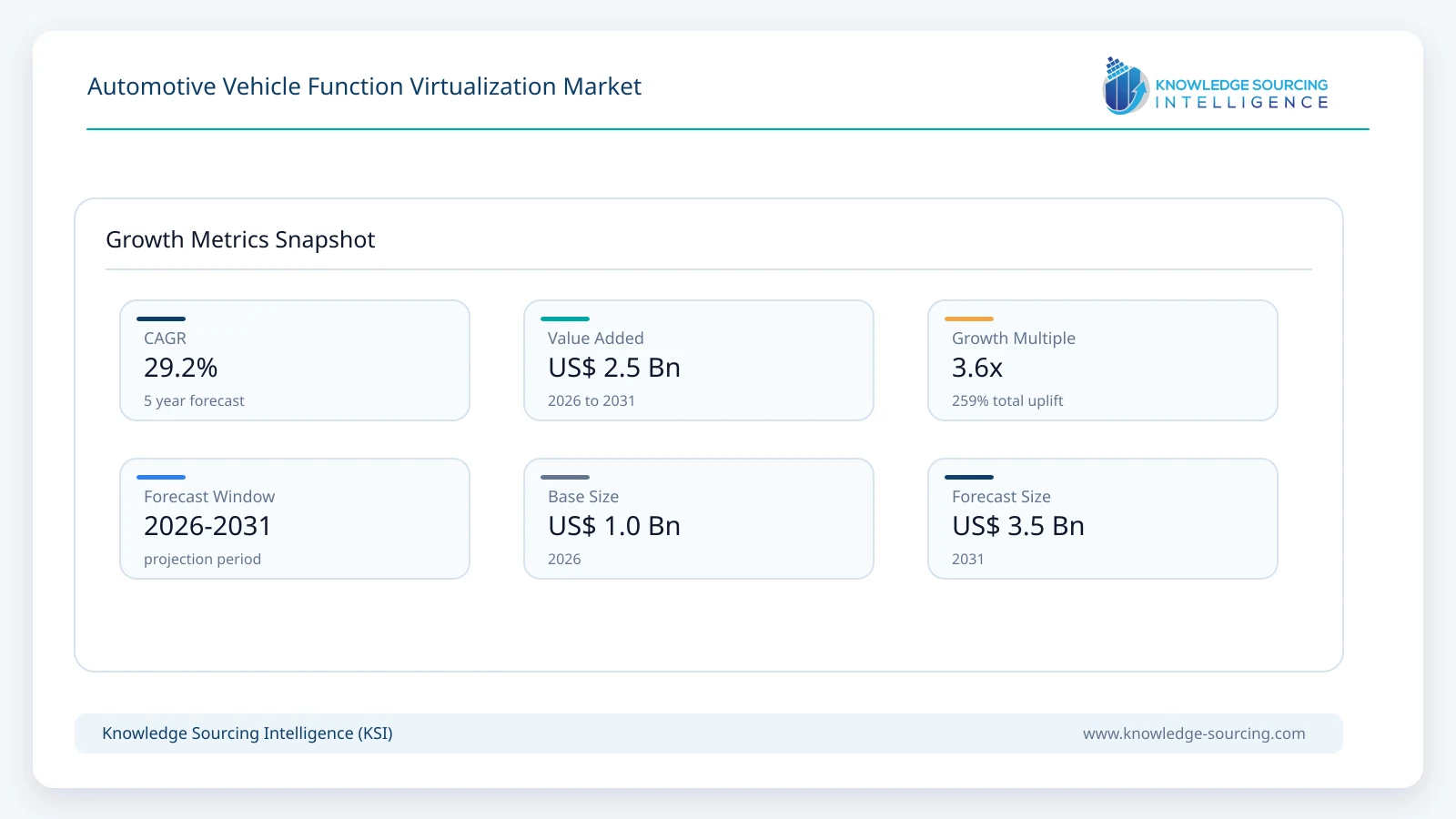
The Automotive Vehicle Function Virtualization Market is forecast to grow at a CAGR of 29.2%, reaching USD 3.45 billion in 2031 from USD 0.96 billion in 2026.
Highlights:
- 1In-vehicle function virtualization is modeled at USD 0.96 billion in 2026 and USD 3.45 billion in 2031.
- 2Hypervisor-led multi-OS platforms account for approximately 58% of attributable 2026 virtualization revenue.
- 3Cockpit and driver-information workloads form the largest initial application group, while safety-related vehicle functions gain share.
- 4Consolidated domain computers lead in 2026; cross-domain central computers are expected to lead in 2031.
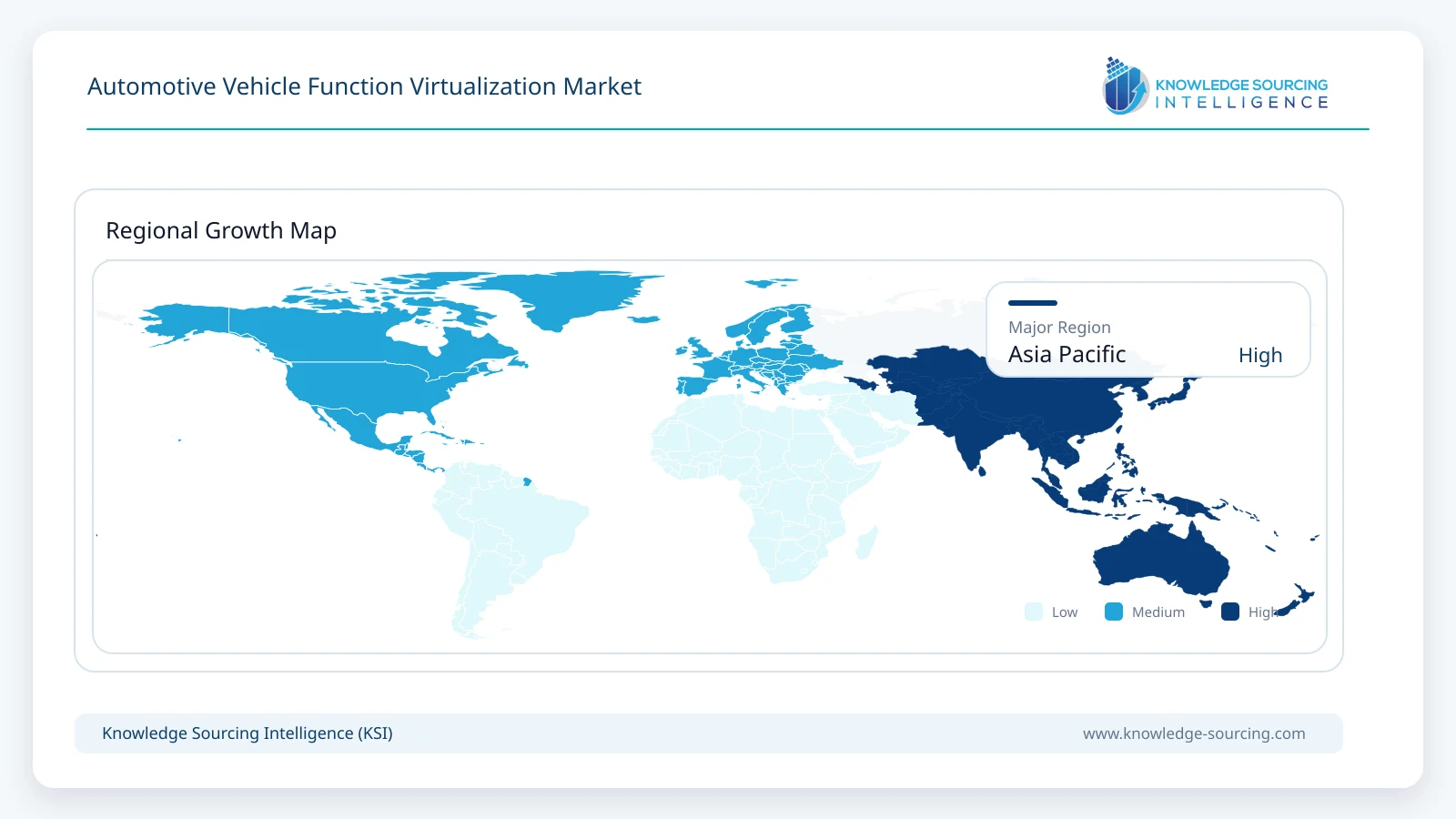
- 5Asia Pacific leads regional market value, supported by Chinese vehicle programs and a substantial regional electronics supply chain.
- 6Supplier qualification, virtual device portability and long-term support influence license and integration economics.
The market covers production-oriented software for isolating, hosting and reusing vehicle functions on domain and central computing systems, together with directly attributable configuration, integration and validation services. OEM demand is concentrated on operating-system separation, controlled hardware access and migration of software between processor generations.
Automotive developers use QNX Hypervisor, Elektrobit EB corbos Hypervisor, Green Hills INTEGRITY Multivisor and similar platforms to preserve boundaries between safety-relevant and general-purpose environments. Function virtualization allows an instrument cluster, infotainment interface, or supported control service to share a computing assembly without sharing an unrestricted failure domain. Hypervisor configuration, peripheral virtualization and long-term software maintenance therefore carry commercial value beyond the basic sale of a processor or control module.
Market Overview
Electronic architectures built around individually programmed ECUs are being replaced selectively by high-performance controllers that host several software environments. QNX describes virtualization as necessary when modern vehicle computers combine operating systems and functions with different criticality levels. Its Hypervisor for Safety 8.0, released in March 2026, targets fault containment and predictable guest execution, while standard non-safety QNX Hypervisor editions have different qualification restrictions.
Elektrobit's EB corbos Hypervisor uses a microkernel foundation and virtualized I/O interfaces to run multiple guest operating systems on one processor. Elektrobit and Kernkonzept previously described the L4Re-based technology as deployed in Continental's ICAS 1 body/chassis computing platform, providing an established example beyond digital cockpit prototyping. OpenSynergy's COQOS Hypervisor SDK and SYSGO's PikeOS address other configurations through reusable virtual devices and partitioned execution.
The commercial ecosystem consists of licensed foundational software vendors, specialist integrators and OEM software teams. Suppliers sell software rights, adaptation to target silicon, freedom-from-interference engineering and sustained updates across vehicle programs. Automotive processor providers contribute hardware virtualization support, but the price of a finished compute unit and stand-alone cloud-based virtual ECU testing are separate revenue pools.
Market Trends
Safety-qualified virtualization is moving beyond multi-OS cockpit consolidation
QNX made Hypervisor 8.0 for Safety generally available in March 2026 with an ISO 26262 ASIL D-oriented architecture for deterministic partitioning. The product targets safety-related systems in which a compromised or malfunctioning guest must not disturb critical functions. Its qualification status is distinct from the regular QNX Hypervisor 8.0 product, which QNX explicitly warns is not intended for safety-related production systems.
Shared-compute architectures increasingly combine safety-relevant displays or control services with Linux and Android environments. Green Hills Software's January 2026 Smart Eye demonstration placed driver monitoring beside instrument-cluster software on a single computing unit with enforced isolation. Although the demonstration is not a vehicle-production award, it indicates the configuration work required before suppliers can commercialize combined safety and information functions.
Virtual device interfaces are reducing dependence on particular processors
Elektrobit EB corbos Hypervisor provides VIRTIO-based access to shared devices, enabling guest operating systems to use virtualized graphics, storage and network resources. OpenSynergy also offers virtual-device capabilities through COQOS Hypervisor SDK. A common guest interface can reduce application rewrites when OEMs select different vehicle processors or revise hardware during a program's life.
Processor portability remains bounded by driver qualification, graphics performance, interrupt behavior and hardware security architecture. Virtualization suppliers therefore compete on validated device support and integration maturity rather than on compatibility claims alone. Engineering contracts can remain substantial even when the base guest software is reusable.
Centralized computing is increasing virtualization content per qualified platform
Automakers introducing cross-domain controllers need to host operating systems, vehicle services and legacy applications within one hardware architecture. Wind River Helix Virtualization Platform, for example, allows multiple guest systems with differing safety requirements to coexist on automotive computing resources. Such designs can substitute virtualization work for separate electronic control assemblies, subject to vehicle-level safety and cost targets.
The 2026 market is still supported by consolidated domain computers, particularly cockpits and body-computing units. By 2031, central cross-domain installations are expected to represent a larger proportion of qualified virtualization revenue, since a greater number of functions and processors require guest migration and virtualized peripherals. The change is not a prediction that every vehicle will employ a single central computer.
Microkernel-based Linux solutions are broadening the qualified software ecosystem
Elektrobit showcased EB corbos Linux for Safety Applications with Telechips, Kernkonzept and Qt at Embedded World 2026. The demonstration combined Linux-based cockpit software, a virtualization foundation, and safety-rendered driver information on the Telechips Dolphin5 processor. The showcased system was a technology demonstration rather than confirmed series production of that exact combination.
Elektrobit's separate February 2026 Mobileye agreement concerns the use of its safety-oriented Linux software in the Mobileye Drive platform. Together, these developments show that certified isolation and automotive-grade Linux are being designed as complementary software layers. They do not establish a common deployment count or justify attributing every Linux installation to virtualization revenue.
Automotive software suppliers are competing on certification and update economics
SYSGO's PikeOS and Green Hills INTEGRITY Multivisor emphasize controlled partitioning, real-time response and support for several guest operating systems. Green Hills announced a May 2026 collaboration involving AMD Versal AI Edge Series Gen 2 silicon and its INTEGRITY, Multivisor and development tools for safety-focused applications, including automotive targets. Certification artifacts and debugging capabilities remain important inputs to supplier selection.
Vehicle manufacturers still must test timing interference, memory protection, device sharing and system recovery after software updates. Standardized guests can reduce porting effort, but changes to the hypervisor, silicon or safety concept may require fresh evidence. Suppliers with mature qualification processes and long support commitments can command a share of the value created by platform reuse.
Segment Analysis
By Virtualization Method: Hypervisor-led Multi-OS Partitioning
Hypervisor-led multi-OS partitioning accounts for an estimated 58% of 2026 market value, supported by cockpit systems that combine Android or Linux with safety-aware real-time functions. QNX, OpenSynergy and Wind River provide commercial solutions for running guest operating systems on shared processors. The segment remains substantial through 2031 even as separation-kernel implementations and lighter-weight isolation approaches serve a growing number of applications.
By Primary Function: Cockpit and Driver Information
Cockpit and driver-information functions represent approximately 45% of 2026 virtualization revenue because instrument displays, infotainment and some camera-related features already share integrated processors. Green Hills, QNX and Elektrobit offer software foundations that allow driver-critical information to remain isolated from consumer-facing applications. The segment is expected to remain the largest single application group while ADAS and vehicle-core integration gain share as central architectures mature.
By Computing Architecture: Consolidated Domain Computers
Consolidated domain computers account for about 58% of the 2026 market, reflecting established multi-OS deployments in cockpits and selected body-control platforms. Cross-domain central computing gains proportionate value toward 2031 as more functions are migrated to shared high-performance processors. Software integrators must maintain defined access to GPUs, memory and interfaces across changing hardware, making the architecture transition a continuing source of configuration and validation revenue.
By Revenue Component: Embedded Virtualization Runtime and Support
Embedded virtualization runtime and attributable software support contribute roughly 74% of the 2026 market. Production-oriented licenses cover partitioning, guest execution, virtual device frameworks, and related platform maintenance. Integration and validation are separately modeled only where not bundled into these software licenses. Reuse across successive vehicle programs is projected to raise the runtime share by 2031, even though vehicle-specific integration remains necessary.
Market Drivers
Consolidation of Cockpit and Vehicle-Core ECUs
Cockpit platforms increasingly run an instrument cluster, media applications, and selected sensing functions on the same processor. Virtualization allows developers to maintain separate software environments while consolidating electronic control hardware, reducing duplicated circuit boards and software interfaces where the vehicle architecture supports it.
QNX and Green Hills offer explicit multi-OS designs for this purpose, while Elektrobit's earlier ICAS 1 experience illustrates use in vehicle-core computing. More consolidated controllers raise demand for platform integration and guest resource management, especially when one OEM architecture serves several models. Vehicle-program repeatability also reduces the number of controller-specific software variants that engineering teams must maintain.
Automotive Functional-Safety and Fault-Isolation Requirements
Instrument-cluster warnings, driver monitoring and controlled vehicle functions require safeguards against faults originating in less critical guest applications. Certified virtualization platforms can establish memory, processing and device-access boundaries that become part of a vehicle's ISO 26262 safety case.
QNX's March 2026 Hypervisor for Safety release strengthens the qualified supplier set, while SYSGO and Green Hills compete through separation-kernel and certified real-time operating-system technologies. Automakers still bear vehicle-level validation responsibility, but supplier safety evidence supports adoption in mixed-criticality platforms. This requirement is especially consequential when a general-purpose guest shares graphics or memory interfaces with regulated warnings.
Reuse of Vehicle Software Across Processor Generations
Automakers that deploy shared vehicle functions across several models benefit from separating guest operating systems and applications from changing processor and device interfaces. VIRTIO-compatible frameworks and hardware abstraction reduce selected migration work when functions move from one controller generation to the next.
Elektrobit, OpenSynergy and Wind River supply virtual-device or hypervisor foundations designed for portability. OEM purchasing teams can therefore justify virtualization through shorter redevelopment cycles and lower long-term integration effort, even when the first platform requires additional engineering expenditure. Standardized guest drivers also make it easier to preserve application behavior during phased processor transitions.
Expansion of Safety-Aware Linux and Android Software Environments
Android and Linux ecosystems provide application flexibility but cannot automatically supply the deterministic isolation expected for safety-related vehicle features. Production software architectures increasingly combine open-source guests with qualified hypervisors, safety monitors or controlled real-time environments.
Elektrobit's 2026 work with Telechips and Kernkonzept demonstrates a safety-focused Linux cockpit architecture, while its Mobileye collaboration supports broader evaluation of automotive-grade Linux. Wider guest-OS choice creates licensing demand for software components that make these environments suitable for shared automotive hardware. Supported guests can also separate infotainment release schedules from functional-safety release baselines.
Long-Lifecycle Update and Service Requirements
Automakers must maintain software partitions and controlled device access for many years after the initial vehicle launch. Updates to an infotainment guest or virtual device should not compromise the timing, availability or security boundary of other functions on the same controller.
Commercial virtualization suppliers offer platform support, integration testing and configuration maintenance to address these obligations. Lifecycle requirements can sustain revenue beyond launch engineering, although software-support payments are counted only once and must be distinguished from unrelated connectivity subscriptions. On-board diagnostics and rollback logic must remain dependable when individual partitions are modified.
Market Restraints
Safety Qualification Remains Platform-Specific
A virtualization product's certification or safety documentation does not automatically certify the completed vehicle function. OEMs and suppliers must still prove that guest tasks meet timing budgets, that failure propagation is contained and that the intended operating conditions match the safety manual.
QNX explicitly distinguishes its safety-qualified hypervisor variant from the regular product. Similar constraints apply when system designers change processor configurations or guest software. These approval cycles slow migration from demonstration hardware into mass-produced controller platforms. A processor change can trigger fresh integration evidence even if the hypervisor version is unchanged.
Shared GPU and I/O Contention Raises Integration Complexity
Cockpit displays, perception tasks and network services can contend for graphics resources, memory bandwidth and external devices even when their operating systems are isolated. Virtual device frameworks introduce configuration layers that must preserve responsiveness and predictable access under heavy loads.
OEM teams must test resource contention during startup, shutdown, faults and updates, not only during typical operation. This engineering burden can reduce the financial benefit of ECU consolidation and discourage virtualization on cost-sensitive vehicle programs. GPU virtualization and direct-memory-access permissions can also affect the fault model for applications with differing criticality.
Legacy ECU Software Is Difficult to Migrate Without Requalification
Functions designed around a particular microcontroller or peripheral frequently rely on hard-coded assumptions about interrupt timing, drivers and memory access. Packaging an existing software image as a guest does not eliminate these dependencies or guarantee predictable performance on a central processor.
Automakers transferring control functions therefore face application adaptation, hardware-interface emulation and renewed validation. Migration risk is greatest where safety-critical software has long established qualification evidence tied to dedicated hardware. Vehicle networks, watchdog timing and actuator access often need bespoke bridge software before the migration is viable.
Open Interfaces Do Not Eliminate Supplier Lock-in
VIRTIO-style device interfaces and portable guest operating systems can reduce dependence on individual processors, but hypervisor-specific management tools, safety artifacts and optimized drivers remain vendor-dependent. Changing suppliers may require redevelopment of partition configurations and revalidation of the complete platform.
Vehicle manufacturers consequently face trade-offs between an integrated, supported virtualization stack and a more modular architecture assembled from multiple vendors. Unclear responsibility for defects can extend debugging cycles and weaken expected reuse savings. Independent safety assessors may also require traceability across hardware, guest operating systems and virtualization configuration tools.
Platform Economics Are Unfavorable for Simpler Vehicles
Entry-level vehicles with modest computing demands may be served effectively by conventional domain ECUs or separate microcontrollers. Licensing, memory overhead, virtual device development, and long-term engineering support can outweigh hardware savings when there are too few workloads to consolidate.
Vehicle makers therefore prioritize virtualization where mixed software ecosystems or rapid feature evolution create a clear engineering need. Fragmented production volumes and shorter application roadmaps can limit attractive software-content value in lower-cost platforms. Smaller production programs may struggle to amortize specialized validation across enough vehicles to justify implementation.
Regional Outlook
Asia Pacific
Asia Pacific is estimated to account for 40% of automotive vehicle function virtualization revenue in 2026, reflecting high production volumes and active development of software-rich passenger vehicles. China hosts rapid iteration of cockpit and central electronic architectures, while Japanese and South Korean manufacturers combine established functional-safety engineering with increasingly connected vehicle platforms.
Elektrobit's 2025 Metoak partnership in China illustrates early work to integrate automotive-grade Linux and processor technology for ADAS functions. Regional opportunities extend to software validation, processor adaptation and guest-environment portability, with the most attractive projects tied to repeated vehicle programs rather than single showcase prototypes.
Europe
European software suppliers account for a significant part of the qualified virtualization technology base. Elektrobit and Kernkonzept support L4Re-based virtualization; SYSGO supplies PikeOS, and OpenSynergy offers COQOS Hypervisor SDK. European OEM engineering teams have strong requirements for functional-safety traceability, controlled software updates and long-lived supplier support.
Europe represents an estimated 29% of 2026 global market value, with demand spanning cockpit, gateway and mixed-criticality computing programs. Adoption is constrained by validation effort and established controller architectures, but industry work on software reuse and portable operating environments supports continued spending on specialist virtualization software.
Competitive Landscape
QNX, Green Hills Software, Elektrobit, OpenSynergy, SYSGO and Wind River compete primarily through foundational virtualization products, automotive safety evidence and support for multiple guest operating systems. Their commercial positions differ by microkernel or separation-kernel architecture, device sharing, integration tooling and relationship with particular OEM programs. Automotive software qualification is a significant differentiator because a general-purpose hypervisor cannot be presumed suitable for safety-related production use.
Kernkonzept contributes the L4Re foundation underlying Elektrobit's solution, while Tata Elxsi and other specialist engineering firms participate through customized cockpit and control-platform integration. Processor vendors support hardware virtual-machine features but are not equivalent to independent virtualization software suppliers. Public financial reporting does not support a reliable company-by-company revenue share for this narrowly defined market.
Recent Developments
March 2026: QNX made QNX Hypervisor 8.0 for Safety generally available for safety-critical embedded virtualization, with qualification-oriented isolation of guest software.
March 2026: Elektrobit introduced a safe-cockpit demonstration with Telechips, Kernkonzept and Qt Group, combining its Linux for Safety software with L4Re virtualization on a Telechips SoC.
February 2026: Elektrobit and Mobileye announced plans to integrate EB corbos Linux for Safety Applications into Mobileye Drive, extending opportunities for qualified Linux software in vehicle systems.
January 2026: Green Hills Software and Smart Eye demonstrated driver-monitoring and instrument-cluster software on a shared ECU with isolation, illustrating a production-oriented mixed-criticality configuration rather than confirming series production.
May 2026: Green Hills announced a collaboration with AMD to offer INTEGRITY, Multivisor and safety-development tools for Versal AI Edge Series Gen 2 devices, targeting automotive and other safety-critical applications.
April 2025: Elektrobit and Metoak announced a strategic ADAS software collaboration in China using EB corbos Linux for Safety Applications, with an initial mass-production project entering development.
Market Outlook
Automotive vehicle function virtualization is projected to rise from USD 0.96 billion in 2026 to USD 3.45 billion by 2031 as production vehicles host more functions on consolidated processors. Cockpit installations remain important, while the relative contribution of central cross-domain and safety-relevant applications increases as OEMs mature their software architectures. Qualified guest isolation, device interfaces and reusable software environments will determine how much value can be captured by specialist vendors.
Product competition will increasingly involve safety documentation, support for newer processors, update resilience and the cost of moving a qualified function between hardware platforms. OEM-owned software and open-source foundations may limit prices for basic virtualization capabilities, but platform integration and safety accountability support continuing demand for commercial suppliers. Future revenue depends on measurable production adoption rather than announcements of virtualization-ready silicon alone.
Automotive Vehicle Function Virtualization Market Scope:
| Report Metric | Details |
|---|---|
| Total Market Size in 2026 | USD 0.96 billion |
| Total Market Size in 2031 | USD 3.45 billion |
| Forecast Unit | USD Billion |
| Growth Rate | 29.2% |
| Study Period | 2021 to 2031 |
| Historical Data | 2021 to 2024 |
| Base Year | 2025 |
| Forecast Period | 2026 – 2031 |
| Segmentation | Virtualization Method, Primary Vehicle Function, Compute Deployment Architecture, Revenue Component |
| Companies |
|
Market Segmentation
By Virtualization Method
Hypervisor-led Multi-OS Partitioning
Separation-kernel and Safety-partitioned Functions
Container-assisted and Lightweight Virtualization
By Primary Vehicle Function
Cockpit and Driver Information
Body, Gateway and Connectivity
ADAS and Safety-relevant Functions
Powertrain and Chassis Integration
By Compute Deployment Architecture
Consolidated Domain Computers
Central Cross-domain Computers
Central-to-zonal Virtualized Systems
By Revenue Component
Embedded Runtime and Software Support
Integration and Validation Services
By Vehicle Type
Passenger Vehicles
Light Commercial Vehicles
Medium and Heavy Commercial Vehicles
By Geography
North America
United States
Canada
Mexico
South America
Brazil
Argentina
Others
Europe
Germany
United Kingdom
France
Italy
Spain
Others
Middle East and Africa
Saudi Arabia
United Arab Emirates
Israel
South Africa
Others
Asia Pacific
China
Japan
India
South Korea
Indonesia
Thailand
Taiwan
Australia
Others
Table of Contents
1. EXECUTIVE SUMMARY
1.1. Market Opportunity and Key Findings
1.2. Global Market Size and Forecast, 2026–2031
1.3. Segmentation and Regional Highlights
2. MARKET SNAPSHOT
2.1. Market Overview
2.2. Market Definition
2.3. Scope of the Study
2.4. Market Segmentation
3. BUSINESS LANDSCAPE
3.1. Market Drivers
3.1.1. Consolidation of Cockpit and Vehicle-Core ECUs
3.1.2. Automotive Functional-Safety and Fault-Isolation Requirements
3.1.3. Reuse of Vehicle Software Across Processor Generations
3.1.4. Expansion of Safety-Aware Linux and Android Software Environments
3.1.5. Long-Lifecycle Update and Service Requirements
3.2. Market Restraints
3.2.1. Safety Qualification Remains Platform-Specific
3.2.2. Shared GPU and I/O Contention Raises Integration Complexity
3.2.3. Legacy ECU Software Is Difficult to Migrate Without Requalification
3.2.4. Open Interfaces Do Not Eliminate Supplier Lock-in
3.2.5. Platform Economics Are Unfavorable for Simpler Vehicles
3.3. Market Opportunities
3.4. Porter’s Five Forces Analysis
3.5. Industry Value Chain Analysis
3.6. Policies and Regulations
3.7. Strategic Recommendations
4. TECHNOLOGICAL OUTLOOK
4.1. Automotive Hypervisors and Virtual Machines
4.2. Microkernel and Separation-Kernel Virtualization
4.3. VIRTIO and Virtual Peripheral Interfaces
4.4. Safety Isolation, Scheduling and Fault Containment
4.5. Guest OS Portability and Legacy ECU Migration
4.6. Virtualization Configuration, Release and Lifecycle Support
5. AUTOMOTIVE VEHICLE FUNCTION VIRTUALIZATION MARKET BY VIRTUALIZATION METHOD
5.1. Introduction
5.2. Hypervisor-led Multi-OS Partitioning
5.3. Separation-Kernel and Safety-Partitioned Functions
5.4. Container-Assisted and Lightweight Virtualization
6. AUTOMOTIVE VEHICLE FUNCTION VIRTUALIZATION MARKET BY PRIMARY VEHICLE FUNCTION
6.1. Introduction
6.2. Cockpit and Driver Information
6.3. Body, Gateway and Connectivity
6.4. ADAS and Safety-Relevant Functions
6.5. Powertrain and Chassis Integration
7. AUTOMOTIVE VEHICLE FUNCTION VIRTUALIZATION MARKET BY COMPUTE DEPLOYMENT ARCHITECTURE
7.1. Introduction
7.2. Consolidated Domain Computers
7.3. Central Cross-Domain Computers
7.4. Central-to-Zonal Virtualized Systems
8. AUTOMOTIVE VEHICLE FUNCTION VIRTUALIZATION MARKET BY REVENUE COMPONENT
8.1. Introduction
8.2. Embedded Runtime and Software Support
8.3. Integration and Validation Services
9. AUTOMOTIVE VEHICLE FUNCTION VIRTUALIZATION MARKET BY VEHICLE TYPE
9.1. Introduction
9.2. Passenger Vehicles
9.3. Light Commercial Vehicles
9.4. Medium and Heavy Commercial Vehicles
10. AUTOMOTIVE VEHICLE FUNCTION VIRTUALIZATION MARKET BY GEOGRAPHY
10.1. North America
10.1.1. United States
10.1.2. Canada
10.1.3. Mexico
10.2. South America
10.2.1. Brazil
10.2.2. Argentina
10.2.3. Others
10.3. Europe
10.3.1. Germany
10.3.2. United Kingdom
10.3.3. France
10.3.4. Italy
10.3.5. Spain
10.3.6. Others
10.4. Middle East and Africa
10.4.1. Saudi Arabia
10.4.2. United Arab Emirates
10.4.3. Israel
10.4.4. South Africa
10.4.5. Others
10.5. Asia Pacific
10.5.1. China
10.5.2. Japan
10.5.3. India
10.5.4. South Korea
10.5.5. Indonesia
10.5.6. Thailand
10.5.7. Taiwan
10.5.8. Australia
10.5.9. Others
11. COMPETITIVE ENVIRONMENT AND ANALYSIS
11.1. Major Players and Strategy Analysis
11.2. Market Share Analysis
11.3. Mergers, Acquisitions, Agreements and Collaborations
11.4. Competitive Dashboard
12. COMPANY PROFILES
12.1. QNX (BlackBerry Limited)
12.2. Green Hills Software, LLC
12.3. Elektrobit Automotive GmbH
12.4. OpenSynergy GmbH
12.5. SYSGO GmbH
12.6. Wind River Systems, Inc.
12.7. Kernkonzept GmbH
12.8. Lynx Software Technologies
12.9. Tata Elxsi Limited
12.10. ETAS GmbH
13. APPENDIX
13.1. Currency
13.2. Assumptions
13.3. Base and Forecast Years Timeline
13.4. Key Benefits to Stakeholders
13.5. Research Methodology
13.6. Abbreviations
Navigate
Trusted by the world's leading organizations











