
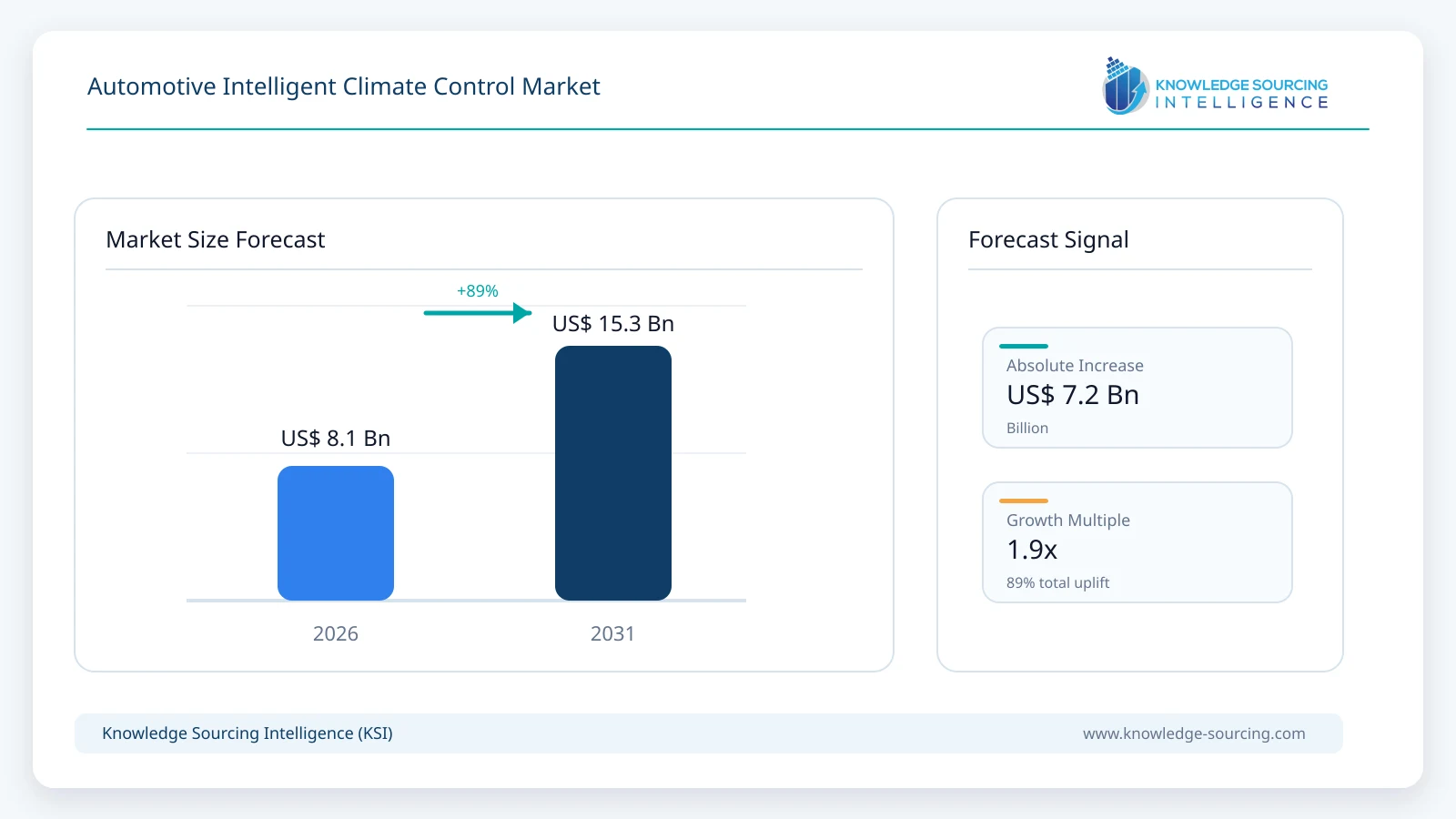
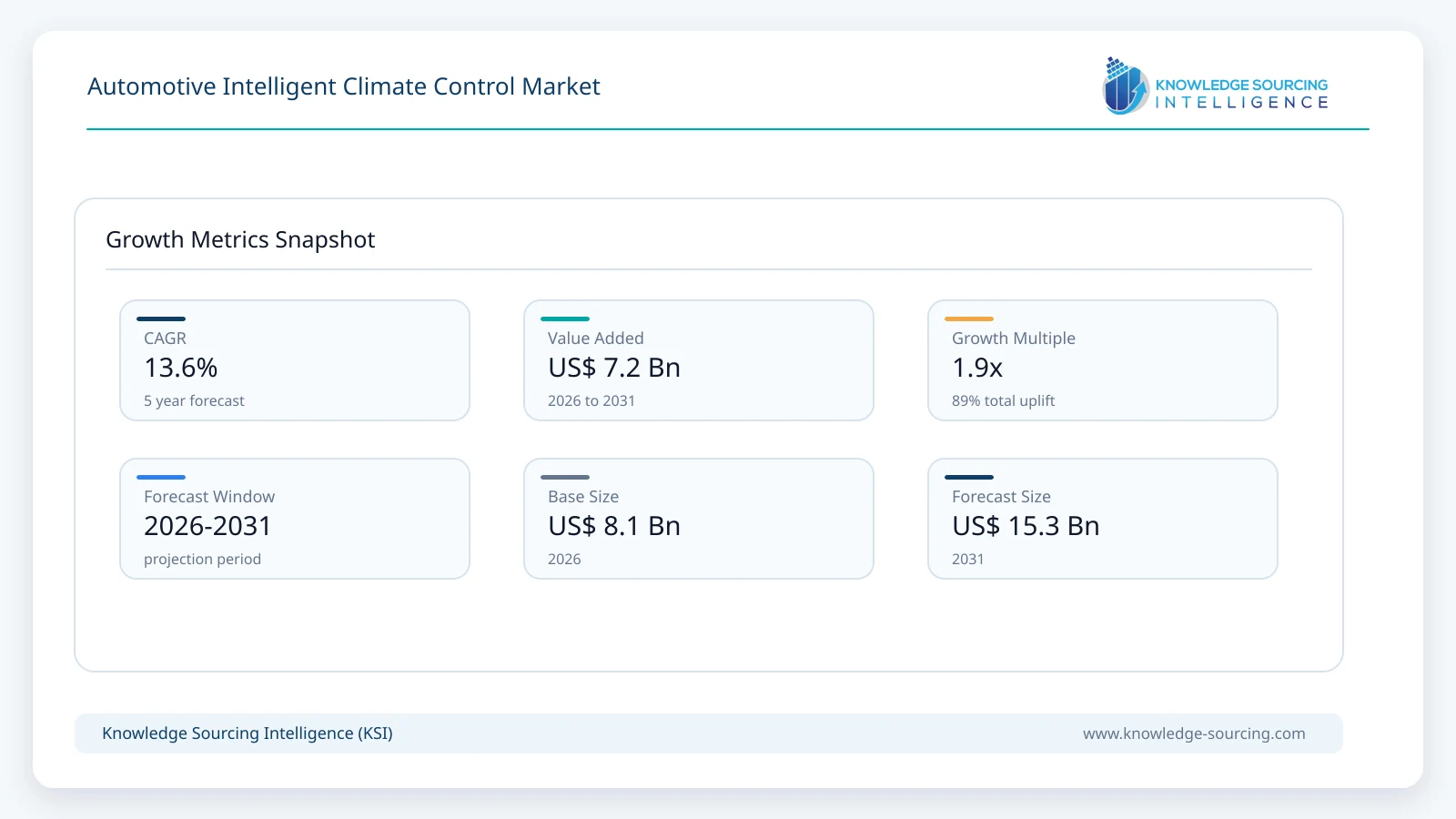
The automotive intelligent climate control market is forecast to grow at a CAGR of 13.6%, reaching approximately USD 15.3 billion by 2031 from USD 8.10 billion in 2026.
Key Highlights
• Multi-zone automatic HVAC and personalized air-distribution systems account for approximately 37% of global market value in 2026 because they provide the primary architecture for independently controlling temperature and airflow across driver and passenger zones.
• Sensor- and AI-driven climate control functions represent approximately 33% of market value in 2026, supported by increasing use of cabin temperature, solar, humidity, air-quality, occupancy and thermal-sensation inputs.
• Integrated central-HVAC and localized microclimate architectures account for approximately 58% of 2026 market value as automakers coordinate vents, seat heating and ventilation, radiant surfaces and other thermal effectors through shared control software.
• Passenger vehicles represent approximately 84% of global market value in 2026 because multi-zone automatic climate control and personalized thermal features are concentrated in passenger cars, SUVs and premium electric vehicles.
• Battery electric vehicles account for approximately 44% of market value in 2026 because efficient cabin climate control is directly linked to driving range, battery utilization and charging-time comfort.
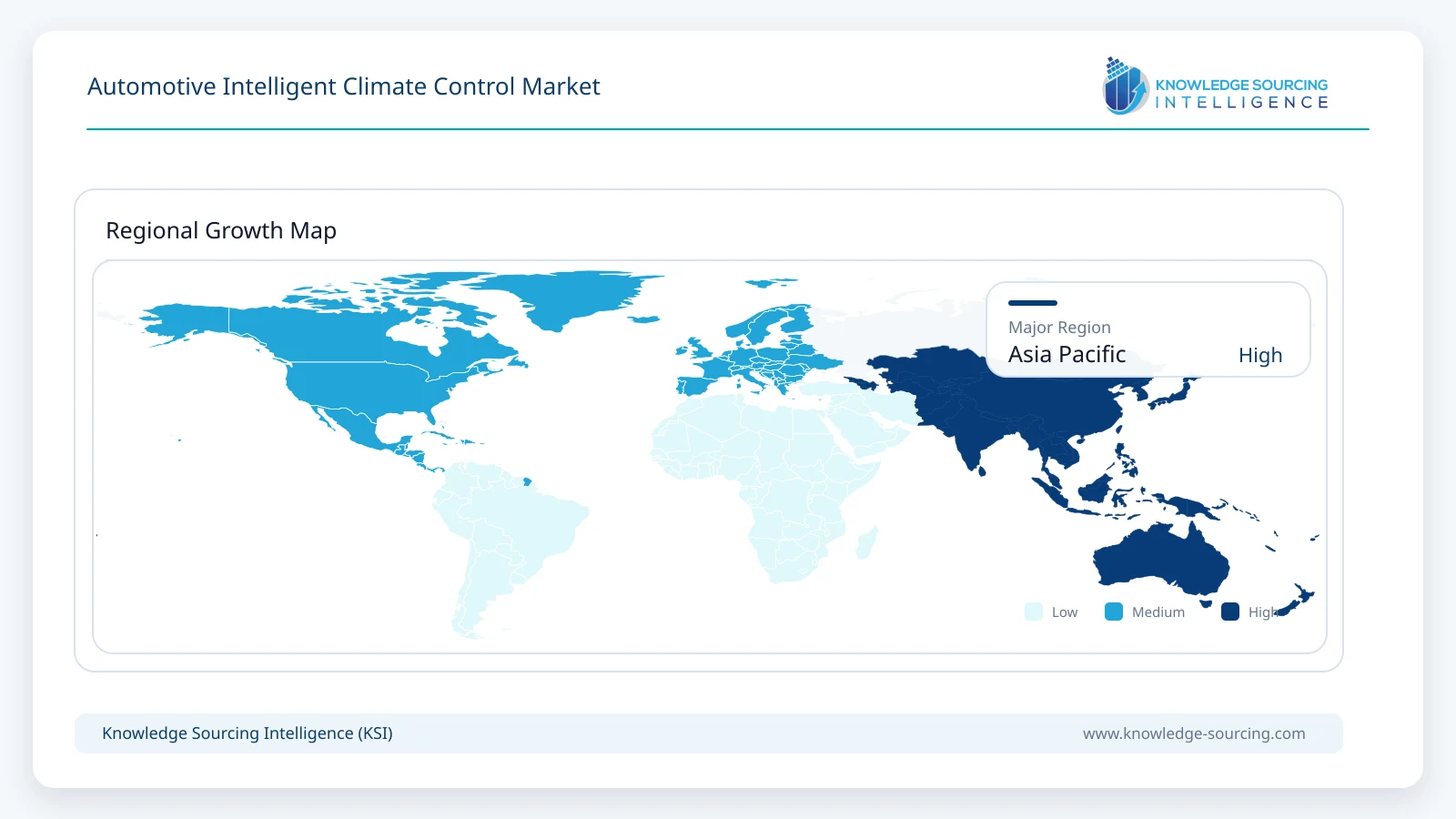
• Asia Pacific represents approximately 43% of global market value in 2026, supported by high vehicle production, rapid EV adoption and strong smart-cabin competition in China, Japan and South Korea.
Climate systems are moving beyond fixed temperature set points toward software-managed thermal environments that use occupancy, solar load, humidity, air quality, physiological inputs and vehicle energy state to determine how heating, cooling and airflow should be delivered.
Commercial development is accelerating across both centralized HVAC and localized microclimate systems. Valeo has secured multiple programs for its Dual Layer HVAC with AI-based temperature and airflow control, Hanon Systems is expanding AI-integrated and software-defined thermal management, Gentherm is scaling ClimateSense and other personalized climate technologies, MAHLE is commercializing intelligent thermal-management and heat-recovery solutions, Lear is expanding modular thermal comfort systems, and DENSO continues to integrate sensors, heat pumps, air-quality controls and personal heating/cooling devices within broader thermal architectures.
Intelligent climate control increasingly connects cabin comfort with vehicle energy management. In battery electric vehicles, heating and cooling compete directly with propulsion for stored energy, increasing the value of heat pumps, heat recovery, localized seat and surface conditioning, occupancy-based zoning and predictive preconditioning. The resulting market includes hardware, sensing, controllers and software that coordinate central HVAC with occupant-level thermal comfort.
Market Overview
Intelligent climate control is becoming a core software-defined cabin function. Conventional automatic HVAC reacts mainly to temperature settings, while newer systems use a wider set of inputs to estimate thermal comfort and distribute heating or cooling only where it is needed. This reduces manual adjustment while improving both comfort consistency and energy efficiency.
Multi-zone architectures are becoming more sophisticated. Valeo's Dual Layer HVAC combines four-zone air distribution with AI-driven temperature and air-volume algorithms that respond to driver and passenger position, while DENSO uses sensors such as matrix infrared and thermal-sensation devices to improve automatic control of cabin conditions.
Localized microclimate technologies are expanding the control surface beyond air vents. Gentherm ClimateSense coordinates localized convective, conductive and radiant heating and cooling with central HVAC using thermal-comfort algorithms. Lear is also scaling modular thermal-comfort products that embed heating, ventilation and other functions into seating systems.
Electrification is reinforcing the shift toward intelligent thermal management. Heat pumps, waste-heat recovery and predictive energy control allow the vehicle to balance passenger comfort with battery, powertrain and charging requirements. MAHLE, Hanon Systems, Valeo and DENSO are all integrating cabin conditioning more closely with full-vehicle thermal-management architectures.
The long-term direction is toward predictive and occupant-aware control. Vehicles can combine weather forecasts, navigation, charging plans, occupancy, user profiles, solar load and physiological comfort models to precondition the cabin and continuously adjust airflow, surface temperature and HVAC output. This shifts climate control from a reactive subsystem toward a coordinated software service.
Market Trends
AI and Predictive Algorithms Are Replacing Fixed Climate-Control Logic
Climate control software is increasingly using occupancy, ambient conditions and learned preferences to determine set points and airflow rather than relying only on manual temperature commands. Valeo has already integrated AI-based temperature and air-volume control into production-oriented HVAC programs, while Hanon Systems is expanding software and AI content across its thermal-management portfolio.
Predictive control can also use navigation, weather and charging information to precondition the cabin before departure or reduce thermal load when vehicle energy is constrained. This creates value around algorithms and centralized control rather than only HVAC hardware.
Personalized Microclimate Is Expanding beyond Central HVAC
Seat ventilation, surface heating, radiant panels, neck conditioning and directed airflow can heat or cool the occupant directly. These localized effectors allow different occupants to experience different thermal conditions even when they share the same cabin.
Gentherm ClimateSense demonstrates this architecture by coordinating central HVAC with localized thermal effectors and occupant-focused algorithms. The approach is especially attractive in EVs because comfort can be delivered with less whole-cabin energy demand.
Smart Recirculation and Air Quality Are Becoming Climate-Control Inputs
Modern climate systems increasingly consider humidity, PM2.5, exhaust gases and cabin air quality when deciding whether to draw fresh air or recirculate interior air. DENSO combines air-quality devices and sensors with automatic control, while other suppliers integrate filtration and fresh-air strategies into energy-efficient HVAC systems.
This makes air quality part of climate intelligence rather than a separate feature. Control software must balance clean air, humidity, demisting, thermal comfort and energy consumption in real time.
EV Range Pressure Is Accelerating Heat Pumps and Heat Recovery
Heating can consume a meaningful share of battery energy in cold weather. MAHLE HeatX Range+ recovers cabin exhaust heat to reduce air-conditioning energy demand, while Valeo and Hanon Systems continue to integrate heat-pump and refrigerant-control technologies into broader EV thermal platforms.
The strongest systems manage cabin, battery and powertrain heat together rather than operating each loop independently. This creates a direct link between climate intelligence, driving range, charging performance and component life.
Software-Defined Thermal Management Is Increasing Lifecycle Value
Centralized vehicle compute enables climate logic to be updated after production. Calibration changes, new comfort modes, smarter energy optimization and personalized profiles can be delivered through software rather than requiring hardware redesign.
This model supports greater differentiation across vehicle trims and regions while allowing OEMs to refine control strategies using fleet data and changing energy-efficiency targets.
Segment Analysis
By System Type: Multi-Zone Automatic HVAC and Personalized Air Distribution
Multi-zone automatic HVAC and personalized air-distribution systems are projected to generate approximately USD 5.60 billion of market value by 2031. Growth will be supported by wider adoption of three- and four-zone climate architectures, occupant-aware vents and software-controlled air distribution across front and rear seating rows.
The segment will remain the largest because central HVAC continues to provide the base thermal capacity for the cabin. Intelligence will increasingly come from sensors, zonal control and algorithms that reduce over-conditioning while improving time-to-comfort.
By Control Architecture: Sensor- and AI-Driven Climate Control
Sensor- and AI-driven climate control is projected to exceed USD 5.30 billion by 2031. These systems combine temperature, humidity, solar, air-quality, occupancy and thermal-sensation data with control algorithms that determine how much heating, cooling and airflow each zone requires.
The segment is expected to grow faster than conventional automatic control because it improves both personalization and efficiency. Integration with driver monitoring, seat occupancy and digital profiles will further strengthen adaptive climate logic.
By Comfort Architecture: Integrated HVAC and Localized Microclimate Systems
Integrated HVAC and localized microclimate systems are projected to approach USD 9.40 billion by 2031. The architecture coordinates central air conditioning with seat heating and ventilation, radiant surfaces, localized blowers and other thermal effectors.
The commercial advantage is the ability to condition occupants directly rather than treating the cabin as one uniform thermal volume. This improves comfort response and can reduce energy consumption, particularly when only selected seats are occupied.
By Vehicle Type: Passenger Vehicles
Passenger vehicles are projected to generate approximately USD 12.70 billion of intelligent climate-control market value by 2031. Premium EVs and SUVs will remain the highest-content applications, but multi-zone and smart automatic climate functions are expected to broaden across mid-range vehicles.
Mass-market adoption will be supported by lower sensor costs, standardized HVAC electronics and software reuse across multiple platforms. Commercial vehicles will remain important for duty-cycle efficiency and driver comfort but represent a smaller value pool.
By Propulsion: Battery Electric Vehicles
Battery electric vehicles are projected to generate approximately USD 7.50 billion of market value by 2031. EVs provide the strongest incentive for energy-aware climate control because cabin heating and cooling directly affect range and battery utilization.
Heat pumps, predictive preconditioning, occupancy-based zoning and localized thermal comfort will therefore see faster adoption in BEVs than in conventional vehicles. Climate software will increasingly coordinate with battery and charging systems to optimize total vehicle energy use.
Market Drivers
Electrification and the Need to Reduce Cabin Thermal Energy Consumption
Battery electric vehicles create a direct economic and range incentive to reduce climate-control energy use. Intelligent zoning, heat pumps, heat recovery and localized heating or cooling can maintain comfort while lowering demand on the high-voltage battery.
This makes climate control part of vehicle energy strategy rather than a standalone comfort subsystem and encourages closer integration between cabin, battery and powertrain thermal management.
Growing Demand for Personalized and Multi-Zone Thermal Comfort
Occupants increasingly expect individual temperature and airflow preferences, particularly in premium vehicles and larger SUVs. Multi-zone HVAC, seat-level thermal systems and occupant sensing allow the vehicle to deliver different comfort conditions within the same cabin.
The shift toward personalized profiles also increases the value of software that can remember preferences and automatically restore them across journeys.
Advances in Sensors, Occupant Detection and Thermal-Sensation Modelling
Cabin temperature, solar, humidity, infrared, occupancy and air-quality sensors provide a richer view of thermal conditions than a single temperature sensor. Thermal-sensation models can then estimate how occupants actually feel rather than simply targeting an air-temperature set point.
Improved sensing makes automatic control more accurate and enables the vehicle to adjust proactively when solar load, clothing, seat occupancy or passenger location changes.
Growth of Software-Defined Vehicle and Centralized Electronics Architectures
Centralized compute allows HVAC, seats, air quality, battery thermal management and digital user profiles to share data. This supports coordinated comfort modes, predictive control and over-the-air improvement of climate algorithms.
Software-defined architecture also lowers the cost of differentiating climate features across trims and regions because many functions can be enabled through calibration and software rather than unique hardware.
Vehicle Premiumization and Competition around Cabin Experience
As powertrain differences narrow, automakers increasingly use cabin experience to differentiate vehicles. Fast heating, individualized airflow, silent climate operation and automatic comfort are visible features that influence perceived quality.
Premium Chinese EVs and established global luxury brands are accelerating adoption of advanced climate technologies, with selected functions expected to migrate into higher-volume segments over the forecast period.
Market Restraints
High Cost and Integration Complexity
Advanced climate architectures can require multiple sensors, electronic vents, localized blowers, thermal effectors, heat-pump components and additional software validation. The combined cost remains difficult to justify in entry-level vehicles.
OEMs must balance personalization with common hardware platforms and modularity to prevent climate systems from becoming too complex or expensive to manufacture and service.
Difficult Calibration across Occupants, Climates and Vehicle Geometries
Thermal comfort is subjective and changes with body size, clothing, age, humidity, sunlight and local climate. A control strategy calibrated for one market or vehicle body style may not deliver the same comfort elsewhere.
Suppliers therefore require extensive climatic testing, human-subject validation and software tuning, increasing development cost and time.
Energy Savings Can Conflict with Fresh-Air and Demisting Requirements
Recirculation and reduced HVAC output can lower energy consumption, but excessive optimization may increase humidity, reduce air freshness or slow windscreen demisting. Intelligent climate control must therefore prioritize safety and air quality before efficiency.
Balancing these objectives becomes more difficult in cold, humid or polluted environments where heating, dehumidification and fresh-air needs can occur simultaneously.
Cybersecurity and Software Reliability in Centralized Climate Control
As climate functions move onto centralized vehicle software, faults or cybersecurity issues can affect multiple comfort and safety functions at once. HVAC controls also support demisting and battery thermal interaction, increasing the importance of robust software validation.
OEMs need fail-safe operating modes, secure updates and clear separation between comfort personalization and safety-critical thermal functions.
Packaging and Refrigerant Transition Constraints
Heat pumps, valves, exchangers and multi-zone air-distribution components compete for limited packaging space. At the same time, the industry is transitioning toward lower-global-warming-potential refrigerants and more integrated thermal loops.
Designing systems that are compact, efficient, serviceable and compatible with multiple powertrains can slow platform adoption and raise engineering costs.
Regional Outlook
Asia Pacific
Asia Pacific is the largest regional market and is expected to remain the strongest growth centre through 2031. China is driving rapid adoption of multi-zone HVAC, smart vents and energy-efficient climate systems through intense EV and smart-cabin competition, while Japan and South Korea contribute deep thermal-management and electronics capabilities.
Valeo has secured multiple Dual Layer HVAC contracts with Chinese automakers, including AI-based control of temperature and air volume, while Hanon Systems is expanding AI-integrated thermal management and DENSO continues to combine HVAC, sensors and personal heating/cooling technologies. MAHLE has also deployed intelligent thermal management on Mahindra electric platforms in India.
Regional growth will be supported by high vehicle production, strong electrification and rapid feature migration from premium to mid-range vehicles. Suppliers that combine localized engineering, low cost and software capability are positioned to gain share.
Europe
Europe is a major high-value market because stringent efficiency targets, strong EV penetration and premium-vehicle demand encourage advanced heat pumps, microclimate systems and predictive thermal control. The region is also home to major suppliers including Valeo, MAHLE and Gentherm's European engineering operations.
European programs increasingly emphasize efficient winter heating, low-energy comfort and integration of cabin climate with full-vehicle thermal management. MAHLE HeatX Range+ demonstrates the focus on recovering cabin heat, while Valeo Smart Thermal Management combines intelligent control with integrated hardware for electrified platforms.
Growth through 2031 will depend on balancing energy efficiency with demisting, air quality and premium comfort. Software integration and localized thermal effectors are expected to gain importance as OEMs seek greater range without compromising occupant experience.
Competitive Landscape
The automotive intelligent climate control market includes HVAC and thermal-management suppliers, seating-comfort specialists and climate-control electronics providers. Gentherm, Hanon Systems, Valeo, MAHLE, Lear and DENSO are directly active in personalized thermal comfort, smart HVAC, heat pumps, climate-control sensing, localized effectors or software-defined thermal management.
Gentherm differentiates through ClimateSense and occupant-focused thermal algorithms, while Hanon Systems combines full-vehicle thermal hardware with an expanding software and AI layer. Valeo provides intelligent multi-zone HVAC and smart thermal-management systems, and MAHLE integrates cabin climate with vehicle heat recovery and electrified powertrain thermal control.
Lear adds modular seat-based thermal comfort that can operate as part of a broader climate architecture, while DENSO combines HVAC, heat pumps, air-quality systems, sensors and personal heating/cooling devices. Competitive advantage is increasingly determined by software integration, energy performance, compact packaging and the ability to coordinate central and localized thermal systems.
Recent Developments
• 31 July 2026: Lear reported significant new awards with Audi for complete seats, ComfortFlex and FlexAir, while its modular thermal comfort systems remained a 2026 Automotive News PACE Award finalist, supporting broader deployment of seat-integrated climate functions.
• 23 July 2026: Gentherm reported 14.1% year-over-year growth in Automotive Climate and Comfort Solutions revenue and USD 690 million of automotive new-business awards during the second quarter, indicating continued OEM demand for advanced thermal-comfort technologies.
• 30 April 2026: Hanon Systems reported that it is expanding AI-integrated thermal management solutions with a stronger focus on software across its full-vehicle thermal-management portfolio.
• 31 March 2026: Hanon Systems announced supply of a highly integrated EV cooling entity combining compressor, valve block, condenser, chiller, heat exchanger, lines and sensors into a compact intelligent thermal-management module.
• 9 February 2026: MAHLE introduced HeatX Range+, a cabin heat-recovery system designed to reduce EV air-conditioning energy demand by approximately 20% while maintaining fresh-air supply and interior air quality.
• 24 September 2025: Valeo announced additional contracts for its Dual Layer HVAC in China. The four-zone system uses AI-based temperature and air-volume control and was scheduled to enter serial production in 2026.
• 9 September 2025: Valeo presented Smart Thermal Management at IAA Mobility 2025, combining intelligent control, a Smart Heat Pump and centralized coolant modules to optimize cabin comfort and electric-vehicle efficiency.
• 15 May 2025: MAHLE announced that Mahindra & Mahindra had recognized its Intelligent Thermal Management System for electric vehicles, highlighting software-based control of cabin temperature, battery temperature and cooling-module airflow.
Market Outlook
The automotive intelligent climate control market is expected to expand steadily through 2031 as climate systems become more personalized, predictive and tightly integrated with vehicle energy management. Multi-zone HVAC will remain the largest value pool, while faster growth is expected in sensor-driven control, localized microclimate effectors, heat recovery and software-defined thermal management.
The market will increasingly shift from set-point control toward thermal-comfort orchestration. Vehicles will combine occupant position, user preference, solar load, humidity, air quality, route, weather and energy state to determine how central HVAC, seats, radiant surfaces and airflow should operate together.
Asia Pacific is expected to retain the largest regional share, while Europe remains a major high-value engineering and commercialization market. Competitive advantage will depend on energy efficiency, fast time-to-comfort, robust sensing, quiet operation, compact packaging, software integration and the ability to deliver personalized comfort without compromising demisting or air quality.
Automotive Intelligent Climate Control Market Scope:
| Report Metric | Details |
|---|---|
| Total Market Size in 2026 | USD 8.10 billion |
| Total Market Size in 2031 | USD 15.3 billion |
| Forecast Unit | USD Billion |
| Growth Rate | 13.6% |
| Study Period | 2021 to 2031 |
| Historical Data | 2021 to 2024 |
| Base Year | 2025 |
| Forecast Period | 2026 – 2031 |
| Segmentation | System Type, Control Architecture, Comfort Architecture, Vehicle Type, Propulsion, Geography |
| Companies |
|
Market Segmentation
By System Type
Multi-Zone Automatic HVAC and Personalized Air Distribution
Localized Microclimate and Surface Conditioning Systems
Heat-Pump and Heat-Recovery Climate Systems
Smart Air Quality and Recirculation Systems
Climate-Control Electronics and Software
By Control Architecture
Sensor- and AI-Driven Climate Control
Predictive and Context-Aware Climate Control
Conventional Automatic Climate Control
By Comfort Architecture
Integrated HVAC and Localized Microclimate Systems
Central HVAC-Dominant Intelligent Systems
Localized and Seat-Centric Climate Systems
By Vehicle Type
Passenger Vehicles
Commercial Vehicles
Shared and Autonomous Mobility Vehicles
By Propulsion
Battery Electric Vehicles
Hybrid and Plug-in Hybrid Electric Vehicles
Internal Combustion Engine Vehicles
Fuel Cell Electric Vehicles
By Geography
North America
United States
Canada
Mexico
South America
Brazil
Argentina
Others
Europe
Germany
United Kingdom
France
Italy
Spain
Others
Middle East and Africa
Saudi Arabia
UAE
South Africa
Others
Asia Pacific
China
Japan
South Korea
India
Singapore
Others
Table of Contents
1. INTRODUCTION
1.1. Market Overview
1.2. Market Definition
1.3. Scope of the Study
1.4. Market Segmentation
1.5. Currency
1.6. Assumptions
1.7. Base and Forecast Years
1.8. Key Benefits to Stakeholders
2. RESEARCH METHODOLOGY
2.1. Research Design
2.2. Secondary Research
2.3. Primary Research
2.4. Market Estimation
2.5. Segment Modelling
2.6. Data Triangulation and Validation
3. EXECUTIVE SUMMARY
3.1. Key Findings
3.2. Automotive Intelligent Climate Control Market Size, 2026-2031
3.3. System Type Outlook
3.4. Control Architecture Outlook
3.5. Comfort Architecture Outlook
3.6. Vehicle Type Outlook
3.7. Propulsion Outlook
3.8. Regional Opportunity Summary
4. MARKET DYNAMICS
4.1. Market Drivers
4.1.1. Electrification and the Need to Reduce Cabin Thermal Energy Consumption
4.1.2. Growing Demand for Personalized and Multi-Zone Thermal Comfort
4.1.3. Advances in Sensors, Occupant Detection and Thermal-Sensation Modelling
4.1.4. Growth of Software-Defined Vehicle and Centralized Electronics Architectures
4.1.5. Vehicle Premiumization and Competition around Cabin Experience
4.2. Market Restraints
4.2.1. High Cost and Integration Complexity
4.2.2. Difficult Calibration across Occupants, Climates and Vehicle Geometries
4.2.3. Energy Savings Can Conflict with Fresh-Air and Demisting Requirements
4.2.4. Cybersecurity and Software Reliability in Centralized Climate Control
4.2.5. Packaging and Refrigerant Transition Constraints
4.3. Market Opportunities
4.4. Porter's Five Forces Analysis
4.5. Industry Value Chain Analysis
4.6. Intelligent Climate Control System Economics
4.7. Thermal Comfort, Energy Efficiency and Functional-Safety Environment
5. TECHNOLOGY OUTLOOK
5.1. Multi-Zone Automatic HVAC and Electronic Air Distribution
5.2. Occupant-Aware and Seat-Aware Climate Control
5.3. Thermal-Sensation Sensors and Infrared Occupant Sensing
5.4. AI-Based Temperature and Airflow Optimization
5.5. Personalized Microclimate and Localized Thermal Effectors
5.6. Heat Pumps and Integrated EV Thermal Management
5.7. Cabin Heat Recovery and Waste-Heat Utilization
5.8. Smart Recirculation, Humidity and Air-Quality Integration
5.9. Predictive Preconditioning and Route-Aware Climate Control
5.10. Climate-Control ECUs, Zonal Controllers and Centralized Compute
5.11. OTA Climate Software, User Profiles and Energy Optimization
6. AUTOMOTIVE INTELLIGENT CLIMATE CONTROL MARKET BY SYSTEM TYPE
6.1. Introduction
6.2. Multi-Zone Automatic HVAC and Personalized Air Distribution
6.3. Localized Microclimate and Surface Conditioning Systems
6.4. Heat-Pump and Heat-Recovery Climate Systems
6.5. Smart Air Quality and Recirculation Systems
6.6. Climate-Control Electronics and Software
7. AUTOMOTIVE INTELLIGENT CLIMATE CONTROL MARKET BY CONTROL ARCHITECTURE
7.1. Introduction
7.2. Sensor- and AI-Driven Climate Control
7.3. Predictive and Context-Aware Climate Control
7.4. Conventional Automatic Climate Control
8. AUTOMOTIVE INTELLIGENT CLIMATE CONTROL MARKET BY COMFORT ARCHITECTURE
8.1. Introduction
8.2. Integrated HVAC and Localized Microclimate Systems
8.3. Central HVAC-Dominant Intelligent Systems
8.4. Localized and Seat-Centric Climate Systems
9. AUTOMOTIVE INTELLIGENT CLIMATE CONTROL MARKET BY VEHICLE TYPE
9.1. Introduction
9.2. Passenger Vehicles
9.3. Commercial Vehicles
9.4. Shared and Autonomous Mobility Vehicles
10. AUTOMOTIVE INTELLIGENT CLIMATE CONTROL MARKET BY PROPULSION
10.1. Introduction
10.2. Battery Electric Vehicles
10.3. Hybrid and Plug-in Hybrid Electric Vehicles
10.4. Internal Combustion Engine Vehicles
10.5. Fuel Cell Electric Vehicles
11. AUTOMOTIVE INTELLIGENT CLIMATE CONTROL MARKET BY GEOGRAPHY
11.1. North America
11.1.1. United States
11.1.2. Canada
11.1.3. Mexico
11.2. South America
11.2.1. Brazil
11.2.2. Argentina
11.2.3. Others
11.3. Europe
11.3.1. Germany
11.3.2. United Kingdom
11.3.3. France
11.3.4. Italy
11.3.5. Spain
11.3.6. Others
11.4. Middle East and Africa
11.4.1. Saudi Arabia
11.4.2. UAE
11.4.3. South Africa
11.4.4. Others
11.5. Asia Pacific
11.5.1. China
11.5.2. Japan
11.5.3. South Korea
11.5.4. India
11.5.5. Singapore
11.5.6. Others
12. COMPETITIVE ENVIRONMENT AND ANALYSIS
12.1. Major Players and Strategy Analysis
12.2. Market Share Analysis
12.3. Intelligent Climate Control Technology Benchmarking
12.4. Product Launches and Development Activity
12.5. Competitive Dashboard
13. COMPANY PROFILES
13.1. Gentherm Incorporated
13.2. Hanon Systems
13.3. Valeo
13.4. MAHLE GmbH
13.5. Lear Corporation
13.6. DENSO Corporation
14. APPENDIX
14.1. Currency
14.2. Assumptions
14.3. Base and Forecast Years Timeline
14.4. Key Benefits for Stakeholders
14.5. Research Methodology
14.6. Abbreviations
14.7. Data Sources
Navigate
Trusted by the world's leading organizations











