
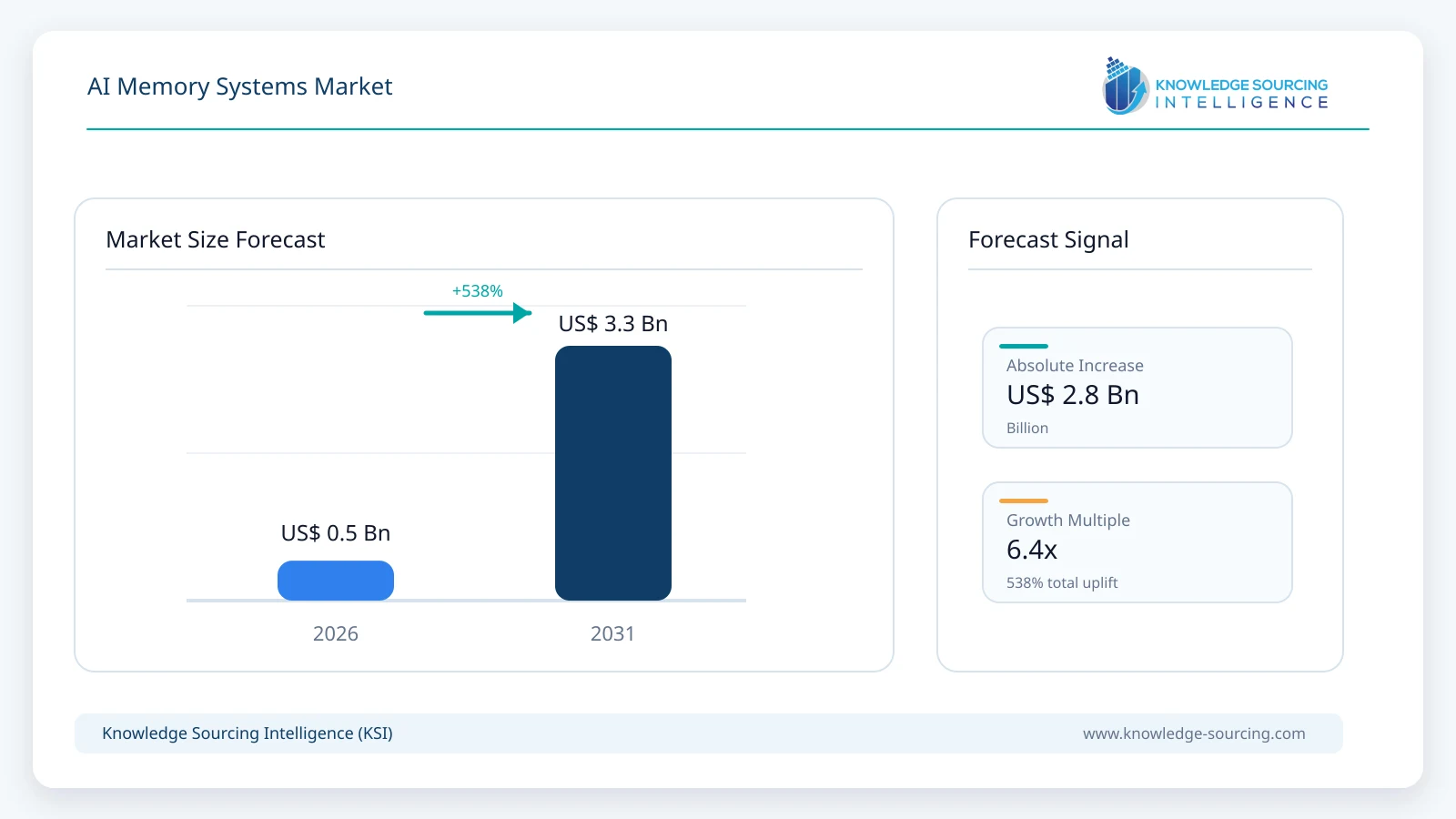
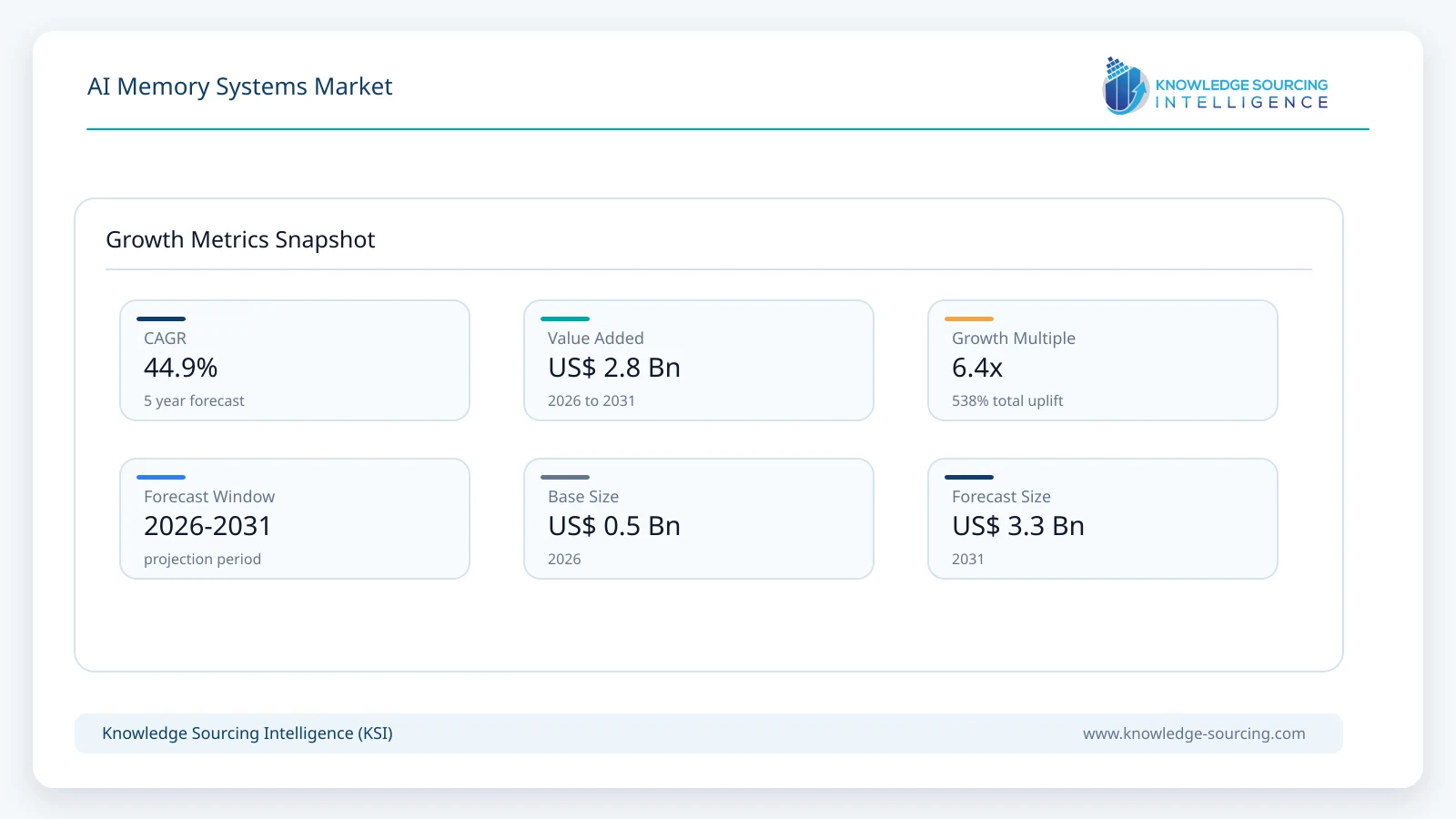
The AI Memory Systems Market is projected to grow from USD 0.52 billion in 2026 to USD 3.32 billion by 2031, registering a CAGR of 44.89% during the forecast period.
Highlights:
- 1Dedicated memory APIs and managed platforms represent approximately 44% of market revenue in 2026, supported by demand for persistent context without custom retrieval infrastructure.
- 2Semantic and preference memory accounts for approximately 38% of 2026 functional revenue as enterprise assistants retain authorized preferences, user context and recurring decisions.
- 3Hybrid and multi-modal architectures represent approximately 38% of 2026 memory infrastructure spending and are expected to approach 48% by 2031 as graph, vector and structured retrieval converge.
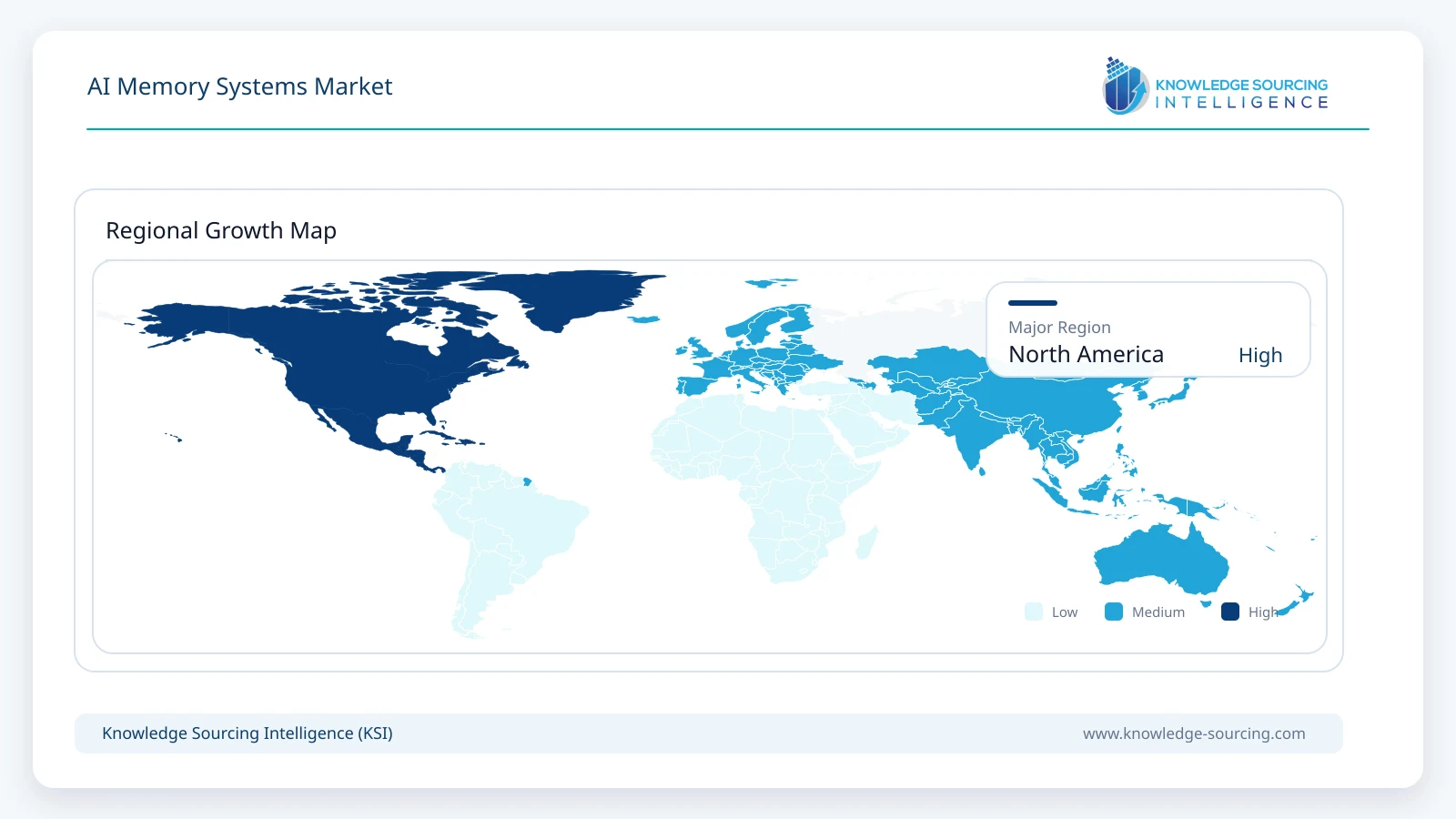
- 4North America accounts for approximately 44% of 2026 market value, supported by leading AI platform suppliers and established enterprise software adoption.
- 5Asia Pacific is projected to be the fastest-growing region through 2031 as commercial agent deployments expand across China, India, Japan and other regional markets.
AI memory systems provide persistent, retrievable context for software agents and enterprise AI applications. Commercial offerings extract useful information from conversations or activity histories, update durable records and retrieve authorized context as needed. The market covers dedicated memory platforms, memory-specific enterprise software and attributable managed cloud memory services, excluding general database and foundation-model inference revenue.
Cloud platforms and independent developers are commercializing this layer using different delivery models. Amazon Bedrock AgentCore Memory and Google Cloud Memory Bank expose usage-priced services, while providers such as Mem0, Zep and Redis offer developer and enterprise memory capabilities. Growth depends on how many AI agents reach production and how much of their memory functionality organizations purchase rather than build or receive inside a bundled platform.
Large language models operate on the context supplied to each request, so AI systems need external mechanisms to preserve relevant information when tasks span sessions or users. AI memory platforms capture conversations and events, identify durable information, preserve user or organizational context and deliver selected records to agents on demand. Session memory and long-term memory address different time horizons, while graph-based retrieval can represent changing relationships and provenance.
AWS AgentCore Memory supports short-term event histories and extracted long-term memory, with separate services for storing and retrieving information. Google Cloud introduced Vertex AI Agent Engine Memory Bank in July 2025 and subsequently published consumption pricing. Microsoft Foundry describes managed memory stores and controls for enterprise agents. These products establish a cloud delivery channel for memory, although much of the underlying agent-platform spend remains outside memory-specific revenue.
Dedicated suppliers provide complementary architectures and commercial terms. Mem0 offers managed APIs with published developer plans and enterprise deployment options; Zep focuses on temporal context graphs; Redis Agent Memory combines session state with durable extracted information. Open-source frameworks such as LangGraph and LlamaIndex provide alternatives for teams that prefer to assemble their own solutions, creating competitive pressure on price and differentiation.
Market Trends
Memory Moves from Chat History to Structured, Durable Context
Agent memory products are evolving beyond stored transcripts toward extracted facts, summarized events, preferences and action history that can be retrieved across sessions. AWS distinguishes short-term events from consolidated long-term records, while Microsoft Foundry defines memory as durable knowledge maintained across interactions. For production users, the economic benefit comes from retrieving the right context at the right time rather than permanently expanding the prompt.
Graph and Temporal Retrieval Gain Commercial Relevance
Zep organizes facts, relationships and their time-dependent changes in context graphs, and Mem0 combines multiple retrieval signals and entity linking. These architectures are useful when an agent must identify which instruction is current, link related people or projects, and explain the origin of a conclusion. Graph-supported systems can command a premium in complex enterprise workflows but also add infrastructure and engineering costs.
Managed Memory Becomes a Metered Cloud Service
AWS changed AgentCore short-term memory pricing in October 2026 to charge for data ingestion, retrieval and storage, while Google has published charges for Memory Bank operations and storage. These developments establish identifiable monetization units even when memory is embedded inside broader cloud platforms. Buyers can scale from development volumes to production traffic without treating memory as an entirely bespoke software subsystem.
Governance and Selective Forgetting Become Product Requirements
Enterprise memory is increasingly tied to tenant isolation, retention policies, auditability and the ability to remove obsolete or sensitive records. Microsoft Foundry exposes scoped memory stores and controls for managing records, while enterprise memory providers emphasize deployment choice and traceability. The ability to forget safely will influence procurement as strongly as the ability to remember.
AI Memory Systems Market Segment Analysis
By Offering
Dedicated Memory APIs and Managed Platforms
Dedicated memory APIs and managed platforms provide a clear purchasing route for teams that want persistent context without operating a complete retrieval stack. This category represents about 44% of 2026 market revenue and is projected to reach USD 1.42 billion in 2031. Its monetization combines developer subscriptions, request volumes, reserved capacity and contracts for security and deployment support.
Mem0 illustrates the range from low-cost developer plans to enterprise offerings with audit controls, private infrastructure and customized integrations. Rising agent volumes expand memory operations, but free tiers and bundled platform options will constrain the achievable revenue per small deployment.
By Memory Function
Semantic and Preference Memory
Semantic and preference memory captures durable facts, selected customer needs and persistent organizational information that must remain available across interactions. It accounts for an estimated USD 200 million in 2026, the largest functional segment, because customer-facing assistants and enterprise copilots routinely need to recall decisions, preferences or identity-scoped instructions.
Semantic and preference memory revenue is projected to reach approximately USD 1.20 billion by 2031, while episodic and procedural memory are expected to gain share as agents preserve completed-task outcomes, execution lessons and reusable skills. Memory extraction quality and authorization checks will be as important as retrieval speed in these deployments.
By Memory Architecture
Hybrid and Multi-Modal Memory
Hybrid memory architectures combine vector similarity, structured records, knowledge graphs and metadata filters to improve recall across different information types. The category accounts for USD 195 million in 2026 and is projected to rise to USD 1.60 billion by 2031 as enterprise agents need to relate users, actions, documents and changing business facts.
Zep uses temporal context graphs for relationships and changes over time, while Cognee combines graph, vector and relational retrieval. These systems can reduce dependence on a single retrieval method, but require carefully managed memory updates, test coverage and infrastructure optimization.
By Application
Enterprise Assistants and Knowledge Work
Enterprise assistants use persistent context to retain decisions, user preferences, work history and task status across recurring employee interactions. Their memory-specific revenue is estimated at USD 145 million in 2026 and USD 870 million in 2031, supported by deployment across internal knowledge workflows and productivity software.
Multi-agent process automation and software development agents are also expected to grow rapidly as systems record prior actions, unsuccessful approaches and reusable procedures. For these applications, memory is purchased to improve continuity and reliability, not simply to archive conversation logs.
Market Drivers
Rising Deployment of Persistent Enterprise AI Agents
Enterprises moving from single-turn chatbots to agents that execute repeated business tasks need memory that survives session boundaries and can be shared selectively among approved workflows. A service agent handling a returning customer must recover prior preferences and unresolved cases, while a coding agent may need the design decisions and failures recorded during earlier runs. This requirement creates demand for memory extraction, retention and retrieval services rather than merely larger model context windows.
AWS makes short- and long-term memory independently consumable in AgentCore, while Google Cloud offers Memory Bank within its managed agent platform. Dedicated providers such as Mem0 and Zep address teams building across model vendors. Enterprise procurement therefore increasingly evaluates memory continuity, reliability and permissions as distinct software capabilities.
Lower Context-Window Waste and Inference Overhead
Long conversational histories add input tokens, processing time and irrelevant information when replayed into every AI request. Memory services filter and consolidate durable facts, provide episodic summaries and retrieve selected context at inference time. Savings are greatest where agents revisit customers or complex processes frequently, even though extraction, embedding and retrieval introduce their own charges.
Google Cloud described the token and relevance limitations of retaining entire chat histories when releasing Memory Bank in July 2025. Mem0 has similarly positioned its offering around automatic memory extraction and more selective recall. Buyers will compare total cost per completed agent task, not just the per-memory API price, encouraging memory layers that demonstrate measurable efficiency.
Commercialization of Cloud-Native Memory APIs
Memory infrastructure is becoming accessible as managed services with separately priced events, stored records, and retrieval operations. AWS uses record- and request-based long-term memory pricing, while Google applies charges for Memory Bank operations and storage. These published meters make it easier for enterprises to trial memory without procuring a dedicated datastore and custom extraction pipeline.
Vendors that simplify deployment, regional availability and identity integration can expand usage among developers who lack specialists in graph retrieval or multi-tenant state. Usage pricing will also pressure independent platforms to differentiate through accuracy, governance, and managed operations rather than a basic storage API.
Greater Demand for Personalization and Workflow Continuity
Retail assistants, financial-service workflows and customer support systems gain value from remembering authorized preferences, previous outcomes and persistent task constraints. Persistent memory can reduce repeated questions and enable agents to resume cases across channels. That creates a direct commercial link between retrieval reliability, customer experience and the number of production agents operated by an organization.
Mem0 reports integration with agent-building tools and marketplace distribution, while Zep organizes changing facts and business relationships through context graphs. The relevant value shifts from passive conversation storage toward continuous extraction, conflict resolution, and context selection that can inform the next response or action.
Enterprise Security and Private Deployment Requirements
Regulated buyers must control which agent can remember, read, update or delete sensitive data. This creates demand for isolation by user or tenant, role-based access, audit trails, retention periods and private-cloud options. A memory service that cannot demonstrate these functions may be unsuitable even when it retrieves facts accurately in tests.
Microsoft Foundry documents scoped memory stores and retention controls, while Mem0 lists audit logs, single sign-on and on-premises deployment in its enterprise offering. Higher-value contracts are likely to concentrate around governed memory operations, integration work and deployment assurance rather than unprotected developer-grade memory calls.
Market Restraints
Unreliable Recall, Stale Facts and Memory Contamination
Memory systems can retain outdated preferences, incorrectly inferred relationships or misleading tool outputs. Enterprises must test extraction accuracy, contradiction resolution and temporal relevance across real tasks. Unreliable recall increases verification work and can reduce confidence in autonomous workflows.
Privacy, Consent and Data-Residency Constraints
A persistent record of conversations may contain personal or confidential information that requires explicit controls for retention, deletion, purpose limitation and access. Cross-border memory replication and shared-agent memory introduce compliance and architecture costs, particularly for regulated workloads.
Bundled and Open-Source Substitutes
LangGraph, LlamaIndex and multiple open-source projects supply memory primitives, while large platforms integrate memory into broader agent products. Buyers can build internal memory stacks with database and framework components, limiting standalone vendors’ pricing power and complicating attribution of memory-specific revenue.
Difficult Evaluation and Production Integration
A high benchmark score does not establish that a memory architecture will perform across changing enterprise records, multiple users and years of retained context. Organizations often need custom extraction policies, entity schemas, retrieval tests and monitoring before putting an agent into production.
Low Unit Pricing and Operational Cost Pressure
Published cloud and developer-plan prices are relatively low for basic memory reads and stored records. As memory becomes a standard platform feature, suppliers must serve high request volumes efficiently and sell enterprise governance or advanced consolidation to sustain revenue per deployment.
Regional Outlook
North America
North America represents approximately 44% of AI memory systems revenue in 2026, with the United States forming the central demand base through its concentration of AI platform providers, software developers and large enterprise adopters. AWS, Microsoft and Google influence procurement by embedding identifiable memory services within managed agent platforms, while independent memory companies expand developer adoption through APIs and enterprise deployment plans.
The region is projected to reach USD 1.28 billion in 2031 as financial services, software, commerce and business-process teams expand production agent programs. Buyers are likely to prioritize security, auditable memory access and integration with existing identity systems. The growing availability of lower-cost cloud memory calls could expand usage while pressuring stand-alone service pricing.
Asia Pacific
Asia Pacific is expected to record the strongest regional growth as enterprises in China, India, Japan, South Korea, Australia and Singapore deploy customer-facing and internal AI agents. Local-language requirements, growing developer communities and cloud platform coverage should support demand for memory extraction, durable session continuity and search across diverse enterprise information.
Regional revenue is projected to rise from USD 128 million in 2026 to USD 1.00 billion in 2031. India and China contribute significant incremental deployments, while Japan, Australia and Singapore support higher-value governed adoption in established enterprises. Data sovereignty, multilingual retrieval accuracy and deployment flexibility will influence supplier selection across the region.
Competitive Landscape
The competitive environment spans hyperscale cloud platforms, dedicated memory-service providers and agent framework developers. AWS and Google expose separately metered memory functionality alongside their broader agent services; Microsoft is embedding long-term memory stores within Foundry. Independent providers including Mem0, Zep and supermemory emphasize portable APIs and retrieval features that can operate across model vendors.
Redis and MongoDB bring database infrastructure and managed retrieval capabilities into the memory stack, while LangChain, LlamaIndex and Letta supply stateful agent development components. Suppliers compete on memory accuracy, latency, integration, enterprise controls and cost per retained useful fact. Because few companies disclose stand-alone AI memory revenue, competitive positioning is better assessed through product reach and customer use cases than invented market-share rankings.
Recent Developments
October 2026: Mem0 introduced bring-your-own-key model selection for memory extraction, allowing customers to control the extraction model and associated inference charges.
October 2026: supermemory launched Memory API v5, adding a revised API structure and namespace handling for agent memory.
September 2026: Mem0 became available through the Vercel Marketplace, simplifying developer adoption and consolidated billing.
September 2026: AWS added direct ingestion for long-term memory extraction through the AgentCore IngestData API.
May 2026: Redis introduced Redis Iris, including Agent Memory for retaining short- and long-term context across agents and tasks.
Market Outlook
Commercial memory infrastructure should grow rapidly through 2031 as enterprises shift from isolated AI conversations toward agents that accumulate authorized context across many tasks and interactions. The strongest revenue opportunities lie in production-scale memory platforms that combine reliable recall with security, monitoring and retention controls. Low-cost developer tooling is likely to remain an important adoption channel, but larger contracts will depend on operational reliability and governance.
Cloud providers are expected to normalize memory as a metered agent capability, while dedicated suppliers compete on hybrid retrieval, temporal reasoning, portability and enterprise customization. Increasing use of background consolidation and selective forgetting will raise the sophistication of memory platforms. At the same time, open-source alternatives and cloud bundling will continue to challenge memory-only pricing.
North America should remain the largest region through 2031, while Asia Pacific gains share through wider AI agent deployment. Software development, enterprise assistance and multi-agent automation create demand for different memory functions, supporting separate semantic, episodic, procedural and session-state offerings within the wider agent infrastructure market.
AI Memory Systems Market Scope:
| Report Metric | Details |
|---|---|
| Total Market Size in 2026 | USD 0.52 billion |
| Total Market Size in 2031 | USD 3.32 billion |
| Forecast Unit | USD Billion |
| Growth Rate | 44.89% |
| Study Period | 2021 to 2031 |
| Historical Data | 2021 to 2024 |
| Base Year | 2025 |
| Forecast Period | 2026 – 2031 |
| Segmentation | Offering, Memory Function, Memory Architecture, Deployment Model, Application, End-User Industry, Organization Size, Geography |
| Companies |
|
Market Segmentation
By Offering
Dedicated Memory APIs and Managed Platforms
Enterprise Memory Software and Support
Embedded Cloud Memory Services
By Memory Function
Semantic and Preference Memory
Episodic and Task Memory
Session and Conversational Memory
Procedural and Agent-Skill Memory
By Memory Architecture
Vector and Semantic Retrieval
Knowledge Graph and Temporal Graph
Structured and Key-Value Memory
Hybrid and Multi-Modal Memory
By Deployment Model
Public Cloud Managed
Private Cloud and Dedicated Managed
Self-Hosted and On-Premises
By Application
Customer Service and Personalization
Enterprise Assistants and Knowledge Work
Multi-Agent Process Automation
Software Development Agents
Other Applications
By End-User Industry
IT and Software Services
Banking, Financial Services and Insurance
Retail and E-Commerce
Healthcare and Life Sciences
Manufacturing and Logistics
Other Industries
By Organization Size
Large Enterprises
Mid-Sized Organizations
Small Businesses and Independent Developers
By Geography
North America
United States
Canada
Mexico
South America
Brazil
Argentina
Chile
Colombia
Rest of South America
Europe
United Kingdom
Germany
France
Italy
Spain
Netherlands
Rest of Europe
Middle East and Africa
United Arab Emirates
Saudi Arabia
Israel
South Africa
Rest of Middle East and Africa
Asia Pacific
China
India
Japan
South Korea
Australia
Singapore
Rest of Asia Pacific
Table of Contents
1. EXECUTIVE SUMMARY
1.1. Key Findings
1.2. Global Market Outlook, 2026–2031
2. MARKET SNAPSHOT
2.1. Market Overview
2.2. Market Definition
2.3. Scope of the Study
2.4. Market Segmentation
3. BUSINESS LANDSCAPE
3.1. Market Drivers
3.1.1. Rising Deployment of Persistent Enterprise AI Agents
3.1.2. Lower Context-Window Waste and Inference Overhead
3.1.3. Commercialization of Cloud-Native Memory APIs
3.1.4. Greater Demand for Personalization and Workflow Continuity
3.1.5. Enterprise Security and Private Deployment Requirements
3.2. Market Restraints
3.2.1. Unreliable Recall, Stale Facts and Memory Contamination
3.2.2. Privacy, Consent and Data-Residency Constraints
3.2.3. Bundled and Open-Source Substitutes
3.2.4. Difficult Evaluation and Production Integration
3.2.5. Low Unit Pricing and Operational Cost Pressure
3.3. Market Opportunities
3.4. Porter’s Five Forces Analysis
3.5. Industry Value Chain Analysis
3.6. Policies and Regulations
3.7. Strategic Recommendations
4. TECHNOLOGICAL OUTLOOK
4.1. Session and Persistent Memory Orchestration
4.2. Semantic Extraction and Consolidation
4.3. Graph and Temporal Memory
4.4. Hybrid Retrieval and Context Selection
4.5. Memory Governance and Selective Forgetting
5. AI MEMORY SYSTEMS MARKET BY OFFERING
5.1. Introduction
5.2. Dedicated Memory APIs and Managed Platforms
5.3. Enterprise Memory Software and Support
5.4. Embedded Cloud Memory Services
6. AI MEMORY SYSTEMS MARKET BY MEMORY FUNCTION
6.1. Introduction
6.2. Semantic and Preference Memory
6.3. Episodic and Task Memory
6.4. Session and Conversational Memory
6.5. Procedural and Agent-Skill Memory
7. AI MEMORY SYSTEMS MARKET BY MEMORY ARCHITECTURE
7.1. Introduction
7.2. Vector and Semantic Retrieval
7.3. Knowledge Graph and Temporal Graph
7.4. Structured and Key-Value Memory
7.5. Hybrid and Multi-Modal Memory
8. AI MEMORY SYSTEMS MARKET BY DEPLOYMENT MODEL
8.1. Introduction
8.2. Public Cloud Managed
8.3. Private Cloud and Dedicated Managed
8.4. Self-Hosted and On-Premises
9. AI MEMORY SYSTEMS MARKET BY APPLICATION
9.1. Introduction
9.2. Customer Service and Personalization
9.3. Enterprise Assistants and Knowledge Work
9.4. Multi-Agent Process Automation
9.5. Software Development Agents
9.6. Other Applications
10. AI MEMORY SYSTEMS MARKET BY END-USER INDUSTRY
10.1. Introduction
10.2. IT and Software Services
10.3. Banking, Financial Services and Insurance
10.4. Retail and E-Commerce
10.5. Healthcare and Life Sciences
10.6. Manufacturing and Logistics
10.7. Other Industries
11. AI MEMORY SYSTEMS MARKET BY ORGANIZATION SIZE
11.1. Introduction
11.2. Large Enterprises
11.3. Mid-Sized Organizations
11.4. Small Businesses and Independent Developers
12. AI MEMORY SYSTEMS MARKET BY GEOGRAPHY
12.1. North America
12.1.1. United States
12.1.2. Canada
12.1.3. Mexico
12.2. South America
12.2.1. Brazil
12.2.2. Argentina
12.2.3. Chile
12.2.4. Colombia
12.2.5. Rest of South America
12.3. Europe
12.3.1. United Kingdom
12.3.2. Germany
12.3.3. France
12.3.4. Italy
12.3.5. Spain
12.3.6. Netherlands
12.3.7. Rest of Europe
12.4. Middle East and Africa
12.4.1. United Arab Emirates
12.4.2. Saudi Arabia
12.4.3. Israel
12.4.4. South Africa
12.4.5. Rest of Middle East and Africa
12.5. Asia Pacific
12.5.1. China
12.5.2. India
12.5.3. Japan
12.5.4. South Korea
12.5.5. Australia
12.5.6. Singapore
12.5.7. Rest of Asia Pacific
13. COMPETITIVE ENVIRONMENT AND ANALYSIS
13.1. Major Players and Strategy Analysis
13.2. Market Share Analysis
13.3. Mergers, Acquisitions, Agreements and Collaborations
13.4. Competitive Dashboard
14. COMPANY PROFILES
14.1. Amazon Web Services, Inc.
14.2. Google LLC
14.3. Microsoft Corporation
14.4. Mem0
14.5. Redis
14.6. LangChain, Inc.
14.7. Zep
14.8. Letta
14.9. supermemory
14.10. Cognee
14.11. LlamaIndex
14.12. MongoDB, Inc.
15. APPENDIX
15.1. Currency
15.2. Assumptions
15.3. Base and Forecast Years Timeline
15.4. Key Benefits for Stakeholders
15.5. Research Methodology
15.6. Abbreviations
Navigate
Trusted by the world's leading organizations











