
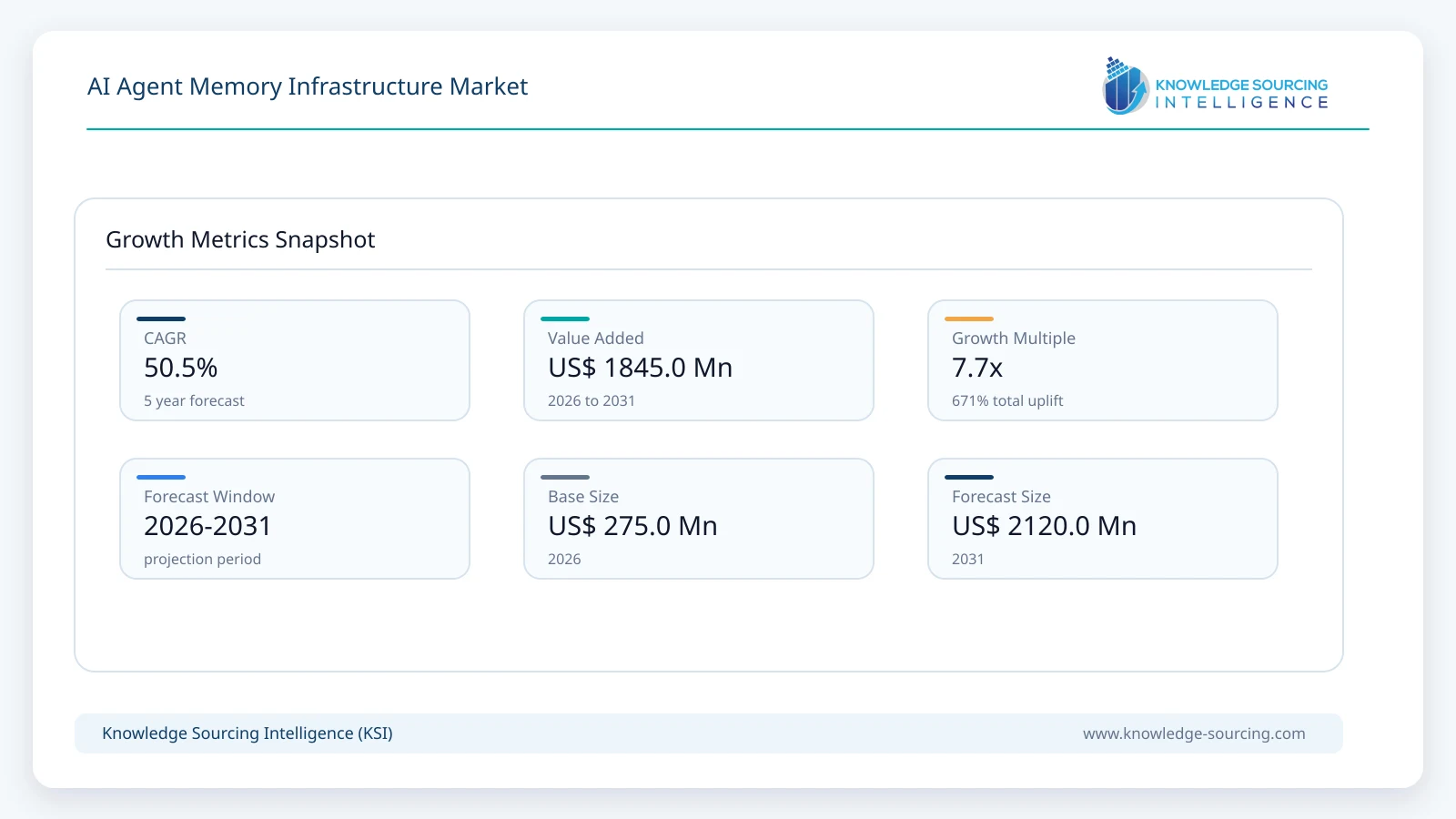
The AI Agent Memory Infrastructure Market is forecast to grow at a CAGR of 50.5%, reaching USD 2,120.0 million in 2031 from USD 275.0 million in 2026.
Highlights:
- 1Dedicated agent memory APIs and managed platforms account for approximately 46% of global revenue in 2026, reflecting adoption of reusable memory services rather than application-by-application storage development.
- 2Long-term semantic and preference memory represents approximately 36% of 2026 value, as enterprises prioritize information that can improve decisions across separate agent sessions.
- 3Managed public cloud deployment accounts for approximately 57% of 2026 market revenue, supported by metered memory operations and lower infrastructure-management requirements.
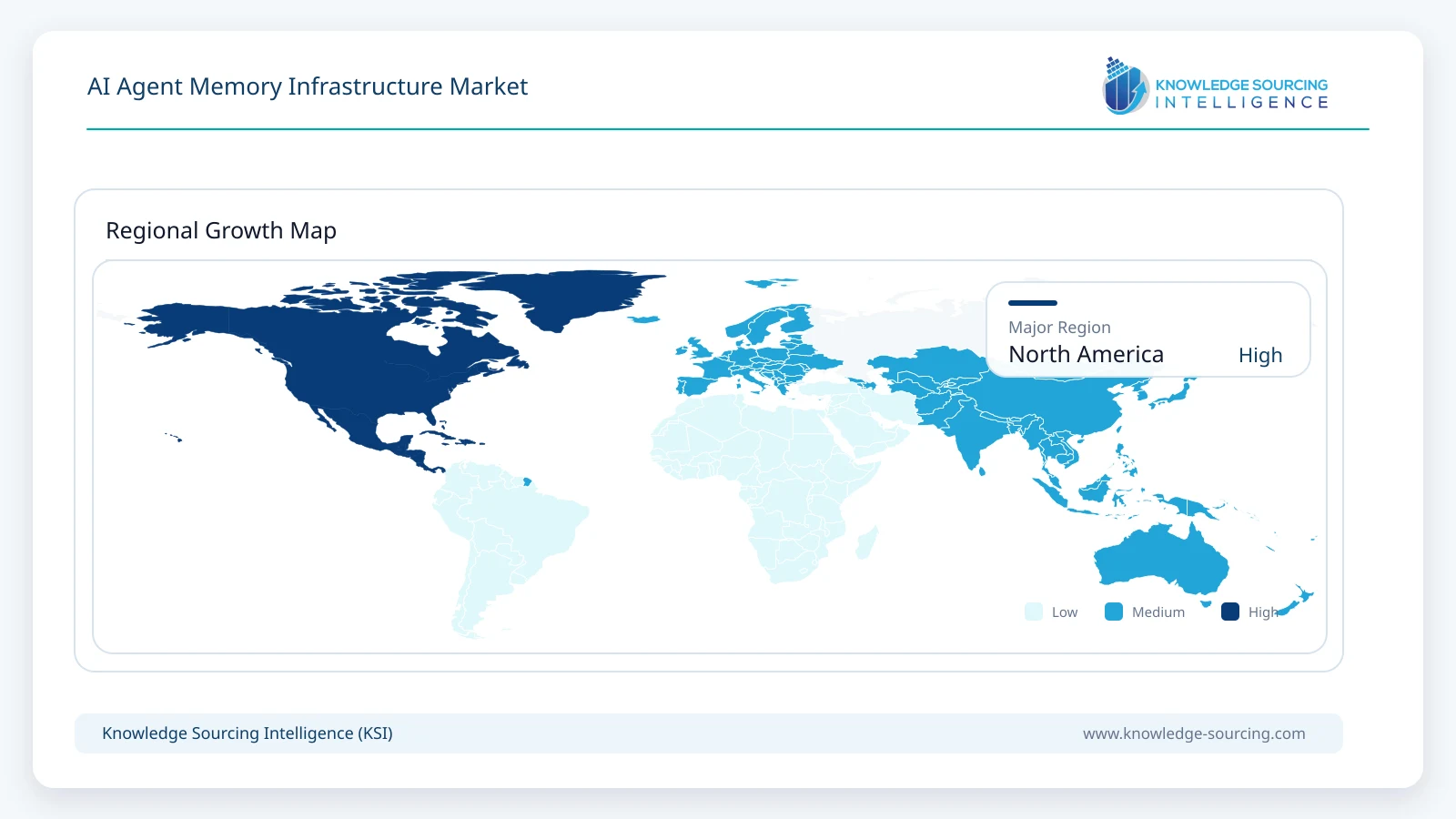
- 4North America represents approximately 44% of global revenue in 2026, supported by early commercial agent deployments and a strong concentration of AI infrastructure suppliers.
- 5Asia Pacific is projected to record the fastest regional expansion through 2031 as enterprise automation, domestic AI platforms, and developer ecosystems increase demand for persistent agent state.
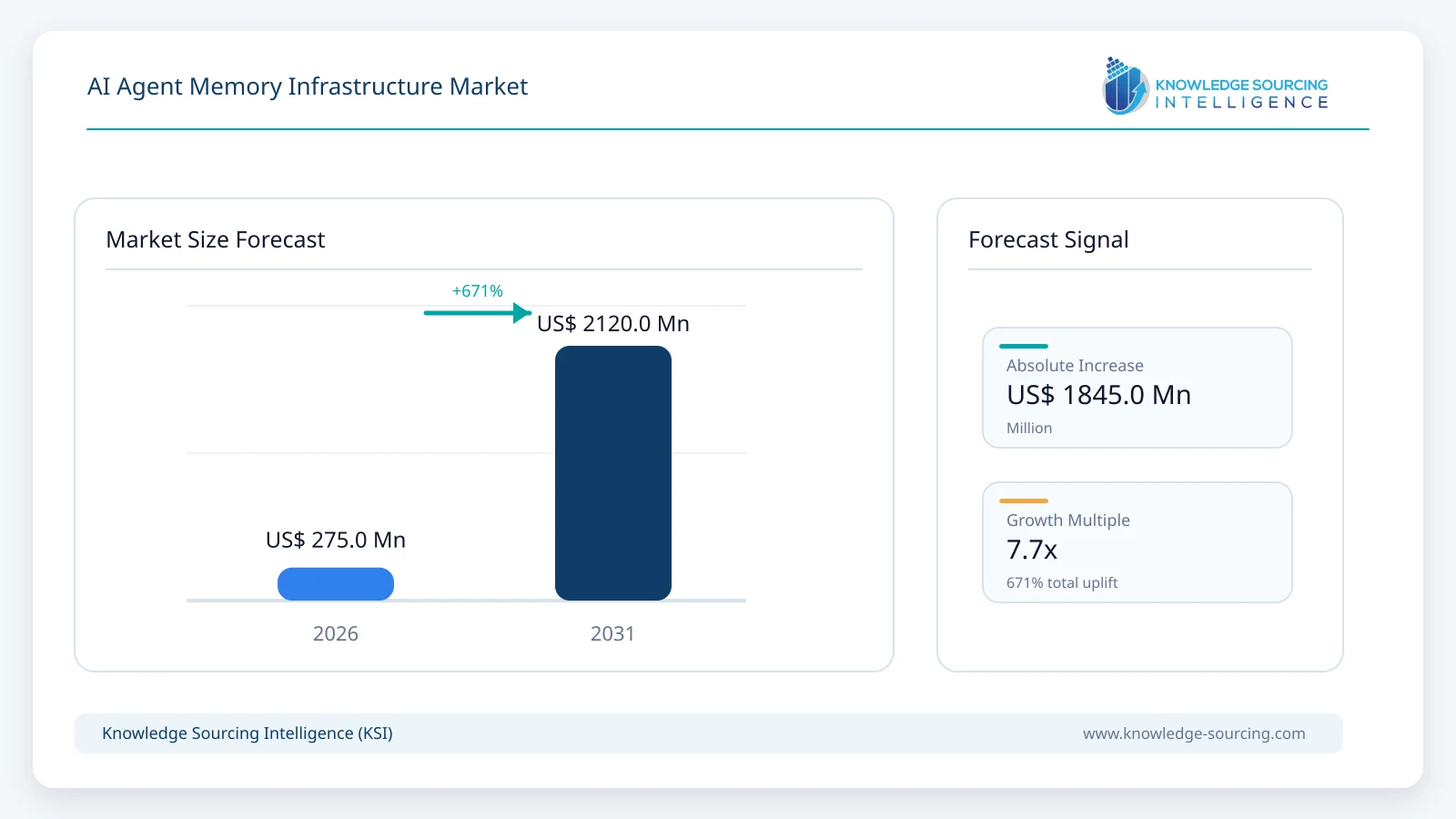
The market includes commercial software and managed services that preserve agent session state, extract and consolidate durable memories, retrieve relevant historical context, and govern information across ongoing AI workflows. It covers attributable memory-infrastructure revenue rather than all spending on databases, inference services, or general-purpose AI platforms.
Amazon Bedrock AgentCore Memory offers separate short-term event storage and long-term knowledge extraction, while Google Cloud Agent Engine Memory Bank and Microsoft Foundry memory stores provide managed mechanisms for retaining and retrieving information between sessions. Mem0, Zep, Redis, and Letta offer different approaches to the same operating requirement, including memory APIs, temporal context graphs, automatic summarization, and agent-managed memory filesystems. Supplier differentiation increasingly concerns recall relevance, update correctness, latency, enterprise access controls, and lifecycle management.
Market Overview
Production AI agents need more than a long prompt history when workflows span multiple sessions, involve several applications, or require agents to act on changing business information. Memory infrastructure separates immediate task state from durable facts, preferences, and decisions, making it possible to resume work while retrieving only relevant information for the next step. Agent-specific architecture adds identity and namespace boundaries, update rules, expiration policies and retrieval ranking that are not supplied automatically by a general-purpose storage engine.
Cloud providers have introduced identifiable services for these operations. AWS publishes distinct consumption charges for short-term memory ingestion, retrieval and storage, as well as pricing for long-term records and retrieval. Google Cloud has documented managed Memory Bank generation and retrieval alongside agent sessions, and Microsoft Foundry has described managed long-term memory stores in preview. These offerings reduce the engineering effort associated with building memory extraction, storage, indexing, and lifecycle pipelines independently.
Specialist suppliers address areas where enterprise application memory must evolve with changing facts. Zep uses temporal context graphs to link facts with their history, Mem0 provides a drop-in managed memory layer, and Redis Agent Memory combines session history, automatic summarization, and long-term memory extraction. LangGraph checkpointers and persistent stores provide an open framework route, MongoDB Atlas Agent Engine integrates a dedicated memory service, and Letta emphasizes durable agent identity and agent-editable memory. The competitive market spans managed usage billing, enterprise support contracts, and embedded memory components within larger platforms.
Market Trends
Persistent Agent State Is Moving into Managed Infrastructure
Long-running coding, operations, and research agents require recoverable state beyond a single model invocation. LangGraph supports checkpointing for resumable workflows and persistent stores for cross-thread memory, while Amazon Bedrock AgentCore records short-term events and generates long-term memories through configurable strategies. Reusable infrastructure can reduce bespoke engineering for session recovery, state isolation, and retention controls.
Enterprise buyers increasingly assess memory as an operating component with service reliability, access permissions and monitoring requirements, particularly when several agents share business context or continue work after an interruption.
Memory Extraction and Maintenance Are Becoming More Automated
Agent memory providers are shifting from storing conversation transcripts toward extracting, consolidating, and refreshing the facts that matter for subsequent tasks. Redis Agent Memory supports background summarization and long-term extraction, and AWS provides semantic, summary, and user-preference memory strategies. These functions can keep prompts concise but create additional requirements for validating facts, removing obsolete entries, and preventing inaccurate memories from propagating.
Temporal tracking and selective memory updates are particularly relevant when customer preferences, project statuses, and operational policies change frequently.
Graph and Hybrid Retrieval Improve Context Quality
Enterprise agents often need to recall relationships between people, tasks, documents, and previous actions rather than search for an isolated sentence. Zep’s Graphiti framework combines temporal graphs with semantic and keyword retrieval, while other vendors use vector, structured, and graph storage together. Hybrid systems can improve fact linkage and time awareness, but their commercial value depends on measurable retrieval precision, operating cost, and data freshness.
Vendor selection is therefore moving toward complete memory pipelines that combine extraction, ranking, provenance and controlled updates rather than capacity alone.
Enterprise Controls Shape Memory Procurement
Regulated deployments require confidence that an agent retrieves only authorized memories and can delete or expire information under retention policies. AWS documents event-expiry options and scoped agent identities; Microsoft Foundry uses memory-store scoping and retention controls; and Zep offers governance across managed and customer-controlled deployments. Buyers will increasingly evaluate memory infrastructure together with identity, privacy, auditability, and deployment location.
The need to distinguish short-lived task state from durable personal or enterprise facts is also influencing system architecture and procurement decisions.
Segment Analysis
By Offering: Dedicated Agent Memory APIs and Managed Platforms
Dedicated memory APIs and managed platforms represent the largest offering category because teams building AI agents can integrate persistent context without independently operating extraction, indexing, and recall pipelines. Specialist services such as Mem0 and Zep compete with cloud-native managed memory capabilities through deployment flexibility, graph functionality, and application integration.
This segment is projected to reach approximately USD 933 million by 2031. Growth depends on production agent workloads adopting billable memory operations and higher-value services for governance, reliability, and managed deployment.
By Memory Layer: Long-Term Semantic and Preference Memory
Long-term semantic and preference memory is the leading memory layer in 2026 because persistent facts, preferences and project context are useful across agent sessions. Enterprises can reduce repeated instructions and tailor agent behavior by preserving relevant information while continuing to update or remove records when circumstances change.
The segment is projected to generate approximately USD 678 million in 2031. Episodic and task memory is expected to gain share as longer-running agents need to retain prior actions, intermediate results, and lessons from completed workflows.
By Architecture: Hybrid Vector, Graph and Structured Memory
Hybrid memory architectures combine semantic matching with explicit records, time-aware relationships, and structured state to support multi-step agents. Zep’s temporal graph approach and Redis memory services illustrate how durable agent context increasingly uses several storage and retrieval methods rather than relying on a single vector index.
Hybrid architectures are projected to reach approximately USD 996 million by 2031, supported by demand for more reliable retrieval across changing enterprise data and longer interaction histories.
By Application: Enterprise Knowledge and Workflow Agents
Enterprise knowledge and workflow agents account for a large application category because administrative assistants, internal service agents and business-process tools must retain work context across employees, tasks and systems. Persistent records help agents resume approvals, remember project constraints and retrieve previous decisions without reprocessing every historical message.
The segment is projected to reach approximately USD 615 million in 2031. Software development and multi-agent process automation are also expected to grow strongly as agents perform larger sequences of interdependent tasks.
Market Drivers
Growth in Production Enterprise AI Agents
Enterprises are deploying AI agents beyond demonstration environments into customer operations, software engineering and internal workflow automation. These applications need reliable session recovery, reusable context and long-term information retention to operate over multiple interactions. AgentCore Memory, Memory Bank and specialist memory APIs provide increasingly standardized components that reduce the effort required to build these functions separately.
Demand for Continuity in Long-Running Workflows
Coding and operational agents often execute tool calls, pause for external actions, and resume after interruptions. Persistent checkpointers and task-memory stores allow workflows to recover earlier state, track completed actions, and avoid restarting work unnecessarily. LangGraph documentation explicitly distinguishes checkpoint persistence from long-term memory stores, reinforcing the commercial requirement for both functions in complex deployments.
Lower Engineering Burden through Managed Memory Services
Managed memory services integrate ingestion, storage, extraction, retrieval, and monitoring through a smaller number of APIs. Google Cloud and AWS publish separate billable memory operations, giving teams alternatives to designing and maintaining custom memory pipelines on databases and embedding platforms. Managed services can be particularly attractive when developers need stable interfaces across many agents and applications.
Higher Demand for Memory Quality and Temporal Accuracy
Agent responses can become unreliable when persistent context contains duplicate, stale, or incorrectly inferred facts. Temporal graphs, governed updates, and memory-ranking strategies help suppliers address those risks. Zep emphasizes time-aware factual relationships, and specialist vendors are developing methods to consolidate memories without reproducing the entire history in each prompt.
Security and Data Lifecycle Requirements
Financial services, healthcare and large enterprises need controls over which agent can access information, how long it is retained and whether it can be deleted on request. Scoped memory stores, retention settings, and audit controls make dedicated infrastructure more relevant than unmanaged transcript storage. These requirements also support higher-value private deployments and enterprise support contracts.
Market Restraints
Inaccurate Recall and Memory Contamination
Automatic memory extraction can preserve outdated assumptions or create incorrect summaries that influence future agent decisions. The problem becomes harder to detect when several agents consume a shared memory store. Organizations must evaluate factual accuracy, provenance, refresh policies, and the effect of persistent errors on downstream workflows.
Bundled and Open-Source Alternatives
LangGraph, open-source memory libraries and cloud-native features allow developers to implement core persistence functions without purchasing a separate commercial product. Basic state storage may be inexpensive, and suppliers must demonstrate incremental benefits in reliability, security, or memory quality to support paid adoption.
Privacy, Consent and Residency Constraints
Long-term stores may contain employee, customer, or project information that must remain within approved access and retention boundaries. Organizations must manage user consent, access revocation, deletion, and cross-border data transfers before allowing agents to persist personal or commercially sensitive facts across sessions.
Difficult Measurement of Incremental Value
Memory infrastructure performance depends on more than retrieval latency. Buyers need to measure whether recalled content improves task completion, reduces token use, and avoids incorrect actions over long periods. Results can change considerably with the agent model, workload, memory strategy, and quality of source data.
Low Unit Prices and Uncertain Standalone Revenue
Cloud memory services increasingly use low per-operation prices, while independent providers face competition from bundled agent platforms and free developer libraries. Customer demand for memory functionality may increase more quickly than the revenue attributable to standalone memory products, placing pressure on pricing and contract conversion.
Regional Outlook
North America
North America is the largest regional market for AI agent memory infrastructure, supported by enterprise deployment of AI agents in software development, financial services, customer operations, and cloud computing. Major infrastructure suppliers are based in the United States, and early enterprise buyers are adopting managed memory services alongside agent orchestration and cloud AI platforms.
The regional market is projected to reach approximately USD 0.827 billion by 2031, with spending concentrated in managed platforms, enterprise memory software and secure deployment options. Buyers increasingly require durable information storage, access controls and reliable checkpointing when agents operate across business systems and extended workflows.
Asia Pacific
Asia Pacific is projected to be the fastest-growing region as enterprises in China, India, Japan, South Korea and Australia invest in agent-based software, business automation and developer infrastructure. Demand spans multilingual assistants, workflow automation and local deployments that must preserve task state without compromising enterprise data controls.
The regional market is projected to reach approximately USD 636 million in 2031, compared with USD 63.25 million in 2026. Growth is expected to come from managed memory operations, specialist integration services and enterprise deployments designed around domestic cloud infrastructure and regional data requirements.
Competitive Landscape
The AI Agent Memory Infrastructure Market combines cloud platform providers, independent memory specialists, agent-framework developers, and data infrastructure companies. AWS, Google, and Microsoft provide managed memory capabilities within their agent platforms; Mem0 and Zep supply dedicated memory services; Redis offers session and long-term agent memory tools; and Letta focuses on stateful agents that can maintain and update durable context. LangChain provides open framework persistence, while graph and database vendors support underlying retrieval and storage integrations.
Commercial differentiation centers on reliable recall, extraction quality, cost of operations, deployment flexibility, temporal updating, and security controls. Free frameworks and bundled cloud features can replace basic memory persistence, making premium governance, multi-agent coordination, provenance and managed lifecycle features important sources of competitive advantage.
Recent Developments
October 2026: AWS announced consumption-based pricing for AgentCore short-term memory ingestion, retrieval and storage, replacing event-based charges and creating clearer economics for different event sizes.
September 2026: Redis published an Agent Memory benchmark report comparing long-term recall strategies and drawing attention to accuracy, retrieval cost and repeatable evaluation.
August 2026: Redis announced availability of Redis Agent Memory through Snowflake Marketplace, extending persistent memory deployment options for Cortex AI agents.
September 2026: MongoDB introduced Atlas Agent Engine with a dedicated agent memory service alongside execution, retrieval, and governance for production AI deployments.
June 2026: Letta published research on memory-native models trained to improve agent learning, emphasizing the evolving role of managed memory beyond transcript retention.
May 2026: Redis introduced Iris, presenting Agent Memory as a dedicated component alongside context retrieval, caching, and real-time data integration.
Market Outlook
AI agent memory infrastructure spending is expected to grow as commercial applications require agents to preserve state, retrieve relevant historical facts, and resume work after interruptions. Enterprises are likely to favor memory layers that combine reliable checkpointing with durable records, measurable recall quality, and controls for updating or removing old information. Dedicated managed services will compete against memory functionality embedded within broader AI platforms.
Hybrid architectures combining vector search, structured records and temporal relationships are expected to gain share as agent workloads become more complex. The ability to distinguish current facts from previous assumptions, keep information scoped to authorized users, and reduce the volume of repeated context may become more important than raw memory capacity. Specialist providers will need to demonstrate operational gains beyond free persistence libraries.
North America should remain the largest market through 2031, while Asia Pacific is positioned for faster expansion as enterprise AI deployment broadens. Cloud-native billing will favor usage growth, but monetization is likely to depend increasingly on production reliability, enterprise support, governance, and managed multi-agent memory services.
AI Agent Memory Infrastructure Market Scope:
| Report Metric | Details |
|---|---|
| Total Market Size in 2026 | USD 275.0 million |
| Total Market Size in 2031 | USD 2,120.0 million |
| Forecast Unit | USD Million |
| Growth Rate | 50.5% |
| Study Period | 2021 to 2031 |
| Historical Data | 2021 to 2024 |
| Base Year | 2025 |
| Forecast Period | 2026 – 2031 |
| Segmentation | Offering, Memory Layer, Architecture, Functionality |
| Companies |
|
Market Segmentation
By Offering
Dedicated Agent Memory APIs and Managed Platforms
Enterprise Agent Memory Software and Support
Embedded Cloud Agent Memory Services
By Memory Layer
Long-Term Semantic and Preference Memory
Episodic and Task Memory
Session and Working Memory
Procedural and Agent-Skill Memory
By Architecture
Hybrid Vector, Graph and Structured Memory
Vector and Semantic Memory
Temporal and Knowledge Graph Memory
Structured and Key-Value Memory
By Functionality
Memory Extraction and Consolidation
Memory Retrieval and Ranking
Persistence and Checkpointing
Memory Governance, Updates and Deletion
By Deployment
Managed Public Cloud
Private Cloud and Dedicated Managed
Self-Hosted and On-Premises
By Application
Enterprise Knowledge and Workflow Agents
Software Development Agents
Customer Engagement and Service Agents
Multi-Agent Process Automation
Research and Specialist Agents
By End User
IT, Software and Cloud Services
Banking, Financial Services and Insurance
Retail and E-Commerce
Healthcare and Life Sciences
Manufacturing and Logistics
Government, Education and Others
By Geography
North America
United States
Canada
Mexico
South America
Brazil
Argentina
Chile
Colombia
Rest of South America
Europe
United Kingdom
Germany
France
Netherlands
Italy
Spain
Rest of Europe
Middle East and Africa
United Arab Emirates
Saudi Arabia
Israel
South Africa
Rest of Middle East and Africa
Asia Pacific
China
India
Japan
South Korea
Australia
Singapore
Rest of Asia Pacific
Table of Contents
1. EXECUTIVE SUMMARY
1.1. Market Opportunity and Key Findings
1.2. AI Agent Memory Infrastructure Market Size, 2026–2031
1.3. Strategic Segment and Regional Outlook
2. MARKET SNAPSHOT
2.1. Market Overview
2.2. Market Definition
2.3. Scope of the Study
2.4. Market Segmentation
3. BUSINESS LANDSCAPE
3.1. Market Drivers
3.1.1. Growth in Production Enterprise AI Agents
3.1.2. Demand for Continuity in Long-Running Workflows
3.1.3. Lower Engineering Burden through Managed Memory Services
3.1.4. Higher Demand for Memory Quality and Temporal Accuracy
3.1.5. Security and Data Lifecycle Requirements
3.2. Market Restraints
3.2.1. Inaccurate Recall and Memory Contamination
3.2.2. Bundled and Open-Source Alternatives
3.2.3. Privacy, Consent and Residency Constraints
3.2.4. Difficult Measurement of Incremental Value
3.2.5. Low Unit Prices and Uncertain Standalone Revenue
3.3. Market Opportunities
3.4. Porter’s Five Forces Analysis
3.5. Industry Value Chain Analysis
3.6. Policies and Regulations
3.7. Strategic Recommendations
4. TECHNOLOGICAL OUTLOOK
4.1. Agent Checkpointing and Session Persistence
4.2. Long-Term Memory Extraction and Consolidation
4.3. Semantic, Episodic and Procedural Memory
4.4. Temporal Knowledge Graphs and Hybrid Retrieval
4.5. Memory Scoping, Governance and Deletion
4.6. Managed APIs and Multi-Agent Memory Sharing
5. AI AGENT MEMORY INFRASTRUCTURE MARKET BY OFFERING
5.1. Introduction
5.2. Dedicated Agent Memory APIs and Managed Platforms
5.3. Enterprise Agent Memory Software and Support
5.4. Embedded Cloud Agent Memory Services
6. AI AGENT MEMORY INFRASTRUCTURE MARKET BY MEMORY LAYER
6.1. Introduction
6.2. Long-Term Semantic and Preference Memory
6.3. Episodic and Task Memory
6.4. Session and Working Memory
6.5. Procedural and Agent-Skill Memory
7. AI AGENT MEMORY INFRASTRUCTURE MARKET BY ARCHITECTURE
7.1. Introduction
7.2. Hybrid Vector, Graph and Structured Memory
7.3. Vector and Semantic Memory
7.4. Temporal and Knowledge Graph Memory
7.5. Structured and Key-Value Memory
8. AI AGENT MEMORY INFRASTRUCTURE MARKET BY FUNCTIONALITY
8.1. Introduction
8.2. Memory Extraction and Consolidation
8.3. Memory Retrieval and Ranking
8.4. Persistence and Checkpointing
8.5. Memory Governance, Updates and Deletion
9. AI AGENT MEMORY INFRASTRUCTURE MARKET BY DEPLOYMENT
9.1. Introduction
9.2. Managed Public Cloud
9.3. Private Cloud and Dedicated Managed
9.4. Self-Hosted and On-Premises
10. AI AGENT MEMORY INFRASTRUCTURE MARKET BY APPLICATION
10.1. Introduction
10.2. Enterprise Knowledge and Workflow Agents
10.3. Software Development Agents
10.4. Customer Engagement and Service Agents
10.5. Multi-Agent Process Automation
10.6. Research and Specialist Agents
11. AI AGENT MEMORY INFRASTRUCTURE MARKET BY END USER
11.1. Introduction
11.2. IT, Software and Cloud Services
11.3. Banking, Financial Services and Insurance
11.4. Retail and E-Commerce
11.5. Healthcare and Life Sciences
11.6. Manufacturing and Logistics
11.7. Government, Education and Others
12. AI AGENT MEMORY INFRASTRUCTURE MARKET BY GEOGRAPHY
12.1. North America
12.1.1. United States
12.1.2. Canada
12.1.3. Mexico
12.2. South America
12.2.1. Brazil
12.2.2. Argentina
12.2.3. Chile
12.2.4. Colombia
12.2.5. Rest of South America
12.3. Europe
12.3.1. United Kingdom
12.3.2. Germany
12.3.3. France
12.3.4. Netherlands
12.3.5. Italy
12.3.6. Spain
12.3.7. Rest of Europe
12.4. Middle East and Africa
12.4.1. United Arab Emirates
12.4.2. Saudi Arabia
12.4.3. Israel
12.4.4. South Africa
12.4.5. Rest of Middle East and Africa
12.5. Asia Pacific
12.5.1. China
12.5.2. India
12.5.3. Japan
12.5.4. South Korea
12.5.5. Australia
12.5.6. Singapore
12.5.7. Rest of Asia Pacific
13. COMPETITIVE ENVIRONMENT AND ANALYSIS
13.1. Major Players and Strategy Analysis
13.2. Market Share Analysis
13.3. Mergers, Acquisitions, Agreements and Collaborations
13.4. Competitive Dashboard
14. COMPANY PROFILES
14.1. Amazon Web Services, Inc.
14.2. Google LLC
14.3. Microsoft Corporation
14.4. Mem0
14.5. Zep
14.6. Letta
14.7. Redis Ltd.
14.8. LangChain, Inc.
14.9. Neo4j, Inc.
14.10. MongoDB, Inc.
14.11. IBM Corporation
14.12. Pinecone Systems, Inc.
15. APPENDIX
15.1. Research Methodology
15.2. Data Sources and Definitions
15.3. Market Estimation Methodology
15.4. Abbreviations
Navigate
Trusted by the world's leading organizations











