
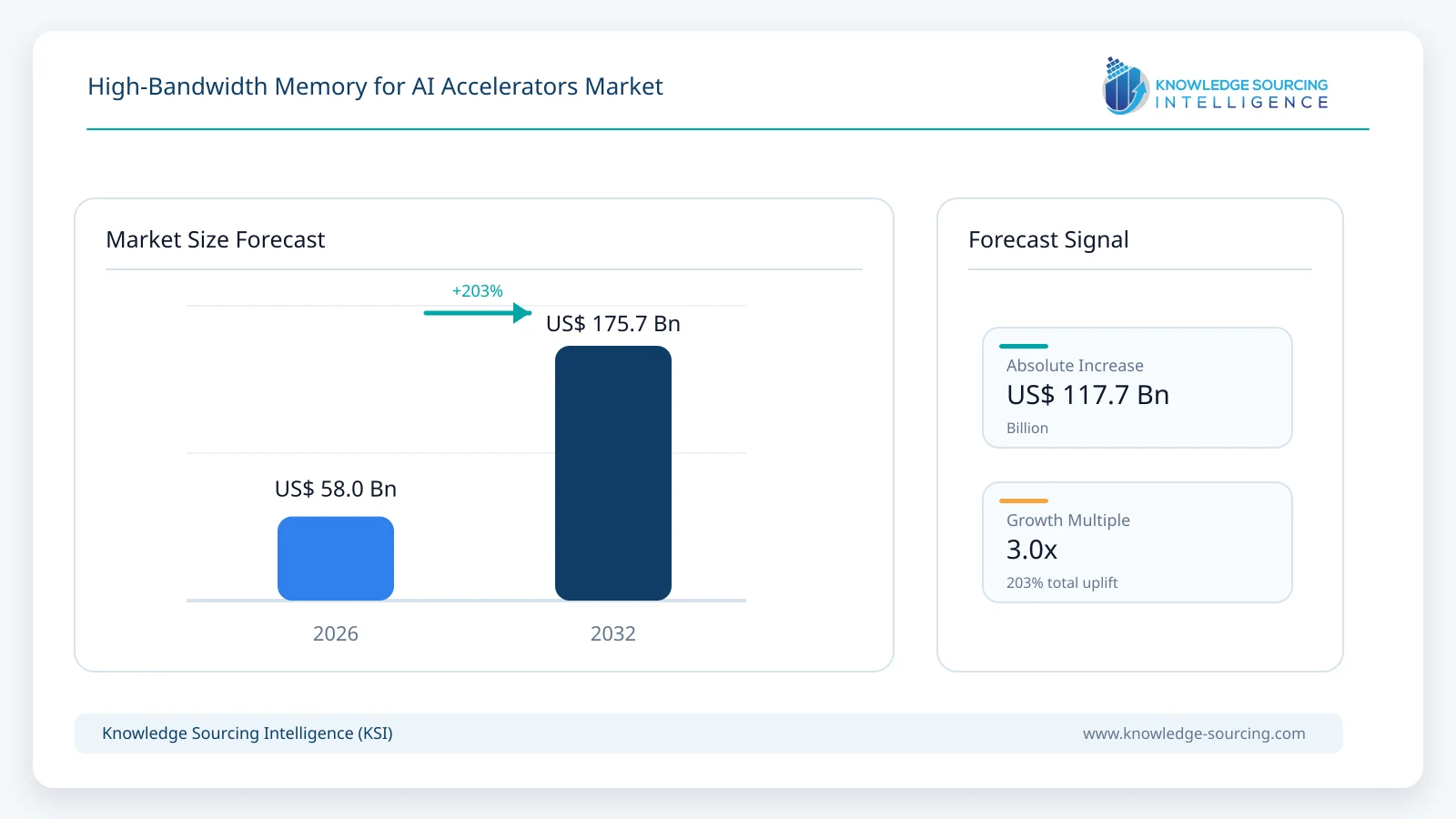
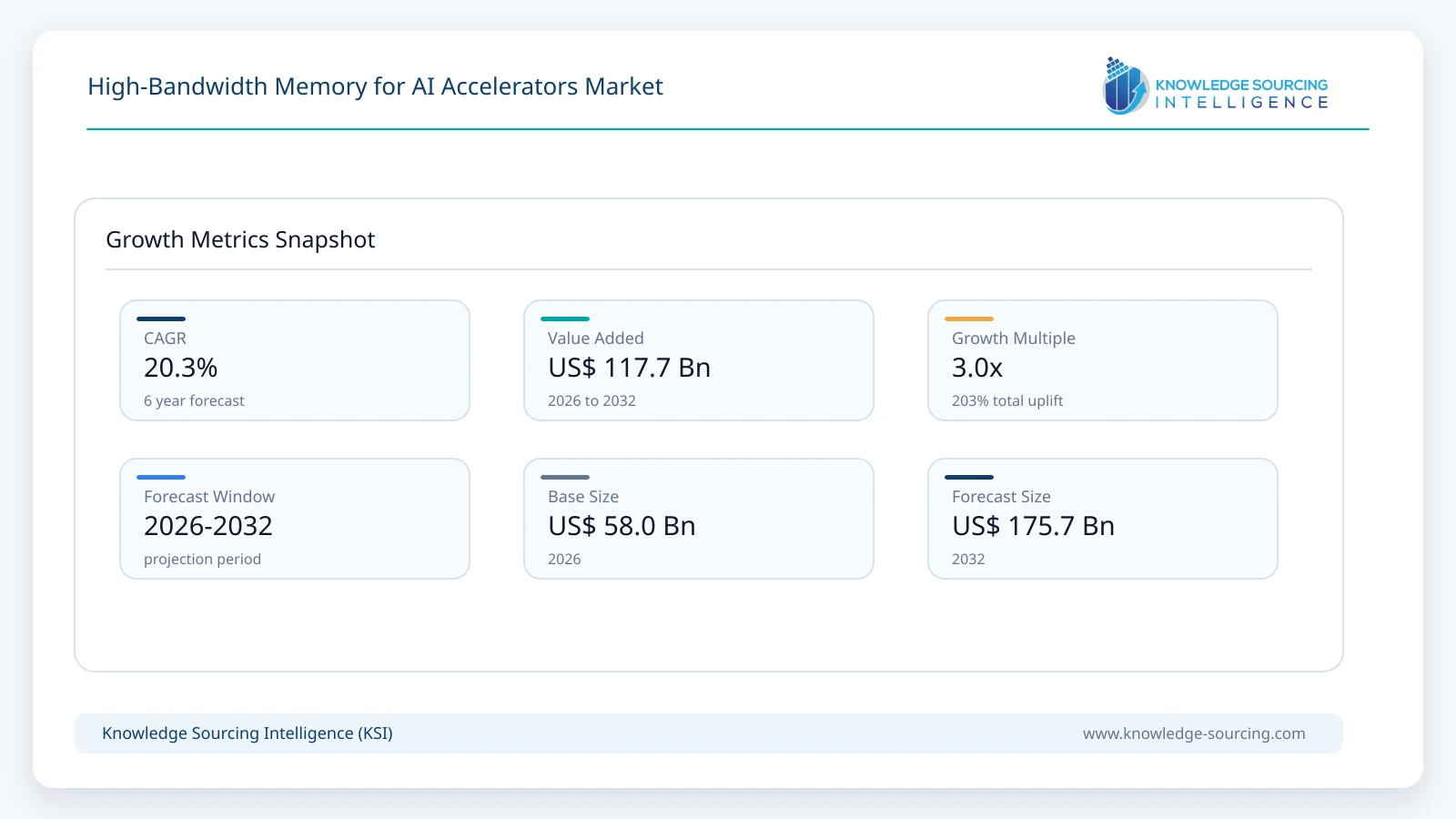
The High-Bandwidth Memory for AI Accelerators Market is estimated at USD 58.0 billion in 2026 and is projected to reach USD 175.7 billion by 2032, representing a CAGR of 20.3% during the forecast period.
Key Highlights
• HBM3E remains the largest 2026 revenue pool across current AI accelerator platforms.
• HBM4 is the fastest-growing generation as Rubin and custom accelerators enter production.
• NVIDIA Rubin increases memory bandwidth to 22 TB/s using 288 GB HBM4.
• Samsung expects 2026 HBM sales to more than triple from 2025 levels.
• SK hynix began HBM4 mass shipments during the second quarter of 2026.
• Micron exceeded USD 1 billion of HBM4 revenue by June 2026.
• Memory capacity per accelerator continues rising alongside model size and context length.
• Custom HBM base dies increase co-design between memory suppliers and accelerator developers.
• Advanced packaging capacity remains a supply constraint alongside DRAM wafer availability.
• Asia Pacific dominates HBM manufacturing through Korea, Taiwan and regional packaging ecosystems.
• HBM growth decelerates gradually as the market scales and cost-per-bit declines.
• AI ASIC adoption broadens demand beyond GPUs and reduces dependence on one accelerator architecture.
Market Overview
HBM differs from conventional DRAM because multiple memory dies are vertically stacked and connected using through-silicon vias (TSVs), then placed close to the accelerator through an advanced package. The architecture provides a very wide interface and high aggregate bandwidth while reducing the energy required to move data relative to off-package memory. That trade-off is particularly valuable in AI, where arithmetic throughput can exceed the rate at which model parameters and cache data can be supplied to the compute cores. The result is a memory subsystem whose capacity, bandwidth and power efficiency directly influence training throughput, inference concurrency and the number of accelerators required for a workload.
The technology is progressing through unusually rapid generations. HBM3E remains the primary production memory for many 2026 accelerator shipments, including NVIDIA Blackwell Ultra and AMD Instinct MI350-series devices. HBM4 increases interface width and adds greater flexibility in the logic base die, enabling tighter co-design with accelerator architectures. NVIDIA states that Rubin uses 288 GB of HBM4 and up to 22 TB/s of bandwidth per GPU, nearly tripling bandwidth relative to Blackwell-class systems. Samsung's commercial HBM4 reaches up to 13 Gbps per pin, while its HBM4E samples are designed for still higher transfer rates. The market is therefore moving from standardized stacked DRAM toward more customized memory subsystems integrated with logic and advanced packaging.
Demand is also broadening beyond merchant GPUs. Hyperscalers and semiconductor companies are increasing investment in custom AI accelerators, and Samsung's 2026 agreements with AMD and Broadcom illustrate how memory supply is being secured alongside accelerator roadmaps. This increases the number of qualification programs and supports custom HBM variants, but it also raises execution risk for suppliers because base-die design, thermal behavior, package architecture and customer-specific validation become more tightly coupled. Through 2032, HBM growth is therefore driven by a combination of accelerator-unit growth, more memory per accelerator and higher-value generations, while moderated by improving yields, cost-per-bit reductions and architectural efforts to use HBM more efficiently.
Market Drivers
Higher memory content per AI accelerator
The strongest structural driver is the increase in high bandwidth memory capacity and bandwidth attached to each high-end accelerator. NVIDIA Blackwell Ultra provides 288 GB of HBM3E, AMD Instinct MI350-series accelerators provide up to 288 GB of HBM3E and NVIDIA Rubin retains 288 GB while moving to much higher HBM4 bandwidth. Future accelerator architectures are expected to continue increasing memory capacity, stack height or effective bandwidth because larger models, longer context windows and higher inference concurrency place pressure on on-package memory. This allows HBM revenue to grow faster than accelerator unit shipments even when the average selling price per gigabyte declines.
Reasoning and agentic AI increase memory-bandwidth intensity
Inference is becoming more memory intensive as reasoning models use longer contexts, repeated tool calls and larger key-value caches. NVIDIA identifies decode as fundamentally memory-subsystem bound and positions HBM4 as critical for multitrillion-parameter models and high-concurrency inference. This changes HBM from a training-centric requirement into a broader inference bottleneck. As more data-center AI spending shifts toward production inference, memory bandwidth becomes a recurring system-design constraint rather than a feature concentrated in frontier training clusters.
Custom accelerators broaden the customer base
HBM demand is expanding beyond NVIDIA and AMD GPUs as hyperscalers and semiconductor suppliers deploy custom AI ASICs. Samsung and Broadcom announced a 2026 collaboration covering HBM for next-generation AI accelerators, while Samsung and AMD aligned on HBM4 supply for the Instinct MI455X. Each additional accelerator platform creates a distinct qualification program and can increase demand for custom base dies, packaging and tailored memory specifications. A wider customer base reduces the market's dependence on a single accelerator family and supports more differentiated HBM products.
Supplier investment is expanding HBM capacity
The three principal HBM suppliers are investing in DRAM process transitions, TSV capacity, packaging and clean-room expansion. Samsung is expanding HBM4 production after beginning commercial shipments, SK hynix is ramping HBM4 through the second half of 2026 and Micron is accelerating its HBM4 ramp while preparing HBM4E for 2027 production. Capacity expansion is necessary to support structural demand growth, but it also introduces the main mechanism that gradually slows market revenue growth after 2029 as supply broadens and yields improve.
Restraints and Adoption Challenges
HBM supply is constrained by more than DRAM wafer capacity. High stack counts, through-silicon via processing, base-die integration, thermal requirements and advanced packaging create yield and qualification challenges that can limit usable output during new-generation ramps. The market is also concentrated among three memory suppliers, creating customer concern around allocation and second-source qualification. At the same time, HBM carries a much higher cost per bit than conventional DRAM, encouraging accelerator designers to improve caching, compression, model partitioning and memory hierarchy efficiency. As production scales, better yields and stronger supplier competition are expected to reduce the revenue growth rate even while HBM bit shipments continue rising quickly.
Segment Analysis
By HBM Generation
HBM3E remains the largest generation in 2026 because current production accelerator platforms are still shipping at high volume and many systems qualified during 2025 continue scaling through 2026. HBM4 is the fastest-growing generation. Samsung, SK hynix and Micron have all moved HBM4 into production or high-volume shipment, and NVIDIA Rubin creates a large anchor platform for the transition. HBM4E and later generations become increasingly important after 2027 as transfer speeds rise and custom base-die architectures become more common. The transition is not instantaneous because accelerator qualification cycles, packaging capacity and existing platform demand keep prior generations commercially relevant during overlap periods.
By Accelerator Type
GPU-based accelerators represent the largest 2026 revenue pool because NVIDIA and AMD account for the majority of commercially deployed high-end AI accelerator systems using HBM. Custom AI ASICs are expected to record faster HBM growth through 2032 as hyperscalers and semiconductor suppliers expand internally designed accelerators for training and inference. HPC processors and specialized accelerators form a smaller but stable demand segment where memory bandwidth remains a core performance requirement.
Segment | 2026 Position | Growth Direction | Primary Demand Logic |
HBM3E | Largest generation | Moderating | Blackwell Ultra, MI350 and installed accelerator platforms |
HBM4 | Fastest-growing generation | Very high | Rubin, MI455X and next-generation custom accelerators |
HBM4E / later | Early-stage | Accelerating after 2027 | Higher transfer speeds, custom base dies and larger stacks |
GPU accelerators | Largest accelerator type | Strong | NVIDIA and AMD data-center AI deployments |
Custom AI ASICs | Smaller 2026 base | Fastest accelerator-type growth | Hyperscaler and merchant custom silicon programs |
Technology and Demand Indicators
Indicator | Latest Development | Market Impact |
NVIDIA Rubin memory | 288 GB HBM4 and up to 22 TB/s per GPU | Raises bandwidth and HBM value per next-generation accelerator |
AMD MI355X memory | 288 GB HBM3E and 8 TB/s per GPU | Sustains very high HBM content outside NVIDIA platforms |
Samsung HBM4 ramp | Commercial shipments began February 2026 | Confirms HBM4 transition from qualification to production |
SK hynix HBM4 ramp | Mass shipments began in Q2 2026 | Adds scaled supply for next-generation AI platforms |
Micron HBM4 ramp | High-volume shipments; over USD 1 billion HBM4 revenue by June 2026 | Shows rapid commercialization by the third major supplier |
Custom accelerator demand | Samsung-Broadcom and Samsung-AMD 2026 agreements | Broadens HBM demand beyond merchant GPU platforms |
Regional Opportunity
Asia Pacific
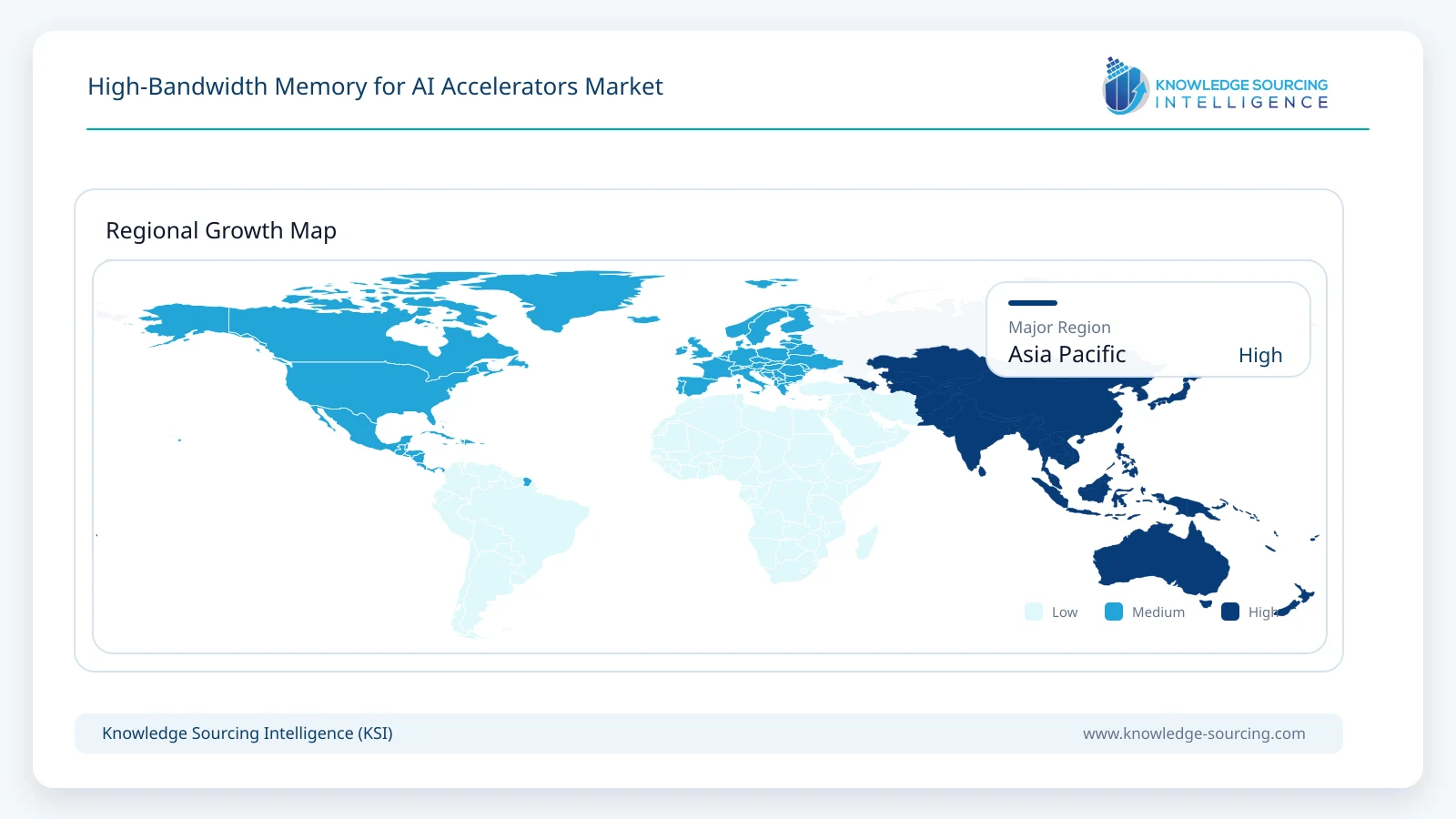
Asia Pacific is the center of the global HBM supply chain because two of the three principal HBM manufacturers are based in South Korea, Micron's production network spans the United States and Asia, and Taiwan plays a critical role in advanced packaging and accelerator integration. SK hynix and Samsung Electronics manufacture HBM in South Korea, and Samsung combines memory, foundry and advanced packaging capabilities within one corporate group. Taiwan Semiconductor Manufacturing Company (TSMC) provides leading-edge logic and advanced packaging used by many AI accelerators, making the Korea-Taiwan manufacturing corridor central to the commercial availability of HBM-equipped AI processors.
The region's competitive position is reinforced by process and packaging specialization. HBM requires advanced DRAM nodes, through-silicon vias, high-stack assembly, logic base dies and package integration with large accelerators. Equipment, materials and outsourced semiconductor assembly and test providers across Korea, Taiwan, Japan, Singapore and Southeast Asia therefore participate in the broader HBM ecosystem even though only three companies manufacture the memory itself at scale. Capacity decisions in this region directly affect lead times and allocation for North American and global accelerator customers.
North America is the largest design and end-demand center because NVIDIA, AMD, Broadcom, Marvell and hyperscale cloud companies drive much of the accelerator roadmap and HBM qualification activity. Europe has a smaller direct production role but participates through semiconductor equipment, bonding technology, AI-system deployment and HPC demand. Through 2032, supply-chain diversification may increase, but HBM manufacturing is expected to remain highly concentrated because the process know-how, capital intensity and qualification barriers are materially higher than for standard DRAM products.
Competitive Landscape
Direct HBM supply is unusually concentrated. SK hynix, Samsung Electronics and Micron Technology are the three scaled global HBM manufacturers, and competition centers on generation timing, transfer speed, stack height, power efficiency, yield, customer qualification and available capacity. HBM4 increases the strategic importance of the logic base die and customer co-design, making memory suppliers more closely integrated with accelerator developers than in conventional commodity DRAM. Multi-year supply agreements and advance qualification are therefore becoming more important commercial tools.
The wider ecosystem includes accelerator designers, advanced-packaging providers, foundries and bonding-equipment suppliers. NVIDIA, AMD, Broadcom and other AI-silicon companies influence HBM specifications and demand timing. TSMC, ASE Technology, Amkor, Powertech Technology and JCET participate across advanced packaging, test and semiconductor integration, while Besi and ASMPT supply bonding and assembly equipment relevant to increasingly complex stacked-memory production. These companies do not all compete in HBM memory sales, but their capacity and process capabilities affect the pace at which qualified HBM systems can reach volume production.
Major companies and ecosystem participants covered: SK hynix, Samsung Electronics, Micron Technology, TSMC, NVIDIA, AMD, Broadcom, Marvell Technology, Intel, ASE Technology, Amkor Technology, Powertech Technology, JCET Group, Besi and ASMPT.
Recent Developments
• August 2026: Samsung presented its next-generation 3D-memory roadmap, including zHBM concepts and an HBM5 model for future AI infrastructure.
• July 2026: SK hynix reported that HBM4 mass shipments began during the second quarter and would ramp further in the second half.
• July 2026: NVIDIA detailed the Rubin GPU architecture with 288 GB of HBM4 and up to 22 TB/s memory bandwidth.
• July 2026: Samsung and Broadcom announced expanded collaboration covering HBM supply for next-generation AI accelerators.
• June 2026: Micron reported high-volume HBM4 shipments and more than USD 1 billion in cumulative HBM4 revenue.
• May 2026: Samsung began shipping 12-layer HBM4E samples to major global customers.
• March 2026: Samsung and AMD aligned on HBM4 supply for the next-generation Instinct MI455X accelerator.
• February 2026: Samsung began mass production and commercial shipment of HBM4 and projected HBM sales to more than triple during 2026.
High-Bandwidth Memory for AI Accelerators Market Scope:
| Report Metric | Details |
|---|---|
| Total Market Size in 2026 | USD 58.0 billion |
| Total Market Size in 2032 | USD 175.7 billion |
| Forecast Unit | USD Billion |
| Growth Rate | 20.3% |
| Study Period | 2021 to 2032 |
| Historical Data | 2021 to 2024 |
| Base Year | 2025 |
| Forecast Period | 2026 – 2032 |
| Segmentation | HBM Generation, Stack Configuration, Accelerator Type, Application, Geography |
| Companies |
|
Market Segmentation
By HBM Generation
HBM3E
HBM4
HBM4E
Later-Generation and Custom HBM
By Stack Configuration
8-High
12-High
16-High and Higher
Advanced and Hybrid-Bonded Structures
By Accelerator Type
GPU Accelerators
Custom AI ASICs
HPC Processors
Other Specialized Accelerators
By Application
AI Training
AI Inference and Reasoning
HPC and Scientific Computing
Cloud and Hyperscale AI
Sovereign and Enterprise AI
By Geography
Asia Pacific
South Korea
Taiwan
Japan
Rest of Asia Pacific
North America
Europe
Rest of World
Table of Contents
1. EXECUTIVE SUMMARY
1.1. Market Opportunity and Key Findings
1.2. HBM Technology Transition
1.3. Principal Revenue Pools
2. MARKET OVERVIEW
2.1. HBM Architecture and AI Memory Bottlenecks
2.2. HBM3E to HBM4 Transition
2.3. Capacity, Bandwidth and Power Efficiency
2.4. Custom Base Dies and Co-Design
3. MARKET SIZE AND FORECAST, 2026-2032
3.1. Global Market Revenue
3.2. Annual Growth Analysis
3.3. HBM Content per Accelerator
3.4. Supply and Capacity Outlook
4. MARKET BY HBM GENERATION
4.1. HBM3E
4.2. HBM4
4.3. HBM4E
4.4. Later-Generation and Custom HBM
5. MARKET BY STACK CONFIGURATION
5.1. 8-High
5.2. 12-High
5.3. 16-High and Higher
5.4. Advanced and Hybrid-Bonded Structures
6. MARKET BY ACCELERATOR TYPE
6.1. GPU Accelerators
6.2. Custom AI ASICs
6.3. HPC Processors
6.4. Other Specialized Accelerators
7. MARKET BY APPLICATION
7.1. AI Training
7.2. AI Inference and Reasoning
7.3. HPC and Scientific Computing
7.4. Cloud and Hyperscale AI
7.5. Sovereign and Enterprise AI
8. SUPPLY CHAIN AND TECHNOLOGY OUTLOOK
8.1. DRAM Die Fabrication
8.2. TSV and Wafer Processing
8.3. Logic Base Die Integration
8.4. Advanced Packaging and Interposers
8.5. Thermal and Power Constraints
8.6. Qualification and Yield
9. REGIONAL MARKET
9.1. Asia Pacific
9.1.1. South Korea
9.1.2. Taiwan
9.1.3. Japan
9.1.4. Rest of Asia Pacific
9.2. North America
9.3. Europe
9.4. Rest of World
10. MARKET DYNAMICS
10.1. Drivers
10.1.1. Increasing HBM Content per Accelerator
10.1.2. Reasoning and Agentic AI
10.1.3. Expansion of Custom AI Accelerators
10.1.4. HBM Capacity Investment
10.2. Restraints
10.2.1. Packaging and Yield Constraints
10.2.2. Supplier Concentration
10.2.3. HBM Cost per Bit
10.2.4. Accelerator Memory-Hierarchy Optimization
11. COMPETITIVE LANDSCAPE
11.1. HBM Supplier Positioning
11.2. Customer Qualification and Long-Term Agreements
11.3. Advanced Packaging Ecosystem
11.4. Custom HBM and Base-Die Collaboration
11.5. Capacity Expansion and Technology Roadmaps
12. COMPANY PROFILES
12.1. SK hynix
12.2. Samsung Electronics
12.3. Micron Technology
12.4. TSMC
12.5. NVIDIA
12.6. AMD
12.7. Broadcom
12.8. Marvell Technology
12.9. Intel
12.10. ASE Technology
12.11. Amkor Technology
12.12. Powertech Technology
12.13. JCET Group
12.14. Besi
12.15. ASMPT
13. RECENT DEVELOPMENTS
14. APPENDIX
14.1. Definitions and Abbreviations
14.2. HBM Generation Comparison
14.3. Accelerator Memory-Content Framework
14.4. Source and Data Notes
Navigate
Trusted by the world's leading organizations











