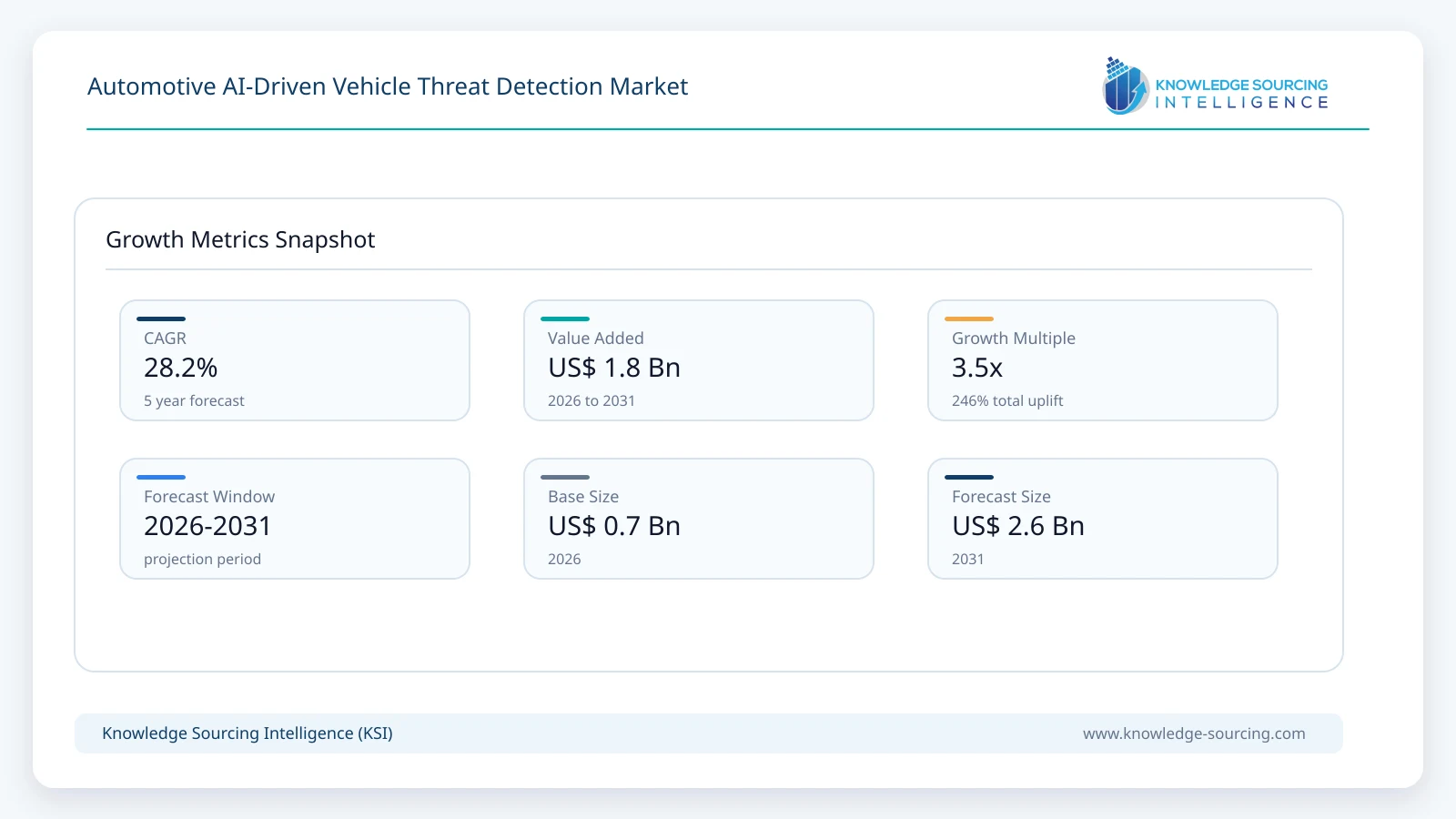
The automotive AI-driven vehicle threat detection market is forecast to grow at a CAGR of 28.2%, reaching USD 2.56 billion in 2031 from USD 0.74 billion in 2026.
Highlights:
- 1AI-enabled network and ECU anomaly detection represents approximately 33% of 2026 market value, reflecting the immediate need for vehicle-level behavioral analysis.
- 2Hybrid edge-cloud architectures account for approximately 37% of 2026 spending and are projected to reach about 44% by 2031 as fleet correlation becomes more widely deployed.
- 3Embedded detection software and attributable security content represent around 58% of estimated 2026 revenue; fleet analytics subscriptions are expected to gain share.
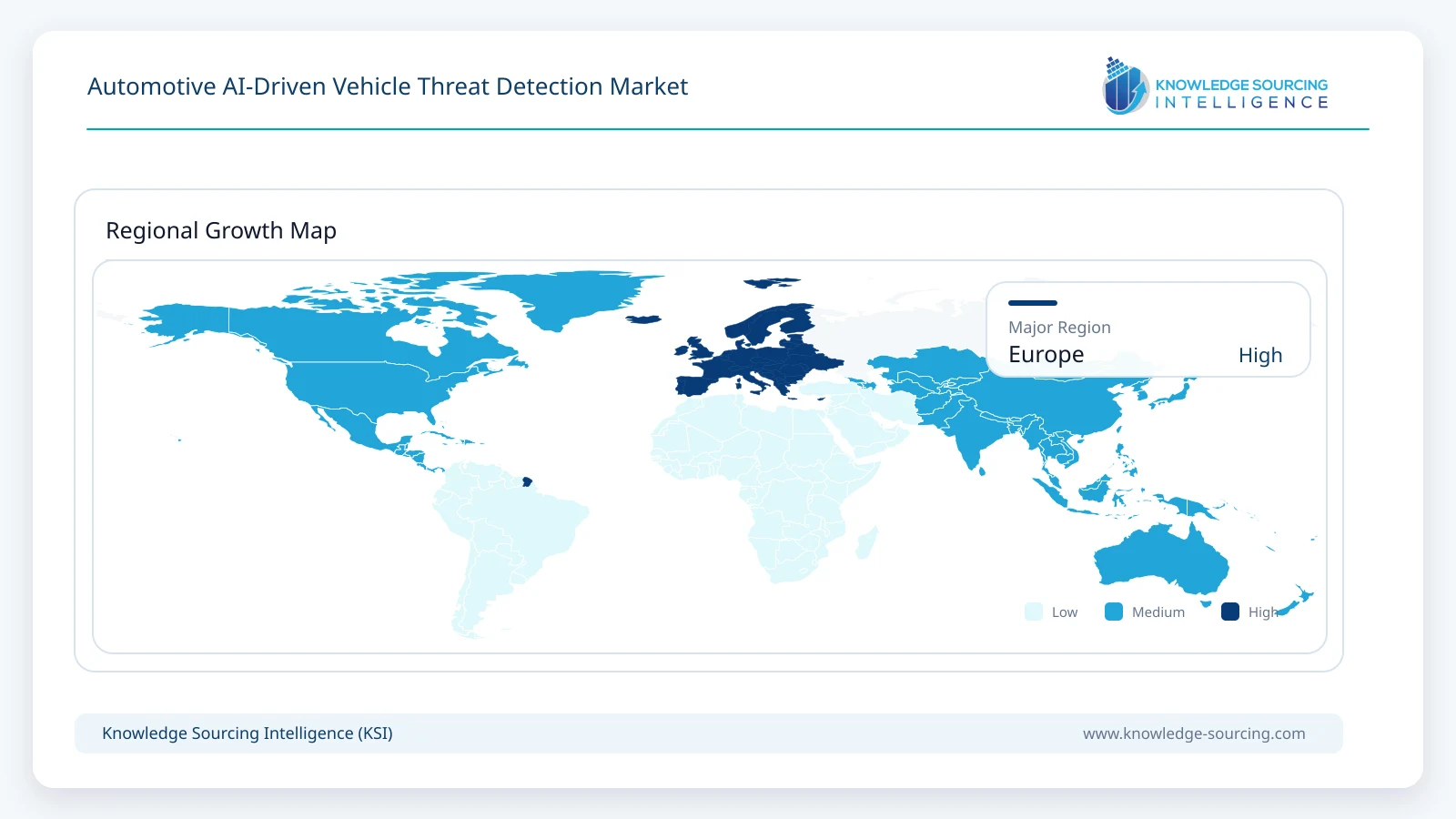
- 4Europe is estimated to account for approximately 35% of 2026 market value, supported by vehicle-type approval and cybersecurity lifecycle requirements.
- 5Automotive AI threat detection depends on reducing false positives and proving stable performance across vehicle variants, updates and normal operating conditions.
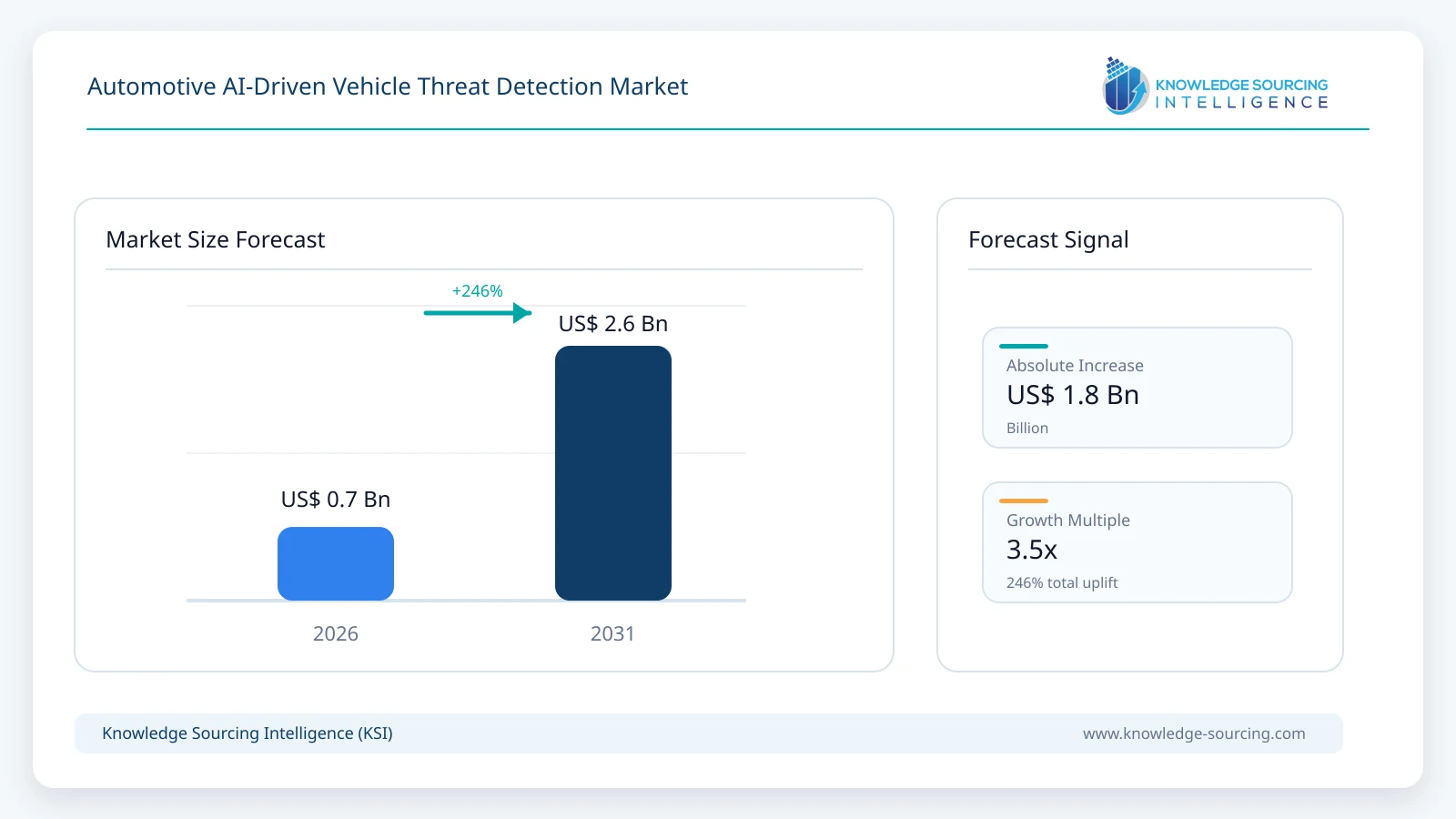
Spending covers AI-based threat classification and anomaly software operating inside vehicles, fleet-scale behavioral detection platforms, and associated engineering required to integrate these functions into vehicle architectures and security operations.
Vehicle networks are becoming more difficult to protect using fixed security rules alone because connected gateways, Ethernet domains, software updates, and shared compute platforms create changing traffic and execution patterns. AI-based detectors can learn expected behavior and identify unusual combinations of events, while rule-based controls continue to provide predictable enforcement. Suppliers such as VicOne, PlaxidityX and Upstream Security are linking local detection with fleet analytics so security teams can distinguish isolated anomalies from coordinated incidents.
Automotive cybersecurity procurement increasingly considers the full operating life of a vehicle, including how a security model is trained, validated, updated, and investigated after deployment. The commercial opportunity therefore extends beyond the installation of an embedded detector to recurring monitoring and the integration of threat intelligence with vehicle configuration data, although vehicle production volumes and contract pricing remain imperfectly disclosed.
Market Overview
AI-driven vehicle threat detection compares live vehicle behavior with models of expected network, software and fleet activity to identify deviations associated with misuse or compromise. CAN messages, automotive Ethernet flows, ECU processes, telematics calls and cloud API events can provide the underlying signals, although their relevance depends on the vehicle architecture. The core commercial task is to rank anomalous activity according to vehicle context rather than generate large numbers of unqualified alarms.
Edge detection models operate close to a gateway, domain controller, or vehicle computer where response time and network availability matter. VicOne and Trustonic introduced a 2026 architecture combining intrusion detection, trusted execution and edge-AI correlation across ECUs, while ETAS and AUTOCRYPT provide automotive-specific IDS infrastructure that can supply security events for higher-level analytics. A model must remain compatible with memory, compute, and functional-safety limits, making deployment engineering a material part of supplier value.
Fleet-level AI adds a second operating layer by comparing events across vehicles, software versions, and connected services. PlaxidityX combines smart edge filtering with cloud-based vehicle detection and response, while Upstream Security analyzes connected-mobility signals without requiring every vehicle to transmit raw log streams.
Market Trends
Edge and Cloud Analytics Are Becoming One Detection Workflow
Vehicle computers and telematics gateways increasingly perform local event selection before forwarding security records to backend platforms. PlaxidityX describes this edge-to-cloud architecture in its vCore platform, where locally filtered records are combined with cloud-based contextual analysis.
Integrated deployment also changes how suppliers are evaluated. OEMs need compatible event schemas, consistent detection policies and reliable fleet investigation workflows across different ECU suppliers.
Behavioral Detection Is Extending Beyond Known Attack Signatures
Signature and rules-based IDS remain important for recognized malicious messages, prohibited commands, and predictable execution violations, but software-defined architectures expose operating patterns that vary with updates and connected services. AI anomaly models complement deterministic sensors by assessing timing, event relationships, and unusual combinations across hosts, gateways, and cloud endpoints. VicOne’s ECU-focused edge-AI development illustrates this layered approach rather than replacement of conventional security controls.
Behavioral models can also misclassify legitimate changes after an OTA update or during atypical driving and service conditions. Vehicle-specific baselines, supervised validation and feedback from security analysts therefore influence adoption as much as raw classification accuracy.
Vehicle Security Operations Are Moving Toward Fleet Context
Connected fleets generate security signals from vehicles, customer applications, charging services and OEM backends, making isolated ECU alerts insufficient for many incidents. Upstream Security reported in February 2026 that ransomware-related events targeting automotive and smart mobility had more than doubled during 2025, indicating that the affected environment often extends beyond the vehicle itself. Fleet analytics can correlate such signals while reducing duplicate alerts.
Centralized threat operations create recurring demand for monitored-asset subscriptions and threat-detection model updates. Škoda’s partnership with Upstream to consolidate cyber intelligence signals illustrates the procurement preference for usable operational context.
AI Detection Is Being Linked More Closely to Vehicle Configuration
Threat classification becomes more useful when telemetry can be interpreted against an ECU’s software revision, network topology and security exposure. A message sequence that is normal for one vehicle variant can indicate abnormal behavior on another, while a reported vulnerability may be relevant only to a subset of the fleet. Integrating software inventories and platform attributes with security analytics helps reduce investigation effort and identify affected vehicles.
VicOne and Saphira connected supplier vulnerability information with live threat assessment workflows in May 2026, underscoring the need to maintain current technical context as vehicle software changes.
Model Governance Is Becoming a Production Qualification Requirement
False alarms, unexpected model drift, explainability, and compatibility with ECU resources must be tested across different vehicle states, software versions, and network loads. UN Regulation No. 155 and ISO/SAE 21434 reinforce lifecycle cybersecurity responsibilities, although neither mandates a particular AI detection algorithm.
Automakers are consequently likely to prefer controlled model releases, documented validation and human-supervised response logic for safety-related systems. AI analysis can prioritize a suspicious event, but deterministic controls and approved response policies remain important when a proposed action could affect vehicle availability.
Segment Analysis
By AI Detection Function
Embedded network and ECU anomaly detection represents approximately one-third of 2026 market value because each qualifying connected vehicle requires monitoring of locally generated security events. The function includes AI-based classification of traffic patterns and ECU behavior, but does not include the complete cost of gateways or unrelated cybersecurity hardware.
Fleet behavioral detection and cross-domain correlation are projected to capture a larger proportion of spending through 2031 as OEMs manage more connected software versions and security telemetry. Predictive threat-signal analysis also has a role, particularly in prioritizing combinations of weak indicators that are unlikely to trigger deterministic controls individually.
By Deployment Architecture
In-vehicle edge detection supports local classification when wireless connectivity is limited or a security event requires rapid attention. Distributed ECU and central gateway implementations are both relevant, with processing resources and safety isolation determining the placement of analytics. Dedicated local software can also minimize the transfer of personally sensitive or high-volume vehicle data.
Hybrid architectures combine local event selection with centralized vehicle detection and response, giving OEMs access to fleet comparisons and remotely updated threat intelligence. Cloud-only analysis remains useful where event feeds already exist and no incremental embedded AI license is required. Hybrid systems are estimated to be the fastest-growing major deployment category because they improve detection coverage without making every vehicle continuously upload raw logs.
By Vehicle Architecture
Connected conventional vehicles provide the largest initial population for AI-assisted threat detection because telematics modules, gateways and existing IDS event collectors can supply usable security signals. Their adoption depends on the cost of software integration and the extent to which older platforms can support event extraction. In many cases, an OEM can add fleet analytics without changing a vehicle’s complete cybersecurity electronics.
Software-defined vehicles are expected to gain market share as centralized compute, Ethernet networking and continuous software deployment create richer telemetry and greater exposure to changing threats. Highly automated vehicle programs add strict availability and security requirements, although their commercial fleet volumes remain more limited.
By Revenue Component
Embedded AI detection licenses and directly attributable security software account for approximately 58% of the estimated 2026 market. This component covers the incremental AI-based classification and vehicle event-analysis value rather than the whole price of a host ECU, secure gateway or base IDS. Program qualification, integration, and validation spending is treated separately where contracted work is not already included in the embedded license.
Recurring fleet analytics is projected to grow more rapidly as security teams monitor expanding in-service vehicle populations and combine events from vehicles with cloud systems. Contracts may be priced by monitored asset, volume of telemetry or service tier, so the model uses conservative equivalent-license assumptions rather than claiming a standardized industry price.
Market Drivers
Expansion of Software-Defined Vehicle Architectures
Centralized computing and software-defined functions increase the number of services sharing common operating systems, data networks and update mechanisms. Security teams must recognize events that move across infotainment, telematics, gateway and application layers, rather than rely on a detector placed on a single network segment. Embedded AI and vehicle-aware correlation become commercially relevant because they can qualify unusual sequences across these domains without transmitting every raw event. The installation opportunity rises with SDV programs, while integration effort remains sensitive to the maturity of each manufacturer’s software architecture.
Lifecycle Cybersecurity and Type-Approval Responsibilities
Automotive manufacturers operating under cybersecurity type-approval regimes need processes for identifying relevant threats after production and maintaining evidence that controls remain effective. UN Regulation No. 155 establishes cybersecurity management requirements, and ISO/SAE 21434 supports cybersecurity engineering across the vehicle lifecycle. These obligations do not prescribe AI, but larger fleets and frequent software releases can make manual review of security events uneconomic. AI-based prioritization creates value when it helps an OEM investigate credible incidents and maintain traceable operational response processes.
Growth in Connected-Vehicle Telemetry and Cross-Domain Attacks
Vehicles increasingly exchange data with mobile applications, cloud services, infrastructure and enterprise systems, introducing security event streams that cannot always be interpreted within a single ECU. Upstream’s 2026 research identifies a rise in large-scale mobility incidents and ransomware-related exposure, while VicOne documented cross-region security events during 2025. Detection platforms that connect fleet context with vehicle identifiers and software versions can reduce investigation time and improve incident scoping. The greatest demand emerges where analysis produces actionable information rather than higher volumes of low-quality alerts.
Demand for Lower-Cost Vehicle Security Operations
Continuous monitoring becomes expensive when each connected vehicle produces logs that must be transmitted, stored and examined by analysts. Edge-based event filtering, behavioral triage and cross-vehicle correlation can reduce avoidable telemetry processing while improving the focus of security investigations. PlaxidityX positions its architecture around source-level filtering and cloud analysis, illustrating the cost rationale for pairing embedded software with fleet services. OEM purchasing decisions are likely to reflect both detection capability and total operating expenditure across several years of vehicle service.
Increasing OEM Investment in AI-Assisted Cyber Defense
Large vehicle manufacturers are extending cybersecurity operations to cover vehicles, customer services and corporate infrastructure through increasingly automated analytics. Stellantis stated in April 2026 that its strategic collaboration with Microsoft includes AI-driven analysis for its global cyber defense center, indicating that OEM investment can encompass both vehicle data and enterprise events. Specialist vendors benefit when their automotive event models can feed broader security workflows without losing vehicle-specific context. Procurement remains selective because engineering teams must prove that detection results translate into practical remediation decisions.
Market Restraints
False Positives and Model Drift During Normal Vehicle Operation
Automotive traffic and software behavior can vary substantially with driving conditions, diagnostics, service events and feature updates, creating a difficult baseline for anomaly detection. Models trained on limited platforms may interpret unusual but legitimate events as attacks, increasing analyst workload and reducing confidence in the system. A change in firmware or network scheduling may require retraining and renewed validation. Suppliers consequently need vehicle-specific test datasets, controlled configuration updates and explainable alert evidence before OEMs will trust automated classification at scale.
Limits on Compute, Memory and Energy in Embedded Controllers
Embedded security analytics competes with vehicle functions for CPU cycles, memory and power, particularly on deeply integrated ECUs that were not designed for data-intensive model inference. Detection logic must retain predictable timing and should not interfere with functional-safety tasks or communication latency. Centralized computers provide more resources, but integration still requires secure partitioning and data access controls. This engineering burden favors compact models and selective feature extraction while slowing adoption of resource-intensive methods on existing platforms.
Incomplete Visibility Across Legacy and Multi-Supplier Architectures
Automakers commonly operate platforms with different CAN layouts, Ethernet configurations, telematics modules and supplier software versions, preventing the use of a uniform telemetry pipeline. Some important events may be unavailable because interfaces were not designed for forensic monitoring or because individual suppliers restrict access to diagnostic data. The absence of consistent event schemas reduces the effectiveness of fleet comparison and cross-domain correlation. Integration may therefore require costly normalization work and careful governance over which data can be collected and used.
Evidence, Privacy and Safety Requirements Restrict Automated Response
An AI model may classify a network event as suspicious without establishing that an attack has occurred or that an intervention would be safe. Disconnecting an ECU, changing access rights or blocking a service at the wrong time could impair vehicle operation, while indiscriminate upload of telemetry may raise privacy concerns. Production architectures usually need deterministic response policies, human escalation and minimal data collection. These controls narrow the range of detection-and-response actions manufacturers can safely authorize without additional human review.
Pricing Opacity and Overlapping Cybersecurity Supplier Bundles
AI detection is often sold inside broader embedded IDS, vehicle security operations or managed cybersecurity contracts, making its standalone commercial value difficult to isolate. OEM procurement packages may also combine deterministic rules, detection models, threat intelligence and integration under a single agreement. Suppliers that cannot demonstrate incremental detection performance or operating-cost savings face pressure to price AI as an enhancement rather than a separate premium product. Revenue disclosure is particularly limited when one supplier bundles conventional signature detection with AI analysis and engineering services.
Regional Outlook
Europe
Europe accounts for an estimated 35% of the 2026 market because cybersecurity management and vehicle type-approval requirements create sustained demand for post-production event monitoring. Manufacturers and Tier 1 suppliers must connect their cybersecurity engineering activities with evidence from vehicles in operation, particularly as software versions and services change. ETAS offers automotive-specific IDS sensors and reporting infrastructure, while European OEMs increasingly use external partners to consolidate vehicle and backend threat information.
Software-defined vehicle development is expected to expand demand for hybrid analysis and cross-domain event correlation across the region. Škoda’s 2026 agreement with Upstream demonstrates an operational interest in consolidating cybersecurity intelligence across connected vehicles and services, rather than treating each security finding in isolation. Adoption will nevertheless depend on data-access rules, supplier interfaces and the ability of monitoring platforms to provide reproducible evidence to engineering and security teams.
Asia Pacific
Asia Pacific combines the world’s largest vehicle production base with expanding adoption of connected architectures and software-controlled cockpit functions. OICA reported that global automotive production growth shifted toward Asian markets in 2025, providing a broad industrial setting for suppliers of vehicle electronics and security software. Demand for embedded detection will be influenced by the pace of vehicle electrification, central-compute adoption and OEM cybersecurity procurement in China, Japan, South Korea and India.
Local suppliers and global cybersecurity vendors are adapting event collection and threat models to diverse vehicle platforms, including compact passenger vehicles and export-oriented models. AUTOCRYPT’s embedded IDS and policy-management tools illustrate the region’s supplier capability in automotive security infrastructure, although not every conventional IDS installation includes AI. Asia Pacific is expected to gain global share through 2031 as growth in qualifying vehicle volumes and cloud-connected operations outpaces several mature markets.
Competitive Landscape
Competition spans automotive cybersecurity specialists, embedded software suppliers and providers of fleet security operations. VicOne and PlaxidityX emphasize layered vehicle-to-cloud detection, while Upstream Security concentrates on connected-mobility threat analytics and vehicle detection and response. ETAS and AUTOCRYPT supply vehicle-specific intrusion detection components, reporting frameworks and policy management that can support advanced analytics. These businesses compete at different layers of the security architecture, so a complete platform contract should not be mistaken for a pure AI software sale.
Automotive security validation is an important competitive differentiator because a useful anomaly model needs realistic vehicle traces, incident evidence and extensive testing against legitimate operating conditions. PlaxidityX describes combining deterministic detection knowledge with AI event prioritization, while VicOne’s 2026 Trustonic collaboration embeds detection alongside a trusted execution environment.
Purchasing decisions increasingly consider operational compatibility as well as classifier performance. OEMs need event normalization, accessible investigation records, secure model updates and integration with engineering vulnerability data, while commercial customers require manageable alert volumes over a vehicle’s long operating life.
Market Outlook
AI-driven vehicle threat detection is expected to become a more established software capability as OEMs connect embedded IDS records with fleet analytics and security response teams. Revenue growth is likely to be strongest where continuously updated behavioral models improve threat prioritization across multiple vehicle domains and software revisions. These gains require robust vehicle-level context and integration with operating processes, not simply larger sets of anomaly scores.
Commercial adoption through 2031 will remain uneven because mature connected fleets, older electronic architectures and newer software-defined platforms have different monitoring requirements. Suppliers that prove low false-positive rates, controllable telemetry expense and safe escalation procedures should capture more durable software and service revenue.
Recent Developments
June 3, 2026: PlaxidityX announced an AutoTech & Wards cybersecurity award for its vCore vehicle cyber protection platform, highlighting edge filtering and cloud-based vehicle detection and response.
April 23, 2026: VicOne and Intellias announced integration of intrusion detection and AI protection capabilities into the IntelliKit automotive technology platform.
April 16, 2026: Stellantis and Microsoft announced a collaboration including AI-driven analytics for Stellantis’ global cyber defense center.
April 14, 2026: VicOne and Trustonic launched a layered ECU protection solution combining an intrusion detection system, trusted execution and edge-AI event analysis.
February 18, 2026: Upstream Security published its 2026 research on automotive cyber incidents and rising ransomware exposure, supporting demand for fleet-level detection.
January 13, 2026: Škoda and Upstream Security announced a partnership to consolidate connected-vehicle cyber intelligence and risk signals.
Automotive AI-Driven Vehicle Threat Detection Market Scope:
| Report Metric | Details |
|---|---|
| Total Market Size in 2026 | USD 0.74 billion |
| Total Market Size in 2031 | USD 2.56 billion |
| Forecast Unit | USD Billion |
| Growth Rate | 28.2% |
| Study Period | 2021 to 2031 |
| Historical Data | 2021 to 2024 |
| Base Year | 2025 |
| Forecast Period | 2026 – 2031 |
| Segmentation | AI Detection Function, Deployment Architecture, Revenue Component -, Vehicle Architecture |
| Companies |
|
Market Segmentation
By AI Detection Function
Network and ECU Anomaly Detection
Fleet Behavioral Threat Detection
Cross-Domain Attack Correlation
Predictive Threat Signal Analysis
By Deployment Architecture
Embedded / Edge
Hybrid Edge-Cloud
Cloud-Centric
By Revenue Component
Embedded AI Detection Software
Fleet Analytics Subscriptions
Engineering and Integration
By Vehicle Architecture
Connected Conventional Vehicles
Software-Defined Vehicles
Highly Automated Vehicles
By Vehicle Type
Passenger Vehicles
Light Commercial Vehicles
Medium and Heavy Commercial Vehicles
By Buyer Type
Automotive OEMs
Tier 1 and Tier 2 Suppliers
Fleet and Mobility Operators
Security Engineering and Service Providers
By Geography
North America
United States
Canada
Mexico
South America
Brazil
Argentina
Others
Europe
Germany
United Kingdom
France
Italy
Spain
Others
Middle East and Africa
Saudi Arabia
United Arab Emirates
Israel
South Africa
Others
Asia Pacific
China
Japan
South Korea
India
Taiwan
Thailand
Indonesia
Others
Table of Contents
1. EXECUTIVE SUMMARY
1.1. Market Opportunity and Key Findings
1.2. Revenue Growth and Competitive Position
2. MARKET SNAPSHOT
2.1. Market Overview
2.2. Market Definition and Scope
2.3. Market Segmentation
2.4. Global Size and Forecast, 2026–2031
3. BUSINESS LANDSCAPE
3.1. Market Drivers
3.1.1. Expansion of Software-Defined Vehicle Architectures
3.1.2. Lifecycle Cybersecurity and Type-Approval Responsibilities
3.1.3. Growth in Connected-Vehicle Telemetry and Cross-Domain Attacks
3.1.4. Demand for Lower-Cost Vehicle Security Operations
3.1.5. Increasing OEM Investment in AI-Assisted Cyber Defense
3.2. Market Restraints
3.2.1. False Positives and Model Drift During Normal Vehicle Operation
3.2.2. Limits on Compute, Memory and Energy in Embedded Controllers
3.2.3. Incomplete Visibility Across Legacy and Multi-Supplier Architectures
3.2.4. Evidence, Privacy and Safety Requirements Restrict Automated Response
3.2.5. Pricing Opacity and Overlapping Cybersecurity Supplier Bundles
3.3. Market Opportunities
3.3.1. Vehicle Software Lifecycle Services
3.3.2. Vehicle-to-Cloud Threat Correlation
3.4. Porter’s Five Forces Analysis
3.5. Industry Value Chain Analysis
3.6. Regulatory and Standards Landscape
3.6.1. UN Regulation No. 155
3.6.2. ISO/SAE 21434
3.7. Strategic Recommendations
4. TECHNOLOGICAL OUTLOOK
4.1. Behavioral AI and Anomaly Detection
4.2. In-Vehicle Network and ECU Telemetry
4.3. Edge-Cloud Event Correlation
4.4. Model Training, Validation and Drift Control
4.5. Cybersecurity Response Integration
5. GLOBAL AUTOMOTIVE AI-DRIVEN VEHICLE THREAT DETECTION MARKET BY AI DETECTION FUNCTION
5.1. Introduction and Forecast
5.2. Network and ECU Anomaly Detection
5.3. Fleet Behavioral Threat Detection
5.4. Cross-Domain Attack Correlation
5.5. Predictive Threat Signal Analysis
6. GLOBAL AUTOMOTIVE AI-DRIVEN VEHICLE THREAT DETECTION MARKET BY DEPLOYMENT ARCHITECTURE
6.1. Introduction and Forecast
6.2. Embedded / Edge
6.3. Hybrid Edge-Cloud
6.4. Cloud-Centric
7. GLOBAL AUTOMOTIVE AI-DRIVEN VEHICLE THREAT DETECTION MARKET BY REVENUE COMPONENT
7.1. Introduction and Forecast
7.2. Embedded AI Detection Software
7.3. Fleet Analytics Subscriptions
7.4. Engineering and Integration
8. GLOBAL AUTOMOTIVE AI-DRIVEN VEHICLE THREAT DETECTION MARKET BY VEHICLE ARCHITECTURE
8.1. Introduction and Forecast
8.2. Connected Conventional Vehicles
8.3. Software-Defined Vehicles
8.4. Highly Automated Vehicles
9. GLOBAL AUTOMOTIVE AI-DRIVEN VEHICLE THREAT DETECTION MARKET BY VEHICLE TYPE
9.1. Introduction and Forecast
9.2. Passenger Vehicles
9.3. Light Commercial Vehicles
9.4. Medium and Heavy Commercial Vehicles
10. GLOBAL AUTOMOTIVE AI-DRIVEN VEHICLE THREAT DETECTION MARKET BY BUYER TYPE
10.1. Introduction and Forecast
10.2. Automotive OEMs
10.3. Tier 1 and Tier 2 Suppliers
10.4. Fleet and Mobility Operators
10.5. Security Engineering and Service Providers
11. AUTOMOTIVE AI-DRIVEN VEHICLE THREAT DETECTION MARKET BY GEOGRAPHY
11.1. Regional Comparison and Outlook
11.2. North America
11.2.1. United States
11.2.2. Canada
11.2.3. Mexico
11.3. South America
11.3.1. Brazil
11.3.2. Argentina
11.3.3. Others
11.4. Europe
11.4.1. Germany
11.4.2. United Kingdom
11.4.3. France
11.4.4. Italy
11.4.5. Spain
11.4.6. Others
11.5. Middle East and Africa
11.5.1. Saudi Arabia
11.5.2. United Arab Emirates
11.5.3. Israel
11.5.4. South Africa
11.5.5. Others
11.6. Asia Pacific
11.6.1. China
11.6.2. Japan
11.6.3. South Korea
11.6.4. India
11.6.5. Taiwan
11.6.6. Thailand
11.6.7. Indonesia
11.6.8. Others
12. COMPETITIVE ENVIRONMENT AND ANALYSIS
12.1. Competitive Landscape
12.2. Market Share Analysis
12.3. Product and Technology Positioning
12.4. Partnerships and Strategic Developments
12.5. Competitive Dashboard
13. COMPANY PROFILES
13.1. Upstream Security
13.2. VicOne Corporation
13.3. PlaxidityX
13.4. ETAS GmbH
13.5. AUTOCRYPT Co., Ltd.
13.6. Karamba Security
13.7. NXP Semiconductors
13.8. Vector Informatik GmbH
13.9. Microsoft Corporation
13.10. Intellias
13.11. Trustonic
14. APPENDIX
14.1. Currency and Units
14.2. Research Methodology
14.3. Base and Forecast Years
14.4. Key Benefits for Stakeholders
14.5. Assumptions
14.6. Abbreviations
14.7. Sources and References
Navigate
Trusted by the world's leading organizations