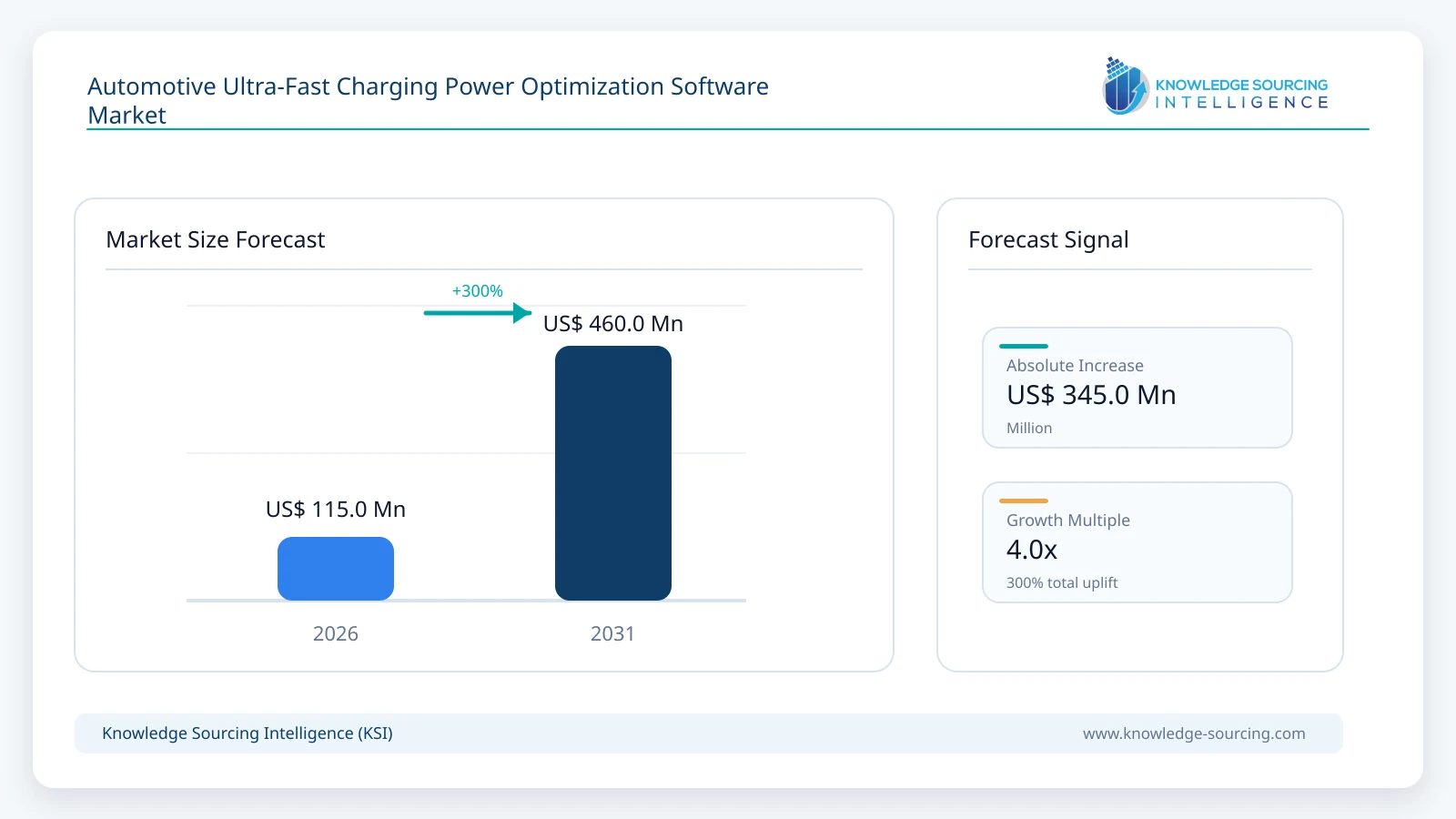
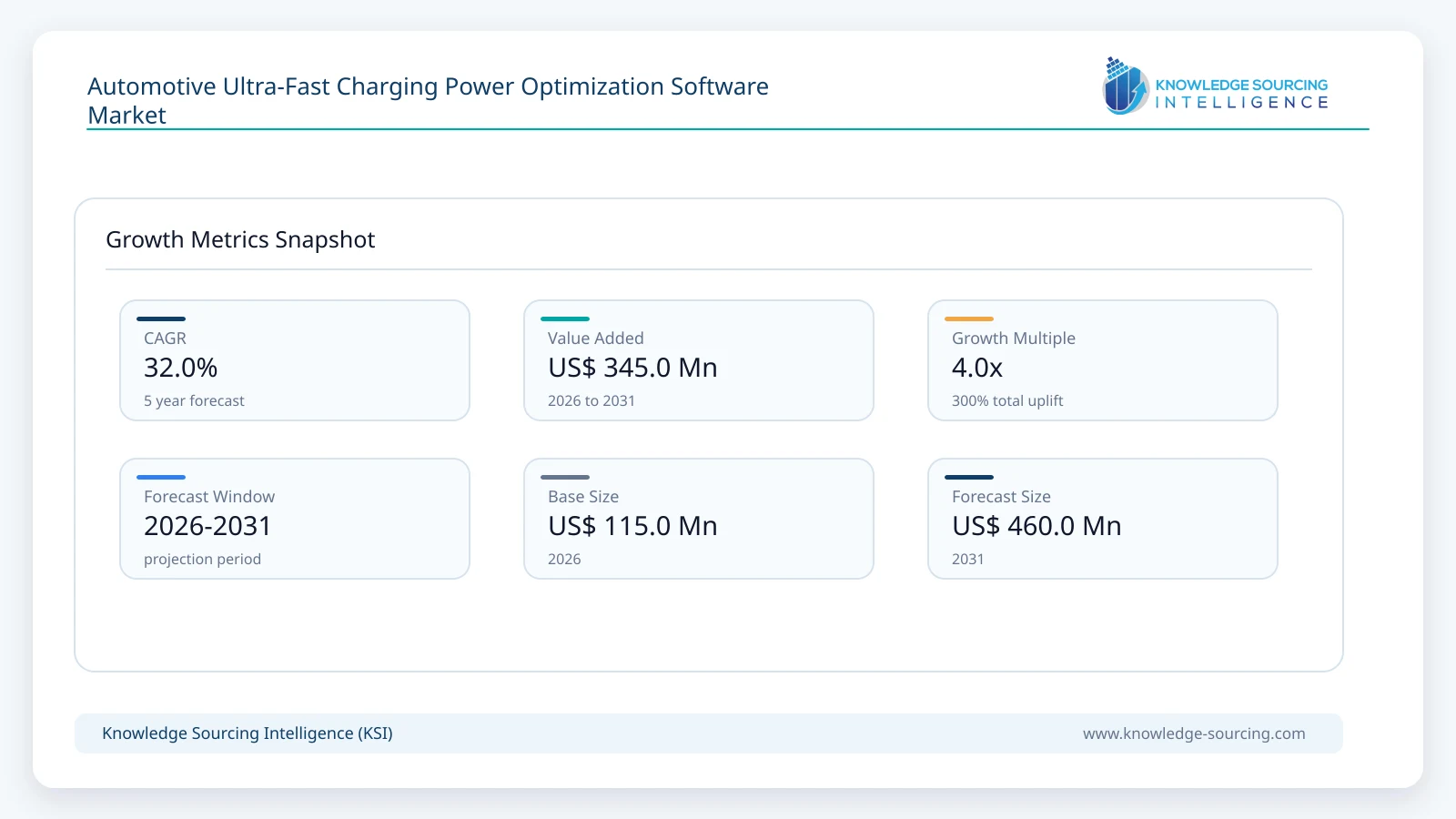
The automotive ultra-fast charging power optimization software market is projected to expand at a CAGR of 32.0%, reaching USD 460 million in 2031 from USD 115 million in 2026.
Highlights:
- 1Adaptive charging-curve and current control accounts for an estimated 44% of 2026 market revenue, reflecting the centrality of safe charge acceptance at high currents.
- 2Embedded charging software represents USD 72 million of 2026 value; cloud charging profiles add another USD 13 million.
- 3Battery-electric vehicles account for approximately 92% of 2026 demand because sustained high-power DC charging is concentrated in BEV platforms.
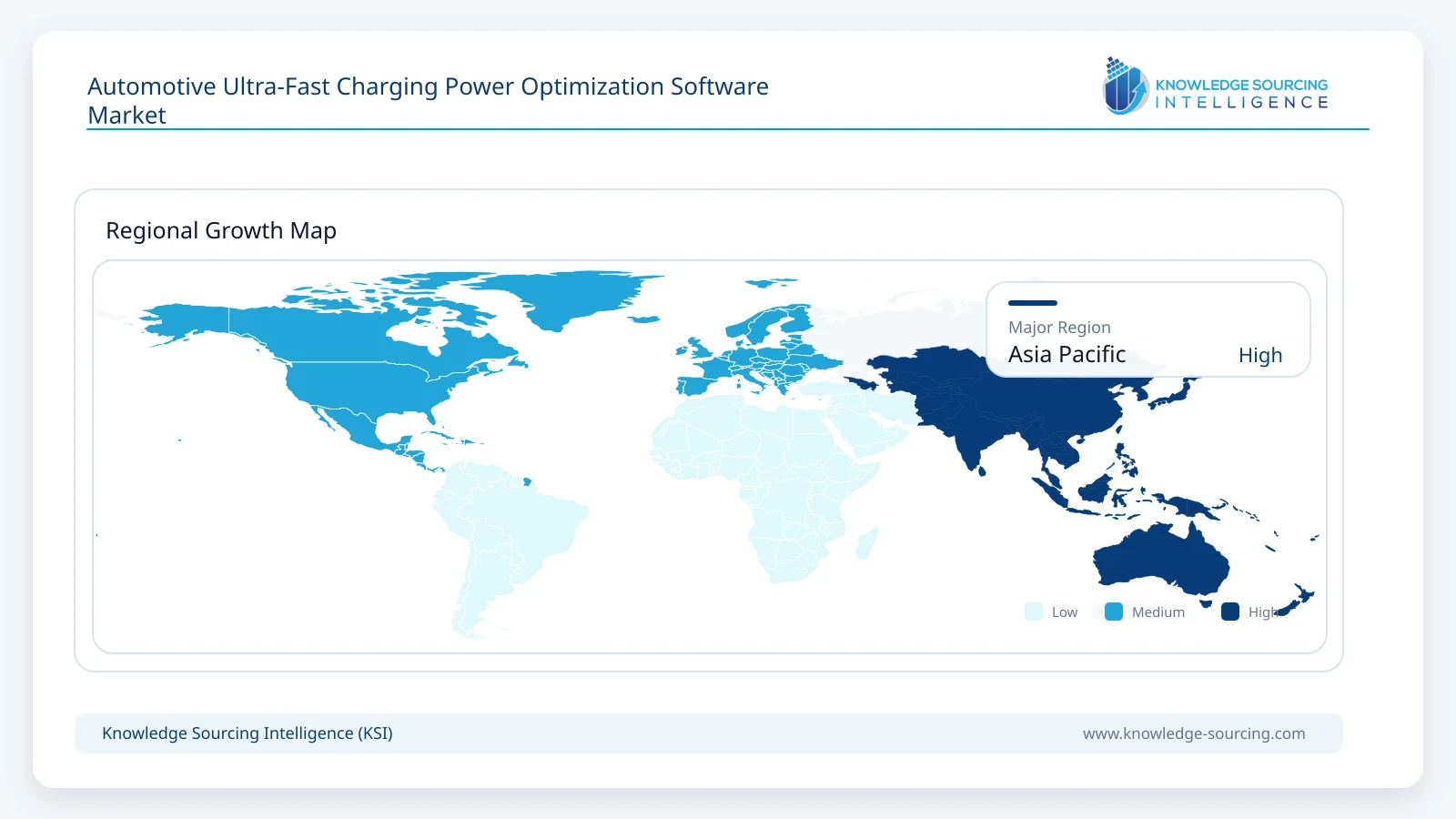
- 4Asia Pacific leads the 2026 market with 47% of estimated global value, supported by the scale of Chinese EV platforms and battery-system engineering.
- 5Physics-informed and AI-hybrid optimization gains share through 2031 as suppliers seek faster adaptation to temperature, battery age and chemistry.
- 6Named OEM integrations have emerged, but charging-power and charging-time claims depend on battery, temperature, charger and state-of-charge conditions.
The automotive ultra-fast charging power optimization software market covers embedded and cloud-assisted algorithms that calculate safe, responsive DC charging power limits for vehicle batteries designed for nominal peak charging capability of at least 150 kW. Attributable revenue includes battery charge-curve optimization, cell-stress and aging-aware control, charger power-request logic and directly related calibration, validation and lifecycle software.
Volvo Cars has incorporated algorithms from Breathe Battery Technologies in its EX60 program, while Polestar announced Breathe Charge for the upgraded 800-volt Polestar 3 in April 2026. Bosch provides battery-cloud charging profiles and a vehicle software development kit; Qnovo offers adaptive charging as an application integrated with existing battery-control hardware.
Market Overview
High-power DC charging requires the vehicle to calculate how much current the battery can accept at each instant rather than draw the maximum power printed on a charger. Temperature, cell voltage, state of charge, battery aging and pack-to-pack variability constrain the permissible charging envelope. Charging optimization software uses measured signals and battery models to reshape that envelope during the session, while protective BMS functions maintain non-negotiable limits.
Breathe Charge uses existing BMS signals to adjust battery power acceptance without adding pack hardware, and Qnovo describes closed-loop control that responds to the weakest monitored series element. Eatron positions its Safe Fast Charging algorithms alongside state-of-charge and state-of-power estimators, allowing charge control to respond to the actual battery condition. Bosch’s cloud-based service calculates charging profiles and passes operational limits to a vehicle SDK.
Automakers adopting high-voltage platforms can source the full charging-control stack internally, license a specialist algorithm, or combine both through a calibrated integration contract. Volvo’s EX60 uses 800-volt hardware alongside software developed in-house and algorithms from Breathe; Porsche’s Cayenne Electric uses predictive thermal control to support a broad high-power charging window. Neither example means that every 800-volt vehicle buys independent optimization software.
Market Trends
Adaptive Charge Curves Are Replacing Static Operating Maps
Battery charge acceptance changes considerably between a cold arrival, a warm low-state-of-charge session and the final portion of a high-power stop. Breathe’s charging software adjusts power acceptance using existing current, voltage, temperature and battery-state inputs, while Qnovo’s adaptive approach monitors individual series-element conditions.
Automakers must still validate charging behavior across battery chemistries, suppliers and production tolerances before permitting a revised power envelope. Software becomes commercially valuable when the improved curve is reproducible under specified test conditions and does not merely shift stress toward weaker cells.
800-Volt Platforms Are Raising the Value of Charge-Power Coordination
Volvo’s ES90 combines an 800-volt electrical architecture with upgraded battery-management software and charging capability up to 350 kW, while the EX60 targets higher-power charging with adaptive battery algorithms. BMW’s iX3 and Porsche’s Cayenne Electric similarly demonstrate that high charging ratings require more than a high-voltage battery: thermal conditioning, current limits and charging-station compatibility determine actual charging performance.
At higher DC power, software interacts with thermal management, cell-voltage constraints and vehicle-charger communication to maintain a safe charging trajectory. Platform teams can purchase charge-current optimization separately even when cooling control remains in a broader thermal controller.
Battery Aging Is Being Incorporated into Charging Decisions
Qnovo’s adaptive fast-charging product uses battery-condition data to modify charging parameters, and Bosch’s Battery in the Cloud offers charging modes designed to balance charging speed and battery lifetime. The practical purchasing question for an OEM is whether an algorithm can sustain competitive charging times over several years of cell aging rather than only on a new pack under laboratory conditions.
Charging software must be robust when diagnostic data are incomplete or a battery has experienced irregular duty cycles. Control models that estimate lithium-plating risk or power acceptance can improve long-term consistency, but confidence must be demonstrated through measured aging and temperature tests.
Charging Optimization Is Moving across Vehicle and Cloud Software Layers
Bosch supplies cloud-generated charging profiles interpreted by an in-vehicle SDK, while Qnovo emphasizes a software application operating directly on a battery-management controller. Eatron supports edge and cloud execution options for battery optimization functions.
Vehicle manufacturers weighing cloud-assisted control must define what happens when connectivity is lost, data arrive late, or model updates conflict with a certified battery configuration. As software-defined vehicle platforms become more common, charge-profile improvements can be delivered through controlled releases, but safety validation and change governance remain necessary before using more aggressive current limits.
Segment Analysis
By Charging Optimization Function: Adaptive Charging-Curve and Current Control
Adaptive charging-curve and current-control applications account for approximately 44% of estimated 2026 revenue because their output directly determines the power requested during a high-rate DC session. Systems adjust charge current using pack conditions and validated constraints, aiming to sustain higher average power rather than a headline peak that lasts only briefly.
Charging curves optimized for each pack variant can reduce reliance on conservative fixed margins, but their deployment depends on evidence across cell lots, temperatures and aging states. The software is also evaluated against charger-handshake behavior and fallback operation so that the driver receives predictable performance even at a limited-power station.
By Algorithm Strategy: Physics-Informed and AI-Hybrid Optimization
Physics-informed and AI-hybrid control is projected to represent a larger share by 2031 as battery programs combine electrochemical constraints with learned relationships from operating data. Eatron uses physics-inspired estimation and fast-charging algorithms, while Bosch combines battery models with connected-vehicle data to generate battery-specific charging profiles.
Algorithm complexity also increases validation requirements. Safety engineers must be able to constrain outputs, trace the response to abnormal cell readings and reproduce charging behavior across software revisions.
By Software Execution Architecture: Embedded Battery Management Controller
Embedded BMS execution accounts for an estimated 69% of 2026 market value because critical current-limit calculations require low-latency access to cell and pack measurements. Qnovo identifies both AUTOSAR and non-AUTOSAR BMS implementations, while Eatron offers executable software for automotive microcontrollers.
Integration into an established controller avoids a separate hardware bill but places tighter constraints on memory, processing time and calibration interfaces. As central vehicle computers take on more energy-domain supervision, embedded charging algorithms will continue to provide deterministic local limits while higher-level systems manage driver preferences and thermal preparation.
Market Drivers
Wider Deployment of High-Power EV Electrical Platforms
Volvo’s 800-volt ES90 and EX60, BMW’s Neue Klasse iX3 and Porsche’s Cayenne Electric demonstrate expanding engineering investment in batteries that can accept several hundred kilowatts of DC power. Stronger hardware capability raises the potential cost of conservative control maps because a small reduction in average charging power can materially lengthen a customer’s journey stop.
EV platform teams therefore have an incentive to purchase more accurate charging algorithms even when they retain control of the rest of the BMS. The expected increase in qualifying vehicle programs supports embedded licensing and battery-specific validation services, with the largest fitment base in higher-volume Asian EV production.
Commercial Pressure to Reduce Actual Charging Time
Polestar’s April 2026 upgrade combines 800-volt hardware and Breathe Charge to target a 10–80% charging time of 22 minutes. Volvo’s EX60 uses adaptive battery algorithms alongside high charging power, showing how charging duration has become a competitive vehicle attribute rather than merely an engineering specification.
OEM product teams are judged on usable charging performance in familiar customer conditions, including cold weather and repeated long-distance stops. Charging software can support differentiation when battery-cell changes would require major redesign, encouraging both specialist procurement and closer collaboration between cell teams and control-software suppliers.
Battery Warranty Exposure and Degradation Control
Qnovo and Bosch position battery-condition-aware charging as a way to preserve pack life while improving charging speed. At elevated current, uneven cell behavior, temperature excursions and aging can constrain available power well before the charger reaches its technical ceiling. Algorithms that identify these constraints help automakers calibrate the trade-off between charge duration and long-term battery stress.
Battery suppliers and OEMs have direct incentives to avoid charging-related warranty losses and premature capacity decline. Software contracts can therefore be evaluated against degradation evidence, warranty risk and fleet-condition monitoring, rather than only against the fastest laboratory charging result.
Reusable Software Across Battery Chemistries and Vehicle Programs
Eatron’s battery optimization suite supports multiple lithium-ion chemistries and edge execution, while Qnovo markets software integration without additional battery-pack hardware. Reusable algorithm architectures allow an OEM to retain common software interfaces while calibrating parameters for different cell suppliers, sizes and thermal circuits.
Each chemistry and hardware variant still requires characterization and validation, but a reusable software base can reduce duplication across a multi-model platform. Program reuse creates revenue for tools, integration libraries and calibration support that may be purchased separately from the physical battery-management controller.
Connected Fleet Data Supporting Charging Profile Improvement
Bosch’s cloud-based battery service combines data from connected vehicles with battery models to calculate charging profiles that can be transferred back to individual vehicles. Fleet learning is commercially relevant because production cells encounter far more varied aging and operating conditions than a fixed development-test matrix can reproduce.
Vehicle manufacturers adopting this approach can revise charging parameters over the ownership period while using local BMS controls for immediate current limits. The opportunity is strongest where telemetry permissions, data quality and OTA release governance support repeatable updates rather than uncontrolled changes to the charging strategy.
Market Restraints
Chemistry-Specific Validation and Safety Requirements
Ultra-fast charging pushes cell kinetics, temperature and voltage behavior toward their operational constraints, making a generic charge curve difficult to qualify across different NMC and LFP cells. A model that performs well on new cells can require additional safeguards when resistance increases or low-temperature conditions raise lithium-plating risk.
Automakers must verify both the optimized operating envelope and the conservative fallback behavior under sensor faults, controller resets and unexpected charger responses. Long qualification cycles delay program revenue and discourage aggressive charging maps without independently reproducible aging and abuse-test evidence.
Inconsistent Charger Power and Communication Conditions
Vehicles advertised with 350–400 kW peak capability may connect to stations that deliver substantially less power because of electrical limits, shared cabinet capacity or site temperature constraints. BMW’s charging planner explicitly checks charging-point availability and records achieved charging rates, highlighting the gap between vehicle capability and field conditions.
Charging optimization software cannot override the external charger’s voltage or current ceiling. Suppliers must validate protocol negotiation, power-request transitions and graceful derating across heterogeneous infrastructure, which can reduce the measurable benefit of an advanced charging algorithm outside controlled tests.
Limited Access to Cell-Level Data and Control Interfaces
Battery manufacturers and vehicle OEMs often restrict access to detailed cell measurements, thermal states and calibration interfaces to preserve intellectual property and functional-safety control. Third-party charging algorithms require timely data and authority to recommend current limits, making integration difficult when the BMS exposes only coarse estimates.
Independent software suppliers may need extended co-development with the cell supplier and OEM before obtaining dependable diagnostic signals. Where a battery platform already uses tightly integrated proprietary control, commercial licensing opportunities can remain narrower than the technical number of high-power-capable vehicles.
Embedded Processing Budgets and Software Release Governance
High-frequency adaptive control must run alongside cell monitoring, contactor safety and other battery software on controllers with fixed memory and execution budgets. More sophisticated physics-informed models increase calibration and computational demands, particularly where the same electronics platform supports many chemistries.
Charge-profile updates also need traceability to software versions, battery part numbers and safety evidence. OEMs may limit over-the-air algorithm changes or require extensive revalidation, slowing recurring software upgrades and favoring solutions that demonstrate deterministic execution and controlled parameter updates.
Economic Pressure from Internal OEM Algorithm Development
Volvo and BMW publicly describe significant in-house battery-management and charging-system software work, and major battery producers also retain proprietary cell knowledge. A vehicle manufacturer can develop charging-power optimization internally when its engineering organization already owns the electrochemical models and charging validation program.
Specialist suppliers must demonstrate measurable reductions in charge time, calibration effort or battery-aging exposure that outweigh license and integration costs. Procurement often occurs within a larger BMS or energy-management contract, requiring differentiated capability rather than a second fee for a function already delivered by the base software stack.
Regional Outlook
Asia Pacific
China’s scale in electric-car production and the breadth of domestic battery-cell and vehicle platforms make Asia Pacific the largest revenue pool for high-power charging control. The IEA reports that China sold more than 13 million electric cars in 2025, while automotive suppliers in Japan and South Korea support battery-control software and cell-development ecosystems.
The regional market is estimated to account for 47% of worldwide value in 2026, increasing toward 52% in 2031 as qualified programs broaden. Chinese OEMs frequently integrate battery development and control software internally, so regional volume does not translate proportionately into external software licensing.
Europe
Volvo’s deployment of Breathe algorithms, Polestar’s 800-volt upgrade, BMW’s new iX3 and Porsche’s electric Cayenne illustrate Europe’s concentration of high-power charging engineering programs. These developments combine electrical architecture upgrades with battery software, thermal preconditioning and charging-interface optimization.
Europe represents an estimated 28% of 2026 market value. Automakers in the region employ a mix of specialist software vendors and internally developed battery-control teams, with different purchasing implications for embedded licenses and program engineering.
Competitive Landscape
The competitive field combines specialist software developers, large automotive technology suppliers and vehicle manufacturers that retain charging algorithms internally. Breathe has named Volvo and Polestar vehicle integrations; Qnovo markets adaptive fast charging as a software application compatible with existing BMS hardware; Eatron combines charge-control algorithms with battery estimation and power-performance software.
Volvo, BMW and Porsche illustrate why a conventional share ranking based on a single product market is difficult: some optimization value is purchased from software specialists, while other functions are engineered inside a broader vehicle program. Buyers assess charge-time consistency, chemistry coverage, microcontroller requirements, safe fallback control and the ability to reuse software across pack variants.
Recent Developments
April 2026 | Polestar and Breathe Battery Technologies: Polestar announced an upgraded 800-volt Polestar 3 using Breathe Charge adaptive software, with a stated 10–80% DC charging time as low as 22 minutes. The announcement directly links a vehicle program to commercially identifiable charging-control software.
March 2026 | Qnovo, Hyundai Motor Company and Kia: Qnovo announced a strategic investment from Hyundai and Kia to support its battery-software deployment agenda. The investment validates OEM interest in battery algorithms; it does not establish the number of vehicles fitted with a specific fast-charging product.
January 2026 | Volvo Cars and Breathe Battery Technologies: Volvo described Breathe-developed charging algorithms in the EX60 alongside 800-volt hardware and up to 400 kW charger compatibility. Vehicle delivery dates vary by configuration, and the stated charging results depend on specified test conditions.
November 2025 | Porsche: Porsche introduced the electric Cayenne with conditional DC charging capability up to 400 kW and predictive thermal management. Its control and thermal architecture illustrates an adjacent OEM implementation, not an independently priced external software license.
September 2025 | BMW Group: BMW presented the Neue Klasse iX3 with a 400 kW peak DC charging rating and automatic battery preconditioning before navigation-planned charging stops. The announcement demonstrates software-hardware coordination at the vehicle level.
February 2025 | Volvo Cars: Volvo disclosed the 800-volt ES90 charging system and new BMS software, targeting a 10–80% charging time of about 20 minutes under suitable conditions. The program established a named high-power battery-software use case before the EX60 introduction.
Market Outlook
Vehicle manufacturers expanding from early 800-volt premium models into higher-volume platforms will face stronger pressure to deliver repeatable charging curves across LFP and nickel-rich batteries, summer heat, winter cold and several years of aging. Software algorithms capable of controlling pack power acceptance without new hardware can have measurable value, but broad commercialization depends on production qualification and stable access to battery state information.
Supplier differentiation is likely to shift toward validated control accuracy, licensing portability and life-cycle model maintenance. Breathe, Qnovo, Eatron and Bosch represent different product and business-model approaches, while major OEMs will continue to engineer important portions in-house.
Automotive Ultra-Fast Charging Power Optimization Software Market Scope
| Report Metric | Details |
|---|---|
| Total Market Size in 2026 | USD 115 million |
| Total Market Size in 2031 | USD 460 million |
| Forecast Unit | Million |
| Growth Rate | 32.0% |
| Study Period | 2021 to 2031 |
| Historical Data | 2021 to 2024 |
| Base Year | 2025 |
| Forecast Period | 2026 – 2031 |
| Segmentation | Charging Optimization Function, Algorithm Strategy, Software Execution Architecture, Qualified Vehicle Peak DC Charging Power, Revenue Component, Battery Chemistry, Vehicle Type, Propulsion Type, Geography |
| Companies |
|
Market Segmentation
By Charging Optimization Function
Adaptive Charging-Curve and Current Control
Battery-Aging and Cell-Stress Optimization
Charging and Thermal-Power Coordination
Vehicle-Charger Power Negotiation and Fallback
In-Service Charging-Profile Adaptation
By Algorithm Strategy
Calibrated Model-Based Control
Physics-Informed and AI-Hybrid Optimization
Adaptive Learning-Based Control
By Software Execution Architecture
Embedded Battery Management Controller
Central or Domain Vehicle Computer
Cloud-Assisted Vehicle Control
By Qualified Vehicle Peak DC Charging Power
150–249 kW
250–349 kW
350–599 kW
600 kW and Above
By Revenue Component
Embedded Charging Software and Licenses
Cloud Charging Profiles and In-Service Licenses
Calibration, Integration and Lifecycle Engineering
By Battery Chemistry
Nickel-Rich Lithium-Ion (NMC/NCA)
Lithium Iron Phosphate (LFP)
Other Lithium Battery Chemistries
By Vehicle Type
Passenger Cars and SUVs
Light Commercial Vehicles
Buses and Medium/Heavy Commercial Vehicles
By Propulsion Type
Battery Electric Vehicles
Plug-In Hybrid Electric Vehicles
By Geography
Asia Pacific
China
Japan
South Korea
India
Thailand
Indonesia
Others
Europe
Germany
United Kingdom
France
Italy
Spain
Others
North America
United States
Canada
Mexico
South America
Brazil
Argentina
Others
Middle East and Africa
Saudi Arabia
United Arab Emirates
South Africa
Others
Table of Contents
1. EXECUTIVE SUMMARY
2. MARKET SNAPSHOT
2.1. Market Overview
2.2. Market Definition
2.3. Scope of the Study
2.4. Market Segmentation
3. BUSINESS LANDSCAPE
3.1. Market Drivers
3.1.1. Wider Deployment of High-Power EV Electrical Platforms
3.1.2. Commercial Pressure to Reduce Actual Charging Time
3.1.3. Battery Warranty Exposure and Degradation Control
3.1.4. Reusable Software Across Battery Chemistries and Vehicle Programs
3.1.5. Connected Fleet Data Supporting Charging Profile Improvement
3.2. Market Restraints
3.2.1. Chemistry-Specific Validation and Safety Requirements
3.2.2. Inconsistent Charger Power and Communication Conditions
3.2.3. Limited Access to Cell-Level Data and Control Interfaces
3.2.4. Embedded Processing Budgets and Software Release Governance
3.2.5. Economic Pressure from Internal OEM Algorithm Development
3.3. Market Opportunities
3.4. Porter’s Five Forces Analysis
3.5. Industry Value Chain Analysis
3.6. Policies and Regulations
3.7. Strategic Recommendations
4. TECHNOLOGICAL OUTLOOK
4.1. Battery Charge-Acceptance Models
4.2. Adaptive Power and Current Optimization
4.3. BMS and Thermal Coordination
4.4. Vehicle-Charger Interface and Fallback Control
4.5. Software Validation and Lifecycle Updating
5. MARKET BY CHARGING OPTIMIZATION FUNCTION
5.1. Introduction
5.2. Adaptive Charging-Curve and Current Control
5.3. Battery-Aging and Cell-Stress Optimization
5.4. Charging and Thermal-Power Coordination
5.5. Vehicle-Charger Power Negotiation and Fallback
5.6. In-Service Charging-Profile Adaptation
6. MARKET BY ALGORITHM STRATEGY
6.1. Introduction
6.2. Calibrated Model-Based Control
6.3. Physics-Informed and AI-Hybrid Optimization
6.4. Adaptive Learning-Based Control
7. MARKET BY SOFTWARE EXECUTION ARCHITECTURE
7.1. Introduction
7.2. Embedded Battery Management Controller
7.3. Central or Domain Vehicle Computer
7.4. Cloud-Assisted Vehicle Control
8. MARKET BY QUALIFIED VEHICLE PEAK DC CHARGING POWER
8.1. Introduction
8.2. 150–249 kW
8.3. 250–349 kW
8.4. 350–599 kW
8.5. 600 kW and Above
9. MARKET BY REVENUE COMPONENT
9.1. Introduction
9.2. Embedded Charging Software and Licenses
9.3. Cloud Charging Profiles and In-Service Licenses
9.4. Calibration, Integration and Lifecycle Engineering
10. MARKET BY BATTERY CHEMISTRY
10.1. Introduction
10.2. Nickel-Rich Lithium-Ion (NMC/NCA)
10.3. Lithium Iron Phosphate (LFP)
10.4. Other Lithium Battery Chemistries
11. MARKET BY VEHICLE TYPE
11.1. Introduction
11.2. Passenger Cars and SUVs
11.3. Light Commercial Vehicles
11.4. Buses and Medium/Heavy Commercial Vehicles
12. MARKET BY PROPULSION TYPE
12.1. Introduction
12.2. Battery Electric Vehicles
12.3. Plug-In Hybrid Electric Vehicles
13. MARKET BY GEOGRAPHY
13.1. Asia Pacific
13.1.1. China
13.1.2. Japan
13.1.3. South Korea
13.1.4. India
13.1.5. Thailand
13.1.6. Indonesia
13.1.7. Others
13.2. Europe
13.2.1. Germany
13.2.2. United Kingdom
13.2.3. France
13.2.4. Italy
13.2.5. Spain
13.2.6. Others
13.3. North America
13.3.1. United States
13.3.2. Canada
13.3.3. Mexico
13.4. South America
13.4.1. Brazil
13.4.2. Argentina
13.4.3. Others
13.5. Middle East and Africa
13.5.1. Saudi Arabia
13.5.2. United Arab Emirates
13.5.3. South Africa
13.5.4. Others
14. COMPETITIVE ENVIRONMENT AND ANALYSIS
14.1. Major Players and Strategy Analysis
14.2. Market Share Analysis
14.3. Mergers, Acquisitions, Agreements and Collaborations
14.4. Competitive Dashboard
15. COMPANY PROFILES
15.1. Breathe Battery Technologies Ltd.
15.2. Qnovo, Inc.
15.3. Eatron Technologies Ltd.
15.4. Robert Bosch GmbH
15.5. Volvo Car AB
15.6. Polestar Automotive Holding UK PLC
15.7. Bayerische Motoren Werke AG (BMW Group)
15.8. Dr. Ing. h.c. F. Porsche AG
15.9. Mercedes-Benz Group AG
16. APPENDIX
16.1. Currency
16.2. Assumptions
16.3. Base and Forecast Years Timeline
16.4. Key Benefits for Stakeholders
16.5. Research Methodology
16.6. Abbreviations
Navigate
Trusted by the world's leading organizations