
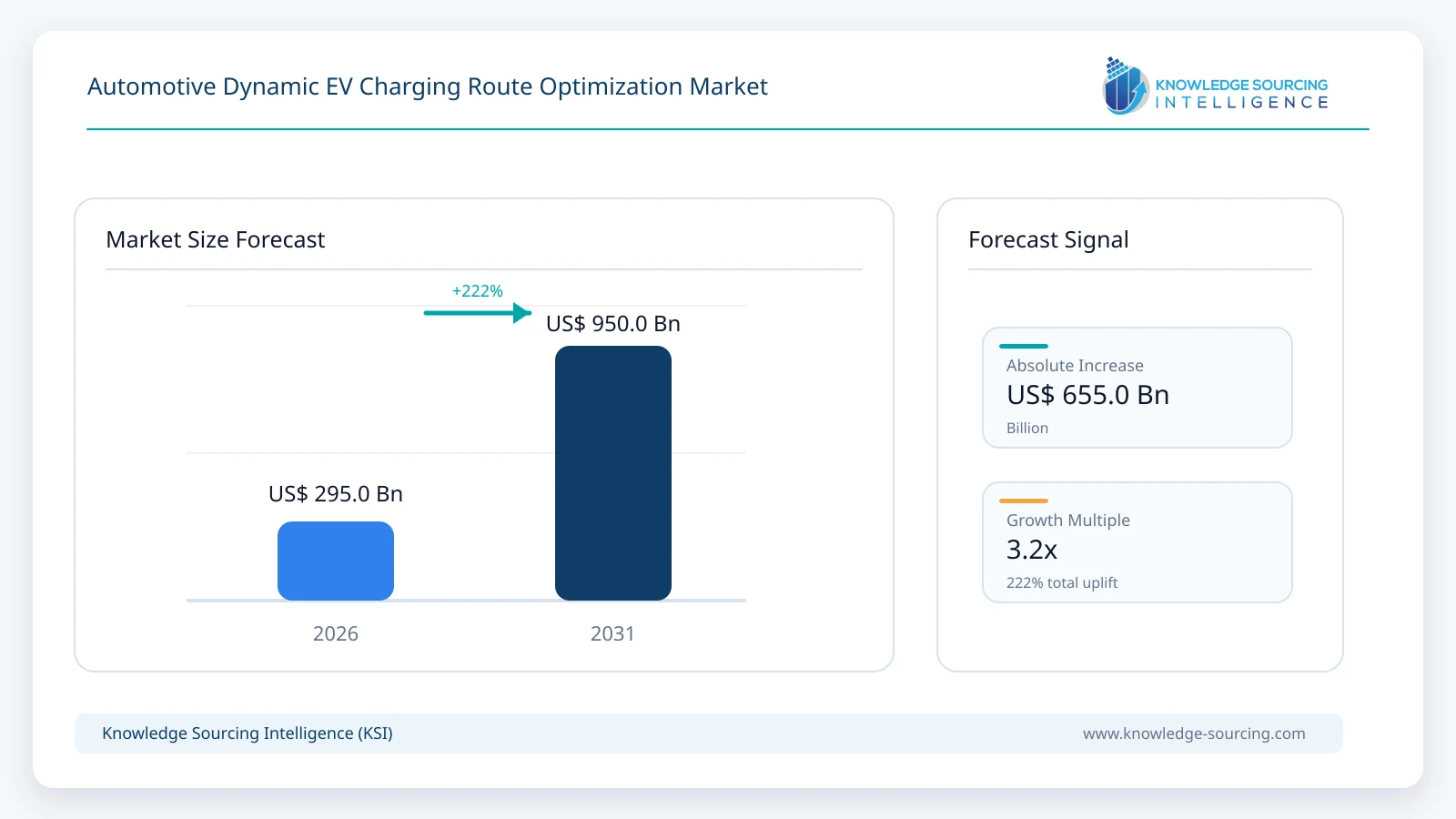
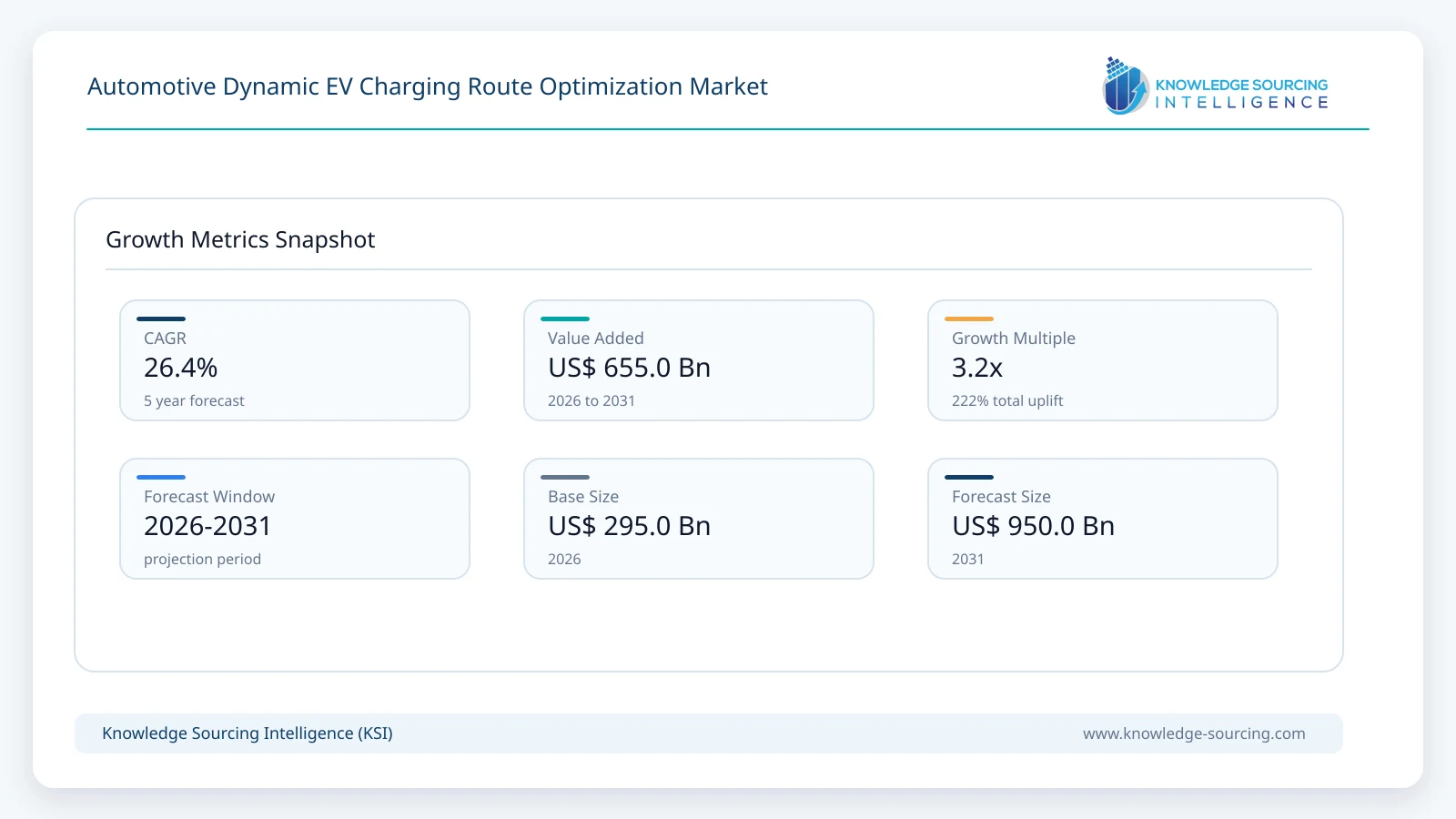
The automotive dynamic EV charging route optimization market is projected to grow from USD 295 million in 2026 to USD 950 million by 2031, registering a five-year CAGR of approximately 26.4% during the forecast period.
Highlights:
- 1Dynamic charging-stop selection and in-trip re-routing represent approximately 38% of modeled 2026 revenue.
- 2Embedded OEM navigation accounts for approximately 54% of 2026 value, while cloud routing APIs and fleet platforms gain share through 2031.
- 3Long-distance and intercity journeys form the largest use case, but fleet routing grows as EV delivery and service operations expand.
- 4Asia Pacific accounts for 40% of the 2026 working market, supported by Chinese EV scale and connected-vehicle adoption.
- 5Charger availability, compatible connectors, actual charging power and detour time increasingly shape route recommendations.
- 6Differentiation depends on validated energy models and live charger data, not solely the number of charging points displayed.
Electric-vehicle routing must account for battery energy and charging duration in addition to distance and traffic. A slower charging station directly on the route may produce a longer journey than a faster charger requiring a modest detour, while a nominally powerful charger may deliver less energy if the vehicle arrives with a cold battery or high state of charge.
TomTom's EV Routing continuously revises its charging plan during a trip using vehicle consumption and charger characteristics, while HERE provides charging-curve and arrival-state inputs that enable reachability-aware routing. Google's March 2026 Android Auto expansion combines car specifications with real-time traffic, elevation and weather to recommend charging stops and forecast battery level at arrival.
EV charging-route software sourcing combines map and traffic services, charger-location and availability aggregators, vehicle energy models, route-search algorithms and software integration with the car's head unit or mobile application. Lucid uses the HERE Navigation SDK across its in-vehicle, mobile and web experiences; Mercedes-Benz integrates charging-aware guidance into Navigation with Electric Intelligence; and Rivian operates A Better Routeplanner as a consumer-facing planning service.
Market Trends
Charging Decisions Are Moving from Static Maps to Live Journey Optimization
TomTom's October 2026 EV suite expansion introduced richer station reliability, connector and availability information to improve selection of charging stops while routes are calculated. Live data is becoming more commercially important because a fast charger listed on a map may be occupied, malfunctioning or poorly matched to the vehicle's actual charge acceptance.
Chargetrip's route API supports charging-network preferences by country and user, reflecting the difference between nominal charger access and stations that a driver's account or mobility card can actually use. Such filtering becomes valuable for leased vehicles and cross-border fleets whose e-mobility contracts differ between markets.
Energy Prediction Is Becoming Vehicle-Specific
Google expanded AI-powered charging and battery estimates in March 2026 to more than 350 Android Auto-compatible EV models, combining vehicle weight and battery details with road elevation, weather and traffic. Instead of displaying a static remaining-range figure, its trip planner estimates arrival charge and incorporates charging time into the journey's ETA.
HERE's EV routing implementation accepts charging-curve parameters and a target battery reserve at the destination, permitting different charging strategies for the same physical route. Battery state, road speed and thermal conditions remain uncertain, however, so commercial systems must revise the plan when actual consumption diverges from the initial forecast.
Navigation and Battery Preconditioning Are Being Coordinated
Porsche Charging Planner uses planned fast-charging stops to control battery preconditioning, allowing thermal preparation to begin before arrival at an appropriate station. The integration reduces the gap between an optimally chosen charger on the map and the power the vehicle can actually accept on arrival.
Route-driven thermal coordination also introduces dependencies between the navigation system, battery controller and thermal-management logic. A late reroute to a different fast charger can change the available preparation time, while a charger outage may invalidate an earlier preconditioning decision.
OEM Navigation and Fleet APIs Are Diverging into Distinct Procurement Models
HERE's January 2026 announcement with Lucid illustrates an OEM-integrated model in which the automaker controls the user experience while licensing mapping and routing infrastructure. Chargetrip's integration into Arval's application illustrates a fleet-oriented route API configured around country-specific charging-card permissions.
TomTom's October 2026 Electric Vehicle Management platform is designed to shorten vehicle onboarding by reusing vehicle specifications across routing and charging services. For fleets, API availability and operator-level policy control may matter more than a branded in-dash experience.
Automotive Dynamic EV Charging Route Optimization Market Segment Analysis
By Charging Route Optimization Function
Dynamic Charging-Stop Selection and Re-Routing
Dynamic charging-stop selection and re-routing is estimated to represent 38% of 2026 value because it addresses the central problem of choosing reachable, usable charging locations as journey conditions change. The function considers predicted battery at arrival, detour distance, charger access, likely charging speed and onward energy requirements.
Dynamic charging-stop optimization rises to a modeled 40% share by 2031 as live status and route updates become standard functionality. Suppliers with credible charger data and robust vehicle models are positioned to capture the greatest benefit, while basic station-directory features face increasing price competition.
By Software Deployment
Embedded OEM Navigation
Embedded OEM navigation accounts for an estimated 54% of 2026 value, reflecting the advantage of direct access to vehicle battery data, charging capability and preconditioning interfaces. Porsche's Charging Planner and Mercedes-Benz's Electric Intelligence demonstrate integrated systems in which navigation can make decisions using vehicle-specific operating states.
Embedded deployment remains substantial by 2031, although its modeled share declines to 50% as API-led fleet and mobility applications scale. Device qualification, vehicle interface access and long model-cycle contracts sustain the OEM channel, while cloud platforms can update charging information more frequently than in-car software releases.
By Navigation Environment
Long-Distance and Intercity Trips
Long-distance and intercity routing is estimated to contribute 60% of 2026 revenue because multi-stop journeys are most sensitive to charger placement and available charging power. HERE's reachability calculations and Porsche's charging-stop planning address trips where a poor charging decision can add material travel time or leave insufficient battery reserve.
Long-distance charging-route services grow in absolute value through 2031 but decline to 51% of modeled revenue as daily regional routing and fleet-specific applications become more capable. Electric service fleets need more frequent optimization of charging opportunities, vehicle schedules and approved network access, supporting additional revenue beyond occasional consumer road trips.
Market Drivers
Mainstream EV Sales Expand the Base for Charging-Aware Navigation
IEA estimates indicate that more than 20 million electric cars were sold in 2025 and approximately 23 million may be sold during 2026. New-vehicle adoption increases the number of drivers who expect charging-stop recommendations to be integrated into the navigation system, particularly as EVs spread beyond early adopters familiar with manual charger searches.
Commercial demand for charging-aware routing depends on how many vehicles support connected, vehicle-aware planning rather than merely displaying charger locations. OEM licensing and cloud service contracts generate supplier value where navigation algorithms, mapping, live charger access and vehicle interfaces are procured commercially.
Public Charging Growth Makes Stop Selection More Complex
TomTom's October 2026 EV suite references more than 2.3 million charging connectors in 117 countries, illustrating the scale of charger information that modern routing engines must filter. Additional stations can improve access while simultaneously making selection more complicated because nominal power, reliability, connector type, location and operating conditions differ widely.
Routing providers that combine operator feeds with vehicle-specific charge acceptance can steer drivers toward stops that minimize total journey time and unnecessary detours. Frequent charger-data updates are particularly valuable for cross-border routes and high-utilization corridors where static station directories age quickly.
Vehicle and Battery Data Improve Route Confidence
Google's 2026 EV routing expansion uses vehicle specifications, traffic, weather and elevation to predict battery consumption for hundreds of model variants. HERE allows charging curves and arrival reserves to be incorporated into trip calculations.
Access to live state-of-charge and energy-consumption history can further improve decisions, particularly on winter journeys and hilly routes. OEMs with integrated navigation can expose a deeper vehicle interface than generic smartphone applications, supporting software differentiation and recurring calibration work.
Cross-Border Fleet and Leasing Applications Need Network-Aware Planning
Chargetrip's route integration for Arval distinguishes charging stations according to energy-card acceptance, roaming relationships and country-specific operating rules. This requirement goes beyond ordinary personal navigation because a fleet driver may be unable to use a technically compatible charger if the vehicle's charging contract does not permit access.
Fleet operators can use such planning to reduce charging interruptions, support driver compliance with authorized networks and make long-distance assignments more predictable. API-based route optimization can be embedded into a leasing portal or dispatch application without replacing the vehicle's infotainment system.
Route-Aware Preconditioning Improves the Fast-Charging Experience
Porsche's Charging Planner links selected fast-charging stops to battery preconditioning so the thermal system can prepare the battery before arrival. Navigation providers therefore influence realized charging time indirectly, even though they do not control the battery's maximum charging power.
Linking route changes to thermal preparation increases software engineering demand because navigation decisions must be communicated reliably to battery and thermal management functions. Changes to the planned charger, ETA or route may need to trigger a new preparation decision.
Market Restraints
Inaccurate Live Charger Availability Can Undermine Route Decisions
Routing algorithms rely on third-party charging-network feeds that may report an available connector even when a station is physically blocked, faulted or unable to deliver its rated power. A route optimized around such a stop can fail despite an accurate vehicle energy model.
Software suppliers must combine source validation, fallback alternatives and conservative routing margins to manage this uncertainty. Multiple aggregators can improve coverage but add licensing costs and inconsistent formats. The need to maintain reliable data reduces the feasibility of low-cost route products built solely on static charging-station maps.
Limited Vehicle Telemetry Restricts Energy Prediction Accuracy
Third-party route planners may know the vehicle model and nominal battery capacity without receiving live battery health, usable energy, current state of charge or actual consumption from the car. Cold temperatures, towing, elevation and driving behavior can cause material variation from the assumed range.
OEM integration provides an advantage where battery and thermal signals can be shared securely with navigation. Independent application providers must instead maintain large vehicle-profile libraries and offer user-adjustable assumptions, both of which increase engineering costs. Deeper telemetry access also raises privacy, permission and interface-governance requirements that differ across automakers.
Bundled Navigation Economics Limit Separately Priced Routing Revenue
Many automakers include charging-aware navigation within a broader connected-services or infotainment package, and smartphone mapping applications increasingly expose charging recommendations without a separate visible user fee. Google and OEM-branded planners create strong baseline expectations for drivers.
Specialist routing providers consequently depend on OEM contracts, cloud API usage, fleet licensing and higher-value data quality or integration services. The same navigation feature may be paid for as part of a larger platform transaction rather than an identifiable per-vehicle charging-routing license. Contract structures favor providers that can show measurable journey-time or fleet-operating benefits over providers whose differentiation is only a user-interface layer.
Cross-Network Tariffs and Roaming Rules Complicate Optimization
Charging prices can differ by operator, user membership, roaming agreement and time of day, while some networks restrict authentication methods or require account enrollment. A technically reachable charging stop may therefore be uneconomic or unavailable to a particular driver.
Maintaining these rules at scale requires reliable contract information and integration with e-mobility service providers. Route recommendations may also need to respect fleet policy or preferred networks without producing unacceptable detours. Suppliers that lack access to commercial charging data may offer less effective cost and access optimization even when their road-routing algorithm is accurate.
Safety Margins and Connectivity Gaps Reduce Planning Precision
Vehicle navigation cannot assume continuous mobile data coverage, particularly on rural corridors and cross-border routes. A charger outage or sudden battery-consumption change may occur before the next data refresh, making a previously optimal charging stop unsuitable.
Offline fallback routes, cached charger information and predictable behavior under weak telemetry increase development and validation expense. Consumers also differ in their preferred reserve levels, charging networks and tolerance for detours, so a single mathematical minimum-travel-time result may not be accepted. Vehicle manufacturers must balance technical optimization with driver trust, cybersecurity and stable in-car interaction.
Regional Outlook
Asia Pacific
China's large electric-vehicle market supports the broadest regional deployment base for connected charging-aware navigation, with the IEA estimating more than 13 million electric-car sales in the country during 2025. Japanese and South Korean automakers are also expanding software-rich vehicle platforms, while India and Southeast Asia present longer-term opportunities as charging density and EV penetration rise. Diverse charging networks make local data coverage and vehicle-specific energy assumptions central to reliable route planning.
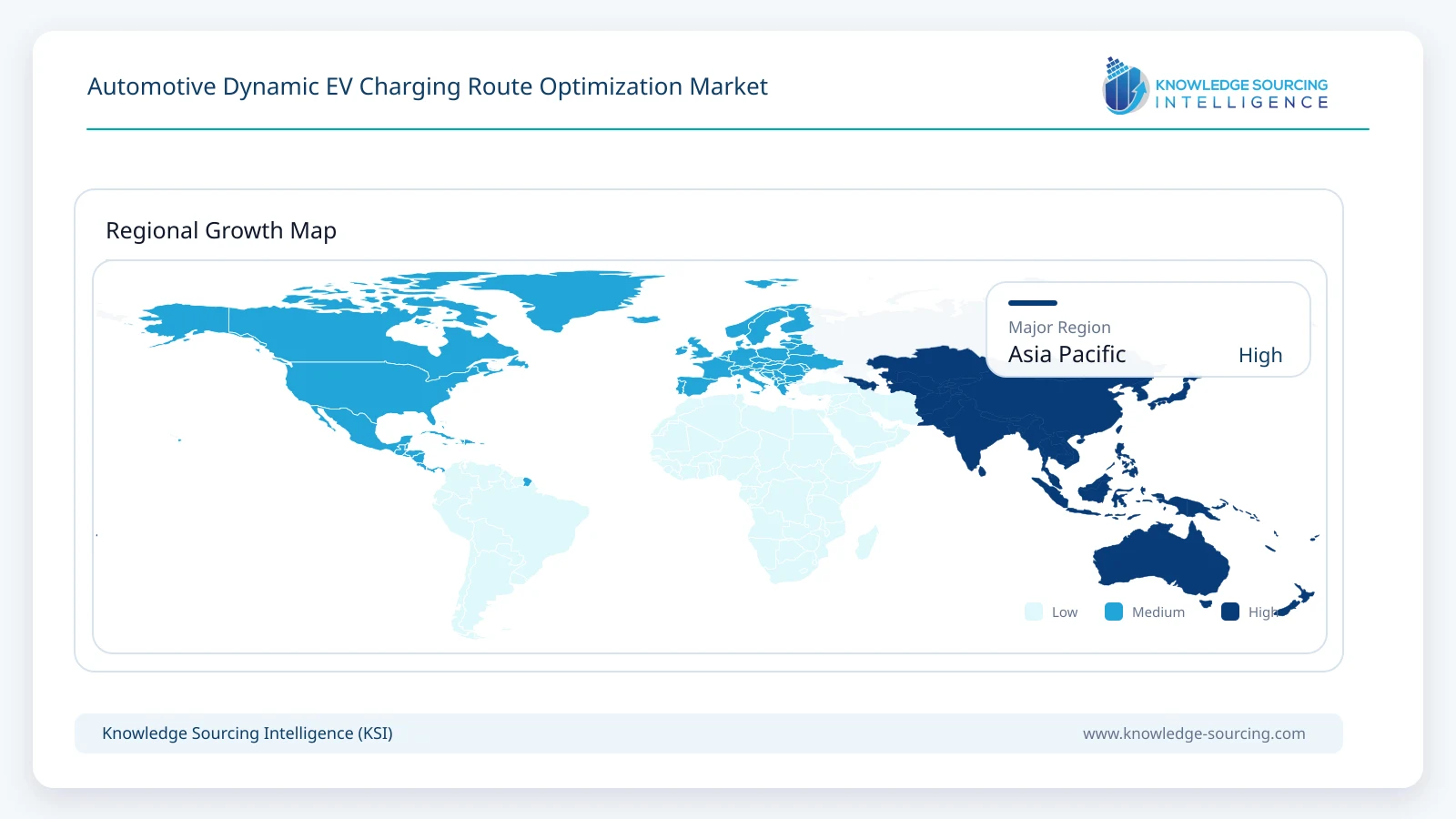
Asia Pacific accounts for an estimated 40% of 2026 market value and 42% in 2031. Regional growth is tied to the availability of embedded navigation on mass-market EVs, improved charging operator feeds and partnerships that combine map services with local payment and charging access.
Europe
European EV drivers commonly cross charging networks and national borders, making roaming compatibility, connector information and route-wide battery reserves commercially important. Porsche's Charging Planner integrates vehicle state and charge-stop preconditioning, while TomTom and Chargetrip provide specialist routing and charge-point intelligence to automakers, fleet providers and application developers. European operators are also extending rapid charging along major corridors, increasing both the number of available options and the need for reliable real-time ranking.
Europe is modeled at 31% of global revenue in 2026 and 30% in 2031, supported by mature OEM procurement and specialized software suppliers. Enterprise and leasing applications such as Arval's charging-route service offer a different growth mechanism from consumer in-dash navigation, with user permissions and cross-border operator policy forming part of the optimization logic.
Competitive Landscape
HERE and TomTom compete through integrated map, traffic and EV-routing platforms that can be embedded in vehicle navigation or consumed as software interfaces. HERE's Lucid integration demonstrates how a vehicle manufacturer can build branded in-car and companion experiences around a licensed navigation SDK. TomTom's October 2026 EV suite expansion highlights vehicle onboarding, charging reliability data and route-specific energy prediction as supplier differentiators.
Google competes through Maps embedded in vehicle systems and projected Android Auto experiences, while Mapbox focuses on modular navigation and routing APIs. Chargetrip's charging-specific API supports integration by leasing and mobility applications that may retain third-party base mapping. Rivian's operation of A Better Routeplanner provides a consumer-facing benchmark for multi-brand EV trip planning, and Porsche and Mercedes-Benz demonstrate OEM-integrated route intelligence.
Recent Developments
October 2026: TomTom launched expanded EV-management and routing capabilities, including easier vehicle variant onboarding and richer reliability and availability insights for charging stops.
March 2026: Google began expanding AI-powered EV battery predictions and charge-stop planning to more than 350 compatible Android Auto electric-vehicle models in the United States.
January 2026: HERE Technologies confirmed that its Navigation SDK supports Lucid Air and Gravity charging-aware navigation across the vehicle, mobile application and web planner.
November 2025: Chargetrip introduced an along-route amenity search and additional operator-avoidance preferences in its Routes API, improving charging-stop flexibility.
January 2025: Mapbox described its partnership with Zeekr for cloud-first navigation including dynamic electric-vehicle routing and trip-planning capabilities.
Market Outlook
Automotive charging-route optimization is expected to become a standard software function on connected EV platforms as route planning incorporates energy prediction, live charger access, charging duration and destination battery reserve. New vehicle programs and fleet-facing APIs should support growth from USD 295 million in 2026 to USD 950 million in 2031.
Charging-route software providers are likely to compete through interoperability with vehicle telemetry, access to charging-operator data, reusable vehicle profiles and the ability to manage routing changes without confusing drivers. Cloud-assisted architecture is well suited to constantly changing charger information, but embedded systems will remain important for reachability decisions and degraded-connectivity operation.
Automotive Dynamic EV Charging Route Optimization Market Scope:
| Report Metric | Details |
|---|---|
| Total Market Size in 2026 | USD 295 million |
| Total Market Size in 2031 | USD 950 million |
| Forecast Unit | USD Billion |
| Growth Rate | 26.4% |
| Study Period | 2021 to 2031 |
| Historical Data | 2021 to 2024 |
| Base Year | 2025 |
| Forecast Period | 2026 – 2031 |
| Segmentation | Charging Route, Software Deployment, Optimization Priority, Vehicle Application, Navigation Environment, Revenue Component, Primary Data Integration Architecture, Execution Architecture, Geography |
| Companies |
|
Market Segmentation
By Charging Route Optimization Function
Dynamic Charging-Stop Selection and Re-Routing
Journey-Time and Charging-Dwell Optimization
Live Charger Reliability and Availability Ranking
Route Energy and Arrival-State Estimation for Charging
Charging Cost and Network Preference Optimization
By Software Deployment
Embedded OEM Navigation
Smartphone and Companion Applications
Cloud Routing APIs and Fleet Platforms
By Optimization Priority
Total Journey Time
Charger Reliability and Availability
Battery Reserve and Route Reachability
Cost, Network and User Preferences
By Vehicle Application
Passenger Battery Electric Vehicles
Passenger Plug-In Hybrid Electric Vehicles
Electric Commercial and Fleet Vehicles
By Navigation Environment
Long-Distance and Intercity Trips
Urban and Regional Charging Trips
Fleet and Multi-Stop Operations
By Revenue Component
New-Vehicle Embedded Software and API Entitlements
Connected In-Service Routing Services
Integration, Calibration and Lifecycle Engineering
By Primary Data Integration Architecture
Vehicle-Telemetry-Integrated Routing
Real-Time Charging-Network-Integrated Routing
Vehicle-Profile and Aggregated-Charger Routing
By Execution Architecture
Cloud-Assisted Hybrid Routing
Embedded Vehicle-First Routing
Cloud-Centric Application Routing
By Geography
Asia Pacific
China
Japan
South Korea
India
Thailand
Indonesia
Others
Europe
Germany
United Kingdom
France
Spain
Italy
Others
North America
United States
Canada
Mexico
South America
Brazil
Argentina
Others
Middle East and Africa
Saudi Arabia
United Arab Emirates
South Africa
Others
Table of Contents
1. EXECUTIVE SUMMARY
1.1. Market Opportunity and Key Findings
1.2. Market Size and Forecast
1.3. Charging-Aware Navigation Outlook
2. MARKET SNAPSHOT
2.1. Market Overview
2.2. Market Definition
2.3. Scope of the Study
2.4. Market Segmentation
3. BUSINESS LANDSCAPE
3.1. Market Drivers
3.1.1. Mainstream EV Sales Expand the Base for Charging-Aware Navigation
3.1.2. Public Charging Growth Makes Stop Selection More Complex
3.1.3. Vehicle and Battery Data Improve Route Confidence
3.1.4. Cross-Border Fleet and Leasing Applications Need Network-Aware Planning
3.1.5. Route-Aware Preconditioning Improves the Fast-Charging Experience
3.2. Market Restraints
3.2.1. Inaccurate Live Charger Availability Can Undermine Route Decisions
3.2.2. Limited Vehicle Telemetry Restricts Energy Prediction Accuracy
3.2.3. Bundled Navigation Economics Limit Separately Priced Routing Revenue
3.2.4. Cross-Network Tariffs and Roaming Rules Complicate Optimization
3.2.5. Safety Margins and Connectivity Gaps Reduce Planning Precision
3.3. Market Opportunities
3.4. Porter’s Five Forces Analysis
3.5. Industry Value Chain Analysis
3.6. Policies and Regulations
3.7. Strategic Recommendations
4. TECHNOLOGICAL OUTLOOK
4.1. Vehicle-Integrated State-of-Charge and Energy Modeling
4.2. Charger Availability and Reliability Data
4.3. Charging-Stop and Dwell-Time Algorithms
4.4. Cloud and Embedded Re-Routing Architecture
4.5. Navigation-to-Battery Preconditioning Interface
5. AUTOMOTIVE RESPONSIVE INTERIOR MARKET BY CHARGING ROUTE OPTIMIZATION FUNCTION
5.1. Introduction
5.2. Dynamic Charging-Stop Selection and Re-Routing
5.3. Journey-Time and Charging-Dwell Optimization
5.4. Live Charger Reliability and Availability Ranking
5.5. Route Energy and Arrival-State Estimation for Charging
5.6. Charging Cost and Network Preference Optimization
6. AUTOMOTIVE RESPONSIVE INTERIOR MARKET BY SOFTWARE DEPLOYMENT
6.1. Introduction
6.2. Embedded OEM Navigation
6.3. Smartphone and Companion Applications
6.4. Cloud Routing APIs and Fleet Platforms
7. AUTOMOTIVE RESPONSIVE INTERIOR MARKET BY OPTIMIZATION PRIORITY
7.1. Introduction
7.2. Total Journey Time
7.3. Charger Reliability and Availability
7.4. Battery Reserve and Route Reachability
7.5. Cost, Network and User Preferences
8. AUTOMOTIVE RESPONSIVE INTERIOR MARKET BY VEHICLE APPLICATION
8.1. Introduction
8.2. Passenger Battery Electric Vehicles
8.3. Passenger Plug-In Hybrid Electric Vehicles
8.4. Electric Commercial and Fleet Vehicles
9. AUTOMOTIVE RESPONSIVE INTERIOR MARKET BY NAVIGATION ENVIRONMENT
9.1. Introduction
9.2. Long-Distance and Intercity Trips
9.3. Urban and Regional Charging Trips
9.4. Fleet and Multi-Stop Operations
10.AUTOMOTIVE RESPONSIVE INTERIOR MARKET BY REVENUE COMPONENT
10.1. Introduction
10.2. New-Vehicle Embedded Software and API Entitlements
10.3. Connected In-Service Routing Services
10.4. Integration, Calibration and Lifecycle Engineering
11. AUTOMOTIVE RESPONSIVE INTERIOR MARKET BY PRIMARY DATA INTEGRATION ARCHITECTURE
11.1. Introduction
11.2. Vehicle-Telemetry-Integrated Routing
11.3. Real-Time Charging-Network-Integrated Routing
11.4. Vehicle-Profile and Aggregated-Charger Routing
12. AUTOMOTIVE RESPONSIVE INTERIOR MARKET BY EXECUTION ARCHITECTURE
12.1. Introduction
12.2. Cloud-Assisted Hybrid Routing
12.3. Embedded Vehicle-First Routing
12.4. Cloud-Centric Application Routing
13. AUTOMOTIVE RESPONSIVE INTERIOR MARKET BY GEOGRAPHY
13.1. Asia Pacific
13.1.1. China
13.1.2. Japan
13.1.3. South Korea
13.1.4. India
13.1.5. Thailand
13.1.6. Indonesia
13.1.7. Others
13.2. Europe
13.2.1. Germany
13.2.2. United Kingdom
13.2.3. France
13.2.4. Spain
13.2.5. Italy
13.2.6. Others
13.3. North America
13.3.1. United States
13.3.2. Canada
13.3.3. Mexico
13.4. South America
13.4.1. Brazil
13.4.2. Argentina
13.4.3. Others
13.5. Middle East and Africa
13.5.1. Saudi Arabia
13.5.2. United Arab Emirates
13.5.3. South Africa
13.5.4. Others
14. COMPETITIVE ENVIRONMENT AND ANALYSIS
14.1. Major Players and Strategy Analysis
14.2. Market Share Analysis
14.3. Mergers, Acquisitions, Agreements and Collaborations
14.4. Competitive Dashboard
15. COMPANY PROFILES
15.1. Google LLC
15.2. TomTom N.V.
15.3. HERE Technologies
15.4. Chargetrip B.V.
15.5. Mapbox, Inc.
15.6. Rivian Automotive, Inc.
15.7. Dr. Ing. h.c. F. Porsche AG
15.8. Mercedes-Benz Group AG
15.9. Lucid Group, Inc.
15.10. Volvo Car AB
16. APPENDIX
16.1. Currency
16.2. Assumptions
16.3. Base and Forecast Years Timeline
16.4. Key Benefits for Stakeholders
16.5. Research Methodology
16.6. Abbreviations
Navigate
Trusted by the world's leading organizations











