
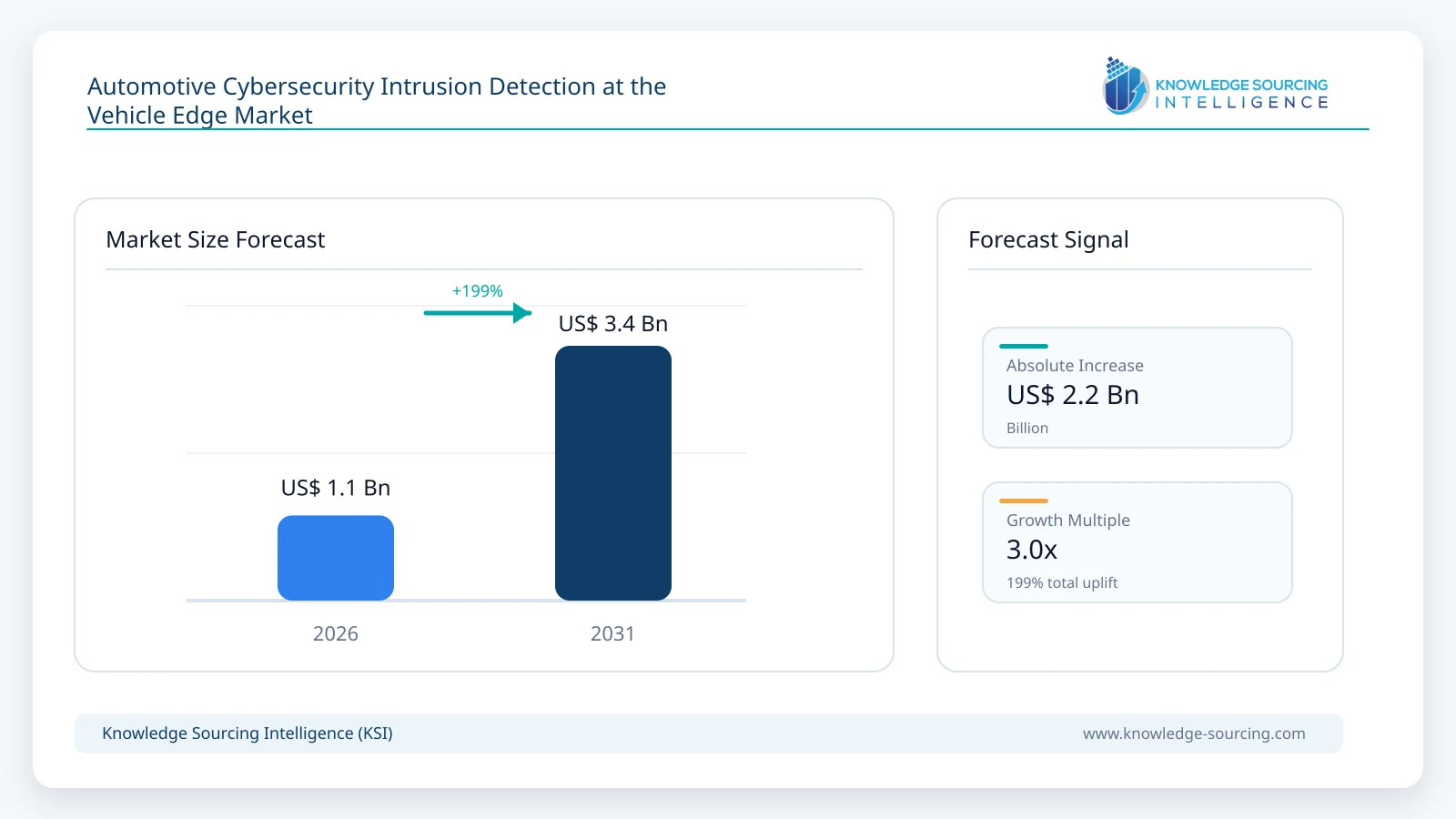
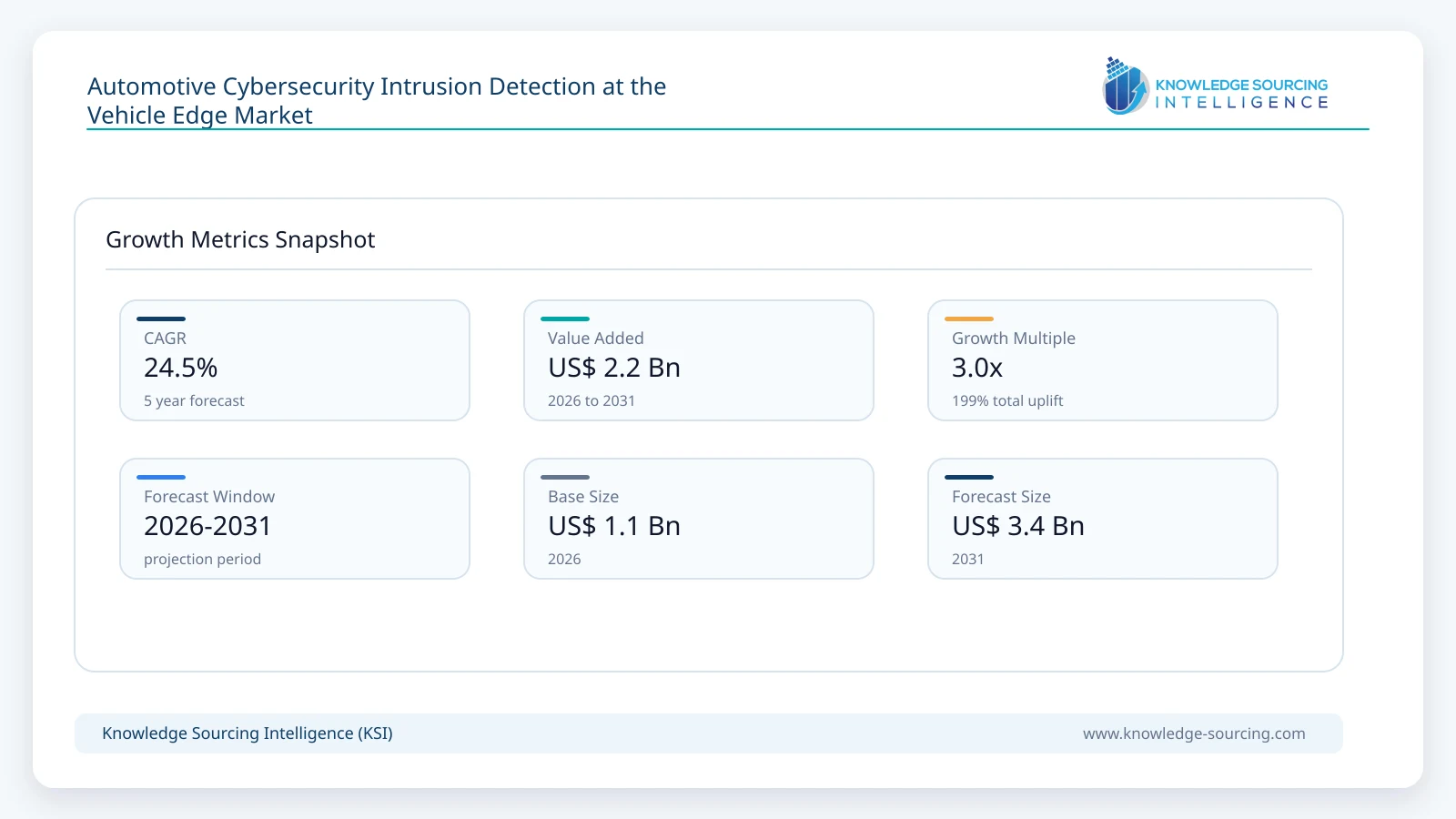
The automotive cybersecurity intrusion detection at the vehicle edge market is forecast to grow at a CAGR of 24.5%, reaching approximately USD 3.35 billion by 2031 from USD 1.12 billion in 2026.
Highlights:
- 1Network-based monitoring accounts for approximately 46% of 2026 market revenue, while host-based detection gains share on centralized vehicle computers.
- 2Rule- and specification-based detection represents around 56% of 2026 value, but anomaly and AI-assisted methods are increasing in commercial relevance.
- 3Distributed ECU architectures remain the largest fitment base in 2026; zonal platforms expand the opportunity for coordinated event management by 2031.
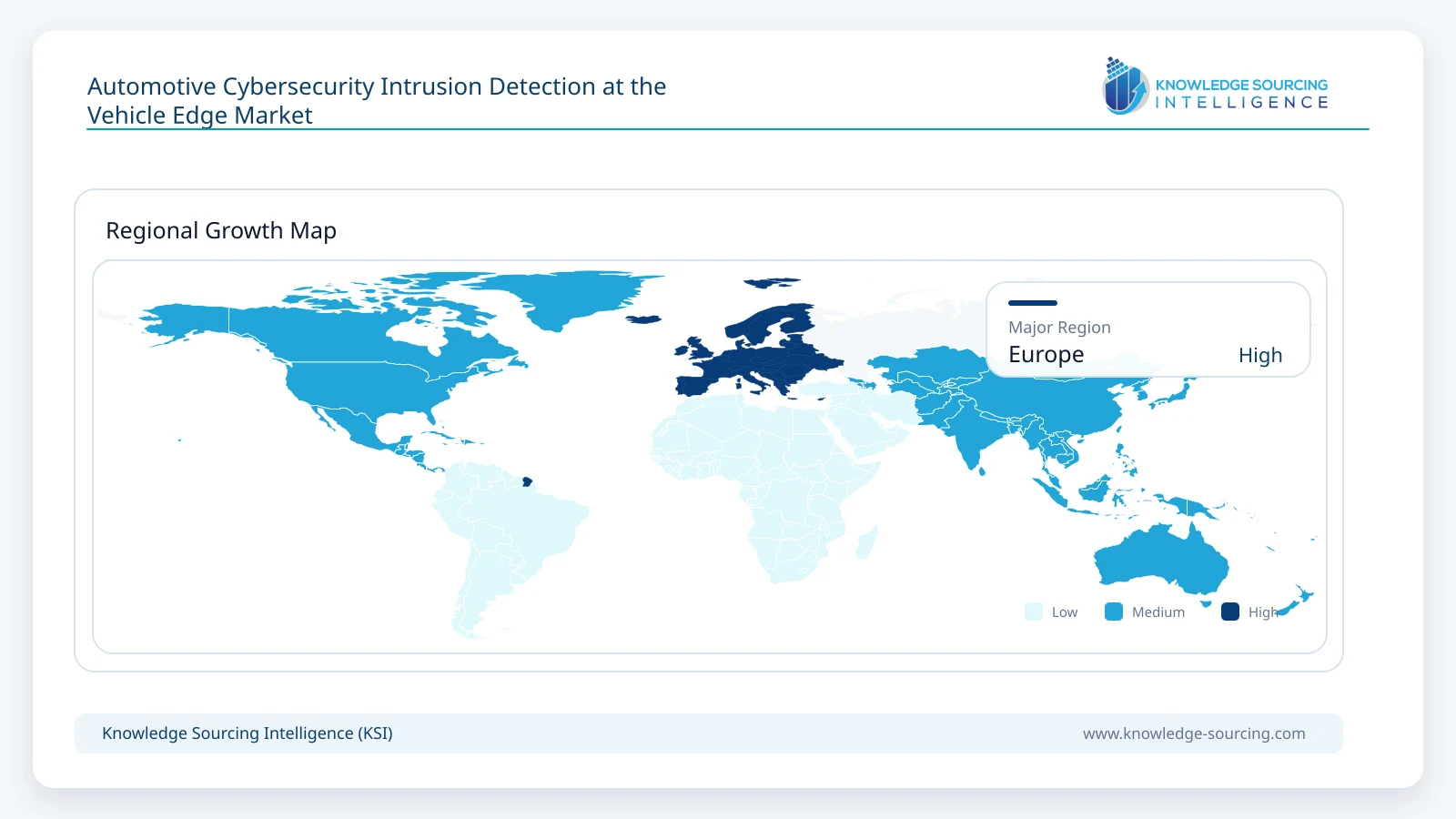
- 4Europe contributes an estimated 33% of market value in 2026, and Asia Pacific is expected to expand its share to approximately 41% by 2031.
- 5Production qualification depends on low false-positive rates, acceptable processor overhead and compatibility with OEM-specific security-event handling.
- 6Autonomy and cloud-based VSOC capabilities may use edge IDS evidence, but their full contract values are not included in the vehicle-edge detection category.
Embedded IDS software checks messages, processes and security events at vehicle gateways, domain computers, ECUs and telematics systems, identifying suspicious behavior without depending on continuous cloud connectivity. CAN FD, automotive Ethernet and service-oriented software broaden the events manufacturers must interpret during operation.
OEM procurement is moving toward modular sensors and vehicle-wide security-event management rather than one isolated intrusion detector per communication channel. ETAS CycurIDS, AUTOCRYPT IDS and VicOne xCarbon illustrate the available approaches, ranging from rule-based CAN inspection to host-based monitoring and edge-assisted correlation. The decisive commercial requirement is a production-qualified system that can operate within automotive compute, memory and power constraints while producing traceable security events for investigation and software maintenance.
Market Overview
In-vehicle intrusion detection examines whether commands and software behavior agree with what a particular vehicle is designed to do. A CAN sensor may flag an unauthorized sender, an impossible message sequence or an abnormal diagnostic request, while an Ethernet sensor can inspect IP-based communications and service-oriented traffic. Host monitoring extends the analysis to changes in processes, files, containers and privileged activity on a vehicle computer. Each route produces security evidence that can be filtered locally before a trusted report is transmitted to a fleet security team.
The interaction between detection sensors and an in-vehicle event manager is especially important when a vehicle includes many ECUs supplied by different companies. AUTOSAR defines an Intrusion Detection System Manager to process security events, and ETAS offers CAN and Ethernet sensors with IDS management and reporting components. AUTOCRYPT similarly combines network- and host-based monitoring with policy management, enabling automotive integration teams to align detection configurations with a vehicle-specific electrical architecture rather than relying on generic enterprise intrusion signatures.
The commercial distinction is between identifying a plausible attack and taking a safety-critical response to it. An IDS can record, qualify and communicate an event, while blocking a network message or isolating an ECU requires additional preventive controls and functional-safety assessment. VicOne’s 2026 work with Trustonic uses a trusted execution environment with xCarbon and edge AI to protect the integrity of security processing itself. Such architectures can improve detection and response capability, but they also increase the importance of demonstrable fail-safe behavior and validated update processes.
Market Trends
Distributed IDS Is Moving Toward Vehicle-Wide Event Management
Vehicle electrical architectures increasingly place different sensing functions on gateways, Ethernet switches and high-performance computers, creating separate streams of security events that need consistent qualification. A distributed IDS manager reduces reporting traffic by filtering routine anomalies locally and retaining the events most relevant to a suspected attack. ETAS provides a modular implementation with CAN, Ethernet, manager and reporter functions, while AUTOSAR standardizes event handling for adaptive platforms. This approach is commercially useful because OEMs can change the network layout or add software functions without replacing the entire security architecture.
Host Monitoring Gains Importance on Consolidated Vehicle Computers
Centralized and zonal vehicle designs increase the amount of software running on Linux, QNX and other high-capability operating environments alongside traditional microcontrollers. Network traffic inspection does not reveal every malicious process, unauthorized privilege change or compromised software container, making host-level behavior monitoring a necessary complementary control. VicOne and Intellias integrated xCarbon into a QNX-based software-defined vehicle platform in April 2026, demonstrating a route to embedded protection for infotainment compute. Adoption will depend on keeping monitoring overhead acceptable while verifying the software against each OEM operating-system and platform release.
CAN and Ethernet Inspection Require Different Detection Rules
CAN and CAN FD remain widespread in body, chassis and powertrain networks, where message identifiers, sender identity and expected timing provide relatively structured inputs for rule-based detection. Automotive Ethernet introduces larger volumes, IP protocols, Diagnostics over IP and service communications that demand different inspection methods. ETAS separates its CAN and Ethernet CycurIDS modules for this reason, while suppliers increasingly package their alerts under common management. Demand therefore grows through both wider IDS fitment and more sophisticated mixed-network deployments, rather than a universal detector applied unchanged across all vehicle buses.
Local AI Correlation Is Supplementing Deterministic Security Policies
Embedded anomaly models are being added where fixed signatures cannot adequately explain combinations of unusual events across ECUs or unfamiliar attack patterns. VicOne and Trustonic announced an ECU-level architecture with edge AI in April 2026, while VicOne’s collaboration with Sonatus positions onboard correlation as a way to limit indiscriminate telemetry transfer. Learned models cannot replace deterministic safety boundaries because false alerts and model drift must be controlled across vehicle variants. The most practical architectures combine known-message policies with selectively deployed statistical or machine-learning analysis on capable processors.
Post-Production Monitoring Is Becoming Part of Security Architecture Design
Vehicle cybersecurity requirements increasingly extend beyond type approval to the operational life of the vehicle, creating a need to investigate field events and change detection policies when attack techniques evolve. UN Regulation No. 155 and ISO/SAE 21434 establish lifecycle risk-management obligations, although neither prescribes that every vehicle must install a particular IDS product. PlaxidityX vCore combines vehicle sensors, intelligent edge management and cloud analytics, while AUTOCRYPT connects IDS components to VSOC workflows. Commercial value lies in providing dependable, low-bandwidth evidence from the vehicle without forcing full cloud processing of every raw network event.
Segment Analysis
By Monitoring Layer: Network-Based IDS
Network-based monitoring accounts for an estimated 46% of 2026 market value because CAN, CAN FD and Ethernet communication channels offer common integration points across many vehicle platforms. Gateway-oriented sensors can identify unexpected message identifiers, suspicious diagnostic access and traffic patterns inconsistent with vehicle communication specifications. The category remains the largest in 2031, although its share moderates as host monitoring and distributed event management expand on centralized compute platforms.
By Monitoring Layer: Host-Based IDS
Host-based intrusion detection represents approximately 29% of modeled 2026 revenue and is expected to rise to 36% in 2031 as vehicles deploy more software on domain and central computers. Monitoring operating-system behavior, processes and privileged activity allows suppliers to detect compromises that would not necessarily produce distinctive CAN traffic. Automotive-grade versions must support constrained runtime environments and preserve deterministic execution alongside infotainment, connectivity and other software workloads.
By Detection Method: Rules, Anomalies and Hybrid AI
Specification- and signature-based detection contributes approximately 56% of 2026 market revenue because OEMs can validate known network behavior and limit false alarms with deterministic rules. Anomaly and hybrid machine-learning methods gain share through 2031 as Ethernet traffic, dynamic software services and distributed computing create more variable behavior. Hybrid implementations are likely to dominate performance-sensitive applications because engineers can reserve complex inference for selected events while retaining explainable baseline monitoring.
By Vehicle Architecture: Distributed and Zonal Platforms
Distributed ECU architectures still contribute the largest modeled share in 2026, at approximately 58%, reflecting the installed design practices of mass-market vehicle programs. Domain and zonal architectures increase the number of shared processing and gateway points where IDS can aggregate several security functions, while zone controllers create demand for coordinated monitoring policies. As zonal platforms gain adoption, the revenue mix shifts toward configurable software, host sensors and integration engineering rather than a simple increase in the number of dedicated hardware modules.
Market Drivers
Connected Vehicle Attack Surfaces Require Continuous Local Detection
Telematics, mobile applications, remote diagnostics and OTA update connections establish more paths between external services and critical vehicle electronics. Manufacturers therefore need a way to identify unusual behavior after a vehicle has passed development-time penetration testing. Edge IDS can inspect suspicious internal messages immediately, preserve a record for later investigation and notify the relevant vehicle security operation. This requirement is strongest in connected platforms where an entry through infotainment or a gateway could create a route toward other onboard functions.
Lifecycle Cybersecurity Requirements Strengthen OEM Security Budgets
UN Regulation No. 155 and ISO/SAE 21434 give vehicle manufacturers a formal basis for managing cyber risks from development into field operation. OEMs must demonstrate effective processes for identifying threats, tracking incidents and responding to vulnerabilities, which favors systems capable of supplying reliable vehicle-level evidence. An embedded IDS is not mandated as a universal standalone component, but it can support a larger cybersecurity management strategy. Suppliers that provide validation records and configurable event reporting are better positioned for repeated vehicle-platform contracts.
Automotive Ethernet and Central Computing Broaden Monitoring Needs
Modern vehicle computers consolidate applications that previously ran on separate ECUs, increasing the consequences of compromised software or unauthorized cross-domain communications. Ethernet-based backbones introduce high-throughput services and IP connectivity that traditional CAN-only inspection cannot fully characterize. Host agents, Ethernet sensors and distributed event management can address these risks from complementary positions. Development programs consequently require more extensive software integration and security testing, raising the attributable value of successful embedded detection deployments.
Supplier-Ready AUTOSAR and Cross-Platform Components Reduce Integration Risk
Automotive OEMs increasingly prefer IDS implementations that can fit multiple electrical architectures and operating environments while preserving a common security-event format. AUTOSAR intrusion-detection management specifications provide a reference for event processing, and ETAS and AUTOCRYPT describe modular deployments spanning traditional and higher-performance controllers. Reusable interfaces help reduce duplicated engineering across vehicle lines while keeping OEM-specific policy decisions under manufacturer control. This makes scalable software modules commercially attractive even when vehicle manufacturers retain direct responsibility for the overall security concept.
Edge Filtering Improves Fleet Security Visibility Without Excess Telemetry
Large connected fleets can create more routine security signals than an external operations center can economically store or review. Filtering and correlating events inside the vehicle makes it possible to forward qualified evidence rather than continuously streaming all bus traffic and system logs. PlaxidityX and ETAS both link in-vehicle event collection with offboard analytics or reporting workflows. Manufacturers gain better incident context while controlling bandwidth, cloud expenditure and the exposure of sensitive operational data, strengthening the case for embedded monitoring as a recurring architecture feature.
Market Restraints
False Positives and Safety-Critical Responses Complicate Validation
Vehicle operating conditions vary across geography, software version, driving mode and diagnostic activity, creating legitimate deviations from expected network patterns. Aggressive intrusion policies can misclassify these events and overwhelm incident investigators, while an incorrectly applied prevention action may interrupt a function that affects vehicle safety. OEMs therefore require extensive calibration, attack simulation and fail-safe design before approving a detection system. These validation obligations slow adoption of complex adaptive models even when their laboratory detection rates appear strong.
Limited ECU Compute and Memory Restrict Detection Sophistication
Embedded security agents must share constrained processor cycles, RAM, storage and power with vehicle functions that have strict timing requirements. High-rate Ethernet packet inspection and learning-based correlation are particularly challenging on low-end microcontrollers. Suppliers must adapt monitoring depth to each hardware platform and often reserve more demanding analysis for gateways or central compute nodes. The resulting architecture can require several product variants and increased integration effort, reducing the economics of uniform vehicle-wide rollouts.
Fragmented Vehicle Architectures Increase Engineering Cost
Vehicle platforms combine different network protocols, operating systems, legacy ECUs and supplier-owned software that do not expose identical security data. An IDS tuned for one vehicle line may need substantial reconfiguration when the manufacturer changes its gateway, diagnostic architecture or domain controller. ETAS and AUTOCRYPT provide modular approaches, but OEM-specific rules, event priorities and validation responsibilities remain demanding. Integration budgets can therefore rise faster than licensing revenue when the product is deployed across fragmented portfolios.
Cybersecurity Procurement Often Bundles Multiple Services
Vehicle intrusion detection may be sold inside a complete cybersecurity suite, bundled with a gateway, integrated into an operating platform or delivered through a Tier 1 electronics contract. OEMs may not negotiate a separate price for the IDS function, especially when it shares hardware and telemetry with other security controls. This limits transparency into supplier-level pricing and creates pressure to demonstrate incremental value against existing firewalls and secure boot systems. Buyers may postpone standalone purchases where their current platform supplies adequate basic event logging.
Update Governance and Long Vehicle Lifecycles Add Maintenance Burden
An embedded detection policy that remains useful for a decade or longer must accommodate evolving attack techniques and software revisions without producing uncontrolled false alarms. Each security-rule update can interact with vehicle variants, diagnostics and service tools, requiring careful release approval and rollback controls. Disconnected vehicles also cannot always obtain immediate threat-intelligence refreshes. Suppliers must provide durable policy management and support arrangements, increasing OEM lifecycle obligations and making low-cost, one-time IDS installations less commercially attractive.
Regional Outlook
Europe
European automotive platforms face concentrated cybersecurity obligations under UN Regulation No. 155 and related type-approval processes, making embedded event monitoring a practical component of wider incident-detection strategies. Europe is modeled at approximately 33% of 2026 vehicle-edge IDS revenue, supported by established vehicle electronics suppliers and demand for lifecycle evidence. ETAS, PlaxidityX and several system integrators participate in modular security architectures that OEMs can qualify across vehicle generations. Growth remains supported by connected mobility and centralized compute adoption, although mature European programs place strong emphasis on test evidence and functional-safety interfaces.
Asia Pacific
Asia Pacific is projected to gain share from approximately 37% in 2026 to 41% in 2031 as large vehicle manufacturing bases expand connected electronics, EV programs and software-rich vehicle platforms. China offers a particularly important deployment base because vehicle software content and locally integrated connectivity systems are progressing rapidly. South Korea and Japan contribute established component suppliers and automotive cybersecurity specialists, including AUTOCRYPT and VicOne. Revenue growth will depend on OEM security procurement maturity and the scope of actual embedded IDS installations rather than connected-vehicle production alone.
Competitive Landscape
Competition combines embedded security software specialists with Tier 1 integration groups and companies offering wider vehicle security operations platforms. ETAS differentiates through modular CAN, Ethernet, management and reporting components; AUTOCRYPT supplies network- and host-based IDS with security-policy integration; VicOne develops compact xCarbon protection across different edge processors; and PlaxidityX connects embedded sensors with managed event correlation. Automotive integrators and semiconductor suppliers influence design wins because the IDS must function within approved operating systems, communication stacks and compute budgets. Platform contracts are therefore shaped by demonstrated detection accuracy, vehicle-specific validation, configuration tools and the ability to maintain policies over the production and field-service lifecycle.
Recent Developments
January 7, 2026: AUTOCRYPT introduced Automotive-CIS at CES 2026, presenting an integrated cybersecurity infrastructure spanning development, driving and maintenance. Its significance for vehicle-edge detection is the connection between embedded defenses and the wider vehicle lifecycle.
February 11, 2026: VicOne published its 2026 automotive cybersecurity report, identifying 610 automotive cyber incidents during 2025 and broadening attack paths across vehicles, cloud and enterprise systems. The findings reinforce the need to qualify onboard events for cross-domain investigation.
April 14, 2026: VicOne and Trustonic announced ECU-level security combining xCarbon IDS/IPS, a trusted execution environment and edge AI. The architecture illustrates supplier investment in local threat detection with protected processing.
April 23, 2026: VicOne and Intellias announced xCarbon integration into the QNX-based IntelliKit automotive technology platform, showing how host protection is being built into software-defined vehicle reference environments.
June 3, 2026: PlaxidityX announced that its vCore system had received the AutoTech & Wards Cybersecurity Excellence Award. Its unified in-vehicle sensors and edge management approach reflects the movement toward combined local and fleet-level detection.
September 30, 2026: VicOne reported successful verification of xCarbon CAN anomaly detection on the SPRESENSE edge board, demonstrating lightweight deployment feasibility. The test is technology validation rather than evidence of an additional vehicle production program.
Market Outlook
Vehicle-edge intrusion detection is expected to become an established component of integrated security architectures as OEMs standardize software-defined vehicle platforms. Network monitoring will retain broad relevance across CAN and Ethernet systems, while host monitoring and edge correlation gain value as central computers take on additional vehicle functions. Commercial adoption will depend on validated security content per platform, dependable event qualification and consistent protection throughout vehicle service life.
Automotive Cybersecurity Intrusion Detection at the Vehicle Edge Market Scope:
| Report Metric | Details |
|---|---|
| Total Market Size in 2026 | USD 1.12 billion |
| Total Market Size in 2031 | USD 3.35 billion |
| Forecast Unit | USD Billion |
| Growth Rate | 24.5% |
| Study Period | 2021 to 2031 |
| Historical Data | 2021 to 2024 |
| Base Year | 2025 |
| Forecast Period | 2026 – 2031 |
| Segmentation | Monitoring Layer, Detection Method, Vehicle Security Domain, Revenue Component, Vehicle Type, Vehicle Architecture, Geography |
| Companies |
|
Market Segmentation
By Monitoring Layer
Network-Based IDS
Host-Based IDS
Distributed IDS Management and Correlation
By Detection Method
Specification and Rule-Based
Signature-Based and Known Pattern
Statistical Anomaly and Behavioral
Machine Learning and Hybrid
By Vehicle Security Domain
Gateway and Network Backbone
Central and Domain Compute
Infotainment and Telematics
Powertrain, Battery and Charging
By Revenue Component
Embedded Software and First-Fit Detection
Dedicated IDS Engineering and Validation
By Vehicle Type
Passenger ICE and Hybrid Vehicles
Passenger Electric Vehicles
Commercial Vehicles
By Vehicle Architecture
Distributed ECU
Domain-Centralized
Zonal and Central Compute
By Geography
North America
United States
Canada
Mexico
South America
Brazil
Argentina
Others
Europe
Germany
United Kingdom
France
Italy
Spain
Others
Middle East and Africa
Saudi Arabia
UAE
Israel
South Africa
Others
Asia Pacific
China
Japan
India
South Korea
Indonesia
Thailand
Australia
Taiwan
Others
Table of Contents
1. EXECUTIVE SUMMARY
1.1. Market Opportunity and Key Findings
1.2. Revenue Growth Outlook
1.3. Strategic Competitive Insights
2. MARKET SNAPSHOT
2.1. Market Overview
2.2. Market Definition
2.3. Scope of the Study
2.4. Market Segmentation
3. BUSINESS LANDSCAPE
3.1. Market Drivers
3.1.1. Connected Vehicle Attack Surfaces Require Continuous Local Detection
3.1.2. Lifecycle Cybersecurity Requirements Strengthen OEM Security Budgets
3.1.3. Automotive Ethernet and Central Computing Broaden Monitoring Needs
3.1.4. Supplier-Ready AUTOSAR and Cross-Platform Components Reduce Integration Risk
3.1.5. Edge Filtering Improves Fleet Security Visibility Without Excess Telemetry
3.2. Market Restraints
3.2.1. False Positives and Safety-Critical Responses Complicate Validation
3.2.2. Limited ECU Compute and Memory Restrict Detection Sophistication
3.2.3. Fragmented Vehicle Architectures Increase Engineering Cost
3.2.4. Cybersecurity Procurement Often Bundles Multiple Services
3.2.5. Update Governance and Long Vehicle Lifecycles Add Maintenance Burden
3.3. Market Opportunities
3.4. Porter’s Five Forces Analysis
3.4.1. Bargaining Power of Suppliers
3.4.2. Bargaining Power of Buyers
3.4.3. Threat of New Entrants
3.4.4. Threat of Substitutes
3.4.5. Competitive Rivalry
3.5. Industry Value Chain Analysis
3.6. Policies and Regulations
3.7. Strategic Recommendations
4. TECHNOLOGICAL OUTLOOK
4.1. CAN and CAN FD Intrusion Monitoring
4.2. Automotive Ethernet and DoIP Security
4.3. Host-Based IDS for Vehicle Computers
4.4. Intrusion Detection System Managers
4.5. Edge AI and Event Correlation
4.6. Validation and Security Lifecycle Management
5. MARKET BY MONITORING LAYER
5.1. Introduction
5.2. Network-Based IDS
5.3. Host-Based IDS
5.4. Distributed IDS Management and Correlation
6. MARKET BY DETECTION METHOD
6.1. Introduction
6.2. Specification and Rule-Based
6.3. Signature-Based and Known Pattern
6.4. Statistical Anomaly and Behavioral
6.5. Machine Learning and Hybrid
7. MARKET BY VEHICLE SECURITY DOMAIN
7.1. Introduction
7.2. Gateway and Network Backbone
7.3. Central and Domain Compute
7.4. Infotainment and Telematics
7.5. Powertrain, Battery and Charging
8. MARKET BY REVENUE COMPONENT
8.1. Introduction
8.2. Embedded Software and First-Fit Detection
8.3. Dedicated IDS Engineering and Validation
9. MARKET BY VEHICLE TYPE
9.1. Introduction
9.2. Passenger ICE and Hybrid Vehicles
9.3. Passenger Electric Vehicles
9.4. Commercial Vehicles
10. MARKET BY VEHICLE ARCHITECTURE
10.1. Introduction
10.2. Distributed ECU
10.3. Domain-Centralized
10.4. Zonal and Central Compute
11. MARKET BY GEOGRAPHY
11.1. Introduction
11.2. North America
11.2.1. United States
11.2.2. Canada
11.2.3. Mexico
11.3. South America
11.3.1. Brazil
11.3.2. Argentina
11.3.3. Others
11.4. Europe
11.4.1. Germany
11.4.2. United Kingdom
11.4.3. France
11.4.4. Italy
11.4.5. Spain
11.4.6. Others
11.5. Middle East and Africa
11.5.1. Saudi Arabia
11.5.2. UAE
11.5.3. Israel
11.5.4. South Africa
11.5.5. Others
11.6. Asia Pacific
11.6.1. China
11.6.2. Japan
11.6.3. India
11.6.4. South Korea
11.6.5. Indonesia
11.6.6. Thailand
11.6.7. Australia
11.6.8. Taiwan
11.6.9. Others
12. COMPETITIVE ENVIRONMENT AND ANALYSIS
12.1. Major Players and Market Positions
12.2. Market Share Analysis
12.3. Strategic Collaborations and M&A
12.4. Competitive Dashboard
13. COMPANY PROFILES
13.1. ETAS GmbH (Bosch)
13.2. AUTOCRYPT Co., Ltd.
13.3. VicOne Corporation
13.4. PlaxidityX
13.5. Argus Cyber Security Ltd.
13.6. Vector Informatik GmbH
13.7. Elektrobit Automotive GmbH
13.8. NXP Semiconductors N.V.
13.9. Sonatus, Inc.
13.10. Upstream Security Ltd.
13.11. Trustonic
13.12. Intellias
14. APPENDIX
14.1. Currency
14.2. Assumptions
14.3. Base and Forecast Years
14.4. Key Benefits to Stakeholders
14.5. Research Methodology
14.6. Abbreviations
Navigate
Trusted by the world's leading organizations











