
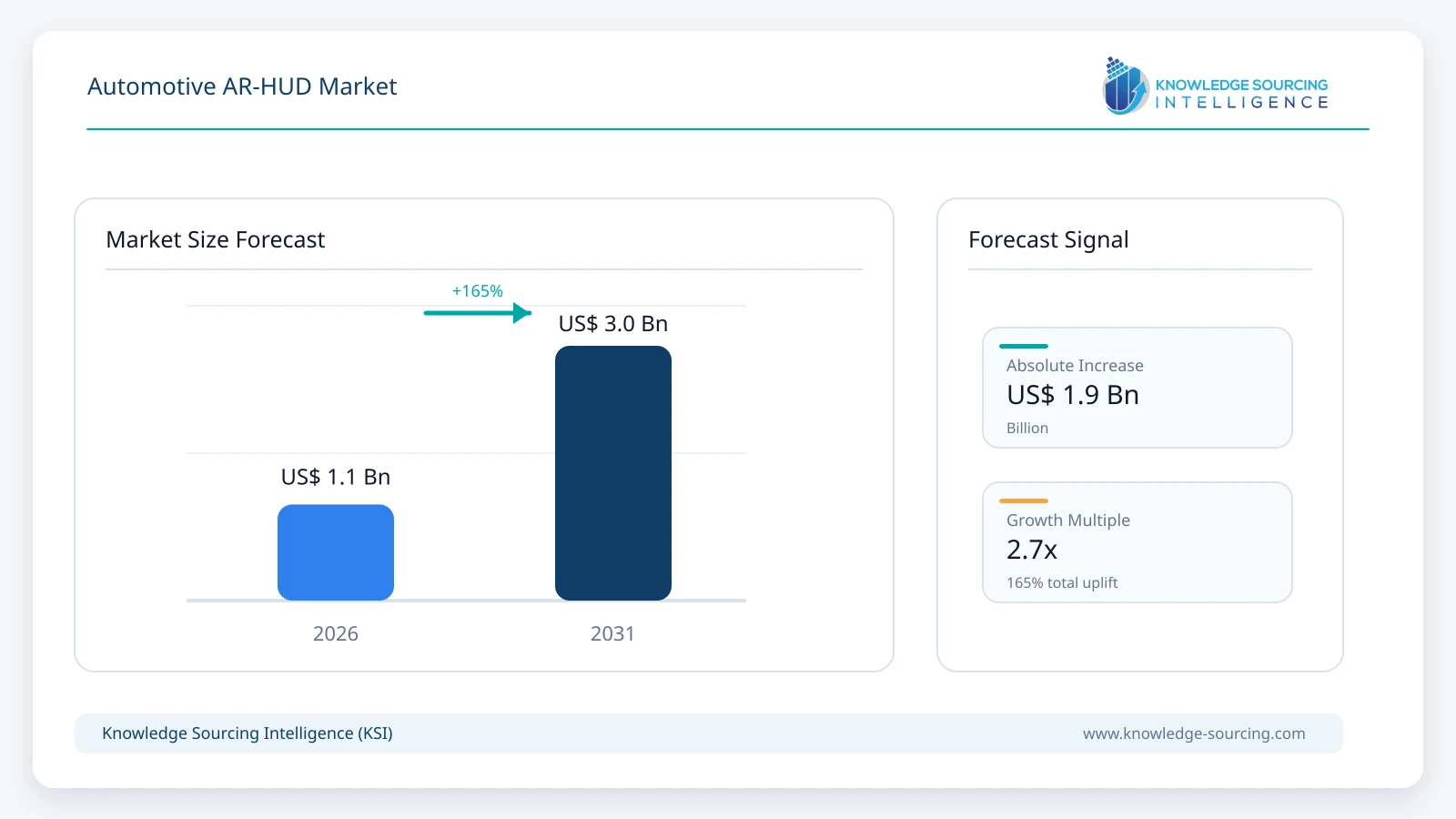
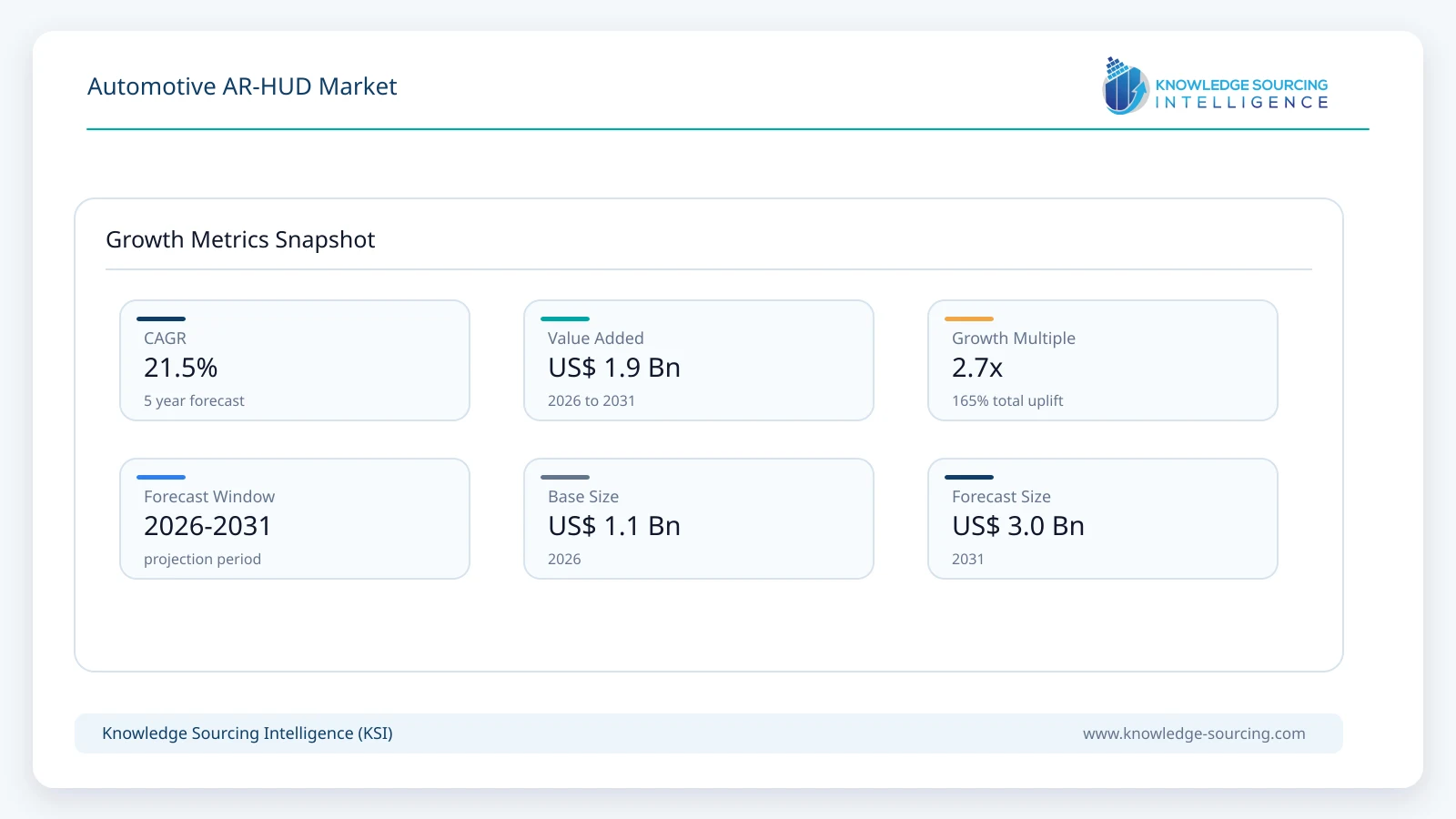
The automotive AR-HUD market is estimated at approximately USD 1.150 billion in 2026 and is projected to reach about USD 3.050 billion by 2031, representing a CAGR of 21.5% over the forecast period.
Highlights:
- 1DLP and LCoS projection architectures together account for approximately 54% of global AR-HUD market value in 2026 because they provide high brightness, contrast and resolution while supporting larger virtual images than conventional TFT-LCD systems.
- 2Single-plane wide-field AR-HUD systems represent approximately 63% of 2026 market value, while dual-plane and multi-plane architectures are gaining share as OEMs seek stronger depth cues and more natural placement of navigation and ADAS content.
- 3Navigation and lane-guidance overlays account for approximately 39% of market value in 2026 because turn-by-turn arrows, lane positioning and route guidance provide the clearest recurring AR use case across premium passenger vehicles.
- 4Windshield-integrated systems account for approximately 91% of AR-HUD market value in 2026 because accurate road registration and large virtual image distances require optical alignment with the front windshield rather than a small combiner display.
- 5Premium and upper-mid-range passenger vehicles represent approximately 78% of global market value in 2026 because AR-HUD content remains concentrated in vehicles with higher ADAS, cockpit-compute and display budgets.
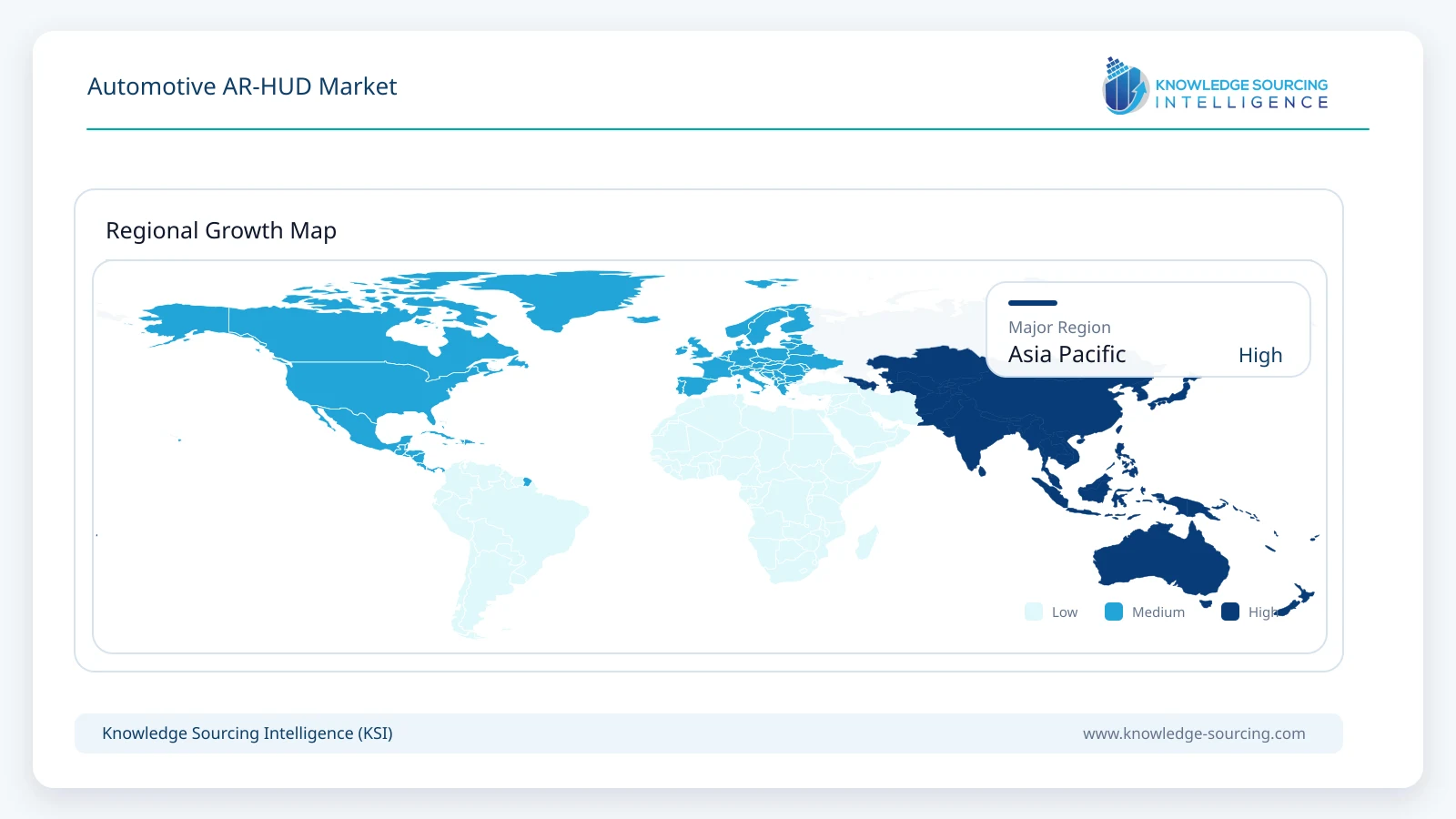
- 6Asia Pacific represents approximately 43% of global market value in 2026, supported by rapid smart-cockpit adoption in China, strong Japanese HUD manufacturing capability and expanding Korean development of AR and holographic windshield displays.
AR-HUD technology combines projection optics, windshield geometry and vehicle perception data so digital information appears spatially connected to the road rather than floating as a simple instrument readout. Navigation arrows can be positioned over the correct lane, ADAS warnings can highlight a vehicle or pedestrian, and automated-driving information can be placed at a depth that better matches the external scene, which reduces refocusing demand and makes the HUD part of the driving-assistance interface rather than an auxiliary display.
Projection-generation technology is central to system performance because brightness, contrast, optical efficiency and package volume determine whether AR content remains visible in direct sunlight and across a sufficiently large field of view. Panasonic uses DLP-based projection, Huawei is advancing LCoS dual-focal-plane systems, conventional HUD suppliers continue to use TFT-LCD where cost and packaging allow, and Envisics applies dynamic holography to create multi-depth images with higher optical efficiency and smaller optical complexity.
Accurate registration is becoming as important as raw image quality because an AR overlay loses value if the graphic drifts away from the lane, object or navigation target it is intended to identify. The rendering stack therefore depends on vehicle position, map data, camera and ADAS perception, windshield compensation, eye-point estimation and low-latency graphics processing. Eye tracking and dynamic eye-box adjustment can further improve placement when drivers change seating position or move their heads.
Packaging and windshield integration remain major commercial constraints because larger fields of view and longer virtual image distances traditionally require substantial optical volume beneath the instrument panel. Waveguides, holographic optical elements, compact mirrors and optimized projection modules are being developed to reduce package size, glare and windshield-distortion sensitivity. The strongest next-generation architectures combine optical miniaturization with software correction so one HUD platform can be adapted across several vehicle lines without redesigning the entire dashboard.
Market Trends
Dual-Plane and Multi-Plane AR-HUDs Are Improving Depth Perception
AR-HUD suppliers are moving beyond a single virtual image plane because navigation, speed and ADAS content are easier to interpret when information appears at different perceived distances. Envisics' second-generation holographic system uses separate virtual-image and AR planes, while Huawei's 2026 LCoS dual-focal-plane AR-HUD reflects the same industry direction toward depth-separated content.
Multiple image planes can reduce visual conflict between near vehicle information and road-registered graphics, but they increase calibration and rendering complexity because content must be assigned to the correct depth and remain stable as the driver and vehicle move. Commercial adoption will therefore favor architectures that deliver meaningful depth without creating excessive optical volume or compute overhead.
Larger Field of View Is Increasing the Role of AR-HUD in ADAS Visualization
AR-HUD systems are expanding horizontally and vertically so lane-level navigation, hazard markers and automated-driving visualization can cover more of the road scene. Panasonic targets wide-field road overlays, CY Vision emphasizes broad 3D coverage, and Hyundai Mobis has demonstrated a 70-inch virtual AR image designed to present richer driving information across the windshield.
A larger field of view increases the amount of information that can be spatially registered but also raises brightness, distortion and eye-box challenges. OEMs therefore need content prioritization rules so the HUD highlights only safety- and navigation-relevant information rather than turning the windshield into a dense display surface.
Holographic and Waveguide Architectures Are Targeting Lower Package Volume
Conventional mirror-based AR-HUD systems can require substantial instrument-panel volume as field of view and virtual image distance increase, encouraging suppliers to explore holographic optical elements and waveguides. Envisics is developing waveguide-based AR-HUD hardware below six liters, while Hyundai Mobis and ZEISS are advancing holographic windshield technologies that use thin optical films to transform a larger area of the glass into a display surface.
Smaller optical packages can expand AR-HUD adoption into vehicles with tighter dashboard packaging, but new optical elements must meet automotive durability, temperature, glare and windshield-manufacturing requirements. The competitive opportunity therefore depends on converting laboratory optical efficiency into repeatable high-volume automotive production.
AR-HUD Is Becoming More Tightly Coupled with ADAS Perception and Automated Driving
Road-registered graphics become more valuable as vehicles gain cameras, radar, lane models and automated-driving functions that can identify hazards and predict vehicle paths in real time. AR-HUD can visualize what the vehicle sees by highlighting lane boundaries, lead vehicles, pedestrians, takeover requests or planned trajectories directly within the driver's forward view.
Closer coupling between AR-HUD rendering and ADAS perception can increase driver trust and situational awareness, but it also makes latency and registration accuracy safety-critical UX parameters. The HUD software stack must synchronize perception, localization and rendering quickly enough that overlays do not lag behind real-world objects, especially during turns, lane changes or rapid driver head movement.
Windshield-Wide and Panoramic Projection Is Expanding the Boundary between HUD and Display
Next-generation cockpit concepts are using larger windshield areas for projected content, blurring the distinction between a traditional HUD and a forward panoramic display. BMW Panoramic Vision, Continental's Scenic View concept and Hyundai Mobis' holographic windshield display show how driving information, navigation and passenger content can migrate from discrete screens toward the windshield.
Windshield-wide projection creates new architectural choices because not every forward display requires true road-registered AR, while premium systems may combine a panoramic lower-windshield information layer with a dedicated 3D or AR-HUD in the driver's direct field of view. Suppliers that can coordinate these layers without duplicating content can capture more cockpit-display value per vehicle.
Automotive AR-HUD Market Segment Analysis
By Projection Technology
DLP and LCoS AR-HUD
DLP and LCoS AR-HUD systems are projected to generate approximately USD 1.75 billion of market value by 2031 because both technologies can deliver high-resolution, high-brightness images suitable for wide-field windshield projection. DLP benefits from mature automotive projection ecosystems and strong contrast, while LCoS is gaining attention for compact high-resolution architectures and multi-focal-plane implementations.
TFT-LCD remains relevant in cost-sensitive or less demanding HUD configurations, while holographic projection is expected to grow faster from a smaller base. DLP and LCoS retain the largest value pool because they balance production maturity with the optical performance needed for premium navigation and ADAS overlays.
By Image Architecture
Single-Plane Wide-Field AR-HUD
Single-plane wide-field AR-HUD systems are projected to generate approximately USD 1.75 billion by 2031 because they offer a practical path to larger road-aligned graphics without the optical and rendering complexity of multiple depth planes. The architecture supports lane guidance, speed, warnings and object highlighting while using a single calibrated virtual image surface.
Dual-plane and multi-plane systems should gain share as holographic and LCoS architectures mature, but single-plane systems remain attractive for mainstream premium vehicles where cost, packaging and validation outweigh the additional depth realism of more complex designs. Single-plane wide-field systems should therefore retain the largest architecture share through most of the forecast period while multi-depth solutions expand in higher-content programs.
By Application
Navigation and Lane Guidance
Navigation and lane-guidance applications are projected to generate approximately USD 1.15 billion of market value by 2031 because spatially aligned turn arrows, lane selection and exit guidance provide an intuitive and frequently used reason to adopt AR-HUD. The value is particularly strong at complex junctions where conventional map instructions require the driver to translate a screen graphic into the real road environment.
ADAS hazard visualization and automated-driving status should grow faster, but navigation retains the largest installed use case because it can operate across a broader vehicle base and does not depend on high automation levels. Integration with high-definition maps and real-time localization will increasingly determine how accurately route graphics remain aligned with the roadway.
By Vehicle Class
Premium and Upper-Mid-Range Vehicles
Premium and upper-mid-range vehicles are projected to generate approximately USD 2.25 billion of AR-HUD market value by 2031 because these platforms carry the ADAS sensors, cockpit compute, windshield specifications and optical packaging budgets required for large high-brightness systems. Premium EVs are especially important because OEMs use digital cockpit technology and AR navigation as visible differentiation features.
Mid-range penetration should expand as optical modules become smaller and cost falls, but premium vehicles will continue to account for disproportionate value because they are more likely to adopt dual-plane, larger-field-of-view and holographic architectures. High-content models also justify the windshield and dashboard engineering required to optimize AR image quality.
By Vehicle Type
Passenger Vehicles
Passenger vehicles are projected to generate approximately USD 2.90 billion of market value by 2031 because AR-HUD deployment is concentrated in passenger cars, SUVs and MPVs with advanced navigation and driver-assistance systems. Large global platforms also allow OEMs to spread optical calibration and windshield-development cost across meaningful production volumes.
Commercial vehicles present useful AR applications in route guidance, lane positioning and hazard warnings, particularly for long-haul trucks, but lower unit volumes keep total market value smaller. Passenger vehicles therefore remain dominant even as specialized commercial and autonomous platforms adopt larger forward displays.
By Display Depth
Long-Virtual-Image-Distance and Road-Registered AR
Long-virtual-image-distance and road-registered AR systems are projected to account for approximately USD 2.15 billion by 2031 because the defining value of AR-HUD comes from placing graphics closer to the apparent depth of the external road scene. Virtual image distances around ten meters or more reduce accommodation changes and make lane, object and navigation overlays appear more naturally connected to real-world targets.
Near-field HUD content remains useful for speed and vehicle status, but road-registered far-field information attracts higher value because it requires more advanced optics, calibration and sensor integration. Suppliers that can support both near and far content without excessive package size should have an advantage in premium multi-depth systems.
Market Drivers
Growing ADAS Content Is Creating More Road-Registered Information to Visualize
Lane keeping, adaptive cruise control, object detection and automated-driving functions generate spatial information that can be displayed more intuitively when aligned with the road rather than presented as icons in an instrument cluster. AR-HUD converts perception data into forward-view guidance, helping drivers understand which lane, vehicle or hazard the assistance system is referencing.
More complex ADAS functions increase the value of road-registered visualization because drivers need clear feedback about system status, detected objects and intended vehicle behavior. HUD suppliers that integrate directly with perception and domain-controller software can therefore capture more value than vendors focused only on optical projection.
Larger Digital Cockpits Are Increasing Demand for Eyes-On-Road Information Delivery
Vehicles are adding larger center displays and more software functions, but moving critical driving information onto a central touchscreen can increase the distance between the driver's gaze and the road. AR-HUD keeps navigation and driver-assistance information in the forward field of view while allowing the rest of the cockpit to become more screen-based.
Reduced eye accommodation and shorter glance shifts support AR-HUD adoption even when the vehicle already carries a digital cluster, because critical navigation and ADAS information remains within the forward field of view. Premium OEMs increasingly treat forward projection as part of the overall display architecture rather than an isolated optional feature.
Advances in Projection, Holography and Optical Correction Are Reducing Technical Barriers
DLP, LCoS, dynamic holography, waveguides and holographic optical elements are improving brightness, depth, optical efficiency and package size relative to earlier wide-field HUD architectures. Envisics, Huawei, Hyundai Mobis and Panasonic illustrate different technical routes toward larger images and better road registration.
Improved optics expand the addressable vehicle base because smaller packages can fit dashboards that previously could not accommodate large mirror assemblies. Software-based windshield distortion correction and reusable optical platforms also reduce engineering cost when suppliers adapt one HUD architecture across multiple models.
Premium EV Competition Is Making AR-HUD a Visible Differentiation Feature
Electric-vehicle platforms increasingly compete on software, displays and digital user experience, creating demand for cockpit technologies that are immediately visible to customers during a test drive. AR navigation, hazard visualization and large virtual imagery provide a premium effect that cannot be replicated by a conventional instrument cluster alone.
High-value EV programs also tend to carry the compute, sensors and networking needed to support accurate road-registered graphics, reducing incremental integration barriers. The feature can therefore move from luxury vehicles into upper-mid-range EVs faster than into conventional entry-level platforms.
Automated Driving Is Increasing the Need to Show What the Vehicle Sees and Intends
Drivers using assisted or partially automated systems need confidence that the vehicle has detected lanes, vehicles and hazards correctly, especially during handover or complex traffic situations. AR-HUD can visualize system perception and planned actions directly on the roadway, making automated-driving behavior easier to understand.
Automated-driving handover increases the importance of spatial visualization because conventional status icons provide limited context about what the vehicle has detected or intends to do. Reliable visualization of takeover requests, lane paths and detected objects can therefore become a functional component of human-machine trust rather than a purely decorative display feature.
Market Restraints
Large Optical Volume and Dashboard Packaging Remain Major Constraints
Wide-field AR-HUD systems traditionally require large mirrors, projection units and controlled optical paths beneath the instrument panel, competing with airbags, HVAC ducts, structural components and cabin storage for limited space. The packaging challenge becomes more severe as OEMs seek larger fields of view and longer virtual image distances.
Waveguides and holographic optics can reduce volume, but these technologies introduce new cost, durability and manufacturing requirements. OEMs may therefore limit AR-HUD adoption to platforms designed around the optical package from an early development stage rather than adding the system late in a vehicle program.
Windshield Distortion and Vehicle-Specific Calibration Increase Development Cost
The windshield is an optical element with curvature, thickness variation and laminated structure that can create distortion, ghost images and double reflections if the HUD is not precisely calibrated. Different vehicle bodies and windshield suppliers can require separate correction maps even when the projection hardware is similar.
Software compensation reduces some variation, but optical validation remains vehicle-specific and must account for temperature, manufacturing tolerance and driver eye position. These engineering costs make platform reuse more difficult than for conventional displays mounted inside the cabin.
Registration Error and Latency Can Make AR Overlays Misleading
Road-registered graphics must remain aligned with lanes, vehicles and hazards while the car moves, turns and vibrates, leaving limited tolerance for localization or rendering delay. A navigation arrow or object marker that drifts from its intended target can confuse the driver and undermine trust in both the HUD and the underlying ADAS system.
Low-latency perception, accurate vehicle pose and continuous eye-box management are therefore required in addition to good optics. Validation becomes especially demanding for high-speed scenarios and uneven roads where small timing errors create visible displacement in the projected graphic.
High Brightness and Thermal Demand Increase Power and Cost
AR-HUDs need sufficient luminance and contrast to remain visible in direct sunlight, through polarized sunglasses and across changing windshield conditions, increasing projector power and thermal load. High-resolution DLP, LCoS and laser or holographic systems also add electronics and cooling requirements that can conflict with compact dashboard packaging.
Optical efficiency improvements reduce power, but premium image quality still carries a higher cost than conventional HUD systems. Mass-market adoption therefore depends on achieving acceptable brightness and field of view without requiring oversized cooling or expensive high-output light sources.
Excessive or Poorly Prioritized AR Content Can Increase Driver Distraction
The windshield can become visually cluttered if navigation, ADAS, infotainment and system-status graphics compete for the same forward field of view. AR-HUD improves attention only when the displayed information is relevant, spatially accurate and limited to what the driver can process quickly.
OEMs therefore need content-priority logic, animation rules and human-factors validation rather than simply projecting more information as optical capability improves. The most successful systems are likely to use AR selectively for navigation, hazards and automation feedback while keeping secondary content on other cockpit displays.
Regional Outlook
Asia Pacific
Asia Pacific is estimated to be the largest regional automotive AR-HUD market in 2026 because China combines rapid smart-cockpit adoption with strong demand for large virtual displays, ADAS visualization and differentiated EV interfaces. Japan adds deep HUD manufacturing expertise through suppliers such as Nippon Seiki and Panasonic, while South Korea contributes major cockpit and optical development through Hyundai Mobis and its expanding holographic and conventional AR-HUD portfolio.
Huawei's 2026 dual-focal-plane LCoS AR-HUD, Hyundai Mobis' 70-inch AR-HUD and holographic windshield programs, and the large installed base of Chinese HUD supplier FUTURUS illustrate the region's rapid technology diversification. Visteon's partnership with FUTURUS also demonstrates growing international interest in Chinese AR optics and computing expertise for global OEM programs.
Regional growth through 2031 should remain strongest where AR-HUD is integrated into common smart-cockpit and ADAS platforms rather than engineered as an isolated display. High vehicle volumes and aggressive EV competition create favorable economics for moving large-field-of-view projection from premium models into upper-mid-range vehicles once package size and windshield cost are reduced.
Europe
Europe represents the second major high-value AR-HUD market because premium OEMs, advanced driver-assistance adoption and strong optical-engineering capabilities support early deployment of large-field and multi-depth projection systems. BMW's 3D Head-Up Display within Panoramic iDrive, AUMOVIO's broader HUD portfolio and European optical expertise in holography and windshield integration provide a substantial commercialization base.
Envisics' UK-developed dynamic holography has entered Cadillac production and has attracted strategic investment from major European and global automakers, while German optical company ZEISS is working with Hyundai Mobis on holographic windshield display technology. These programs reinforce Europe's role in optical architectures that seek to reduce package size and place information at more natural depths.
European growth will depend on combining premium image quality with strict driver-distraction, cybersecurity and functional-safety expectations. OEMs are likely to emphasize navigation, automated-driving status and hazard visualization while requiring strong validation of registration accuracy and display prioritization before expanding AR content across the windshield.
Competitive Landscape
The automotive AR-HUD market combines established HUD suppliers, optical specialists, cockpit-electronics companies and emerging holographic-display developers. AUMOVIO, Panasonic Automotive Systems, Hyundai Mobis, Nippon Seiki, Visteon, Envisics, Huawei and CY Vision are directly relevant through production HUD portfolios, DLP and LCoS projection, holographic optics, panoramic windshield displays, multi-plane imaging and road-registered AR software.
AUMOVIO competes from a large conventional HUD base and is extending its user-experience portfolio toward AR and Scenic View products, while Panasonic combines DLP projection, eye tracking and road-registered graphics. Nippon Seiki brings large-scale HUD manufacturing and optical design experience, giving established suppliers an advantage in automotive quality, windshield calibration and global production.
Hyundai Mobis is pursuing both conventional AR-HUD and holographic windshield architectures, including a global optical-material alliance for future mass production, while Visteon is partnering with FUTURUS to add advanced AR, windshield and panoramic HUD technology to its cockpit-electronics portfolio. Huawei's LCoS dual-focal-plane system strengthens competition in China by combining optical hardware with a broader smart-cockpit and ADAS ecosystem.
Envisics and CY Vision differentiate through specialized holographic and true-3D AR architectures designed to improve depth, field of view and package efficiency. Competitive advantage increasingly depends on optical volume, brightness, registration accuracy, windshield compensation, multi-depth capability and the ability to integrate rendering with vehicle perception and cockpit compute rather than on projection hardware alone.
Recent Developments
August 2026: Nippon Seiki highlighted the continuing evolution of its automotive HUD technology while reinforcing its leading global HUD manufacturing position and focus on safer forward-view information display.
April 2026: Huawei launched a new dual-focal-plane LCoS AR-HUD as part of its next-generation Qiankun smart-vehicle technology portfolio, expanding multi-depth projection within an integrated cockpit and ADAS ecosystem.
February 2026: Hyundai Mobis formed a global alliance with ZEISS, tesa and Saint-Gobain Sekurit to industrialize holographic windshield displays, targeting mass production by 2029 and deeper integration of the windshield into the forward information interface.
September 2025: Visteon and FUTURUS announced a partnership to co-develop next-generation AR-HUD, windshield HUD and panoramic HUD systems for global automakers by combining Visteon's cockpit-electronics scale with FUTURUS optical and AR expertise.
June 2025: Envisics confirmed that its second-generation holographic AR-HUD is supplying the 2026 Cadillac VISTIQ, following deployment on the Cadillac LYRIQ-V and marking a major production milestone for dual-plane holographic automotive projection.
Market Outlook
The automotive AR-HUD market is expected to expand from approximately USD 1.150 billion in 2026 to about USD 3.050 billion by 2031 as road-registered navigation, ADAS visualization and multi-depth projection move from flagship vehicles into a broader premium and upper-mid-range base. DLP and LCoS should retain the largest combined technology value pool, while holographic and waveguide architectures gain share where package size and multi-plane depth justify higher optical complexity.
The most important structural shift will be tighter integration between AR-HUD rendering and vehicle perception because future systems will increasingly visualize lanes, hazards, automated-driving status and navigation targets using the same camera, radar and localization data that supports ADAS. Registration accuracy, end-to-end latency and eye-box management will therefore become as important as brightness and image resolution in supplier benchmarking.
Asia Pacific is expected to retain the largest regional value pool, while Europe remains a major premium engineering and commercialization market. Competitive performance will depend on compact optics, strong sunlight visibility, low distortion, large field of view, long virtual image distance, software-based windshield correction and the ability to support multiple vehicle platforms without redesigning the complete optical stack.
Automotive AR-HUD Market Scope:
| Report Metric | Details |
|---|---|
| Total Market Size in 2026 | USD 1.150 billion |
| Total Market Size in 2031 | USD 3.050 billion |
| Forecast Unit | USD Billion |
| Growth Rate | 21.5% |
| Study Period | 2021 to 2031 |
| Historical Data | 2021 to 2024 |
| Base Year | 2025 |
| Forecast Period | 2026 – 2031 |
| Segmentation | Projection Technology, Image Architecture, Application, Display Depth, Vehicle Class, Vehicle Type, Geography |
| Companies |
|
Market Segmentation
By Projection Technology
DLP AR-HUD
LCoS AR-HUD
TFT-LCD AR-HUD
Holographic and Waveguide AR-HUD
Other Advanced Projection Technologies
By Image Architecture
Single-Plane Wide-Field AR-HUD
Dual-Plane AR-HUD
Multi-Plane and True-3D AR-HUD
Panoramic and Windshield-Wide AR Display Architectures
By Application
Navigation and Lane Guidance
ADAS Hazard and Object Visualization
Automated-Driving Status and Takeover Support
Speed, Traffic Sign and Vehicle Information
Infotainment and Contextual Information
By Display Depth
Long-Virtual-Image-Distance and Road-Registered AR
Dual-Distance and Multi-Depth Projection
Near-Field Combined Instrument Information
By Vehicle Class
Premium and Luxury Vehicles
Upper-Mid-Range Vehicles
Mid-Range and Mass-Market Vehicles
By Vehicle Type
Passenger Vehicles
Light Commercial Vehicles
Medium and Heavy Commercial Vehicles
Shared and Autonomous Mobility Vehicles
By Geography
North America
United States
Canada
Mexico
South America
Brazil
Argentina
Others
Europe
Germany
United Kingdom
France
Italy
Spain
Others
Middle East and Africa
Saudi Arabia
UAE
South Africa
Others
Asia Pacific
China
Japan
South Korea
India
Singapore
Others
Table of Contents
1. INTRODUCTION
1.1. Market Overview
1.2. Market Definition
1.3. Scope of the Study
1.4. Market Segmentation
1.5. Currency
1.6. Assumptions
1.7. Base and Forecast Years
1.8. Key Benefits to Stakeholders
2. RESEARCH METHODOLOGY
2.1. Research Design
2.2. Secondary Research
2.3. Primary Research
2.4. Market Estimation
2.5. Segment Modelling
2.6. Data Triangulation and Validation
3. EXECUTIVE SUMMARY
3.1. Key Findings
3.2. Automotive AR-HUD Market Size, 2026-2031
3.3. Projection Technology Outlook
3.4. Image Architecture Outlook
3.5. Application Outlook
3.6. Vehicle Class Outlook
3.7. Vehicle Type Outlook
3.8. Display Depth Outlook
3.9. Regional Opportunity Summary
4. MARKET DYNAMICS
4.1. Market Drivers
4.1.1. Growing ADAS Content Is Creating More Road-Registered Information to Visualize
4.1.2. Larger Digital Cockpits Are Increasing Demand for Eyes-On-Road Information Delivery
4.1.3. Advances in Projection, Holography and Optical Correction Are Reducing Technical Barriers
4.1.4. Premium EV Competition Is Making AR-HUD a Visible Differentiation Feature
4.1.5. Automated Driving Is Increasing the Need to Show What the Vehicle Sees and Intends
4.2. Market Restraints
4.2.1. Large Optical Volume and Dashboard Packaging Remain Major Constraints
4.2.2. Windshield Distortion and Vehicle-Specific Calibration Increase Development Cost
4.2.3. Registration Error and Latency Can Make AR Overlays Misleading
4.2.4. High Brightness and Thermal Demand Increase Power and Cost
4.2.5. Excessive or Poorly Prioritized AR Content Can Increase Driver Distraction
4.3. Market Opportunities
4.4. Porter's Five Forces Analysis
4.5. Industry Value Chain Analysis
4.6. AR-HUD Optical Module, Windshield and Software Economics
4.7. Driver-Distraction, Functional-Safety and Display Validation Environment
5. TECHNOLOGY OUTLOOK
5.1. TFT-LCD Projection Generation Units
5.2. Digital Light Processing AR-HUD
5.3. LCoS AR-HUD
5.4. Dynamic Holographic Projection
5.5. Waveguides and Holographic Optical Elements
5.6. Laser and Other Advanced Projection Architectures
5.7. Single-Plane, Dual-Plane and Multi-Plane Imaging
5.8. Field of View, Eye Box and Virtual Image Distance
5.9. Windshield Geometry, Ghosting and Distortion Compensation
5.10. Driver Eye Tracking and Dynamic Image Positioning
5.11. ADAS Perception and Road-Registration Software
5.12. High-Brightness and Thermal Management
5.13. Panoramic and Windshield-Wide Projection
6. AUTOMOTIVE AR-HUD MARKET BY PROJECTION TECHNOLOGY
6.1. Introduction
6.2. DLP AR-HUD
6.3. LCoS AR-HUD
6.4. TFT-LCD AR-HUD
6.5. Holographic and Waveguide AR-HUD
6.6. Other Advanced Projection Technologies
7. AUTOMOTIVE AR-HUD MARKET BY IMAGE ARCHITECTURE
7.1. Introduction
7.2. Single-Plane Wide-Field AR-HUD
7.3. Dual-Plane AR-HUD
7.4. Multi-Plane and True-3D AR-HUD
7.5. Panoramic and Windshield-Wide AR Display Architectures
8. AUTOMOTIVE AR-HUD MARKET BY APPLICATION
8.1. Introduction
8.2. Navigation and Lane Guidance
8.3. ADAS Hazard and Object Visualization
8.4. Automated-Driving Status and Takeover Support
8.5. Speed, Traffic Sign and Vehicle Information
8.6. Infotainment and Contextual Information
9. AUTOMOTIVE AR-HUD MARKET BY DISPLAY DEPTH
9.1. Introduction
9.2. Long-Virtual-Image-Distance and Road-Registered AR
9.3. Dual-Distance and Multi-Depth Projection
9.4. Near-Field Combined Instrument Information
10. AUTOMOTIVE AR-HUD MARKET BY VEHICLE CLASS
10.1. Introduction
10.2. Premium and Luxury Vehicles
10.3. Upper-Mid-Range Vehicles
10.4. Mid-Range and Mass-Market Vehicles
11. AUTOMOTIVE AR-HUD MARKET BY VEHICLE TYPE
11.1. Introduction
11.2. Passenger Vehicles
11.3. Light Commercial Vehicles
11.4. Medium and Heavy Commercial Vehicles
11.5. Shared and Autonomous Mobility Vehicles
12. AUTOMOTIVE AR-HUD MARKET BY GEOGRAPHY
12.1. North America
12.1.1. United States
12.1.2. Canada
12.1.3. Mexico
12.2. South America
12.2.1. Brazil
12.2.2. Argentina
12.2.3. Others
12.3. Europe
12.3.1. Germany
12.3.2. United Kingdom
12.3.3. France
12.3.4. Italy
12.3.5. Spain
12.3.6. Others
12.4. Middle East and Africa
12.4.1. Saudi Arabia
12.4.2. UAE
12.4.3. South Africa
12.4.4. Others
12.5. Asia Pacific
12.5.1. China
12.5.2. Japan
12.5.3. South Korea
12.5.4. India
12.5.5. Singapore
12.5.6. Others
13. COMPETITIVE ENVIRONMENT AND ANALYSIS
13.1. Major Players and Strategy Analysis
13.2. Market Share Analysis
13.3. AR-HUD Technology Benchmarking
13.4. DLP versus LCoS versus Holographic Projection Comparison
13.5. Field of View, Virtual Image Distance and Eye-Box Benchmarking
13.6. Single-Plane versus Dual-Plane and Multi-Plane Comparison
13.7. Optical Volume, Brightness and Thermal Benchmarking
13.8. Windshield Compensation and Registration-Accuracy Benchmarking
13.9. OEM Programs and Production Readiness
13.10. Competitive Dashboard
14. COMPANY PROFILES
14.1. AUMOVIO
14.2. Panasonic Automotive Systems Co., Ltd.
14.3. Hyundai Mobis
14.4. Nippon Seiki Co., Ltd.
14.5. Visteon Corporation
14.6. Envisics
14.7. Huawei
14.8. CY Vision
15. APPENDIX
15.1. Currency
15.2. Assumptions
15.3. Base and Forecast Years Timeline
15.4. Key Benefits for Stakeholders
15.5. Research Methodology
15.6. Abbreviations
15.7. Data Sources
Navigate
Trusted by the world's leading organizations











