
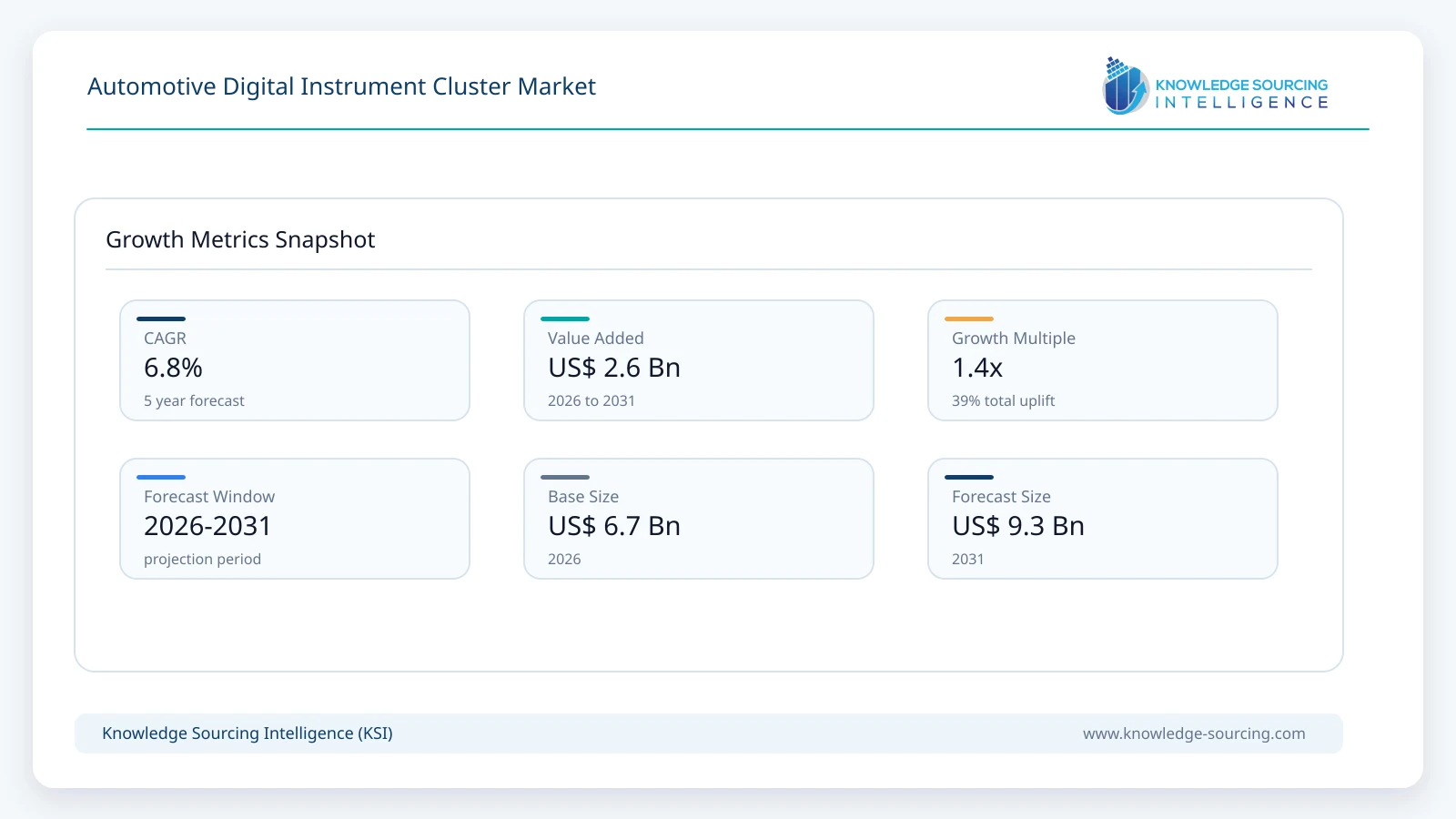
The automotive digital instrument cluster market is estimated at approximately USD 6.70 billion in 2026 and is projected to reach about USD 9.30 billion by 2031, representing a CAGR of 6.8% during the forecast period.
Highlights:
- 1TFT-LCD accounts for approximately 94% of global digital instrument cluster market value in 2026 because it combines automotive durability, high brightness, mature supply and scalable cost across mainstream vehicle programs.
- 2Clusters between 8 and 12 inches represent approximately 53% of 2026 market value, while displays above 12 inches are modeled to gain the most share through 2031.
- 3Standalone cluster-controller architecture accounts for approximately 52% of market value in 2026 but is modeled to decline to 28% by 2031 as cockpit-domain compute absorbs graphics and control functions.
- 4Premium and upper-mid-range vehicles represent approximately 42% of global market value in 2026, although mid-range vehicles become the largest value segment by 2031 as full digital clusters become standard equipment.
- 5Passenger vehicles account for approximately 90% of global market value in 2026 because digital cluster adoption remains concentrated in passenger cars, SUVs and MPVs.
- 6Asia Pacific represents approximately 44% of global market value in 2026 and is modeled to reach 47% by 2031, supported by high vehicle production and rapid digital-cockpit adoption in China and other Asian markets.
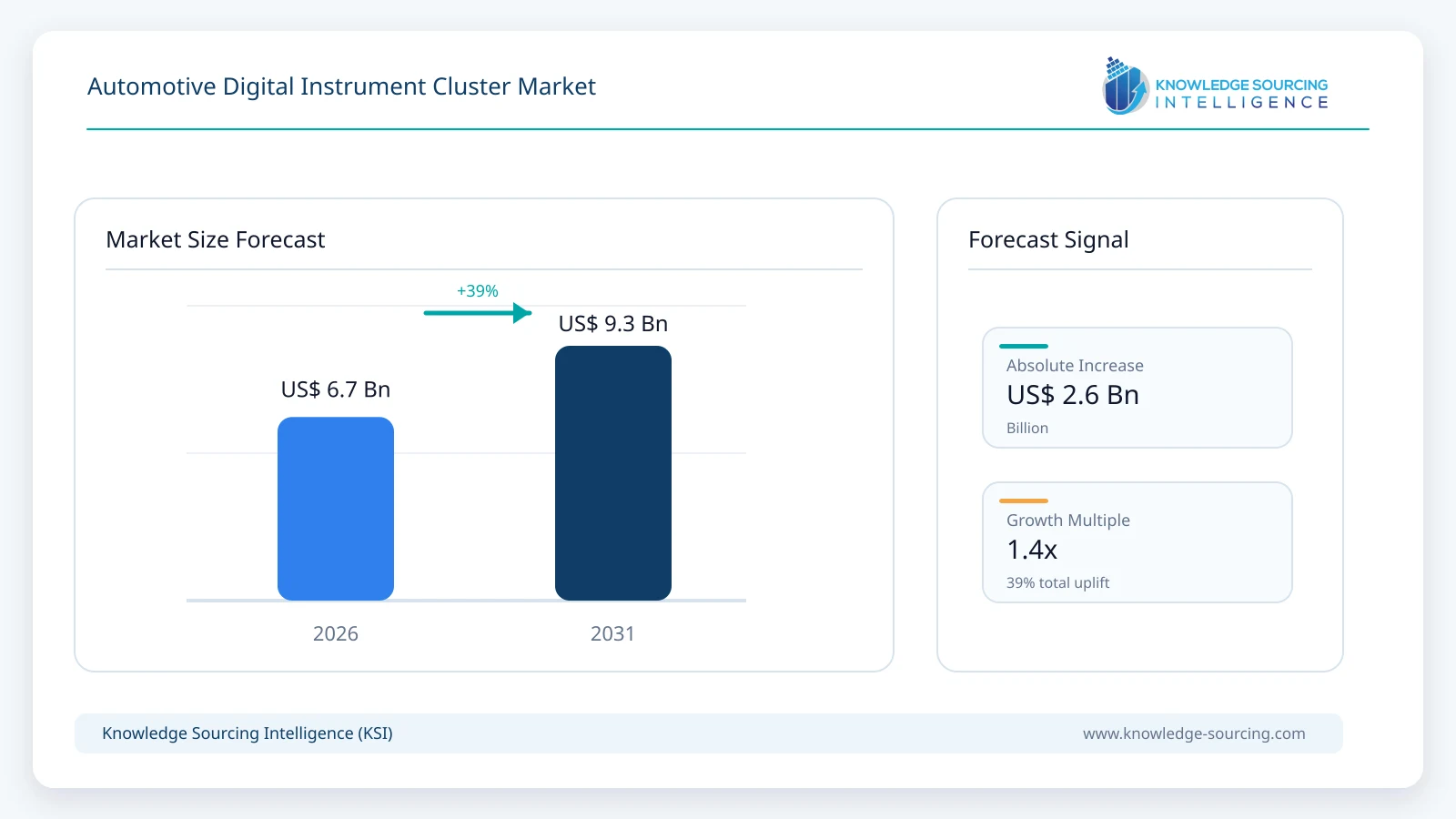
The estimate is anchored to a 96.4-million-unit global vehicle-production base in 2025, rising penetration of fully digital clusters and continued increases in screen size and feature integration. Nippon Seiki provides a useful scale benchmark: its automotive business generated JPY 258.1 billion in fiscal 2025, with automotive instruments accounting for 69% of automotive-business sales, while Visteon secured USD 1.4 billion of cluster new-business awards in 2025 and continued launching digital clusters across several passenger and commercial vehicle programs in 2026.
The principal structural shift is from standalone cluster ECUs toward driver displays controlled by cockpit domain controllers or integrated into panoramic cockpit architectures. LG is combining instrument-cluster and infotainment control within SDV cockpit platforms, Visteon is integrating driver displays with SmartCore and under-display driver-monitoring technology, and AUMOVIO has secured a production order for an OLED driver display with an invisibly integrated camera. This transition reduces dedicated controller value inside the cluster while increasing display area, optical quality, software and sensing content, resulting in moderate overall market growth but much faster expansion in domain-controlled, large-format and OLED cluster segments.
Market Overview
Digital instrument clusters are becoming a primary safety and information interface because modern vehicles must present navigation, ADAS status, battery data and configurable warnings in addition to conventional speed and fuel information. A fully digital display lets the information hierarchy change with drive mode or automation state while retaining mandatory telltales in a controlled layout.
TFT-LCD remains dominant because high-brightness panels, mature optical bonding and long automotive qualification histories provide reliable operation across temperature and sunlight conditions. Panasonic emphasizes 3D graphics and spatial depth in its full-display cluster, while AUMOVIO supports HD graphics, rapid startup and safety-compliant cluster architectures. OLED is gaining relevance where premium contrast and thin packaging justify higher cost.
Cluster electronics are increasingly separated from cluster rendering as cockpit domain controllers generate graphics for several displays from one SoC. LG combines instrument-cluster and infotainment control in its SDV cockpit architecture, while Hyundai Mobis and Visteon support digital clusters within broader multi-display systems. The physical driver display remains distinct, but control electronics shift progressively toward shared compute.
Integrated sensing is adding cluster value as OEMs move driver-monitoring cameras closer to the driver's natural line of sight. Visteon and Smart Eye have demonstrated an LCD cluster with the DMS camera behind the display, while AUMOVIO has secured a production OLED driver display with a camera under the active area. These designs add infrared, optical and calibration requirements to the cluster module.
Market Trends
Domain-Controlled Clusters Are Replacing Standalone Cluster ECUs
Cockpit domain controllers increasingly generate cluster graphics alongside infotainment and other display outputs, reducing the need for a dedicated high-performance controller inside every instrument panel. LG's integrated cockpit solution, Visteon SmartCore and Hyundai Mobis multi-display platforms all reflect this architecture. The internal model lowers standalone cluster-controller share from 52% in 2026 to 28% by 2031 and raises domain-controlled clusters to 57%.
Large Driver Displays Are Expanding beyond Premium Vehicles
Instrument clusters are increasing in size as OEMs add map views, ADAS visualization and EV energy information to the driver's primary display. Visteon's 12.3-inch Lexus ES driver display shows the premium direction, while similar formats are moving into upper-mid-range vehicles. Displays above 12 inches are modeled to rise from 22% of market value in 2026 to 37% by 2031.
OLED Is Emerging as a Premium Driver-Display Technology
OLED offers deeper blacks, higher contrast and thinner packaging than conventional TFT-LCD, improving premium cockpit integration. AUMOVIO's 2026 production order for an OLED driver display with an integrated under-display camera provides direct evidence of series adoption. OLED remains a small share because of cost and lifetime requirements, but the internal model doubles its share from 5% in 2026 to 10% by 2031.
Driver-Monitoring Cameras Are Moving behind the Instrument Cluster Display
Driver-monitoring requirements are encouraging camera placement directly behind or within the cluster because the location provides a clear view of the driver's face. Visteon and Smart Eye introduced an LCD instrument cluster with an under-display DMS camera in 2026, while AUMOVIO is commercializing a similar OLED concept. The approach reduces visible hardware but adds infrared-transmission and display-uniformity challenges.
Panoramic Cockpit Design Is Blurring the Boundary between Cluster and Display System
Digital clusters are increasingly integrated visually with center and passenger screens through common glass, curved panels or panoramic structures. LG's Genesis GV90 architecture can combine cluster and AVN within one variable display environment, while broader cockpit platforms coordinate several information zones under shared styling. Integrated driver displays are modeled to rise from 7% of cluster value in 2026 to 15% by 2031.
Segment Analysis
By Display Technology: TFT-LCD
TFT-LCD digital instrument clusters account for approximately USD 6.30 billion in 2026 and are projected to reach about USD 8.18 billion by 2031. Share declines from 94% to 88% as OLED expands, but TFT-LCD remains dominant because it combines mature qualification, strong sunlight readability and scalable cost. Improvements in backlighting, optics and panel efficiency continue to extend its competitive life.
By Screen Size: 8 to 12 Inches
Digital clusters between 8 and 12 inches account for approximately USD 3.55 billion in 2026 and are projected to reach about USD 4.56 billion by 2031. The format provides sufficient area for navigation, ADAS and configurable graphics without the cost of very large driver displays. Share eases from 53% to 49%, but the category remains the largest screen-size segment through 2031.
By Screen Size: Above 12 Inches
Digital clusters above 12 inches account for approximately USD 1.47 billion in 2026 and are projected to reach about USD 3.44 billion by 2031, implying roughly 18.5% annual growth. Share rises from 22% to 37% as large driver displays move beyond luxury models. The segment captures disproportionate incremental value because screen area, optics and graphics requirements increase together.
By Integration Architecture: Domain-Controlled Digital Cluster
Domain-controlled digital clusters account for approximately USD 2.75 billion in 2026 and are projected to reach about USD 5.30 billion by 2031, implying approximately 14.1% annual growth. Share rises from 41% to 57% as OEMs consolidate cluster and infotainment compute. The architecture becomes the largest value pool while the physical driver display remains a separate safety-relevant module.
By Vehicle Class: Premium and Upper-Mid-Range Vehicles
Premium and upper-mid-range vehicles account for approximately USD 2.81 billion in 2026 because they adopt full digital clusters, larger screens and advanced graphics earlier. Share declines from 42% to 35% by 2031 as digital clusters become standard in mid-range models. Premium vehicles remain the launch point for OLED, large-format and sensing-integrated displays.
By Vehicle Type: Passenger Vehicles
Passenger vehicles account for approximately USD 6.03 billion in 2026 and are projected to reach about USD 8.09 billion by 2031. Share eases from 90% to 87% as light and heavy commercial vehicles adopt larger digital clusters for navigation, fleet information and ADAS visualization. Passenger cars, SUVs and MPVs nevertheless remain the dominant value pool.
Market Drivers
Conversion from Analog and Hybrid Clusters Is Expanding the Addressable Base
Analog and partially digital instrument panels continue to migrate toward full LCD driver displays as screen and controller costs decline. Nippon Seiki, Visteon, Panasonic and AUMOVIO maintain active cluster portfolios across mainstream and premium programs. Each conversion replaces mechanical gauge content with higher-value display, graphics and software content, supporting growth even with moderate vehicle-volume expansion.
ADAS and Navigation Visualization Require More Flexible Driver Displays
Modern clusters increasingly present lane guidance, adaptive-cruise status, speed-limit recognition and camera views that fixed analog gauges cannot communicate effectively. AUMOVIO highlights navigation, media, camera and driver-assistance information as core digital-cluster functions. Richer safety content therefore increases demand for larger displays and flexible graphics software.
Cockpit Domain Consolidation Is Accelerating Digital Cluster Standardization
Shared cockpit compute lets OEMs reuse graphics frameworks and cluster applications across several vehicle lines while reducing dedicated controller hardware. LG, Visteon and Hyundai Mobis are all integrating cluster output within broader cockpit-domain platforms. Standardized software lowers program-specific engineering and makes full digital clusters more economical in mid-range vehicles.
Larger Displays and Premium Visual Quality Are Raising Value per Vehicle
Narrow bezels, optical bonding, high-brightness TFT panels and OLED improve readability and perceived quality while increasing module value. Visteon's Lexus ES driver display and AUMOVIO's OLED camera-under-display order illustrate premium investment in the driver-information zone. These technologies offset pricing pressure in smaller mainstream clusters.
Driver Monitoring Integration Is Adding New Functions to the Cluster Module
Driver-monitoring cameras are moving into the cluster area because the display sits close to the driver's natural line of sight. Visteon and Smart Eye have demonstrated an LCD cluster with an under-display camera, while AUMOVIO has secured a production OLED program using the same integration logic. The added optical and infrared requirements create incremental module value.
Market Restraints
Domain Controllers Can Remove Dedicated Cluster Compute Value
Shared cockpit compute reduces the amount of processing hardware physically contained in the cluster because rendering and application logic can move to a domain controller. The display remains valuable, but some electronics content migrates into another market layer. This limits overall cluster-market growth even as digital penetration increases.
TFT-LCD Price Erosion Limits Revenue Growth in Mainstream Programs
Automotive TFT-LCD benefits from mature manufacturing and strong supplier competition, reducing cost as volumes rise. Lower panel prices expand digital-cluster penetration but offset part of the revenue gain from higher unit shipments. Suppliers therefore need larger formats, better optics or additional functions to sustain value growth.
OLED Lifetime and Cost Requirements Slow Broad Adoption
OLED improves contrast and packaging but remains more expensive and requires careful management of image retention and static telltales over long vehicle lifecycles. These constraints keep adoption concentrated in premium programs despite rapid percentage growth. TFT-LCD is therefore expected to remain dominant through 2031.
Safety-Critical Display Validation Increases Development Complexity
The instrument cluster presents regulated telltales, speed and warning information that must remain available under fault conditions. Digital systems therefore require rapid startup, functional safety, fault handling and cybersecurity beyond normal consumer-display requirements. Validation becomes more complex when graphics share compute with infotainment or DMS cameras sit behind the display.
Panoramic Cockpit Integration Can Reduce the Cluster as a Separate Sourcing Category
Integrating driver and center information under common glass or one panoramic panel can shift instrument-cluster value away from a discrete module even though the driver-information function remains mandatory. Cluster suppliers therefore need participation in broader cockpit-display systems to retain content as physical screen boundaries disappear.
Regional Outlook
Asia Pacific
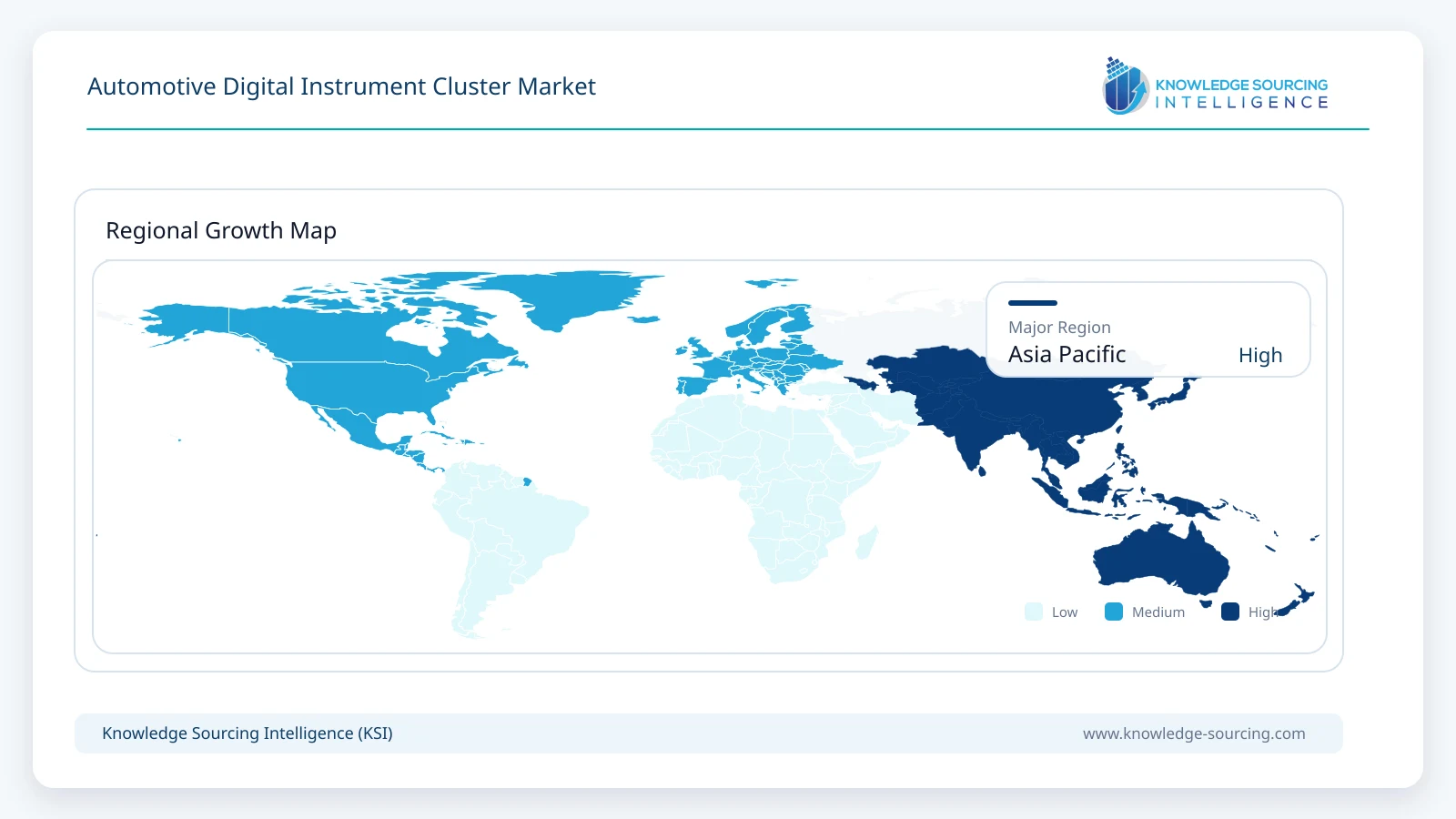
Asia Pacific accounts for approximately 44% of global market value in 2026 and is modeled to reach 47% by 2031. China combines the largest vehicle-production base with rapid conversion to full digital cockpits, while Japan hosts major suppliers including Nippon Seiki and Panasonic and South Korea adds Hyundai Mobis and LG. High volumes and fast technology diffusion support large TFT clusters and domain-controlled architectures across a broad price range.
Europe
Europe is the second major high-value market because premium OEMs and stringent driver-information requirements support large digital clusters and early adoption of OLED, integrated DMS and domain-controlled architectures. AUMOVIO's OLED production order and Visteon's premium driver-display programs provide current evidence. Europe's share eases from approximately 27% in 2026 to 25% by 2031 as Asia Pacific grows faster.
Competitive Landscape
Digital instrument cluster value is distributed across display modules, safety-critical graphics, cockpit integration and increasingly shared compute, creating competition among specialist instrument suppliers, cockpit Tier 1 companies and display integrators rather than one homogeneous supplier group. Nippon Seiki, Visteon, AUMOVIO, Panasonic Automotive Systems, DENSO, Yazaki, Hyundai Mobis, Marelli, LG Vehicle Solution, Desay SV, BOE Varitronix and Bosch are among the most relevant participants for deeper profiling.
Nippon Seiki remains one of the clearest cluster-focused benchmarks, with automotive instruments representing 69% of its automotive-business sales in fiscal 2025. Visteon competes through high-volume digital clusters and premium driver displays while integrating cluster output with SmartCore compute. AUMOVIO and Panasonic combine cluster technology with broader display and cockpit architectures.
Hyundai Mobis, DENSO, Yazaki and Marelli can bundle clusters with adjacent cockpit electronics, while LG and Desay SV become more relevant as cluster and infotainment control merge within SDV platforms. Competitive advantage increasingly depends on screen quality, startup speed, functional safety, software compatibility and the ability to integrate sensing without compromising display performance.
Competitive Company Universe
• Nippon Seiki Co., Ltd.
• Visteon Corporation
• AUMOVIO
• Panasonic Automotive Systems Co., Ltd.
• DENSO Corporation
• Yazaki Corporation
• Hyundai Mobis
• Marelli
• LG Electronics Vehicle Solution Company
• Desay SV
• BOE Varitronix Limited
• Robert Bosch GmbH
• AUO Mobility Solutions Corporation
• Alps Alpine Co., Ltd.
• Samsung Display
• Japan Display Inc.
Recent Developments
6 October 2026: LG Electronics announced an integrated cockpit solution for Renault Group's New Trafic E-Tech Electric that combines instrument-cluster and infotainment control within an SDV-oriented architecture.
23 July 2026: Visteon reported second-quarter product launches including a digital cluster on the Hyundai Exter, alongside continued multi-display and SmartCore expansion.
3 June 2026: Visteon launched a 12.3-inch narrow-border driver display on the all-new Lexus ES, using optical bonding, high brightness and a slim premium cluster design.
26 May 2026: Visteon and Smart Eye introduced an LCD instrument cluster with an under-display driver-monitoring camera designed to preserve cluster image quality while providing direct DMS sight lines.
20 May 2026: Nippon Seiki announced a new circular TFT dual-gauge cluster prototype for Automotive Engineering Exposition 2026, combining classical gauge styling with expandable TFT infotainment content.
7 April 2026: AUMOVIO announced a major series-production order for an OLED driver display with a camera invisibly integrated beneath the active display area for a European premium OEM.
Market Outlook
The automotive digital instrument cluster market is expected to increase from approximately USD 6.700 billion in 2026 to USD 9.300 billion by 2031. Growth remains moderate at 6.8% because full digital penetration and larger screens are partly offset by TFT-LCD price erosion and migration of dedicated cluster compute into shared cockpit-domain controllers. The strongest value growth comes from large-format, OLED, domain-controlled and sensing-integrated driver displays.
Asia Pacific should retain the largest regional value pool, while Europe remains important for premium display and safety integration. Supplier performance will increasingly depend on maintaining safety-critical graphics and startup performance while supporting shared compute, panoramic cockpit design and hidden sensing hardware.
Automotive Digital Instrument Cluster Market Scope
| Report Metric | Details |
|---|---|
| Total Market Size in 2026 | USD 6.70 billion |
| Total Market Size in 2031 | USD 9.30 billion |
| Forecast Unit | Billion |
| Growth Rate | 6.8% |
| Study Period | 2021 to 2031 |
| Historical Data | 2021 to 2024 |
| Base Year | 2025 |
| Forecast Period | 2026 – 2031 |
| Segmentation | Display Technology, Screen Size, Integration Architecture, Vehicle Class, Vehicle Type, Geography |
| Companies |
|
Market Segmentation
By Display Technology
TFT-LCD
OLED
Other Emerging Displays
By Screen Size
Below 8 Inches
8 to 12 Inches
Above 12 Inches
By Integration Architecture
Standalone Cluster Controller
Domain-Controlled Digital Cluster
Integrated / Panoramic Driver Display
By Vehicle Class
Premium & Upper-Mid-Range Vehicles
Mid-Range Vehicles
Mass-Market & Economy Vehicles
By Vehicle Type
Passenger Vehicles
Light Commercial Vehicles
Medium & Heavy Commercial Vehicles
By Geography
North America
United States
Canada
Mexico
South America
Brazil
Argentina
Others
Europe
United Kingdom
Germany
France
Italy
Spain
Others
Middle East & Africa
Saudi Arabia
UAE
Israel
South Africa
Others
Asia Pacific
China
India
Japan
South Korea
Australia
Indonesia
Thailand
Taiwan
Others
Table of Contents
1. EXECUTIVE SUMMARY
2. MARKET SNAPSHOT
2.1. Market Overview
2.2. Market Definition
2.3. Scope of the Study
2.4. Market Segmentation
3. BUSINESS LANDSCAPE
3.1. Market Drivers
3.1.1. Conversion from Analog and Hybrid Clusters Is Expanding the Addressable Base
3.1.2. ADAS and Navigation Visualization Require More Flexible Driver Displays
3.1.3. Cockpit Domain Consolidation Is Accelerating Digital Cluster Standardization
3.1.4. Larger Displays and Premium Visual Quality Are Raising Value per Vehicle
3.1.5. Driver Monitoring Integration Is Adding New Functions to the Cluster Module
3.2. Market Restraints
3.2.1. Domain Controllers Can Remove Dedicated Cluster Compute Value
3.2.2. TFT-LCD Price Erosion Limits Revenue Growth in Mainstream Programs
3.2.3. OLED Lifetime and Cost Requirements Slow Broad Adoption
3.2.4. Safety-Critical Display Validation Increases Development Complexity
3.2.5. Panoramic Cockpit Integration Can Reduce the Cluster as a Separate Sourcing Category
3.3. Market Opportunities
3.4. Porter's Five Forces Analysis
3.5. Industry Value Chain Analysis
3.6. Policies and Regulations
3.7. Strategic Recommendations
4. TECHNOLOGICAL OUTLOOK
4.1. TFT-LCD Digital Instrument Clusters
4.2. OLED Driver Displays
4.3. Emerging MicroLED and Other Display Technologies
4.4. Optical Bonding, Cover Glass and Anti-Reflection Technologies
4.5. High-Brightness and Low-Power Cluster Displays
4.6. Cluster Graphics Controllers and GPU Architecture
4.7. Domain-Controlled Cluster Rendering
4.8. Functional Safety, Rapid Startup and Tell-Tale Management
4.9. 3D Graphics and Depth-Enhanced Driver Information
4.10. Navigation and ADAS Visualization
4.11. Camera-Under-Display and Driver-Monitoring Integration
4.12. Panoramic and Shared Driver Display Architectures
4.13. OTA-Configurable Cluster HMI
5. AUTOMOTIVE DIGITAL INSTRUMENT CLUSTER MARKET BY DISPLAY TECHNOLOGY
5.1. TFT-LCD
5.2. OLED
5.3. Other Emerging Displays
6. AUTOMOTIVE DIGITAL INSTRUMENT CLUSTER MARKET BY SCREEN SIZE
6.1. Below 8 Inches
6.2. 8 to 12 Inches
6.3. Above 12 Inches
7. AUTOMOTIVE DIGITAL INSTRUMENT CLUSTER MARKET BY INTEGRATION ARCHITECTURE
7.1. Standalone Cluster Controller
7.2. Domain-Controlled Digital Cluster
7.3. Integrated / Panoramic Driver Display
8. AUTOMOTIVE DIGITAL INSTRUMENT CLUSTER MARKET BY VEHICLE CLASS
8.1. Premium & Upper-Mid-Range Vehicles
8.2. Mid-Range Vehicles
8.3. Mass-Market & Economy Vehicles
9. AUTOMOTIVE DIGITAL INSTRUMENT CLUSTER MARKET BY VEHICLE TYPE
9.1. Passenger Vehicles
9.2. Light Commercial Vehicles
9.3. Medium & Heavy Commercial Vehicles
10. AUTOMOTIVE DIGITAL INSTRUMENT CLUSTER MARKET BY GEOGRAPHY
10.1. North America
10.1.1. United States
10.1.2. Canada
10.1.3. Mexico
10.2. South America
10.2.1. Brazil
10.2.2. Argentina
10.2.3. Others
10.3. Europe
10.3.1. United Kingdom
10.3.2. Germany
10.3.3. France
10.3.4. Italy
10.3.5. Spain
10.3.6. Others
10.4. Middle East & Africa
10.4.1. Saudi Arabia
10.4.2. UAE
10.4.3. Israel
10.4.4. South Africa
10.4.5. Others
10.5. Asia Pacific
10.5.1. China
10.5.2. India
10.5.3. Japan
10.5.4. South Korea
10.5.5. Australia
10.5.6. Indonesia
10.5.7. Thailand
10.5.8. Taiwan
10.5.9. Others
11. COMPETITIVE ENVIRONMENT AND ANALYSIS
11.1. Major Players and Strategy Analysis
11.2. Market Share Analysis
11.3. Digital Cluster Technology Benchmarking
11.4. TFT-LCD versus OLED Comparison
11.5. Screen Size and Optical Performance Benchmarking
11.6. Standalone versus Domain-Controlled Cluster Architecture
11.7. DMS-Integrated and Panoramic Driver Display Benchmarking
11.8. Agreements, Collaborations and Platform Partnerships
11.9. Competitive Dashboard
12. COMPANY PROFILES
12.1. Nippon Seiki Co., Ltd.
12.2. Visteon Corporation
12.3. AUMOVIO
12.4. Panasonic Automotive Systems Co., Ltd.
12.5. DENSO Corporation
12.6. Yazaki Corporation
12.7. Hyundai Mobis
12.8. Marelli
12.9. LG Electronics Vehicle Solution Company
12.10. Desay SV
12.11. BOE Varitronix Limited
12.12. Robert Bosch GmbH
13. APPENDIX
13.1. Currency
13.2. Assumptions
13.3. Base and Forecast Years Timeline
13.4. Key Benefits for Stakeholders
13.5. Research Methodology
13.6. Abbreviations
13.7. Data Sources
Navigate
Trusted by the world's leading organizations











