
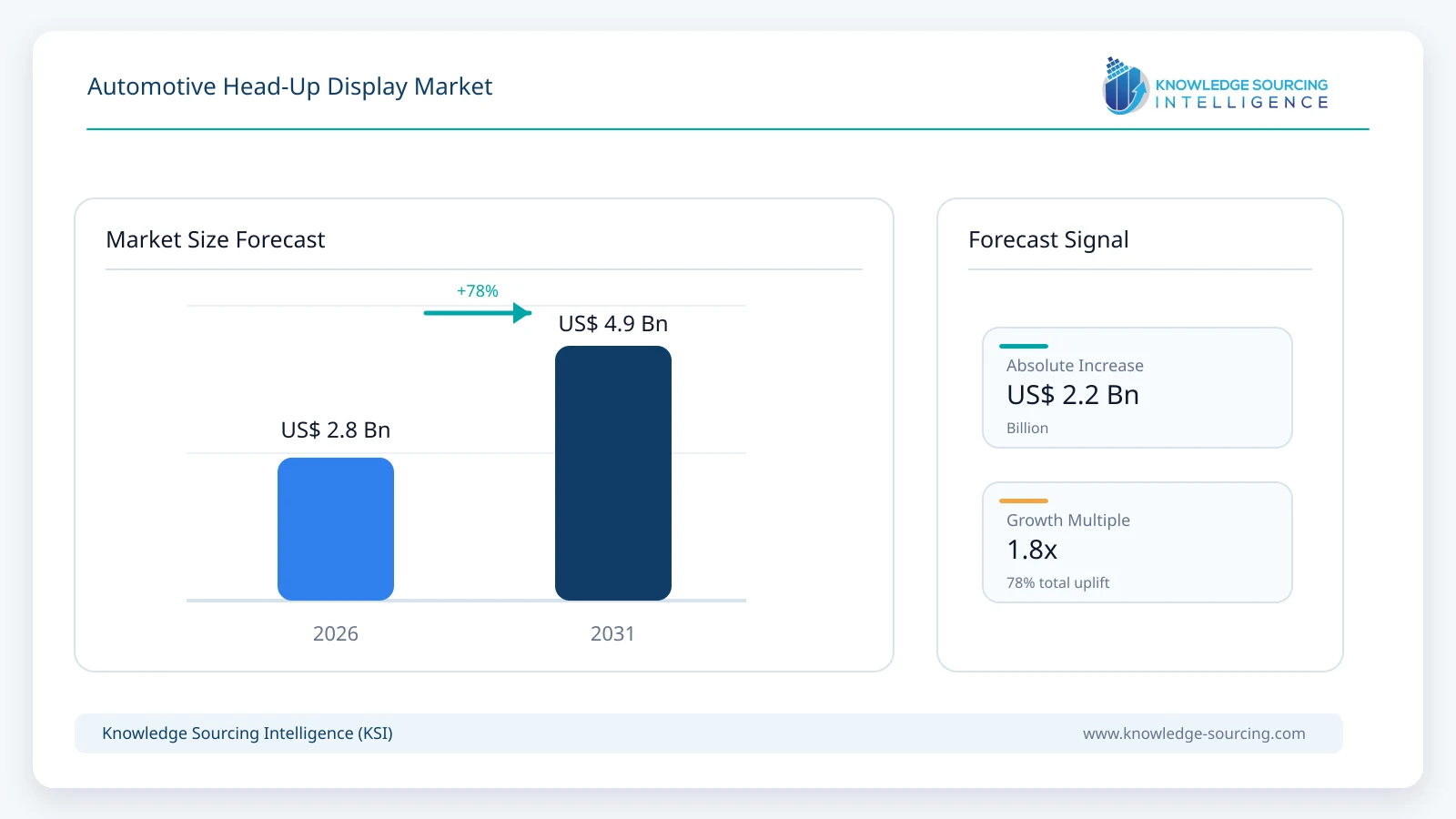
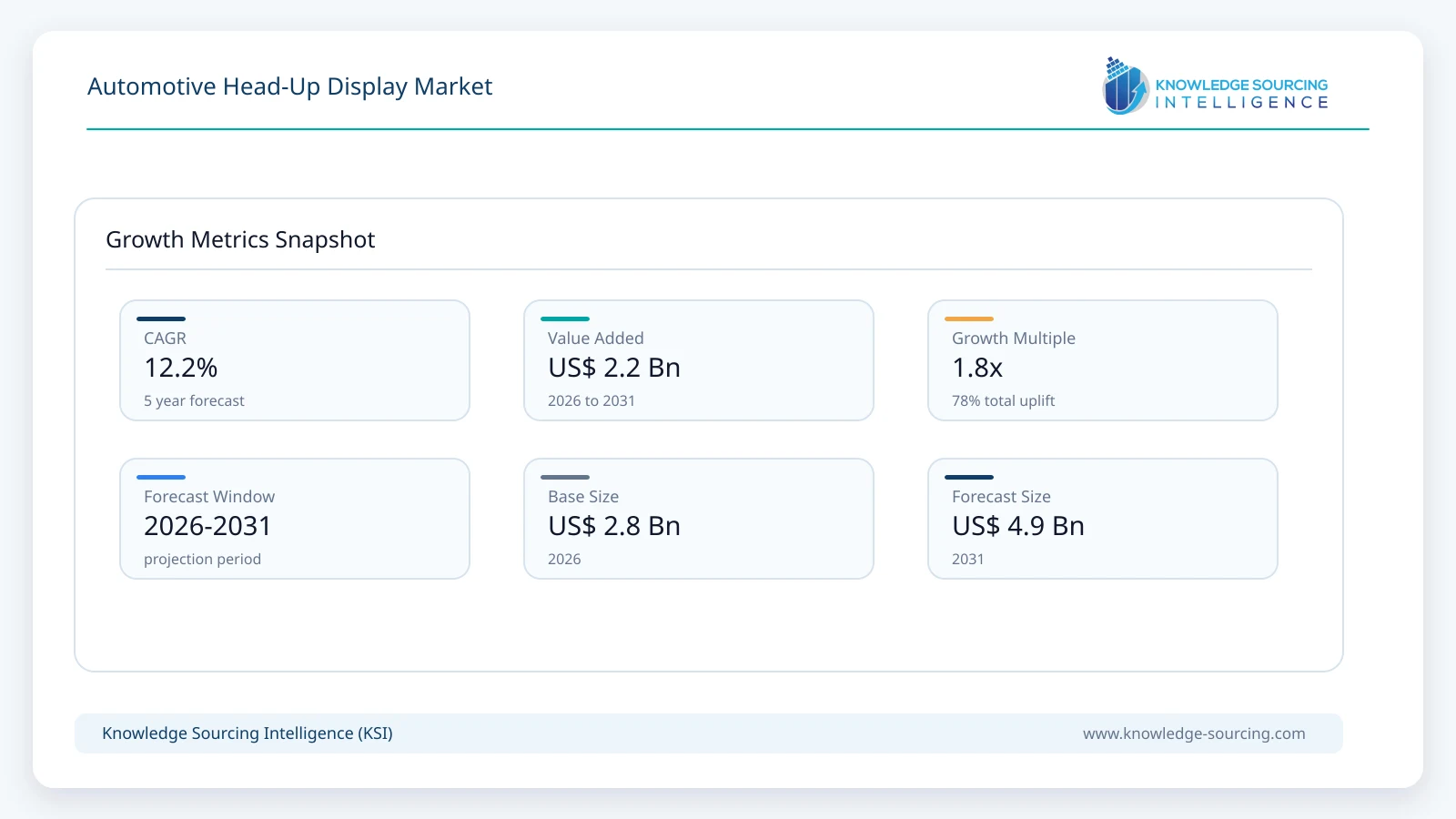
The automotive head-up display market is estimated at approximately USD 2.75 billion in 2026 and is projected to reach about USD 4.90 billion by 2031, representing a CAGR of 12.2% during the forecast period.
Highlights:
- 1Conventional windshield HUDs account for approximately 49% of global market value in 2026, while AR-HUD already represents about 42% and becomes the largest value segment well before 2031.
- 2AR-HUD value is modeled to increase from approximately USD 1.150 billion in 2026 to USD 3.050 billion in 2031, lifting its market share to about 62%.
- 3TFT-LCD remains the largest projection technology in 2026, but DLP, LCoS and holographic architectures collectively gain substantial share as field-of-view and virtual-image requirements increase.
- 4Cockpit-domain controlled HUD architectures represent approximately 35% of market value in 2026 and are modeled to reach 55% by 2031 as rendering shifts from standalone HUD electronics toward shared cockpit compute.
- 5Premium and upper-mid-range vehicles account for approximately 70% of global market value in 2026, although mid-range vehicles capture a growing share as conventional and compact HUD systems become more affordable.
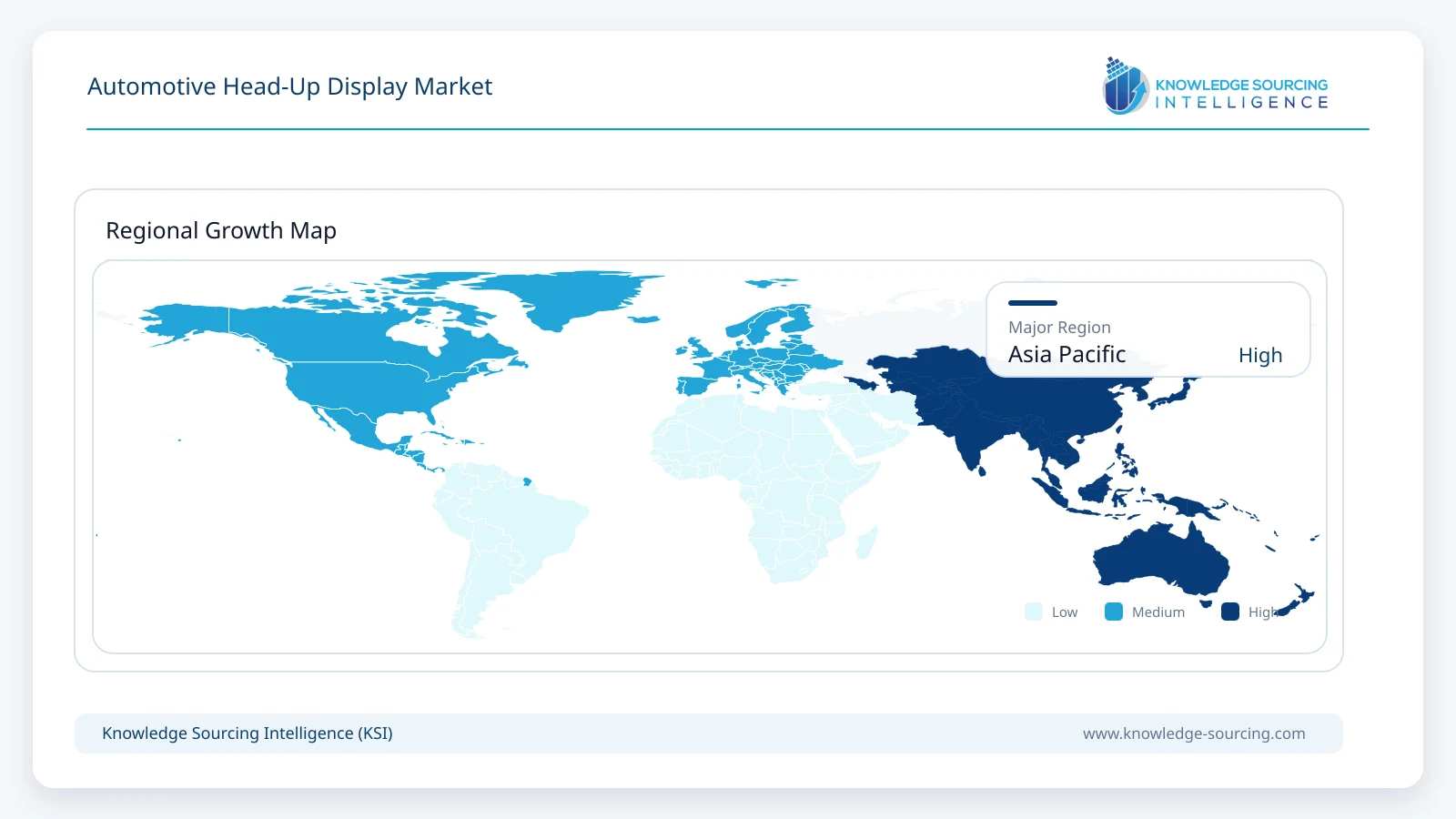
- 6Asia Pacific represents approximately 44% of global market value in 2026 and is modeled to reach 47% by 2031, supported by strong HUD adoption in China, Japan and South Korea.
The estimate is anchored to global vehicle production of 96.4 million units in 2025 and is cross-checked against AUMOVIO's industry study, which places the passenger-car and light-commercial-vehicle HUD market at approximately EUR 2.0 billion in 2024 and EUR 3.5 billion by 2029. Nippon Seiki separately expects global HUD installation rates to move beyond 10%, while continued production expansion from conventional windshield HUD into AR-HUD raises average content per equipped vehicle.
Augmented-reality and domain-integrated systems are shifting HUD value away from mature conventional projection because wider fields of view, longer virtual image distances and road-registered graphics require more advanced optics and software. The internal model preserves the previously established Automotive AR-HUD market at approximately USD 1.150 billion in 2026 and USD 3.050 billion in 2031, while conventional windshield HUD value grows only modestly as penetration gains are partly offset by pricing pressure. Huawei's dual-focal-plane LCoS AR-HUD, Envisics' production holographic system, Hyundai Mobis' holographic windshield program and AUMOVIO's mirrorless 3D HUD illustrate this transition.
Market Overview
Head-up displays move critical driving information closer to the driver's natural sight line by creating a virtual image above the dashboard or within the windshield view. Conventional systems typically present speed, navigation prompts and warnings at a fixed virtual distance, while AR-HUD places graphics farther into the road scene so lane guidance, hazards and ADAS information can align more closely with external objects.
TFT-LCD remains important because it combines established qualification with relatively low system cost, but premium development is shifting toward DLP, LCoS and holographic projection. Huawei introduced a dual-focal-plane LCoS AR-HUD in 2026, Envisics uses dynamic holography for multi-depth projection, and AUMOVIO is developing a mirrorless 3D HUD to reduce optical volume.
HUD rendering is also moving into broader cockpit compute because cluster, navigation and ADAS data can be generated by one domain controller and distributed to several displays. Panasonic's Mazda cockpit domain controller centrally manages IVI, instrument cluster and HUD, reducing standalone electronics while increasing software, networking and graphics integration.
Expanding AR and panoramic projection across a larger portion of the driver's forward view makes the windshield itself a more important optical component within the HUD system. Hyundai Mobis is working with ZEISS, tesa and Saint-Gobain Sekurit to commercialize a holographic windshield display by 2029, while Visteon and FUTURUS are developing windshield, panoramic and AR-HUD systems. Lamination, distortion control and vehicle-specific calibration therefore become larger parts of the HUD value chain.
Market Trends
AR-HUD Is Becoming the Primary Growth Engine within the HUD Market
Conventional HUD penetration continues to rise, but most incremental value shifts toward AR-HUD because wider fields of view and longer virtual image distances require higher-value optics, projectors and software. Huawei's dual-focal-plane LCoS module and Envisics' production holographic system show this move toward road-registered content. The internal model raises AR-HUD share from about 42% in 2026 to roughly 62% by 2031.
Mirrorless and Holographic Optics Are Reducing Package-Volume Constraints
Large fields of view traditionally require sizeable mirror assemblies beneath the dashboard, creating packaging conflicts with HVAC, airbags and structural components. AUMOVIO and Epitone have demonstrated a mirrorless 3D HUD, while Hyundai Mobis and Envisics pursue holographic approaches that reduce reliance on conventional optics. Lower package volume is essential to moving advanced HUD into more vehicle platforms.
Dual-Focal-Plane and Multi-Depth Projection Are Improving Information Hierarchy
HUD suppliers are separating near-field vehicle information from farther AR content so speed and status data can coexist with navigation and ADAS graphics at more natural apparent distances. Huawei's 2026 LCoS system creates separate near and far focal planes, while holographic architectures can generate several virtual depths. Multi-depth imaging improves hierarchy but increases calibration and rendering requirements.
Cockpit Domain Controllers Are Absorbing HUD Rendering and Software
HUD graphics increasingly originate from the same cockpit controller that manages cluster and infotainment displays, allowing one graphics stack to distribute synchronized information across the driver's visual environment. Panasonic's Mazda CDC already centralizes HUD, IVI and cluster control. The shift reduces duplicated electronics while increasing the importance of domain-level software and display interfaces.
Windshield-Wide Projection Is Expanding the Boundary of the HUD Category
Holographic windshield displays and panoramic forward-projection systems extend beyond the traditional driver-only HUD aperture. Hyundai Mobis plans holographic windshield-display production from 2029, while Visteon and FUTURUS are developing panoramic HUD systems. These architectures increase addressable display area but remain constrained by driver-distraction and optical-safety requirements.
Segment Analysis
By HUD Type: Conventional Windshield HUD
Conventional windshield HUDs account for approximately USD 1.350 billion in 2026 and are projected to reach about USD 1.500 billion by 2031. Penetration continues to rise across mid-range vehicles, but mature TFT-LCD architectures face pricing pressure. Share therefore falls from about 49% to 31% as AR-HUD captures most incremental value.
By HUD Type: Augmented Reality HUD
AR-HUD accounts for approximately USD 1.150 billion in 2026 and is projected to reach about USD 3.050 billion by 2031. Road-registered navigation, ADAS visualization and multi-depth imaging raise optical, compute and calibration content relative to conventional HUD. Share rises from about 42% to 62%, making AR-HUD the dominant value segment.
By Projection Technology: TFT-LCD
TFT-LCD projection accounts for approximately USD 1.400 billion in 2026 and is projected to reach about USD 1.450 billion by 2031. Mature supply, proven reliability and lower cost keep it important in conventional HUD, but share falls as DLP, LCoS and holographic architectures expand. TFT-LCD remains relevant in high-volume cost-sensitive programs.
By Projection Technology: LCoS
LCoS HUD systems account for approximately USD 0.400 billion in 2026 and are projected to reach about USD 1.300 billion by 2031. High pixel density and flexible optics support dual-focal-plane and advanced AR applications, as demonstrated by Huawei's XHUD platform. LCoS gains share as OEMs seek larger virtual images with more compact optical architectures.
By Integration Architecture: Cockpit-Domain Controlled HUD
Cockpit-domain controlled HUD systems account for approximately USD 0.963 billion in 2026 and are projected to reach about USD 2.695 billion by 2031. Share rises from 35% to 55% as rendering migrates to shared cockpit compute. The architecture improves graphics consistency across cluster, center display and HUD while reducing duplicated controller hardware.
By Vehicle Class: Premium and Upper-Mid-Range Vehicles
Premium and upper-mid-range vehicles account for approximately USD 1.925 billion in 2026 because they carry the highest penetration of large-field windshield HUD and AR-HUD. Their modeled share declines from 70% to 57% by 2031 as compact conventional HUD and lower-cost AR systems spread into mid-range vehicles. Premium programs remain the launch environment for holographic and multi-depth technologies.
Market Drivers
Rising HUD Penetration Is Expanding the Installed Base across Vehicle Classes
Nippon Seiki expects global HUD installation rates to exceed 10%, while AUMOVIO identifies increasing penetration as a principal market driver. Wider availability in upper-mid-range and mid-range vehicles expands unit demand even before accounting for higher-value AR systems. This penetration effect provides the baseline growth layer through 2031.
ADAS and Navigation Visualization Are Increasing HUD Content per Vehicle
Lane guidance, collision warnings, speed-limit information and automated-driving status are more useful when presented within the driver's forward field of view. AR-HUD can align selected graphics with the road, increasing optical, graphics and perception integration per vehicle. Higher ADAS penetration therefore raises both HUD adoption and average system value.
Advanced Optical Technologies Are Reducing Dashboard Packaging Barriers
Mirrorless projection, LCoS, holography and improved optical elements are reducing the installation volume required for large HUD images. AUMOVIO's mirrorless 3D system and Hyundai Mobis' holographic windshield program show how suppliers are attacking this constraint. Smaller packages allow advanced HUD to fit more platforms without major dashboard redesign.
Cockpit Domain Consolidation Is Lowering Electronics Duplication
Shared cockpit compute can generate graphics for cluster, center display and HUD from one controller, reducing dedicated processing hardware inside the HUD module. Panasonic's Mazda architecture demonstrates this approach in production. Lower electronics duplication helps offset the cost of higher-value optics and supports wider deployment.
Premium EV and Smart-Cockpit Competition Is Accelerating AR-HUD Adoption
Electric and software-focused vehicle brands increasingly use large virtual displays and road-registered navigation as visible cockpit differentiation. Chinese premium EV programs have accelerated advanced HUD adoption, encouraging global OEMs to respond with larger-field and AR-capable systems. This competition pushes higher-value HUD content into more launches.
Market Restraints
Windshield and Optical Calibration Requirements Increase Vehicle-Specific Engineering
The windshield forms part of the optical path, and curvature, lamination and manufacturing tolerances can create distortion or double images. Larger AR fields of view increase sensitivity to these effects. Vehicle-specific optical correction and validation therefore limit simple reuse of one HUD module across unrelated platforms.
Large Fields of View Create Packaging and Thermal Challenges
Advanced HUDs require high-brightness light sources, projectors and optical paths within a dashboard already occupied by HVAC, airbags and structural hardware. Larger virtual images increase package demand while higher luminance adds thermal load. New optical architectures reduce but do not eliminate these constraints.
AR Registration Error Can Reduce Driver Trust
Road-registered AR content must remain aligned with lanes, hazards and navigation targets while the vehicle and driver's head are moving. Localization, perception or rendering latency can cause graphics to drift from the real object. High-value AR-HUD therefore requires tighter calibration, eye-box management and software validation than conventional projection.
Conventional HUD Pricing Pressure Limits Revenue Growth
TFT-LCD windshield HUD is becoming a mature technology, and broader supplier competition lowers module pricing as penetration increases. Higher unit volumes therefore do not translate directly into equivalent revenue growth. The market increasingly relies on AR, multi-depth and advanced optical systems to raise average content per vehicle.
Driver-Distraction Rules Limit Uncontrolled Expansion of Windshield Content
More projection area does not automatically create a better HMI because excessive graphics can obscure the road or increase cognitive load. OEMs must prioritize navigation, safety and automation information while limiting nonessential content in the driver's direct view. Human-factors validation therefore constrains panoramic and windshield-wide expansion.
Regional Outlook
Asia Pacific
Asia Pacific accounts for approximately 44% of global automotive HUD market value in 2026 and is modeled to reach 47% by 2031. China combines high vehicle production with rapid adoption of AR-HUD in premium and new-energy vehicles, while Japan remains home to major HUD suppliers such as Nippon Seiki and Panasonic and South Korea contributes Hyundai Mobis. Huawei, FUTURUS and ReaVis further strengthen the regional technology base in LCoS, AR and holographic display systems.
Europe
Europe is the second major high-value HUD market because premium OEMs and strong driver-assistance adoption support large windshield HUD and AR-HUD content per vehicle. AUMOVIO is a leading HUD supplier and is developing mirrorless 3D architectures, while Envisics' UK-based holographic technology has entered Cadillac production and attracted global OEM investment. Europe's modeled share eases from 28% in 2026 to 26% by 2031 as Asia Pacific grows faster.
Competitive Landscape
Automotive HUD competition spans established Tier 1 display suppliers, specialist optical companies and newer AR or holographic developers because value is distributed across projection hardware, optics, software and windshield integration. AUMOVIO, Nippon Seiki, Panasonic Automotive Systems, Hyundai Mobis, DENSO, Visteon, Envisics, Huawei, FUTURUS, CY Vision, Marelli and ReaVis are among the most relevant participants for deeper profiling.
AUMOVIO combines large-scale conventional HUD production with AR, Scenic View and mirrorless 3D development, while Nippon Seiki remains a major specialist with extensive optical engineering. Panasonic and DENSO add long production experience in windshield HUD, and Hyundai Mobis is extending toward holographic windshield display.
Envisics differentiates through dynamic holography and has moved its second-generation AR-HUD into Cadillac production, while Huawei is commercializing dual-focal-plane LCoS technology. FUTURUS and ReaVis strengthen the Chinese AR-HUD supplier base, and Visteon's FUTURUS partnership adds global cockpit-electronics scale.
Competitive advantage increasingly depends on optical volume, field of view, brightness, virtual image distance, distortion control, domain-compute integration and automotive industrialization. Suppliers able to span conventional HUD and next-generation AR architectures are best positioned as the market shifts without abandoning high-volume cost-sensitive systems.
Competitive Company Universe
• AUMOVIO
• Nippon Seiki Co., Ltd.
• Panasonic Automotive Systems Co., Ltd.
• Hyundai Mobis
• DENSO Corporation
• Visteon Corporation
• Envisics
• Huawei
• FUTURUS
• CY Vision
• Marelli
• ReaVis
• Yazaki Corporation
• Desay SV
• Valeo
Recent Developments
29 May 2026: Nippon Seiki and ReaVis established a joint innovation laboratory in Shanghai to accelerate HUD technology development and expand applications across different vehicle types and driving scenarios.
23 April 2026: Huawei introduced a single-PGU dual-focal-plane LCoS AR-HUD, using separate near and far focal planes to improve information clarity and road alignment.
3 February 2026: Hyundai Mobis formed a four-company alliance with ZEISS, tesa and Saint-Gobain Sekurit to industrialize holographic windshield displays, targeting mass production from 2029.
January 2026: Visteon previewed next-generation HUD and projection technologies developed with FUTURUS at CES 2026, expanding its cockpit display portfolio into advanced forward visualization.
18 September 2025: Visteon and FUTURUS announced a partnership to co-develop AR-HUD, windshield HUD and panoramic HUD systems for global automakers.
25 June 2025: Envisics confirmed production deployment of its second-generation holographic AR-HUD on the 2026 Cadillac VISTIQ and LYRIQ-V, marking a major series-production milestone for holographic automotive projection.
Market Outlook
The automotive head-up display market is expected to increase from approximately USD 2.750 billion in 2026 to USD 4.900 billion by 2031. The 12.2% CAGR reflects both rising HUD penetration and a strong mix shift toward AR-HUD, which becomes the largest value segment during the forecast period. Conventional windshield HUD remains a substantial high-volume category, but most incremental revenue comes from LCoS, DLP, holographic and multi-depth systems.
Asia Pacific should retain the largest regional value pool as China accelerates AR-HUD adoption, while Europe remains a major premium engineering market. Supplier performance will increasingly depend on reducing optical package size, maintaining sunlight visibility, controlling windshield distortion and integrating HUD rendering with cockpit and ADAS compute without allowing latency or driver-distraction risk to undermine the safety benefit.
Automotive Head-Up Display Market Scope
| Report Metric | Details |
|---|---|
| Total Market Size in 2026 | USD 2.75 billion |
| Total Market Size in 2031 | USD 4.90 billion |
| Forecast Unit | Billion |
| Growth Rate | 12.2% |
| Study Period | 2021 to 2031 |
| Historical Data | 2021 to 2024 |
| Base Year | 2025 |
| Forecast Period | 2026 – 2031 |
| Segmentation | HUD Type, Projection Technology, Integration Architecture, Vehicle Class, Vehicle Type, Geography |
| Companies |
|
Market Segmentation
By HUD Type
Conventional Windshield HUD
Augmented Reality HUD
Combiner / Compact HUD
By Projection Technology
TFT-LCD
DLP
LCoS
Holographic & Other Advanced Projection
By Integration Architecture
Standalone HUD Electronics
Cockpit-Domain Controlled HUD
Cross-Domain / Centralized HUD Rendering
By Vehicle Class
Premium & Upper-Mid-Range Vehicles
Mid-Range Vehicles
Mass-Market & Economy Vehicles
By Vehicle Type
Passenger Vehicles
Light Commercial Vehicles
Medium & Heavy Commercial Vehicles
By Geography
North America
United States
Canada
Mexico
South America
Brazil
Argentina
Others
Europe
United Kingdom
Germany
France
Italy
Spain
Others
Middle East & Africa
Saudi Arabia
UAE
Israel
South Africa
Others
Asia Pacific
China
India
Japan
South Korea
Australia
Indonesia
Thailand
Taiwan
Others
Table of Contents
1. EXECUTIVE SUMMARY
2. MARKET SNAPSHOT
2.1. Market Overview
2.2. Market Definition
2.3. Scope of the Study
2.4. Market Segmentation
3. BUSINESS LANDSCAPE
3.1. Market Drivers
3.1.1. Rising HUD Penetration Is Expanding the Installed Base across Vehicle Classes
3.1.2. ADAS and Navigation Visualization Are Increasing HUD Content per Vehicle
3.1.3. Advanced Optical Technologies Are Reducing Dashboard Packaging Barriers
3.1.4. Cockpit Domain Consolidation Is Lowering Electronics Duplication
3.1.5. Premium EV and Smart-Cockpit Competition Is Accelerating AR-HUD Adoption
3.2. Market Restraints
3.2.1. Windshield and Optical Calibration Requirements Increase Vehicle-Specific Engineering
3.2.2. Large Fields of View Create Packaging and Thermal Challenges
3.2.3. AR Registration Error Can Reduce Driver Trust
3.2.4. Conventional HUD Pricing Pressure Limits Revenue Growth
3.2.5. Driver-Distraction Rules Limit Uncontrolled Expansion of Windshield Content
3.3. Market Opportunities
3.4. Porter's Five Forces Analysis
3.5. Industry Value Chain Analysis
3.6. Policies and Regulations
3.7. Strategic Recommendations
4. TECHNOLOGICAL OUTLOOK
4.1. Conventional Windshield HUD
4.2. Combiner and Compact HUD
4.3. Augmented Reality HUD
4.4. TFT-LCD Projection
4.5. DLP Projection
4.6. LCoS Projection
4.7. Dynamic Holographic Projection
4.8. Mirrorless and Compact Optical Architectures
4.9. Single-Plane, Dual-Plane and Multi-Depth Imaging
4.10. Field of View, Eye Box and Virtual Image Distance
4.11. Windshield Distortion and Optical Compensation
4.12. ADAS and Navigation Registration Software
4.13. Cockpit-Domain and Cross-Domain HUD Rendering
4.14. Holographic Windshield and Panoramic Projection
5. AUTOMOTIVE HEAD-UP DISPLAY MARKET BY HUD TYPE
5.1. Conventional Windshield HUD
5.2. Augmented Reality HUD
5.3. Combiner / Compact HUD
6. AUTOMOTIVE HEAD-UP DISPLAY MARKET BY PROJECTION TECHNOLOGY
6.1. TFT-LCD
6.2. DLP
6.3. LCoS
6.4. Holographic & Other Advanced Projection
7. AUTOMOTIVE HEAD-UP DISPLAY MARKET BY INTEGRATION ARCHITECTURE
7.1. Standalone HUD Electronics
7.2. Cockpit-Domain Controlled HUD
7.3. Cross-Domain / Centralized HUD Rendering
8. AUTOMOTIVE HEAD-UP DISPLAY MARKET BY VEHICLE CLASS
8.1. Premium & Upper-Mid-Range Vehicles
8.2. Mid-Range Vehicles
8.3. Mass-Market & Economy Vehicles
9. AUTOMOTIVE HEAD-UP DISPLAY MARKET BY VEHICLE TYPE
9.1. Passenger Vehicles
9.2. Light Commercial Vehicles
9.3. Medium & Heavy Commercial Vehicles
10. AUTOMOTIVE HEAD-UP DISPLAY MARKET BY GEOGRAPHY
10.1. North America
10.1.1. United States
10.1.2. Canada
10.1.3. Mexico
10.2. South America
10.2.1. Brazil
10.2.2. Argentina
10.2.3. Others
10.3. Europe
10.3.1. United Kingdom
10.3.2. Germany
10.3.3. France
10.3.4. Italy
10.3.5. Spain
10.3.6. Others
10.4. Middle East & Africa
10.4.1. Saudi Arabia
10.4.2. UAE
10.4.3. Israel
10.4.4. South Africa
10.4.5. Others
10.5. Asia Pacific
10.5.1. China
10.5.2. India
10.5.3. Japan
10.5.4. South Korea
10.5.5. Australia
10.5.6. Indonesia
10.5.7. Thailand
10.5.8. Taiwan
10.5.9. Others
11. COMPETITIVE ENVIRONMENT AND ANALYSIS
11.1. Major Players and Strategy Analysis
11.2. Market Share Analysis
11.3. Conventional HUD versus AR-HUD Benchmarking
11.4. TFT-LCD versus DLP versus LCoS versus Holographic Projection
11.5. Field of View, Virtual Image Distance and Optical-Volume Benchmarking
11.6. Standalone versus Cockpit-Domain HUD Architecture
11.7. Windshield and Panoramic Projection Benchmarking
11.8. Agreements, Collaborations and Platform Partnerships
11.9. Competitive Dashboard
12. COMPANY PROFILES
12.1. AUMOVIO
12.2. Nippon Seiki Co., Ltd.
12.3. Panasonic Automotive Systems Co., Ltd.
12.4. Hyundai Mobis
12.5. DENSO Corporation
12.6. Visteon Corporation
12.7. Envisics
12.8. Huawei
12.9. FUTURUS
12.10. CY Vision
12.11. Marelli
12.12. ReaVis
13. APPENDIX
13.1. Currency
13.2. Assumptions
13.3. Base and Forecast Years Timeline
13.4. Key Benefits for Stakeholders
13.5. Research Methodology
13.6. Abbreviations
13.7. Data Sources
Navigate
Trusted by the world's leading organizations











