
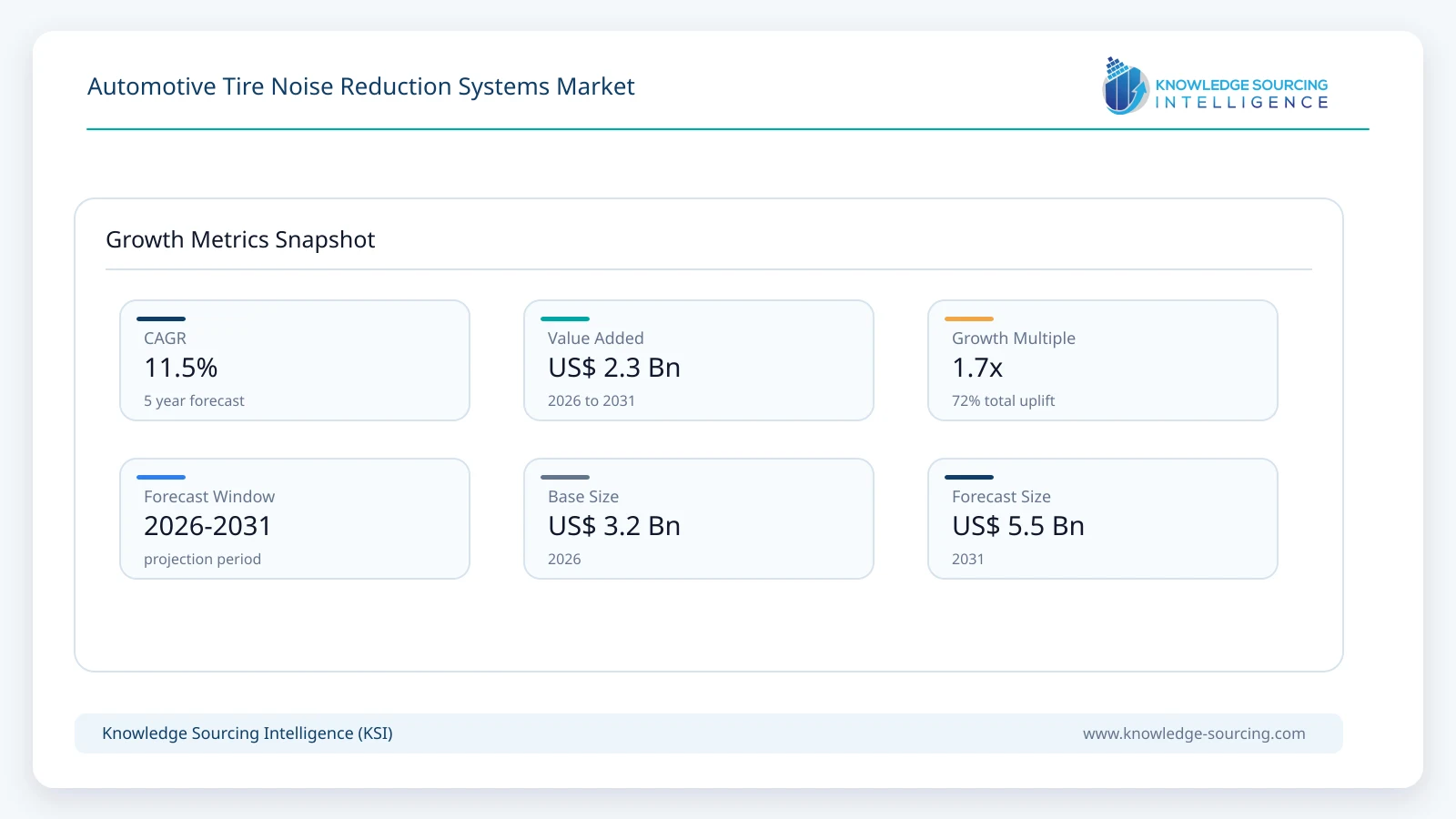
The Automotive Tire Noise Reduction Systems Market is forecast to grow at a CAGR of 11.5%, reaching USD 5.52 billion in 2031 from USD 3.20 billion in 2026.
Highlights:
- 1Acoustic foam and porous in-tire absorber systems account for approximately 60% of global market value in 2026 because they are the most established production solution for suppressing tire-cavity resonance without altering the vehicle suspension or cabin hardware.
- 2Tire-cavity resonance represents approximately 58% of the addressed noise opportunity in 2026, reflecting the strong concentration of proprietary technologies around the 170-250 Hz band where cavity noise is particularly intrusive inside passenger vehicles.
- 3Original-equipment applications represent approximately 63% of 2026 market value because premium acoustic tires are frequently co-developed with automakers for specific vehicle, wheel, and suspension combinations.
- 4Battery-electric and fuel-cell vehicles account for approximately 27% of 2026 market value and are the fastest-growing propulsion group as the absence of continuous engine masking makes tire and road noise more perceptible.
- 5Passenger vehicles represent approximately 92% of global market value in 2026, with SUVs and premium sedans providing the strongest penetration of acoustic foam, low-noise tread and large-diameter tire technologies.
- 6Asia Pacific represents approximately 44% of global market value in 2026, supported by high vehicle production, rapid EV adoption and broad deployment of quiet-tire technologies by Japanese, Korean and Chinese vehicle manufacturers.
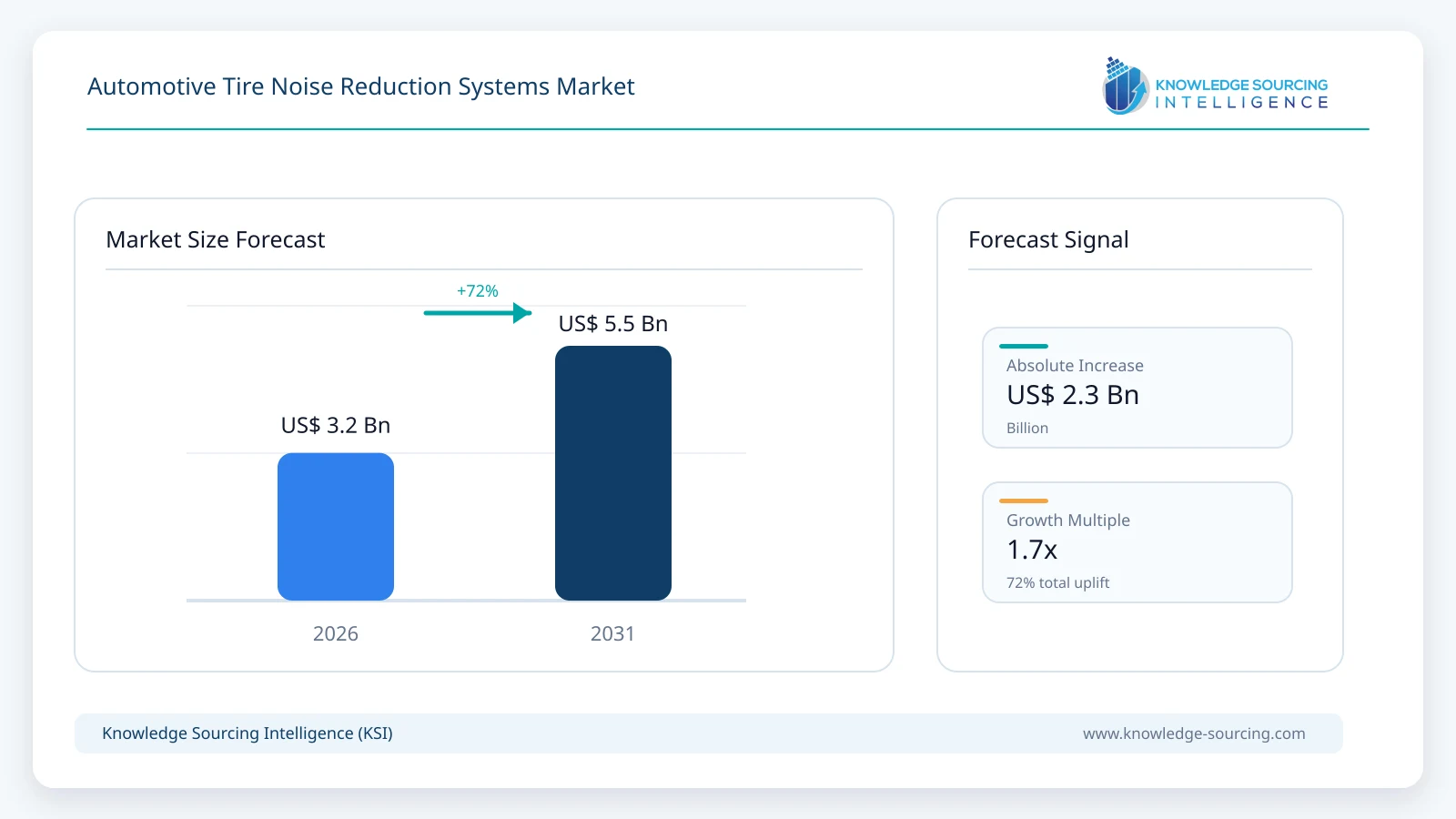
The market is moving from a niche premium-vehicle feature toward a broader tire-engineering requirement as low powertrain noise exposes cavity resonance, tread impact and road-contact sound more clearly inside the cabin.
Foam-in-tire systems remain the largest value pool. Continental ContiSilent, Pirelli PNCS, Michelin Acoustic, Goodyear SoundComfort and Hankook i Sound Absorber use porous material bonded inside the tire to attenuate cavity resonance, while Toyo and other manufacturers have developed internal devices and tread technologies that target the same acoustic problem through different mechanisms.
The scope includes only the incremental tire or wheel-system value attributable to acoustic mitigation. Conventional tire value, active cabin road-noise cancellation, acoustic wheelhouse liners, suspension isolation, interior sound packages and general premium-audio systems are excluded. Low-noise tread architecture is included only where it is deliberately engineered and commercialized as part of a tire-noise-reduction proposition.
Market Overview
Tire-generated noise reaches occupants through several paths. Air trapped inside the tire can resonate when the tread is excited by the road, tread blocks create airborne patterns and air-pumping noise, and impact forces travel through the wheel, suspension and body as structure-borne vibration. Tire noise reduction systems attack these sources before they require heavier cabin-side treatment.
The dominant production architecture uses an open-cell polyurethane or similar porous absorber bonded to the inner liner beneath the tread. The absorber dissipates acoustic energy inside the tire cavity and reduces the pressure oscillation transmitted through the wheel hub. Alternative approaches use internal resonators, perforated structures, optimized pitch sequences and tread-block geometry to reduce excitation at the source.
The market is increasingly integrated with EV tire development. Higher vehicle mass, instant torque and large wheel packages can intensify tire-related noise while OEMs simultaneously demand low rolling resistance, wet grip and long wear. Acoustic engineering is therefore becoming part of the complete tire-performance balance rather than an isolated comfort feature.
Market Trends
Foam-in-Tire Technology Is Moving Beyond Flagship Luxury Applications
In-tire acoustic absorbers are now available across a wider mix of performance, touring, SUV and EV-specific tires. Manufacturers are extending the technology across more rim diameters and OE fitments instead of limiting it to a small number of luxury sedans.
The commercial effect is a larger addressable replacement market. Once vehicles leave the factory with acoustic tires, owners increasingly expect equivalent noise performance at replacement, supporting demand outside the initial OEM contract.
EV Tire Platforms Are Combining Several Noise-Control Mechanisms
New EV tires increasingly combine cavity absorbers with variable-pitch tread blocks, optimized groove entry, stiffer load-bearing structures and low-rolling-resistance compounds. The objective is to reduce several noise mechanisms without sacrificing range, wet braking or wear.
Hankook, Pirelli and Continental all position quietness as one element of a broader EV tire package, showing that acoustic performance is becoming a system-level design variable rather than a stand-alone foam insert.
Larger Wheel Diameters Are Increasing the Value of Acoustic Engineering
The shift toward 19- to 23-inch wheels on electric SUVs and premium vehicles increases exposure to low-profile tires, stiff sidewalls and broad tread footprints. These configurations can transmit more impact and pattern noise into the cabin, particularly on coarse road surfaces.
Acoustic absorbers and low-noise tread designs therefore carry more value on larger sizes. Tire manufacturers are expanding quiet-tire technology precisely where wheel growth and premium vehicle mix create both a technical need and a willingness to pay.
Internal and External Tire Noise Are Being Optimized Together
Cabin noise and pass-by rolling noise are related but not identical engineering problems. Internal foam mainly targets cavity resonance, while tread and block-sequence design has a stronger influence on external rolling sound and airborne pattern noise.
Regulatory and labeling pressure is encouraging manufacturers to address both. UN Regulation No. 117 and the European tire label keep rolling sound visible, while EV customers simultaneously expect lower cabin noise, pushing acoustic optimization across the complete tire structure.
Non-Foam Resonators and Alternative Absorber Structures Are Expanding the Design Space
Foam remains dominant, but it introduces bonding, service, and recycling considerations. Toyo Silent Technology demonstrates an alternative path using perforated-film and cylindrical-foam structures that exploit airflow inside the tire cavity rather than relying only on a continuous foam ring.
Future systems are likely to use lighter absorbers, tuned resonators, and more recyclable constructions. The key challenge will be maintaining acoustic effectiveness across temperature, speed, and tire wear without adding meaningful rotating mass.
Segment Analysis
By Technology: Acoustic Foam and Porous Absorber Systems
Acoustic foam and porous absorber systems lead the market because they can be added to a conventional tire architecture with limited effect on braking, handling or rolling resistance. Open-cell polyurethane is commonly bonded to the inner liner under the tread where it directly attenuates cavity resonance.
This technology represents approximately USD 1.92 billion in 2026 and could reach about USD 3.53 billion by 2031. Penetration is expected to rise as acoustic tires move from luxury OE programs into EV replacement ranges and higher-volume crossover platforms.
By Noise Target: Tire-Cavity Resonance
Tire-cavity resonance is the largest noise target because the enclosed air volume creates a strong, narrow-frequency pressure mode that readily couples through the wheel and suspension into the cabin. The effect is especially noticeable when engine masking is low.
Cavity-resonance solutions account for approximately USD 1.86 billion in 2026 and are expected to exceed USD 3.36 billion by 2031. Foam absorbers remain the primary solution, while tuned internal devices offer additional paths for specific tire geometries.
By Sales Channel: Original Equipment
Original equipment leads because acoustic performance is most effective when the tire is developed around a specific vehicle, wheel, suspension, and cabin target. Premium and electric vehicles frequently receive marked or homologated tires that incorporate acoustic technologies selected during vehicle development.
OEM demand is estimated at approximately USD 2.02 billion in 2026 and could reach about USD 3.25 billion by 2031. Replacement tires will grow faster as installed acoustic-tire fleets age and consumers seek to preserve factory-level comfort.
By Propulsion: Internal-Combustion Engine Vehicles
Internal-combustion vehicles remain the largest propulsion segment in 2026 because the installed and production base is still much larger than the electrified fleet. Premium ICE sedans and SUVs also continue to use acoustic tires to meet high cabin-refinement targets.
ICE applications account for approximately USD 1.70 billion in 2026 but are expected to lose substantial share through 2031. Battery-electric applications grow much faster as quiet drivetrains expose tire-generated sound and EV-specific tires spread across mainstream platforms.
By Vehicle Type: Passenger Vehicles
Passenger vehicles dominate the market because cabin-noise expectations, large-wheel adoption and acoustic-tire availability are far higher in cars, SUVs and MPVs than in commercial fleets. Premium SUVs are particularly important because they combine heavy loads, broad tires and high comfort expectations.
Passenger vehicles represent approximately USD 2.94 billion in 2026 and could approach USD 4.96 billion by 2031. Commercial applications will grow from a smaller base as urban vans and electric buses place greater emphasis on low rolling noise and occupant comfort.
Market Drivers
Electrification Is Making Tire-Generated Noise More Perceptible
Electric motors remove much of the continuous combustion noise that previously masked road and tire sound. At urban and moderate speeds, occupants therefore hear cavity resonance, tread impacts and coarse-surface noise more clearly.
This creates a direct comfort case for source-level tire treatment. Acoustic tires can reduce a major noise input without adding cabin mass or consuming electrical power, making them attractive for range-sensitive electric vehicles.
Large Wheels and High-Load EV Tires Increase Acoustic Challenges
Electric SUVs and premium vehicles increasingly use large-diameter wheels, wide contact patches and reinforced high-load tires. These configurations support vehicle mass and handling but can make road impacts and pattern noise harder to isolate.
Noise-reduction systems allow tire manufacturers to offset some of these penalties. The value proposition strengthens as 19-inch and larger fitments become more common across high-volume electric and premium platforms.
Premium Cabin Comfort Is Becoming a Stronger Vehicle Differentiator
Interior refinement increasingly influences perceived vehicle quality, particularly as powertrains become smoother and software features converge. A quieter tire can improve speech intelligibility, audio performance and long-distance comfort without visible cabin hardware.
Automakers therefore use acoustic tires as part of a wider NVH package. OE-specific marked tires also help preserve the intended acoustic character of premium vehicles through tightly controlled tire construction and tuning.
Rolling-Noise Regulation and Labeling Keep Acoustic Performance Visible
UN Regulation No. 117 governs tire rolling sound alongside rolling resistance and wet grip, while the European tire label displays an external rolling-noise class and decibel value. These frameworks make tire noise a measurable market attribute rather than only a subjective comfort claim.
Although internal and external noise are not identical, regulatory pressure reinforces investment in quieter tread patterns and contact mechanics. Technologies that improve cabin comfort while also lowering pass-by noise gain a stronger commercial advantage.
Broader OE Co-Development Is Scaling Proprietary Quiet-Tire Technologies
Major tire suppliers increasingly develop acoustic tires directly with vehicle manufacturers. Continental, Pirelli, Michelin, Goodyear and Hankook all support OEM-specific products in which noise reduction is integrated with load capacity, efficiency, wet grip and durability.
Platform co-development lowers adoption risk because the tire can be tuned alongside the vehicle suspension and body. Once a technology is validated on one architecture, it can often be extended across related wheel sizes and replacement products.
Market Restraints
Acoustic Improvements Must Not Compromise Wet Grip, Wear or Efficiency
Tire design is a multi-objective optimization problem. Softer tread, more compliant structures or aggressive noise-focused block shaping can affect rolling resistance, steering response, wear and wet braking if not carefully balanced.
This limits how far noise can be reduced through tread design alone and increases development cost. Premium acoustic systems must demonstrate that quietness does not come at the expense of safety or driving range.
Foam Bonding, Repair and Sealant Compatibility Add Service Complexity
Internal foam must remain attached under heat, centrifugal force and repeated deformation for the life of the tire. Poor bonding can create imbalance or noise, while puncture repair may require technicians to cut or reposition the absorber around the repair area.
Combining foam with self-sealing compounds, TPMS hardware or sensorized tires adds further integration work. These issues increase manufacturing discipline and aftermarket training requirements.
Vehicle- and Size-Specific Acoustic Tuning Limits Standardization
Cavity resonance frequency, transfer paths and perceived noise vary with tire size, wheel design, suspension and cabin structure. A foam thickness or tread pattern optimized for one fitment may not deliver the same result on another vehicle.
Suppliers therefore manage a large number of acoustic variants and homologations. This raises development and inventory complexity compared with using one common technology specification across an entire tire family.
Price Premium Limits Penetration in Cost-Sensitive Segments
The benefit of an acoustic tire is strongest in vehicles with otherwise low cabin noise. In entry vehicles with high wind, powertrain or body noise, consumers may perceive less value from paying extra for a tire-cavity absorber.
This slows penetration in price-sensitive replacement markets. Manufacturers must reduce material and processing cost before foam or resonator systems can become standard across the broadest tire categories.
End-of-Life Circularity Is More Difficult with Added Internal Materials
Bonded foam, adhesives and multi-material inserts complicate tire recycling and material recovery. The problem becomes more important as OEMs and regulators place greater emphasis on circularity and recycled content.
Future systems will need to reduce adhesive use, simplify separation or use materials compatible with established recycling pathways. Acoustic performance alone will not be sufficient if the added system creates a significant end-of-life penalty.
Regional Outlook
Asia Pacific
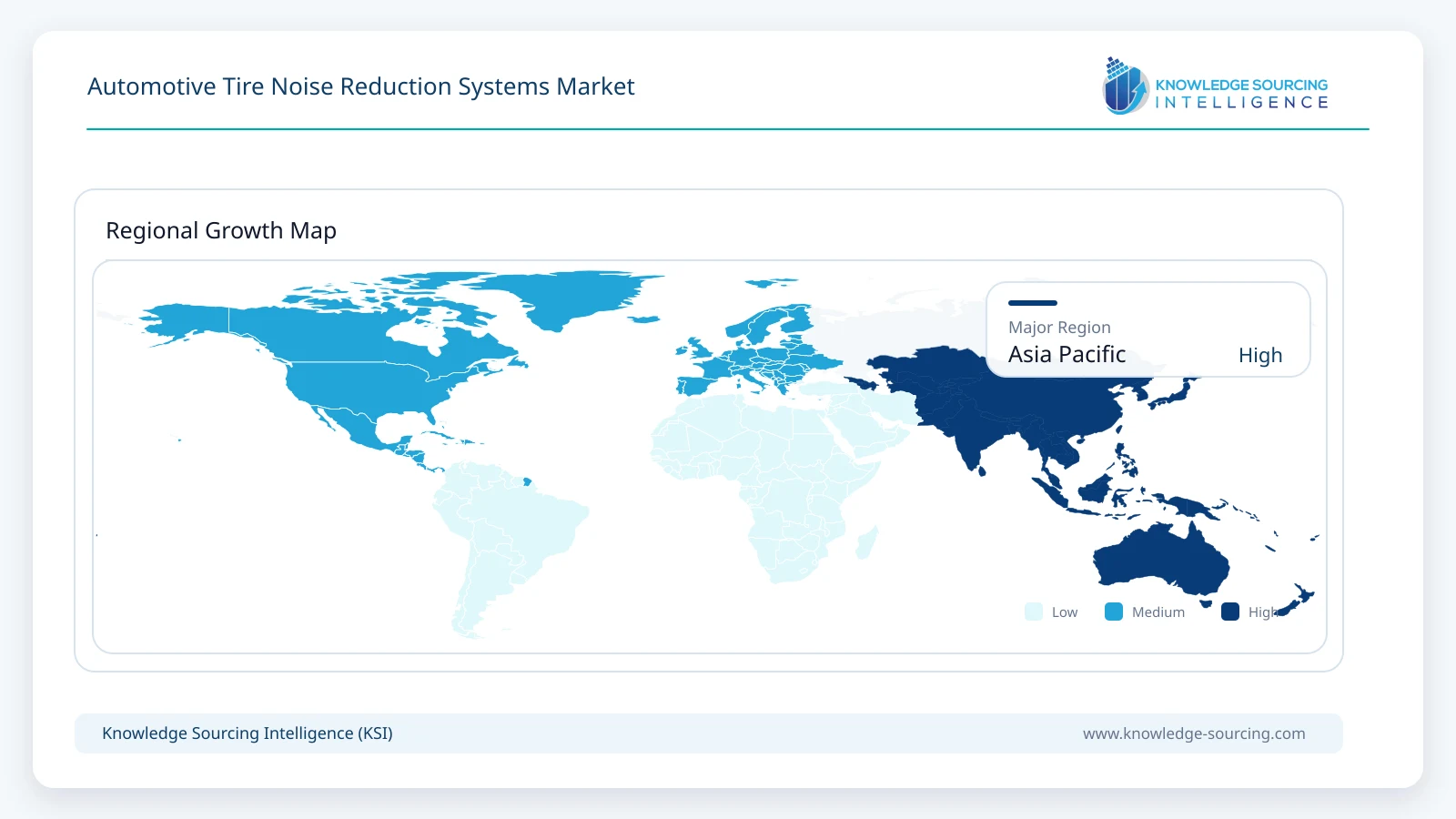
Asia Pacific is the largest regional market, supported by high vehicle and tire production in China, Japan, South Korea and India. Rapid EV penetration in China and South Korea is increasing demand for quiet tires because large electric SUVs and sedans expose tire-generated noise more clearly than comparable combustion vehicles.
Regional innovation is broad. Hankook continues to expand i Sound Absorber across its iON EV range, Toyo has developed a dedicated internal cavity-noise device, and Japanese automakers have long used low-noise tire specifications as part of vehicle NVH tuning. Local EV brands are also raising cabin-comfort expectations at lower price points.
Growth through 2031 will be supported by larger wheel sizes and the migration of premium acoustic features into mainstream EVs. Suppliers with strong local OE engineering and replacement distribution will be best positioned to capture the expanding installed base.
Europe
Europe is a high-value market because premium vehicles, EV penetration and formal tire labeling all place strong emphasis on acoustic performance. Continental ContiSilent, Pirelli PNCS and Michelin Acoustic are widely positioned for European OE and replacement applications.
The regulatory environment also keeps rolling sound visible through UN R117 type approval and the EU tire label. This encourages investment in tread architectures that reduce external noise while in-tire absorbers address cabin cavity resonance.
European growth will be driven more by technology penetration than vehicle volume. The strongest opportunities are in premium EVs, electric SUVs and replacement tires that preserve the low-noise character of factory-equipped vehicles.
Competitive Landscape
The market is led by global tire manufacturers with proprietary acoustic technologies and direct OEM development relationships. Continental, Pirelli, Michelin, Goodyear and Hankook have established foam-based systems, while Toyo differentiates through a dedicated cavity-noise reduction device and Sumitomo Rubber has developed noise-control technologies across its tire portfolio.
Competition is moving beyond a simple foam insert. Suppliers increasingly combine internal absorbers with low-noise tread sequences, EV-specific load structures, low rolling resistance and puncture-management technologies. Pirelli, for example, offers PNCS alongside ELECT, Seal Inside and RunForward on selected products, illustrating the shift toward multifunctional premium tire platforms.
Competitive advantage will depend on acoustic reduction per unit of mass and cost, durability of the internal system, ease of repair, vehicle-specific tuning and the ability to scale technology across many sizes. Strong OE relationships remain important because acoustic tire performance is closely linked to the complete vehicle NVH package.
Recent Developments
26 August 2026: Pirelli expanded current P ZERO E listings across 18- to 23-inch fitments, with selected OE-specific sizes combining ELECT and PNCS technologies and acoustic-focused tread features for premium and electrified vehicles.
16 June 2026: Continental announced worldwide original-equipment supply of the 18-inch EcoContact 7 for the all-electric Renault Twingo, highlighting Silent Pattern tread design and top-tier rolling-noise performance on the EU label.
10 March 2026: Continental announced EcoContact 7 original-equipment approvals for the electric smart #5 in 20- and 21-inch sizes, positioning low rolling noise as a core requirement alongside efficiency and high-load capability.
27 February 2026: Hankook expanded the iON ST AS EV tire range in China by 17 sizes; all 18- to 21-inch additions use the company's i Sound Absorber low-noise technology.
29 January 2026: Continental detailed its current rolling-noise strategy, combining low-noise tread development with ContiSilent polyurethane foam, which is designed to reduce cabin rolling noise by up to nine decibels.
22 October 2025: Goodyear launched the Wrangler ElectricDrive AT for electric SUVs and pickups in North America with SoundComfort technology, extending foam-based acoustic treatment into the all-terrain EV category.
Market Outlook
The automotive tire noise reduction systems market is gaining traction as automakers prioritize quieter cabins and improved acoustic comfort. Acoustic foam remains a key technology category, while low-noise tread engineering and alternative cavity-resonance devices are gaining importance as manufacturers address a wider range of sound frequencies, tire designs, and vehicle classes.
Battery-electric vehicles will provide the strongest growth, but replacement demand will become increasingly important as the first large installed base of factory-equipped acoustic tires reaches replacement cycles. This will shift part of the market from tightly controlled OE programs toward branded consumer tire propositions.
Asia Pacific is expected to remain the largest regional market, while Europe retains a high-value position through premium vehicles and rolling-noise regulation. Supplier success will depend on combining quietness with wet grip, efficiency, wear, repairability and recyclability rather than optimizing noise in isolation.
Automotive Rear Seat Entertainment Market Scope:
| Report Metric | Details |
|---|---|
| Total Market Size in 2026 | USD 3.20 billion |
| Total Market Size in 2031 | USD 5.52 billion |
| Forecast Unit | USD Billion |
| Growth Rate | 11.5% |
| Study Period | 2021 to 2031 |
| Historical Data | 2021 to 2024 |
| Base Year | 2025 |
| Forecast Period | 2026 – 2031 |
| Segmentation | Technology, Noise Target, Sales Channel, Propulsion |
| Companies |
|
Market Segmentation
By Technology
Acoustic Foam and Porous Absorber Systems
Tread-Pattern and Pitch-Control Systems
Cavity Resonator and Internal Damper Systems
By Noise Target
Tire-Cavity Resonance
Tread and Air-Pumping Noise
Impact and Structure-Borne Tire Noise
By Sales Channel
Original Equipment
Replacement and Aftermarket
By Propulsion
Internal-Combustion Engine Vehicles
Hybrid and Plug-In Hybrid Vehicles
Battery Electric and Fuel-Cell Electric Vehicles
By Vehicle Type
Passenger Vehicles
Light Commercial Vehicles
Medium and Heavy Commercial Vehicles and Buses
By Geography
North America
United States
Canada
Mexico
South America
Brazil
Argentina
Others
Europe
Germany
United Kingdom
France
Italy
Spain
Others
Middle East and Africa
Saudi Arabia
UAE
South Africa
Others
Asia Pacific
China
Japan
South Korea
India
Indonesia
Thailand
Others
Table of Contents
1. INTRODUCTION
1.1. Market Overview
1.2. Market Definition
1.3. Scope of the Study
1.4. Market Segmentation
1.5. Currency
1.6. Assumptions
1.7. Base and Forecast Years
1.8. Key Benefits to Stakeholders
2. RESEARCH METHODOLOGY
2.1. Research Design
2.2. Secondary Research
2.3. Primary Research
2.4. Market Estimation
2.5. Segment Modelling
2.6. Data Triangulation and Validation
3. EXECUTIVE SUMMARY
3.1. Key Findings
3.2. Automotive Tire Noise Reduction Systems Market Size, 2026-2031
3.3. Technology Outlook
3.4. Noise Target Outlook
3.5. Sales Channel Outlook
3.6. Propulsion Outlook
3.7. Vehicle Type Outlook
3.8. Regional Opportunity Summary
4. MARKET DYNAMICS
4.1. Market Drivers
4.1.1. Electrification Is Making Tire-Generated Noise More Perceptible
4.1.2. Large Wheels and High-Load EV Tires Increase Acoustic Challenges
4.1.3. Premium Cabin Comfort Is Becoming a Stronger Vehicle Differentiator
4.1.4. Rolling-Noise Regulation and Labeling Keep Acoustic Performance Visible
4.1.5. Broader OE Co-Development Is Scaling Proprietary Quiet-Tire Technologies
4.2. Market Restraints
4.2.1. Acoustic Improvements Must Not Compromise Wet Grip, Wear or Efficiency
4.2.2. Foam Bonding, Repair and Sealant Compatibility Add Service Complexity
4.2.3. Vehicle- and Size-Specific Acoustic Tuning Limits Standardization
4.2.4. Price Premium Limits Penetration in Cost-Sensitive Segments
4.2.5. End-of-Life Circularity Is More Difficult with Added Internal Materials
4.3. Market Opportunities
4.4. Porter's Five Forces Analysis
4.5. Industry Value Chain Analysis
4.6. Tire Acoustic Technology Cost and Performance Trade-Offs
4.7. UN R117, EU Tire Label and Rolling-Noise Requirements
5. TECHNOLOGY OUTLOOK
5.1. Open-Cell Polyurethane Foam Absorbers
5.2. Alternative Porous and Lightweight Absorber Materials
5.3. Internal Cavity Resonators and Damper Devices
5.4. Perforated-Film and Airflow-Based Cavity Control
5.5. Variable-Pitch and Low-Noise Tread Sequencing
5.6. Groove, Sipe and Block-Entry Noise Optimization
5.7. Tire-Cavity Resonance Modelling and Simulation
5.8. EV High-Load Tire Acoustic Engineering
5.9. Acoustic Foam with Self-Sealing Tire Systems
5.10. Acoustic Tires with Run-Flat and Run-Forward Architectures
5.11. Tire-Wheel System Acoustic Co-Optimization
5.12. Recyclable and Low-Mass Noise-Reduction Materials
6. AUTOMOTIVE TIRE NOISE REDUCTION SYSTEMS MARKET BY TECHNOLOGY
6.1. Introduction
6.2. Acoustic Foam and Porous Absorber Systems
6.3. Tread-Pattern and Pitch-Control Systems
6.4. Cavity Resonator and Internal Damper Systems
7. AUTOMOTIVE TIRE NOISE REDUCTION SYSTEMS MARKET BY NOISE TARGET
7.1. Introduction
7.2. Tire-Cavity Resonance
7.3. Tread and Air-Pumping Noise
7.4. Impact and Structure-Borne Tire Noise
8. AUTOMOTIVE TIRE NOISE REDUCTION SYSTEMS MARKET BY SALES CHANNEL
8.1. Introduction
8.2. Original Equipment
8.3. Replacement and Aftermarket
9. AUTOMOTIVE TIRE NOISE REDUCTION SYSTEMS MARKET BY PROPULSION
9.1. Introduction
9.2. Internal-Combustion Engine Vehicles
9.3. Hybrid and Plug-In Hybrid Vehicles
9.4. Battery Electric and Fuel-Cell Electric Vehicles
10. AUTOMOTIVE TIRE NOISE REDUCTION SYSTEMS MARKET BY VEHICLE TYPE
10.1. Introduction
10.2. Passenger Vehicles
10.3. Light Commercial Vehicles
10.4. Medium and Heavy Commercial Vehicles and Buses
11. AUTOMOTIVE TIRE NOISE REDUCTION SYSTEMS MARKET BY GEOGRAPHY
11.1. North America
11.1.1. United States
11.1.2. Canada
11.1.3. Mexico
11.2. South America
11.2.1. Brazil
11.2.2. Argentina
11.2.3. Others
11.3. Europe
11.3.1. Germany
11.3.2. United Kingdom
11.3.3. France
11.3.4. Italy
11.3.5. Spain
11.3.6. Others
11.4. Middle East and Africa
11.4.1. Saudi Arabia
11.4.2. UAE
11.4.3. South Africa
11.4.4. Others
11.5. Asia Pacific
11.5.1. China
11.5.2. Japan
11.5.3. South Korea
11.5.4. India
11.5.5. Indonesia
11.5.6. Thailand
11.5.7. Others
12. COMPETITIVE ENVIRONMENT AND ANALYSIS
12.1. Major Players and Strategy Analysis
12.2. Market Share Analysis
12.3. Foam-Based Acoustic Technology Benchmarking
12.4. Tread and Pitch Noise-Reduction Benchmarking
12.5. Cavity Resonator and Alternative Device Benchmarking
12.6. OEM versus Replacement Acoustic Tire Positioning
12.7. EV Tire Noise-Reduction and High-Load Capability Benchmarking
12.8. Repairability, Durability and Circularity Benchmarking
12.9. Competitive Dashboard
13. COMPANY PROFILES
13.1. Continental AG
13.2. Pirelli & C. S.p.A.
13.3. Michelin Group
13.4. The Goodyear Tire & Rubber Company
13.5. Hankook Tire & Technology Co., Ltd.
13.6. Toyo Tire Corporation
13.7. Sumitomo Rubber Industries, Ltd.
13.8. Bridgestone Corporation
13.9. Yokohama Rubber Co., Ltd.
14. APPENDIX
14.1. Currency
14.2. Assumptions
14.3. Base and Forecast Years Timeline
14.4. Key Benefits for Stakeholders
14.5. Research Methodology
14.6. Abbreviations
14.7. Data Sources
Navigate
Trusted by the world's leading organizations











