
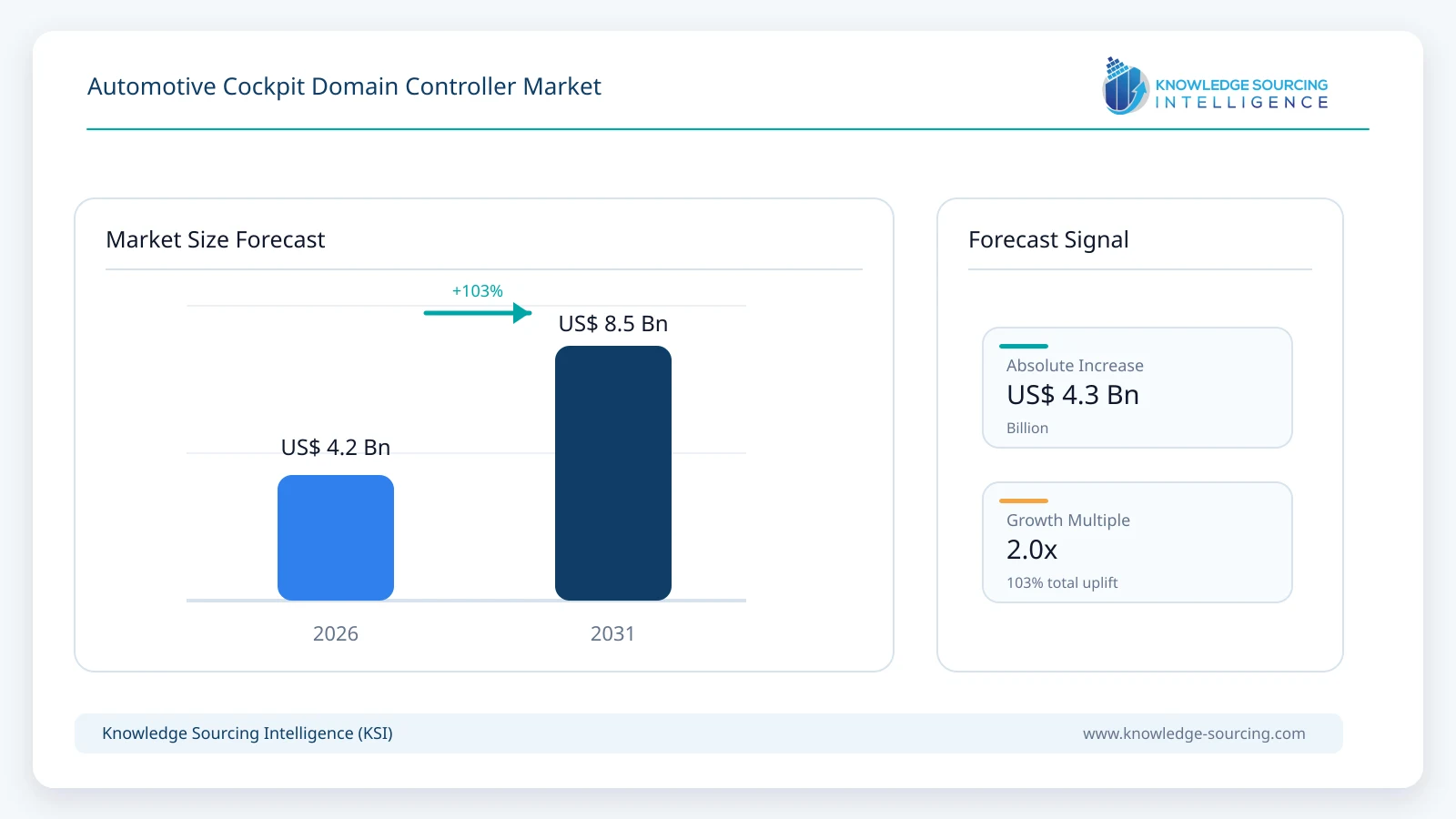
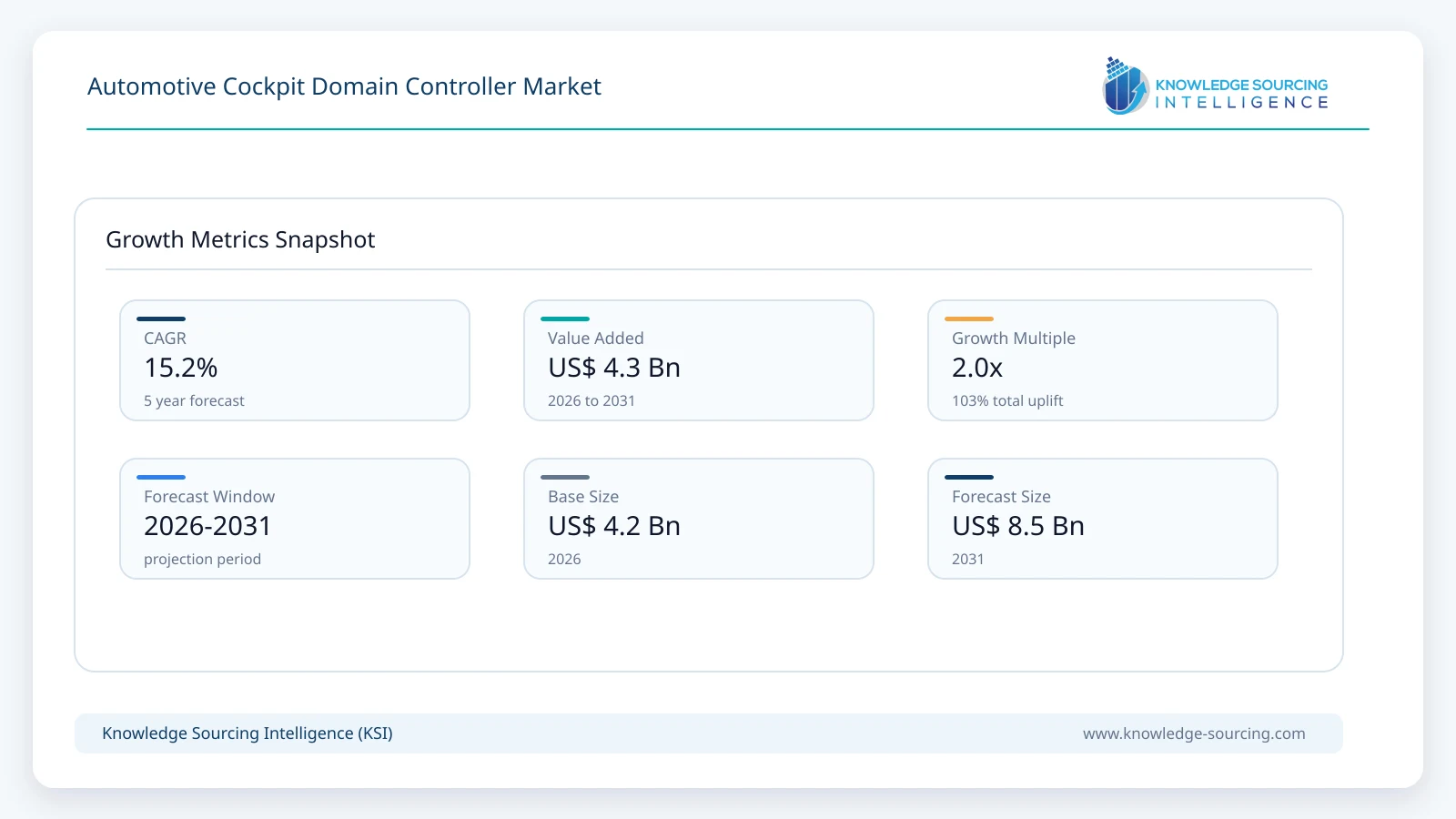
The automotive cockpit domain controller market is estimated at approximately USD 4.200 billion in 2026 and is projected to reach about USD 8.521 billion by 2031, representing a CAGR of 15.2% throughout the forecast period.
Highlights:
- 1Dedicated cockpit domain controllers and cockpit-focused HPCs account for approximately 74% of global market value in 2026 because most OEMs still prefer a clearly bounded cockpit compute domain even as broader central-compute architectures expand.
- 2Controller hardware, including SoC, memory, storage, networking, power and thermal hardware, represents approximately 76% of 2026 market value, while virtualization and base-software content are gaining share as OEMs decouple applications from hardware.
- 3Integrated cluster, infotainment and multi-display control accounts for approximately 49% of 2026 market value because these functions remain the core workload set consolidated by cockpit domain controllers.
- 4Single-SoC cockpit-domain architectures represent approximately 65% of market value in 2026 due to lower board complexity, power and cost compared with multi-processor designs, although modular and multi-SoC configurations are gaining share at the premium end.
- 5Passenger vehicles account for approximately 94% of global market value in 2026 because digital-cockpit adoption and large production volumes are concentrated in passenger cars, SUVs and MPVs.
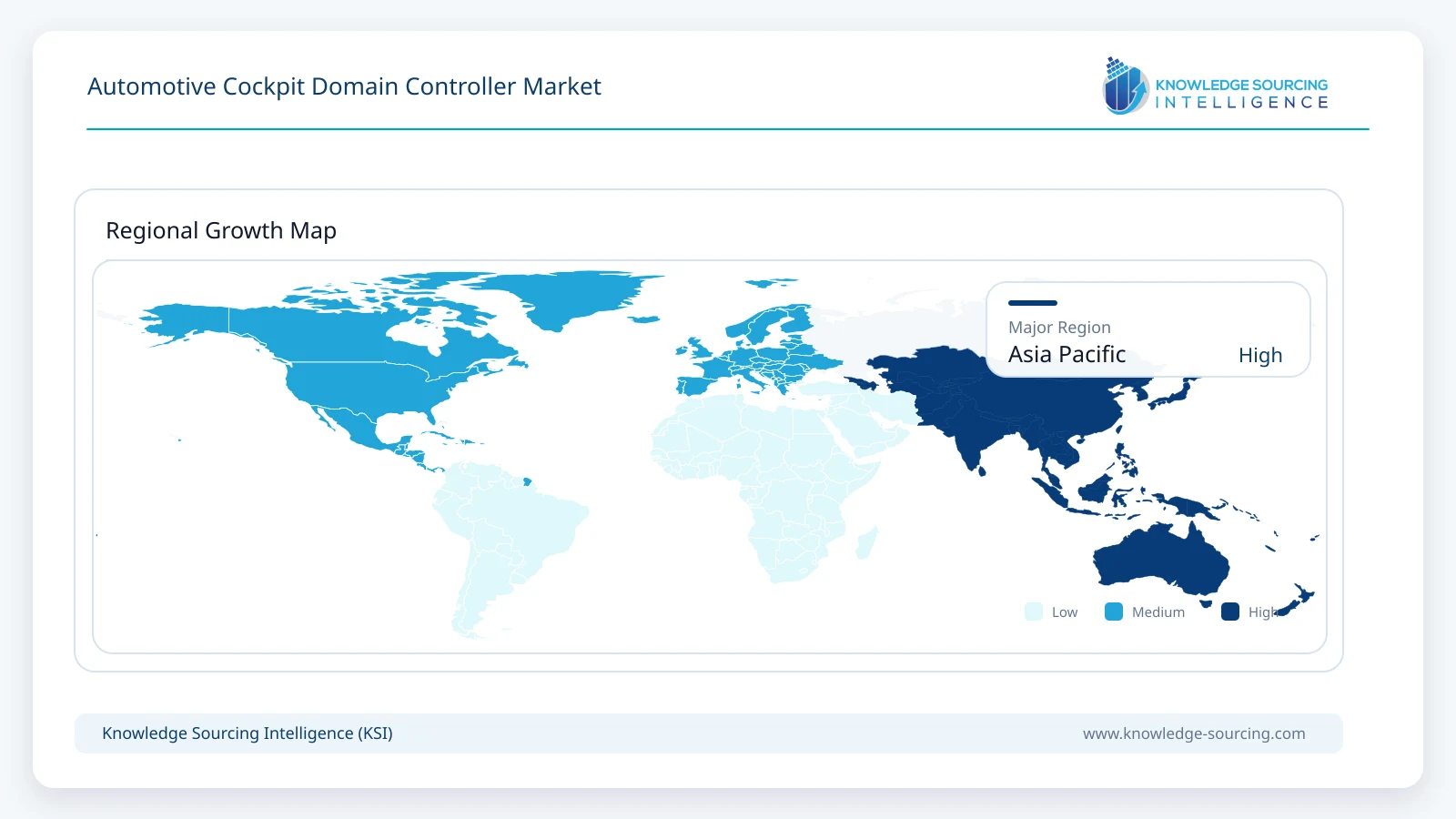
- 6Asia Pacific represents approximately 47% of global market value in 2026, supported by rapid smart-cockpit deployment in China, high vehicle production and strong electronics and cockpit-controller ecosystems across China, Japan, South Korea and India.
Cockpit domain controllers create one centralized execution environment for digital cluster, infotainment, head-up display, audio, connectivity and related HMI workloads that were historically distributed across separate ECUs. Consolidation reduces controller count, wiring and duplicated processing resources while giving OEMs a common software platform for multiple displays and vehicle functions, which is especially valuable as digital cockpit content expands faster than traditional hardware development cycles.
High-performance automotive SoCs are increasing the amount of cockpit functionality that can be consolidated because CPU, GPU and NPU resources can support multiple displays, camera inputs, 3D graphics and AI workloads concurrently. Bosch and Qualcomm have scaled this architecture across more than ten million delivered cockpit computers, while Visteon SmartCore HPC supports high-performance graphics, AI workloads and up to large multi-display configurations within a cockpit-domain framework.
Virtualization and multi-OS execution are becoming core architectural requirements because safety-relevant cluster software and rapidly changing infotainment applications cannot share one controller without controlled isolation. Panasonic's VirtIO-compliant cockpit-domain software, LG's hardware-agnostic multi-VM platform and Visteon's hypervisor-based SmartCore environment show how QNX, Android, Linux and OEM software can coexist while retaining independent update and lifecycle management.
The long-term architecture is moving toward tighter interaction between cockpit domain controllers and broader vehicle-compute systems without eliminating the dedicated cockpit domain immediately. Cross-domain controllers can integrate ADAS visualization, surround view, cabin sensing or gateway services, but dedicated cockpit controllers remain commercially attractive where OEMs want predictable validation, clear software ownership and cost-efficient scaling from entry to premium vehicles. The market therefore evolves through progressive domain expansion rather than an abrupt replacement by full central compute.
Market Trends
Cockpit Domain Consolidation Is Replacing Separate Cluster and Infotainment ECUs
OEMs are consolidating digital cluster, infotainment, HUD and display functions because maintaining separate ECUs for each cockpit domain duplicates processor, memory, power and networking resources. Panasonic's Mazda CX-5 controller and Visteon's SmartCore platforms demonstrate how one domain controller can manage several cockpit functions while presenting a unified visual and interaction environment.
Consolidation improves bill-of-material efficiency and software reuse, but the larger commercial advantage comes from using one controller family across multiple trims and vehicle programs. Suppliers that support several SoC tiers and reusable software layers can therefore participate in a wider range of OEM programs without redesigning the controller from the ground up.
Virtualization Is Becoming a Standard Requirement for Mixed Cockpit Workloads
Cockpit domain controllers increasingly host safety-relevant cluster software alongside Android infotainment, third-party applications and connected services, making hypervisors and device virtualization essential for workload isolation. Panasonic's VirtIO initiative, LG's multi-VM cockpit domain controller and Visteon's SmartCore middleware illustrate the move toward standardized abstraction layers that reduce dependence on one processor or operating system.
Virtualized hardware allows OEM software teams to develop and update applications independently while preserving a stable interface to the underlying controller. The architecture also improves long-term portability, although it introduces validation, boot-time, cybersecurity and performance-overhead requirements that controller suppliers must manage carefully.
Cockpit Controllers Are Expanding from Display Control into Camera, AI and Telematics Workloads
Higher-performance controllers increasingly absorb surround-view cameras, driver monitoring, AI assistants, telematics and selected cabin-sensing functions in addition to cluster and infotainment. Visteon's SmartCore Pro for Mahindra integrates three-display cockpit electronics, 360-degree camera capability and advanced telematics, while AUMOVIO cockpit HPC platforms support cameras, AI acceleration and augmented-reality display workloads.
Adding adjacent workloads improves system economics because one high-performance SoC can replace several smaller ECUs, but it also increases memory bandwidth, thermal and safety requirements. Controller design therefore becomes a platform-engineering challenge in which workload balance and software isolation matter as much as raw compute capability.
Upgradeable and Modular Controller Architectures Are Addressing Semiconductor Obsolescence
Vehicle programs can remain in production far longer than one processor generation, creating pressure for cockpit controllers that can evolve without forcing a complete electronics redesign. HARMAN Ready Upgrade uses multiple pre-certified controller tiers and upgradeable compute modules, while AUMOVIO's modular system-on-module concepts provide another route to changing processor performance within a stable base architecture.
Modularity can protect OEM software investment and reduce mid-cycle redesign cost, but it requires standardized interfaces, thermal headroom and long-term hardware qualification. The commercial advantage is strongest when a controller family preserves software compatibility across several silicon generations rather than simply allowing a physical module swap.
Dedicated Cockpit Controllers Are Becoming the Bridge to Cross-Domain Central Compute
Cockpit domain controllers increasingly share data and hardware architecture with ADAS, gateway and body domains as OEMs migrate toward centralized electrical and electronic architectures. AUMOVIO's AD-Cockpit HPC and Bosch's broader compute collaboration with Qualcomm show how cockpit controllers can evolve into cross-domain systems without discarding the software and display integration developed for the cockpit.
This migration allows OEMs to consolidate further when economics and validation maturity justify it, while preserving a dedicated cockpit controller in vehicle lines where full centralization is unnecessary. Suppliers with software and hardware that can span both architectures are better positioned than vendors tied exclusively to either distributed ECUs or monolithic central compute.
Automotive Cockpit Domain Controller Market Segment Analysis
By Component
Controller Hardware
Controller hardware is projected to generate approximately USD 6.15 billion of market value by 2031 because the physical cockpit ECU contains the SoC, memory, storage, networking, power management and thermal system required to execute several high-bandwidth cockpit workloads. High-end controllers also add dedicated AI acceleration, camera interfaces and higher-speed Ethernet as the cockpit absorbs more perception and visualization functions.
Software share should increase through the forecast period as hypervisors, middleware and lifecycle platforms become more valuable, but hardware remains the largest value pool because every production program requires automotive-qualified electronics and thermal packaging. Suppliers that reuse one base design across several processor tiers can improve cost and sourcing flexibility while preserving common software interfaces.
By Controller Architecture
Dedicated Cockpit Domain Controller and Cockpit HPC
Dedicated cockpit domain controllers and cockpit-focused HPCs are projected to generate approximately USD 6.45 billion by 2031 because most vehicle programs still require a clearly defined compute domain for cluster, IVI, displays and related HMI functions. The architecture delivers substantial ECU consolidation without the full integration and validation burden of a central computer that also hosts ADAS or body-control workloads.
Cross-domain controllers should gain share fastest in premium and software-defined platforms, but dedicated cockpit controllers retain broad adoption across mainstream vehicles. Their cost, software ownership and validation advantages make them particularly attractive where OEMs want scalable digital cockpits without committing the complete vehicle architecture to central compute.
By Processing Configuration
Single-SoC Integrated Controller
Single-SoC integrated controllers are projected to generate approximately USD 5.40 billion of market value by 2031 because one processor can increasingly host cluster, infotainment, graphics, audio and selected camera workloads through virtualization. The architecture lowers board complexity and power consumption compared with multi-processor designs and supports high-volume reuse across vehicle lines.
Multi-SoC and modular configurations will gain value where premium systems require additional graphics, AI or cross-domain compute, but single-SoC controllers remain commercially attractive for mainstream programs. Processor roadmaps that provide several performance levels with a common software environment therefore have strong leverage in cockpit-domain sourcing.
By Workload
Cluster, Infotainment and Multi-Display Control
Cluster, infotainment and multi-display workloads are projected to generate approximately USD 4.10 billion of market value by 2031 because these functions remain the foundational reason for consolidating cockpit electronics. Centralized rendering, synchronized displays and shared vehicle data allow OEMs to create a consistent HMI across instrument cluster, center display, passenger screen and HUD.
AI, camera and cabin-sensing workloads should expand faster from a smaller base, but cluster and IVI remain the largest absolute value pool because they are deployed across nearly every cockpit-domain controller program. Controllers that can scale from two-screen mainstream layouts to premium multi-display cockpits without changing the base architecture should retain an advantage.
By Vehicle Class
Premium and Upper-Mid-Range Vehicles
Premium and upper-mid-range vehicles are projected to generate approximately USD 4.15 billion of market value by 2031 because these platforms carry the highest display count, graphics workload, AI content and virtualization requirements. Premium programs are also the earliest adopters of cockpit HPC, liquid cooling, multi-SoC configurations and integrated camera workloads.
Mid-range deployment should expand rapidly as cost-optimized single-SoC controllers replace separate infotainment and cluster ECUs, but premium vehicles retain disproportionate value through richer hardware and software content. The segment therefore remains the primary commercialization path for next-generation controller features before they migrate to higher-volume architectures.
By Vehicle Type
Passenger Vehicles
Passenger vehicles are projected to generate approximately USD 8.00 billion of cockpit-domain-controller market value by 2031 because digital cockpit architectures, multi-display HMI and software-defined vehicle programs are concentrated in passenger cars, SUVs and MPVs. Large global platforms also allow one controller design to serve several nameplates and trim levels, improving lifetime program volumes.
Commercial vehicles increasingly adopt domain controllers for digital clusters, navigation, fleet applications and connectivity, but lower production keeps aggregate value smaller. Passenger vehicles therefore remain dominant even as higher-content trucks and shared mobility platforms adopt more centralized cockpit electronics.
Market Drivers
Software-Defined Vehicle Architectures Are Accelerating Cockpit ECU Consolidation
Software-defined vehicles require common compute platforms that can host applications, expose standardized services and receive OTA updates throughout the vehicle lifecycle. Cockpit domain controllers provide a commercially mature path to this architecture by consolidating cluster, IVI and display functions behind one reusable software and hardware platform.
The shift improves engineering leverage because OEMs can deploy one controller family across several models while differentiating features through software. Domain-controller suppliers therefore benefit from both ECU consolidation and the growing need for lifecycle software support, hardware abstraction and OTA-ready platform management.
Rising Display and Graphics Content Is Increasing Controller Performance Requirements
Digital cockpits increasingly drive instrument clusters, large center displays, passenger screens and HUDs while rendering complex 3D graphics and camera visualization in real time. Panasonic's CX-5 CDC centrally controls IVI, HUD and cluster displays, while Visteon and AUMOVIO scale their controllers toward multi-display and high-performance graphics workloads.
Higher display content prevents the controller from becoming a commodity head unit because GPU capability, memory bandwidth and graphics scheduling directly affect perceived cockpit quality. OEMs therefore continue to increase controller performance even when the number of physical ECUs falls.
Virtualization and Hardware Abstraction Are Reducing Software Rework
Cockpit programs increasingly need to run Android, QNX, Linux and OEM applications on shared hardware while maintaining independent update paths and safety boundaries. VirtIO, hypervisors and reusable middleware allow application teams to target stable software interfaces instead of rewriting code for every processor generation.
Hardware-software decoupling shortens development cycles and improves platform reuse because OEMs can move a software stack between controller variants with less revalidation. This raises the commercial value of virtualization and base software within the domain-controller market even when the physical hardware remains broadly similar.
AI and Camera Workloads Are Increasing Content per Cockpit Controller
Voice assistants, occupant intelligence, surround view and camera-based HMI are adding AI inference and image-processing workloads to controllers that were originally designed around cluster and infotainment. Visteon SmartCore HPC, AUMOVIO cockpit HPC and next-generation Snapdragon-based controllers all reserve greater compute capacity for AI and camera integration.
Additional workloads increase controller ASP and software value while strengthening the economic case for replacing several smaller ECUs with one high-performance domain controller. The opportunity is greatest where OEMs can reuse the same hardware across safety-adjacent and user-experience functions without compromising isolation.
OTA Updates and Feature-on-Demand Are Extending Controller Value beyond Vehicle Launch
Cockpit domain controllers increasingly support software updates, feature activation and application changes after the vehicle enters service, turning the controller into a long-lived software platform rather than a fixed electronics module. Panasonic's Mazda CDC includes OTA orchestration, LG supports feature-on-demand through containerized services, and HARMAN Ready Upgrade is designed around repeated software and hardware evolution.
Lifecycle flexibility improves the business case for higher-performance controllers because OEMs can monetize new features or improve the cockpit without replacing electronics. Long-term value therefore depends on updateability, storage, cybersecurity and compute headroom as much as on initial launch specifications.
Market Restraints
High Compute Cost and Thermal Requirements Can Limit Mainstream Adoption
Higher-end cockpit domain controllers combine powerful SoCs, large memory, fast storage, Ethernet networking and advanced cooling, creating materially higher cost than conventional infotainment head units. Sustained graphics, camera and AI workloads also increase heat generation and packaging requirements behind the dashboard.
Cost pressure is strongest in entry vehicles where the savings from ECU consolidation may not fully offset premium processor and thermal hardware. Suppliers therefore need scalable controller families that preserve software compatibility while reducing compute, memory and cooling content for lower-price vehicle segments.
Mixed-Criticality Software Increases Validation Complexity
A cockpit controller can host safety-relevant cluster software beside infotainment, third-party applications and AI workloads, which requires strong isolation so a failure or update in one domain cannot compromise another. Hypervisors and hardware security features provide separation, but every additional OS and application expands the validation matrix.
Validation becomes more demanding as cockpit controllers absorb cameras, telematics or ADAS visualization because interactions between domains create additional failure paths. OEMs need deterministic scheduling, fault containment and traceable update processes, which can slow platform rollout and increase engineering cost.
Rapid Semiconductor Cycles Conflict with Long Automotive Lifecycles
Leading cockpit SoCs evolve on much shorter cycles than vehicle programs, creating a risk that a controller selected early in development becomes performance-constrained before the end of production. Long qualification and support requirements also limit how quickly OEMs can adopt the newest silicon.
Modular hardware and software abstraction can reduce the mismatch, but OEMs still need to choose how much future compute headroom to purchase at launch. Overprovisioning increases initial cost, while underprovisioning can shorten the useful software life of the controller.
Software Fragmentation Can Reduce the Benefits of ECU Consolidation
Cockpit domain controllers often combine Android, QNX, Linux, OEM middleware and supplier frameworks, so reducing physical ECU count does not automatically eliminate duplicated software or unclear ownership. Multiple software stacks can continue to consume engineering resources even when they run on the same controller.
Common service layers and hardware abstraction are therefore necessary to capture the full economic benefit of consolidation. Without software harmonization, OEMs can end up carrying both the cost of a high-performance domain controller and the maintenance burden of several parallel software environments.
Migration toward Central Compute Can Create Architecture Uncertainty
OEM roadmaps increasingly consider combining cockpit, ADAS, body and gateway functions on central computers, creating uncertainty over how long a dedicated cockpit controller remains the preferred architecture for every vehicle class. A controller platform selected today must therefore fit within a broader E/E roadmap that may become more centralized over the next vehicle generation.
The uncertainty can delay sourcing or encourage OEMs to demand migration paths toward cross-domain compute. Suppliers that cannot reuse their software and hardware concepts beyond a dedicated cockpit domain may face greater displacement risk as central architectures mature.
Regional Outlook
Asia Pacific
Asia Pacific is estimated to be the largest regional automotive cockpit domain controller market in 2026 because China combines high vehicle production with rapid smart-cockpit adoption and aggressive migration toward integrated digital cockpits. Japan and South Korea contribute major Tier 1 and electronics suppliers, while India is emerging as an important deployment market for cost-optimized cockpit controllers in high-volume SUVs and passenger vehicles.
Panasonic's Mazda CX-5 cockpit domain controller, Visteon's SmartCore Pro program with Mahindra and additional SmartCore wins in China and India demonstrate the breadth of regional commercialization. LG also maintains a hardware-agnostic multi-VM cockpit domain controller platform, giving Asia Pacific a strong combination of local demand, software expertise and electronics manufacturing capability.
Regional growth through 2031 should remain strongest where OEMs reuse common controller families across several brands and price points rather than developing one architecture per model. High vehicle volumes favor single-SoC platforms in mainstream segments, while premium Chinese and Korean programs are expected to accelerate AI-capable and cross-domain cockpit controllers.
Europe
Europe represents the second major high-value cockpit domain controller market because premium OEMs, software-defined vehicle programs and strong Tier 1 engineering capabilities support early adoption of high-performance controllers and virtualization. Bosch, AUMOVIO and HARMAN maintain scalable cockpit-compute portfolios, while European OEMs increasingly require long-term OTA support, cybersecurity and hardware-software decoupling.
Bosch's delivery of more than ten million Snapdragon-based cockpit computers demonstrates substantial production scale across entry through premium vehicles, while AUMOVIO offers cockpit HPC systems with hypervisors, AI acceleration and multi-display support. HARMAN's Ready Upgrade adds pre-certified controller variants and upgradeable compute modules, illustrating the region's focus on lifecycle flexibility rather than one-time hardware performance.
European growth will depend on preserving mixed-criticality isolation and software portability as cockpit controllers absorb more camera, AI and cross-domain functions. Premium programs should continue to lead adoption of high-end controller architectures, while scalable single-SoC platforms gradually extend the same software-defined principles into higher-volume vehicles.
Competitive Landscape
The automotive cockpit domain controller market includes Tier 1 system integrators, cockpit-electronics specialists and compute-platform suppliers. Panasonic Automotive Systems, Visteon Corporation, Robert Bosch GmbH, AUMOVIO, LG Electronics Vehicle Solution Company, HARMAN International and Qualcomm Technologies are directly relevant through production cockpit domain controllers, scalable cockpit HPCs, virtualization, upgradeable controller platforms and automotive SoC ecosystems.
Panasonic differentiates through an SDV-oriented cockpit domain controller with centralized multi-display control and VirtIO-based software abstraction, while Visteon uses SmartCore and SmartCore HPC to consolidate infotainment, cluster, displays, cameras and AI workloads. Bosch competes at large production scale through Snapdragon-based cockpit computers deployed from entry to premium segments.
AUMOVIO provides a scalable cockpit HPC portfolio with multi-display, camera and AI support, while LG offers hardware-agnostic multi-VM architecture and feature-on-demand services. HARMAN adds pre-certified and upgradeable domain-controller variants through Ready Upgrade, emphasizing shortened development cycles and lifecycle flexibility.
Qualcomm remains strategically important as the processor-platform supplier behind many Tier 1 controller programs and provides a common Snapdragon Cockpit roadmap that spans cost-optimized through premium architectures. Competitive advantage increasingly depends on system-level integration, virtualization, software reuse, thermal design, OTA support and the ability to migrate from dedicated cockpit control toward cross-domain compute without forcing OEMs to rebuild their application stack.
Recent Developments
July 2026: Panasonic Automotive Systems announced that its cockpit domain controller was adopted in Mazda's all-new CX-5, centrally controlling infotainment, head-up display and instrument-cluster functions on an OTA-updatable SDV platform.
April 2026: Visteon reported continued SmartCore cockpit-domain-controller momentum, including a new SmartCore HPC win with a premium Chinese OEM and an additional cockpit-domain-controller program for vehicles in India and other emerging markets.
April 2026: AUMOVIO Engineering Solutions highlighted its scalable cockpit HPC architecture for software-defined vehicles, consolidating cockpit functions on a high-performance SoC and integrating compute, displays and camera technologies into one platform.
April 2026: Bosch and Qualcomm announced that Bosch had delivered more than ten million Snapdragon-based cockpit computers globally, with deployments spanning entry-level through premium vehicle segments.
February 2026: Panasonic Automotive Systems completed development of a VirtIO-compliant in-vehicle software platform for cockpit domain controllers, supporting standardized device virtualization and hardware-software decoupling.
January 2026: Visteon and Mahindra announced the next-generation SmartCore Pro cockpit domain controller for the XUV7X0 lineup, integrating a three-display cockpit, surround-view camera technology and advanced telematics for 2026 production.
Market Outlook
The automotive cockpit domain controller market is expected to expand from approximately USD 4.200 billion in 2026 to about USD 8.521 billion by 2031 as OEMs consolidate cluster, infotainment, display and adjacent cockpit functions onto fewer high-performance controllers. Dedicated cockpit domain controllers and cockpit-focused HPCs should remain the largest architecture through the forecast period because they deliver meaningful ECU consolidation without imposing the full integration burden of central vehicle compute.
Virtualization, hardware abstraction and scalable SoC families will become increasingly important as OEMs seek to preserve application software across multiple processor generations and vehicle classes. AI, camera and surround-view workloads should raise content per controller, while cross-domain designs capture the fastest growth in premium platforms where cockpit and ADAS functions are increasingly combined.
Asia Pacific is expected to retain the largest regional value pool, while Europe remains a major high-value engineering and commercialization market. Competitive performance will depend on software portability, mixed-criticality isolation, display and camera scalability, thermal efficiency, OTA lifecycle support and a credible migration path from dedicated cockpit control toward broader centralized computing.
Automotive Cockpit Domain Controller Market Scope:
| Report Metric | Details |
|---|---|
| Total Market Size in 2026 | USD 4.200 billion |
| Total Market Size in 2031 | USD 8.521 billion |
| Forecast Unit | USD Billion |
| Growth Rate | 15.2% |
| Study Period | 2021 to 2031 |
| Historical Data | 2021 to 2024 |
| Base Year | 2025 |
| Forecast Period | 2026 – 2031 |
| Segmentation | By Component, Controller Architecture, Processing Configuration, Workload, Vehicle Class, Vehicle Type, Geography |
| Companies |
|
Market Segmentation
By Component
Controller Hardware
Virtualization, Base Software and Middleware
Integration and Engineering Software
By Controller Architecture
Dedicated Cockpit Domain Controller and Cockpit HPC
Cross-Domain Cockpit and ADAS Controller
Modular and Distributed Cockpit Controller
By Processing Configuration
Single-SoC Integrated Controller
Multi-SoC and Multi-Processor Controller
System-on-Module and Upgradeable Controller
By Workload
Cluster, Infotainment and Multi-Display Control
AI HMI and Voice Processing
Camera, Surround-View and Cabin Sensing
Connectivity, Audio and Telematics Integration
ADAS Visualization and Selected Cross-Domain Workloads
By Vehicle Class
Premium and Upper-Mid-Range Vehicles
Mid-Range Vehicles
Mass-Market and Economy Vehicles
By Vehicle Type
Passenger Vehicles
Light Commercial Vehicles
Medium and Heavy Commercial Vehicles
Shared and Autonomous Mobility Vehicles
By Geography
North America
United States
Canada
Mexico
South America
Brazil
Argentina
Others
Europe
Germany
United Kingdom
France
Italy
Spain
Others
Middle East and Africa
Saudi Arabia
UAE
South Africa
Others
Asia Pacific
China
Japan
South Korea
India
Singapore
Others
Table of Contents
1. INTRODUCTION
1.1. Market Overview
1.2. Market Definition
1.3. Scope of the Study
1.4. Market Segmentation
1.5. Currency
1.6. Assumptions
1.7. Base and Forecast Years
1.8. Key Benefits to Stakeholders
2. RESEARCH METHODOLOGY
2.1. Research Design
2.2. Secondary Research
2.3. Primary Research
2.4. Market Estimation
2.5. Segment Modelling
2.6. Data Triangulation and Validation
3. EXECUTIVE SUMMARY
3.1. Key Findings
3.2. Automotive Cockpit Domain Controller Market Size, 2026-2031
3.3. Component Outlook
3.4. Controller Architecture Outlook
3.5. Processing Configuration Outlook
3.6. Workload Outlook
3.7. Vehicle Class Outlook
3.8. Vehicle Type Outlook
3.9. Regional Opportunity Summary
4. MARKET DYNAMICS
4.1. Market Drivers
4.1.1. Software-Defined Vehicle Architectures Are Accelerating Cockpit ECU Consolidation
4.1.2. Rising Display and Graphics Content Is Increasing Controller Performance Requirements
4.1.3. Virtualization and Hardware Abstraction Are Reducing Software Rework
4.1.4. AI and Camera Workloads Are Increasing Content per Cockpit Controller
4.1.5. OTA Updates and Feature-on-Demand Are Extending Controller Value beyond Vehicle Launch
4.2. Market Restraints
4.2.1. High Compute Cost and Thermal Requirements Can Limit Mainstream Adoption
4.2.2. Mixed-Criticality Software Increases Validation Complexity
4.2.3. Rapid Semiconductor Cycles Conflict with Long Automotive Lifecycles
4.2.4. Software Fragmentation Can Reduce the Benefits of ECU Consolidation
4.2.5. Migration toward Central Compute Can Create Architecture Uncertainty
4.3. Market Opportunities
4.4. Porter's Five Forces Analysis
4.5. Industry Value Chain Analysis
4.6. Controller Hardware, Base Software and Integration Economics
4.7. Functional Safety, Cybersecurity and SDV Software Environment
5. TECHNOLOGY OUTLOOK
5.1. Dedicated Cockpit Domain Controllers
5.2. Cockpit High-Performance Computers
5.3. Automotive CPU, GPU and NPU SoC Architectures
5.4. Single-SoC and Multi-SoC Controller Design
5.5. Hypervisors and Multi-OS Virtualization
5.6. VirtIO and Hardware-Abstraction Architecture
5.7. Cluster and Infotainment Consolidation
5.8. Multi-Display, HUD and Graphics Control
5.9. Camera, Surround-View and Cabin-Sensing Integration
5.10. AI Acceleration and Edge Inference
5.11. Memory, Storage, Ethernet and High-Speed I/O
5.12. Thermal Management and Liquid-Cooled Controllers
5.13. System-on-Module and Upgradeable Controller Architecture
5.14. OTA Updates and Feature-on-Demand
5.15. Migration toward Cross-Domain and Central Compute
6. AUTOMOTIVE COCKPIT DOMAIN CONTROLLER MARKET BY COMPONENT
6.1. Introduction
6.2. Controller Hardware
6.3. Virtualization, Base Software and Middleware
6.4. Integration and Engineering Software
7. AUTOMOTIVE COCKPIT DOMAIN CONTROLLER MARKET BY CONTROLLER ARCHITECTURE
7.1. Introduction
7.2. Dedicated Cockpit Domain Controller and Cockpit HPC
7.3. Cross-Domain Cockpit and ADAS Controller
7.4. Modular and Distributed Cockpit Controller
8. AUTOMOTIVE COCKPIT DOMAIN CONTROLLER MARKET BY PROCESSING CONFIGURATION
8.1. Introduction
8.2. Single-SoC Integrated Controller
8.3. Multi-SoC and Multi-Processor Controller
8.4. System-on-Module and Upgradeable Controller
9. AUTOMOTIVE COCKPIT DOMAIN CONTROLLER MARKET BY WORKLOAD
9.1. Introduction
9.2. Cluster, Infotainment and Multi-Display Control
9.3. AI HMI and Voice Processing
9.4. Camera, Surround-View and Cabin Sensing
9.5. Connectivity, Audio and Telematics Integration
9.6. ADAS Visualization and Selected Cross-Domain Workloads
10. AUTOMOTIVE COCKPIT DOMAIN CONTROLLER MARKET BY VEHICLE CLASS
10.1. Introduction
10.2. Premium and Upper-Mid-Range Vehicles
10.3. Mid-Range Vehicles
10.4. Mass-Market and Economy Vehicles
11. AUTOMOTIVE COCKPIT DOMAIN CONTROLLER MARKET BY VEHICLE TYPE
11.1. Introduction
11.2. Passenger Vehicles
11.3. Light Commercial Vehicles
11.4. Medium and Heavy Commercial Vehicles
11.5. Shared and Autonomous Mobility Vehicles
12. AUTOMOTIVE COCKPIT DOMAIN CONTROLLER MARKET BY GEOGRAPHY
12.1. North America
12.1.1. United States
12.1.2. Canada
12.1.3. Mexico
12.2. South America
12.2.1. Brazil
12.2.2. Argentina
12.2.3. Others
12.3. Europe
12.3.1. Germany
12.3.2. United Kingdom
12.3.3. France
12.3.4. Italy
12.3.5. Spain
12.3.6. Others
12.4. Middle East and Africa
12.4.1. Saudi Arabia
12.4.2. UAE
12.4.3. South Africa
12.4.4. Others
12.5. Asia Pacific
12.5.1. China
12.5.2. Japan
12.5.3. South Korea
12.5.4. India
12.5.5. Singapore
12.5.6. Others
13. COMPETITIVE ENVIRONMENT AND ANALYSIS
13.1. Major Players and Strategy Analysis
13.2. Market Share Analysis
13.3. Cockpit Domain Controller Architecture Benchmarking
13.4. Dedicated Cockpit Controller versus Cross-Domain Compute Comparison
13.5. Single-SoC versus Multi-SoC and SoM Architecture Comparison
13.6. Virtualization, Hypervisor and Multi-OS Benchmarking
13.7. Display, Camera and AI Workload Benchmarking
13.8. OTA, Feature-on-Demand and Lifecycle Software Benchmarking
13.9. OEM Programs and Production Readiness
13.10. Competitive Dashboard
14. COMPANY PROFILES
14.1. Panasonic Automotive Systems Co., Ltd.
14.2. Visteon Corporation
14.3. Robert Bosch GmbH
14.4. AUMOVIO
14.5. LG Electronics Vehicle Solution Company
14.6. HARMAN International
14.7. Qualcomm Technologies, Inc.
15. APPENDIX
15.1. Currency
15.2. Assumptions
15.3. Base and Forecast Years Timeline
15.4. Key Benefits for Stakeholders
15.5. Research Methodology
15.6. Abbreviations
15.7. Data Sources
Navigate
Trusted by the world's leading organizations











