
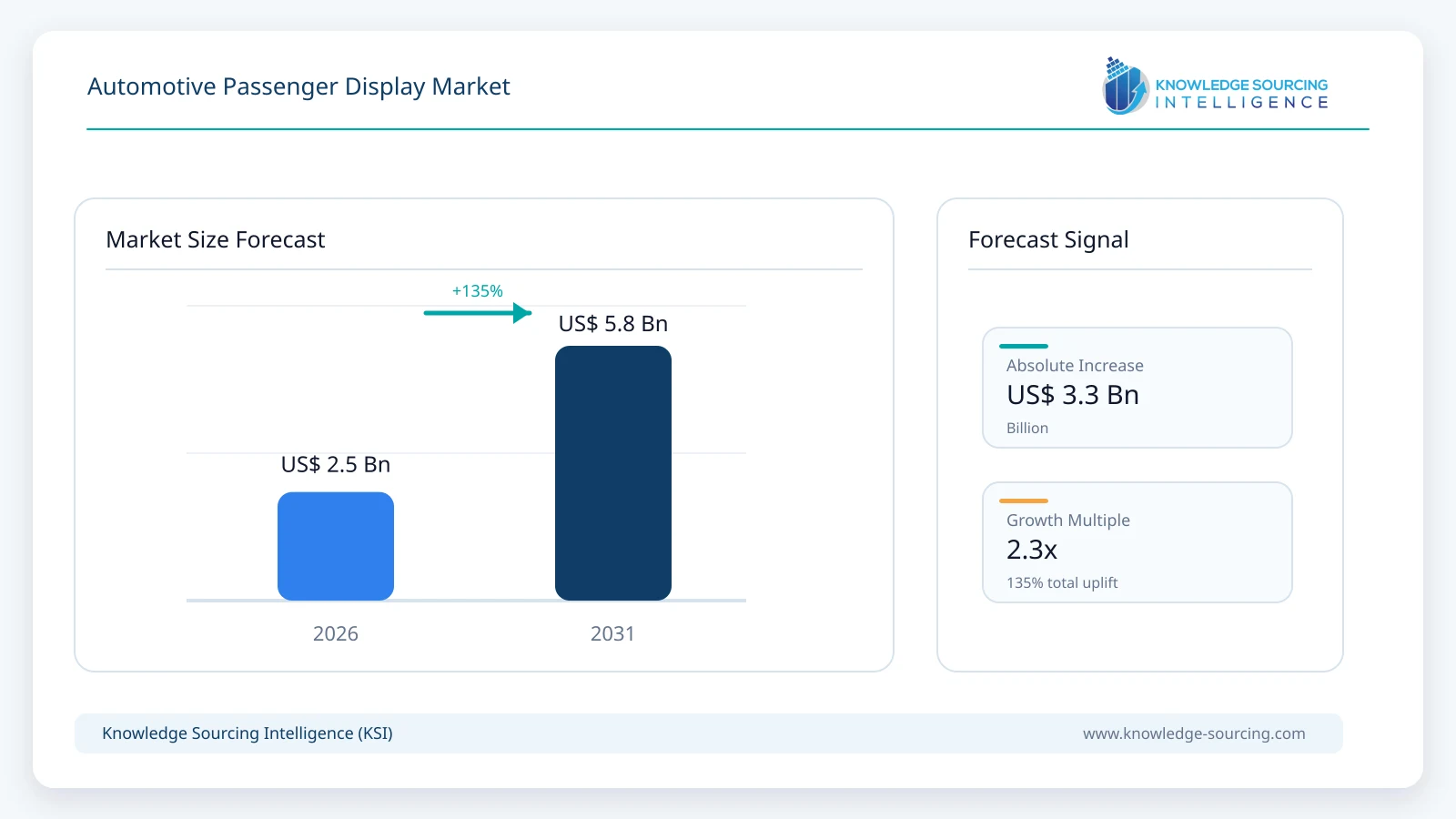
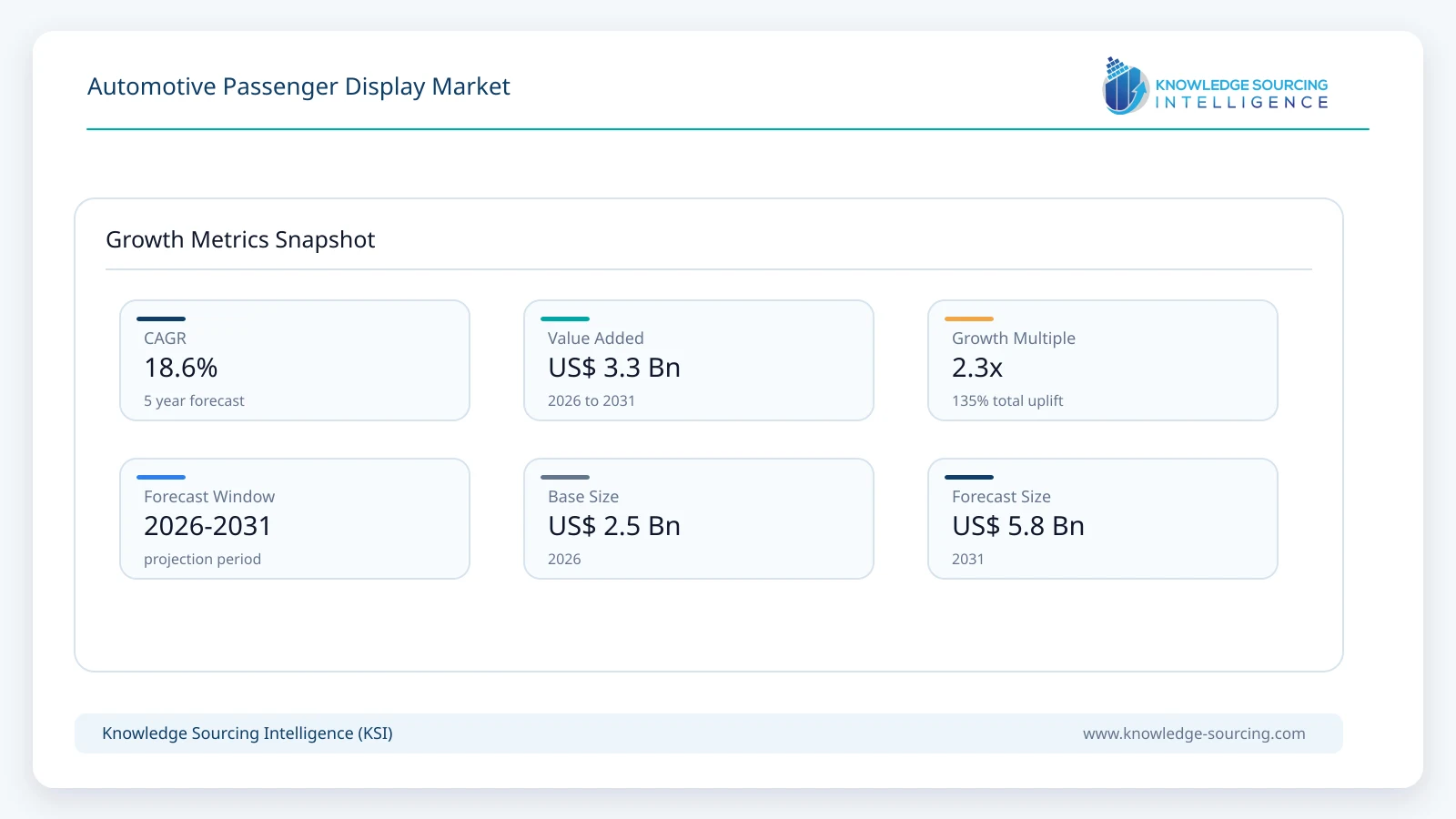
The automotive passenger display market is estimated at approximately USD 2.45 billion in 2026 and is projected to reach about USD 5.75 billion by 2031, representing a CAGR of 18.6% during the forecast period.
Highlights:
- 1Standalone dedicated passenger displays account for approximately 54% of global market value in 2026, while integrated passenger zones within panoramic or multi-display cockpit assemblies are expected to gain share through 2031.
- 2TFT and LTPS LCD technologies represent approximately 62% of 2026 market value because they combine mature automotive qualification with scalable cost, although OLED and Mini-LED systems are growing faster in premium applications.
- 3Displays above 11 inches and up to 14 inches account for approximately 44% of 2026 market value, reflecting the current concentration of passenger screens around 12- to 14-inch formats.
- 4Entertainment and media represent approximately 46% of 2026 passenger-display value, supported by video streaming, music, gaming and app ecosystems that are increasingly available while the vehicle is moving.
- 5SUVs and crossovers represent approximately 55% of 2026 market value as passenger displays are concentrated in premium SUVs, electric crossovers and high-content pickup-based utility vehicles.
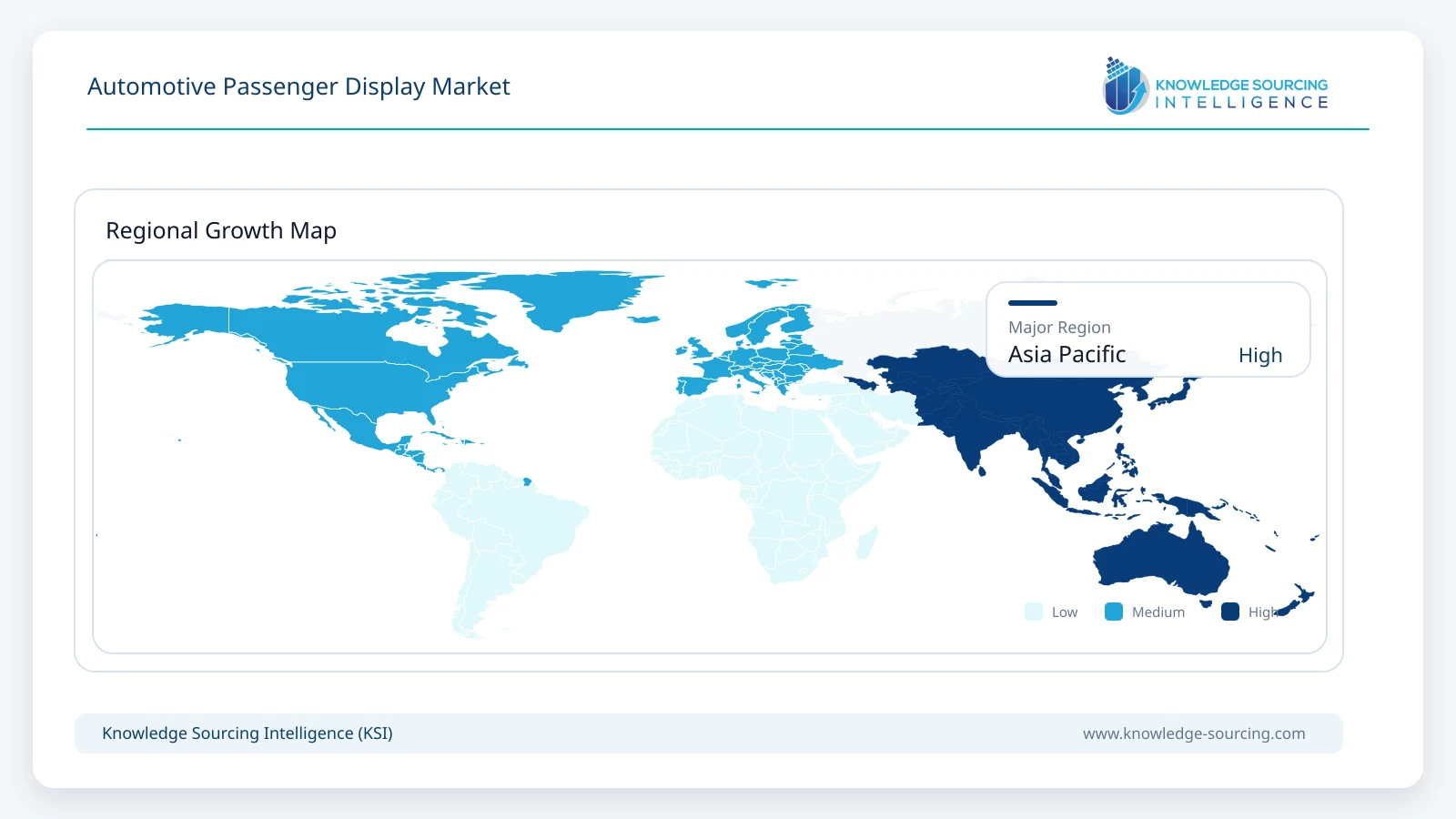
- 6Asia Pacific accounts for approximately 50% of global market value in 2026, supported by rapid smart-cockpit adoption in China and a dense regional automotive-display supply chain.
The market is moving from optional 10- to 11-inch secondary screens in premium vehicles toward larger passenger-specific interfaces integrated with the vehicle operating system, cloud entertainment, navigation, cameras and comfort functions. Passenger displays are increasingly designed as an independent digital zone rather than a mirrored extension of the center infotainment screen.
OEM adoption is broadening. Mercedes-Benz is making passenger displays standard within MBUX Superscreen architectures across several 2026 model lines, BMW has introduced a 14.6-inch Passenger Screen in the new 7 Series and X5/iX5, Porsche continues to offer an independent 10.9-inch passenger display in the Taycan, and Stellantis uses dedicated passenger screens across Ram and Jeep products. The common direction is toward larger panels, richer app ecosystems and stronger integration with vehicle data and cockpit compute.
The market value includes the passenger display panel and module, touch interface, privacy or directional-view technology, optical bonding and cover glass, display-control electronics and software integration directly attributable to the passenger interface. Driver clusters, ordinary center displays, rear-seat entertainment screens and the remaining value of panoramic cockpit systems are excluded unless a clearly separable passenger display zone is present.
Market Overview
A passenger display gives the front-seat passenger a dedicated digital workspace that can operate independently from the driver and center infotainment interface. Typical functions include video and music, gaming, navigation input, route planning, exterior camera views, vehicle-status information and selected comfort controls. In more advanced systems, the passenger can manage content, apps and connected services without interrupting the driver’s primary screen.
The architecture is evolving from a separate rectangular screen toward an integrated passenger zone within a wider glass or panoramic cockpit surface. Mercedes-Benz Superscreen and Hyperscreen systems place a passenger display beneath a continuous cover surface, while BMW positions the passenger screen next to the central display as a visually connected interface. This integration increases the importance of common cockpit compute, synchronized graphics, user profiles and content rights management.
Safety is a defining technical requirement. Video content visible to the driver can create distraction risk, so suppliers increasingly use active privacy, switchable viewing angles, eye-tracking or camera-based dimming. Porsche uses Privacy Mode on the Taycan passenger display, Visteon offers Active Privacy technology, LG Display provides Safe View Control and Smart Dual View, and newer Mercedes-Benz and BMW systems use camera-based shielding to keep passenger entertainment outside the driver’s effective viewing field.
Market Trends
Passenger Displays Are Becoming a Standard Element of Premium Digital Cockpits
Passenger screens are moving from niche options toward regular content in premium digital cockpits. Mercedes-Benz has expanded MBUX Superscreen across the S-Class, GLS, GLE and newer compact and midsize products, while BMW has introduced its 14.6-inch Passenger Screen across the 7 Series and X5/iX5.
The shift matters because a passenger display becomes easier to justify when the cockpit platform already supports multiple high-resolution outputs. Common software, graphics processing and app frameworks reduce incremental engineering cost across several model lines.
Privacy Technology Is Becoming Core Display Content
Passenger entertainment is commercially attractive only if it does not undermine driver attention. Visteon Active Privacy can alter the effective viewing angle of a passenger display, while LG Display Safe View Control and Smart Dual View restrict or separate content by viewing position.
OEMs are also combining the display with cabin cameras. BMW can darken the Passenger Screen if driver distraction is detected, while Mercedes-Benz uses camera-based blocking in newer Superscreen systems. Privacy therefore becomes both an optical function and a software-controlled safety feature.
Screen Size Is Increasing as Entertainment Becomes More Important
Early passenger displays commonly measured around 10 inches. Newer systems are moving toward 12- to 15-inch formats, with BMW using a 14.6-inch full-HD screen and Mercedes-Benz deploying 12.3- to 14-inch passenger displays across current Superscreen architectures.
Larger panels improve video, gaming and productivity use, but they also raise power, heat, glare and packaging requirements. Growth will favor thin panels, narrow bezels and integrated cover surfaces that preserve dashboard design while providing a larger active area.
Passenger Interfaces Are Shifting from Entertainment Screens to Co-Pilot Workspaces
Navigation support is becoming a meaningful use case. Ram passenger displays support co-pilot functions, navigation and exterior camera views, while Porsche allows the passenger to interact independently with route and vehicle information. This creates a functional role beyond passive entertainment.
The next step is collaborative cockpit interaction. Passenger screens can support trip planning, charging-stop selection, vehicle settings and app management while the driver remains focused on the road. Software-defined cockpits make this coordination easier because both screens share common vehicle data and services.
OLED, Mini-LED and Dual-View Technologies Are Raising Visual Quality
LCD remains the volume technology, but premium passenger screens are adopting higher-contrast display systems. Mercedes-Benz has used OLED in passenger display zones, HARMAN is applying Neo QLED and HDR10+ automotive capability, and LG Display is advancing Tandem OLED and Dual View OLED for automotive use.
These technologies improve contrast and viewing quality but must meet automotive lifetime, sunlight and temperature requirements. Their adoption will therefore remain concentrated in higher-value vehicles before moving into broader production segments.
Segment Analysis
By Integration Type: Standalone Dedicated Passenger Display
Standalone dedicated displays remain the largest architecture because they can be packaged independently and offered as an option without redesigning the full dashboard. Porsche Taycan and Ram 1500 illustrate this approach, with dedicated passenger screens that operate separately from the central display.
The segment is estimated at approximately USD 1.32 billion in 2026 and could reach about USD 2.59 billion by 2031. Absolute value will grow, but share is expected to decline as passenger zones become increasingly integrated into panoramic and multi-display cockpit assemblies.
By Display Technology: TFT / LTPS LCD
TFT and LTPS LCD lead the market because they offer mature automotive qualification, broad panel availability and competitive cost. They remain well suited to 10- to 15-inch passenger displays where high brightness, long life and reliable operation are more important than extreme thinness.
LCD-based passenger displays represent approximately USD 1.52 billion in 2026 and are expected to reach about USD 2.70 billion by 2031. OLED and advanced Mini-LED systems will grow faster, reducing LCD share even as LCD value continues to rise.
By Display Size: Above 11 Inches to 14 Inches
The 11- to 14-inch range is the largest size segment because it balances video usability, dashboard packaging and cost. Current Mercedes-Benz, Porsche and several Chinese smart-cockpit implementations cluster around this size band.
The segment accounts for approximately USD 1.08 billion in 2026 and could reach about USD 2.47 billion by 2031. Above-14-inch passenger screens are expected to grow faster as OEMs increase display area and integrate passenger screens with larger panoramic surfaces.
By Primary Function: Entertainment and Media
Entertainment is the largest value pool because dedicated passenger screens allow video, music, gaming and app use without occupying the driver’s main interface. Streaming ecosystems and improved in-vehicle connectivity are increasing the amount of content designed specifically for passengers.
Entertainment and media applications account for approximately USD 1.13 billion in 2026 and could approach USD 2.93 billion by 2031. Growth depends on privacy controls, data connectivity, content licensing and the ability to maintain high visual quality while the vehicle is moving.
By Vehicle Type: SUVs and Crossovers
SUVs and crossovers lead passenger-display adoption because they combine higher transaction prices, larger dashboards and strong demand for premium digital-cockpit content. Many current implementations are found in luxury SUVs, electric crossovers and high-content utility vehicles.
SUVs and crossovers account for approximately USD 1.35 billion in 2026 and are expected to reach about USD 3.57 billion by 2031. Passenger cars remain important, while pickups and light commercial vehicles form a smaller but growing segment led by premium truck applications.
Market Drivers
Expansion of Software-Defined and Multi-Display Cockpit Architectures
Centralized cockpit compute makes it easier to add a passenger display without creating a separate electronics stack. One controller can render driver, center and passenger interfaces while sharing applications, vehicle data and user profiles.
This reduces incremental system cost and supports consistent software across model lines. As cockpit controllers become more powerful, passenger displays can be added through display and software content rather than a fully independent infotainment platform.
Growth of In-Vehicle Entertainment, Streaming and Gaming
Streaming video, music, games and app stores are turning the vehicle into a connected media environment. Passenger displays provide a logical surface for this content because they can remain active while the vehicle is moving when privacy requirements are satisfied.
The commercial opportunity extends beyond hardware. OEMs can bundle data, premium apps, subscriptions and digital services around the passenger interface, improving the business case for adding a dedicated screen.
OEM Competition around Premium Cabin Experience
Large passenger displays create visible differentiation at the point of sale. Mercedes-Benz, BMW, Porsche and Stellantis use dedicated passenger interfaces to communicate technology, luxury and personalization in the cabin.
Chinese EV and smart-cockpit programs intensify this competition by normalizing high display counts and larger panels. Global OEMs are responding by adding passenger-specific interfaces across more vehicle classes instead of reserving them for flagship models.
Improving Privacy and Driver-Distraction Mitigation Technology
Active privacy, directional backlights and camera-based shielding reduce one of the largest barriers to front-passenger entertainment. These systems allow video or games to remain visible to the passenger while limiting the driver’s viewing angle.
Better privacy performance increases the usable time and content range of the passenger display. It also helps OEMs meet internal human-factors requirements and country-specific legal restrictions on moving visual entertainment.
Falling Cost of Large Automotive-Grade Displays
Automotive display manufacturing is scaling across East Asia, and suppliers now offer LCD, OLED, Mini-LED and large integrated cockpit panels in a wider range of sizes. Higher production volume lowers the cost of adding a second front-cabin screen.
Common cover glass, shared electronics and integrated panoramic assemblies can further reduce packaging cost. This is supporting migration from premium vehicles into upper-midrange and selected high-volume models.
Market Restraints
Driver Distraction and Regulatory Limits on Visible Entertainment
Passenger screens sit within the driver’s peripheral vision, creating a direct human-factors risk when moving video or bright animation is visible. Country-specific rules and OEM safety policies can restrict content or require it to be shielded while driving.
Privacy technologies reduce the risk but add validation requirements. Systems must remain effective across seating positions, ambient light, driver height and passenger viewing angles without degrading display quality.
Incremental Hardware, Compute and Connectivity Cost
A passenger display adds the panel, cover glass, touch layer, wiring, graphics bandwidth and thermal load. Premium OLED or privacy-enabled systems can materially increase cockpit bill of materials compared with a single center screen.
OEMs must also provision compute and network capacity for independent high-resolution content. Cost pressure can delay adoption in entry-level vehicles where the passenger display has limited impact on purchase decisions.
Packaging and Crash-Safety Constraints
The passenger side of the dashboard must accommodate airbags, vents, structural elements and storage. Large display surfaces can conflict with deployment paths or require more complex breakaway structures and cover-glass engineering.
Each vehicle platform therefore needs dedicated packaging and crash validation. Integrated panoramic designs can improve appearance but make replacement and service more expensive if a large shared glass assembly is damaged.
Automotive Reliability, Heat and Sunlight Requirements
Passenger displays are exposed to extreme cabin temperatures, direct sunlight, vibration and long vehicle life cycles. OLED burn-in, LCD backlight aging and thermal performance can become more challenging when entertainment content runs for long periods.
Higher brightness improves daytime visibility but increases power and heat. Suppliers must balance image quality with thermal management, energy efficiency and long-term reliability.
Content Rights, Data Use and Software Lifecycle Complexity
Video, gaming and connected applications introduce content licensing, regional availability and data-consumption requirements that do not exist in conventional vehicle-information displays. Services may differ by country and can become obsolete faster than vehicle hardware.
OEMs therefore need app maintenance, cybersecurity, over-the-air updates and long-term platform support. A weak software ecosystem can reduce the value of an otherwise capable passenger display.
Regional Outlook
Asia Pacific
Asia Pacific is the largest automotive passenger display market, supported by China’s rapid adoption of smart cockpits, high EV penetration and strong consumer demand for large in-cabin screens. Regional panel suppliers including BOE, LG Display, Samsung Display, Tianma and AUO also shorten the supply chain for high-content display systems.
The region is expected to increase its share through 2031 as passenger displays move into a wider range of Chinese SUVs, sedans and MPVs. Japan and South Korea contribute premium vehicle programs and advanced panel technology, while India is beginning to adopt multi-display cockpits in higher-end SUVs.
Europe
Europe is the second-largest high-value market, led by premium OEMs that have made the passenger display an important element of digital-cockpit design. Mercedes-Benz, BMW and Porsche are expanding dedicated passenger interfaces across new model generations and multiple price points.
Growth will be shaped by safety and distraction requirements as much as by screen size. Camera-based shielding, directional privacy and careful HMI design are likely to become standard characteristics of passenger displays sold in the region.
Competitive Landscape
The automotive passenger display market combines panel manufacturers, cockpit electronics suppliers and system integrators. LG Display, BOE, Samsung Display, Tianma and AUO compete through panel technology, size, curvature and advanced privacy features, while Visteon, HARMAN, AUMOVIO, Panasonic Automotive, Marelli and FORVIA HELLA compete through display modules, cockpit controllers and vehicle integration.
Competitive differentiation is moving beyond resolution and diagonal size. Active privacy, dual-view operation, OLED or Mini-LED image quality, low power consumption, thermal performance and the ability to synchronize the passenger display with navigation, cameras and the vehicle operating system are becoming more important selection criteria.
Production readiness remains a strong barrier to entry. Passenger displays must meet automotive qualification, crash-integration and long-term software requirements while maintaining consistent optical performance. Suppliers with established OEM programs, broad panel sourcing and reusable cockpit software are better positioned to scale across multiple vehicle platforms.
Recent Developments
July 2026: BMW introduced a 14.6-inch full-HD Passenger Screen for the new X5 and iX5, with an interior-camera shield function that automatically darkens the display if driver distraction is detected.
May 2026: BMW made its 14.6-inch Passenger Screen standard in the new 7 Series, expanding front-passenger streaming, gaming, music and video-conferencing functions within the brand’s flagship sedan.
31 March 2026: Mercedes-Benz announced the new GLS with MBUX Superscreen and a passenger display as standard, extending dedicated passenger entertainment into the updated large-SUV platform.
31 March 2026: Mercedes-Benz introduced the new GLE family with a standard MBUX Superscreen architecture that includes a dedicated front-passenger display under the shared glass surface.
2026: Mercedes-Benz introduced the new S-Class with a 12.3-inch passenger display integrated into MBUX Superscreen and a camera-based privacy function that reduces driver distraction during passenger entertainment.
7 January 2026: Visteon and Mahindra announced the next-generation SmartCore Pro cockpit for the XUV7X0, using a three-display configuration that expands independent driver and passenger access to entertainment, connectivity and vehicle information.
13 January 2026: HARMAN expanded its production-ready display portfolio with Neo QLED-based Ready Display technology, combining higher visual quality and improved energy efficiency for driver and passenger applications.
Market Outlook
The automotive passenger display market is expected to grow from approximately USD 2.450 billion in 2026 to about USD 5.750 billion by 2031. Dedicated standalone screens will remain important, but integrated passenger zones within panoramic and multi-display cockpit surfaces will gain share as OEMs standardize common display and software architectures across several vehicle lines.
LCD will continue to provide the largest value base, while OLED and Mini-LED technologies grow faster in premium and large-format applications. Passenger entertainment will remain the largest functional use case, but navigation support, vehicle controls, camera views and productivity features will increase the screen’s role as an active co-pilot interface.
Asia Pacific is expected to remain the largest regional market, while Europe retains strong premium-system value. Competitive advantage will depend on privacy performance, optical quality, low power consumption, software integration, app ecosystems and the ability to deliver a passenger experience that adds utility without increasing driver distraction.
Automotive Passenger Display Market Scope
| Report Metric | Details |
|---|---|
| Total Market Size in 2026 | USD 2.45 billion |
| Total Market Size in 2031 | USD 5.75 billion |
| Forecast Unit | Billion |
| Growth Rate | 18.6% |
| Study Period | 2021 to 2031 |
| Historical Data | 2021 to 2024 |
| Base Year | 2025 |
| Forecast Period | 2026 – 2031 |
| Segmentation | Integration Type, Display Technology, Display Size, Primary Function, Vehicle Type, Geography |
| Companies |
|
Market Segmentation
By Integration Type
Standalone Dedicated Passenger Display
Integrated Panoramic / Multi-Display Passenger Zone
By Display Technology
TFT / LTPS LCD
OLED / POLED
Mini-LED / Quantum-Dot Enhanced LCD
MicroLED and Other Emerging Technologies
By Display Size
Up to 11 Inches
Above 11 Inches to 14 Inches
Above 14 Inches
By Primary Function
Entertainment and Media
Navigation and Co-Pilot Functions
Comfort and Vehicle Controls
Productivity, Connected Apps and Camera Visualization
By Vehicle Type
Passenger Cars
SUVs and Crossovers
Pickups and Light Commercial Vehicles
By Geography
North America
United States
Canada
Mexico
South America
Brazil
Argentina
Others
Europe
Germany
United Kingdom
France
Italy
Spain
Others
Middle East and Africa
Saudi Arabia
UAE
South Africa
Others
Asia Pacific
China
Japan
South Korea
India
Indonesia
Thailand
Others
Table of Contents
1. INTRODUCTION
1.1. Market Overview
1.2. Market Definition
1.3. Scope of the Study
1.4. Market Segmentation
1.5. Currency
1.6. Assumptions
1.7. Base and Forecast Years
1.8. Key Benefits to Stakeholders
2. RESEARCH METHODOLOGY
2.1. Research Design
2.2. Secondary Research
2.3. Primary Research
2.4. Market Estimation
2.5. Segment Modelling
2.6. Data Triangulation and Validation
3. EXECUTIVE SUMMARY
3.1. Key Findings
3.2. Automotive Passenger Display Market Size, 2026-2031
3.3. Integration Type Outlook
3.4. Display Technology Outlook
3.5. Display Size Outlook
3.6. Primary Function Outlook
3.7. Vehicle Type Outlook
3.8. Regional Opportunity Summary
4. MARKET DYNAMICS
4.1. Market Drivers
4.1.1. Expansion of Software-Defined and Multi-Display Cockpit Architectures
4.1.2. Growth of In-Vehicle Entertainment, Streaming and Gaming
4.1.3. OEM Competition around Premium Cabin Experience
4.1.4. Improving Privacy and Driver-Distraction Mitigation Technology
4.1.5. Falling Cost of Large Automotive-Grade Displays
4.2. Market Restraints
4.2.1. Driver Distraction and Regulatory Limits on Visible Entertainment
4.2.2. Incremental Hardware, Compute and Connectivity Cost
4.2.3. Packaging and Crash-Safety Constraints
4.2.4. Automotive Reliability, Heat and Sunlight Requirements
4.2.5. Content Rights, Data Use and Software Lifecycle Complexity
4.3. Market Opportunities
4.4. Porter's Five Forces Analysis
4.5. Industry Value Chain Analysis
4.6. Passenger Display Hardware, Software and Integration Economics
4.7. Driver-Distraction, Privacy and Display-Safety Environment
5. TECHNOLOGY OUTLOOK
5.1. TFT and LTPS LCD Passenger Displays
5.2. Automotive OLED and Tandem OLED
5.3. Mini-LED and Quantum-Dot Enhanced LCD
5.4. MicroLED and Emerging Emissive Displays
5.5. Active Privacy and Switchable Viewing-Angle Technology
5.6. Dual-View and Directional Display Technology
5.7. Touch, Haptic and Cover-Glass Integration
5.8. Optical Bonding, Anti-Glare and Anti-Reflective Treatment
5.9. Passenger-Screen Camera and Eye-Tracking Integration
5.10. Cockpit Domain Controllers and Multi-Display Synchronization
5.11. Streaming, Gaming and In-Vehicle App Platforms
5.12. Automotive Ethernet and High-Speed Display Connectivity
6. AUTOMOTIVE PASSENGER DISPLAY MARKET BY INTEGRATION TYPE
6.1. Introduction
6.2. Standalone Dedicated Passenger Display
6.3. Integrated Panoramic / Multi-Display Passenger Zone
7. AUTOMOTIVE PASSENGER DISPLAY MARKET BY DISPLAY TECHNOLOGY
7.1. Introduction
7.2. TFT / LTPS LCD
7.3. OLED / POLED
7.4. Mini-LED / Quantum-Dot Enhanced LCD
7.5. MicroLED and Other Emerging Technologies
8. AUTOMOTIVE PASSENGER DISPLAY MARKET BY DISPLAY SIZE
8.1. Introduction
8.2. Up to 11 Inches
8.3. Above 11 Inches to 14 Inches
8.4. Above 14 Inches
9. AUTOMOTIVE PASSENGER DISPLAY MARKET BY PRIMARY FUNCTION
9.1. Introduction
9.2. Entertainment and Media
9.3. Navigation and Co-Pilot Functions
9.4. Comfort and Vehicle Controls
9.5. Productivity, Connected Apps and Camera Visualization
10. AUTOMOTIVE PASSENGER DISPLAY MARKET BY VEHICLE TYPE
10.1. Introduction
10.2. Passenger Cars
10.3. SUVs and Crossovers
10.4. Pickups and Light Commercial Vehicles
11. AUTOMOTIVE PASSENGER DISPLAY MARKET BY GEOGRAPHY
11.1. North America
11.1.1. United States
11.1.2. Canada
11.1.3. Mexico
11.2. South America
11.2.1. Brazil
11.2.2. Argentina
11.2.3. Others
11.3. Europe
11.3.1. Germany
11.3.2. United Kingdom
11.3.3. France
11.3.4. Italy
11.3.5. Spain
11.3.6. Others
11.4. Middle East and Africa
11.4.1. Saudi Arabia
11.4.2. UAE
11.4.3. South Africa
11.4.4. Others
11.5. Asia Pacific
11.5.1. China
11.5.2. Japan
11.5.3. South Korea
11.5.4. India
11.5.5. Indonesia
11.5.6. Thailand
11.5.7. Others
12. COMPETITIVE ENVIRONMENT AND ANALYSIS
12.1. Major Players and Strategy Analysis
12.2. Market Share Analysis
12.3. Passenger Display Technology Benchmarking
12.4. Standalone versus Integrated Passenger Display Architecture
12.5. LCD versus OLED versus Mini-LED Benchmarking
12.6. Privacy and Dual-View Technology Benchmarking
12.7. OEM Programs and Production Readiness
12.8. Competitive Dashboard
13. COMPANY PROFILES
13.1. LG Display Co., Ltd.
13.2. BOE Varitronix Limited
13.3. Visteon Corporation
13.4. HARMAN International
13.5. Samsung Display Co., Ltd.
13.6. AUMOVIO SE
13.7. Tianma Microelectronics Co., Ltd.
13.8. AUO Corporation / AUO Mobility Solutions
13.9. Panasonic Automotive Systems Co., Ltd.
13.10. Marelli Holdings Co., Ltd.
13.11. FORVIA HELLA
14. APPENDIX
14.1. Currency
14.2. Assumptions
14.3. Base and Forecast Years Timeline
14.4. Key Benefits for Stakeholders
14.5. Research Methodology
14.6. Abbreviations
14.7. Data Sources
Navigate
Trusted by the world's leading organizations











