
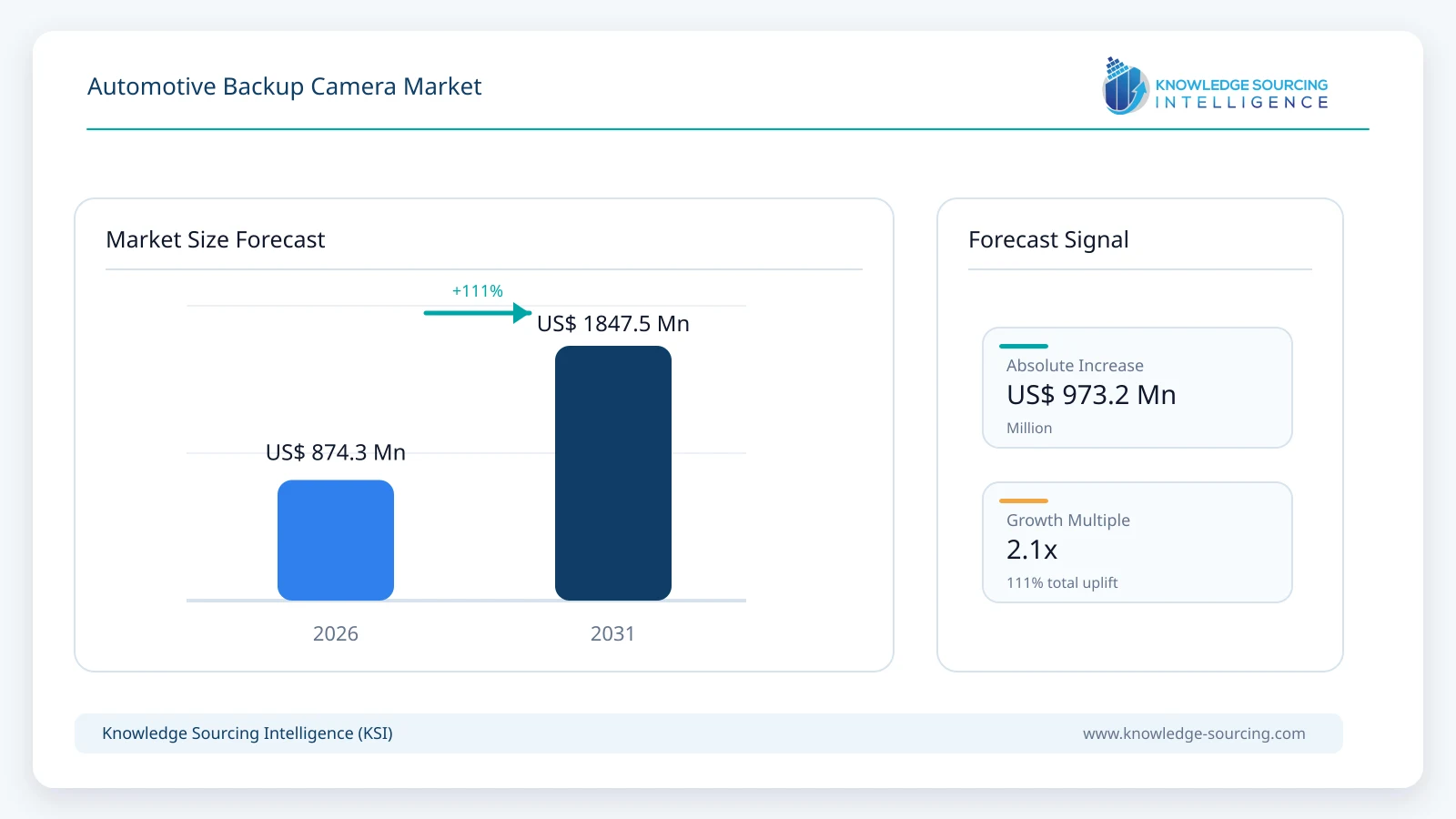
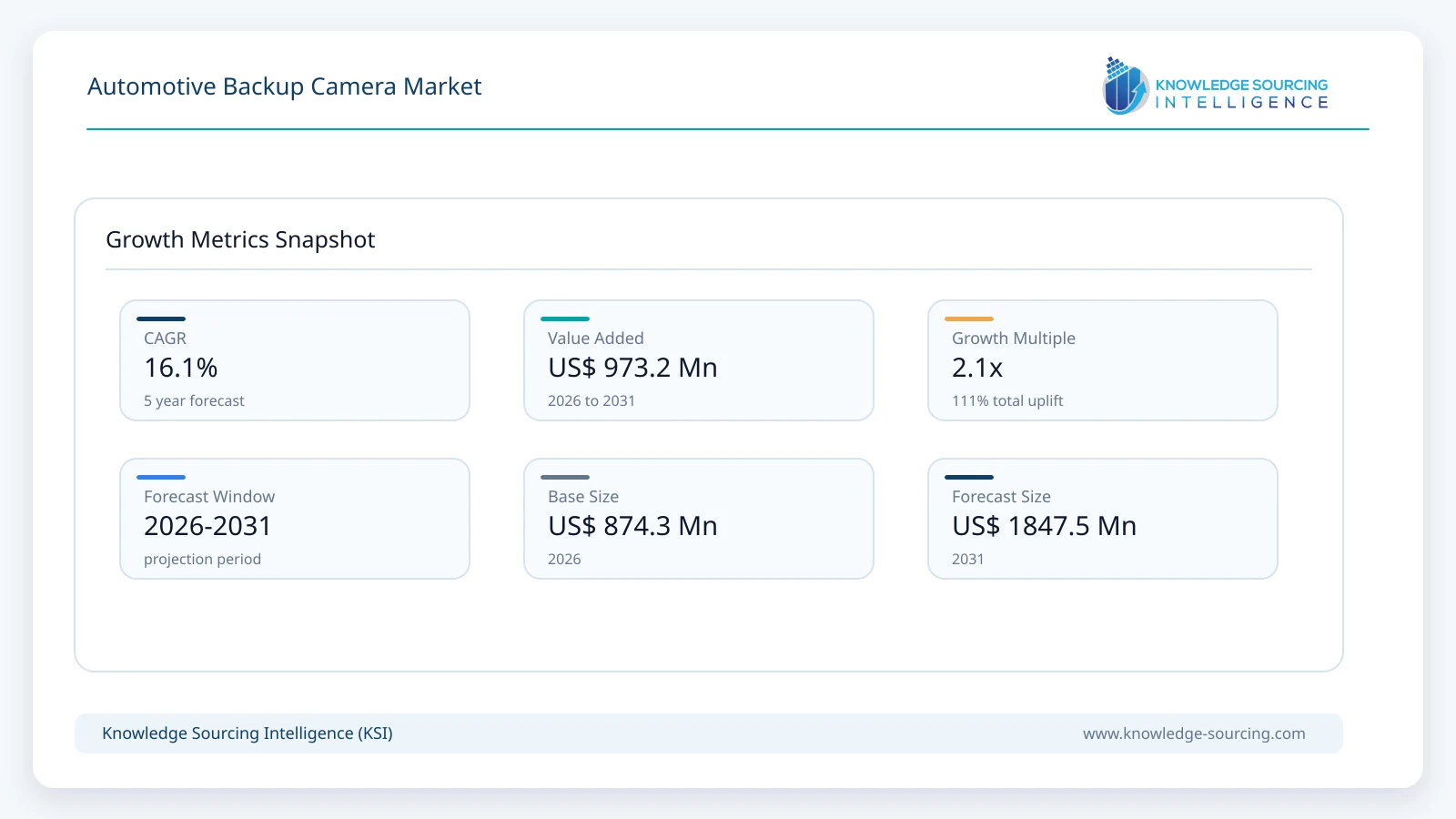
The Automotive Backup Camera Market is forecast to grow at a CAGR of 16.1%, reaching USD 1,847.5 million in 2031 from USD 874.3 million in 2026.
Highlights:
- 1Safety regulation is strengthening baseline demandRear-visibility and reversing-detection requirements are converting camera systems from discretionary equipment into mandated or specification-driven vehicle content in major markets.
- 2Passenger vehicles remain commercially importantHigh vehicle production volumes and widespread integration with infotainment and parking systems create a large addressable installation base.
- 3Commercial vehicles offer higher equipment complexityTrucks, buses, vans, and specialty vehicles require wider viewing angles, greater environmental protection, and configurations suited to long or obstructed rear profiles.
- 4Camera integration is expandingSuppliers are combining cameras with radar, displays, software, and broader ADAS functions, increasing the value of integrated vision architectures.
- 5Asia Pacific remains strategically importantVehicle manufacturing scale, localized electronics production, and expanding safety-system adoption support demand, while India is attracting localized camera manufacturing investment.
- 6Aftermarket economics remain relevantReplacement cameras, calibration requirements, vehicle modifications, and fleet applications create recurring demand after initial vehicle sale.
The Automotive Backup Camera Market covers camera systems installed on passenger and commercial vehicles to provide a visual view of the area behind the vehicle during reversing and low-speed maneuvering. The market includes camera hardware, associated imaging components, vehicle displays, mounting configurations, wiring or connectivity interfaces, and integrated camera-monitor systems supplied through original equipment and aftermarket channels.
Backup cameras have moved from an optional convenience feature toward a regulated vehicle-safety component in several major automotive markets. The commercial significance of this shift is substantial because demand is increasingly determined by vehicle production, safety compliance, platform specifications, and replacement requirements rather than consumer preference alone. In the United States, rear visibility requirements under FMVSS No. 111 established performance requirements for rear visibility systems, while Canada requires backup cameras on passenger cars, SUVs, light pickup trucks, and minivans under CMVSS 111.
The European market provides another important demand reference. The European Union's General Safety Regulation requires reversing detection using cameras or sensors in new vehicles, with the requirements applying to all new vehicles from July 7, 2024. This regulation creates a structural procurement requirement for camera and sensing technologies across cars, vans, trucks, and buses.
Demand therefore comes from several buyer groups. Vehicle manufacturers purchase camera modules as part of vehicle programs and electronic architectures. Commercial fleet operators and body builders procure systems where factory equipment does not fully satisfy visibility or operational requirements. Independent workshops, distributors, and vehicle owners create replacement demand after camera damage, electrical failures, display faults, or vehicle modifications.
Buyer priorities vary by application. Passenger-vehicle OEMs generally emphasize compact packaging, image quality, integration with infotainment displays, electrical compatibility, styling, functional safety, cybersecurity, and unit economics. Commercial-vehicle buyers place greater weight on durability, wide viewing angles, water and dust resistance, vibration tolerance, night performance, serviceability, and compatibility with multiple vehicle configurations.
The market's revenue structure is also changing because backup cameras increasingly operate as part of broader vision architectures. A camera originally purchased for reversing can share electronic processing, displays, wiring, or software with parking assistance, surround-view, blind-spot monitoring, and other driver-assistance functions. This creates opportunities for suppliers that can provide integrated vision systems rather than standalone imaging hardware.
Mounting position remains commercially relevant because vehicle architecture determines camera placement. Surface-mounted units can simplify installation and aftermarket replacement, while flush-mounted systems provide better integration with vehicle styling. License-plate-mounted cameras are particularly relevant to aftermarket applications and vehicles where dedicated factory mounting points are unavailable.
The aftermarket consequently remains important even where OEM penetration is high. Collision repairs, vehicle aging, accessory installation, fleet modifications, and replacement requirements sustain demand beyond new-vehicle production. The distinction between OEM and aftermarket competition is therefore important: OEM suppliers compete primarily through engineering capability, qualification, reliability, cost and program execution, while aftermarket suppliers compete through application coverage, installation simplicity, inventory availability, compatibility, and service support.
Market Drivers
Regulatory Requirements for Rear Visibility
Regulation is one of the strongest structural demand mechanisms because vehicle manufacturers must design compliant rear-visibility systems into affected platforms. In Canada, Transport Canada explicitly identifies backup cameras as required equipment for passenger cars, SUVs, light pickup trucks, and minivans under CMVSS 111.
The European Union has created another substantial regulatory requirement. The General Safety Regulation includes reversing detection through cameras or sensors among mandatory safety features for new road vehicles. The requirements apply across cars, vans, trucks, and buses, expanding the addressable vehicle base beyond conventional passenger cars.
For suppliers, regulation reduces dependence on discretionary consumer demand. OEM procurement becomes tied to vehicle homologation, production schedules, and technical compliance. This favors suppliers with established validation processes and the ability to provide components that meet vehicle-program requirements without creating additional integration risk.
Expansion of Vehicle Electronics and Parking Assistance
Backup cameras are increasingly connected to vehicle displays and electronic control systems rather than functioning as isolated accessories. The same image-processing architecture can support parking assistance, surround-view functions, object detection, and other low-speed driving functions.
This changes purchasing criteria. OEMs are not evaluating only lens quality or camera resolution. They increasingly consider interface compatibility, processing requirements, software integration, cybersecurity, functional safety, thermal performance, and calibration.
The commercial consequence is greater value capture for suppliers capable of supplying complete or semi-integrated systems. Companies with expertise across cameras, electronics, software, displays, and vehicle integration can compete for larger portions of vehicle electronic content.
Rising Demand for Commercial-Vehicle Visibility
Commercial vehicles present a different operating environment from passenger cars. Trucks, buses, vans, construction vehicles, agricultural equipment, and specialty vehicles can have large rear blind zones, long bodies, high mounting positions, and frequent loading or unloading activity.
Consequently, fleet operators place considerable value on wide-angle imaging, low-light performance, weather resistance, vibration tolerance, and easy replacement. STONKAM, for example, markets automotive-grade cameras for commercial and specialty vehicles with features including 1080P imaging, wide viewing angles, IP69K protection, and operation across demanding temperature ranges.
This segment can support higher-value configurations because the buyer evaluates the camera as part of operational risk management rather than simply as a convenience accessory.
Growth of Vehicle Safety Electronics
Modern vehicles contain a growing number of camera-based safety functions. The European Commission's vehicle-safety framework requires multiple driver-assistance technologies, including reversing detection, while other systems use cameras for lane support, driver monitoring, emergency braking, and vulnerable-road-user detection.
This creates economies of scale for camera suppliers. A manufacturer can apply common image sensors, processing technologies, housings, connectors, and manufacturing processes across several camera applications.
The resulting purchasing environment favors platforms that can be adapted to different vehicle programs while maintaining common components. It also creates opportunities to increase revenue per vehicle by combining backup-camera functionality with wider perception systems.
Expansion of Localized Automotive Electronics Manufacturing
Automotive camera production is becoming more geographically distributed as OEMs seek shorter supply chains and regional manufacturing capacity. Valeo's April 2026 announcement of a new high-volume HD surround-view camera production line at its Sanand facility in Gujarat illustrates this trend. The facility is intended to manufacture vision systems for major Indian OEMs while supporting localized supply and regional engineering.
Localization can reduce logistics exposure, improve responsiveness to OEM production schedules, and simplify customer support. For camera suppliers, regional manufacturing also provides a means of meeting local-content expectations and adapting products to vehicle platforms produced in specific markets.
Market Restraints and Challenges
High Reliability Requirements
A backup camera operates in an exposed position and must function despite water, dirt, vibration, temperature changes, road debris, and repeated electrical cycling. Failures can create warranty costs and, in regulated markets, potential compliance issues.
Suppliers therefore need extensive environmental and vehicle-level validation. This increases development expenditure and can make low-cost competition difficult where OEMs require long service life and stable performance.
Image Performance Under Difficult Conditions
Camera performance can deteriorate in rain, darkness, glare, dirt, snow, condensation, or when the lens becomes obstructed. Transport Canada specifically notes that rain, darkness, glare, and dirt can reduce the visibility provided by backup cameras.
The challenge is commercial as well as technical. Buyers increasingly expect a camera to provide reliable information across varied operating conditions, which raises requirements for dynamic range, low-light performance, lens coatings, image processing, heating or cleaning provisions, and software correction.
Integration and Calibration Complexity
When cameras become part of broader ADAS or parking architectures, replacement is no longer limited to removing one physical component and installing another. Calibration, software compatibility, diagnostic equipment, and communication with vehicle control systems can affect repair costs.
ZF's May 2025 aftermarket launch demonstrates this shift. Its Smart Camera offering was accompanied by diagnostic systems, calibration equipment, and workshop training, indicating that camera replacement can require a broader service ecosystem.
Pricing Pressure in High-Volume OEM Programs
OEM buyers generally negotiate aggressively because camera systems are installed across large vehicle volumes. Suppliers must absorb engineering, validation, tooling, quality, and localization costs while meeting target component prices.
This creates pressure on margins, particularly for standardized camera hardware. Differentiation through software, integration, environmental performance, diagnostics, and broader system capability can therefore become more commercially important than incremental hardware specifications.
Supply Chain Exposure
Automotive cameras depend on image sensors, semiconductor components, connectors, processors, lenses, printed circuit boards, housings, and specialized manufacturing equipment. Disruptions in any of these components can affect vehicle production schedules.
Suppliers with multiple sourcing options, regional production, common component architectures, and strong inventory planning have greater flexibility. Localization initiatives can further reduce dependence on long international supply chains, although they require additional capital expenditure.
Major Segment Analysis
Passenger Vehicles by Vehicle Type
Passenger vehicles represent the most commercially important segment because of their high global production volumes and extensive integration of rear cameras into standard vehicle electronic architectures.
The demand mechanism differs from that of commercial vehicles. Passenger-vehicle manufacturers must balance safety performance with vehicle styling, packaging, cost, consumer expectations, and integration with infotainment screens. A camera mounted in a tailgate, trunk lid, bumper, or license-plate area must deliver adequate visibility without disrupting exterior design.
Regulation provides a strong baseline. Canada requires backup cameras for specified passenger-vehicle categories, while the European Union requires reversing detection using cameras or sensors across new road vehicles. These rules reduce the extent to which OEMs can treat rear visibility as an optional feature.
The buyer base is concentrated among automakers and Tier 1 suppliers that manage vehicle electronics programs. Their procurement decisions emphasize unit cost, reliability, qualification history, software compatibility, image quality, and long-term supply assurance.
Passenger-vehicle camera systems are also becoming integrated with parking assistance and surround-view functionality. This creates a shift from a single-purpose component toward a multifunctional perception device. Suppliers that can provide scalable camera architectures can potentially serve several vehicle platforms using common technical foundations.
The aftermarket remains relevant because the installed base continues to expand even when new-vehicle penetration becomes high. Damaged cameras, replacement after collisions, infotainment upgrades, and vehicle modifications create demand for compatible replacement products. Consequently, passenger vehicles support both high-volume OEM installations and recurring aftermarket sales.
Regional Analysis
North America
North American demand is strongly influenced by vehicle safety requirements, large passenger-vehicle production, pickup trucks, SUVs, commercial fleets, and a mature aftermarket ecosystem. The United States has established rear-visibility requirements under FMVSS No. 111, while Canada's CMVSS 111 explicitly requires backup cameras across several passenger-vehicle categories.
The regional market therefore combines regulatory replacement of optional equipment with continued demand from vehicle production and repair. Pickup trucks, SUVs, vans, and fleet vehicles create opportunities for cameras designed for larger rear blind zones.
Aftermarket demand is supported by the region's large vehicle parc and extensive independent repair network. Suppliers compete through compatibility, installation simplicity, image quality, durability, and integration with existing displays.
Europe
Europe has one of the clearest regulatory demand structures for automotive cameras. The EU General Safety Regulation requires reversing detection using cameras or sensors in all new vehicles from July 2024.
The region also has a mature automotive supplier base with extensive experience in vehicle electronics and ADAS. This supports demand for integrated camera architectures rather than basic standalone reversing devices.
Repair and calibration requirements are also becoming more important as camera-equipped vehicles age. ZF's expansion into independent workshop camera solutions illustrates the emerging aftermarket opportunity created by the installed base of camera-dependent safety systems.
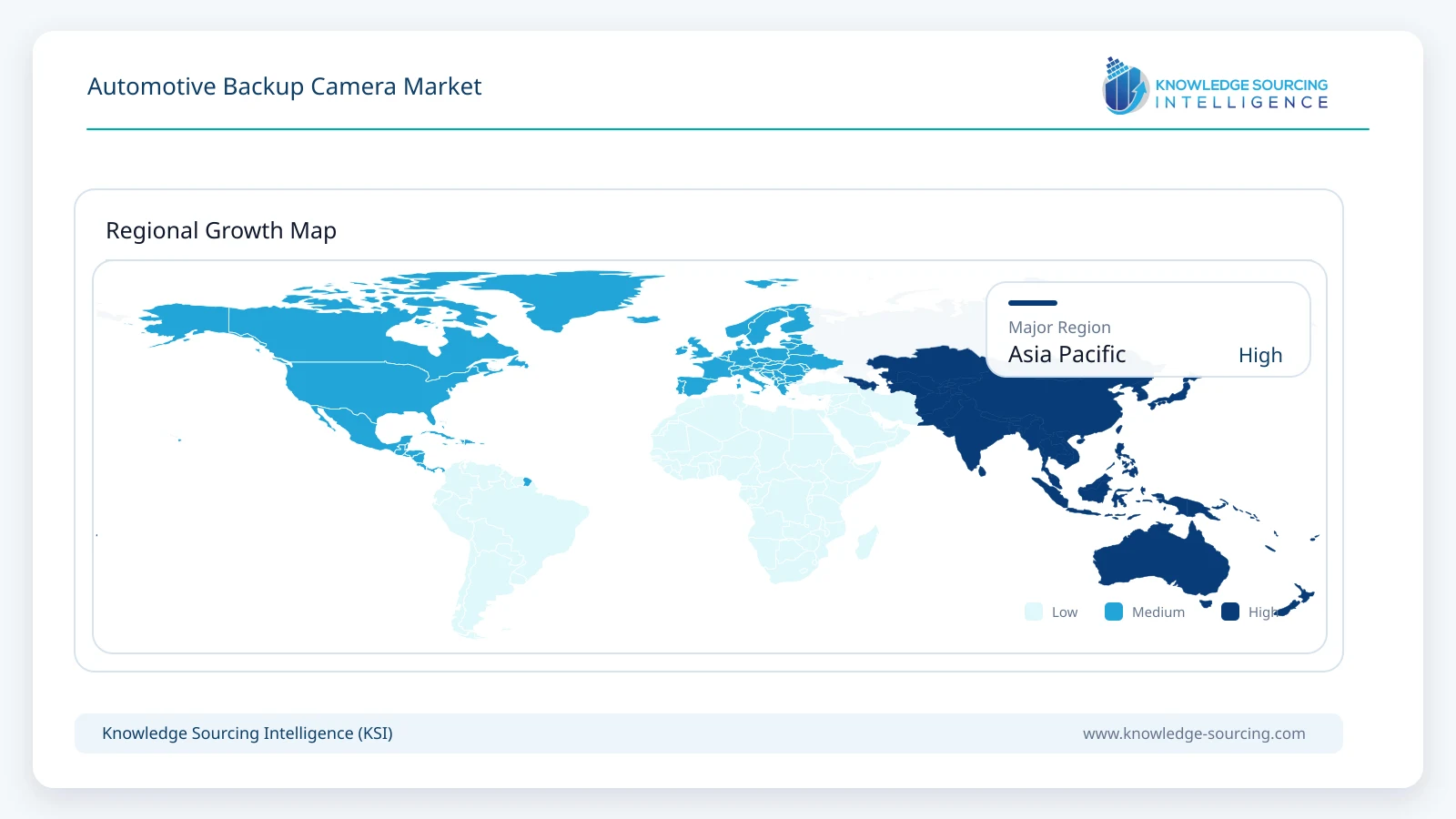
Asia Pacific
Asia Pacific is commercially important because it combines large vehicle production volumes, expanding automotive electronics manufacturing, and growing adoption of advanced safety technologies.
China remains a major production center for vehicle electronics and commercial-vehicle camera equipment. Japan and South Korea provide established automotive technology ecosystems, while Southeast Asian markets benefit from expanding vehicle manufacturing and regional supply chains.
India is gaining importance as both a vehicle market and production base. Valeo's 2026 investment in localized surround-view camera manufacturing at Sanand demonstrates supplier commitment to local production. Its May 2026 nomination from an Indian OEM for a commercial-vehicle ADAS system further indicates increasing demand for locally produced camera-based safety technologies.
Cost sensitivity remains a major constraint across several Asia Pacific markets. Suppliers therefore need products that meet safety requirements without adding excessive vehicle cost.
Middle East and Africa
Demand in the Middle East and Africa is influenced by passenger vehicles, commercial fleets, buses, logistics vehicles, construction equipment, and specialty vehicles. Larger commercial vehicles can benefit from wide-angle rear-view systems because vehicle dimensions create substantial blind zones.
Environmental durability is especially relevant in markets with high temperatures, dust, and demanding operating conditions. Camera housings, sealing, thermal management, and lens performance therefore influence purchasing decisions.
The market remains less uniform than North America, Europe, or major Asian economies. Procurement can vary substantially by vehicle type and fleet application, creating opportunities for distributors and specialist suppliers alongside OEM programs.
South America
South American demand is supported by passenger vehicles, commercial transportation, logistics, buses, agricultural activity, and the replacement market. Brazil represents the largest commercial opportunity within the supplied regional segmentation because of its vehicle manufacturing base and large domestic automotive market.
Price sensitivity remains a central consideration. Buyers often evaluate durability and installation cost alongside camera specifications. Aftermarket products can therefore compete effectively where factory-installed systems are unavailable or where vehicle owners seek replacement or upgraded visibility.
Regional supply-chain conditions and currency fluctuations can affect imported component costs. Local distribution capabilities and compatibility with commonly operated vehicle models are important competitive factors.
Competitive Landscape
The Automotive Backup Camera Market contains a mix of global automotive Tier 1 suppliers, imaging technology specialists, commercial-vehicle vision suppliers, and aftermarket specialists. The supplied competitive set includes Continental AG, DENSO Corporation, FORVIA HELLA, Magna International Inc., OMNIVISION Technologies, Inc., Rear View Safety LLC, Robert Bosch GmbH, STONKAM Co., Ltd., Valeo, and ZF Friedrichshafen AG.
Competition is not limited to camera resolution or viewing angle. OEM programs typically require suppliers to demonstrate manufacturing quality, vehicle integration capability, functional safety, cybersecurity readiness, validation capacity, and supply continuity. This creates barriers for suppliers that lack automotive-grade qualification systems.
Product differentiation increasingly occurs through integration. Camera suppliers can compete by combining imaging with software, radar, displays, electronic control units, calibration tools, and broader ADAS functions. ZF's Smart Camera aftermarket program demonstrates how hardware, diagnostics, calibration, and training can form a broader commercial offering.
The competitive model also differs between OEM and aftermarket channels. OEM suppliers compete for multi-year vehicle programs and must support platform development, testing, localization, and production ramp-up. Aftermarket suppliers prioritize application coverage, replacement availability, installer support, and price.
Regional manufacturing is becoming another competitive variable. Valeo's Sanand investment illustrates how localization can connect manufacturing capacity with regional OEM demand and shorten supply-chain distances.
Technology positioning also matters. Camera suppliers increasingly develop systems that can support functions beyond reversing. Continental has demonstrated camera technologies for intelligent driving and AI-supported night vision, while Valeo has developed camera-centered ADAS architectures integrating multiple sensing technologies.
Recent Developments
July 2026: Linxup released LinxCam Rear Vision and Rear Vision Slimline, two auxiliary rear-facing cameras designed to add full rear visibility and collision documentation for commercial fleets.
June 2026: Rydeen Mobile Electronics launched the PV8-AX digital mirror, featuring a 2,200-nit display, three-second boot time, Always-On and Classic Backup modes, and a 1080p rear camera.
May 2026: Valeo announced selection by a leading Indian OEM for its Smart Safety 360 system for commercial vehicles, with production planned in Sanand and camera-radar integration supporting multiple ADAS functions. The award expands camera-based safety-system deployment in India's commercial-vehicle segment.
April 2026: Valeo inaugurated a new high-volume HD surround-view camera production line at its Sanand, Gujarat facility. The investment increases localized camera manufacturing capacity for Indian OEM programs and strengthens regional supply capabilities.
May 2025: ZF Aftermarket introduced its Smart Camera for independent passenger-car workshops, initially covering more than 50 vehicle applications, alongside diagnostic and calibration support. The move expands camera replacement opportunities beyond OEM service networks.
Regulatory and Policy Environment
Regulation is a central demand determinant because camera systems can form part of mandatory rear-visibility or reversing-detection equipment.
In the United States, FMVSS No. 111 establishes rear-visibility requirements, including requirements governing the rearview image displayed during backing events. NHTSA enforcement and recall documentation demonstrates that camera-display functionality can directly affect vehicle compliance.
Canada applies CMVSS 111 Rear Visibility. Transport Canada states that backup cameras are required for passenger cars, SUVs, light pickup trucks, and minivans. The agency also highlights operational limitations caused by weather, darkness, glare, and dirt, reinforcing the importance of camera performance and driver awareness.
The European Union's Regulation (EU) 2019/2144 provides the legal framework for enhanced vehicle safety requirements. The European Commission confirms that reversing detection using cameras or sensors is mandatory for new road vehicles under the General Safety Regulation, with requirements applying to all new vehicles from July 7, 2024.
UNECE regulatory work is also relevant to reversing systems and driver awareness of vulnerable road users behind vehicles. UN Regulation No. 158 provides an international regulatory reference for devices associated with reversing motion and rearward vulnerable-road-user awareness.
India's regulatory framework is developing through requirements covering indirect vision and vehicle safety systems. A 2024 amendment to India's Central Motor Vehicles Rules expanded the terminology and requirements around devices for indirect vision for specified vehicle categories, referencing AIS-001 and AIS-002 standards. ARAI documentation also identifies Reverse Park Assist System requirements under AIS-145 and recognizes rear-view camera functionality within the technical framework.
These regulatory developments influence supplier economics in several ways. Compliance increases the value of validated components, raises qualification barriers, and encourages OEMs to select suppliers with established testing and documentation capabilities. At the same time, regulatory convergence can help suppliers scale common camera platforms across multiple vehicle markets.
Outlook and Strategic Implications
The market outlook through 2031 will be shaped less by the novelty of backup cameras and more by their integration into broader vehicle perception systems.
OEM procurement is likely to favor camera platforms that can serve several functions across vehicle architectures. A camera capable of supporting reversing, parking assistance, surround-view, or other perception applications can reduce component proliferation and simplify vehicle electronic architectures. Suppliers should therefore prioritize modular hardware, software compatibility, scalable image processing, and flexible interfaces.
Localization will remain an important investment consideration. Regional manufacturing can reduce transportation exposure and improve response to OEM production changes. Valeo's investments in India demonstrate how camera manufacturing is being positioned closer to growing vehicle-production centers.
Commercial-vehicle applications offer another strategic opportunity. Fleet operators need reliable visibility systems that withstand harsh operating conditions and can be repaired without excessive downtime. Suppliers that combine cameras with monitors, recording, diagnostics, AI-based detection, and fleet connectivity can address a broader operational requirement.
The aftermarket will also become more technically sophisticated. As camera-equipped vehicles age, replacement will increasingly involve calibration, software compatibility, diagnostics, and electronic integration. ZF's aftermarket strategy illustrates the commercial value of supplying not only replacement hardware but also the tools and training needed for correct installation.
Technology investment will increasingly target image quality under difficult conditions, compact packaging, high dynamic range, low-light performance, wider fields of view, environmental protection, and integration with centralized vehicle computing. The distinction between a backup camera and a broader automotive vision sensor will consequently become less pronounced.
Cost remains a strategic risk. Regulatory requirements create baseline demand, but OEMs will continue to pressure suppliers on component prices. Suppliers with common platforms, localized production, efficient manufacturing, and multi-function products will have greater scope to spread development costs across vehicle programs.
Supply-chain resilience will also influence sourcing decisions. Image sensors and semiconductor components remain critical inputs, while automotive qualification requirements make rapid supplier substitution difficult. Multi-region manufacturing and dual sourcing can therefore become important factors in long-term OEM contracts.
For investors and strategic planners, the most attractive opportunities are likely to sit at the intersection of regulatory demand, high-volume vehicle production, commercial-vehicle safety, localized manufacturing, and multifunctional camera architectures. The market should be evaluated not simply as a standalone reversing-camera category, but as an increasingly integrated component of the vehicle's broader electronic safety architecture.
Automotive Backup Camera Market Scope
| Report Metric | Details |
|---|---|
| Total Market Size in 2026 | USD 874.3 million |
| Total Market Size in 2031 | USD 1,847.5 million |
| Forecast Unit | Million |
| Growth Rate | 16.1% |
| Study Period | 2021 to 2031 |
| Historical Data | 2021 to 2024 |
| Base Year | 2025 |
| Forecast Period | 2026 – 2031 |
| Segmentation | Vehicle Type, Mounting Position, Sales Channel, Geography |
| Companies |
|
Market Segmentation
By Vehicle Type
By Mounting Position
By Sales Channel
By Geography
Table of Contents
1. EXECUTIVE SUMMARY
2. MARKET SNAPSHOT
2.1. Market Overview
2.2. Market Definition
2.3. Scope of the Study
2.4. Market Segmentation
3. BUSINESS LANDSCAPE
3.1. Market Drivers
3.2. Market Restraints
3.3. Market Opportunities
3.4. Porter’s Five Forces Analysis
3.5. Industry Value Chain Analysis
3.6. Policies and Regulations
3.7. Strategic Recommendations
4. TECHNOLOGY ANALYSIS
5. AUTOMOTIVE BACKUP CAMERA MARKET BY VEHICLE TYPE
5.1. Introduction
5.2. Passenger Vehicles
5.3. Commercial Vehicles
6. AUTOMOTIVE BACKUP CAMERA MARKET BY MOUNTING POSITION
6.1. Introduction
6.2. Surface Mounted
6.3. Flush Mounted
6.4. License Plate Mounted
7. AUTOMOTIVE BACKUP CAMERA MARKET BY SALES CHANNEL
7.1. Introduction
7.2. OEM
7.3. Aftermarket
8. AUTOMOTIVE BACKUP CAMERA MARKET BY GEOGRAPHY
8.1. Introduction
8.2. North America
8.2.1. USA
8.2.2. Canada
8.2.3. Mexico
8.3. South America
8.3.1. Brazil
8.3.2. Argentina
8.3.3. Others
8.4. Europe
8.4.1. Germany
8.4.2. France
8.4.3. United Kingdom
8.4.4. Spain
8.4.5. Others
8.5. Middle East and Africa
8.5.1. Saudi Arabia
8.5.2. UAE
8.5.3. Others
8.6. Asia Pacific
8.6.1. China
8.6.2. India
8.6.3. Japan
8.6.4. South Korea
8.6.5. Indonesia
8.6.6. Thailand
8.6.7. Others
9. COMPETITIVE ENVIRONMENT AND ANALYSIS
9.1. Major Players and Strategy Analysis
9.2. Market Share Analysis
9.3. Mergers, Acquisitions, Agreements, and Collaborations
9.4. Competitive Dashboard
10. COMPANY PROFILES
10.1. Continental AG
10.2. DENSO Corporation
10.3. FORVIA HELLA (HELLA GmbH & Co. KGaA)
10.4. Magna International Inc.
10.5. OMNIVISION Technologies, Inc.
10.6. Rear View Safety LLC (Safe Fleet)
10.7. Robert Bosch GmbH
10.8. STONKAM Co., Ltd.
10.9. Valeo
10.10. ZF Friedrichshafen AG
11. APPENDIX
11.1. Currency
11.2. Assumptions
11.3. Base and Forecast Years Timeline
11.4. Key Benefits for Stakeholders
11.5. Research Methodology
11.6. Abbreviations
LIST OF FIGURES
LIST OF TABLES
Navigate
Trusted by the world's leading organizations











