
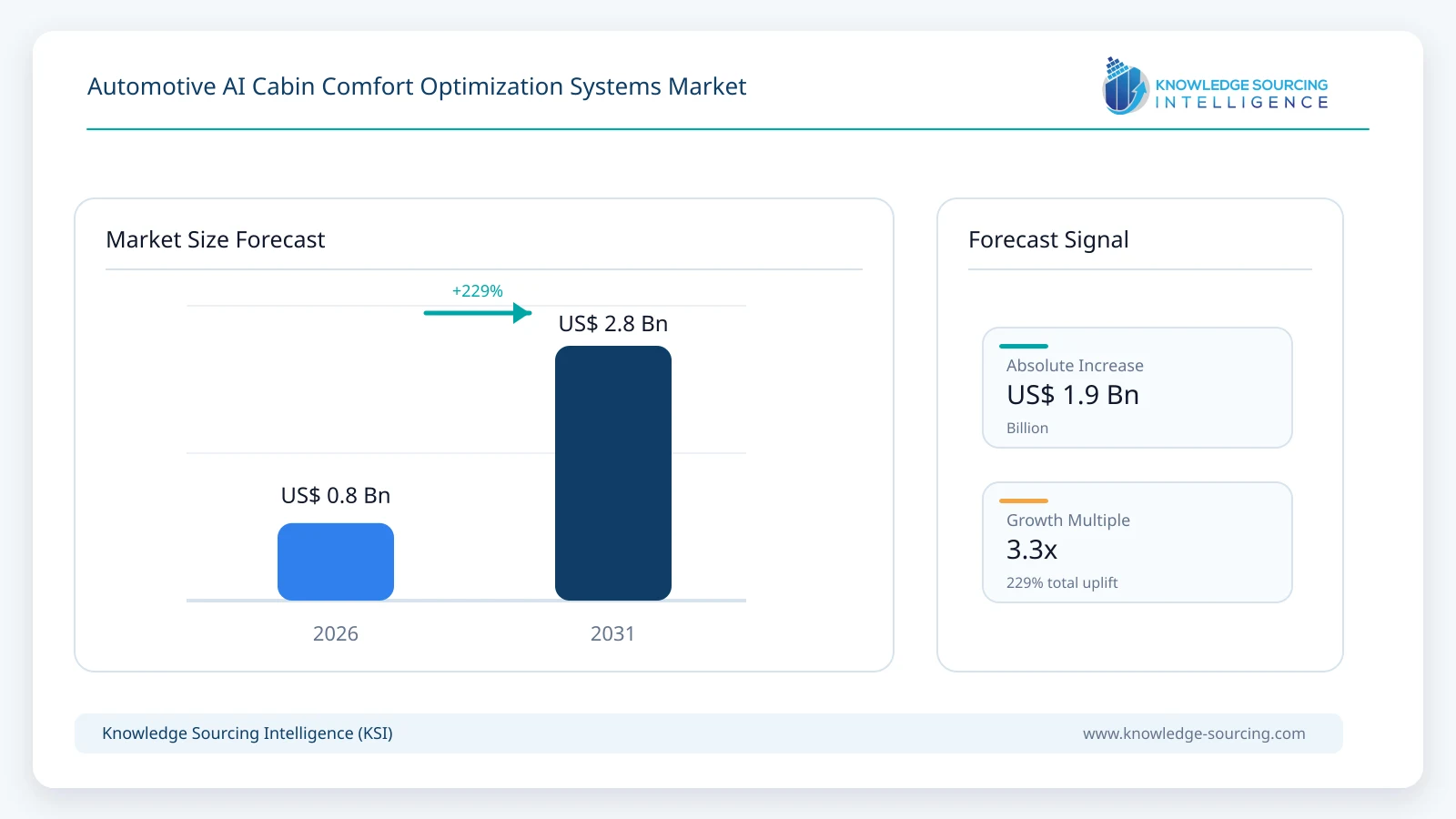
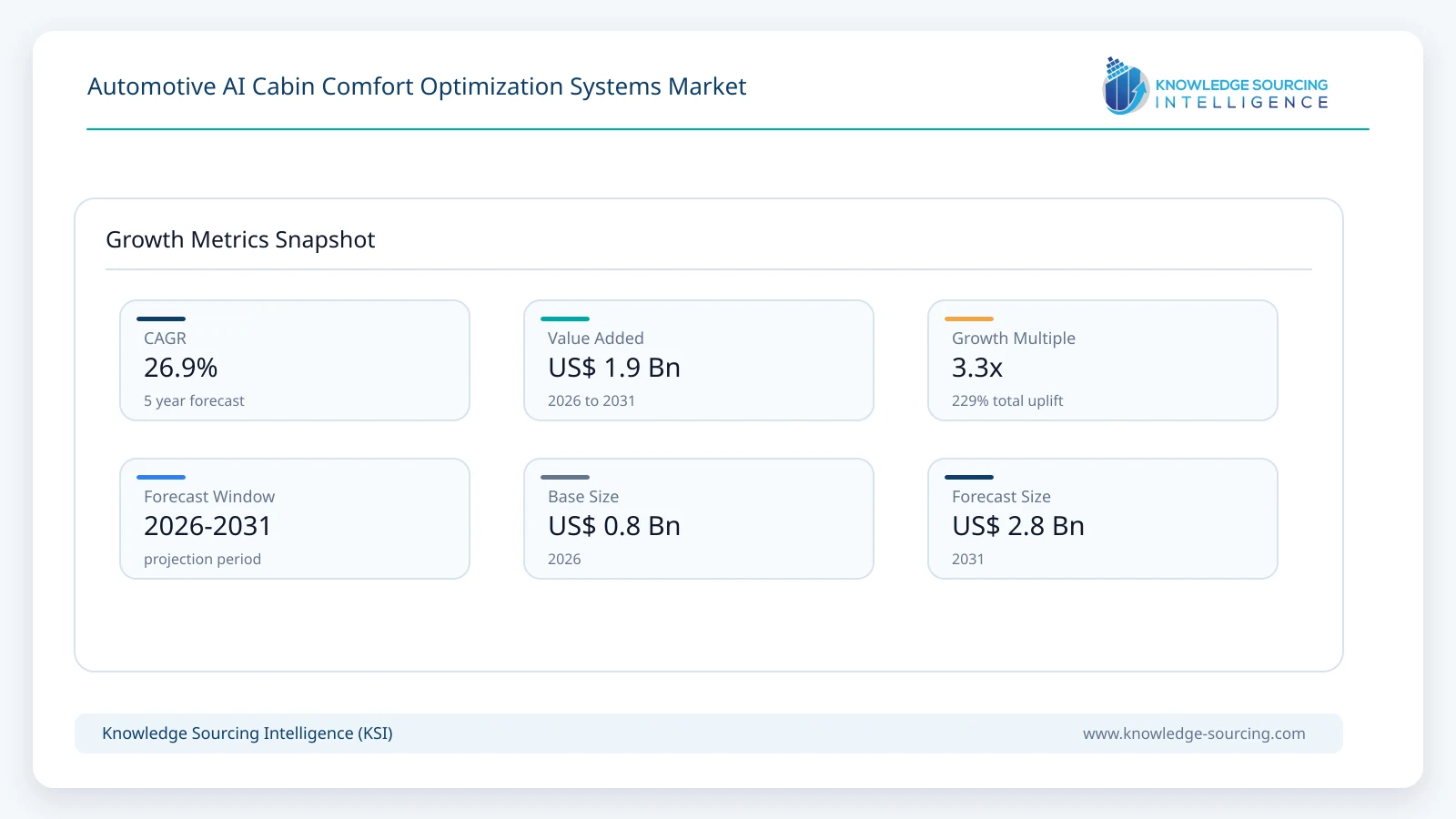
The Automotive AI Cabin Comfort Optimization Systems Market is forecast to grow at a CAGR of 26.9%, reaching USD 2.76 billion in 2031 from USD 0.84 billion in 2026.
Highlights:
- 1The global market is estimated at USD 0.84 billion in 2026 and is forecast to reach USD 2.76 billion by 2031, a 26.9% CAGR.
- 2AI climate and localized microclimate control accounts for approximately 44% of estimated 2026 revenue.
- 3Predictive and context-aware optimization is estimated at 33% of 2026 value and 38% in 2031.
- 4Premium and luxury vehicles represent about 48% of the estimated 2026 market, with broader mid-range adoption expected.
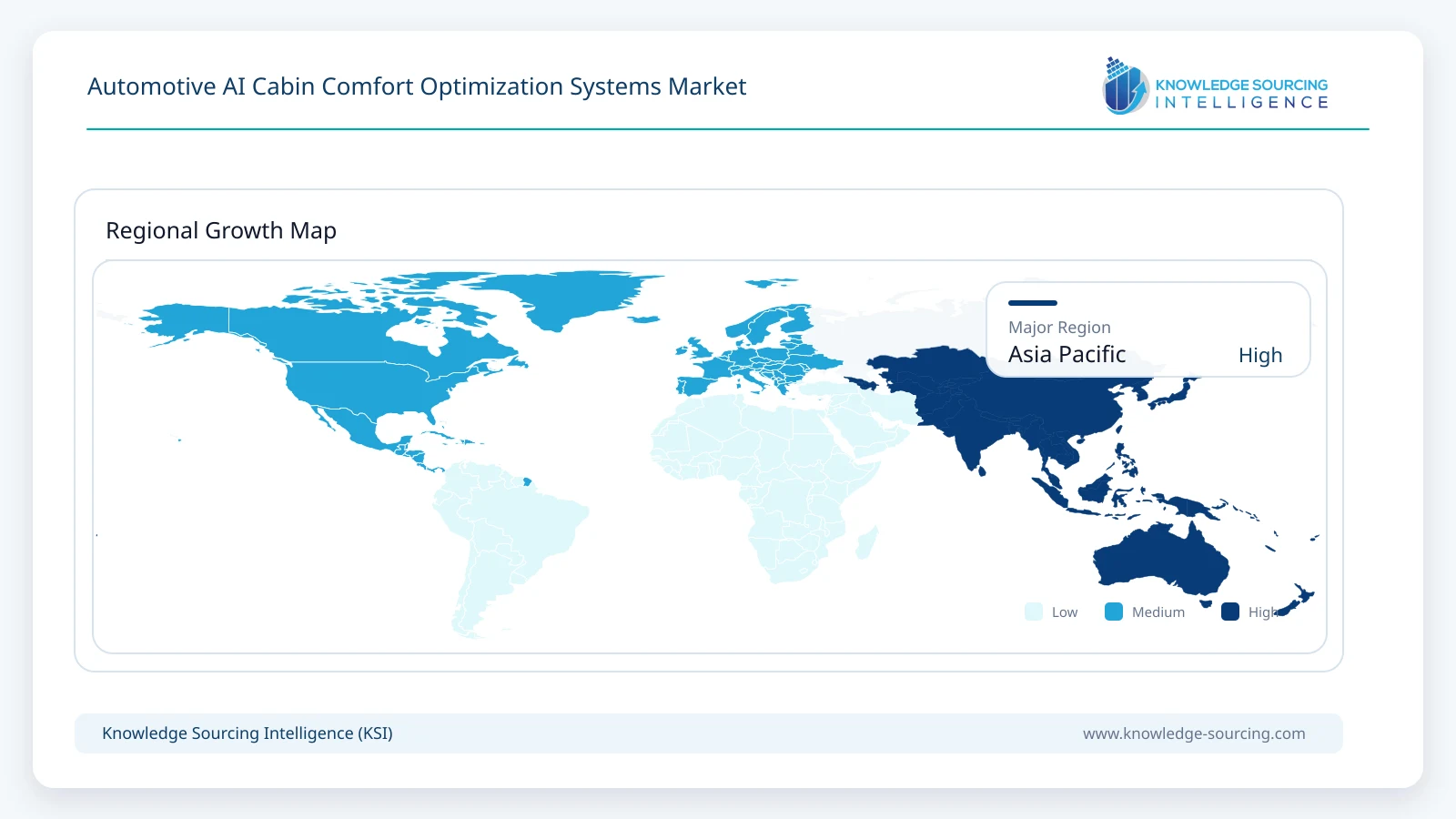
- 5Asia Pacific leads with an estimated 44% share in 2026 and is projected to reach 48% by 2031.
- 6Demand depends on occupant-specific comfort gains, electrical efficiency, sensor reliability and safe integration with HVAC controls.
Qualifying systems use occupant or environmental information to adjust at least one comfort function through adaptive control, rather than merely restoring a stored temperature or seat setting. The market includes identifiable AI-specific software, incremental comfort controls, and the integration needed to connect climate, seating, and related cabin functions.
Cabin comfort systems are increasingly designed around individual occupants rather than a single cabin-temperature target. Gentherm's ClimateSense integrates occupant-focused algorithms with localized heating and cooling, while Valeo's Dual Layer HVAC uses AI-based temperature and airflow control for four-zone operation. Suppliers must connect these capabilities to production vehicle architecture, preserve effective window demisting, and maintain predictable behavior when sensors or software become unavailable.
Market Overview
AI-based cabin comfort control uses occupant presence, temperature, solar exposure, thermal preferences and selected physiological or driving-context inputs to determine how heating, cooling, airflow and seat-based effectors should respond during a journey. Conventional automatic climate systems regulate air temperature against a set point; more advanced implementations estimate the comfort required by a particular occupant and coordinate the available hardware to achieve it. This can reduce unnecessary conditioning of unoccupied zones and improve the time taken to reach an acceptable comfort level, particularly in electric vehicles where cabin conditioning directly affects available driving energy.
Current production use of occupant-specific thermal control is strongest in seat-level microclimate and AI-assisted zonal HVAC, while the depth of coordination still differs across vehicle programs. Gentherm reports ClimateSense technology on Cadillac models, bringing occupant-focused thermal algorithms together with localized effectors, while Valeo secured Chinese OEM contracts for its AI-controlled four-zone HVAC architecture with serial production planned from 2026. Lear's seat thermal technologies add heating and ventilation close to the occupant. These examples show how intelligent software can be implemented through different combinations of climate hardware and seat-level components without requiring every vehicle to carry a complete multi-domain wellness system.
OEM engineering teams determine whether a comfort algorithm can use available cabin sensors, command HVAC and seat controllers, and maintain performance across climate conditions and vehicle trims. The supplier base consequently spans thermal-management specialists, seating manufacturers, cockpit software providers, and in-cabin sensing companies rather than a single software category. Competitive differentiation is linked to demonstrated comfort response, energy consumption, calibration effort and dependable control under unusual operating conditions, with occupant-data protection becoming increasingly relevant as systems incorporate personal profiles or physiological indicators.
Market Trends
Occupant-Level Thermal Models Are Replacing Uniform Cabin Control
Automakers are extending climate-control logic from average cabin temperature toward thermal responses based on occupant location, body exposure and available localized effectors. Gentherm's ClimateSense software coordinates convective, conductive, and radiant heating and cooling, allowing the system to target parts of the body instead of relying entirely on warming or cooling the cabin air. For vehicle programs, the commercial benefit depends on faster comfort and reduced HVAC demand, not the presence of an AI label alone.
Localized control needs careful calibration because comfort varies with clothing, sunlight, seat position and personal preference. The strongest solutions combine basic temperature regulation with an occupant-specific layer that can be disabled or overridden without impairing core HVAC operation.
Climate and Seating Controls Are Becoming Connected Comfort Systems
Seat ventilation and heating increasingly operate alongside zonal airflow and cabin temperature rather than as separate buttons. Lear's ComfortMax and ComfortFlex platforms consolidate comfort hardware, while advanced climate suppliers are developing interfaces that coordinate those effectors with central HVAC. Integrating these controls creates scope for occupant-level comfort scenes but also places new demands on command arbitration and software responsibility across suppliers.
When OEMs reuse existing HVAC modules and seat hardware, coordinated controllers can improve perceived comfort without introducing an entirely new climate module or compromising common hardware across trims. Program value depends on how much software and electronic control is newly attributable to that coordination.
Predictive Comfort Is Entering Vehicle Energy Decisions
Electric-vehicle climate software can use journey information, ambient conditions and battery state to determine when and how aggressively the cabin should be conditioned. MAHLE's intelligent thermal-management work with Mahindra demonstrates how interior and battery thermal functions can share a software control strategy, while Valeo's smart thermal-management portfolio combines cabin comfort with wider vehicle energy performance.
Predictive approaches can reduce peak conditioning requirements when occupants are about to enter the vehicle or when only selected seating positions are occupied. These capabilities are economically valuable only when energy savings can be established under representative driving and weather conditions.
Occupant Sensing Is Expanding Comfort Beyond Temperature
In-cabin sensing can connect driver fatigue, posture, and apparent stress with adjustments to lighting, audio, temperature and seat massage. HARMAN Ready Care demonstrates a commercial technology approach in which occupant-awareness software informs cabin responses, although availability of individual interventions depends on the vehicle program and installed effectors. This broader use case links comfort optimization with driver awareness without equating the two markets.
Access to camera or physiological information introduces privacy and consent requirements that are less demanding for conventional thermal sensors. Suppliers must therefore offer defined data-handling controls and prove that comfort actions do not interfere with safety-relevant alerts.
Software Reuse Is Becoming Important to Commercial Scale
Automotive groups are trying to adapt common comfort algorithms across different seating layouts, HVAC capacity and regional climates rather than commissioning a separate software design for every vehicle. Common interfaces can shorten development cycles, but the calibration required for different cabin geometries and thermal hardware remains substantial. Software value may grow even as duplicated engineering effort falls on mature platforms.
The transition is likely to favor companies that combine domain-specific human-comfort models with proven actuator interfaces and long-term automotive software support. General-purpose AI platforms without thermal calibration or vehicle validation provide only a limited substitute.
Segment Analysis
By Primary Comfort Domain: Climate and Localized Microclimate Control
Climate and localized microclimate optimization represents an estimated 44% of global market value in 2026, reflecting its direct connection to central HVAC, seat heating, and occupant-zone airflow. Gentherm and Valeo offer two different routes to this market, one using targeted thermal effectors and another using more intelligent distribution of conditioned air. Demand will depend on OEM willingness to pay for measurable comfort and energy benefits rather than basic automatic climate control already fitted as standard equipment.
Localized thermal software is expected to remain the largest individual domain through 2031 even as integrated comfort and wellness responses gain importance, especially on common electric-vehicle platforms.
By AI Control Architecture: Predictive and Context-Aware Optimization
Predictive and context-aware optimization accounts for an estimated 33% of value in 2026 and is projected to reach 38% by 2031 as control systems use more than immediate temperature readings. Route information, solar load, recent occupant feedback and vehicle energy state can improve preconditioning and comfort distribution across longer journeys. The architecture becomes more valuable when its predictions are validated against available HVAC and seat-system response times.
Cost and reliability constraints favor a mix of rule-based protections and adaptive models rather than uncontrolled algorithmic decision-making, particularly when window visibility or battery thermal limits take priority.
By Revenue Layer: AI Software and Comfort-Control Algorithms
Attributable AI software and control algorithms account for approximately 49% of 2026 value and grow toward 69% by 2031 as suppliers reuse software across wider vehicle fleets. The layer includes model calibration, occupant-zone optimization and the command logic linking eligible comfort effectors; it does not include the full value of seats, heat pumps or cockpit processors.
Software spending remains coupled to integration because a comfort application must interface with OEM climate controllers, occupant sensors and safety policies. Embedded software already included in hardware transaction values must be recognized once rather than counted again as a separate license.
By Vehicle Class: Premium and Luxury Vehicles
Premium and luxury vehicles represent approximately 48% of market value in 2026 because they offer multi-zone HVAC, ventilated seats, richer sensing and the electronic control capacity needed for coordinated comfort functions. High-end electric vehicles are particularly suitable early applications as manufacturers seek both individualized comfort and improved energy efficiency.
The premium contribution is projected to moderate to 38% by 2031 as standardized comfort electronics and reusable software move into mid-range vehicles. Entry-level adoption will remain selective where incremental sensors or seat effectors increase vehicle cost without a clear customer benefit.
Market Drivers
Electric-Vehicle Range and Thermal-Energy Efficiency
Battery electric vehicles expose cabin heating and cooling as meaningful electrical loads, particularly during cold-weather operation and short urban trips. AI comfort software can coordinate occupied zones, preconditioning and localized warmth so the vehicle does not need to condition every cubic meter of air at the same intensity. Gentherm's occupant-focused approach and Valeo's intelligent HVAC contracts show how suppliers are developing different methods to improve perceived comfort alongside energy performance.
OEM adoption depends on measured results under representative climates and usage patterns. Platforms able to show acceptable comfort with lower conditioning demand can justify software and sensing costs more readily than solutions promoted only as premium convenience features.
Growth of Seat-Level Thermal and Postural Comfort Features
Seat-integrated heating, ventilation, massage, and lumbar functions provide a practical group of effectors for personalized comfort control because they act close to the occupant. Lear's ComfortMax deployment with General Motors and subsequent ComfortFlex awards indicate commercial demand for more integrated seat-comfort modules, which can support coordinated control as OEM software architectures mature.
The opportunity extends beyond adding comfort hardware to connecting seat functions with cabin sensors and climate settings. Integrated controls can improve time-to-comfort, limit repeated manual changes and help suppliers differentiate vehicles without rebuilding complete HVAC systems.
Greater Availability of Occupant and Cabin Context Data
Vehicles increasingly contain sensors for occupancy, solar load, air quality and driver-state awareness, providing more information than traditional cabin temperature feedback alone. When properly integrated, this information can help optimization software identify which zones need conditioning and when changes in comfort settings are likely to be useful. HARMAN's Ready Care capabilities show how occupant context may inform cabin temperature, lighting or audio responses.
Reuse of already installed sensing hardware improves the economics of comfort optimization, but data quality and consumer consent still determine how broadly advanced features can be enabled. OEMs favor applications with predictable fallback behavior and limited processing requirements.
Increasing Premium Cabin Differentiation
Competition in premium and upper-midrange passenger vehicles is encouraging OEMs to distinguish their interiors through personalized experiences that respond automatically to changing conditions. Adaptive comfort software connects visible features such as ventilated seats, directional airflow and adjustable lighting into an integrated journey experience, making installed hardware more useful to occupants.
Chinese EV producers and established luxury brands are both raising expectations for tailored cabin features. The commercial opportunity remains program-specific because OEMs must establish whether customers perceive enough benefit to justify incremental software, calibration and sensor costs.
Improving Integration of HVAC, Seating and Vehicle Software
Shared vehicle computing and improved interfaces between body, climate, and seat controllers are making it easier to coordinate comfort functions that once operated independently. Thermal suppliers can deliver domain software while cockpit integrators supply occupant-context and orchestration capabilities, expanding the range of viable development partnerships.
Greater software reuse should gradually lower per-program integration effort and support wider adoption beyond flagship vehicles. The gains will be uneven because traditional vehicle platforms may require extensive gateway, actuator, and diagnostic work before coordinated comfort functions can operate reliably.
Market Restraints
High Incremental Cost and Uneven Customer Willingness to Pay
Advanced comfort optimization can require additional sensing, upgraded seat effectors, zonal air distribution and more extensive software calibration. The combined cost is difficult to justify on vehicles where basic automatic air conditioning already meets customer expectations, especially in price-sensitive markets and entry-level trims.
Manufacturers must decide which functions can reuse existing equipment and which require expensive new components. Systems offering modest improvements in comfort or energy use may remain limited to premium variants even when the associated algorithms are technically mature.
Calibration Challenges across Occupants and Operating Conditions
Human thermal comfort differs by clothing, age, physical activity, sunlight exposure and individual preference, making it difficult to validate a single algorithm for every occupant and climate. Seat position, interior material and cabin geometry also influence how quickly temperature adjustments are felt, increasing the test burden across vehicle variants.
Suppliers need practical calibration tools and robust override mechanisms rather than assuming a learned model can replace all manual settings. Poorly tuned responses risk generating occupant dissatisfaction and additional warranty or software-support work.
Safety, Demisting and Multi-System Control Dependencies
Comfort algorithms must operate within established HVAC safety functions, including windshield demisting, air quality and temperature-protection limits, even when occupant preferences suggest a different setting. Coordinated control across seats, vents and thermal-management units can create command conflicts if supplier responsibilities and system priorities are not clearly defined.
Verification work therefore extends beyond testing the AI model and includes fault handling, actuator limits and predictable fallback behavior. These requirements can delay integration into legacy electrical architectures and reduce the short-term benefit of software reuse.
Privacy Constraints on Occupant-State Information
Systems that adjust comfort using facial analysis, physiological signals or learned journey habits require more careful data handling than conventional temperature sensors. OEMs need to define which inputs are necessary, how long they are retained and whether the functions remain useful when an occupant declines optional sensing.
Privacy controls can restrict the information available to personalization algorithms, while regional differences in requirements add software-validation work. The strongest commercial designs limit data collection and keep core comfort functions available without remote processing.
Fragmented Hardware Architectures and Supplier Interfaces
Cabin control architectures vary widely across vehicle manufacturers, with climate units, seat modules, occupancy sensors and infotainment processors often supplied by different companies. Integrating adaptive software across these components can require bespoke gateways, diagnostics and release testing that reduce the value of a nominally reusable platform.
A multi-supplier system also raises questions about responsibility when an occupant complains of discomfort or a sensor causes inappropriate behavior. Platform adoption will depend on standardized interfaces, clear validation ownership and the willingness of OEMs to fund long-term software maintenance.
Regional Outlook
Asia Pacific
Asia Pacific represents an estimated 44% of 2026 revenue, supported by the region's vehicle-production scale and active development of EV cabin comfort systems. Chinese automakers are adopting sophisticated air-distribution and connected-cabin functions, with Valeo's announced Dual Layer HVAC contracts providing a specific example of commercial procurement. Japanese and South Korean suppliers also contribute thermal-control, sensing and integrated cockpit technologies across global vehicle platforms.
The region's share is projected to reach 48% by 2031 as adaptive comfort functions spread into mid-range electric vehicles and larger vehicle platforms. Adoption will remain uneven across price segments, and supplier program announcements should not be confused with full-volume feature deployment.
Europe
Europe accounts for an estimated 28% of 2026 revenue, supported by premium passenger vehicles, automotive thermal-management engineering and strong demand for efficient electric-vehicle systems. Gentherm, Valeo, FORVIA and other suppliers have development programs that combine occupant-centered comfort, seat technologies and software-managed thermal performance, with premium vehicle programs providing attractive initial deployment economics.
By 2031 the European share is estimated at 25% as faster growth in Asian vehicle production shifts the global value mix. The region remains commercially important for algorithm validation, advanced seat architecture and software integration, particularly where safety requirements and cold-weather operating conditions raise the performance threshold.
Competitive Landscape
The competitive landscape combines thermal comfort specialists, HVAC system suppliers, seating manufacturers and cabin software providers that contribute different parts of an occupant-focused control system. Gentherm supplies microclimate algorithms and thermal effectors, Valeo and MAHLE connect climate response with vehicle thermal management, and Lear integrates heating, ventilation and massage into seating products. DENSO, Hanon Systems, FORVIA and Hyundai Mobis participate in adjacent thermal, seating or cabin-system integration work, while HARMAN and Panasonic Automotive contribute sensing or connected-cabin software capabilities.
OEMs are increasingly evaluating how these components perform together rather than selecting each comfort feature only by its independent specification. Technology providers must demonstrate comfort improvement, energy use, safe actuator behavior, calibration effort and maintainability over successive software releases. Premium vehicle awards can establish technical credibility, but they do not automatically demonstrate adoption across a supplier's full customer base or justify treating complete climate-system revenue as AI optimization revenue.
Recent Developments
August 2026: Lear reported new second-quarter awards involving ComfortFlex and FlexAir in Europe and North America, highlighting continued OEM purchasing of modular thermal-comfort systems.
24 February 2026: FORVIA presented an intelligent-seat concept using sensors and software to adjust up to ten parameters based on occupant characteristics and driving conditions; it was an innovation presentation, not confirmation of fleet-wide production.
13 January 2026: HARMAN announced additional Ready Care and Ready Aware capabilities for in-cabin sensing and driver awareness, supporting occupant-context functions relevant to comfort response.
24 September 2025: Valeo disclosed further Dual Layer HVAC contracts in China and indicated that AI-enabled four-zone system serial production was expected to begin in 2026.
15 May 2025: MAHLE said Mahindra recognized its Intelligent Thermal Management System used on the BE 6 and XEV 9e platform for coordinated cabin and battery temperature control.
5 February 2025: Lear announced ComfortMax seat engineering integration with General Motors, targeting faster thermal response and more compact seat-comfort assembly.
Market Outlook
AI cabin comfort optimization is expected to expand as occupant-aware software becomes more closely connected to climate-control hardware, seat effectors and vehicle energy management. Localized thermal response is likely to remain the largest immediate application, while predictive comfort control and cross-domain coordination gain value as automakers integrate richer sensing and standardized software interfaces. Wider mid-market adoption depends on achieving measurable benefits without adding excessive equipment and calibration cost.
Asia Pacific is expected to account for a growing share of global demand, supported by Chinese electric-vehicle programs, while Europe remains important for premium development and thermal-control integration. Competitive advantage will favor suppliers that can demonstrate dependable performance across occupants, vehicle configurations, and climate conditions, with clear distinction between commercially deployed features and technology concepts.
Automotive AI Cabin Comfort Optimization Systems Market Scope:
| Report Metric | Details |
|---|---|
| Total Market Size in 2026 | USD 0.84 billion |
| Total Market Size in 2031 | USD 2.76 billion |
| Forecast Unit | USD Billion |
| Growth Rate | 26.9% |
| Study Period | 2021 to 2031 |
| Historical Data | 2021 to 2024 |
| Base Year | 2025 |
| Forecast Period | 2026 – 2031 |
| Segmentation | Primary Comfort Domain, AI Control Architecture, Revenue Layer, Vehicle Class |
| Companies |
|
Market Segmentation
By Primary Comfort Domain
AI Climate and Localized Microclimate Control
Seat Thermal and Postural Optimization
Occupant Wellness Response
Cross-Domain Comfort Coordination
By AI Control Architecture
Adaptive Reactive Comfort Control
Predictive and Context-Aware Optimization
Occupant-State Adaptive Optimization
By Revenue Layer
AI Software and Control Algorithms
Incremental Sensing and Comfort Electronics
Integration, Validation and Lifecycle Services
By Vehicle Class
Premium and Luxury Vehicles
Mid-Range Vehicles
Entry-Level and Economy Vehicles
By Vehicle Type
Passenger Vehicles
Light Commercial Vehicles
Medium and Heavy Commercial Vehicles
By Propulsion
Battery Electric Vehicles
Hybrid and Plug-In Hybrid Vehicles
Internal-Combustion Vehicles
By Geography
North America
United States
Canada
Mexico
South America
Brazil
Argentina
Others
Europe
Germany
United Kingdom
France
Italy
Spain
Others
Middle East and Africa
Saudi Arabia
United Arab Emirates
South Africa
Others
Asia Pacific
China
Japan
South Korea
India
Australia
Indonesia
Others
Table of Contents
1. EXECUTIVE SUMMARY
2. MARKET SNAPSHOT
2.1. Market Overview
2.2. Market Definition
2.3. Scope
2.4. Market Segmentation
3. BUSINESS LANDSCAPE
3.1. Market Drivers
3.1.1. Electric-Vehicle Range and Thermal-Energy Efficiency
3.1.2. Growth of Seat-Level Thermal and Postural Comfort Features
3.1.3. Greater Availability of Occupant and Cabin Context Data
3.1.4. Increasing Premium Cabin Differentiation
3.1.5. Improving Integration of HVAC, Seating and Vehicle Software
3.2. Market Restraints
3.2.1. High Incremental Cost and Uneven Customer Willingness to Pay
3.2.2. Calibration Challenges across Occupants and Operating Conditions
3.2.3. Safety, Demisting and Multi-System Control Dependencies
3.2.4. Privacy Constraints on Occupant-State Information
3.2.5. Fragmented Hardware Architectures and Supplier Interfaces
3.3. Market Opportunities
3.4. Porter’s Five Forces Analysis
3.5. Industry Value Chain Analysis
3.6. Policies and Regulations
3.7. Strategic Recommendations
4. TECHNOLOGICAL OUTLOOK
4.1. Occupant-Centric Thermal Sensing and Comfort Models
4.2. AI Control Algorithms and Predictive Comfort
4.3. Climate, Seat and Wellness Actuator Integration
4.4. On-Device Inference, Diagnostics and Software Updates
5. AUTOMOTIVE AI CABIN COMFORT OPTIMIZATION SYSTEMS MARKET BY PRIMARY COMFORT DOMAIN
5.1. AI Climate and Localized Microclimate Control
5.2. Seat Thermal and Postural Optimization
5.3. Occupant Wellness Response
5.4. Cross-Domain Comfort Coordination
6. AUTOMOTIVE AI CABIN COMFORT OPTIMIZATION SYSTEMS MARKET BY AI CONTROL ARCHITECTURE
6.1. Adaptive Reactive Comfort Control
6.2. Predictive and Context-Aware Optimization
6.3. Occupant-State Adaptive Optimization
7. AUTOMOTIVE AI CABIN COMFORT OPTIMIZATION SYSTEMS MARKET BY REVENUE LAYER
7.1. AI Software and Control Algorithms
7.2. Incremental Sensing and Comfort Electronics
7.3. Integration, Validation and Lifecycle Services
8. AUTOMOTIVE AI CABIN COMFORT OPTIMIZATION SYSTEMS MARKET BY VEHICLE CLASS
8.1. Premium and Luxury Vehicles
8.2. Mid-Range Vehicles
8.3. Entry-Level and Economy Vehicles
9. AUTOMOTIVE AI CABIN COMFORT OPTIMIZATION SYSTEMS MARKET BY VEHICLE TYPE
9.1. Passenger Vehicles
9.2. Light Commercial Vehicles
9.3. Medium and Heavy Commercial Vehicles
10. AUTOMOTIVE AI CABIN COMFORT OPTIMIZATION SYSTEMS MARKET BY PROPULSION
10.1. Battery Electric Vehicles
10.2. Hybrid and Plug-In Hybrid Vehicles
10.3. Internal-Combustion Vehicles
11. AUTOMOTIVE AI CABIN COMFORT OPTIMIZATION SYSTEMS MARKET BY GEOGRAPHY
11.1. North America
11.1.1. United States
11.1.2. Canada
11.1.3. Mexico
11.2. South America
11.2.1. Brazil
11.2.2. Argentina
11.2.3. Others
11.3. Europe
11.3.1. Germany
11.3.2. United Kingdom
11.3.3. France
11.3.4. Italy
11.3.5. Spain
11.3.6. Others
11.4. Middle East and Africa
11.4.1. Saudi Arabia
11.4.2. United Arab Emirates
11.4.3. South Africa
11.4.4. Others
11.5. Asia Pacific
11.5.1. China
11.5.2. Japan
11.5.3. South Korea
11.5.4. India
11.5.5. Australia
11.5.6. Indonesia
11.5.7. Others
12. COMPETITIVE ENVIRONMENT AND ANALYSIS
12.1. Major Players and Strategies
12.2. Market Share Analysis
12.3. Mergers, Acquisitions and Collaborations
12.4. Technology and OEM Program Benchmarking
12.5. Competitive Dashboard
13. COMPANY PROFILES
13.1. Gentherm Incorporated
13.2. Valeo SA
13.3. Lear Corporation
13.4. DENSO Corporation
13.5. MAHLE GmbH
13.6. Hanon Systems
13.7. FORVIA SE
13.8. HARMAN International
13.9. Hyundai Mobis Co., Ltd.
13.10. Panasonic Automotive Systems Co., Ltd.
13.11. Yanfeng
14. APPENDIX
14.1. Currency
14.2. Assumptions
14.3. Base and Forecast Years
14.4. Key Benefits to Stakeholders
14.5. Research Methodology
14.6. Abbreviations
14.7. Data Sources
Navigate
Trusted by the world's leading organizations











