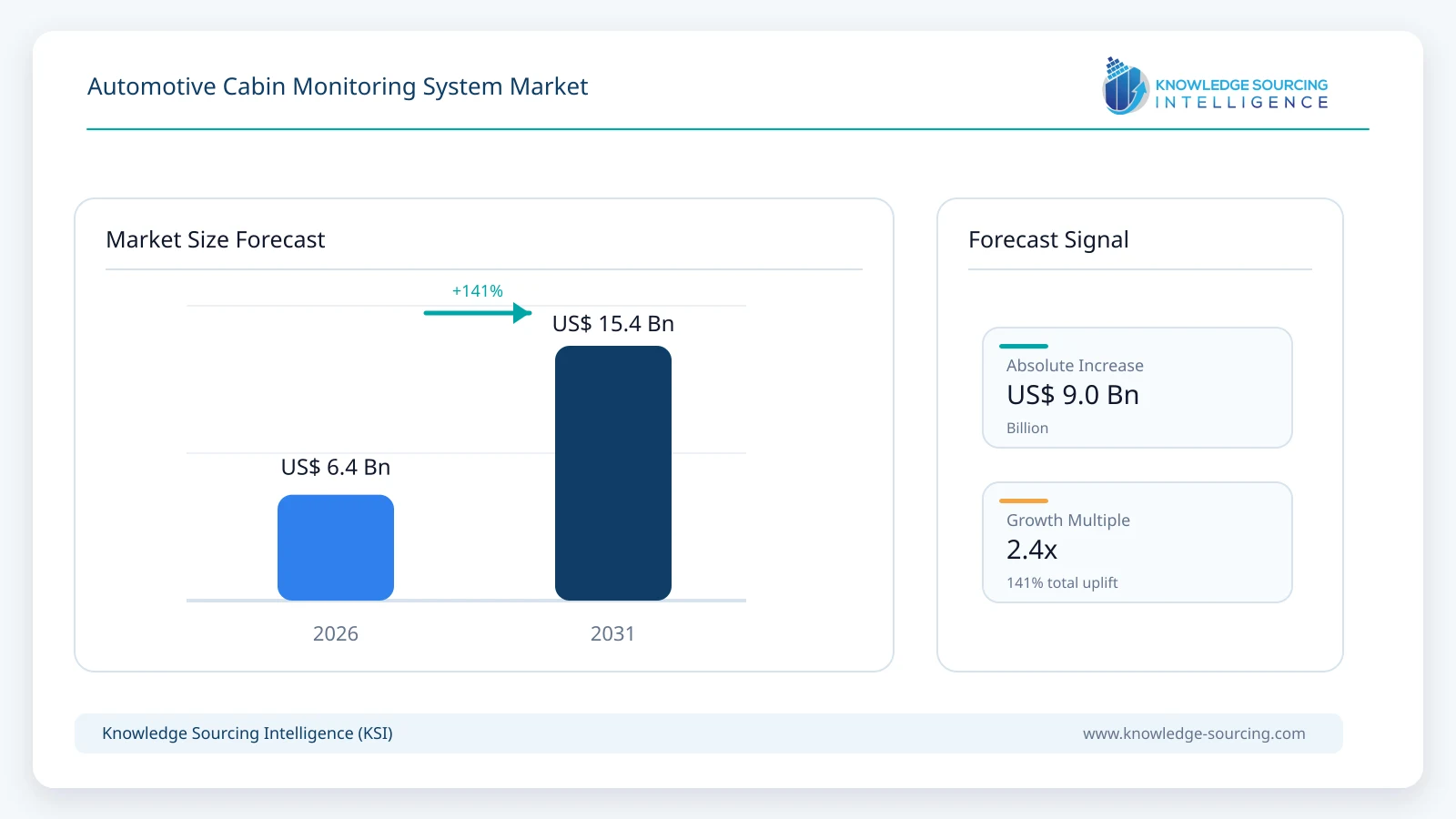
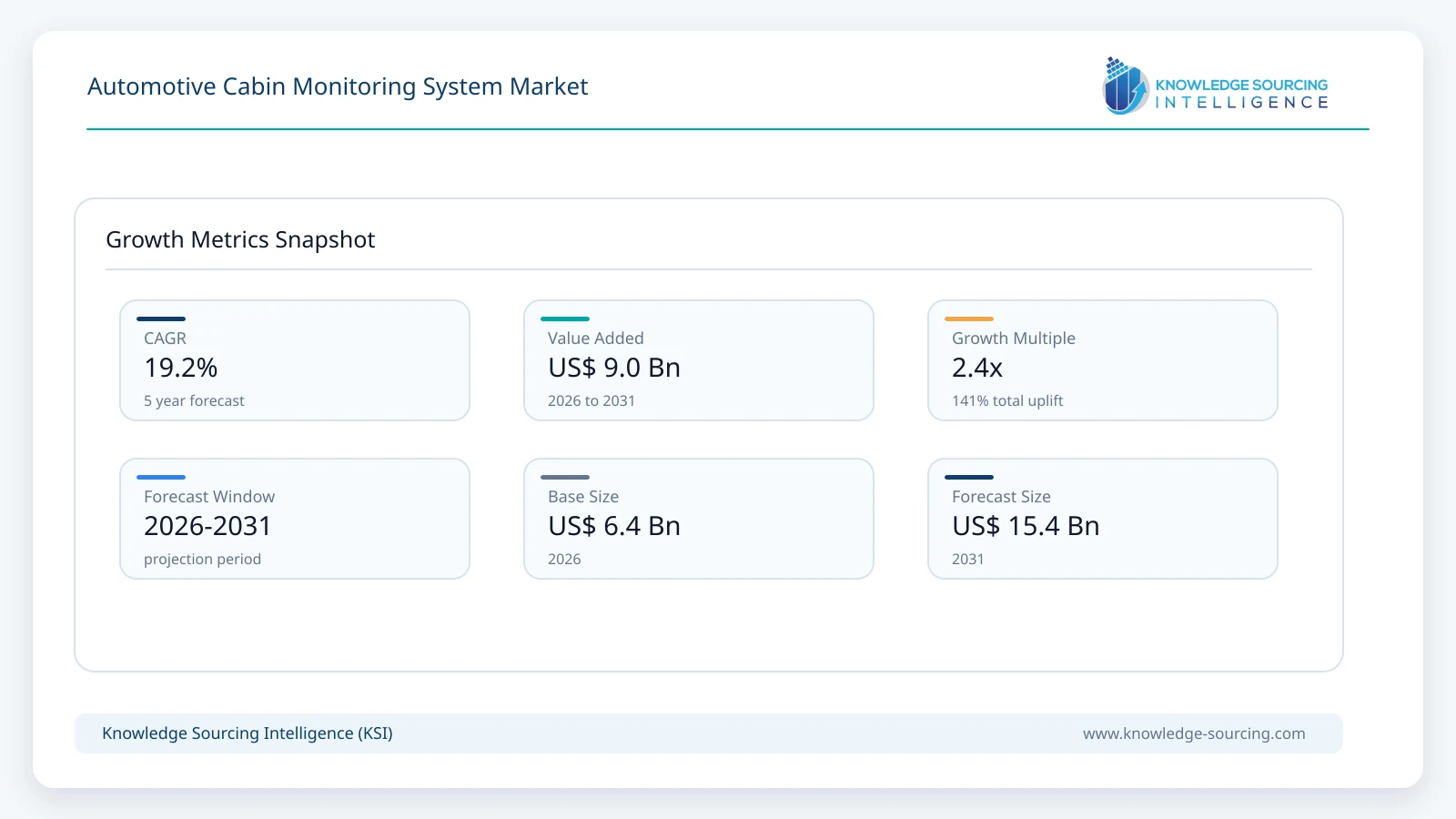
The automotive cabin monitoring system market is estimated at approximately USD 6.40 billion in 2026 and is projected to reach about USD 15.40 billion by 2031, representing a CAGR of 19.2% during the forecast period.
Highlights:
- 1Camera-based and camera-led cabin monitoring systems account for approximately 55% of global market value in 2026 because cameras remain the primary source for gaze, eyelid, head-pose, posture, activity, identity, seat-belt and object-recognition functions.
- 2Integrated driver and occupant monitoring architectures represent approximately 48% of market value in 2026 as OEMs increasingly combine DMS and OMS through shared cameras, illumination, compute and perception software rather than deploying isolated systems.
- 3Safety-oriented driver-state and occupant-protection functions account for approximately 46% of 2026 market value, supported by distraction and drowsiness monitoring, child presence, occupant classification, restraint context and passive-safety optimization.
- 4Centralized and domain-integrated processing architectures account for approximately 52% of market value in 2026 as cabin monitoring migrates from dedicated ECUs toward cockpit HPCs, central vehicle computers and shared in-cabin perception layers.
- 5Passenger vehicles represent approximately 91% of global market value in 2026 because regulatory and NCAP pressure, high production volumes and premium smart-cabin features are concentrated in passenger cars, SUVs and MPVs.
- 6Europe represents approximately 36% of global market value in 2026, supported by Euro NCAP 2026 occupant-monitoring protocols, EU driver-monitoring requirements and strong production activity among European OEMs and Tier 1 suppliers.
Cabin monitoring is advancing from separate driver-facing cameras and basic seat-occupancy sensors toward integrated architectures that maintain a real-time understanding of driver readiness, occupant presence, posture, classification, restraint status, activity and selected physiological conditions across the vehicle interior. This shift expands the role of cabin sensing from a set of discrete safety functions into a common perception layer supporting driver monitoring, occupant protection and increasingly automated vehicle operation.
Commercial deployment is broadening as OEMs seek monitoring platforms that can be reused across vehicle lines and functions. Smart Eye and Seeing Machines are extending combined DMS/OMS software across European, Japanese and global OEM programs, while Magna and Gentex are using the interior mirror as a scalable location for cameras, illumination and processing. Valeo, Bosch, HARMAN, Aptiv, LG, FORVIA and AUMOVIO are likewise integrating in-cabin perception with passive safety, cockpit and software-defined vehicle architectures. The underlying commercial advantage is hardware and software reuse: a camera introduced for distraction monitoring can also support occupant detection, seat-belt recognition and personalization, while radar and depth sensing can add child-presence, vital-sign and body-pose functions. This consolidation increases software content per vehicle and reduces dependence on separate single-purpose sensors and controllers.
Market Overview
Cabin monitoring converts activity inside the passenger compartment into a structured, continuously updated view of driver condition, occupant presence and broader cabin context. Near-infrared and RGB-IR cameras form the most mature part of the architecture by tracking gaze, eye closure, head pose and facial behaviour for distraction, drowsiness, impairment and driver-readiness functions. Wide-angle cameras, cabin radar, depth sensors and seat-based inputs extend that perception beyond the driver to passengers, children, objects, seating positions and seat-belt use, allowing the same cabin-awareness layer to support active safety, passive safety, automated-driving handover and emergency-response functions.
No single sensing technology provides equally strong performance across every cabin condition, which is increasing the importance of multimodal architectures. Cameras offer rich semantic information, radar can detect micro-motion and life presence when occupants are partially obscured, and Time-of-Flight or structured-light sensing improves three-dimensional body-pose and position estimation. Bosch, Infineon, Gentex and AUMOVIO position combinations of these technologies as a route to higher reliability, while platforms such as Seeing Machines' 3D Cabin Perception Mapping illustrate the broader architectural shift toward one common representation of occupants and activity that can be reused across camera positions, vehicle programs and functions rather than maintaining a separate perception pipeline for each feature.
Market Trends
Integrated DMS/OMS Is Replacing Isolated Monitoring Functions
Automakers are increasingly selecting platforms that monitor both the driver and the remaining cabin through shared hardware and software. Smart Eye, Seeing Machines, Magna and Valeo all have current programs or product architectures that combine DMS and OMS, allowing the same system to support driver attention, passenger presence, child detection and other interior functions.
By reusing cameras, infrared illumination, embedded processing and software interfaces across several safety features, a combined DMS/OMS platform can lower duplication while giving OEMs a cleaner migration path as regulations expand from driver monitoring toward broader occupant-awareness requirements.
Mirror-Integrated Monitoring Is Becoming a Scalable Packaging Architecture
The interior rear-view mirror is emerging as an important monitoring location because it provides a central, elevated view of the driver and much of the cabin while already containing power, electronics and communication infrastructure. Magna, Smart Eye, Seeing Machines-linked Tier 1 programs and Gentex are all using or supporting mirror-integrated architectures.
A mirror-based module can reduce visible hardware, preserve cockpit styling and provide a common package that transfers more easily across vehicle lines. That portability is especially useful for OEMs scaling DMS/OMS without developing a different camera installation for every instrument panel or display architecture.
Full-Cabin 3D Perception Is Replacing Feature-by-Feature Pipelines
Interior perception software is moving toward a unified representation of the complete cabin. Seeing Machines demonstrated a 3D Cabin Perception Mapping architecture capable of supporting multiple cameras, multiple occupants and multiple features from a common high-trust perception layer rather than solving each function independently.
Using one underlying cabin model also reduces redevelopment when camera positions or interior layouts change. Body-pose recognition, passenger localization, child monitoring, restraint adaptation and future automated-driving functions can consume the same perception layer rather than depend on separate feature-specific pipelines.
Camera, Radar and Depth Fusion Is Raising Recognition Robustness
Camera-only architectures remain commercially important, but higher-end monitoring systems increasingly combine imaging with radar or depth sensing. Bosch pairs occupant-monitoring cameras with cabin sensing radar, Infineon combines 60 GHz radar with REAL3 Time-of-Flight sensing, and Gentex is developing structured-light-based 3D cabin monitoring.
Radar can confirm life presence when a child is covered or poorly visible, while cameras identify posture and objects and depth sensors improve three-dimensional position estimates. Combining those strengths makes the monitoring stack more robust across lighting conditions, seating positions and occlusion scenarios.
Cabin Monitoring Is Becoming a Shared Input to Safety and Experience Domains
The same in-cabin intelligence increasingly feeds both safety and user-experience functions. HARMAN Ready Care uses driver and occupant state to trigger interventions, FORVIA links monitoring inputs with cockpit behavior, and LG uses its in-cabin perception platform for safety, personalization and passenger interaction.
Once the same sensing stack is shared across safety and experience domains, a system justified initially by NCAP compliance can also support personalized seats, climate zoning, digital assistants, content routing, health monitoring or post-crash occupant information. This software reuse raises the value of each installed sensor without requiring a separate hardware architecture for every added function.
Segment Analysis
By Monitoring Scope: Integrated Driver and Occupant Monitoring Systems
Integrated Driver and Occupant Monitoring Systems represent the principal growth segment because OEMs increasingly want one cabin-awareness architecture that can satisfy both driver-state and occupant-safety requirements. The system typically combines a driver-facing perception stack with wider cabin coverage, allowing the same hardware family and software framework to support distraction, drowsiness, driver readiness, passenger presence, child detection, seat-belt monitoring and selected personalization functions.
Integrated driver and occupant monitoring systems are expected to reach approximately USD 8.25 billion by 2031. Growth is being supported by mirror-integrated architectures, shared infrared illumination, centralized processing and regulatory convergence. Seeing Machines secured a European DMS/OMS mirror program in July 2026 and expanded an existing global production program by an estimated US$31 million in June 2026, while Magna won a European OEM DMS/OMS program built around a mirror-integrated hardware and software platform. The commercial advantage extends beyond component consolidation because one integrated cabin model can serve passive safety, automated-driving handover, child protection and HMI, allowing OEMs to add functions over time without installing a separate sensing system for each use case.
By Sensing Technology: Camera-Based Cabin Monitoring
Camera-based monitoring remains the largest sensing segment because cameras provide the richest semantic information inside the cabin. RGB, RGB-IR and near-infrared imaging can support gaze tracking, eye-state analysis, head pose, hand and object detection, seat-belt routing, body posture, occupant classification and identity recognition from a common optical platform. Infrared illumination also allows performance at night without relying on visible cabin light.
Camera-based cabin monitoring is forecast to reach approximately USD 7.90 billion by 2031. Adoption benefits from regulatory-driven DMS hardware already entering mass-market vehicles, which creates an installed optical platform for additional OMS functionality. Smart Eye's August 2026 mirror-integrated program uses both infrared and color images for driver attention and full-cabin occupant activity, while Aptiv's Advanced Occupancy Classification demonstrates how software can use an existing interior camera to estimate occupant height, weight, posture and seating position. Cameras still face occlusion, eyewear and geometry limitations, but their ability to support many visible behaviors and objects from a common sensor keeps the technology economically attractive even as radar and depth fusion expand.
By Monitoring Function: Safety-Oriented Driver and Occupant Monitoring
Safety-oriented monitoring is the largest functional segment because regulation and consumer testing provide a direct route to series-production adoption. The category includes driver distraction and drowsiness, readiness and impairment assessment, child-presence detection, passenger occupancy and classification, seat-belt status, posture recognition and information used to optimize restraint and airbag behavior.
By 2031, safety-oriented driver and occupant monitoring is expected to approach approximately USD 7.10 billion. Euro NCAP's 2026 framework increases the commercial value of both driver monitoring and occupant presence, while EU regulatory timelines continue to expand requirements for driver drowsiness, attention and distraction warning. System value rises further when monitoring data are linked to intervention: driver-state information can support safe-stop or ADAS responses, while occupant position and classification can improve airbag suppression and restraint behavior. Bosch, HARMAN, Aptiv and AUMOVIO all position cabin monitoring as an input to broader safety logic rather than a passive warning function.
By Processing Architecture: Centralized and Domain-Integrated Cabin Monitoring
Centralized and domain-integrated processing is becoming the leading architecture as software-defined vehicles consolidate cockpit, ADAS and body functions onto high-performance computers. Instead of placing a complete processor beside every camera or radar, OEMs can stream cabin sensor data to a cockpit domain controller or central vehicle computer and run DMS, OMS and other perception functions through shared compute resources.
Centralized and domain-integrated cabin monitoring could account for approximately USD 8.50 billion by 2031 as OEMs consolidate more in-cabin perception onto shared compute platforms. Magna explicitly aligns its mirror-integrated DMS/OMS with centralized vehicle compute, Bosch offers monitoring functions that can run on vehicle computers or dedicated ECUs, and LG is combining in-cabin sensing with multi-domain HPC and AI software. Centralization reduces ECU duplication and improves sensor fusion, while also enabling software licensing and updates after start of production. The trade-off is greater pressure on cybersecurity, deterministic performance and compute-resource management because several safety-relevant functions may share the same processor.
By Vehicle Type: Passenger Vehicles
Passenger vehicles form the dominant demand pool because the strongest regulatory, NCAP and premium-cabin drivers are concentrated in passenger cars, SUVs and MPVs. High annual production volumes magnify the impact of even modest monitoring content per vehicle, while rapid deployment of large displays, centralized cockpit computers and semi-automated driving provides the electronic foundation needed for more capable interior sensing.
Passenger vehicles are forecast to represent approximately USD 14.0 billion of market value by 2031. Deployment is broadening from premium models into upper-mid and mass-market vehicles as DMS becomes a standard safety feature and integrated DMS/OMS reduces the incremental cost of wider cabin coverage. Smart Eye, Seeing Machines, Magna and Gentex all emphasize scalable architectures that can span multiple vehicle lines. Commercial vehicles, buses and shared mobility remain relevant secondary opportunities, but passenger vehicles retain the strongest value concentration because they combine regulatory volume, consumer-rating pressure and higher willingness to pay for comfort and personalization.
Market Drivers
Euro NCAP and Regulatory Expansion of Driver and Occupant Monitoring
Regulation and consumer testing are the strongest structural adoption drivers because they move cabin monitoring from optional premium equipment into platform-level safety content. Euro NCAP's 2026 protocols place greater emphasis on real-time driver engagement and separately score occupant-presence functions such as child detection and crash-occupancy information. EU rules also continue to expand drowsiness, attention and distraction-warning requirements across new vehicle approvals.
Platform-level procurement follows directly from these requirements. OEMs increasingly need monitoring performance across broad model ranges rather than only on flagship vehicles, encouraging scalable camera positions, reusable software and multi-function platforms. Recent Smart Eye, Seeing Machines and Magna program awards show suppliers being selected for vehicle platforms, often through Tier 1 partners, rather than for isolated one-model demonstrations.
Growth of Automated Driving and the Need to Verify Driver Readiness
Higher levels of driving assistance increase the importance of knowing whether the driver is attentive, available and capable of taking control. A vehicle cannot safely transfer responsibility from automation to a person without understanding gaze, drowsiness, distraction and potentially impairment or sudden health events. Cabin monitoring therefore becomes part of the operational design of assisted and automated driving rather than a separate comfort feature.
Continuous confidence in driver state becomes more valuable as assisted-driving capability increases. Bosch positions interior sensing as an enabler for determining driver takeover ability, while Gentex and HARMAN are extending monitoring into cognitive state, vital signs and sudden-sickness detection. Stronger state estimation and clearer intervention logic therefore support higher software content per vehicle.
Sensor Consolidation and the Economics of Multi-Function Cabin Awareness
Cabin monitoring can replace or supplement several single-purpose sensors by using one camera, radar or fused sensing stack for multiple functions. Aptiv's camera-only occupancy classification can reduce reliance on traditional in-seat hardware, while radar can combine child presence, occupancy, intrusion and vital-sign functions. Mirror-integrated DMS/OMS can similarly reuse camera, illumination and processing resources across driver and passenger monitoring.
Reusing one sensing stack changes the total-cost calculation even when a sophisticated camera or radar module costs more than a basic pressure sensor. Wiring, ECU, calibration and packaging requirements can be reduced across the full cabin, and additional software functions can be added to hardware that is already installed. This helps shift cabin monitoring from a compliance cost toward reusable digital infrastructure.
Software-Defined Vehicles and Centralized Compute
Centralized vehicle computers provide the processing capacity and software architecture required to combine DMS, OMS, radar, depth and other interior signals. Cabin monitoring can therefore operate as a shared service that publishes driver and occupant context to safety, cockpit, comfort and connected-service applications instead of remaining isolated within one dedicated ECU.
Magna, Bosch, LG, FORVIA and AUMOVIO all position monitoring within broader software-defined or centralized architectures. This allows OEMs to scale functions through common hardware platforms and over-the-air updates, while suppliers can monetize algorithms, calibration and new features over the vehicle lifecycle. The trend raises demand for hardware abstraction and modular software that can operate across several SoCs and camera configurations.
Expansion of Child Protection, Passive Safety and Full-Cabin Awareness
Cabin monitoring is gaining importance because safety systems increasingly need information about every occupant, not only the driver. Direct child-presence detection, seat-belt routing, body position, adult-versus-child classification and crash-occupancy counts all require reliable sensing across rear and third-row seating positions. Flexible seating and highly automated interiors make fixed assumptions about passenger location less reliable.
Radar, depth sensing and wider-angle cameras are expanding the addressable function set. Euro NCAP requires direct sensing for child-presence scoring, while Bosch, Infineon, Gentex and AUMOVIO offer technologies capable of detecting life presence, body pose or passenger classification. These applications create incremental value beyond DMS and support broader adoption of full-cabin monitoring hardware.
Market Restraints
Recognition Accuracy across Diverse Occupants and Real-World Conditions
Cabin-monitoring systems must perform across different ages, body sizes, skin tones, facial structures, eyewear, clothing and seating positions. Performance can also be affected by sunlight, darkness, reflections, sunglasses, masks, partial occlusion, child seats and passengers moving between normal and reclined postures. These conditions make real-world recognition materially more difficult than controlled laboratory demonstrations.
OEM approval requires high detection rates across global populations and vehicle interiors, especially where monitoring affects seat-belt warnings, airbag decisions or automated-driving handover. Meeting that standard demands large training data sets, demographic performance analysis, confidence scoring and repeatable vehicle-specific validation, and a weak edge case can delay program approval even when the core algorithm performs well in typical conditions.
Privacy and Acceptance of Continuous In-Cabin Observation
Interior cameras, identity recognition, voice-related context and physiological monitoring can create stronger privacy concerns than exterior vehicle sensing. Passengers may not have chosen the vehicle or accepted the same data terms as the owner, while biometric or health-related signals can be especially sensitive. Continuous recording or cloud transmission can therefore create significant regulatory and consumer-acceptance risk.
Local processing, data minimization and closed-loop architectures are becoming the preferred response to these concerns. EU vehicle-safety rules explicitly limit retention for some driver-monitoring data, and suppliers increasingly emphasize on-device analysis rather than storing raw imagery. OEMs still need clear consent, cybersecurity and separation between mandatory safety processing and optional personalization if monitoring is to remain trusted by occupants.
Higher Hardware, Compute and Thermal Requirements for Multimodal Systems
A high-performance cabin-monitoring system can require multiple cameras, infrared emitters, radar, depth sensing and substantial AI compute. These components add bill-of-materials cost, wiring, power consumption and thermal load. Large cabins may need additional sensing positions to cover rear rows or changing seat configurations, further increasing complexity.
Even with centralized compute, OEMs must provision processors for peak vision and AI workloads over long vehicle lifecycles while infotainment or ADAS software may be using the same hardware. Cost pressure therefore favors efficient neural networks, sensor consolidation and architectures that reuse hardware already required by regulation instead of adding dedicated monitoring modules for every new function.
Vehicle-Specific Packaging, Calibration and Integration Complexity
Cabin geometry has a direct impact on monitoring performance. Steering wheels, displays, mirrors, roof consoles, seatbacks and interior trim can block the camera field of view or change radar propagation. A sensor position that performs well in one sedan may not provide the same coverage in a three-row SUV, MPV or vehicle with rotating seats.
Each vehicle platform therefore requires renewed work on camera optics, illumination, exposure control, radar antenna placement and body-pose calibration. Mirror-integrated and hardware-independent software architectures reduce the burden but do not eliminate it, giving an advantage to suppliers with strong validation tooling and flexible sensor-location support.
AI Lifecycle, Cybersecurity and Functional-Safety Validation
Cabin monitoring increasingly relies on machine-learning models that can evolve faster than the vehicle hardware around them. OEMs must manage model versions, cybersecurity vulnerabilities, training-data changes and performance drift over a vehicle life that may exceed a decade. Over-the-air updates create opportunities for improvement but also expand the validation surface.
When monitoring output influences airbag logic, automated-driving handover or emergency response, model updates cannot be treated like ordinary infotainment releases. Suppliers need controlled update processes, traceable performance and clear separation between safety-certified functions and faster-moving personalization features as algorithms evolve over the vehicle lifecycle.
Regional Outlook
Europe
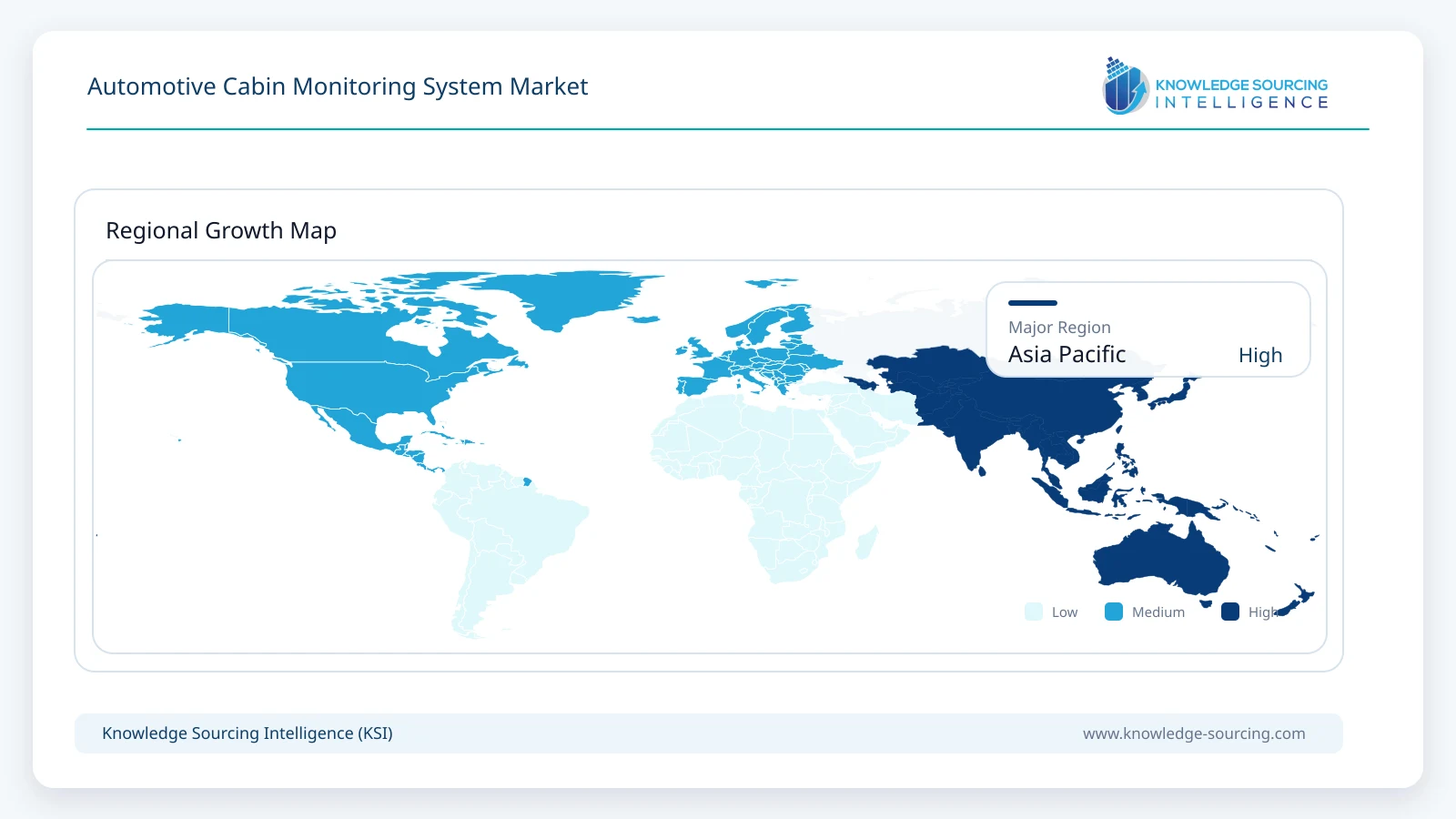
Europe is the largest regional automotive cabin monitoring market, supported by Euro NCAP 2026 protocols, EU driver-monitoring requirements and a high concentration of premium and technology-intensive vehicle platforms. The regulatory environment creates demand for both driver-state monitoring and full-cabin occupant awareness, including child-presence detection, seat-belt context and crash-occupancy information.
The region is also a major commercial base for current supplier programs. Smart Eye, Seeing Machines and Magna announced new European DMS/OMS awards during 2026, while Bosch, Valeo, FORVIA and AUMOVIO provide system-level interior-sensing capabilities. Mirror-integrated and centralized architectures are particularly attractive because European OEMs must scale monitoring across broad model portfolios while controlling visible hardware and electronic complexity.
Growth through 2031 will increasingly depend on software depth rather than basic camera penetration. As DMS hardware becomes widespread, incremental value will move toward occupant monitoring, impairment and health functions, adaptive restraints, sensor fusion and software updates. Privacy-preserving processing and rigorous cross-demographic validation will remain important purchasing criteria.
Asia Pacific
Asia Pacific is expected to be the fastest-growing regional market through 2031, supported by the scale of vehicle production in China, Japan, South Korea and India and rapid adoption of smart-cabin electronics. Chinese EV manufacturers in particular are using interior sensing, AI and centralized cockpit compute as visible points of differentiation, while Japanese OEMs are expanding formal DMS/OMS sourcing programs.
Seeing Machines announced two Japanese OEM DMS/OMS programs in June 2026, Smart Eye and Magna are expanding production activity in Asia, and LG combines in-cabin sensing with AI-defined mobility and multi-domain vehicle computing. Regional semiconductor and camera supply chains also support faster cost reduction for imaging, radar and ToF hardware.
The market is likely to broaden from premium safety applications into mass-market passenger vehicles as monitoring becomes a prerequisite for global NCAP ratings. Suppliers that can support Chinese-language ecosystems, local SoCs, diverse cabin layouts and fast OEM development cycles will be better positioned than platforms requiring extensive hardware redesign for each program.
Competitive Landscape
The automotive cabin monitoring system market combines specialist perception-software companies, Tier 1 system integrators, mirror suppliers, cockpit and interior-system providers, and semiconductor or sensing-platform companies. Smart Eye and Seeing Machines compete through production-proven DMS/OMS algorithms and OEM program scale, while Valeo, Bosch and Magna combine perception with system design and vehicle integration.
Gentex has a differentiated position through mirror-integrated monitoring, 2D and structured-light 3D sensing and the ability to package processing in the mirror, a standalone module or centralized controller. HARMAN extends monitoring into driver stress, vital signs and intervention through Ready Care, while Aptiv is using software-only camera perception to move occupant classification away from traditional seat hardware.
FORVIA, LG and AUMOVIO are integrating cabin monitoring with broader cockpit, seating and software-defined vehicle architectures. LG combines DMS, interior monitoring, Vision AI and sensor fusion; FORVIA uses in-cabin sensor content across safety and software-defined experience; and AUMOVIO offers driver monitoring, cabin monitoring and camera-radar sensor fusion as a modular software portfolio.
Infineon strengthens the ecosystem through 60 GHz radar and 3D Time-of-Flight sensing that can be combined with camera-based systems for child presence, occupancy and body-pose applications. Competitive advantage increasingly depends on production scale, full-cabin coverage, low false-positive rates, flexible hardware integration and the ability to maintain one perception layer across changing sensor and compute architectures.
Recent Developments
13 August 2026: Smart Eye secured a mirror-integrated DMS/OMS program for three vehicles from a major European OEM, using infrared and color imaging to monitor driver attention and occupant presence, position and activity throughout the cabin.
22 July 2026: Seeing Machines secured a European OEM DMS/OMS program through an existing Tier 1 customer, using a rear-view-mirror architecture scheduled for production from 2028.
18 June 2026: Seeing Machines announced an estimated US$31 million expansion of an existing automotive DMS/OMS production program across additional vehicle models in China, the United States and Europe.
8 June 2026: Aptiv launched Advanced Occupancy Classification, a camera-only software system that estimates occupant height, weight and seating position and can replace traditional in-seat occupancy hardware.
19 May 2026: Magna announced a new European OEM DMS/OMS program using its mirror-integrated hardware and software platform aligned with centralized, software-defined vehicle architectures.
13 January 2026: HARMAN introduced new Ready Care capabilities combining driver and occupant monitoring with stress, vital-sign, posture, location and seat-belt-related intelligence for production vehicles.
13 January 2026: Seeing Machines debuted 3D Cabin Perception Mapping at CES 2026, creating a real-time digital reconstruction of multiple occupants and features from one cabin-perception layer.
6 January 2026: Gentex introduced a next-generation driver and in-cabin monitoring demonstrator with cognitive-state recognition, vital-sign monitoring, post-crash communication and 2D/structured-light 3D cabin sensing.
5 January 2026: Valeo and Seeing Machines announced CES 2026 demonstrations of integrated In-Cabin Monitoring Solutions combining Valeo system integration with Seeing Machines perception software for driver and occupant applications.
Market Outlook
The automotive cabin monitoring system market is expected to expand rapidly through 2031 as monitoring moves from isolated compliance functions toward a persistent cabin-awareness layer. Integrated DMS/OMS and camera-led systems will remain the largest value pools, while radar, 3D depth sensing and sensor fusion gain share in child presence, body pose, health and robust full-cabin detection.
Centralized vehicle computers and common perception frameworks will allow the same cabin model to feed driver assistance, passive safety, automated-driving handover, climate, seating, infotainment and connected emergency services. As this architecture spreads, software and validation are likely to capture more value relative to standalone sensor hardware.
Europe is expected to remain the largest high-value regional market, while Asia Pacific delivers the strongest volume growth. Competitive advantage will depend on regulatory performance, low false-positive rates, flexible sensor placement, full-cabin coverage, privacy-preserving local processing and the ability to deploy the same monitoring stack across multiple SoCs and vehicle interiors.
Automotive Cabin Monitoring System Market Scope
| Report Metric | Details |
|---|---|
| Total Market Size in 2026 | USD 6.40 billion |
| Total Market Size in 2031 | USD 15.40 billion |
| Forecast Unit | Billion |
| Growth Rate | 19.2% |
| Study Period | 2021 to 2031 |
| Historical Data | 2021 to 2024 |
| Base Year | 2025 |
| Forecast Period | 2026 – 2031 |
| Segmentation | Monitoring Scope, Sensing Technology, Monitoring Function, Processing Architecture, Vehicle Type, Geography |
| Companies |
|
Market Segmentation
By Monitoring Scope
Integrated Driver and Occupant Monitoring Systems
Driver Monitoring Systems
Occupant and Passenger Monitoring Systems
By Sensing Technology
Camera-Based Cabin Monitoring
Radar-Based Cabin Monitoring
3D Depth and Time-of-Flight Monitoring
Seat and Contact-Sensor Monitoring
Multimodal Sensor-Fusion Monitoring
By Monitoring Function
Driver State, Attention and Readiness Monitoring
Occupant Presence, Position and Classification
Child Presence and Rear-Seat Monitoring
Seat-Belt, Posture and Restraint Monitoring
Vital Signs, Health and Impairment Monitoring
Identity, Personalization and Cabin Interaction
By Processing Architecture
Centralized and Domain-Integrated Cabin Monitoring
Dedicated Cabin-Monitoring ECU
Mirror-Integrated Monitoring Architecture
Distributed Sensor-Edge Processing
By Vehicle Type
Passenger Vehicles
Light Commercial Vehicles
Medium and Heavy Commercial Vehicles
Buses, Shared and Autonomous Mobility Vehicles
By Geography
North America
United States
Canada
Mexico
South America
Brazil
Argentina
Others
Europe
Germany
United Kingdom
France
Italy
Spain
Others
Middle East and Africa
Saudi Arabia
UAE
South Africa
Others
Asia Pacific
China
Japan
South Korea
India
Indonesia
Thailand
Others
Table of Contents
1. INTRODUCTION
1.1. Market Overview
1.2. Market Definition
1.3. Scope of the Study
1.4. Market Segmentation
1.5. Currency
1.6. Assumptions
1.7. Base and Forecast Years
1.8. Key Benefits to Stakeholders
2. RESEARCH METHODOLOGY
2.1. Research Design
2.2. Secondary Research
2.3. Primary Research
2.4. Market Estimation
2.5. Segment Modelling
2.6. Data Triangulation and Validation
3. EXECUTIVE SUMMARY
3.1. Key Findings
3.2. Automotive Cabin Monitoring System Market Size, 2026-2031
3.3. Monitoring Scope Outlook
3.4. Sensing Technology Outlook
3.5. Monitoring Function Outlook
3.6. Processing Architecture Outlook
3.7. Vehicle Type Outlook
3.8. Regional Opportunity Summary
4. MARKET DYNAMICS
4.1. Market Drivers
4.1.1. Euro NCAP and Regulatory Expansion of Driver and Occupant Monitoring
4.1.2. Growth of Automated Driving and the Need to Verify Driver Readiness
4.1.3. Sensor Consolidation and the Economics of Multi-Function Cabin Awareness
4.1.4. Software-Defined Vehicles and Centralized Compute
4.1.5. Expansion of Child Protection, Passive Safety and Full-Cabin Awareness
4.2. Market Restraints
4.2.1. Recognition Accuracy across Diverse Occupants and Real-World Conditions
4.2.2. Privacy and Acceptance of Continuous In-Cabin Observation
4.2.3. Higher Hardware, Compute and Thermal Requirements for Multimodal Systems
4.2.4. Vehicle-Specific Packaging, Calibration and Integration Complexity
4.2.5. AI Lifecycle, Cybersecurity and Functional-Safety Validation
4.3. Market Opportunities
4.4. Porter's Five Forces Analysis
4.5. Industry Value Chain Analysis
4.6. Cabin Monitoring Hardware, Software and Integration Economics
4.7. Euro NCAP, EU-GSR, Privacy and Functional-Safety Environment
5. TECHNOLOGY OUTLOOK
5.1. RGB-IR and Near-Infrared Driver Monitoring Cameras
5.2. Wide-Angle Occupant and Full-Cabin Monitoring Cameras
5.3. 60 GHz Radar for Occupancy, Child Presence and Vital Signs
5.4. 3D Time-of-Flight and Structured-Light Cabin Sensing
5.5. Seat, Pressure and Contact-Sensor Inputs
5.6. Driver Gaze, Head Pose, Eyelid and Attention Estimation
5.7. Occupant Presence, Classification and Body-Pose Recognition
5.8. Child Presence, Seat-Belt and Restraint Monitoring
5.9. Vital Signs, Impairment and Cognitive-State Monitoring
5.10. Camera-Radar-Depth Sensor Fusion
5.11. Edge AI, Confidence Scoring and Perception Software
5.12. Centralized Cabin Perception and Software-Defined Integration
6. AUTOMOTIVE CABIN MONITORING SYSTEM MARKET BY MONITORING SCOPE
6.1. Introduction
6.2. Integrated Driver and Occupant Monitoring Systems
6.3. Driver Monitoring Systems
6.4. Occupant and Passenger Monitoring Systems
7. AUTOMOTIVE CABIN MONITORING SYSTEM MARKET BY SENSING TECHNOLOGY
7.1. Introduction
7.2. Camera-Based Cabin Monitoring
7.3. Radar-Based Cabin Monitoring
7.4. 3D Depth and Time-of-Flight Monitoring
7.5. Seat and Contact-Sensor Monitoring
7.6. Multimodal Sensor-Fusion Monitoring
8. AUTOMOTIVE CABIN MONITORING SYSTEM MARKET BY MONITORING FUNCTION
8.1. Introduction
8.2. Driver State, Attention and Readiness Monitoring
8.3. Occupant Presence, Position and Classification
8.4. Child Presence and Rear-Seat Monitoring
8.5. Seat-Belt, Posture and Restraint Monitoring
8.6. Vital Signs, Health and Impairment Monitoring
8.7. Identity, Personalization and Cabin Interaction
9. AUTOMOTIVE CABIN MONITORING SYSTEM MARKET BY PROCESSING ARCHITECTURE
9.1. Introduction
9.2. Centralized and Domain-Integrated Cabin Monitoring
9.3. Dedicated Cabin-Monitoring ECU
9.4. Mirror-Integrated Monitoring Architecture
9.5. Distributed Sensor-Edge Processing
10. AUTOMOTIVE CABIN MONITORING SYSTEM MARKET BY VEHICLE TYPE
10.1. Introduction
10.2. Passenger Vehicles
10.3. Light Commercial Vehicles
10.4. Medium and Heavy Commercial Vehicles
10.5. Buses, Shared and Autonomous Mobility Vehicles
11. AUTOMOTIVE CABIN MONITORING SYSTEM MARKET BY GEOGRAPHY
11.1. North America
11.1.1. United States
11.1.2. Canada
11.1.3. Mexico
11.2. South America
11.2.1. Brazil
11.2.2. Argentina
11.2.3. Others
11.3. Europe
11.3.1. Germany
11.3.2. United Kingdom
11.3.3. France
11.3.4. Italy
11.3.5. Spain
11.3.6. Others
11.4. Middle East and Africa
11.4.1. Saudi Arabia
11.4.2. UAE
11.4.3. South Africa
11.4.4. Others
11.5. Asia Pacific
11.5.1. China
11.5.2. Japan
11.5.3. South Korea
11.5.4. India
11.5.5. Indonesia
11.5.6. Thailand
11.5.7. Others
12. COMPETITIVE ENVIRONMENT AND ANALYSIS
12.1. Major Players and Strategy Analysis
12.2. Market Share Analysis
12.3. Cabin Monitoring Technology Benchmarking
12.4. DMS versus OMS versus Integrated DMS/OMS Architecture Comparison
12.5. Camera, Radar and 3D Sensor-Fusion Benchmarking
12.6. Regulatory and NCAP Performance Benchmarking
12.7. OEM Programs and Production Readiness
12.8. Competitive Dashboard
13. COMPANY PROFILES
13.1. Smart Eye AB
13.2. Seeing Machines Limited
13.3. Valeo
13.4. Robert Bosch GmbH
13.5. Magna International Inc.
13.6. Gentex Corporation
13.7. HARMAN International
13.8. Aptiv PLC
13.9. FORVIA
13.10. LG Electronics Vehicle Solution Company
13.11. Infineon Technologies AG
13.12. AUMOVIO SE
14. APPENDIX
14.1. Currency
14.2. Assumptions
14.3. Base and Forecast Years Timeline
14.4. Key Benefits for Stakeholders
14.5. Research Methodology
14.6. Abbreviations
14.7. Data Sources
Navigate
Trusted by the world's leading organizations