
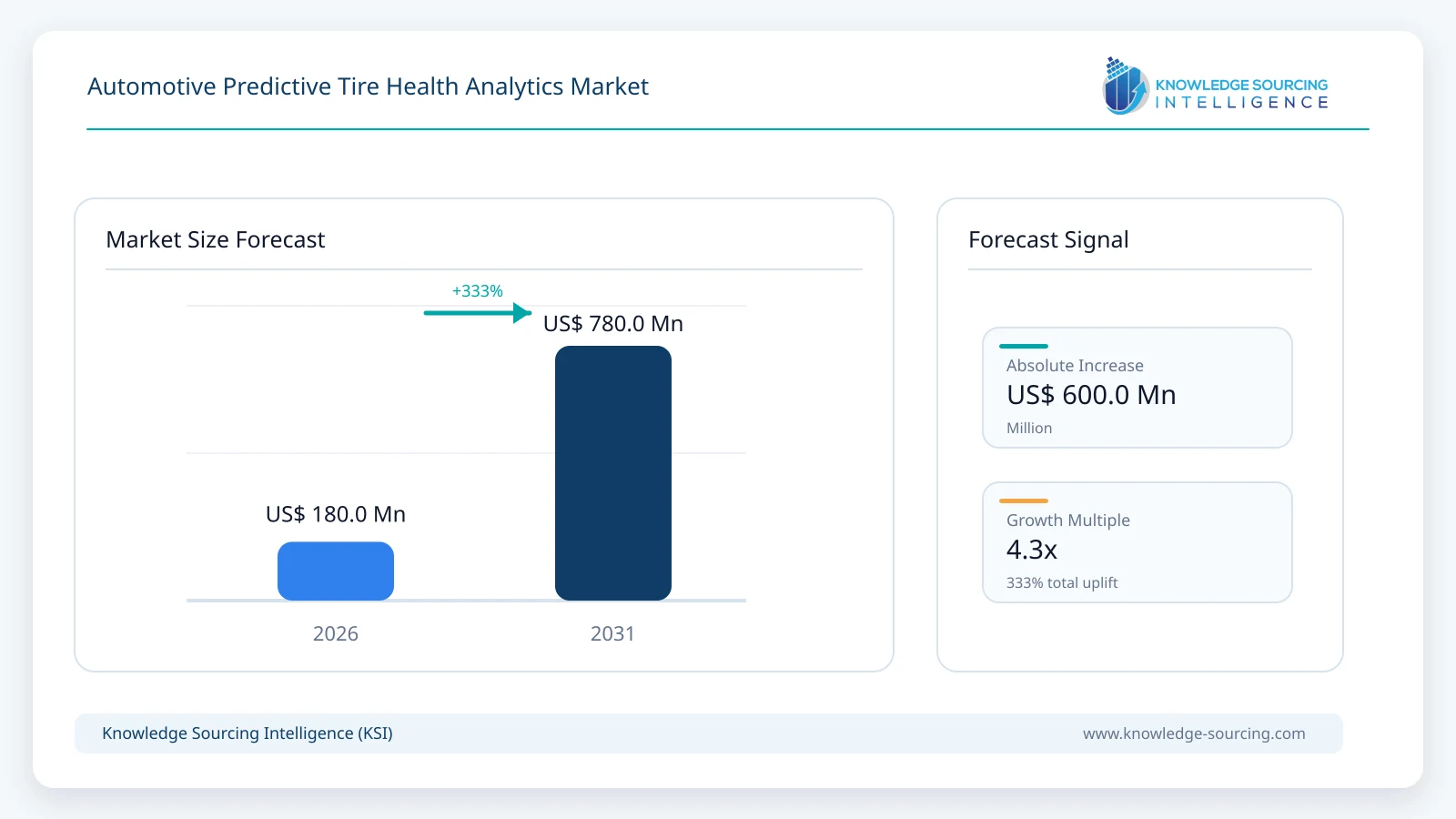
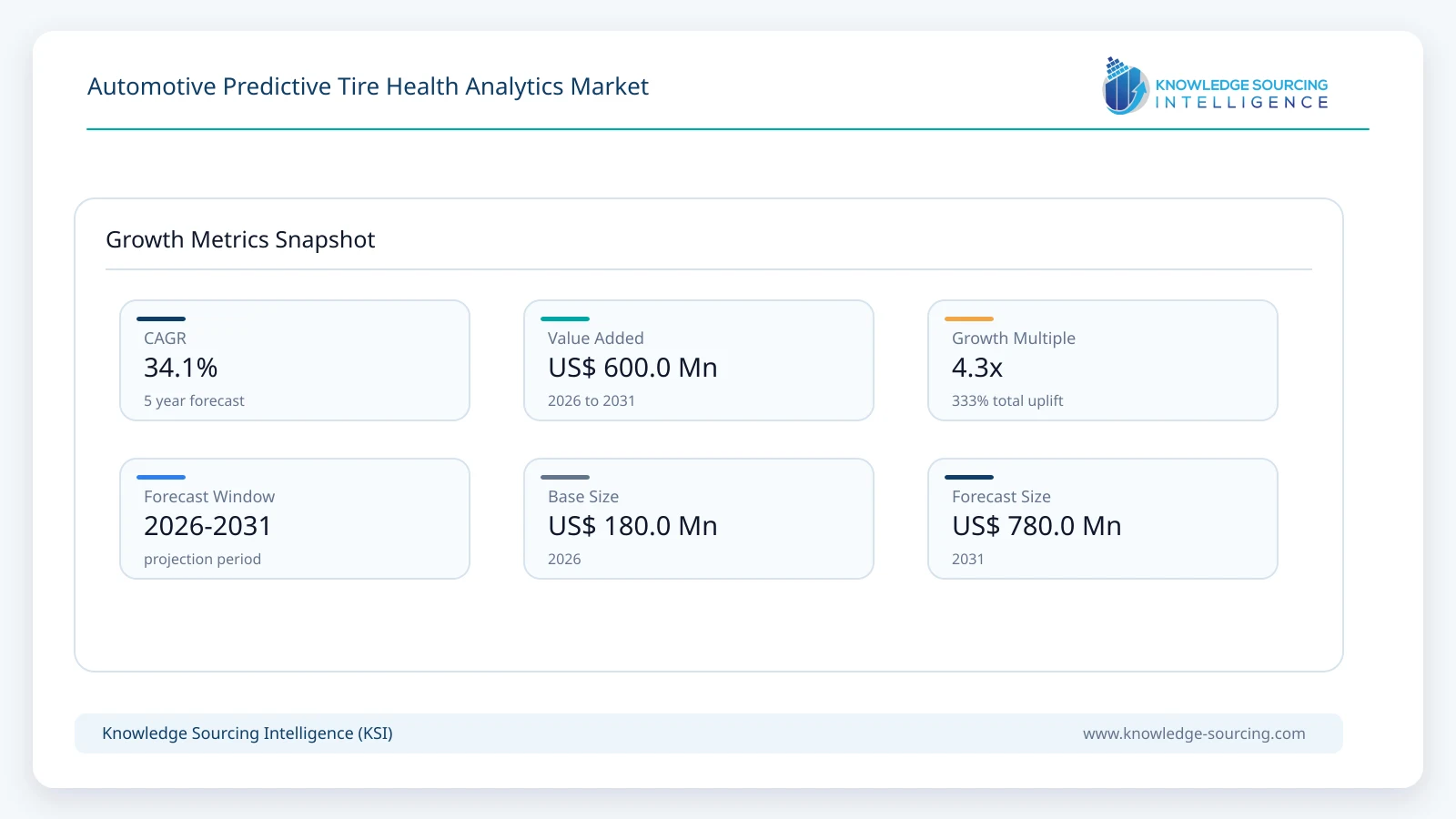
The Automotive Predictive Tire Health Analytics Market is forecast to grow at a CAGR of 34.1%, reaching USD 780.0 million in 2031 from USD 180.0 million in 2026.
Highlights:
- 1Global supplier revenue is modeled at USD 180 million in 2026 and USD 780 million in 2031.
- 2Pressure leak and time-to-critical intelligence accounts for approximately 44% of 2026 market value.
- 3Tread wear and remaining-life prediction becomes an increasingly important service category through 2031.
- 4Commercial fleet analytics subscriptions represent roughly 37% of modeled 2026 revenue.
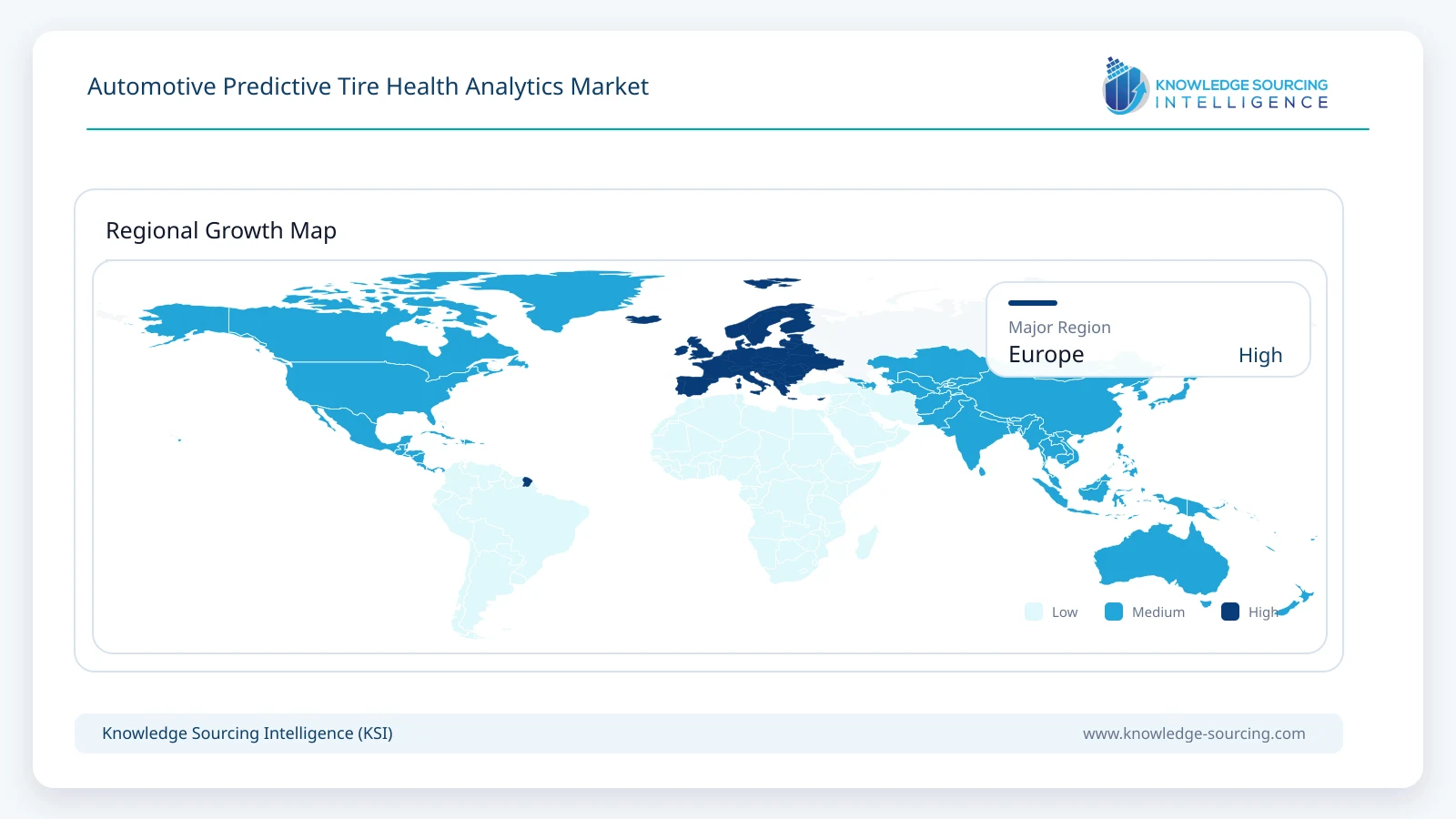
- 5Europe leads the 2026 regional market, while Asia Pacific records the fastest modeled growth.
- 6Software-only virtual sensing expands the addressable passenger-vehicle base without requiring new tire electronics.
- 7Validation across tire brands and the cost of advanced sensing remain principal adoption constraints.
The automotive predictive tire health analytics market covers digitally delivered functions that estimate tire condition and forecast maintenance requirements from tire-mounted sensors, standard vehicle signals, connected-fleet data, or inspection records. The purchased content includes embedded tire-health licenses, subscription analytics, selectively upgraded sensor or processing content and direct calibration work. Software may identify a slow leak, estimate usable tread, or rank maintenance urgency, enabling drivers and fleet operators to act before the problem causes a service interruption.
Michelin Smart Predictive Tire combines pressure and temperature data with leak prediction and actionable fleet service workflows. Continental ContiConnect uses tire measurements and AI-assisted wear analysis, while NIRA Dynamics offers a sensor-free Tread Wear Indicator for vehicle platforms. Michelin and Sonatus have also demonstrated SmartWear running on automotive edge computing. These different approaches create separate commercial routes for fleet subscriptions, hardware-linked monitoring and factory-installed software.
Market Overview
A predictive tire-health application converts tire state and vehicle operating data into a future maintenance decision rather than only detecting a current fault. Pressure-loss trajectories can indicate when inflation will become unsafe, while models of vibration, tire loading and wear progression can estimate remaining service life. Commercial fleets gain value from fewer emergency repairs and more efficient tire rotation, whereas passenger-vehicle programs can use the information to improve safety reminders and maintain service relationships.
Michelin’s July and September 2026 agreements demonstrate how predictive tire analytics is being distributed through connected-fleet platforms and connected to third-party pressure sensors. Continental’s tire sensor and ContiConnect offering provides a more hardware-linked path; NIRA’s Tread Wear Indicator instead uses existing vehicle measurements. Pirelli Cyber Tyre adds rich tire-mounted data to premium vehicle control systems, although only the health-specific analytics component is economically relevant to this market.
Supplier value is created through predictive algorithms, vehicle-data integration, fleet workflows, and selected sensors that enable functions beyond ordinary tire-pressure monitoring. The same vehicle can produce revenue through distinct product categories, such as a separately purchased connected analytics subscription and an incremental advanced sensor, but the full tire price, standard TPMS electronics, and unrelated fleet management charges are not part of market demand. This market is therefore shaped by purchasing contracts and software adoption as much as by the number of connected vehicles.
Market Trends
Tire Wear Prediction Shifts Toward Continuous Vehicle Data
Digital tire-health products are moving beyond a low-pressure warning by analyzing changes in wheel behavior, axle loads, driving history, and tire construction to estimate remaining tread. NIRA Dynamics uses existing vehicle sensor signals in its Tread Wear Indicator, while Michelin’s SmartWear and universal tire digital-twin work apply tire physics and data models to predict condition without fitting another sensor. This approach makes predictive monitoring available to vehicle programs that cannot justify additional tire-mounted electronics.
Continental follows a complementary route in commercial fleets by combining tire acceleration data, known tire characteristics and AI-assisted wear estimates in the ContiConnect environment. Its automated tread-depth proposition connects a changing sensor signature to a useful maintenance decision. The commercial benefit depends on model calibration for replacement tires, duty cycles and environmental conditions, so OEM implementation and fleet commissioning remain important sources of attributable service value.
Fleet Tire Monitoring Moves from Warnings to Maintenance Workflows
Michelin Connected Fleet’s Smart Predictive Tire uses pressure, temperature, and connected-vehicle data to estimate when a tire may cross a critical pressure threshold and to prioritize workshop activity. Its September 2026 collaboration with Doran joins tire-mounted pressure measurement with Michelin’s Smart Leak analytics and distribution through Platform Science. The combined proposition is aimed at reducing emergency roadside service rather than merely sending additional dashboard alerts.
Fleet purchasers evaluate predictive tire software against unplanned downtime, technician dispatches, premature tire replacement and fuel use. The economic case is strongest among long-distance trucks and service-intensive commercial vehicles, where a single tire-related interruption can affect freight delivery and equipment availability. Pricing still depends on the share of value sold as a distinct analytics subscription instead of bundled into existing telematics, tire supply or maintenance contracts.
Sensor-Free Embedded Tire Intelligence Expands OEM Options
Michelin’s May 2026 universal tire digital twin and NIRA’s sensor-free Tread Wear Indicator illustrate how software suppliers can use wheel-speed, chassis and operating signals already present in the car. Sensor-free deployment reduces the bill of materials but increases reliance on high-quality vehicle signals, validated tire models, and software access. Automotive manufacturers can integrate wear and pressure intelligence into service reminders and connected aftersales programs without requiring a new tire hardware standard.
Sonatus demonstrated Michelin SmartWear running through an in-vehicle AI deployment framework at CES 2026. The demonstration supports the technical case for updating tire-health functions on shared vehicle processors, although it does not establish mass-volume program shipments. Over time, OEM procurement may shift from isolated tire-monitoring features to software packages maintained across multiple vehicle platforms and tire fitments.
Advanced Sensors Add Health Information Beyond Conventional TPMS
Continental’s next-generation in-tire sensors and Goodyear SightLine demonstrate the value of combining pressure and temperature with motion or other tire-specific measurements. In commercial fleets, a richer signal can distinguish gradual air loss, uneven wear and abnormal loading more effectively than a basic threshold warning. The added hardware must generate enough improvement in prediction quality to justify its cost and replacement requirements.
Pirelli Cyber Tyre connects tire-mounted sensing and proprietary algorithms with vehicle control systems on selected premium applications. For predictive tire-health revenue, the relevant share is the monitoring, life-estimation, and health interpretation content rather than every grip-control or vehicle-dynamics function delivered by the same system. This distinction matters as intelligent-tire suppliers extend their offering into multiple chassis and safety applications.
Predictive Maintenance Data Becomes a Fleet and Aftersales Asset
Connected-fleet operators increasingly combine tire wear estimates, maintenance records, mileage and pressure trends to decide when a specific tire should be inspected, rotated or removed. Michelin’s automated depot inspection software demonstrates the importance of connecting a measurement to a predicted replacement date and workshop task, even though the physical drive-over inspection equipment falls outside embedded predictive-health revenue.
Vehicle manufacturers and service partners can also use reliable tire-life estimates to plan dealership contact, replacement inventory and customer reminders. The analytics must remain robust after tire changes and across mixed brands; otherwise false service alerts erode customer confidence. Products able to translate condition estimates into documented actions should achieve stronger recurring revenue than applications that only visualize sensor readings.
Segment Analysis
By Predictive Function: Pressure Leak and Time-to-Critical Alerts
Predictive pressure-loss analysis represents about 44% of modeled 2026 revenue because commercial fleets already have substantial pressure and temperature data, and preventing a roadside tire event offers a direct economic incentive. Michelin Smart Predictive Tire calculates time-to-critical pressure warnings and produces service job lists, demonstrating why interpreting the trajectory of a leak can have greater value than a static threshold message.
Although pressure-related intelligence leads in 2026, tread-wear and remaining-life prediction is expected to grow faster as sensor-free vehicle models and higher-resolution tire data become more common. Pressure monitoring remains a recurring service category, particularly for trailers and long-haul trucks, while wear prediction can extend into passenger-car service and OEM digital ownership channels.
By Data Acquisition Method: TPMS-Linked Predictive Analytics
TPMS-linked predictive analytics accounts for approximately 46% of 2026 market value, reflecting an existing source of tire pressure and temperature data across fleets and passenger vehicles. The value pool includes the incremental modeling, connected data processing and integration required to forecast risk, but excludes conventional TPMS sensors when no predictive function is purchased. Michelin’s Doran integration provides an example of separating sensing hardware from predictive software.
Existing-vehicle-signal models gain share as suppliers such as NIRA and Michelin bring sensor-free wear estimates to wider vehicle platforms. Advanced tire-mounted sensing remains attractive for heavy-duty applications and premium vehicles when added data improve prediction accuracy, but its cost and service complexity constrain universal fitment.
By Revenue Component: Connected Fleet Analytics Subscriptions
Connected fleet analytics subscriptions account for approximately 37% of modeled 2026 revenue, supported by recurring monitoring of pressure-loss risk, tire condition and maintenance deadlines. Commercial operators can purchase these services through tire manufacturers, connected-fleet platforms or equipment providers, often alongside other telematics products. The independently attributable tire-health subscription, rather than the entire telematics fee, forms the market revenue base.
OEM embedded software licenses increase from about 31% of market revenue in 2026 toward 39% by 2031 as sensor-free algorithms support passenger-vehicle deployment. Higher volume does not necessarily mean proportionately higher unit pricing, but continuing product validation and multi-platform license agreements can expand total supplier value.
By Vehicle Type: Medium- and Heavy-Duty Trucks
Medium- and heavy-duty trucks represent the largest individual modeled vehicle category in 2026 because they operate multiple high-value tires and face substantial interruption costs if tire failures occur in service. Michelin Connected Fleet, Continental ContiConnect and Goodyear SightLine all address fleet maintenance economics through condition information and actionable warnings, making heavy trucks a relatively mature purchasing segment.
Passenger electric vehicles and plug-in hybrids contribute faster incremental demand as greater vehicle connectivity and software-defined architectures make embedded tire wear models easier to deploy. Light commercial vehicles offer an intermediate opportunity for delivery fleets whose short service intervals and frequent stop-start operation support tighter tire-maintenance scheduling.
Market Drivers
Commercial Fleets Seek Lower Tire-Related Downtime
Long-haul trucks, buses and delivery fleets incur costs from tire-related breakdowns, emergency callouts and vehicle immobilization, creating a direct reason to purchase predictive health analytics. Michelin’s Smart Predictive Tire links time-to-critical warnings to maintenance decisions, while Continental positions ContiConnect around improved fleet servicing. The systems are particularly relevant when service planning can prevent a disruption before a vehicle departs on a long route.
Fleet operators generally already pay for tire replacement, routine inspection and connected-vehicle monitoring, so the strongest incremental opportunity comes from software that improves those decisions. Subscription penetration is modeled to rise with wider integrations into dispatch and maintenance workflows, rather than assuming that every fleet uses predictive services.
Existing Vehicle Sensors Support Lower-Cost Wear Intelligence
NIRA Dynamics estimates tread wear through vehicle signals without requiring a tire-mounted depth sensor, and Michelin is expanding a similar sensor-free digital-twin approach. These technologies can reduce the cost of adding tire-health intelligence to passenger platforms because the required wheel-speed and chassis signals are already available in many vehicles. The reduced hardware burden is particularly valuable for automakers managing tight component cost targets.
Software-only architectures still require tire-type information, calibration and validation across different load, speed and weather conditions. Suppliers capable of maintaining model performance over an entire vehicle platform can capture software and integration revenue while allowing manufacturers to reach a broader installed base.
Fleet Platforms Simplify Analytics Distribution
Michelin Connected Fleet’s July 2026 agreement with Platform Science makes Smart Predictive Tire accessible through an existing connected-vehicle marketplace rather than a stand-alone installation path. Its September integration with Doran adds compatible pressure measurement, creating a practical solution for operators using mixed equipment and telematics suppliers. Distribution through familiar fleet software can reduce the effort required to add tire-specific features.
Scalable deployment matters because fleet buyers prefer actionable maintenance reports in the systems already used to manage vehicles. The ability to share tire-health signals with service schedules, driver reports and repair partners should increase paid adoption even when the underlying tire analytics has already existed for several years.
Vehicle Digital Twins Increase Tire-Life Visibility
Michelin’s universal tire digital twin estimates pressure, wear and load from available vehicle signals, while Sonatus demonstrated how SmartWear can run through an automotive edge AI framework. Tire-life models can convert operating history into forward-looking estimates and enable service functions that extend beyond regulatory tire-pressure warnings. They also support more consistent diagnostics when drivers seldom measure remaining tread manually.
OEMs and software suppliers can use these estimates to offer timely maintenance reminders and to help workshops prepare replacement appointments. Adoption depends on reliable output across tire brands and replacement cycles, but it introduces a software monetization path beyond premium intelligent-tire hardware.
Data-Rich Tires Support More Precise Maintenance Decisions
Continental is developing tire sensors that estimate tread depth from radial acceleration, and Goodyear SightLine combines tire condition sensing with analytics. When combined with tire specifications, mileage and vehicle usage, these measurements can improve forecasts of remaining usable life and abnormal wear. Commercial fleets stand to benefit where tire rotation and replacement timing affect operating costs materially.
Higher-resolution sensing is most likely to justify its price in larger fleets, specialist vehicles and premium applications rather than every passenger car. The resulting market combines higher-value hardware-enabled installations with a more scalable software-only approach, each purchased for a different maintenance requirement.
Market Restraints
Predictive Accuracy Varies by Tire and Duty Cycle
Estimating remaining tread life from indirect signals is affected by replacement tire brand, compound, load, climate, road surface and driver behavior. A model calibrated on one operating pattern may produce biased remaining-life estimates when a vehicle changes tires or duty cycle. Suppliers therefore need broad datasets and routine model updates to prevent premature replacements or missed end-of-life conditions.
Automotive OEMs and fleet buyers will hesitate to use automated replacement recommendations when false predictions increase workshop visits or leave a vehicle operating with unsafe tires. Qualification and monitoring expenses can delay rollouts, particularly for sensor-free estimates lacking a directly measured tread-depth reference.
Basic TPMS and Manual Inspection Remain Low-Cost Substitutes
Many vehicles already alert drivers to low tire pressure, while fleet workshops can manually inspect tire tread and visible damage during scheduled stops. The predictive upgrade must show value beyond data that a driver or technician can already obtain at low cost. The decision is especially sensitive among small fleets and lower-priced passenger models.
Smart analytics is more compelling when it predicts the timing of a problem, prioritizes repairs or captures otherwise missed wear patterns. If the product only duplicates a standard pressure alert, fleet managers are unlikely to pay a durable premium, constraining the addressable revenue pool.
Sensor and Connectivity Costs Limit Broad Retrofit Adoption
Advanced in-tire acceleration sensors, receivers, gateways and installation services can add material cost to connected tire programs. Tire-mounted electronics must also survive high centrifugal load, vibration, moisture and replacement operations. Retrofitting sensors on mixed truck and trailer fleets creates recurring service and configuration work that can erode the expected savings.
Sensor-free OEM software avoids part of the hardware cost but depends on permission to access vehicle signals and on software integration with existing control architectures. Buyers need to compare the incremental tire-health value against the full cost of deployment and ongoing support.
Vehicle Data Access and Integration Remain Fragmented
Fleet systems aggregate vehicles and trailers from multiple brands, but signal quality, data permissions and tire pressure protocols are not uniform. A predictive application that cannot reliably associate a sensor with a tire position or vehicle operating state can issue misleading maintenance alerts. This fragmentation increases engineering effort for multi-brand platform providers.
OEM embedded programs face a similar challenge in updating health models across vehicle versions and replacement tires. Cybersecurity controls, data ownership and software update governance can lengthen deployment cycles, limiting how quickly a successful demonstration converts into a broad recurring service.
Purchasing Bundles Can Obscure the Value of Predictive Features
Tire companies frequently combine digital services with tire supply, roadside assistance, telematics or maintenance contracts. Fleet customers may treat tire-health analytics as part of a larger service promise, rather than buy it as an individually priced product. Suppliers must therefore demonstrate measurable operating gains to defend incremental fees.
OEMs also evaluate tire-health algorithms as one of many connected service features. If the functionality is included at no separate price in standard vehicle software, the commercially attributable revenue is lower than the number of capable vehicles might imply. This buying behavior restrains specialized analytics spending even as technical availability improves.
Regional Outlook
Europe
European tire manufacturers and fleet technology providers have established a broad base for predictive tire condition services. Continental supplies ContiConnect and is developing AI-assisted tread-depth measurement, Michelin provides commercial fleet predictive tire monitoring and NIRA Dynamics offers sensor-free tread-wear software. Established truck fleets and vehicle service networks create recurring demand for maintenance prediction, particularly where fleet operators manage costly commercial tire replacement and vehicle downtime.
Europe accounts for approximately 34% of modeled global revenue in 2026 and remains a substantial market through 2031. Growth depends on moving from basic pressure monitoring to priced analytics subscriptions and on scaling embedded software to OEM vehicle platforms. Tire replacement practices, mixed brands and data access across fleet systems continue to influence adoption economics.
Asia Pacific
Asia Pacific is modeled as the fastest-growing regional market because of expanding connected passenger-vehicle production, large commercial transport fleets and growing adoption of vehicle software platforms. China supplies a broad vehicle production base for embedded wear-estimation functions, while Japan and South Korea contribute vehicle electronics and tire technology. India and Southeast Asian countries offer fleet opportunities where downtime management and tire operating cost are important, although software penetration begins from a smaller base.
The region is estimated at approximately 27% of 2026 revenue, rising to around 32% in 2031. Supplier partnerships, analytics integration and lower-cost sensor-free functions support the expansion. Commercial fleet adoption is expected to remain uneven by country, reflecting different telematics penetration, service-channel development and customer willingness to pay for predictive maintenance.
Competitive Landscape
Michelin, Continental, Goodyear and Bridgestone compete through their tire engineering knowledge, commercial fleet relationships and digital monitoring platforms. Michelin’s Smart Predictive Tire combines tire data with forward-looking service recommendations; Continental connects tire sensors with AI-based wear estimation; and Goodyear SightLine brings tire-condition intelligence into vehicle and fleet applications. Bridgestone Tirematics has a stronger historical position in monitoring and maintenance visibility, with predictive functions assessed as incremental analytics rather than the full monitoring service.
NIRA Dynamics differentiates itself through sensor-free tire-wear estimation using existing vehicle signals, while Pirelli Cyber Tyre combines tire-embedded sensing with vehicle electronics on selected premium programs. Geotab contributes fleet software and contextual pressure analytics, Sonatus provides edge software deployment capabilities, and Platform Science enables marketplace distribution for Michelin’s fleet solution. Doran supplies tire monitoring hardware that can feed predictive models.
Winning programs depend on reliable predictions across tire changes, service integration, and the ability to substantiate reductions in unplanned tire maintenance. OEM deployment also requires robust calibration and software maintenance, while fleet customers prioritize workflow simplicity over model sophistication alone. Commercial share cannot be inferred directly from published technology announcements because most suppliers do not isolate predictive tire-health revenue within their reported operations.
Recent Developments
September 2026: Michelin Connected Fleet and Doran announced integration of tire pressure and temperature monitoring with Smart Predictive Tire and distribution through Platform Science, providing a practical combined sensing-and-analytics fleet solution.
August 2026: Geotab highlighted predictive tire-pressure monitoring in Geotab Signals 2026 Vol. 2, extending its fleet intelligence product roadmap toward condition-based monitoring.
July 2026: Michelin Connected Fleet partnered with Platform Science to make Smart Predictive Tire available through the Virtual Vehicle Marketplace, expanding the distribution route for its analytics.
May 2026: Michelin introduced its universal tire digital twin using existing vehicle signals to estimate tire pressure, wear and load, strengthening the potential for sensor-free embedded health prediction.
January 2026: Michelin and Sonatus demonstrated SmartWear and SmartLoad within an automotive edge-computing environment at CES; the activity represented a technology demonstration rather than verified series shipments.
December 2025: Michelin and Sonatus announced their CES 2026 collaboration to demonstrate predictive tire health software, illustrating a practical deployment architecture for future vehicle programs.
Market Outlook
Predictive tire health analytics is expected to grow most quickly where an estimated future tire condition changes a maintenance decision. Connected commercial fleets will continue buying pressure-loss predictions, prioritized job lists and tire-life analytics, while OEM software programs should increasingly offer tread-wear and service-life information in passenger vehicles. Suppliers will need to demonstrate accuracy across changing tire brands, climate and driving duty if software-led models are to reach high-volume vehicle platforms.
Fleet subscriptions remain economically attractive because operating costs and vehicle downtime can be measured over repeated trips. At the same time, software-only tire state models can broaden adoption among passenger vehicles without material new sensor cost. Advanced in-tire sensing will be selected more carefully where additional pressure, temperature, and acceleration information improves maintenance forecasts enough to justify its installation and servicing.
Europe retains a strong supplier and installed fleet base, while Asia Pacific offers the fastest modeled expansion of OEM-embedded tire-health functions. Competitive advantage should depend increasingly on dependable remaining-life prediction, interoperability, and workshop integration rather than on the quantity of tire readings shown to the driver or fleet manager.
Automotive Predictive Tire Health Analytics Market Scope:
| Report Metric | Details |
|---|---|
| Total Market Size in 2026 | USD 180.0 million |
| Total Market Size in 2031 | USD 780.0 million |
| Forecast Unit | USD Million |
| Growth Rate | 34.1% |
| Study Period | 2021 to 2031 |
| Historical Data | 2021 to 2024 |
| Base Year | 2025 |
| Forecast Period | 2026 – 2031 |
| Segmentation | Predictive Function, Data Acquisition Method, Revenue Component, Vehicle Type |
| Companies |
|
Market Segmentation
By Predictive Function
Pressure Leak and Time-to-Critical Alerts
Tread Wear and Remaining-Life Prediction
Thermal and Structural Abnormality Detection
Integrated Multi-Risk Tire Health
By Data Acquisition Method
Existing Vehicle Signals and Virtual Sensors
TPMS-Linked Predictive Analytics
Advanced Tire-Mounted Sensors
Inspection-Linked Condition Data
By Revenue Component
OEM Embedded Software Licenses
Connected Fleet Analytics Subscriptions
Incremental Intelligent Sensor and Edge Content
Dedicated Calibration and Integration Services
By Vehicle Type
Passenger Battery Electric and Plug-In Hybrid Vehicles
Other Passenger Vehicles
Light Commercial Vehicles
Medium- and Heavy-Duty Trucks
Buses and Specialist Vehicles
By Direct Customer
Automotive OEMs and Tier-One System Buyers
Large Commercial Fleet Operators
Service Networks and Fleet Software Integrators
Small Fleets and Other Buyers
By Deployment Channel
Factory-Integrated Vehicle Software
Retrofit Connected-Fleet Platforms
Service-Network Integrated Analytics
By Analytical Method
Physics-Based Tire State Models
Statistical Pressure and Wear Trend Models
Machine Learning Sensor Fusion
Hybrid Tire Digital Twin Models
By Software Execution Architecture
In-Vehicle Edge Analytics
Cloud-Centric Fleet Analytics
Hybrid Edge and Cloud Intelligence
By Geography
North America
United States
Canada
Mexico
South America
Brazil
Argentina
Others
Europe
Germany
United Kingdom
France
Italy
Spain
Others
Middle East and Africa
Saudi Arabia
United Arab Emirates
South Africa
Others
Asia Pacific
China
India
Japan
South Korea
Indonesia
Thailand
Taiwan
Australia
Others
Table of Contents
1. EXECUTIVE SUMMARY
1.1. Market Opportunity and Key Findings
1.2. Market Size and Growth, 2026–2031
1.3. Tire Health Analytics Technology Outlook
1.4. Regional Opportunity Summary
2. MARKET SNAPSHOT
2.1. Market Overview
2.2. Market Definition
2.3. Scope of the Study
2.4. Market Segmentation
3. BUSINESS LANDSCAPE
3.1. Market Drivers
3.1.1. Commercial Fleets Seek Lower Tire-Related Downtime
3.1.2. Existing Vehicle Sensors Support Lower-Cost Wear Intelligence
3.1.3. Fleet Platforms Simplify Analytics Distribution
3.1.4. Vehicle Digital Twins Increase Tire-Life Visibility
3.1.5. Data-Rich Tires Support More Precise Maintenance Decisions
3.2. Market Restraints
3.2.1. Predictive Accuracy Varies by Tire and Duty Cycle
3.2.2. Basic TPMS and Manual Inspection Remain Low-Cost Substitutes
3.2.3. Sensor and Connectivity Costs Limit Broad Retrofit Adoption
3.2.4. Vehicle Data Access and Integration Remain Fragmented
3.2.5. Purchasing Bundles Can Obscure the Value of Predictive Features
3.3. Market Opportunities
3.4. Porter’s Five Forces Analysis
3.5. Industry Value Chain Analysis
3.6. Policies and Regulations
3.7. Strategic Recommendations
4. TECHNOLOGICAL OUTLOOK
4.1. Sensor-Free Tread Wear Estimation
4.2. Predictive Leak Detection and Time-to-Critical
4.3. In-Tire Motion and Temperature Sensing
4.4. Tire Digital Twins and Remaining-Life Algorithms
4.5. Fleet Analytics and Service Integration
4.6. Edge and Cloud Execution
5. AUTOMOTIVE PREDICTIVE TIRE HEALTH ANALYTICS MARKET BY PREDICTIVE FUNCTION
5.1. Introduction
5.2. Pressure Leak and Time-to-Critical Alerts
5.3. Tread Wear and Remaining-Life Prediction
5.4. Thermal and Structural Abnormality Detection
5.5. Integrated Multi-Risk Tire Health
6. AUTOMOTIVE PREDICTIVE TIRE HEALTH ANALYTICS MARKET BY DATA ACQUISITION METHOD
6.1. Introduction
6.2. Existing Vehicle Signals and Virtual Sensors
6.3. TPMS-Linked Predictive Analytics
6.4. Advanced Tire-Mounted Sensors
6.5. Inspection-Linked Condition Data
7. AUTOMOTIVE PREDICTIVE TIRE HEALTH ANALYTICS MARKET BY REVENUE COMPONENT
7.1. Introduction
7.2. OEM Embedded Software Licenses
7.3. Connected Fleet Analytics Subscriptions
7.4. Incremental Intelligent Sensor and Edge Content
7.5. Dedicated Calibration and Integration Services
8. AUTOMOTIVE PREDICTIVE TIRE HEALTH ANALYTICS MARKET BY VEHICLE TYPE
8.1. Introduction
8.2. Passenger Battery Electric and Plug-In Hybrid Vehicles
8.3. Other Passenger Vehicles
8.4. Light Commercial Vehicles
8.5. Medium- and Heavy-Duty Trucks
8.6. Buses and Specialist Vehicles
9. AUTOMOTIVE PREDICTIVE TIRE HEALTH ANALYTICS MARKET BY DIRECT CUSTOMER
9.1. Introduction
9.2. Automotive OEMs and Tier-One System Buyers
9.3. Large Commercial Fleet Operators
9.4. Service Networks and Fleet Software Integrators
9.5. Small Fleets and Other Buyers
10. AUTOMOTIVE PREDICTIVE TIRE HEALTH ANALYTICS MARKET BY DEPLOYMENT CHANNEL
10.1. Introduction
10.2. Factory-Integrated Vehicle Software
10.3. Retrofit Connected-Fleet Platforms
10.4. Service-Network Integrated Analytics
11. AUTOMOTIVE PREDICTIVE TIRE HEALTH ANALYTICS MARKET BY ANALYTICAL METHOD
11.1. Introduction
11.2. Physics-Based Tire State Models
11.3. Statistical Pressure and Wear Trend Models
11.4. Machine Learning Sensor Fusion
11.5. Hybrid Tire Digital Twin Models
12. AUTOMOTIVE PREDICTIVE TIRE HEALTH ANALYTICS MARKET BY SOFTWARE EXECUTION ARCHITECTURE
12.1. Introduction
12.2. In-Vehicle Edge Analytics
12.3. Cloud-Centric Fleet Analytics
12.4. Hybrid Edge and Cloud Intelligence
13. AUTOMOTIVE PREDICTIVE TIRE HEALTH ANALYTICS MARKET BY GEOGRAPHY
13.1. North America
13.1.1. United States
13.1.2. Canada
13.1.3. Mexico
13.2. South America
13.2.1. Brazil
13.2.2. Argentina
13.2.3. Others
13.3. Europe
13.3.1. Germany
13.3.2. United Kingdom
13.3.3. France
13.3.4. Italy
13.3.5. Spain
13.3.6. Others
13.4. Middle East and Africa
13.4.1. Saudi Arabia
13.4.2. United Arab Emirates
13.4.3. South Africa
13.4.4. Others
13.5. Asia Pacific
13.5.1. China
13.5.2. India
13.5.3. Japan
13.5.4. South Korea
13.5.5. Indonesia
13.5.6. Thailand
13.5.7. Taiwan
13.5.8. Australia
13.5.9. Others
14. COMPETITIVE ENVIRONMENT AND ANALYSIS
14.1. Major Players and Strategy Analysis
14.2. Market Share Analysis
14.3. Mergers, Acquisitions, Agreements and Collaborations
14.4. Competitive Dashboard
15. COMPANY PROFILES
15.1. Michelin
15.2. Continental AG
15.3. The Goodyear Tire & Rubber Company
15.4. Bridgestone Corporation
15.5. Pirelli & C. S.p.A.
15.6. NIRA Dynamics AB
15.7. Geotab Inc.
15.8. Sonatus, Inc.
15.9. Platform Science, Inc.
15.10. Doran Manufacturing, LLC
16. APPENDIX
16.1. Currency
16.2. Assumptions
16.3. Base and Forecast Years Timeline
16.4. Key Benefits for Stakeholders
16.5. Research Methodology
16.6. Abbreviations
Navigate
Trusted by the world's leading organizations











