
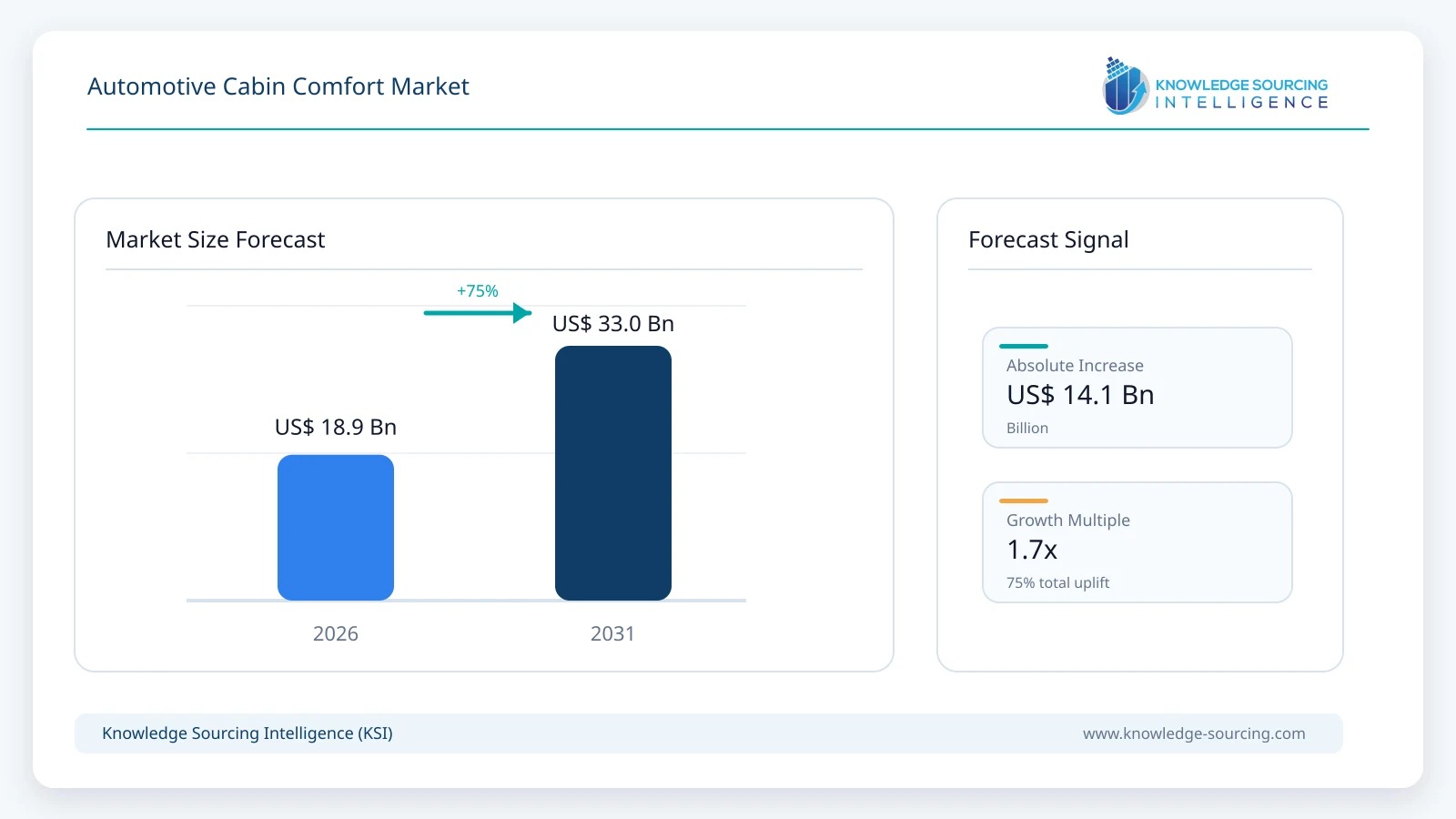
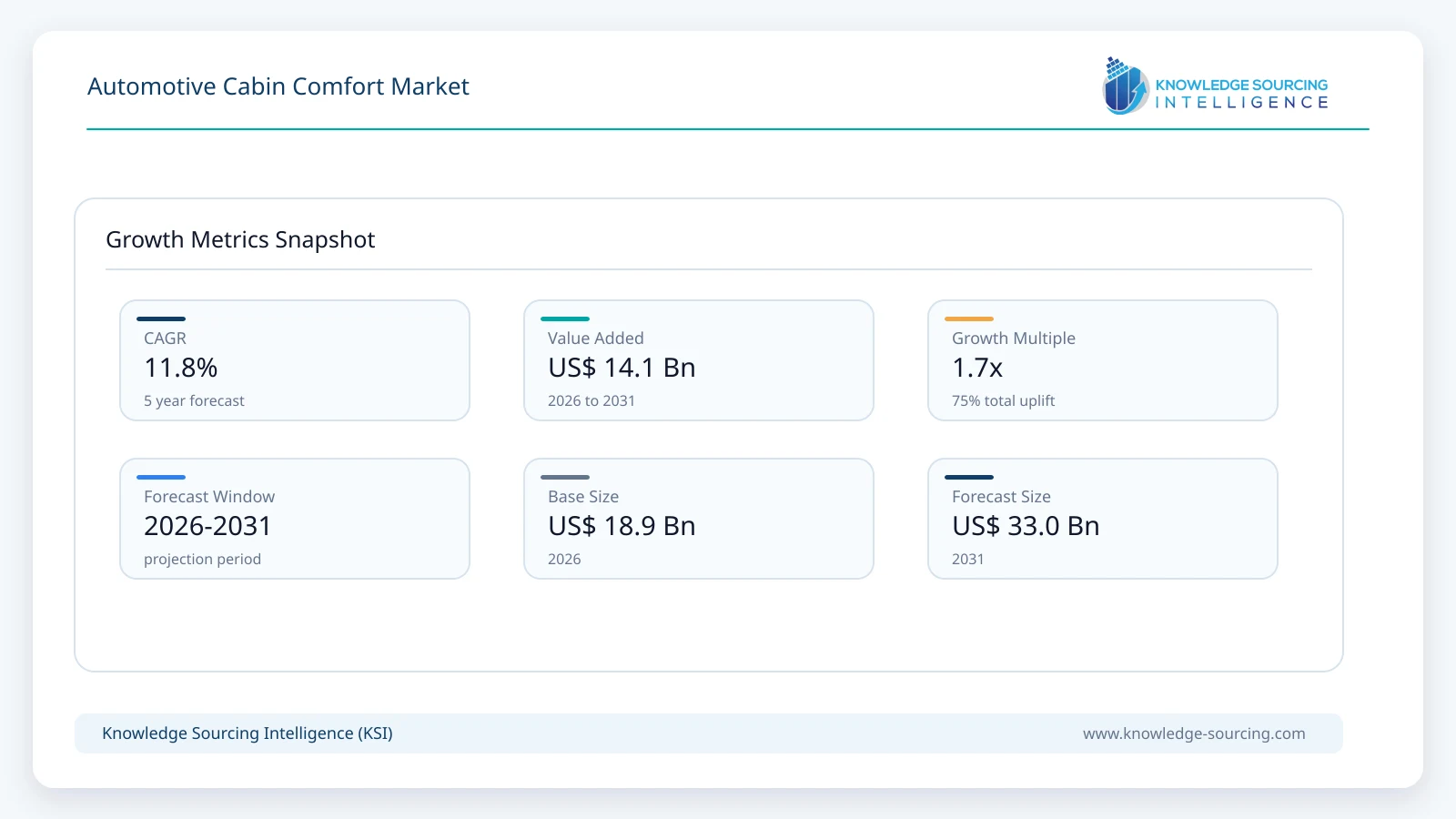
The automotive cabin comfort market is forecast to grow at a CAGR of 11.8%, reaching approximately USD 33.0 billion by 2031 from USD 18.9 billion in 2026.
Key Highlights
• Seating and postural comfort systems account for approximately 36% of global market value in 2026 because power adjustment, lumbar support, ventilation, massage, cushioning and adaptive posture functions represent the largest concentration of dedicated comfort hardware per vehicle.
• Thermal comfort and climate personalization represent approximately 31% of market value in 2026, supported by seat heating and ventilation, localized airflow, radiant heating, surface conditioning and zonal thermal-control technologies.
• Integrated multi-modal comfort architectures account for approximately 56% of 2026 market value as OEMs increasingly coordinate seating, climate, lighting, audio, sensing and air quality through shared electronics and software.
• Premium and luxury vehicles represent approximately 38% of global market value in 2026 because higher trim levels support advanced seating, massage, acoustic refinement, multi-zone climate, ambient lighting and other high-content comfort functions.
• Battery electric vehicles account for approximately 36% of market value in 2026 because EV platforms emphasize energy-efficient microclimate control, quiet-cabin refinement and software-defined user experience.
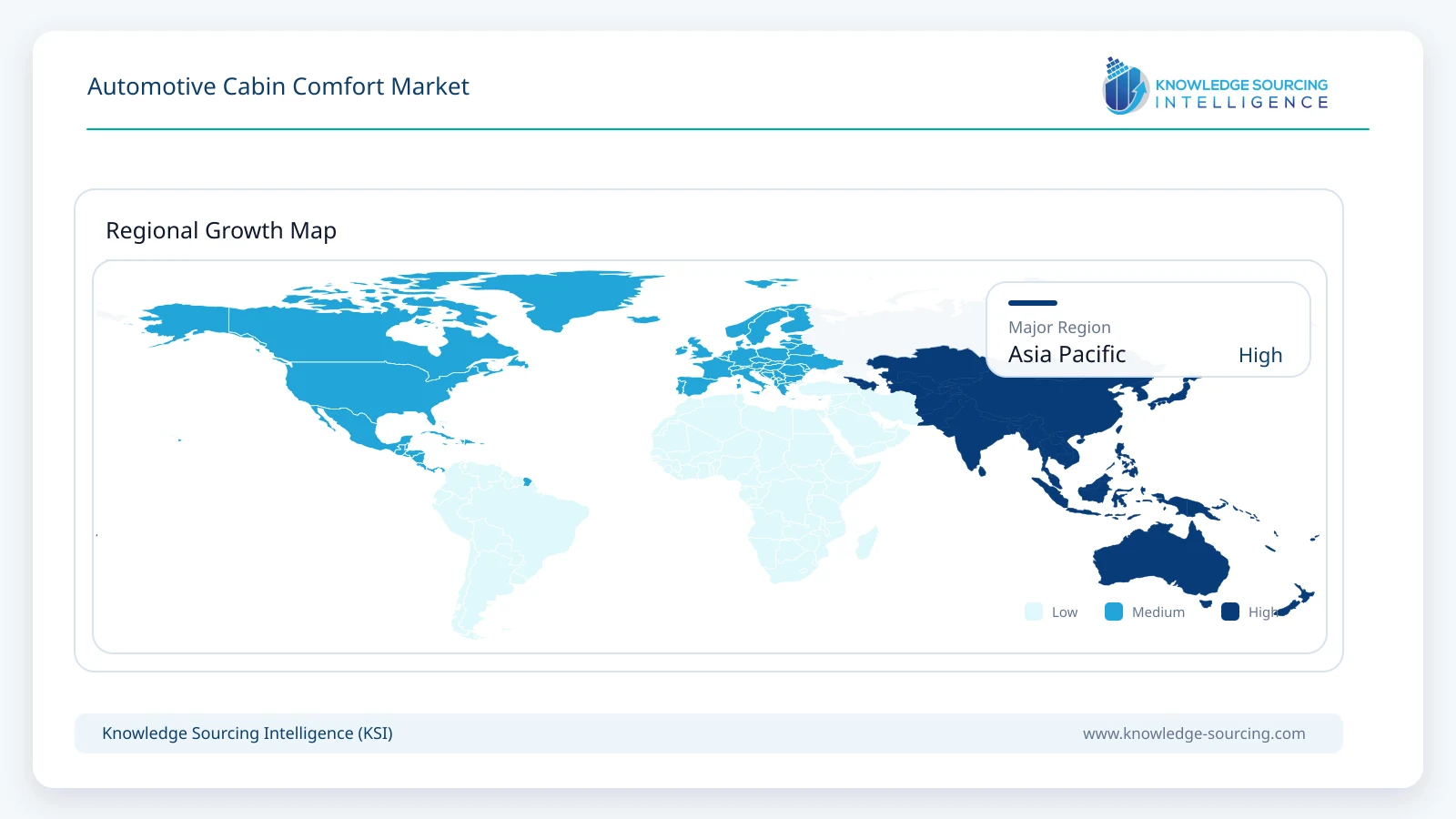
• Asia Pacific represents approximately 43% of global market value in 2026, supported by high vehicle production, rapid premium EV development in China and established seating, electronics and interior-system capabilities in Japan and South Korea.
Comfort content per vehicle is increasing as automakers combine seat ergonomics, thermal microclimate, pneumatic support, acoustic control, adaptive lighting and air-quality functions through increasingly integrated electrical and software architectures.
Commercial momentum is broadening across both hardware and software. Gentherm continues to expand climate-controlled seating, pneumatic comfort and massage technologies; Lear is scaling ComfortFlex and ComfortMax across multiple 2026 launches; FORVIA is advancing intelligent seating with automatic posture, massage and lumbar adjustment; Yanfeng's XiM27 coordinates seating, lighting, spatial audio and individualized climate; Toyota Boshoku's LOUNZE+ links seats, door trims and console functions around relaxation; and HARMAN Ready Care connects occupant-state sensing with personalized temperature, audio, lighting and seat-massage responses.
Cabin comfort is increasingly delivered as a coordinated system rather than as isolated options. Localized thermal effectors reduce the need to condition the entire cabin, sensorized seats can respond to posture and body morphology, active acoustic technologies improve perceived refinement, and centralized cabin software can shift the environment between driving, relaxation, work and rest scenarios. These developments increase the value of integration, calibration and software alongside traditional seat and HVAC hardware.
Market Overview
Cabin comfort is becoming a deliberate vehicle-system layer that combines physical ergonomics with thermal, acoustic and sensory conditions. Conventional comfort features such as seat heating, ventilation and lumbar support remain important, but the strongest value growth is moving toward adaptive systems that change automatically according to occupant profile, vehicle state and journey context.
Seating remains the central physical interface. Modern seats increasingly integrate power adjustment, active lumbar support, massage, heating, ventilation, haptics and occupant sensing, while advanced architectures can change support according to body morphology, posture and road conditions. This shifts seating from a static structure toward an electronically controlled comfort platform.
Thermal comfort is also becoming more localized. Instead of relying only on whole-cabin HVAC, suppliers are combining climate-controlled seats, heated surfaces, directed airflow and software-based thermal balancing. Localized approaches can improve time-to-comfort and reduce energy demand, which is especially valuable in electric vehicles where HVAC load directly affects driving range.
Acoustics, lighting and air quality increasingly influence perceived comfort alongside seating and temperature. Quiet electric powertrains make wind, road and interior noise more noticeable, encouraging active-noise management and personal audio zones. Adaptive lighting can reduce visual strain or support relaxation, while smart filtration and air-quality sensing contribute to a cleaner cabin environment.
The long-term direction is toward context-aware comfort orchestration. Occupant monitoring, preference profiles and centralized cabin controllers allow the vehicle to coordinate temperature, airflow, seat posture, massage, lighting, audio and air quality around activities such as commuting, long-distance driving, relaxation or rest. This creates a growing software and systems-integration value pool around traditionally mechanical comfort functions.
Market Trends
Localized Microclimate Is Reducing Dependence on Whole-Cabin Conditioning
Seat-based heating and ventilation, neck warmers, radiant panels and targeted airflow can deliver comfort directly to the occupant rather than conditioning all cabin air to the same set point. This improves responsiveness and can reduce HVAC energy demand, particularly during vehicle start-up or when only one or two seats are occupied.
Gentherm, Lear and other suppliers are scaling modular thermal technologies that combine heating, ventilation and other comfort functions in lighter, easier-to-integrate systems. The result is a shift from isolated heated-seat options toward multi-surface microclimate architectures.
Seats Are Becoming Intelligent Adaptive Comfort Platforms
Advanced seating increasingly uses sensors, software and multi-axis actuation to adjust support according to occupant body shape, posture and driving conditions. FORVIA has highlighted intelligent seats that monitor posture and road conditions and automatically control pneumatic support, massage and lumbar settings.
This expands the seat value pool beyond frame, foam and trim into electronics, sensing, software and personalization. Comfort algorithms can also coordinate with driver monitoring and cabin profiles, allowing the seat to intervene before discomfort becomes severe.
Multi-Sensory Comfort Is Replacing Isolated Feature Packages
Premium cabins increasingly coordinate seat posture, lighting, temperature, audio and airflow around complete scenarios rather than independent functions. Yanfeng's XiM27 and Toyota Boshoku's LOUNZE+ illustrate this shift through interiors that adapt multiple components simultaneously for rest, entertainment or social use.
Integrated scenarios make comfort more intuitive because occupants do not need to configure each system separately. They also create new software content that can be updated, personalized and differentiated by vehicle brand.
Acoustic Comfort Is Becoming More Important as Powertrains Become Quieter
Electric vehicles remove much of the masking effect of engine noise, making tire, wind and structural noise more perceptible. Automakers are therefore using active noise cancellation, acoustic zoning, optimized materials and seat-integrated audio to improve perceived refinement.
The same architecture can create personal sound zones that allow different occupants to consume media without raising overall cabin noise. Acoustic comfort is therefore converging with infotainment and passenger-experience systems.
Occupant Sensing and AI Are Moving Comfort from Reactive to Predictive
In-cabin cameras, seat sensors and software can identify posture, stress, fatigue and user preferences, allowing the vehicle to adjust comfort settings automatically. HARMAN Ready Care, for example, links occupant-state detection with interventions such as temperature changes, lighting, audio and seat massage.
Predictive comfort is expected to become a major differentiation layer because it reduces manual interaction and allows the cabin to respond before the occupant actively requests a change. The technical challenge is to make these interventions subtle, explainable and privacy-conscious.
Segment Analysis
By Comfort System: Seating and Postural Comfort Systems
Seating and postural comfort systems are projected to generate approximately USD 11.8 billion of market value by 2031. Growth will be driven by wider adoption of climate-controlled seats, massage, active lumbar support, dynamic posture adjustment and sensorized seating beyond traditional luxury applications.
The segment is also gaining software content as seat functions are integrated with occupant profiles, cabin controllers and driver-state monitoring. Modular designs that reduce mass, part count and assembly complexity are expected to accelerate adoption in second- and third-row seating.
By Comfort Function: Thermal Comfort and Climate Personalization
Thermal comfort and climate personalization are projected to exceed USD 10.5 billion by 2031. Localized heating, ventilation, radiant surfaces and zonal airflow will increasingly complement conventional HVAC by delivering faster time-to-comfort with lower energy consumption.
Electric vehicles provide a particularly strong use case because targeted thermal comfort can reduce the need to heat or cool the entire cabin. Software-based thermal balancing will also allow vehicles to adapt automatically to occupancy, solar load and individual preference.
By Integration Architecture: Integrated Multi-Modal Comfort Systems
Integrated multi-modal comfort systems are projected to approach USD 20.5 billion by 2031 as seating, climate, lighting, audio, sensing and air-quality functions increasingly operate through shared electronics and centralized software.
The commercial advantage is not only feature integration but coordinated behavior. A single relaxation mode can change seat posture, temperature, massage intensity, cabin lighting and audio simultaneously, improving perceived quality while reducing user interaction.
By Vehicle Class: Premium and Luxury Vehicles
Premium and luxury vehicles are projected to generate approximately USD 12.5 billion of cabin-comfort market value by 2031. These vehicles will remain the principal launch platform for high-content massage, multi-zone climate, acoustic technologies, adaptive lighting and sensing-led comfort.
However, modular thermal systems, scalable software and lower-cost sensors are expected to move selected premium functions into upper-mid and mass-market vehicles over the forecast period, particularly seat ventilation, lumbar support and zonal comfort.
By Propulsion: Battery Electric Vehicles
Battery electric vehicles are projected to generate approximately USD 14.5 billion of cabin-comfort market value by 2031. EV platforms combine centralized electronics, high-content interiors and a strong need for energy-efficient thermal management, making them a major adoption channel for integrated comfort systems.
Quiet EV cabins also raise expectations around acoustic refinement and expose noise sources that were previously masked by combustion engines. This supports additional spending on active noise management, personal audio and vibration control alongside thermal comfort.
Market Drivers
Vehicle Premiumization and Competition around In-Cabin Experience
Automakers increasingly use interior comfort to differentiate models that share similar electric powertrains, digital platforms and performance characteristics. Advanced seating, quiet-cabin technologies, adaptive lighting and personalized climate therefore become visible brand attributes rather than secondary options.
The effect is strongest in premium EVs and high-end SUVs, but competitive pressure is also pulling comfort features into lower segments through modular hardware and software-defined packaging.
Energy-Efficient Thermal Comfort in Electric Vehicles
Heating and cooling can materially affect electric-vehicle range, particularly in extreme weather. Localized seat and surface conditioning can improve occupant comfort while reducing the energy required to condition the full cabin volume.
This creates a direct efficiency case for heated surfaces, seat ventilation, zonal airflow and intelligent thermal control, allowing comfort technologies to contribute to both user experience and vehicle energy management.
Rising Demand for Ergonomic Support and Reduced Physical Fatigue
Long commutes, aging populations and greater use of vehicles for work or relaxation are increasing demand for lumbar support, massage, posture adjustment and pressure management. These functions can reduce discomfort during extended travel and support a broader range of occupant body types.
Seat suppliers are responding with sensor-based adjustment, pneumatic support and software-calibrated comfort modes that can adapt automatically rather than relying entirely on manual configuration.
Growth of Software-Defined Cabin Architectures
Centralized computing allows seats, climate, lighting, audio and air-quality systems to share data and operate as coordinated domains. This enables scenario-based comfort, persistent user profiles and over-the-air updates without redesigning the entire hardware stack.
Software-defined architecture also makes it easier for OEMs to differentiate comfort across trims or vehicle brands using calibration and feature activation, creating recurring value around traditionally fixed hardware.
Advances in Occupant Sensing and Personalized Cabin Control
Cameras, seat sensors and biometric monitoring can increasingly estimate posture, stress, fatigue and occupancy state. These inputs allow comfort systems to make more relevant adjustments and reduce the need for repeated manual changes.
As sensing becomes more accurate and less intrusive, predictive comfort can become a core interface between occupant monitoring and cabin actuation, linking safety, wellness and convenience functions.
Market Restraints
High Cost and Concentration in Higher Vehicle Segments
Massage systems, multi-zone climate, active acoustics, dense sensor networks and premium seat actuation add significant hardware and validation cost. Many functions therefore remain concentrated in premium vehicles or top trim levels where buyers accept higher option prices.
Broader adoption depends on modular designs that share actuators, sensors and controllers across several functions while reducing assembly complexity and mass.
Energy, Weight and Packaging Trade-Offs
Comfort systems compete for limited packaging space and electrical power. Seat blowers, pumps, massage units, active-noise hardware and additional control modules can increase mass and energy use if not integrated carefully.
Suppliers must therefore improve efficiency and combine multiple functions into fewer components, especially in EVs where energy consumption and packaging directly affect range and cabin space.
Integration Complexity across Seats, HVAC, Audio, Lighting and Sensing
Multi-modal comfort requires coordination between systems that were historically developed by different suppliers and vehicle domains. Latency, conflicting control logic, calibration differences or network faults can create inconsistent behavior and increase validation effort.
Centralized software architectures reduce some complexity but also raise the importance of standardized interfaces, functional ownership and long-term software maintenance.
Subjective Comfort Preferences and Difficult Validation
Comfort is highly personal. Body size, age, clothing, thermal preference, posture and cultural expectations can change how occupants perceive the same seat, temperature or lighting condition.
OEMs therefore need broad human-factors testing and adaptive calibration rather than relying on one fixed comfort target. This increases development time and makes cross-market standardization more difficult.
Privacy and Acceptance of Continuous Occupant Monitoring
Predictive comfort can use camera, posture, biometric or behavioral data to decide how the cabin should respond. Users may resist systems that feel intrusive or that make unexplained changes to their environment.
Local processing, transparent consent and clear manual override will be important for maintaining trust as comfort becomes more dependent on occupant-state sensing.
Regional Outlook
Asia Pacific
Asia Pacific is the largest regional market and is expected to remain the strongest growth centre through 2031. China is accelerating adoption of premium smart-cabin functions across electric vehicles, while Japan and South Korea contribute deep expertise in seating, electronics, climate systems, materials and interior integration.
Yanfeng's XiM27 demonstrates the region's move toward coordinated seating, lighting, spatial audio and individualized climate, while Toyota Boshoku's LOUNZE+ emphasizes relaxation and living-room-like mobility spaces. Chinese EV competition is also pushing comfort functions into vehicles below traditional luxury price points.
Growth will be supported by high vehicle production, rapid EV penetration and strong demand for feature-rich interiors. Suppliers that can combine competitive cost with software-enabled personalization are positioned to benefit as comfort content expands across vehicle classes.
Europe
Europe is a major high-value market because premium automakers and established Tier 1 suppliers continue to lead in advanced seating, thermal comfort, acoustic refinement and occupant-aware interior technologies. FORVIA, Gentherm, Lear and HARMAN all maintain strong European OEM relationships and development activity.
FORVIA's 2026 strategy places seating comfort and wellness among the technologies expected to raise content per vehicle, while Lear is launching modular thermal-comfort systems across European programs. European premium brands also provide a strong commercialization path for massage, advanced climate, active acoustics and software-defined comfort modes.
The regional market will increasingly emphasize energy-efficient comfort for EVs, premium refinement and integrated electronics. Competitive advantage will depend on demonstrable comfort improvement, low mass and energy consumption, software integration and the ability to scale high-end functions across broader model ranges.
Competitive Landscape
The automotive cabin comfort market includes seating, thermal-management, interior-system, electronics and software suppliers that directly shape occupant comfort. Gentherm, Lear, FORVIA, Yanfeng, Toyota Boshoku and HARMAN are directly active across climate-controlled seating, massage, postural support, smart-cabin integration, acoustic and sensory technologies, or occupant-aware comfort software.
Gentherm is differentiated by thermal management and pneumatic comfort technologies spanning climate-controlled seats, climate-control interiors and lumbar/massage solutions. Lear combines complete-seat capability with modular thermal comfort through ComfortFlex and ComfortMax, while FORVIA integrates intelligent seating, massage, lumbar adjustment and software-based adaptation.
Yanfeng and Toyota Boshoku compete through broader interior integration and scenario-based comfort, while HARMAN links sensing with software-triggered cabin interventions. Competition is increasingly shifting from individual components toward the ability to coordinate multiple comfort domains through a shared electronic and software architecture.
Recent Developments
• 23 July 2026: Gentherm reported USD 690 million of automotive new-business awards in the second quarter and 14.1% year-over-year growth in Automotive Climate and Comfort Solutions revenue, with especially strong growth in lumbar and massage comfort solutions.
• 10 July 2026: Yanfeng announced that XiM27 received the 2026 Red Dot Design Concept Award. The platform combines adaptive seating, individualized climate, spatial audio and responsive lighting to create a personalized sensory environment.
• 29 June 2026: Yanfeng unveiled XiM27, a production-ready smart-cabin platform with AI-adaptive seating, natural wave-like ventilation, centralized cabin control and comfort modes for work, relaxation, sleep and entertainment.
• 23 April 2026: Toyota Boshoku presented LOUNZE+ at Auto China 2026, coordinating seats, door trims and console functions to create a relaxing living-space-oriented mobility environment.
• 24 February 2026: FORVIA's 2026 Capital Markets Day highlighted intelligent seating as a growth technology, including postural and road-condition monitoring, pneumatic functions, massage, lumbar adjustment and software/AI-based comfort adaptation.
• 4 February 2026: Lear reported continued scaling of its thermal-comfort portfolio, with ComfortFlex, ComfortMax and related modular systems positioned for multiple 2026 vehicle launches across global automakers.
• 13 January 2026: HARMAN introduced new Ready Care capabilities combining occupant monitoring and vital-sign sensing with personalized cabin interventions including temperature, lighting, audio and seat-massage adjustments.
• 5 February 2025: Lear announced engineering integration of ComfortMax Seat with General Motors, embedding heating, ventilation and other thermal-comfort functions directly into seat trim covers to improve occupant comfort and manufacturing efficiency.
Market Outlook
The automotive cabin comfort market is expected to expand steadily through 2031 as comfort functions become more personalized, more energy-efficient and more deeply connected through software. Seating and thermal comfort will remain the largest value pools, while faster growth is expected in intelligent postural support, acoustic zoning, adaptive lighting and sensor-driven comfort orchestration.
The market will increasingly move from user-selected features toward predictive comfort. Vehicles will learn individual preferences, interpret posture and occupant state, and coordinate temperature, airflow, seat support, massage, lighting, audio and air quality automatically. The most successful systems will improve comfort without excessive power consumption, intrusive interaction or unnecessary hardware complexity.
Asia Pacific is expected to retain the largest regional share, while Europe remains a major premium engineering and commercialization market. Competitive advantage will depend on scalable hardware, energy-efficient thermal performance, strong human-factors validation, low-latency software integration and the ability to deliver consistent comfort across different occupants, climates and vehicle classes.
Automotive Cabin Comfort Market Scope:
| Report Metric | Details |
|---|---|
| Total Market Size in 2026 | USD 18.9 billion |
| Total Market Size in 2031 | USD 33.0 billion |
| Forecast Unit | USD Billion |
| Growth Rate | 11.8% |
| Study Period | 2021 to 2031 |
| Historical Data | 2021 to 2024 |
| Base Year | 2025 |
| Forecast Period | 2026 – 2031 |
| Segmentation | Comfort System, Comfort Function, Integration Architecture, Vehicle Class, Propulsion, Geography |
| Companies |
|
Market Segmentation
By Comfort System
Seating and Postural Comfort Systems
Thermal and Microclimate Comfort Systems
Acoustic and NVH Comfort Systems
Lighting, Air Quality and Sensory Comfort Systems
Comfort Electronics, Sensing and Software
By Comfort Function
Thermal Comfort and Climate Personalization
Ergonomic and Postural Comfort
Relaxation, Massage and Fatigue Reduction
Acoustic and Sensory Comfort
Air Quality and Environmental Comfort
By Integration Architecture
Integrated Multi-Modal Comfort Systems
Domain-Integrated Comfort Subsystems
Standalone and Single-Function Comfort Systems
By Vehicle Class
Premium and Luxury Vehicles
Mid-Range Vehicles
Mass-Market and Economy Vehicles
By Propulsion
Battery Electric Vehicles
Hybrid and Plug-in Hybrid Electric Vehicles
Internal Combustion Engine Vehicles
Fuel Cell Electric Vehicles
By Geography
North America
United States
Canada
Mexico
South America
Brazil
Argentina
Others
Europe
Germany
United Kingdom
France
Italy
Spain
Others
Middle East and Africa
Saudi Arabia
UAE
South Africa
Others
Asia Pacific
China
Japan
South Korea
India
Singapore
Others
Table of Contents
1. INTRODUCTION
1.1. Market Overview
1.2. Market Definition
1.3. Scope of the Study
1.4. Market Segmentation
1.5. Currency
1.6. Assumptions
1.7. Base and Forecast Years
1.8. Key Benefits to Stakeholders
2. RESEARCH METHODOLOGY
2.1. Research Design
2.2. Secondary Research
2.3. Primary Research
2.4. Market Estimation
2.5. Segment Modelling
2.6. Data Triangulation and Validation
3. EXECUTIVE SUMMARY
3.1. Key Findings
3.2. Automotive Cabin Comfort Market Size, 2026-2031
3.3. Comfort System Outlook
3.4. Comfort Function Outlook
3.5. Integration Architecture Outlook
3.6. Vehicle Class Outlook
3.7. Propulsion Outlook
3.8. Regional Opportunity Summary
4. MARKET DYNAMICS
4.1. Market Drivers
4.1.1. Vehicle Premiumization and Competition around In-Cabin Experience
4.1.2. Energy-Efficient Thermal Comfort in Electric Vehicles
4.1.3. Rising Demand for Ergonomic Support and Reduced Physical Fatigue
4.1.4. Growth of Software-Defined Cabin Architectures
4.1.5. Advances in Occupant Sensing and Personalized Cabin Control
4.2. Market Restraints
4.2.1. High Cost and Concentration in Higher Vehicle Segments
4.2.2. Energy, Weight and Packaging Trade-Offs
4.2.3. Integration Complexity across Seats, HVAC, Audio, Lighting and Sensing
4.2.4. Subjective Comfort Preferences and Difficult Validation
4.2.5. Privacy and Acceptance of Continuous Occupant Monitoring
4.3. Market Opportunities
4.4. Porter's Five Forces Analysis
4.5. Industry Value Chain Analysis
4.6. Cabin Comfort System Economics
4.7. Human-Factors, Comfort Validation and Data-Privacy Environment
5. TECHNOLOGY OUTLOOK
5.1. Climate-Controlled Seating and Surface Thermal Management
5.2. Zonal HVAC, Radiant Heating and Personalized Airflow
5.3. Lumbar, Massage, Pneumatic and Dynamic Posture Systems
5.4. Intelligent Seating and Occupant-Adaptive Support
5.5. Active Noise Control, Acoustic Zoning and Personal Audio
5.6. Adaptive Interior Lighting and Visual Comfort
5.7. Cabin Air Quality and Odour Management
5.8. Occupant Sensing, Stress and Fatigue Inputs
5.9. AI-Based Comfort Personalization and Scenario Control
5.10. Energy-Efficient Comfort Architectures for Electric Vehicles
5.11. Centralized Cabin Controllers and Cross-Domain Integration
6. AUTOMOTIVE CABIN COMFORT MARKET BY COMFORT SYSTEM
6.1. Introduction
6.2. Seating and Postural Comfort Systems
6.3. Thermal and Microclimate Comfort Systems
6.4. Acoustic and NVH Comfort Systems
6.5. Lighting, Air Quality and Sensory Comfort Systems
6.6. Comfort Electronics, Sensing and Software
7. AUTOMOTIVE CABIN COMFORT MARKET BY COMFORT FUNCTION
7.1. Introduction
7.2. Thermal Comfort and Climate Personalization
7.3. Ergonomic and Postural Comfort
7.4. Relaxation, Massage and Fatigue Reduction
7.5. Acoustic and Sensory Comfort
7.6. Air Quality and Environmental Comfort
8. AUTOMOTIVE CABIN COMFORT MARKET BY INTEGRATION ARCHITECTURE
8.1. Introduction
8.2. Integrated Multi-Modal Comfort Systems
8.3. Domain-Integrated Comfort Subsystems
8.4. Standalone and Single-Function Comfort Systems
9. AUTOMOTIVE CABIN COMFORT MARKET BY VEHICLE CLASS
9.1. Introduction
9.2. Premium and Luxury Vehicles
9.3. Mid-Range Vehicles
9.4. Mass-Market and Economy Vehicles
10. AUTOMOTIVE CABIN COMFORT MARKET BY PROPULSION
10.1. Introduction
10.2. Battery Electric Vehicles
10.3. Hybrid and Plug-in Hybrid Electric Vehicles
10.4. Internal Combustion Engine Vehicles
10.5. Fuel Cell Electric Vehicles
11. AUTOMOTIVE CABIN COMFORT MARKET BY GEOGRAPHY
11.1. North America
11.1.1. United States
11.1.2. Canada
11.1.3. Mexico
11.2. South America
11.2.1. Brazil
11.2.2. Argentina
11.2.3. Others
11.3. Europe
11.3.1. Germany
11.3.2. United Kingdom
11.3.3. France
11.3.4. Italy
11.3.5. Spain
11.3.6. Others
11.4. Middle East and Africa
11.4.1. Saudi Arabia
11.4.2. UAE
11.4.3. South Africa
11.4.4. Others
11.5. Asia Pacific
11.5.1. China
11.5.2. Japan
11.5.3. South Korea
11.5.4. India
11.5.5. Singapore
11.5.6. Others
12. COMPETITIVE ENVIRONMENT AND ANALYSIS
12.1. Major Players and Strategy Analysis
12.2. Market Share Analysis
12.3. Cabin Comfort Technology Benchmarking
12.4. Product Launches and Development Activity
12.5. Competitive Dashboard
13. COMPANY PROFILES
13.1. Gentherm Incorporated
13.2. Lear Corporation
13.3. FORVIA
13.4. Yanfeng
13.5. Toyota Boshoku Corporation
13.6. HARMAN International
14. APPENDIX
14.1. Currency
14.2. Assumptions
14.3. Base and Forecast Years Timeline
14.4. Key Benefits for Stakeholders
14.5. Research Methodology
14.6. Abbreviations
14.7. Data Sources
Navigate
Trusted by the world's leading organizations











