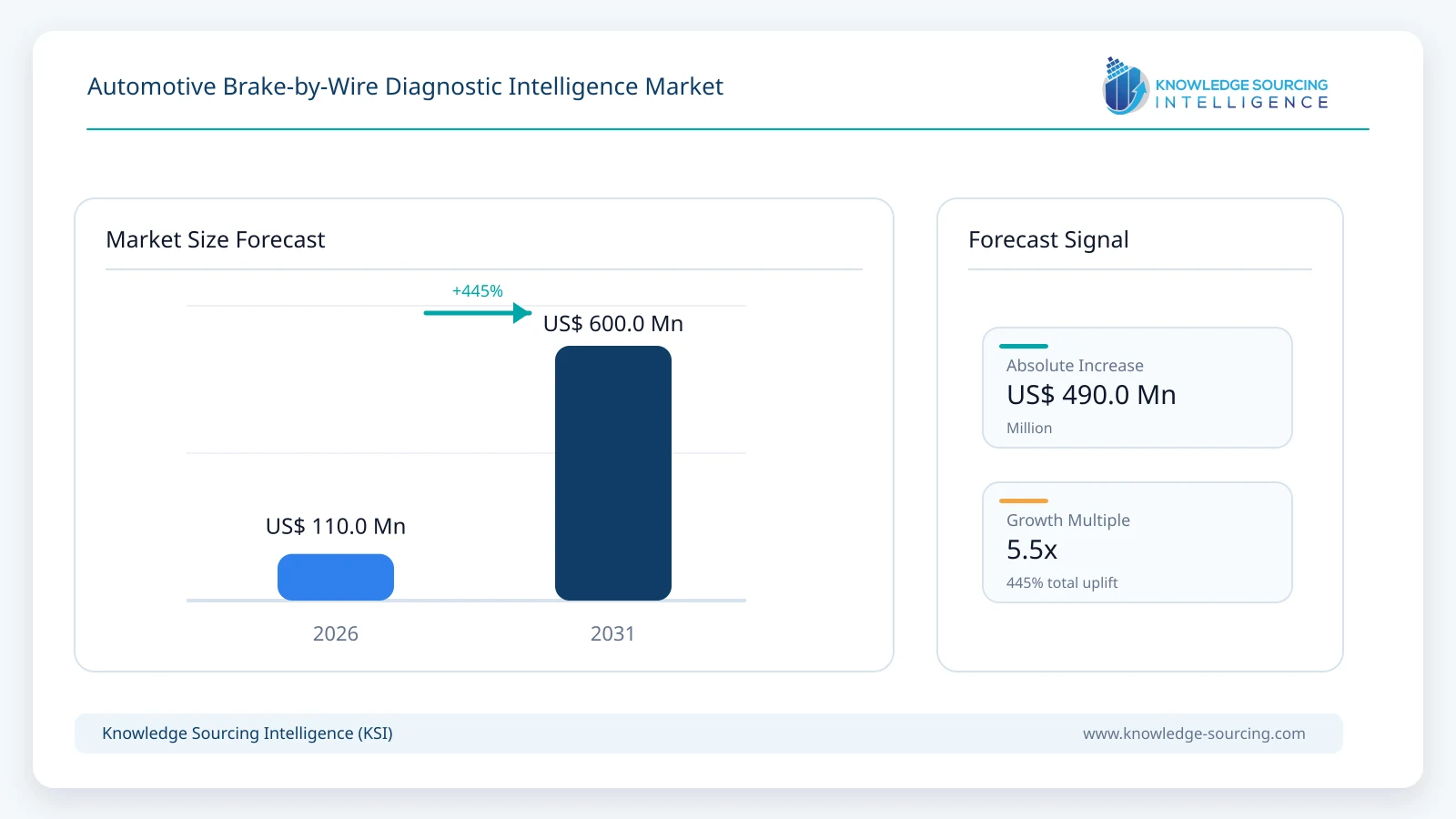
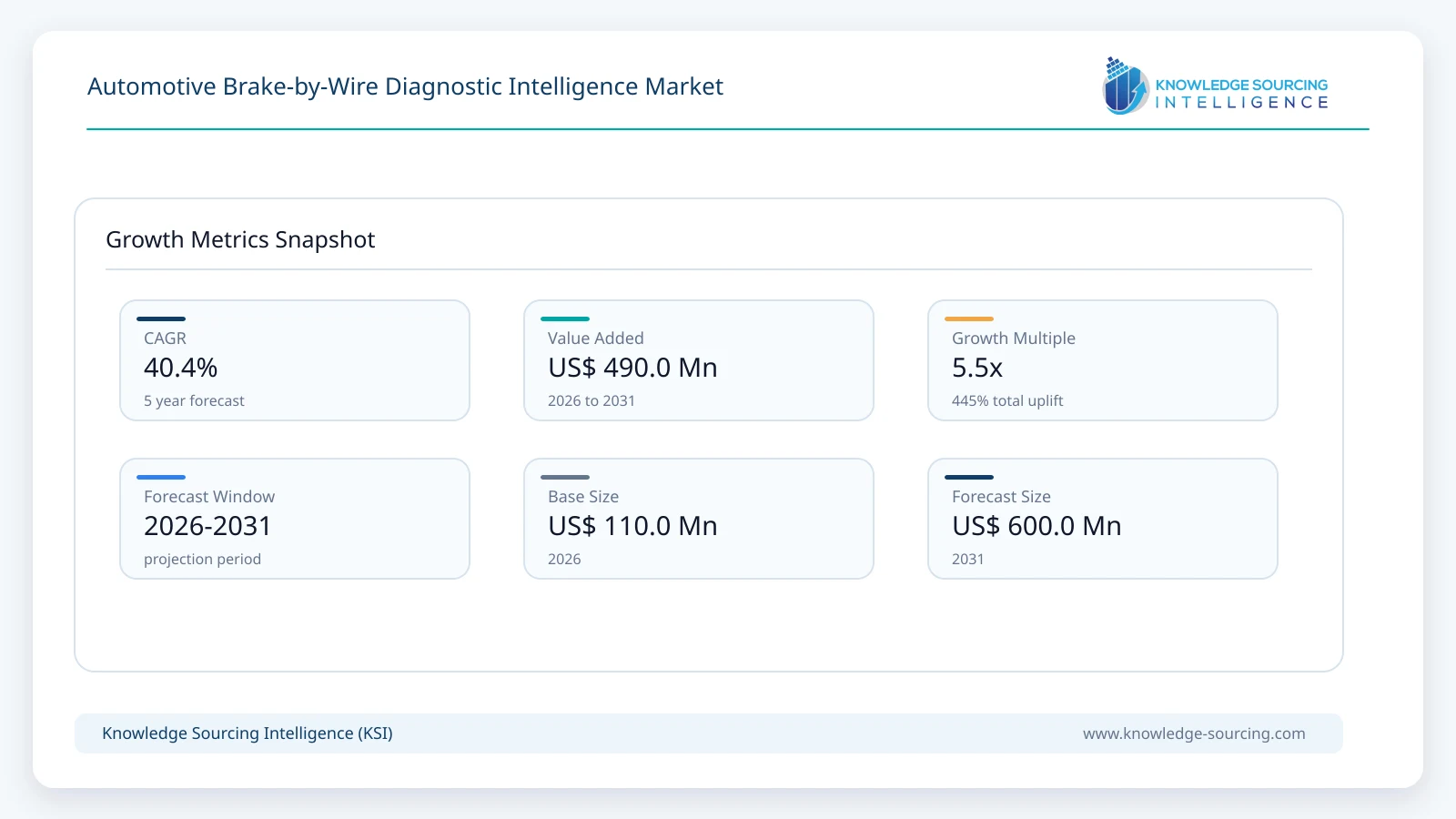
The global Automotive Brake-by-Wire Diagnostic Intelligence Market is forecast to grow at a CAGR of 40.4%, reaching USD 600.0 million in 2031 from USD 110.0 million in 2026.
Highlights:
- 1Global estimated revenue rises from USD 110 million in 2026 to USD 600 million by 2031, as advanced diagnostic attachment expands across qualified brake-by-wire platforms.
- 2Redundancy and fallback supervision represents approximately 29% of 2026 value and gains importance as electrically independent brake channels become more common.
- 3Integrated electrohydraulic brake systems remain the largest 2026 actuation group, while hybrid and fully electromechanical designs gain share through 2031.
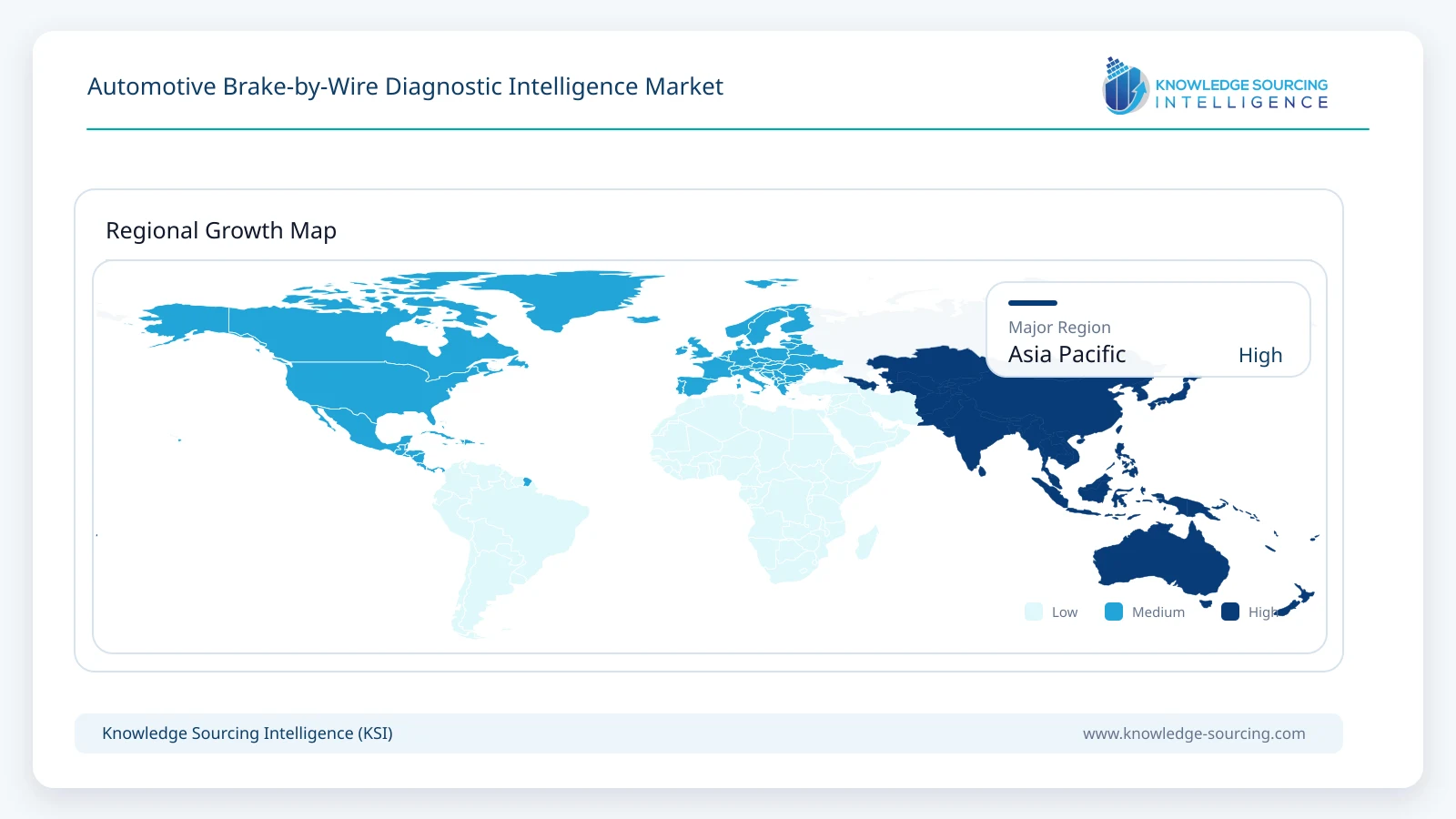
- 4Asia Pacific accounts for approximately 48% of 2026 global value, supported by Chinese electrified-vehicle production and regional brake-system manufacturing.
- 5Embedded brake-controller intelligence remains the main revenue pool; centralized vehicle computing and connected diagnostics increase their contribution over the forecast period.
- 6Supplier differentiation depends on verified fault localization, fallback availability, low false-alarm rates and durable cybersecurity controls rather than the number of logged diagnostic trouble codes.
In advanced electronically commanded brakes, diagnostic intelligence interprets pedal-demand signals, motor current, brake pressure, actuator position, control-channel status, and network messages to identify faults before they threaten controlled deceleration. Safety-oriented brake controllers already perform mandatory checks; higher-value diagnostic functions distinguish which actuator or supply path is degrading, verify whether a fallback path remains effective, and convert historical operating signals into serviceable fault information. The market includes these identifiable software and control features and related directly contracted integration work.
Bosch designs brake-by-wire systems with redundant signal lines and independently acting pressure-generating channels, while AUMOVIO’s distributed brake arrangement keeps two actuators active in normal operation and the fallback architecture. ZF extends the information available in vehicle motion systems into condition monitoring and digital service. These developments increase demand for better cross-checking, status interpretation, and program-specific diagnostic calibration without making the full brake actuator or chassis controller part of the diagnostic market.
Market Overview
Electronically controlled brakes must convert a digital pedal request into repeatable vehicle deceleration across changing load, road friction, voltage, temperature and component condition. Embedded observers compare a requested pressure or wheel-end clamp force with achieved response, while plausibility monitors verify that sensor inputs, electrical supply and communications agree. Advanced diagnostics extend these conventional protections by classifying failures at actuator or channel level and distinguishing temporary electrical disturbances from wear that requires service.
AUMOVIO’s MK C2 integrated electrohydraulic platform entered series production in 2022, establishing an installed base for electronic braking functions, while its September 2026 distributed brake announcement describes two continuously operating actuators and redundant vehicle power and communications. Bosch’s brake-by-wire architecture likewise separates braking demand from the hydraulic actuators through redundant signal paths. Both designs illustrate why diagnostic software must understand system topology: a warning about a failed channel is useful only when the controller knows which second channel can safely continue braking.
ZF combines wet, hybrid and dry brake-by-wire systems with a broader vehicle-health monitoring capability that evaluates chassis information to anticipate mechanical or electrical faults. BWI Group is expanding its iDBC platform from China into European production, and Brembo’s Sensify concept uses sensor data and independent wheel-end control. The commercial opportunity for diagnostic intelligence arises where these data are converted into additional validated fault coverage, condition reports and service actions, rather than being sold as an undifferentiated part of complete brake assemblies.
Market Trends
Independent Brake Channels Demand More Sophisticated Fault Localization
Brake-by-wire systems with electrically separate command and power paths have to determine not only whether a brake fault exists, but also whether a particular actuator, sensor or supply channel can be isolated without losing necessary braking capability. Bosch describes independent brake pressure sources in its by-wire configuration, and AUMOVIO’s distributed design relies on both actuators working together during ordinary braking. Diagnostic intelligence therefore becomes part of the architecture decision at the beginning of each OEM program.
The most useful fault-detection algorithms compare channel responses against one another and against a controlled vehicle-dynamics reference. A local pressure shortfall and a missing communication acknowledgement should lead to different fallback actions and service records. Suppliers that deliver validated fault classifications can reduce the burden on vehicle makers developing separate safety cases for every actuator variant.
Condition Monitoring Is Extending Beyond Immediate Failures
Brake controllers can measure changes in pressure buildup, actuator response time, electric-motor current or sensor drift over repeated braking events. These measurements offer a route to identifying deterioration before an operating limit is reached, especially in integrated electrohydraulic units where fluid-pressure demand and electrically driven actuators are already monitored. ZF’s vehicle-health monitoring work demonstrates the broader shift toward ongoing condition interpretation across chassis functions.
Predictive algorithms must distinguish real wear from the effects of ambient temperature, road conditions, battery voltage and driving style. Excessive warnings can be as damaging commercially as missed faults because they raise unnecessary service cost and undermine driver trust. Controlled deployment will therefore favor well-characterized condition indicators and gradual expansion of prognostic coverage rather than immediate adoption of open-ended AI predictions.
Chassis Computing Architectures Are Changing Diagnostic Ownership
Brake-by-wire systems previously hosted much of their supervision inside dedicated brake electronic control units, but modern vehicle architectures increasingly coordinate actuator health through centralized motion-control and zonal computing. ZF positions its cubiX platform around cross-actuator control, and AUMOVIO’s newer distributed brake uses multiple vehicle power supply points and redundant electrical networks. These changes require explicit decisions about which diagnostic checks stay safety-local and which results can move to shared vehicle computers.
Local fault detection must remain dependable even if a central processor or external connection is temporarily unavailable. Cross-domain computing can improve interpretation when brake pressure measurements are combined with yaw-rate, wheel-speed or motor-torque signals, but validation becomes more complex. The resulting need for software interfaces, calibration and diagnostic orchestration increases the value of integration work within qualified platform programs.
Electromechanical Brakes Are Introducing New Health Signals
Hybrid and fully electromechanical brake systems introduce wheel-end motors, gears and position feedback that require different diagnostic methods from a conventional hydraulic circuit. ZF announced a multi-vehicle electromechanical-braking order in January 2025, while Astemo presented its Smart Brake actuator in 2025 and ADVICS displayed electric disc-brake concepts in 2026. These programs create new potential monitoring needs even when their disclosed stage is nomination or engineering development.
Wheel-end electromechanical brakes can be monitored through commanded current, achieved clamp force, movement speed and thermal response, but these signals are sensitive to pad contact, environment and actuator mechanics. Suppliers will need to characterize how ageing shifts the expected relationship between electrical inputs and braking output. Diagnostics developed for a hydraulic one-box system cannot be reused without substantial adaptation.
Connected Brake-Health Services Are Creating a Second Revenue Route
ZF’s September 2025 vehicle-health announcement explicitly identifies brake-by-wire and other chassis systems as data sources for monitoring and service recommendations. Fleet operators and OEM service networks can benefit when fault histories identify a deteriorating actuator or intermittent sensor connection before a roadside failure. The underlying vehicle service value comes from useful, validated maintenance guidance rather than transmitting raw brake-controller messages.
Continuous connected monitoring will remain selective because safety-critical functions need local independence and customers may not purchase a standalone brake-health subscription. A practical route to revenue combines an embedded diagnostic entitlement with OEM-authorized fleet analytics or engineering support. Data privacy, security, access rights, and clear responsibility for safety advice will determine which additional connected services are commercially sustainable.
Segment Analysis
By Diagnostic Function: Redundancy and Fallback Supervision
Redundancy supervision is estimated to account for approximately 29% of 2026 market revenue because multiple independent brake channels require continual evaluation of actuator readiness, signal plausibility and power-supply availability. AUMOVIO’s dual-actuator system and Bosch’s redundant pressure sources show how safety architecture creates demand for cross-channel monitoring. The diagnostic value comes from distinguishing a harmless temporary deviation from a condition that requires a controlled degraded mode.
As architectures move toward distributed or fully electromechanical braking, suppliers must validate more possible combinations of mechanical and electronic failures. Monitoring remains embedded in safety controllers, but software complexity and system-integration work can rise even where the number of hydraulic components falls. This supports a growing revenue share for higher-value redundancy analytics.
By Actuation Architecture: Integrated Electrohydraulic Systems
Integrated electrohydraulic brake units account for an estimated 69% of market value in 2026 because one-box control systems have an established commercial presence and already support pressure, booster and stability-control feedback. AUMOVIO has reported more than 15 million cumulative MK C1/MK C2 units since the initial family launch, providing a useful indication of maturity without implying that those units all purchase advanced diagnostics.
New hybrid and dry wheel-end brake programs expand faster through 2031, but installation ramps depend on automotive qualification, actuator manufacturing and fail-operational control design. The electrohydraulic installed production base consequently remains an important market for improved event classification, fault-record quality and specialized diagnostic engineering even as its relative share declines.
By Computing Architecture: Embedded Brake ECU Intelligence
Brake ECU-embedded intelligence contributes roughly 65% of 2026 market value because fast fault response and verified fallback control need a local execution path. Actuator pressure and electrical-supply checks must remain operational even when a vehicle-wide domain controller or telematics link is unavailable. Automotive suppliers therefore embed fault monitors and safety-status logic within the control unit that directly commands braking.
Centralized chassis and edge-to-cloud services gain share as vehicle platforms consolidate computing and coordinate condition signals across brakes, steering and vehicle motion. Shared computation can improve diagnosis of complex operating events, but it does not remove the need for deterministic local safety checks. Suppliers that can divide these tasks cleanly across controllers should gain integration opportunities.
By Diagnostic Method: Model-Based Residual and Observer Diagnostics
Model-based diagnostics compare measured actuator and brake-pressure behavior with a reference response predicted from the driver request and operating conditions. This approach is estimated at around 35% of 2026 revenue, reflecting its usefulness in fault isolation where a simple pressure threshold can miss a slow actuator or produce false alerts under low-voltage operation. Model-based methods also fit established vehicle validation practices.
Multi-sensor fusion and selected learning-based methods may increase their market contribution as suppliers collect data from wheel-end actuators and larger production fleets. Any data-driven method used in a safety-related brake diagnosis requires robust evaluation across environmental and failure scenarios. Its commercial value depends on demonstrably better diagnostic coverage and fewer incorrect alerts, not a generalized claim that artificial intelligence improves braking.
Market Drivers
Growing Adoption of Electronically Commanded Brake Architectures
One-box integrated brake controls, distributed electrohydraulic brakes and wheel-end electromechanical systems replace simpler mechanical relationships with controlled electrical signals and software decisions. AUMOVIO’s MK C2 series-production base and newer distributed brake order demonstrate that these architectures are moving through different stages of commercial adoption. Each qualifying vehicle needs fault supervision designed around its actual braking topology.
Advanced functions add value when the controller can identify which channel is degraded and how much braking authority remains. Additional by-wire penetration broadens the addressable vehicle population, while more complex configurations increase the diagnostic content required per vehicle. Both factors contribute to market growth.
Functional-Safety Requirements for Redundant Braking
Brake-by-wire suppliers must demonstrate reliable braking when electronic or hydraulic components fail, making channel-health verification a practical part of vehicle development. Bosch describes redundant signal transmission and independent pressure-generating actuators, while UNECE braking requirements address warning and failure-related performance across regulated vehicle categories.
Basic compliance checks are already part of electronic brake systems, but richer fault classification, fallback readiness scoring and detailed service information involve additional design and validation effort. OEM demand favors suppliers that can support these functions without compromising the safety case of the primary brake controller.
Software-Defined Chassis and Cross-Actuator Integration
Centralized vehicle architectures increasingly connect braking with steering, propulsion and stability control, creating opportunities to interpret a brake fault using more than a single pressure sensor. ZF’s chassis software and AUMOVIO’s electrical-network requirements illustrate the interface complexity that brake suppliers must address when vehicle controls share computing resources.
Correct separation of local safety supervision from broader condition analytics requires program-specific middleware, interfaces and controlled calibration. Suppliers able to deliver validated diagnostic interfaces and predictable behavior across updates can win more integration work during platform development and lifecycle support.
Expansion of Electromechanical Wheel-End Braking
Wheel-end electric brake actuators add motor current, position, gear and clamp-force variables that can reveal performance degradation. ZF’s long-term electromechanical-brake order, together with Astemo and ADVICS technology development, points to a broader supplier push beyond established hydraulic units.
As production adoption expands, brake engineers need new diagnostic models for seizure, slow response, electrical faults and uneven actuator wear. Such models require extensive thermal and mechanical validation but support higher-value differentiated software content where complete wheel-end systems are procured.
Fleet Uptime and Predictive Service Economics
Connected chassis data can support earlier identification of brake-actuator wear or intermittently failing control channels, reducing avoidable downtime in high-utilization vehicles. ZF’s vehicle-health monitoring announcement places braking within a wider service-diagnostics portfolio and demonstrates a route toward OEM-managed condition reports.
Fleet service value is strongest when diagnostic outputs lead to reliable maintenance decisions and manageable workshop workloads. Suppliers must prove that projected component health adds information beyond conventional fault codes and scheduled inspections. Validated service logic creates opportunities for recurring or separately contracted engineering revenue.
Market Restraints
Complex Functional-Safety Validation
Brake diagnostic functions interact with actuators that directly determine deceleration, so incorrect fault isolation or fallback decisions can create significant safety consequences. Supplier teams must test diverse combinations of sensor drift, intermittent communication, low voltage, actuator failure and driver demand across the operating envelope.
Independent validation effort increases when architectures add wheel-end motors or shared computing pathways. An algorithm that performs well in normal road testing may still require redesign after rare-failure analysis, extending development programs and delaying deployment.
False Alerts and Difficult Condition Thresholds
Brake pressure and actuator response naturally vary with ambient temperature, wear, vehicle load and friction conditions. A diagnostic threshold that fails to account for these effects can produce unnecessary warnings, while an overly permissive threshold can miss a deteriorating braking channel.
Continuous condition scoring needs high-quality vehicle data across many duty cycles and sufficient knowledge of failure mechanisms. Automotive OEMs may reject a feature that increases warranty claims or service visits without demonstrating better fault detection and lower lifetime ownership costs.
Long-Lived Brake ECU and Actuator Platform Dependencies
Embedded brake diagnostics depend on the control unit’s safety architecture, sensor locations, actuator design and network behavior. Even small changes to hydraulic routing or electromechanical actuator gearing can affect fault signatures and require new calibration.
Brake systems typically remain in a vehicle platform for multiple years after qualification. OEMs may prefer incremental improvements to proven monitors rather than replace a validated controller with a substantially new diagnostic stack before the next platform update.
Software Update and Cybersecurity Constraints
Connected brake-health analytics introduce data access, update and software integrity requirements in a safety-related system. UNECE R155 and R156 establish cybersecurity and software-update management expectations applicable to covered vehicle types, although they do not mandate a dedicated brake-intelligence product.
An OTA update that changes thresholds or fault interpretation must be evaluated for compatibility with vehicle safety functions and controller configurations. Suppliers face documentation, security and validation costs that can restrict rapid release of adaptive diagnostics after production launch.
Competitive Substitution by Existing Brake-Safety Logic
Electronic stability-control and integrated brake units already contain extensive self-tests and diagnostic trouble-code capabilities. For cost-sensitive programs, these mandatory or bundled functions may meet service requirements without a purchased advanced prognostic feature.
Diagnostic intelligence must therefore demonstrate an incremental benefit through better fault isolation, verified channel availability or reduced maintenance expenditure. Where such benefits are small, software may remain absorbed into standard brake-controller pricing rather than support a distinct premium.
Regional Outlook
Asia Pacific
Asia Pacific accounts for an estimated USD 53 million, or approximately 48% of worldwide brake-by-wire diagnostic intelligence value in 2026. Chinese passenger-vehicle platforms provide a large market for integrated electrohydraulic systems and growing interest in distributed or wheel-end electric braking. AUMOVIO’s September 2026 series award with a Chinese OEM and BWI Group’s China-to-Europe iDBC production expansion demonstrate the regional supplier and vehicle-program depth that supports integrated brake electronics.
Japan and South Korea also contribute substantial electronic-brake engineering through ADVICS, Astemo and Hyundai Mobis. Asia Pacific remains the largest regional market through 2031 as higher-content condition monitoring spreads across electrified cars and qualified by-wire applications. Local software capability, high-volume manufacturing and pressure to reduce false alarms shape commercial success more than standalone aftermarket demand.
Europe
European suppliers ZF, Bosch, AUMOVIO and Brembo provide a concentrated engineering base for redundant brake architecture, intelligent brake-control algorithms and chassis health analytics. ZF’s 2025 vehicle-health monitoring launch and AUMOVIO’s distributed design connect traditional safety-system expertise with increasingly data-driven diagnostics. The regional value pool is estimated at USD 27 million in 2026, reflecting supplier engineering as well as locally sourced OEM programs.
Europe is projected to reach approximately USD 151 million by 2031 as hybrid and dry brake systems move from nominated programs toward broader production and vehicles integrate more chassis-health information. Qualification requirements remain demanding, particularly around redundancy and update controls. Suppliers able to document safe degraded operation while making fault records useful to service organizations should maintain a favorable position in high-content platforms.
Competitive Landscape
The automotive brake-by-wire diagnostic intelligence market is led by companies that own braking-control software and the detailed physical models of their actuators. Bosch and AUMOVIO have substantial electrohydraulic brake-system expertise; ZF competes through wet, hybrid and dry actuation as well as a broader vehicle-health analytics platform. Their strongest commercial advantage is access to real sensor signals, failure-mode validation data and OEM-approved safety architectures, rather than ownership of a generic predictive analytics algorithm.
BWI Group, ADVICS, Astemo and Hyundai Mobis participate through electronically controlled braking, actuation and integration programs. Brembo’s Sensify emphasizes software-led independent wheel-end operation and sensor-rich braking concepts. Supplier competition centers on validated fault isolation, support for multiple actuator designs, integration with central chassis computing and dependable manufacturing quality. Product announcements and technology demonstrators do not establish separate diagnostic-intelligence market shares.
The purchasing process can involve brake-system suppliers, OEM software groups and vehicle-health service organizations, but most safety-critical supervision remains bundled inside a qualified platform. OEMs may award additional value for advanced degradation analytics, specialized fault classifications or ongoing service interpretation when these functions solve a measurable operational need. Suppliers with disciplined software validation and control of diagnostic intellectual property are best positioned to secure this incremental spend.
Recent Developments
September 2026: AUMOVIO unveiled its distributed brake system and disclosed a first series order from a major Chinese OEM, with production scheduled for late 2027. The dual-active-actuator layout increases the need for cross-channel supervision.
September 2026: BWI Group opened its Brazil R&D center and described the regional introduction of electronic stability control and the iDBC1 brake-by-wire roadmap, expanding localized software and vehicle integration support.
July 2026: BWI Group discussed software-based brake-pedal calibration on its iDBC1 system, which entered a European brake program. The launch underlines growing control-software content, while the diagnostic subset remains separately attributable.
May 2026: ADVICS displayed hybrid and four-wheel electric disc-brake configurations at Automotive Engineering Exposition 2026, illustrating a future need to validate electric actuator status and system faults.
September 2025: ZF introduced vehicle-health monitoring services using information from brake-by-wire and other chassis systems to identify developing faults and recommend service actions.
January 2025: ZF announced a major global OEM contract covering nearly five million vehicles with electromechanical braking over the contract life, signaling a growing installed base for complex brake actuator supervision.
Market Outlook
Brake-by-wire diagnostic intelligence will gain value as vehicle makers adopt more electrically separated actuation channels and move toward hybrid or fluid-free braking systems. Embedded safety-local monitors remain essential, while model-based comparisons and multi-sensor interpretation help distinguish channel faults from ordinary operating variation. More of the revenue growth should come from useful diagnostic content per qualified vehicle and new braking-platform deployments rather than from one universal condition-monitoring subscription.
Advanced service offerings can become an additional supplier opportunity when OEMs can access trustworthy brake-condition records and translate them into maintenance schedules. The limits are equally important: mandatory braking diagnostics are already included in electronic brake architectures, and any new predictor must prove improved coverage without excessive warnings or added risk. Commercial growth will reward demonstrated fault-classification performance and platform-specific integration.
Asia Pacific is expected to remain the largest destination for attributable brake-diagnostic value, with European technology suppliers and vehicle programs supporting strong growth in advanced safety supervision. By 2031, suppliers that integrate fault-aware software with durable actuator designs and secure lifecycle support should capture a larger share of differentiated electronic braking content.
Automotive Brake-by-Wire Diagnostic Intelligence Market Scope:
| Report Metric | Details |
|---|---|
| Total Market Size in 2026 | USD 110.0 million |
| Total Market Size in 2031 | USD 600.0 million |
| Forecast Unit | USD Million |
| Growth Rate | 40.4% |
| Study Period | 2021 to 2031 |
| Historical Data | 2021 to 2024 |
| Base Year | 2025 |
| Forecast Period | 2026 – 2031 |
| Segmentation | Diagnostic Function -, Brake Actuation Architecture, Diagnostic Computing Architecture, Diagnostic Method |
| Companies |
|
Market Segmentation
By Diagnostic Function
Brake Fault Detection and Isolation
Redundancy and Fallback Supervision
Actuator and Hydraulic Condition Assessment
Predictive Component Health
Connected Brake Diagnostics
By Brake Actuation Architecture
Integrated Electrohydraulic Systems
Hybrid Hydraulic–Electromechanical Systems
Fully Electromechanical Brake Systems
By Diagnostic Computing Architecture
Brake ECU-Embedded Intelligence
Centralized Chassis and Zonal Computing
Connected Edge-to-Cloud Diagnostics
By Diagnostic Method
Rules, Thresholds and Plausibility Analytics
Model-Based Residual and Observer Diagnostics
Multi-Sensor Condition Fusion
Data-Driven Prognostic Analytics
By Vehicle Type
Passenger Cars and SUVs
Light Commercial Vehicles
Buses and Medium/Heavy Trucks
By Powertrain
Battery Electric Vehicles
Hybrid and Plug-in Hybrid Vehicles
Internal Combustion Engine Vehicles
By Direct Purchasing Customer
OEM-Directed Software and Safety Programs
Tier-1 Braking and Chassis Integrators
Fleet and Service-Platform Operators
By Revenue Category
Embedded Safety and Fault-Isolation Intelligence
Advanced Condition and Prognostic Intelligence
Program Engineering and Diagnostic Services
By Geography
North America
United States
Canada
Mexico
South America
Brazil
Argentina
Others
Europe
Germany
France
United Kingdom
Italy
Spain
Others
Middle East and Africa
Saudi Arabia
United Arab Emirates
South Africa
Others
Asia Pacific
China
Japan
South Korea
India
Indonesia
Thailand
Taiwan
Others
Table of Contents
1. EXECUTIVE SUMMARY
1.1. Key Findings
1.2. Market Size and Growth, 2026–2031
1.3. Brake-by-Wire Diagnostics Technology Outlook
1.4. Regional Opportunity Summary
2. MARKET SNAPSHOT
2.1. Market Overview
2.2. Market Definition
2.3. Scope of the Study
2.4. Market Segmentation
3. BUSINESS LANDSCAPE
3.1. Market Drivers
3.1.1. Growing Adoption of Electronically Commanded Brake Architectures
3.1.2. Functional-Safety Requirements for Redundant Braking
3.1.3. Software-Defined Chassis and Cross-Actuator Integration
3.1.4. Expansion of Electromechanical Wheel-End Braking
3.1.5. Fleet Uptime and Predictive Service Economics
3.2. Market Restraints
3.2.1. Complex Functional-Safety Validation
3.2.2. False Alerts and Difficult Condition Thresholds
3.2.3. Long-Lived Brake ECU and Actuator Platform Dependencies
3.2.4. Software Update and Cybersecurity Constraints
3.2.5. Competitive Substitution by Existing Brake-Safety Logic
3.3. Market Opportunities
3.4. Porter’s Five Forces Analysis
3.5. Industry Value Chain Analysis
3.6. Policies and Regulations
3.7. Strategic Recommendations
4. TECHNOLOGICAL OUTLOOK
4.1. Fault-Tolerant Electronic Brake Control
4.2. Multi-Channel Sensor Plausibility and Redundancy
4.3. Model-Based Brake Actuator Diagnostics
4.4. Actuator Condition and Prognostic Analytics
4.5. Chassis Computing and Diagnostic Data Integration
4.6. Connected Brake Health and Secure Software Updates
5. AUTOMOTIVE BRAKE-BY-WIRE DIAGNOSTIC INTELLIGENCE MARKET BY DIAGNOSTIC FUNCTION
5.1. Introduction
5.2. Brake Fault Detection and Isolation
5.3. Redundancy and Fallback Supervision
5.4. Actuator and Hydraulic Condition Assessment
5.5. Predictive Component Health
5.6. Connected Brake Diagnostics
6. AUTOMOTIVE BRAKE-BY-WIRE DIAGNOSTIC INTELLIGENCE MARKET BY BRAKE ACTUATION ARCHITECTURE
6.1. Introduction
6.2. Integrated Electrohydraulic Systems
6.3. Hybrid Hydraulic–Electromechanical Systems
6.4. Fully Electromechanical Brake Systems
7. AUTOMOTIVE BRAKE-BY-WIRE DIAGNOSTIC INTELLIGENCE MARKET BY DIAGNOSTIC COMPUTING ARCHITECTURE
7.1. Introduction
7.2. Brake ECU-Embedded Intelligence
7.3. Centralized Chassis and Zonal Computing
7.4. Connected Edge-to-Cloud Diagnostics
8. AUTOMOTIVE BRAKE-BY-WIRE DIAGNOSTIC INTELLIGENCE MARKET BY DIAGNOSTIC METHOD
8.1. Introduction
8.2. Rules, Thresholds and Plausibility Analytics
8.3. Model-Based Residual and Observer Diagnostics
8.4. Multi-Sensor Condition Fusion
8.5. Data-Driven Prognostic Analytics
9. AUTOMOTIVE BRAKE-BY-WIRE DIAGNOSTIC INTELLIGENCE MARKET BY VEHICLE TYPE
9.1. Introduction
9.2. Passenger Cars and SUVs
9.3. Light Commercial Vehicles
9.4. Buses and Medium/Heavy Trucks
10. AUTOMOTIVE BRAKE-BY-WIRE DIAGNOSTIC INTELLIGENCE MARKET BY POWERTRAIN
10.1. Introduction
10.2. Battery Electric Vehicles
10.3. Hybrid and Plug-in Hybrid Vehicles
10.4. Internal Combustion Engine Vehicles
11. AUTOMOTIVE BRAKE-BY-WIRE DIAGNOSTIC INTELLIGENCE MARKET BY DIRECT PURCHASING CUSTOMER
11.1. Introduction
11.2. OEM-Directed Software and Safety Programs
11.3. Tier-1 Braking and Chassis Integrators
11.4. Fleet and Service-Platform Operators
12. AUTOMOTIVE BRAKE-BY-WIRE DIAGNOSTIC INTELLIGENCE MARKET BY REVENUE CATEGORY
12.1. Introduction
12.2. Embedded Safety and Fault-Isolation Intelligence
12.3. Advanced Condition and Prognostic Intelligence
12.4. Program Engineering and Diagnostic Services
13. AUTOMOTIVE BRAKE-BY-WIRE DIAGNOSTIC INTELLIGENCE MARKET BY GEOGRAPHY
13.1. North America
13.1.1. United States
13.1.2. Canada
13.1.3. Mexico
13.2. South America
13.2.1. Brazil
13.2.2. Argentina
13.2.3. Others
13.3. Europe
13.3.1. Germany
13.3.2. France
13.3.3. United Kingdom
13.3.4. Italy
13.3.5. Spain
13.3.6. Others
13.4. Middle East and Africa
13.4.1. Saudi Arabia
13.4.2. United Arab Emirates
13.4.3. South Africa
13.4.4. Others
13.5. Asia Pacific
13.5.1. China
13.5.2. Japan
13.5.3. South Korea
13.5.4. India
13.5.5. Indonesia
13.5.6. Thailand
13.5.7. Taiwan
13.5.8. Others
14. COMPETITIVE ENVIRONMENT AND ANALYSIS
14.1. Major Players and Strategy Analysis
14.2. Market Share Analysis
14.3. Mergers, Acquisitions, Agreements and Collaborations
14.4. Competitive Dashboard
15. COMPANY PROFILES
15.1. Robert Bosch GmbH
15.2. ZF Friedrichshafen AG
15.3. AUMOVIO SE
15.4. BWI Group
15.5. Brembo N.V.
15.6. ADVICS CO., LTD.
15.7. Astemo, Ltd.
15.8. Hyundai Mobis Co., Ltd.
16. APPENDIX
16.1. Currency
16.2. Assumptions
16.3. Base and Forecast Years Timeline
16.4. Key Benefits for Stakeholders
16.5. Research Methodology
16.6. Abbreviations
Navigate
Trusted by the world's leading organizations