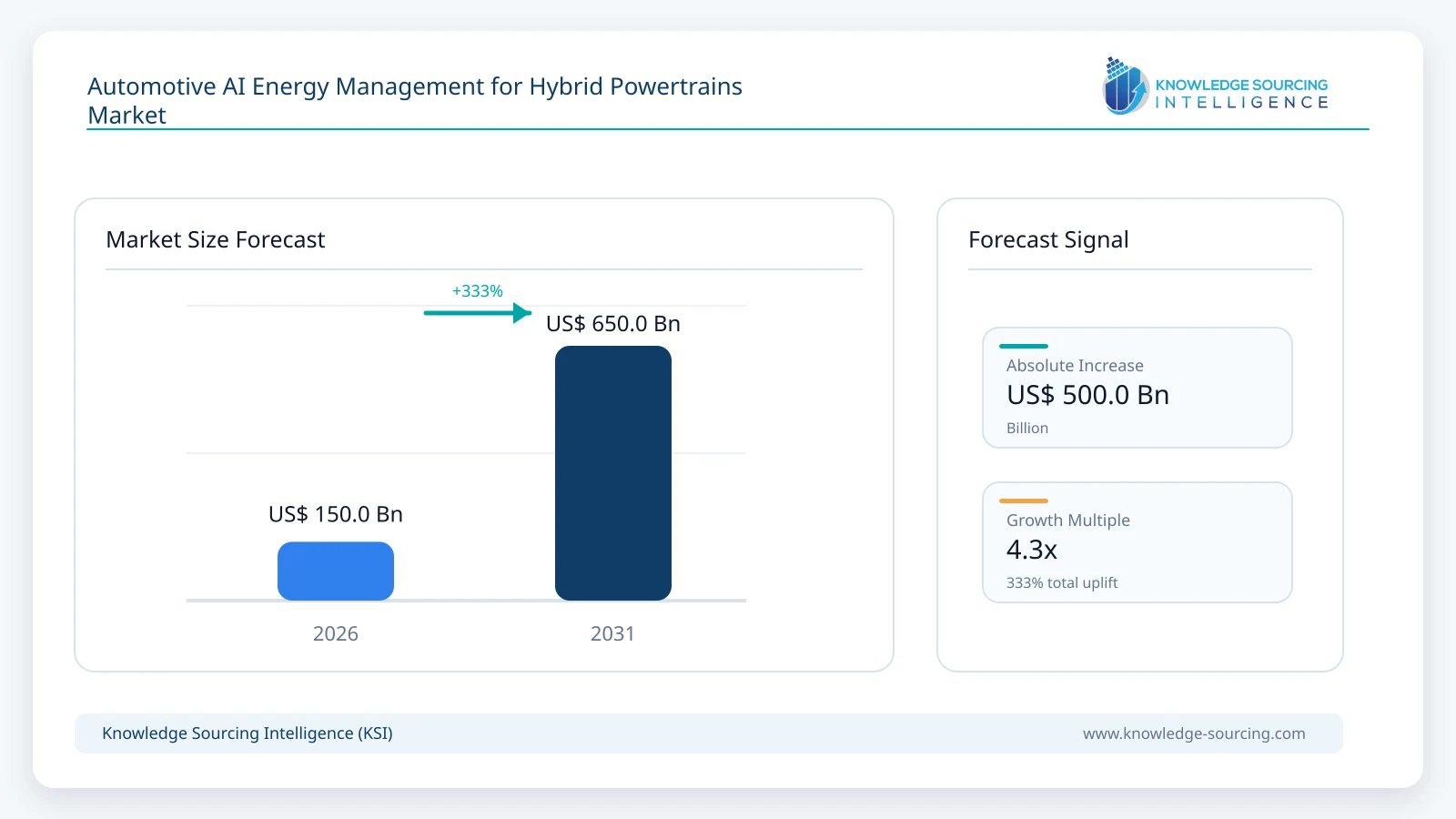
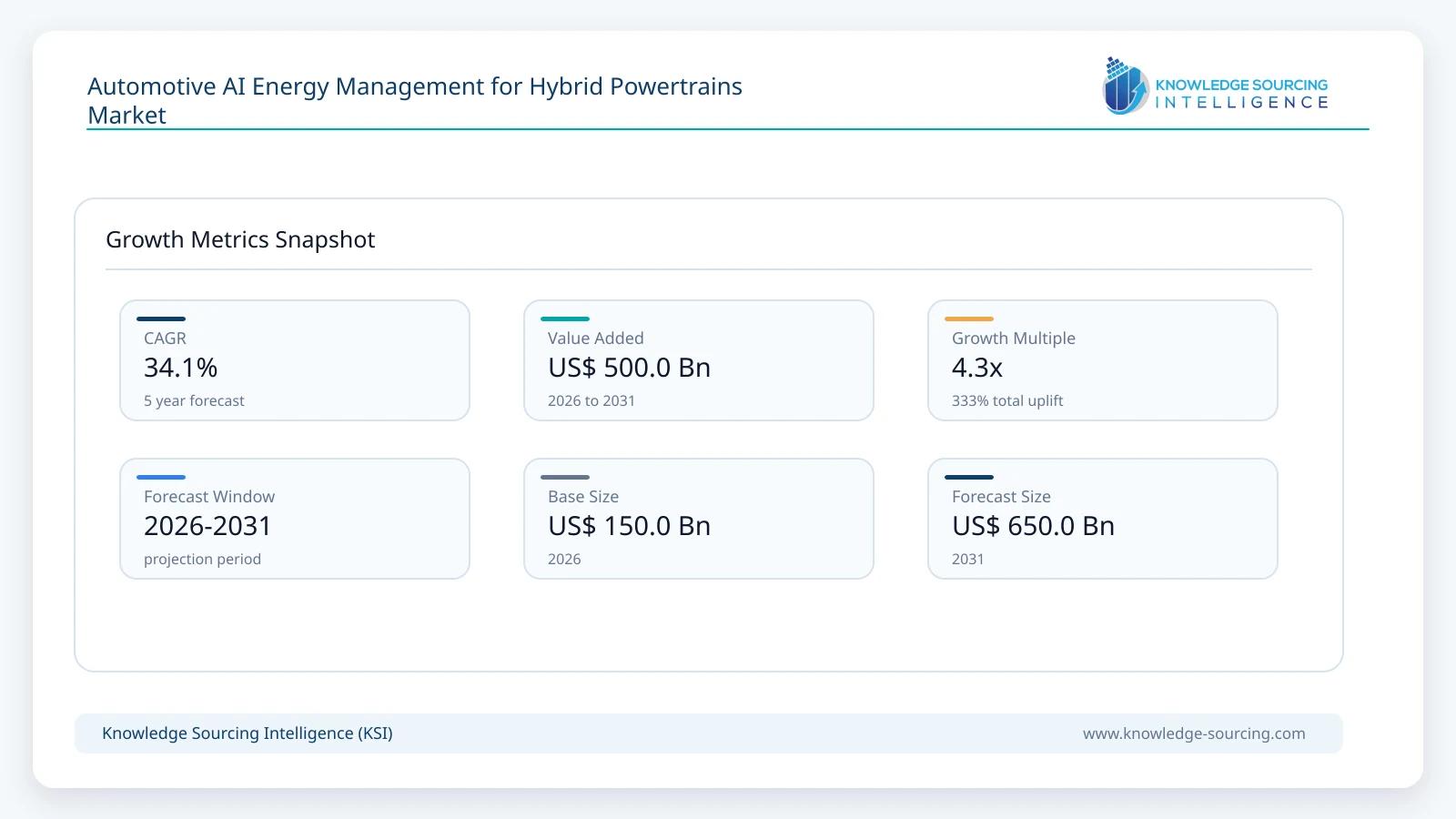
The Automotive AI Energy Management for Hybrid Powertrains Market is forecast to grow at a CAGR of 34.1%, reaching USD 650.0 million in 2031 from USD 150.0 million in 2026.
Highlights:
- 1Revenue increases from USD 150 million in 2026 to USD 650 million in 2031, representing a 34.1% CAGR.
- 2Plug-in hybrids account for approximately 43% of 2026 modeled value, supported by greater electric-mode and route-allocation flexibility.
- 3Predictive engine-motor power allocation is the largest 2026 control function, with route-aware electric-mode planning gaining relative importance.
- 4Asia Pacific contributes an estimated 48% of 2026 demand, reflecting Chinese, Japanese and Korean hybrid program scale.
- 5Integrated powertrain controllers are displacing some standalone control functions as software architectures consolidate.
- 6Automakers increasingly require adaptive energy optimization to coexist with proven deterministic safety fallbacks and predictable battery-state limits.
Hybrid energy-management controllers determine when the engine should generate propulsion or recharge the battery, how strongly the electric machine should assist, and when braking energy should be recovered. Adaptive and prediction-enabled variants extend conventional fixed control maps with route, traffic, driver, and battery-state estimates. Their commercial use depends on rapid, safe execution inside automotive powertrain controllers and careful calibration of engine starting, torque transitions and battery reserve.
Hyundai’s next-generation hybrid architecture uses Hierarchical Predictive Control to anticipate route and road conditions when selecting EV, hybrid and regenerative operation. Bosch offers a Connected Horizon data layer for anticipatory powertrain decisions, while FEV documents AI-based prediction work for plug-in hybrid programs. These applications place the most economically significant software value at the supervisory layer connecting combustion power, electric traction, braking and battery management.
Market Overview
A hybrid vehicle’s energy-management system must satisfy multiple targets at once: driver torque demand, fuel use, emissions compliance, battery state of charge, component temperature, and expected driving conditions. Conventional controllers use calibrated maps and deterministic optimization. More advanced approaches employ learned speed or demand forecasts and constrained optimization to prepare the battery before congestion, gradients, or low-emission urban sections, improving the use of energy already available onboard.
Renault documents E-Nav allocation of hybrid electrical energy using route gradients and traffic, while Mercedes-Benz applies navigation and topography to PHEV mode selection. Hyundai has introduced Hierarchical Predictive Control alongside smart regenerative braking in its next-generation hybrid platform. These examples demonstrate a market moving toward anticipatory operating strategies, although not every predictive production feature necessarily uses machine learning.
Bosch’s vehicle control unit, ZF’s revised 8HP evo hybrid software architecture and Schaeffler’s master control unit illustrate the supplier hardware and software environments on which advanced strategies run. FEV provides more direct evidence of independently supplied predictive-control algorithms and engineering. Commercial pricing is shaped by the amount of reusable software, the OEM’s ownership of the control stack, and the validation work needed for each powertrain rather than by the complete cost of a hybrid transmission.
Market Trends
Route-Aware Hybrid Operation Is Moving into Vehicle Platforms
Navigation-assisted hybrid energy management increasingly uses road grade, predicted speed, and traffic to select a battery reserve appropriate for the next portion of a journey. Hyundai’s Hierarchical Predictive Control adjusts powertrain modes around expected conditions, while Bosch’s Connected Horizon supplies map and live traffic information to the controller. This gives software an opportunity to reduce fuel consumption through better timing of engine starts and charging events rather than higher battery capacity alone.
Route-aware operation is valuable to plug-in hybrids whose drivers move between suburban, motorway and urban use. A controller can preserve electric energy for a later low-speed section and create capacity for recuperation before a descent. Commercial value depends on the accuracy of the preview, timely navigation updates and the ability to fall back safely when routing data is unavailable or wrong.
Learning-Based Prediction Is Being Combined with Deterministic Control
Hybrid supervisory software is increasingly developed using measured drive cycles, driver-behaviour profiles and virtual models that anticipate traction demand. FEV describes an Asian OEM PHEV project with AI-based prediction and multi-layer optimization, demonstrating a practical route from algorithm development toward automotive integration. Learning-based forecasts are particularly useful when fixed calibration cannot capture the range of roads, traffic patterns, and driver demand.
Automakers generally retain well-characterized control constraints around battery state of charge, thermal limits, torque delivery and emissions even when demand prediction uses machine learning. Embedded controllers must deliver repeatable results and explainable fallback behaviour, which favors hybrid solutions combining learned predictions with model-predictive or calibrated supervisory control rather than unrestricted self-learning while driving.
More Hybrid Functions Are Concentrating in Powertrain Controllers
Bosch’s vehicle control platform coordinates engine, transmission, electric drive and charging functions, while ZF’s 8HP evo architecture is designed to accommodate additional OEM software functions. Combining control tasks can reduce separate ECU interfaces and make power-split decisions responsive to a larger set of operating conditions. It also shifts procurement from individual software features toward packaged functions integrated within higher-value controller systems.
Software consolidation can strengthen Tier 1 suppliers with functional-safety expertise and reusable application libraries. At the same time, OEMs with proprietary hybrid strategies may prefer to purchase a controller platform while retaining their own energy-management code. The share of value assigned to each participant will therefore vary with software ownership and vehicle-program contracting.
Hybrid Diversity Is Increasing Calibration Requirements
Full hybrids, plug-in hybrids, range extenders and 48 V mild hybrids use different electric power levels, battery reserves and engine operating strategies. ZF’s expansion of its 8HP evo platform across hybrid variants reflects the need for modular control rather than a single calibration. More advanced energy optimization becomes useful when OEMs seek consistent driving response across a growing number of transmission and electrification combinations.
Model-based engineering and measured-data calibration help teams reuse portions of the control architecture without applying the same driving-mode thresholds to every powertrain. ETAS offers data-based modeling and optimization tools for these calibration tasks, while engineering specialists can license reusable predictive functions. The largest software opportunity remains with programs where the control improvement can be validated against conventional operating strategies.
Regenerative Energy Is Becoming Part of Journey-Level Planning
Hyundai’s advanced hybrid control coordinates regenerative braking with road and traffic conditions, while Toyota’s predictive hybrid guidance has demonstrated the principle of reserving battery charging capacity before anticipated downhill travel. Energy captured during braking has more value when the control system anticipates whether the battery can accept it and how soon the engine may be needed.
A controller that links recuperation to route prediction can reduce waste at battery state-of-charge limits and avoid unnecessary combustion generation. Procurement remains tied to evidence that the strategy improves real-world fuel economy without disturbing brake feel, stability controls, or driver-requested torque, making validation a central part of supplier differentiation.
Segment Analysis
By Hybrid Powertrain Type: Plug-in Hybrid Electric Vehicles
Plug-in hybrids generate an estimated 43% of 2026 AI-enabled energy-management revenue because their relatively large traction batteries create meaningful choices between electric driving, combustion support, charge sustenance and recuperation. Navigation data can improve the timing of electric operation across a journey, particularly when road grades and congestion vary. Mercedes-Benz and Renault illustrate production-facing approaches to route-guided energy planning.
Extended-range vehicles are modeled to grow faster from a smaller base as their combustion generators increasingly operate around predicted battery demand rather than directly following wheel load. Full hybrids maintain a substantial installed production base and benefit from anticipatory engine starting, but cost-sensitive mild hybrids generally support less complex control value per vehicle.
By Energy Management Function: Predictive Engine-Motor Power Allocation
Predictive engine-motor dispatch represents about 34% of 2026 revenue because it governs the most frequent commercial decision in a hybrid: how much propulsion to request from each available source. Better speed and torque predictions allow the engine to avoid inefficient operating points while the electric motor responds to transient demand. Hyundai’s new dual-motor hybrid system demonstrates the breadth of control choices created by tighter motor and engine coordination.
Battery reserve planning and route-aware EV-mode scheduling gain importance as PHEV programs widen and more journeys are represented in map and traffic data. Power-allocation software must still protect catalyst requirements, electric-motor temperature and battery durability. Those system constraints favor validated strategies that translate prediction into auditable control commands rather than relying on performance claims from simulation alone.
By AI-Enabled Control Method: Learned Forecasts with Model Predictive Control
Learned forecasts used within constrained model-predictive control account for approximately 34% of 2026 value because they offer a practical balance between adaptability and automotive verification. The prediction layer estimates approaching energy demand, while the optimization layer respects battery state, component temperature and minimum engine-running requirements. FEV’s documented predictive-control framework supplies relevant software and calibration evidence for these mixed architectures.
Adaptive policies and reinforcement-learning approaches expand their modeled share toward 2031 but face greater requirements for training coverage, verification and robust behavior under unseen conditions. OEM purchasing is likely to prioritize a demonstrated improvement over a conventional controller and the ability to update learned parameters without reopening full vehicle-level safety approval.
By Deployment Architecture: Integrated Powertrain Domain Controllers
Integrated powertrain domain controllers lead the modeled 2026 architecture because they can coordinate combustion, electric drive and transmission decisions without routing every request through several isolated controllers. Bosch’s vehicle control unit and ZF’s evolving hybrid software interface support that direction. Reuse of common control hardware enables automakers to configure different hybrid applications around a smaller number of validated computing platforms.
Central vehicle computers gain share later in the forecast as software-defined architectures mature, though timing-critical torque and safety loops may remain closer to propulsion hardware. Suppliers that provide modular software interfaces, functional-safety documentation and reliable integration with existing engine and battery controls are better positioned to protect their share of the value pool.
Market Drivers
Increasing Production and Variety of Hybrid Powertrains
Automakers are broadening HEV, PHEV and range-extended lineups to address different charging access, cost and driving patterns. Hyundai’s new-generation hybrid system and ZF’s multiformat 8HP evo illustrate the growing number of engine-electric operating strategies that must be calibrated. Each additional platform creates potential demand for predictive supervisory functions when the expected efficiency gain exceeds integration cost.
Unlike conventional fuel-saving hardware, adaptive software can be reused across vehicle derivatives after initial validation. This creates an attractive source of licensed functionality and project engineering, especially for automakers operating several battery sizes or hybrid transmission layouts.
Efficiency Improvements Without Larger Batteries
Route forecasting and predicted power demand can change when a hybrid charges its battery or operates the engine, improving the utilization of installed electrical capacity. Bosch’s Connected Horizon and the documented Hyundai predictive strategy show that navigation, gradients and traffic information are becoming relevant inputs to energy management. Software gains are appealing because they need not require a larger or heavier battery pack.
The purchasing case is strongest when measured benefits persist across independent drive cycles, climates and real drivers. OEMs are therefore likely to fund robust energy prediction and calibration tools that translate potential efficiency improvements into repeatable fleet-level results.
More Powerful Domain Controllers and Software Reuse
Powertrain controllers increasingly support broader coordination across the combustion engine, electric machine, gearbox and battery. Bosch’s vehicle controller and Schaeffler’s master control architecture demonstrate how computing resources can be consolidated to support richer supervisory algorithms. A common platform reduces repeated electrical and software interfaces across hybrid variants.
Reusable predictive-control modules can lower the incremental cost of bringing advanced functions into additional models. Suppliers with validated base software, integration services and calibration libraries have a stronger opportunity than vendors offering an algorithm detached from automotive execution requirements.
Demand for Predictive PHEV and Range-Extender Operation
Plug-in hybrids must preserve sufficient electric range for parts of a journey while keeping the combustion system ready to meet performance and emissions conditions. FEV’s PHEV and range-extender predictive projects show that battery reserve and road-preview allocation can be developed as discrete software workstreams. More varied usage patterns strengthen the value of adaptive predictions over one fixed route or laboratory cycle.
Advanced strategies are particularly attractive where the engine is used as a generator in range-extended operation. Suppliers can create value by minimizing inefficient starts and scheduling generation without allowing battery state of charge to fall below safe operating limits.
Growing Value of Calibrated Regeneration and Energy Recovery
Regenerative braking interacts with available battery headroom, engine charging and vehicle deceleration requirements. Hyundai’s Smart Regenerative Braking adjusts recovery around traffic and navigation information, making energy capture a more dynamic control decision. Hybrid vehicles with frequent urban operation can benefit from better preparation for braking events.
Powertrain teams nevertheless need to align the energy strategy with friction-braking systems, battery temperature and driver-requested deceleration. That creates recurring demand for careful software integration, model validation and production calibration rather than a simple standalone algorithm purchase.
Market Restraints
High Validation Burden for Learned Hybrid Control
An AI-supported controller must preserve predictable vehicle response when its route forecast is wrong, sensor data are missing or a driver accelerates unexpectedly. Hybrid torque arbitration also affects engine restarts, battery reserve and emissions controls, making poorly bounded predictions a vehicle-level risk. Qualification therefore requires much broader driving and environment coverage than a demonstration on a known route.
Automakers can limit deployment to learned predictions that feed a deterministic optimizer and preserve fallback maps. The cost of verification, diagnostics and recalibration can reduce the attractiveness of a new algorithm even where simulation indicates a fuel-economy advantage.
Limited Standalone Purchasing of Supervisory Software
Hybrid control functions are frequently embedded within an OEM-developed vehicle controller or a Tier 1 transmission package rather than sold as a separate software product. Bosch and ZF demonstrate the breadth of functionality included in such integrated systems. Supplier competition therefore depends on software ownership, documented contribution and lifecycle support rather than a simple module price list.
OEMs with mature internal hybrid expertise may be reluctant to outsource their operating strategy, particularly where it affects drivability and brand differentiation. Specialist vendors must show that predictive functions reduce engineering effort or provide demonstrable results beyond the buyer’s existing calibration.
Uncertain Route and Driver Forecasts
Traffic delays, weather changes, poor map updates and unexpected journeys can invalidate predictions used for battery reserve planning. Bosch’s connected route information improves context but does not eliminate uncertainty or guarantee a correct operating strategy. A hybrid controller must continue to satisfy the driver’s requested torque and safety limits even when the planned route is abandoned.
Persistent errors can lead to unnecessary engine operation or missed recuperation opportunities, eroding the very fuel savings the software is intended to deliver. Robustness testing and sensor-data quality become essential procurement conditions for connected and learning-assisted designs.
Hybrid Architecture and Regional Calibration Fragmentation
Engine displacement, battery size, transmission configuration and local emissions requirements differ substantially among 48 V, full-hybrid, plug-in and range-extended vehicles. ZF’s modular hybrid portfolio illustrates the scale of engineering variation that advanced control vendors must support. A strategy developed for a PHEV with a large battery cannot be transferred unchanged to a compact mild-hybrid system.
Calibration must also cover differences in fuel characteristics, driving cycles, climate and customer expectations. These recurring program costs make reusable platform architecture important and can slow the commercial conversion of promising AI development methods into volume production.
Compute, Data and Lifecycle Cost Constraints
Learned powertrain models compete for processing capacity, memory and software-update budgets with mandatory engine, inverter, transmission and safety functions. More complex controllers may need secure software lifecycle tooling and sufficient onboard storage for predictive data. Entry-price hybrids are especially sensitive to extra processor cost where the fuel saving is small.
Automakers must also decide whether cloud-connected traffic information justifies recurring data expense and service complexity. Control designs capable of running with limited connectivity and reliable onboard fallback are likely to expand more broadly than approaches dependent on continuous cloud availability.
Regional Outlook
Asia Pacific
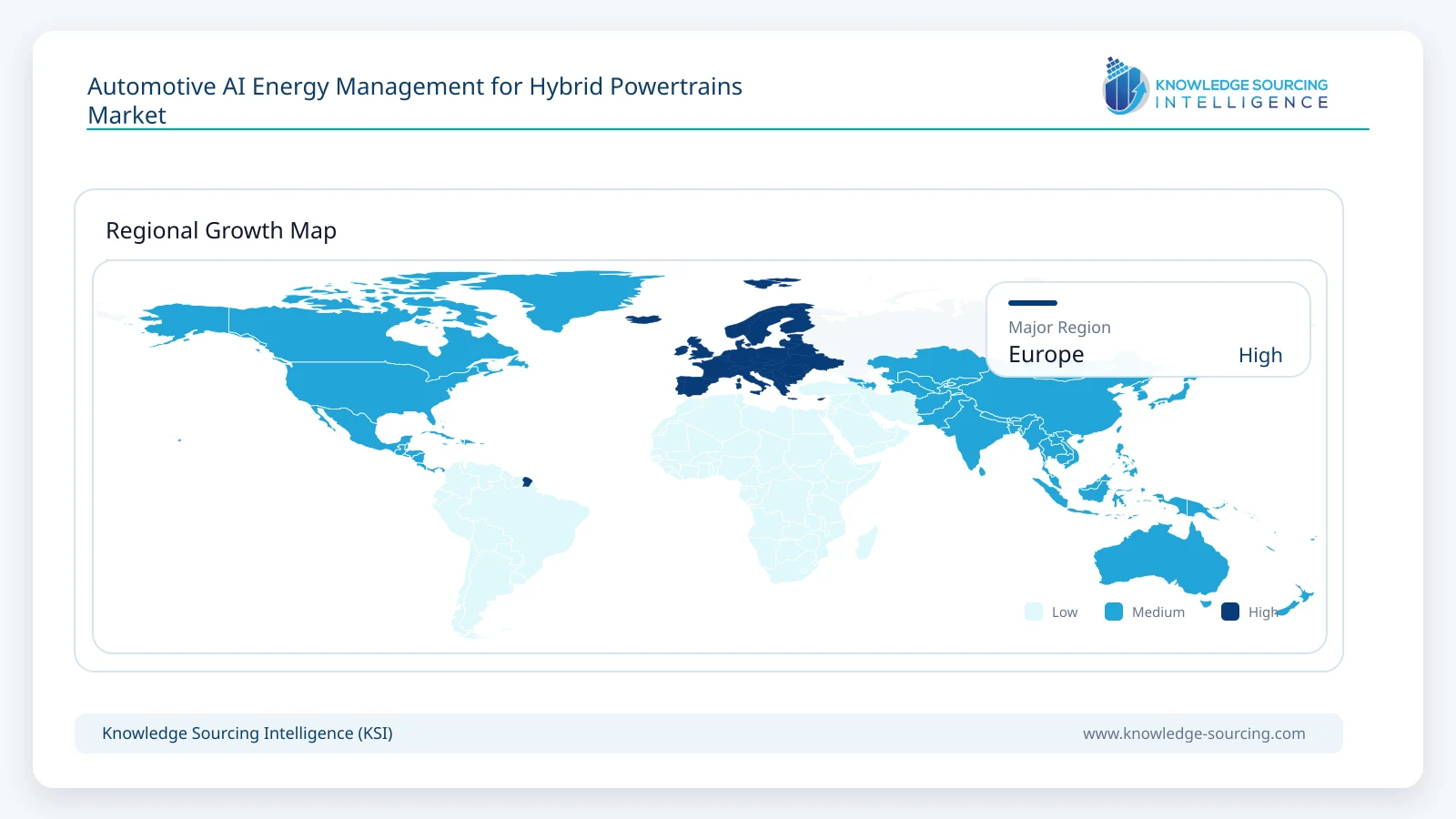
Asia Pacific is the largest modeled regional market, representing approximately 48% of global AI-enabled hybrid energy-management revenue in 2026. China’s broad PHEV and range-extender portfolio is joined by Japan’s established full-hybrid engineering base and South Korea’s expanding next-generation hybrid platforms. Hyundai’s route-predictive strategy and long-standing Japanese hybrid-control capabilities create a practical ecosystem for more advanced supervisory functions.
The region remains the largest through 2031 as OEMs spread calibrated algorithms across more vehicle classes. China offers scale for rapid hardware and software iteration, while Japanese and Korean programs place strong emphasis on dependable real-world efficiency and long-life control. Cost and the distinction between conventional optimization and genuine adaptive functions remain important factors in the speed of deployment.
Europe
European hybrid suppliers and automakers emphasize route-aware electric operation and coordinated controls in high-value PHEV applications. Mercedes-Benz uses navigation-aware operating strategies, Renault provides E-Nav energy planning, and ZF supplies hybrid transmission architectures with expanding software capacity. These functions align with European manufacturers’ need to optimize electric running, smooth mode switching and fuel efficiency across mixed urban and motorway travel.
Europe accounts for approximately 29% of modeled 2026 revenue, supported by both OEM-developed control functions and specialist engineering companies such as FEV. Demand is expected to increase as adaptive prediction, software reuse and central control computing become more established. Strong compliance and validation requirements can lengthen development cycles but also favor qualified suppliers with repeatable, documented engineering processes.
Competitive Landscape
The supplier landscape combines domain-controller and hybrid driveline manufacturers with specialist predictive software developers and vehicle manufacturers retaining proprietary operating strategies. Bosch supplies control electronics and predictive road-data capabilities; ZF focuses on hybrid transmission integration and reusable control interfaces; Schaeffler and DENSO provide relevant electronic and powertrain-control platforms. FEV is differentiated by directly documented predictive-control software and OEM project engineering.
Hyundai, Toyota, Mercedes-Benz, Renault and Stellantis demonstrate different approaches to hybrid energy management on production or announced vehicle platforms. Their roles are primarily as implementers and buyers, although captive software development also contributes to the economic value of the segment. Control software often arrives embedded in a larger transmission or ECU agreement, so commercial leadership cannot be inferred from total hybrid vehicle sales.
Automotive safety, calibration repeatability, system integration and ownership of route and driving data are likely to determine competitive advantage more strongly than claims about neural-network complexity. Suppliers able to deliver a well-bounded adaptive function, documented efficiency improvements and lifecycle maintenance support can participate in an expanding software value pool without requiring control over the complete hybrid drivetrain.
Recent Developments
October 2026: Hyundai Motor introduced the all-new TUCSON with the next-generation hybrid system and intelligent-efficiency technology, supporting greater vehicle-program relevance for coordinated hybrid supervisory control.
July 2026: Stellantis / Peugeot launched the Peugeot 208 hybrid in Taiwan and described intelligent energy management that adjusts petrol-electric contribution to driving conditions; the announcement does not identify a separately billed AI algorithm.
March 2026: Mercedes-AMG announced updated GLE 53 hybrid models with intelligent mode switching and battery-hold operation, reinforcing demand for flexible electric-combustion allocation.
November 2025: ZF described the 8HP evo hybrid transmission and revised software interfaces designed to accommodate more advanced OEM functions across HEV, PHEV and mild-hybrid variants.
September 2025: Schaeffler presented an MCU-based vehicle electronic architecture supporting thermal and energy management along with driving and charging functions.
April 2025: Hyundai Motor Group unveiled Hierarchical Predictive Control and Smart Regenerative Braking within its next-generation hybrid system, explicitly linking route forecasts to propulsion-mode decisions.
Market Outlook
Predictive hybrid supervisory control is expected to become more valuable as OEMs increase the diversity of electrified powertrain offerings while retaining tight cost and calibration discipline. Data-informed power split, charge-state planning and route-guided electric operation should remain the principal applications. Connected prediction and learned adaptation will gain importance where they improve existing control strategies without compromising the driver’s expected vehicle response.
Embedded control software is likely to remain the main source of attributable revenue, with growth in integration and calibration work as OEMs introduce more complex hybrid variants. Conventional fuel-saving strategies will continue to coexist with AI-assisted functions, particularly in entry-priced mild hybrids. Asian vehicle production creates the largest absolute opportunity, while European suppliers maintain a meaningful position in higher-content PHEV software and engineering programs.
Long-term competition will depend on control algorithms that perform reliably outside laboratory cycles, can be verified within automotive software processes and integrate with changing domain-controller architectures. Specialist developers may capture value through reusable modules and validation services, while OEM-controlled software stacks retain a significant share of implementation spending.
Automotive AI Energy Management for Hybrid Powertrains Market Scope:
| Report Metric | Details |
|---|---|
| Total Market Size in 2026 | USD 150.0 million |
| Total Market Size in 2031 | USD 650.0 million |
| Forecast Unit | USD Billion |
| Growth Rate | 34.1% |
| Study Period | 2021 to 2031 |
| Historical Data | 2021 to 2024 |
| Base Year | 2025 |
| Forecast Period | 2026 – 2031 |
| Segmentation | Hybrid Powertrain Type, Energy Management Function, AI-Enabled Control Method, Revenue Component |
| Companies |
|
Market Segmentation
By Hybrid Powertrain Type
Full Hybrid Electric Vehicles (HEVs)
Plug-in Hybrid Electric Vehicles (PHEVs)
Extended-Range Electric Vehicles (EREVs)
48 V Mild-Hybrid Systems
By Energy Management Function
Predictive Engine-Motor Power Allocation
Battery Charge-State and Reserve Planning
Route-Aware Electric Driving Mode
Regenerative Energy and Coasting Optimization
Fuel, Emissions and Thermal Trade-off Control
By AI-Enabled Control Method
Learned Forecasts with Model Predictive Control
Online Adaptive and Reinforcement-Learning Policies
Driver and Route Prediction with Constrained Optimization
Learned Calibration with Adaptive Rule-Based Control
By Revenue Component
Embedded AI Application Software
Attributable Controller and Edge Computing Content
Program Engineering and Calibration
Connected Analytics and Software Updates
By Deployment Architecture
Hybrid-Specific Control ECU
Integrated Powertrain Domain Controller
Central Vehicle Computer Supervisory Application
By Predictive Data Input
Onboard Sensor and Driver-State Inputs
Navigation, Map and Road Preview Inputs
Cloud-Connected Traffic and Learning Inputs
By Vehicle Type
Passenger Cars and SUVs
Light Commercial Vehicles
Buses and Medium/Heavy Commercial Vehicles
By Commercial Procurement Channel
OEM-Owned and Internally Integrated Control
Tier-1 Integrated Powertrain Control Supply
Independent Software and Engineering Licensing
By Geography
North America
United States
Canada
Mexico
South America
Brazil
Argentina
Others
Europe
Germany
United Kingdom
France
Italy
Spain
Others
Middle East and Africa
Saudi Arabia
United Arab Emirates
South Africa
Others
Asia Pacific
China
Japan
South Korea
India
Indonesia
Thailand
Taiwan
Others
Table of Contents
1. EXECUTIVE SUMMARY
1.1. Market Opportunity and Key Findings
1.2. Global Revenue Forecast, 2026–2031
1.3. Hybrid Powertrain AI Technology Outlook
1.4. Regional Opportunity Summary
2. MARKET SNAPSHOT
2.1. Market Overview
2.2. Market Definition
2.3. Scope of the Study
2.4. Market Segmentation
3. BUSINESS LANDSCAPE
3.1. Market Drivers
3.1.1. Increasing Production and Variety of Hybrid Powertrains
3.1.2. Efficiency Improvements Without Larger Batteries
3.1.3. More Powerful Domain Controllers and Software Reuse
3.1.4. Demand for Predictive PHEV and Range-Extender Operation
3.1.5. Growing Value of Calibrated Regeneration and Energy Recovery
3.2. Market Restraints
3.2.1. High Validation Burden for Learned Hybrid Control
3.2.2. Limited Standalone Purchasing of Supervisory Software
3.2.3. Uncertain Route and Driver Forecasts
3.2.4. Hybrid Architecture and Regional Calibration Fragmentation
3.2.5. Compute, Data and Lifecycle Cost Constraints
3.3. Market Opportunities
3.4. Porter’s Five Forces Analysis
3.5. Industry Value Chain Analysis
3.6. Policies and Regulations
3.7. Strategic Recommendations
4. TECHNOLOGICAL OUTLOOK
4.1. Hybrid Supervisory Energy Control
4.2. Prediction-Enabled Engine-Motor Power Allocation
4.3. Machine Learning and Model Predictive Control
4.4. Route, Traffic and Driver Demand Forecasting
4.5. Regenerative Energy and Battery Reserve Planning
4.6. Functional Safety and Calibration Validation
5. AUTOMOTIVE AI ENERGY MANAGEMENT FOR HYBRID POWERTRAINS MARKET BY HYBRID POWERTRAIN TYPE
5.1. Introduction
5.2. Full Hybrid Electric Vehicles (HEVs)
5.3. Plug-in Hybrid Electric Vehicles (PHEVs)
5.4. Extended-Range Electric Vehicles (EREVs)
5.5. 48 V Mild-Hybrid Systems
6. AUTOMOTIVE AI ENERGY MANAGEMENT FOR HYBRID POWERTRAINS MARKET BY ENERGY MANAGEMENT FUNCTION
6.1. Introduction
6.2. Predictive Engine-Motor Power Allocation
6.3. Battery Charge-State and Reserve Planning
6.4. Route-Aware Electric Driving Mode
6.5. Regenerative Energy and Coasting Optimization
6.6. Fuel, Emissions and Thermal Trade-off Control
7. AUTOMOTIVE AI ENERGY MANAGEMENT FOR HYBRID POWERTRAINS MARKET BY AI-ENABLED CONTROL METHOD
7.1. Introduction
7.2. Learned Forecasts with Model Predictive Control
7.3. Online Adaptive and Reinforcement-Learning Policies
7.4. Driver and Route Prediction with Constrained Optimization
7.5. Learned Calibration with Adaptive Rule-Based Control
8. AUTOMOTIVE AI ENERGY MANAGEMENT FOR HYBRID POWERTRAINS MARKET BY REVENUE COMPONENT
8.1. Introduction
8.2. Embedded AI Application Software
8.3. Attributable Controller and Edge Computing Content
8.4. Program Engineering and Calibration
8.5. Connected Analytics and Software Updates
9. AUTOMOTIVE AI ENERGY MANAGEMENT FOR HYBRID POWERTRAINS MARKET BY DEPLOYMENT ARCHITECTURE
9.1. Introduction
9.2. Hybrid-Specific Control ECU
9.3. Integrated Powertrain Domain Controller
9.4. Central Vehicle Computer Supervisory Application
10. AUTOMOTIVE AI ENERGY MANAGEMENT FOR HYBRID POWERTRAINS MARKET BY PREDICTIVE DATA INPUT
10.1. Introduction
10.2. Onboard Sensor and Driver-State Inputs
10.3. Navigation, Map and Road Preview Inputs
10.4. Cloud-Connected Traffic and Learning Inputs
11. AUTOMOTIVE AI ENERGY MANAGEMENT FOR HYBRID POWERTRAINS MARKET BY VEHICLE TYPE
11.1. Introduction
11.2. Passenger Cars and SUVs
11.3. Light Commercial Vehicles
11.4. Buses and Medium/Heavy Commercial Vehicles
12. AUTOMOTIVE AI ENERGY MANAGEMENT FOR HYBRID POWERTRAINS MARKET BY COMMERCIAL PROCUREMENT CHANNEL
12.1. Introduction
12.2. OEM-Owned and Internally Integrated Control
12.3. Tier-1 Integrated Powertrain Control Supply
12.4. Independent Software and Engineering Licensing
13. AUTOMOTIVE AI ENERGY MANAGEMENT FOR HYBRID POWERTRAINS MARKET BY GEOGRAPHY
13.1. North America
13.1.1. United States
13.1.2. Canada
13.1.3. Mexico
13.2. South America
13.2.1. Brazil
13.2.2. Argentina
13.2.3. Others
13.3. Europe
13.3.1. Germany
13.3.2. United Kingdom
13.3.3. France
13.3.4. Italy
13.3.5. Spain
13.3.6. Others
13.4. Middle East and Africa
13.4.1. Saudi Arabia
13.4.2. United Arab Emirates
13.4.3. South Africa
13.4.4. Others
13.5. Asia Pacific
13.5.1. China
13.5.2. Japan
13.5.3. South Korea
13.5.4. India
13.5.5. Indonesia
13.5.6. Thailand
13.5.7. Taiwan
13.5.8. Others
14. COMPETITIVE ENVIRONMENT AND ANALYSIS
14.1. Major Players and Strategy Analysis
14.2. Market Share Analysis
14.3. Mergers, Acquisitions, Agreements and Collaborations
14.4. Competitive Dashboard
15. COMPANY PROFILES
15.1. Robert Bosch GmbH
15.2. ZF Friedrichshafen AG
15.3. FEV Group GmbH
15.4. DENSO CORPORATION
15.5. Schaeffler AG
15.6. Hyundai Motor Company
15.7. Toyota Motor Corporation
15.8. Mercedes-Benz Group AG
15.9. Renault Group
15.10. Stellantis N.V.
16. APPENDIX
16.1. Currency
16.2. Assumptions
16.3. Base and Forecast Years Timeline
16.4. Key Benefits for Stakeholders
16.5. Research Methodology
16.6. Abbreviations
Navigate
Trusted by the world's leading organizations