
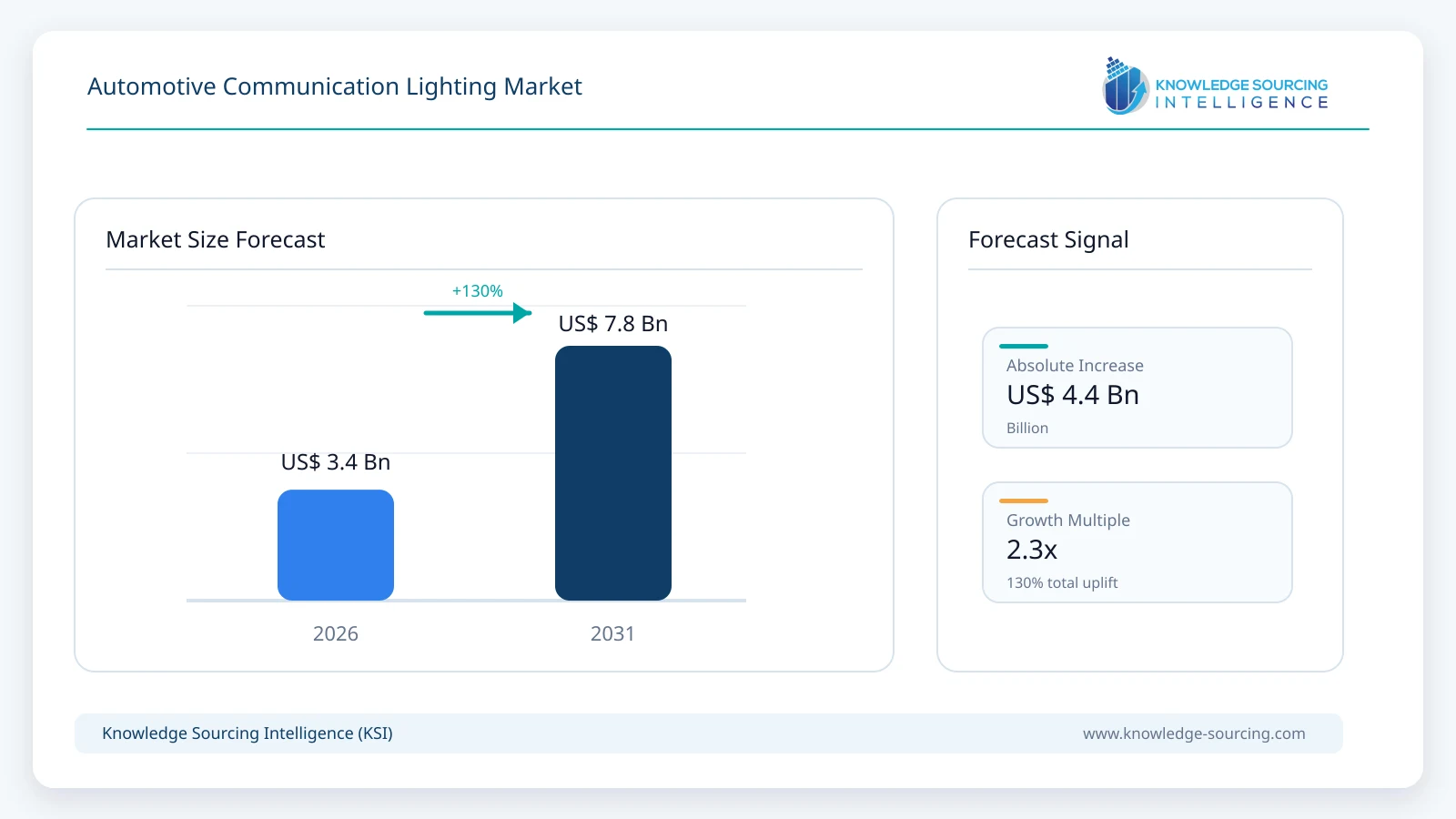
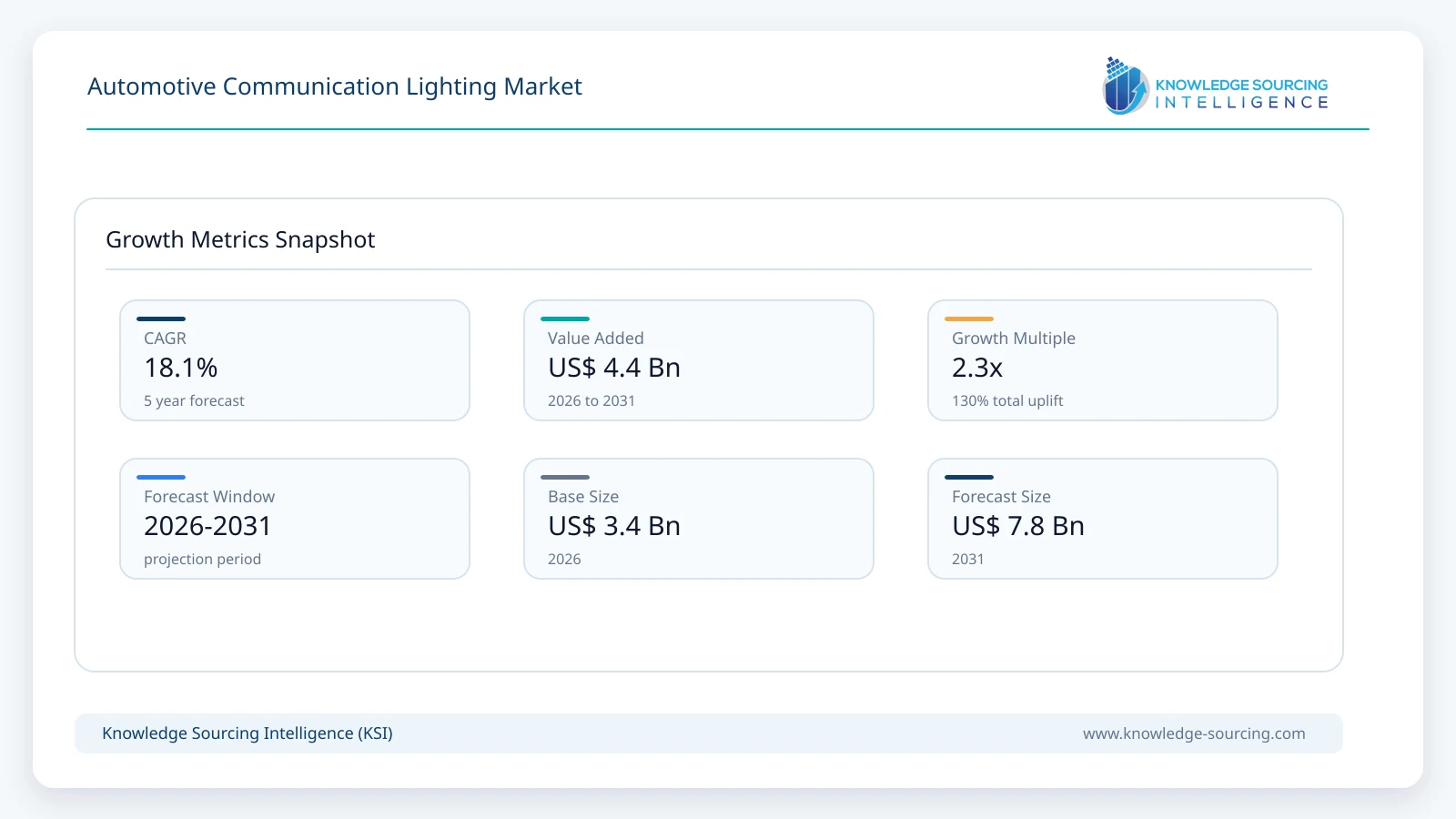
The Automotive Communication Lighting Market is expected to grow at a CAGR of 18.1%, with its value rising from USD 3.40 billion in 2026 to USD 7.81 billion in 2031.
Highlights:
- 1Projection-based communication systems account for approximately 31% of global market value in 2026 because high-resolution headlamp and dedicated ground-projection modules can communicate warnings, guidance and reversing or lane-intent information directly onto the road surface.
- 2LED and matrix-LED architectures represent approximately 42% of 2026 market value, while MicroLED and other high-resolution pixel technologies are the fastest-growing technology class.
- 3Front-mounted communication lighting accounts for approximately 39% of 2026 market value because high-resolution headlamps, illuminated front panels and intelligent signal displays are currently the most active development area.
- 4Safety and V2X-oriented communication represents approximately 41% of 2026 market value, ahead of branding and personalization use cases.
- 5Passenger vehicles account for approximately 95% of global market value in 2026, supported by premium, EV and software-defined vehicle programs.
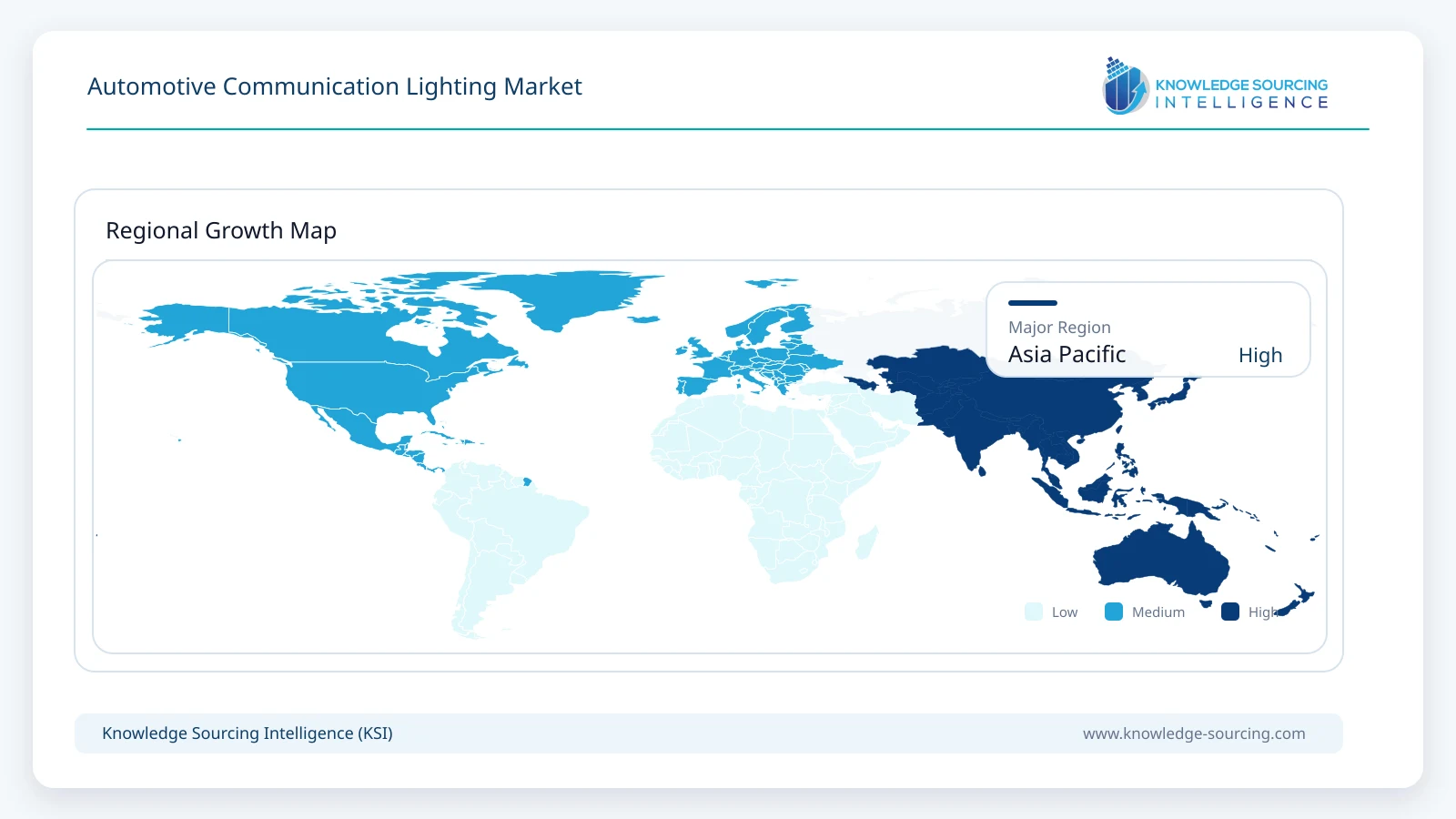
- 6Asia Pacific represents approximately 46% of global market value in 2026, with China leading rapid adoption of digital front lighting, intelligent signal displays and projected communication functions.
The market is emerging from conventional signaling into a software-defined communication layer in which light can convey lane guidance, reversing warnings, charging status, welcome information, automated-driving state, and other context-dependent messages.
High-resolution headlamps and projection modules are becoming an important value pool because individually addressable pixels allow the same optical system to support both road illumination and selected communication functions. At the same time, digital rear lamps, illuminated grilles, front panels and intelligent signal displays are turning vehicle surfaces into programmable interfaces rather than fixed lamps.
The market counts only the incremental value associated with communication capability. Conventional low beam, high beam, stop, tail, turn and daytime-running functions are excluded unless a specific pixelated, projection or display layer adds communication content. Purely decorative ambient lighting and illuminated brand signatures without a communication function are also outside the core market.
Market Overview
Communication lighting extends the traditional role of vehicle lighting from visibility and regulated signaling into programmable visual interaction. The vehicle can use light to indicate what it is doing, warn about a hazard, guide the driver through a maneuver, show charging or access status, or provide visual information to pedestrians and cyclists who may not receive digital V2X messages.
The enabling architecture can take several forms. Pixelated headlamps can project symbols or lane guidance, dedicated projectors can display information on the ground, LED matrices can create animated front or rear patterns, and intelligent signal displays can present context-aware icons or status information. Software determines when and where the message appears, while the optical system must meet brightness, contrast, legibility, and glare-control requirements.
Commercial adoption is therefore shaped by regulation as much as by technology. UNECE rules already govern light-signalling and road-illumination devices, while ongoing working-party activity is addressing signal road projections and automated-driving marker functions. This creates a market in which hardware readiness is advancing quickly, but the available communication vocabulary remains jurisdiction-dependent.
Market Trends
Road Projection Is Moving from Demonstration to Series Deployment
High-resolution headlamps are increasingly capable of projecting lane boundaries, hazard markers and other visual guidance. The commercial transition is visible in 2026 series programs using pixelated headlamp modules with tens of thousands of individually addressable emitters.
Dedicated short-distance projectors are also improving. Daytime-capable MEMS and laser-scanning systems expand communication beyond dark conditions and make projected warnings more usable in urban environments.
Intelligent Signal Displays Are Turning Body Surfaces into Interfaces
LED-based intelligent signal displays can be integrated into front, side or rear vehicle surfaces to communicate status, charging condition, access state, or future V2X information. Unlike a conventional fixed lamp, the displayed content can change according to vehicle context.
This creates new demand for high-density emitters, driver ICs, thermal management and weather-resistant optical surfaces that support display-like behavior without adopting a conventional screen architecture.
Digital Rear Lighting Is Becoming Software-Defined
Rear lamps are evolving from segmented styling elements into addressable light surfaces capable of animation and changing content. OLED, surface-light and pixelated LED technologies allow welcome sequences, warnings and future communication symbols to be added through software.
The rear of the vehicle is particularly attractive for communication because following road users already look there for stop, turn and hazard information, although regulation limits how far additional content can depart from standardized signals.
Electric Vehicles Are Creating New Communication Surfaces
The reduced cooling requirement of many EVs frees front-grille area for illuminated panels, phygital shields and integrated sensing. Suppliers are combining light, trim and sensors in front-end modules that can support brand identity today and broader communication functions as regulation develops.
Illuminated charging indicators, access feedback and status information are also easier to integrate into EV front and side surfaces because software-defined electronics are already present.
Lighting Is Becoming Part of the V2X Interaction Stack
Digital V2X can exchange detailed information between connected vehicles, but pedestrians, cyclists and older vehicles may not receive those messages. Communication lighting provides a physical visual layer that can make selected vehicle intent or hazard information visible to nearby road users.
The long-term value lies in coordinating connected data, ADAS perception and lighting output so the visual message is context-aware rather than a fixed animation.
Segment Analysis
By Communication Architecture: Projection-Based Communication
Projection-based communication leads the market because it can place information directly where the road user is looking. High-resolution headlamps and dedicated ground projectors support lane guidance, reversing alerts, pedestrian-crossing cues, hazard marking and selected V2X-style messages.
The segment is estimated at approximately USD 1.05 billion in 2026 and could approach USD 2.70 billion by 2031 as pixel density improves and daytime-visible projection becomes more practical.
By Technology: LED and Matrix-LED Systems
LED and matrix-LED systems remain the largest technology category because they underpin digital front and rear lamps, intelligent signal displays, illuminated grilles and many lower-resolution projection functions. They combine mature automotive qualification with falling emitter cost and flexible packaging.
The category represents approximately USD 1.43 billion in 2026. MicroLED and other high-resolution pixel architectures will grow faster through 2031, particularly in premium headlamps and display-like exterior communication.
By Vehicle Location: Front Communication Lighting
Front communication lighting holds the largest share because the front fascia combines headlamps, grilles, sensor zones, and increasingly large illuminated panels. This location can support guidance projection, pedestrian interaction, charging or access status, and brand-specific animated communication.
Front-mounted systems account for approximately USD 1.33 billion in 2026 and remain the largest value pool through 2031, although digital rear lighting and road projection gain share.
By Communication Function: Safety and V2X-Oriented Communication
Safety-oriented communication is the largest functional segment because road-user warnings, reversing projections, lane guidance and automated-driving status can provide a direct safety rationale beyond styling. These applications are also the focus of current regulatory discussion.
The segment accounts for approximately USD 1.39 billion in 2026 and is expected to exceed USD 3.30 billion by 2031 as approved projection and external communication functions broaden.
By Vehicle Type: Passenger Vehicles
Passenger vehicles dominate because high-resolution lighting, animated signatures and software-defined exterior electronics are being introduced first in premium cars, EVs, and technology-focused SUVs. Chinese and European OEMs are particularly active in digital front-lighting and intelligent surface programs.
Passenger vehicles represent approximately USD 3.23 billion in 2026. Commercial-vehicle adoption is smaller but relevant for buses, autonomous shuttles, and fleets where external intent or status communication may provide operational value.
Market Drivers
Rapid Adoption of High-Resolution Digital Lighting
MicroLED, pixelated LED and high-density matrix systems can control thousands of light points individually, transforming headlamps and signal lamps into addressable optical platforms. The same hardware that improves adaptive beam control can support communication functions at relatively low incremental software cost.
Series deployments in 2026 demonstrate that high-resolution communication is no longer limited to concept vehicles.
Software-Defined Vehicles and Centralized Lighting Control
Centralized compute and zonal electrical architectures make it easier to coordinate lighting with ADAS, navigation, access and connected-vehicle data. Communication content can therefore change according to vehicle state without requiring a dedicated controller for each lamp.
OTA capability also allows approved visual behaviors to evolve during the vehicle lifecycle, increasing software value relative to fixed-function lighting.
EV Front-End Redesign and Illuminated Surface Integration
Electrification reduces the need for large open radiator grilles on many vehicles, creating space for illuminated front panels and integrated lighting surfaces. These modules can combine styling, sensing and communication while simplifying the front-end visual architecture.
The same trend supports illuminated charging-status and access indicators that provide functional communication around parked vehicles.
Need for Visual Interaction with Non-Connected Road Users
Connected V2X messages cannot reach every pedestrian, cyclist or legacy vehicle. Light-based communication can translate selected digital information into an immediately visible local signal without requiring the recipient to own compatible equipment.
This becomes more important as automated vehicles perform maneuvers that may not include traditional eye contact or driver gestures.
Expansion of Digital Brand Signatures into Functional Communication
OEMs already invest heavily in animated light signatures, illuminated logos and welcome sequences. The same addressable hardware can support status or safety communication, improving the business case for higher-content lighting systems.
This convergence allows manufacturers to monetize both design differentiation and functional communication from one optical platform.
Market Restraints
Fragmented Regulatory Approval for New Light Signals
Exterior lighting remains one of the most tightly regulated vehicle domains. New symbols, colors, animations and projections can create confusion if they conflict with standardized traffic signals, so approval pathways vary by function and jurisdiction.
UNECE working groups continue to address signal road projections and automated-driving marker lamps, meaning commercial hardware capability can advance faster than legal deployment.
Risk of Misinterpretation by Pedestrians and Other Road Users
A communication signal only improves safety if people understand it consistently. Complex icons, animations or brand-specific patterns can increase cognitive load, especially across different cultures and traffic contexts.
OEMs therefore need strong human-factors validation and may ultimately depend on standardized visual conventions for safety-critical use cases.
Daylight Visibility, Glare and Optical Contrast Constraints
Projected or surface-displayed messages must remain visible in bright daylight without creating excessive glare at night. Achieving that contrast can require high optical power, tight beam control and adaptive brightness.
Daytime ground projection is particularly demanding because road color, texture, rain and sunlight can degrade legibility.
Higher Cost and Thermal Load of High-Resolution Systems
MicroLED arrays, high-density drivers, precision optics and laser or MEMS projection modules cost more than conventional signal lamps. High emitter density also increases thermal-management requirements.
The value proposition is strongest when communication shares hardware with adaptive headlighting or premium design functions rather than requiring a standalone module.
Cybersecurity and Software Validation Requirements
Software-defined lighting that reacts to ADAS or connected data introduces a broader validation surface. Incorrect or malicious output could create misleading road-user information even if the underlying lamp hardware remains functional.
Safety-relevant communication therefore requires authenticated software updates, fault handling and clear separation between approved signal functions and non-safety animation content.
Regional Outlook
Asia Pacific
Asia Pacific is the largest regional market in 2026, supported by China's rapid deployment of digital headlamps, illuminated front panels, intelligent signal displays and software-defined lighting on new energy vehicles. Local OEMs increasingly use lighting as both a design signature and a visible technology feature, shortening the adoption cycle for high-resolution communication functions.
The region also benefits from a dense LED, display, semiconductor, and lighting-system supply chain. FORVIA HELLA's localized SSL | HD program for the Zeekr 8X and broad adoption of high-resolution light sources by Chinese OEMs illustrate the region's production momentum.
Europe
Europe remains a high-value communication-lighting market because premium OEMs are early adopters of pixel headlamps, digital rear lamps, illuminated grilles and advanced front-end modules. The region also plays a central role in UNECE lighting regulation, giving European suppliers and OEMs strong influence over the technical and legal framework for new communication functions.
Growth through 2031 will be driven by series adoption of high-resolution projection, phygital front panels and software-defined rear lighting, while regulatory harmonization determines how quickly safety-critical external messages can scale.
Competitive Landscape
The market combines major lighting Tier 1 suppliers, LED and semiconductor companies, optical-technology specialists and vehicle-front module suppliers. FORVIA HELLA, Valeo, Marelli, ZKW and other system suppliers compete through high-resolution headlamps, projection, digital rear lighting and illuminated exterior modules, while ams OSRAM and Infineon provide enabling emitters and projection electronics.
Competitive differentiation is shifting from lamp hardware alone toward optical resolution, software control, communication-content flexibility and the ability to integrate lighting with ADAS and connected-vehicle data. Suppliers with both production-scale lighting capability and software-defined architecture are better positioned than companies focused only on decorative illumination.
Regulatory readiness is also becoming a competitive asset. Vendors need to design communication functions that can be adapted by region, disable non-permitted content where necessary and maintain conventional compliant lighting performance even when advanced communication features are unavailable.
Recent Developments
28 May 2026: FORVIA HELLA announced the first fully localized Chinese production program for its SSL | HD high-resolution headlamp in the Zeekr 8X, including projected functions used for communication with surrounding road users.
24 April 2026: Valeo and Infineon presented a short-distance high-definition ground-projection module using Infineon's 2D MEMS mirror technology, targeting daytime-visible V2X communication and safety messages.
16 April 2026: Valeo and RESRG Automotive expanded their strategic alliance from illuminated front panels to additional exterior illuminated products including grilles, bumpers, spoilers, tailgates and rocker panels, with the collaboration extended to China.
2 April 2026: Marelli introduced its Flat Lit Surface digital rear-lighting platform and expanded h-Digi MicroLED headlamp portfolio, positioning both technologies for software-defined communication and future V2X use cases.
23 March 2026: ams OSRAM announced series deployment of EVIYOS HD25 in the Audi Q3 through ZKW's high-resolution microZ module, supporting adaptive projection and data-driven light communication.
23 March 2026: FORVIA HELLA announced series production of Front Phygital Shields for the BMW iX3, combining lighting, styling and sensing in a scalable front-end module for future software-defined vehicle interaction.
Market Outlook
The automotive communication lighting market is gaining traction as automakers integrate advanced lighting technologies into vehicle designs to improve road safety, driver communication and visual appeal. Projection-based communication and digital front lighting remain important applications, while intelligent signal displays, software-defined rear lamps and illuminated body surfaces are gaining prominence. These technologies enable vehicles to communicate warnings, driving intentions and contextual information to pedestrians and other road users. Continued advancements in LED technology, software integration and vehicle connectivity are supporting the development of more sophisticated lighting systems. Growing adoption of advanced driver assistance systems and software-defined vehicles is further strengthening demand for adaptive, interactive and customizable automotive lighting solutions.
The central market transition will be from fixed lamp functions toward addressable optical platforms that receive context from ADAS, navigation, vehicle state, and connected systems. MicroLED, high-density LED matrices, MEMS projection and flexible surface-lighting technologies will increase the amount of information that can be conveyed without turning the vehicle into a conventional screen.
Asia Pacific will remain the largest regional market, while Europe continues to shape premium adoption and regulatory development. Long-term market expansion will depend less on emitter capability than on regulatory harmonization, standardized visual language, reliable human interpretation, and the ability to deliver communication functions at acceptable cost.
Automotive Communication Lighting Market Scope:
| Report Metric | Details |
|---|---|
| Total Market Size in 2026 | USD 3.40 billion |
| Total Market Size in 2031 | USD 7.81 billion |
| Forecast Unit | USD Billion |
| Growth Rate | 18.1% |
| Study Period | 2021 to 2031 |
| Historical Data | 2021 to 2024 |
| Base Year | 2025 |
| Forecast Period | 2026 – 2031 |
| Segmentation | Communication Architecture, Technology, Vehicle Location, Communication Function |
| Companies |
|
Market Segmentation
By Communication Architecture
Projection-Based Communication
Intelligent Signal Displays
Dynamic Front and Rear Communication Lighting
Illuminated Body and Surface Communication
By Technology
LED and Matrix-LED Systems
MicroLED and High-Resolution Pixel Systems
OLED and Flexible Surface Lighting
MEMS, Laser and DLP Projection
Other Optical Communication Technologies
By Vehicle Location
Front Communication Lighting
Rear Communication Lighting
Ground and Roadway Projection
Side and Body-Surface Communication
Interior Communication Lighting
By Communication Function
Safety and V2X-Oriented Communication
Vehicle Intent and Status Signaling
Guidance and Driver-Assistance Projection
Branding, Welcome and Personalization Communication
Occupant Alert and Interior Communication
By Vehicle Type
Passenger Vehicles
Light Commercial Vehicles
Medium and Heavy Commercial Vehicles and Buses
Shared and Autonomous Mobility Vehicles
By Geography
North America
United States
Canada
Mexico
South America
Brazil
Argentina
Others
Europe
Germany
United Kingdom
France
Italy
Spain
Others
Middle East and Africa
Saudi Arabia
UAE
South Africa
Others
Asia Pacific
China
Japan
South Korea
India
Indonesia
Thailand
Others
Table of Contents
1. INTRODUCTION
1.1. Market Overview
1.2. Market Definition
1.3. Scope of the Study
1.4. Market Segmentation
1.5. Currency
1.6. Assumptions
1.7. Base and Forecast Years
1.8. Key Benefits to Stakeholders
2. RESEARCH METHODOLOGY
2.1. Research Design
2.2. Secondary Research
2.3. Primary Research
2.4. Market Estimation
2.5. Segment Modelling
2.6. Data Triangulation and Validation
3. EXECUTIVE SUMMARY
3.1. Key Findings
3.2. Automotive Communication Lighting Market Size, 2026-2031
3.3. Communication Architecture Outlook
3.4. Technology Outlook
3.5. Vehicle Location Outlook
3.6. Communication Function Outlook
3.7. Vehicle Type Outlook
3.8. Regional Opportunity Summary
4. MARKET DYNAMICS
4.1. Market Drivers
4.1.1. Rapid Adoption of High-Resolution Digital Lighting
4.1.2. Software-Defined Vehicles and Centralized Lighting Control
4.1.3. EV Front-End Redesign and Illuminated Surface Integration
4.1.4. Need for Visual Interaction with Non-Connected Road Users
4.1.5. Expansion of Digital Brand Signatures into Functional Communication
4.2. Market Restraints
4.2.1. Fragmented Regulatory Approval for New Light Signals
4.2.2. Risk of Misinterpretation by Pedestrians and Other Road Users
4.2.3. Daylight Visibility, Glare and Optical Contrast Constraints
4.2.4. Higher Cost and Thermal Load of High-Resolution Systems
4.2.5. Cybersecurity and Software Validation Requirements
4.3. Market Opportunities
4.4. Porter's Five Forces Analysis
4.5. Industry Value Chain Analysis
4.6. Communication Lighting Hardware, Software and Optical-System Economics
4.7. UNECE R48, R148, R149 and Emerging Signal-Projection Requirements
5. TECHNOLOGY OUTLOOK
5.1. Matrix LED and Segmented Communication Lighting
5.2. MicroLED and High-Resolution Pixel Light Sources
5.3. OLED and Flexible Surface Lighting
5.4. MEMS, Laser and DLP Projection Technologies
5.5. Intelligent Signal Displays
5.6. High-Resolution Headlamp Projection
5.7. Dedicated Ground and Short-Distance Projectors
5.8. Digital Rear Light Surfaces
5.9. Illuminated Grilles, Front Panels and Phygital Shields
5.10. Lighting Control Software and Communication Content Management
5.11. V2X, ADAS and Vehicle-State Data Integration
5.12. Brightness Adaptation, Glare Control and Human-Factors Validation
6. AUTOMOTIVE COMMUNICATION LIGHTING MARKET BY COMMUNICATION ARCHITECTURE
6.1. Introduction
6.2. Projection-Based Communication
6.3. Intelligent Signal Displays
6.4. Dynamic Front and Rear Communication Lighting
6.5. Illuminated Body and Surface Communication
7. AUTOMOTIVE COMMUNICATION LIGHTING MARKET BY TECHNOLOGY
7.1. Introduction
7.2. LED and Matrix-LED Systems
7.3. MicroLED and High-Resolution Pixel Systems
7.4. OLED and Flexible Surface Lighting
7.5. MEMS, Laser and DLP Projection
7.6. Other Optical Communication Technologies
8. AUTOMOTIVE COMMUNICATION LIGHTING MARKET BY VEHICLE LOCATION
8.1. Introduction
8.2. Front Communication Lighting
8.3. Rear Communication Lighting
8.4. Ground and Roadway Projection
8.5. Side and Body-Surface Communication
8.6. Interior Communication Lighting
9. AUTOMOTIVE COMMUNICATION LIGHTING MARKET BY COMMUNICATION FUNCTION
9.1. Introduction
9.2. Safety and V2X-Oriented Communication
9.3. Vehicle Intent and Status Signaling
9.4. Guidance and Driver-Assistance Projection
9.5. Branding, Welcome and Personalization Communication
9.6. Occupant Alert and Interior Communication
10. AUTOMOTIVE COMMUNICATION LIGHTING MARKET BY VEHICLE TYPE
10.1. Introduction
10.2. Passenger Vehicles
10.3. Light Commercial Vehicles
10.4. Medium and Heavy Commercial Vehicles and Buses
10.5. Shared and Autonomous Mobility Vehicles
11. AUTOMOTIVE COMMUNICATION LIGHTING MARKET BY GEOGRAPHY
11.1. North America
11.1.1. United States
11.1.2. Canada
11.1.3. Mexico
11.2. South America
11.2.1. Brazil
11.2.2. Argentina
11.2.3. Others
11.3. Europe
11.3.1. Germany
11.3.2. United Kingdom
11.3.3. France
11.3.4. Italy
11.3.5. Spain
11.3.6. Others
11.4. Middle East and Africa
11.4.1. Saudi Arabia
11.4.2. UAE
11.4.3. South Africa
11.4.4. Others
11.5. Asia Pacific
11.5.1. China
11.5.2. Japan
11.5.3. South Korea
11.5.4. India
11.5.5. Indonesia
11.5.6. Thailand
11.5.7. Others
12. COMPETITIVE ENVIRONMENT AND ANALYSIS
12.1. Major Players and Strategy Analysis
12.2. Market Share Analysis
12.3. Projection and Intelligent Signal Display Benchmarking
12.4. MicroLED, Matrix LED and OLED Technology Benchmarking
12.5. Communication Function and Software Capability Benchmarking
12.6. Regulatory Readiness and Regional Function Availability
12.7. OEM Programs and Series-Production Readiness
12.8. Competitive Dashboard
13. COMPANY PROFILES
13.1. FORVIA HELLA
13.2. Valeo
13.3. Marelli
13.4. ZKW Group
13.5. ams OSRAM
13.6. Infineon Technologies AG
13.7. Koito Manufacturing Co., Ltd.
13.8. Stanley Electric Co., Ltd.
13.9. Hyundai Mobis
13.10. Magna International Inc.
14. APPENDIX
14.1. Currency
14.2. Assumptions
14.3. Base and Forecast Years Timeline
14.4. Key Benefits for Stakeholders
14.5. Research Methodology
14.6. Abbreviations
14.7. Data Sources
Navigate
Trusted by the world's leading organizations











