
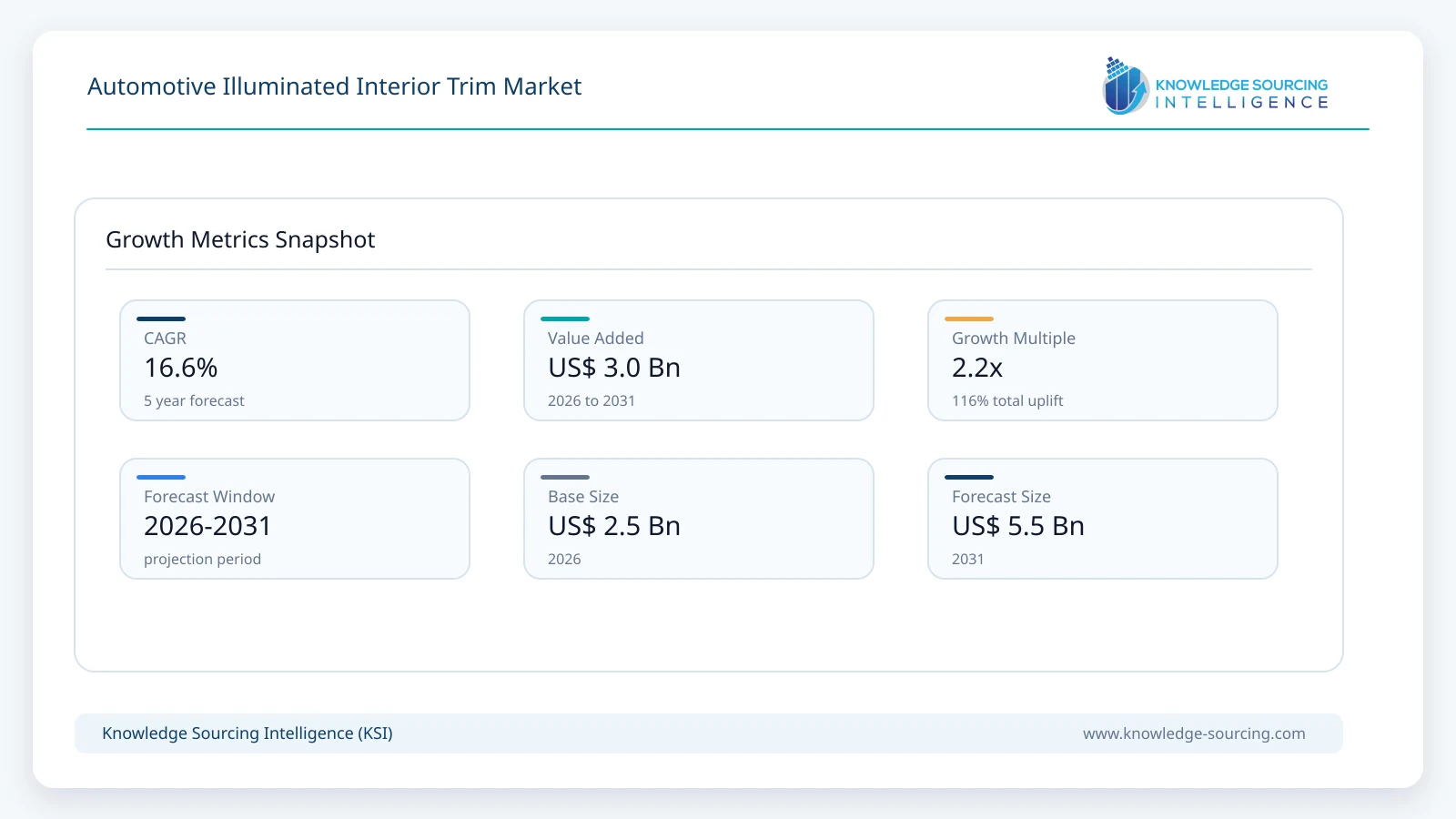
The Automotive Illuminated Interior Trim Market is forecast to grow at a CAGR of 16.6%, reaching USD 5.50 billion in 2031 from USD 2.55 billion in 2026.
Highlights:
- 1Door trim accounts for approximately 34% of global market value in 2026 because it provides the largest continuous interior surface for combining ambient lighting, hidden controls, safety cues and decorative illumination.
- 2Backlit and hidden-until-lit trim architectures represent approximately 36% of 2026 market value, while in-mold structural electronics and other embedded-lighting formats are growing faster.
- 3Ambient, personalization and decorative functions account for approximately 46% of 2026 demand, although HMI feedback and safety-related lighting are gaining share as trim becomes part of the cabin interface.
- 4Polymer-based rigid trim remains the largest substrate platform, but translucent skins, coated textiles, films and soft-touch illuminated surfaces are expanding across doors, dashboards and roof applications.
- 5Passenger vehicles account for approximately 97% of global market value in 2026, supported by premium, EV and smart-cockpit adoption.
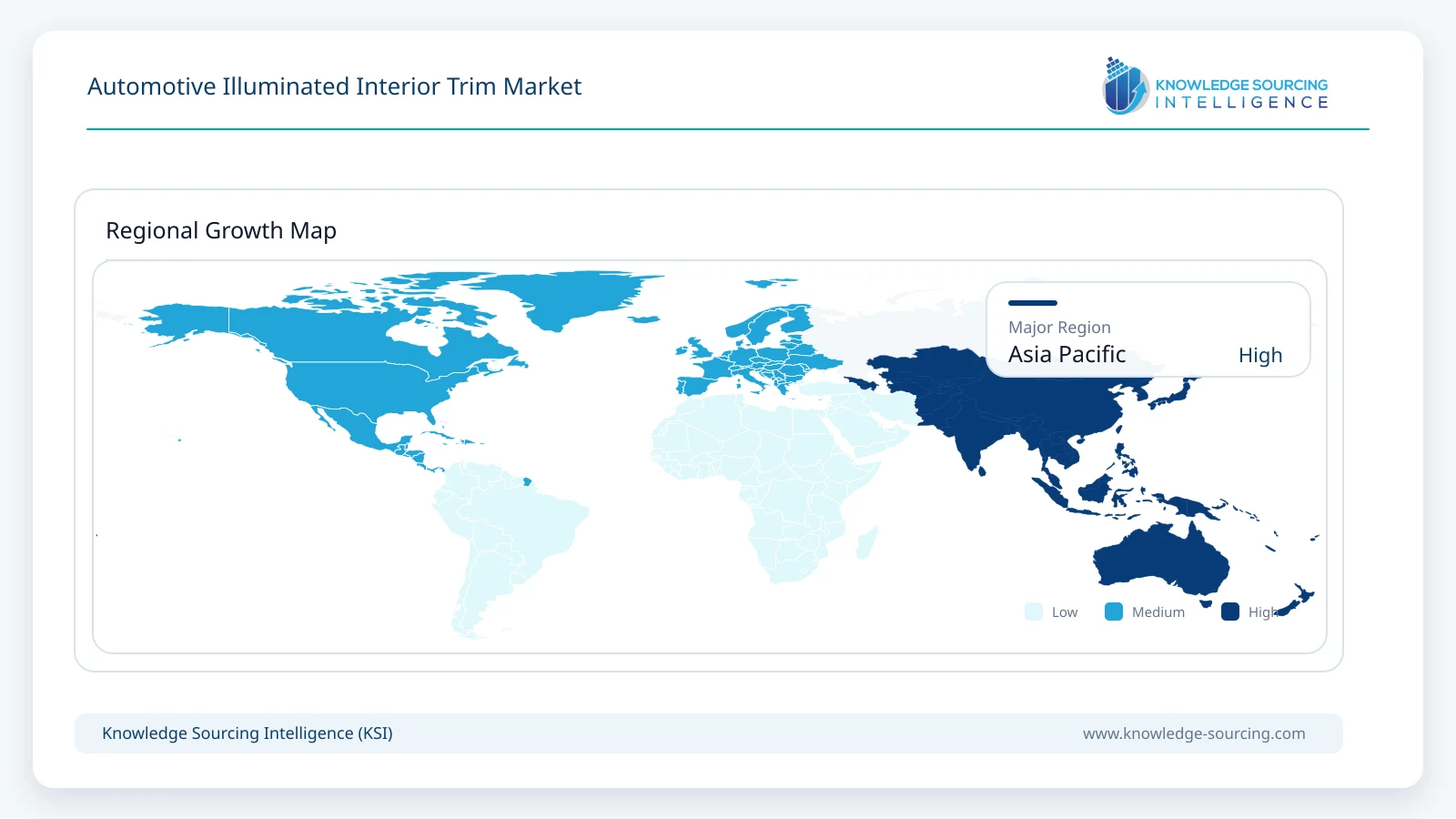
- 6Asia Pacific represents approximately 46% of global market value in 2026, with China leading rapid deployment of illuminated trim, smart surfaces and highly animated cabin-lighting features.
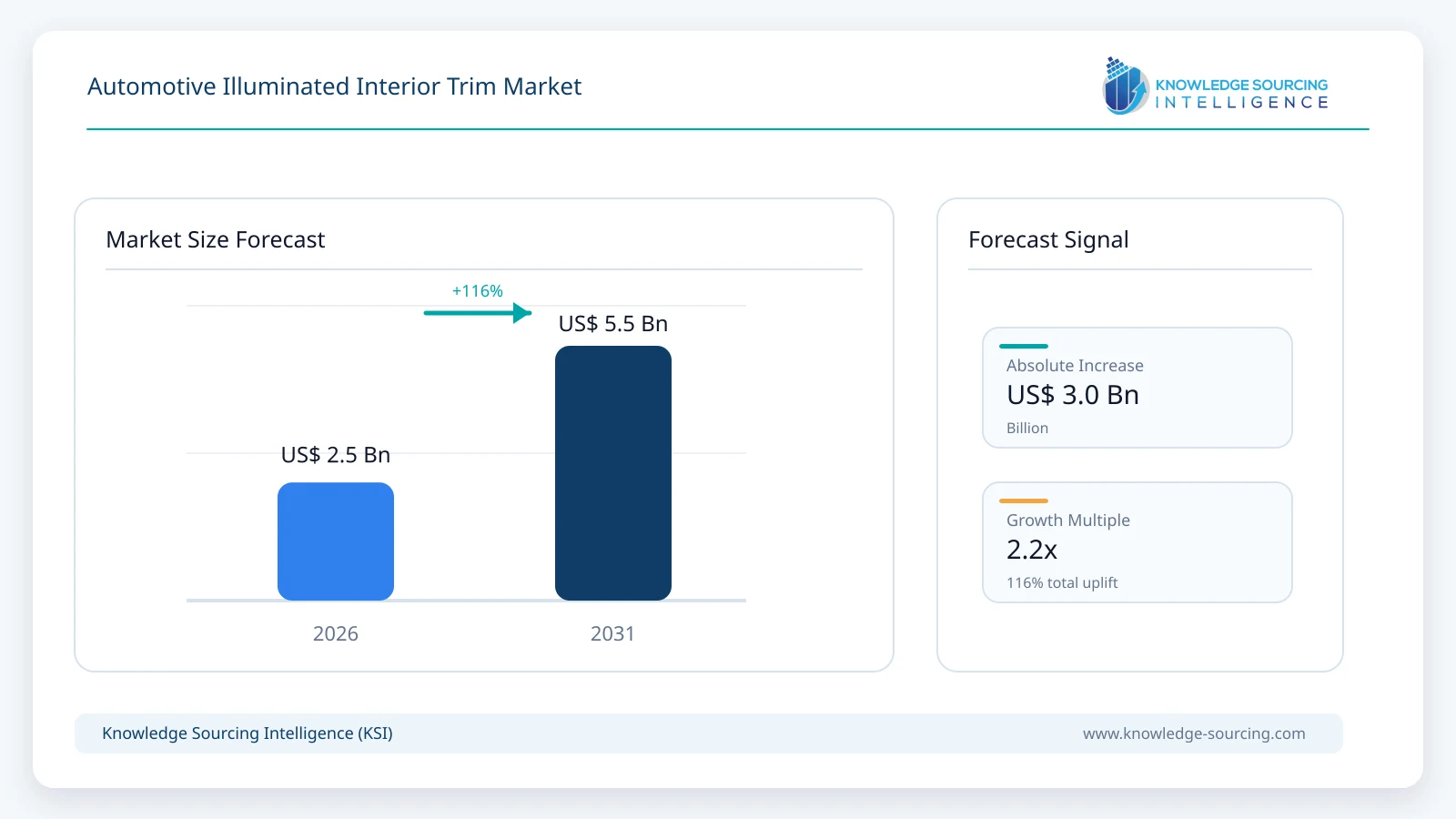
Illuminated trim is moving from narrow accent-light strips toward complete interior surfaces that combine decoration, light diffusion, controls and visual feedback within one production assembly.
Door trim remains the largest application because its long visible contours and broad decorative area allow lighting to support ambience, blind-spot or status warnings, hidden controls and brand-specific animation. Instrument-panel and center-console trim add another large value pool as OEMs replace exposed switchgear with backlit graphics, translucent decorative layers and integrated smart-surface interfaces.
The market measures the attributable value of finished illuminated trim assemblies, including the visible surface, carrier or local substrate, optical and diffusion layers, embedded light sources, conductive elements and local electronics required for the trim function. Standalone ambient-light modules, conventional dome and reading lamps, full display systems, exterior illuminated surfaces and raw light-transmitting materials sold independently are outside the core scope.
Market Overview
Integrating light directly into trim allows an interior surface to perform several roles without adding visible hardware. A door insert can remain visually clean when the vehicle is off, provide ambient color during normal driving, display a warning near the mirror area when required, and reveal touch controls only when the associated function becomes available.
The component architecture varies by trim type, but most systems combine a molded or wrapped surface with light guides, diffusers, translucent films, perforated skins, printed conductors, or embedded electronics. Higher-value designs also integrate touch, force, or haptic sensing so the illuminated trim becomes an active HMI rather than a decorative element.
Manufacturing quality has become a major competitive issue because large illuminated surfaces expose small variations in material thickness, surface grain, LED output, and optical alignment. Suppliers therefore need to control the complete stack from trim material and tooling through lighting, electronics, calibration and final assembly, which favors companies with both interior-system and lighting expertise.
Market Trends
Hidden-Until-Lit Trim Is Moving from Individual Symbols to Larger Surfaces
Translucent films, coated skins and optical molding techniques allow controls, symbols and graphics to disappear into the trim when inactive and become visible only when illumination is required. This approach supports cleaner interior themes while preserving access to functions and visual feedback.
Larger hidden-until-lit areas are also changing trim economics because lighting, decoration and HMI can be engineered as one surface instead of separate bezels, switch packs and light modules.
In-Mold Electronics Is Improving the Industrial Case for Illuminated Trim
In-mold structural electronics places conductive traces, LEDs and selected electronic functions directly within molded trim, reducing wiring, connectors and separate housings. Valeo's 2026 premium-vehicle award using TactoTek IMSE technology demonstrates that the approach is moving into high-volume automotive production.
Licensing agreements with large Tier 1 suppliers are widening production capacity and should make thin illuminated trim structures easier to source across multiple regions and vehicle platforms.
Dynamic Door and Dashboard Surfaces Are Becoming Part of the HMI
Individually addressable LEDs and software-controlled light patterns allow door and dashboard trim to communicate more than a fixed color theme. Lighting can confirm touch input, indicate ADAS states, guide attention, show charging status or create animated transitions that remain aligned with the vehicle's digital interface.
The strongest value proposition appears where the illuminated trim replaces another control or communication element rather than functioning only as additional decoration.
Light-Transmitting Materials Are Expanding into Soft Trim
Backlighting is no longer limited to clear rigid plastics because translucent synthetic leather, coated textiles, films and engineered soft-touch skins can preserve a premium daytime appearance while transmitting light when activated. These materials broaden illuminated trim into armrests, door inserts, headliners and other surfaces that previously relied on conventional wrapped construction.
Material development is increasingly focused on balancing hiding power, transmission, abrasion resistance, UV stability and recyclability so the illuminated effect does not compromise long-term cabin quality.
Patterned and Animated Lighting Is Adding a New Decorative Layer
Optical plates, microstructures and multi-source lighting can create moving patterns or depth effects without using a conventional display. Toyoda Gosei's Dynamic Shadowy Illumination on the Lexus RZ shows how trim lighting can create a visually rich effect across a door surface using compact LED lamp units and patterned optics.
This type of animation allows OEMs to differentiate the cabin through lighting behavior while keeping the surface itself relatively simple and lightweight.
Segment Analysis
By Trim Type: Door Trim
Long contours, large visible areas, and proximity to controls, handles, and speakers make door trim the largest illuminated-trim segment. The same assembly can support ambient lighting, blind-spot warnings, touch feedback, illuminated graphics and brand-specific effects across front and rear doors.
Door trim accounts for approximately USD 0.87 billion in 2026 and is projected to approach USD 1.82 billion by 2031. The segment will retain the largest value pool even as instrument-panel and console applications gain content.
By Lighting Integration: Backlit and Hidden-Until-Lit Trim
Backlit trim leads the market because it can be applied across rigid and soft surfaces using established LEDs, diffusers, translucent films and decorated layers. The technology supports both simple icons and broad illuminated zones without requiring a fully molded electronic circuit.
The segment represents approximately USD 0.92 billion in 2026 and could reach about USD 1.76 billion by 2031. Its share is expected to decline modestly as in-mold structural electronics and more complex embedded-lighting architectures grow faster.
By Function: Ambient, Personalization and Decorative Lighting
Color themes, welcome sequences and drive-mode-linked effects remain the largest function because they provide immediate visual differentiation and can be deployed across several trim zones using common lighting electronics. Premium EVs and smart-cabin platforms have made these features an important part of perceived interior technology.
Ambient and decorative functions account for approximately USD 1.17 billion in 2026 and are projected to exceed USD 2.30 billion by 2031. HMI feedback and safety-status functions will grow faster, reducing the decorative share without lowering its absolute value.
By Application Location: Door and Side-Trim Surfaces
Door and side trim provides the most practical combination of surface area, occupant visibility and integration opportunities, which explains its leading position across vehicle programs. Illuminated door surfaces can support both front-seat and rear-seat experiences while sharing wiring and control with other door electronics.
The application is estimated at approximately USD 0.87 billion in 2026 and is expected to remain the largest location through 2031 as smart-surface integration spreads into higher-volume vehicles.
By Vehicle Type: Passenger Vehicles
Passenger cars, SUVs and MPVs dominate demand because cabin design and perceived technology are major purchase differentiators, particularly in premium and electric vehicles. Chinese OEMs are accelerating adoption by bringing illuminated trim and dynamic ambient-light features into broader price segments.
Passenger vehicles represent approximately USD 2.47 billion in 2026 and are projected to reach about USD 5.31 billion by 2031. Commercial-vehicle adoption remains smaller but is expanding in premium vans, buses and driver cabins.
Market Drivers
Smart-Cabin Development Is Increasing Lighting Content within Trim
Centralized cockpit software and zonal electronics allow illuminated trim to respond to user profiles, ADAS events, drive modes and infotainment states rather than operating as a fixed decorative feature. This raises the functional value of the trim assembly without requiring a separate display at every interaction point.
Shared electronics also make it easier to reuse one illuminated-trim architecture across several vehicle grades, which improves the economics of adding more addressable light points.
Cleaner Interior Design Is Accelerating Hidden Controls and Backlit Graphics
OEMs are reducing exposed switchgear and visual clutter as dashboards and consoles become more digital. Illuminated trim allows symbols and controls to disappear into decorative surfaces when inactive, preserving a simple visual theme while maintaining access to functions.
The approach is particularly valuable in premium interiors where design continuity across wood-like, metallic, textile or soft-touch surfaces is as important as the electronic function.
EV Interior Differentiation Is Raising Demand for High-Content Trim
Electric vehicles place greater emphasis on the cabin as a technology and brand differentiator because powertrain character is less visible to occupants. Lighting offers a relatively lightweight way to create identity, personalization, and perceived innovation across doors, dashboards, consoles, and roof areas.
Fast model cycles among Chinese EV manufacturers are also shortening the time between concept introduction and production use, encouraging suppliers to industrialize new illuminated-trim formats more quickly.
Industrialization of Smart Surfaces Is Reducing Packaging and Assembly Burden
Integrated electronics, printed conductors and in-mold structures can replace separate harnesses, lamp housings and mechanical switch packs within selected trim components. The result is a thinner assembly with fewer interfaces and more freedom to place light across curved surfaces.
Higher production maturity among suppliers such as Valeo, Motherson and TactoTek is improving the commercial case for illuminated trim beyond flagship vehicles.
Lighting-Based HMI and Safety Cues Are Adding Functional Value
Trim lighting can reinforce blind-spot warnings, door-opening alerts, incoming-call notifications, navigation prompts, and assistance-system states without adding another screen. The information is more intuitive when it appears close to the relevant physical location, such as a warning near the door or mirror.
Functional use strengthens the business case for illuminated trim because the same component contributes to design, interaction, and safety instead of serving only as ambient decoration.
Market Restraints
Large Illuminated Surfaces Require Tight Optical and Material Control
Small differences in LED output, surface thickness, pigment concentration or light-guide alignment can become visible across a broad illuminated panel. Premium trim therefore requires careful calibration and optical simulation to prevent hotspots, color mismatch and uneven brightness.
Manufacturing variation that would be hidden in conventional trim can become immediately visible once the surface is backlit, increasing yield and quality-control pressure.
Multi-Layer Construction Complicates Durability and Recycling
Illuminated trim can combine molded carriers, films, skins, adhesives, conductors, light guides, LEDs and coatings within a single part. Each material interface must withstand heat, humidity, vibration, cleaning chemicals and repeated touch without delamination or visible degradation.
The same multi-layer structure can make end-of-life separation more difficult, increasing pressure for compatible materials, simpler architectures and design-for-recycling.
Repair Cost Can Rise when Lighting and Trim Are Integrated
Damage to a conventional decorative panel may affect only the surface, whereas a smart illuminated assembly can contain lighting and electronics that remain functional but must still be replaced with the trim. This can increase service cost and create concerns for insurers and fleet operators.
Modular connectors, replaceable local light units and repair-oriented design will become more important as illuminated trim moves into larger and more exposed surfaces.
Cost Pressure Limits Adoption in Entry-Level Models
Translucent materials, optical guides, smart LEDs, embedded electronics and additional validation increase the cost of illuminated trim relative to conventional molded or wrapped surfaces. The economics are strongest when integration removes another component or supports several functions from the same surface.
Mainstream adoption will depend on common platforms, standardized lighting electronics, and scalable manufacturing that allow OEMs to differentiate trim levels without redesigning the complete assembly.
Driver Distraction and HMI Prioritization Require Careful Control
Animated lighting and good decorative effects can compete with safety-related visual cues if color, motion, and intensity are not managed consistently. A warning function loses value if the same visual language is already used for entertainment or personalization.
OEMs therefore need clear priority rules, automatic dimming and context-based software behavior so illuminated trim remains supportive rather than visually intrusive.
Regional Outlook
Asia Pacific
China's fast smart-cabin development cycle and large electric-vehicle production base make Asia Pacific the largest automotive illuminated interior trim market in 2026. Regional OEMs increasingly use animated door lighting, backlit controls, light-transmitting surfaces and multi-zone ambient effects as visible technology features, pushing suppliers to deliver new trim concepts on shorter program timelines.
Yanfeng's 2026 XiM27 concept, Toyoda Gosei's series use of full-color door-trim illumination and the region's strong electronics and polymer supply chain support continued growth through 2031. Japan and South Korea add established optical and interior-system capability, while India and Southeast Asia provide longer-term volume opportunities as premium cabin content expands.
Europe
European premium OEMs continue to generate high value per vehicle through hidden-until-lit surfaces, integrated ambient lighting and smart HMI trim, supporting a strong regional market despite slower vehicle-production growth. Valeo, FORVIA HELLA, Antolin, Continental and other European suppliers are combining lighting, surface materials and electronics within production-ready trim architectures.
Sustainability will increasingly influence illuminated-trim design because European OEMs are under pressure to increase recycled content and simplify end-of-life material recovery. Suppliers that can deliver thin, low-mass illuminated surfaces with compatible material stacks and consistent optical quality are likely to gain an advantage.
Competitive Landscape
The market brings together interior-system suppliers, lighting specialists, smart-surface technology providers and material companies because illuminated trim requires coordinated expertise across design, optics, electronics and mass production. Valeo and FORVIA HELLA contribute lighting and industrial scale, while Antolin, Yanfeng, Motherson and Toyoda Gosei bring strong trim integration and OEM program relationships.
TactoTek's IMSE platform is helping move embedded lighting and electronics into thinner molded structures, while Continental contributes translucent surface materials and Marelli combines decorative, informative and interactive smart-surface concepts. The competitive boundary is therefore shifting from individual light modules toward complete illuminated trim systems.
Supplier advantage will increasingly depend on optical uniformity, surface quality, software compatibility, thin packaging, repairability and the ability to scale one architecture across several trim levels. OEMs are likely to favor suppliers that can manage the full illuminated-trim stack rather than coordinating separate surface, lighting and electronics vendors.
Recent Developments
3 September 2026: FORVIA HELLA presented adaptive RGB interior lighting for commercial vehicles with lighting functions seamlessly integrated into cabin surfaces for ambience, communication and safety-related cues.
29 June 2026: Yanfeng unveiled the production-ready XiM27 smart-cabin platform with ultra-thin wrap-around light strips, 3D dynamic light-transmitting surfaces and touch-interactive LUXkin materials.
29 May 2026: Toyoda Gosei announced that its LIN-supported interior full-color illumination unit was adopted on the new Mazda CX-5, including door-trim lighting with networked color control and improved installation flexibility.
21 May 2026: Motherson licensed TactoTek IMSE technology to scale production of smart-surface components for global automotive interior and exterior programs.
20 January 2026: Valeo won a major premium-automaker interior-lighting program using TactoTek IMSE technology, bringing lighting and electronics into a single high-volume production-ready smart structure.
8 January 2026: Toyoda Gosei introduced Dynamic Shadowy Illumination for the Lexus RZ, using multiple LED lamp units and patterned optics to create moving light effects across the interior door surface.
Market Outlook
Broader adoption of hidden-until-lit controls, dynamic ambient effects and embedded smart-surface electronics is driving the expansion of the automotive illuminated interior trim market. Door trim remains a key product area, while instrument-panel, console and roof applications are gaining traction as more cabin surfaces incorporate integrated lighting. These developments are supported by growing demand for personalized cabin experiences, enhanced vehicle aesthetics and seamless integration of lighting with interior controls.
In-mold electronics, translucent soft surfaces and high-resolution addressable lighting will gradually reduce the separation between trim, lighting and HMI. The strongest growth will come from assemblies that combine decoration, interaction and communication because multifunctional trim provides a clearer packaging and cost benefit than adding light to an otherwise conventional panel.
Asia Pacific is expected to remain the largest regional market, while Europe continues to generate high value through premium integration and advanced surface engineering. Long-term supplier success will depend on optical consistency, mass-production yield, repairability, recyclable material stacks and clear functional value that extends beyond decorative lighting.
Automotive Illuminated Interior Trim Market Scope:
| Report Metric | Details |
|---|---|
| Total Market Size in 2026 | USD 2.55 billion |
| Total Market Size in 2031 | USD 5.50 billion |
| Forecast Unit | USD Billion |
| Growth Rate | 16.6% |
| Study Period | 2021 to 2031 |
| Historical Data | 2021 to 2024 |
| Base Year | 2025 |
| Forecast Period | 2026 – 2031 |
| Segmentation | Trim Type, Lighting Integration, Function, Material and Surface |
| Companies |
|
Market Segmentation
By Trim Type
Door Trim
Instrument Panel and Dashboard Trim
Center Console Trim
Headliner and Roof Trim
Pillar, Side and Other Interior Trim
By Lighting Integration
Backlit and Hidden-Until-Lit Trim
Contour and Light-Guide Integrated Trim
In-Mold and Embedded Electronic Trim
Patterned, Projected and Other Illuminated Trim
By Function
Ambient, Personalization and Decorative Lighting
HMI and Interactive Feedback
Safety, Warning and Status Communication
Wellness and Other Functional Illumination
By Material and Surface
Rigid Polymer and Decorated Trim
Soft-Touch Skins and Synthetic Leather
Films, In-Mold Decoration and Optical Layers
Textiles and Light-Permeable Soft Surfaces
Natural-Fiber and Sustainable Surface Platforms
By Vehicle Type
Passenger Vehicles
Light Commercial Vehicles
Medium and Heavy Commercial Vehicles and Buses
By Geography
North America
United States
Canada
Mexico
South America
Brazil
Argentina
Others
Europe
Germany
United Kingdom
France
Italy
Spain
Others
Middle East and Africa
Saudi Arabia
UAE
South Africa
Others
Asia Pacific
China
Japan
South Korea
India
Indonesia
Thailand
Others
Table of Contents
1. INTRODUCTION
1.1. Market Overview
1.2. Market Definition
1.3. Scope of the Study
1.4. Market Segmentation
1.5. Currency
1.6. Assumptions
1.7. Base and Forecast Years
1.8. Key Benefits to Stakeholders
2. RESEARCH METHODOLOGY
2.1. Research Design
2.2. Secondary Research
2.3. Primary Research
2.4. Market Estimation
2.5. Segment Modelling
2.6. Data Triangulation and Validation
3. EXECUTIVE SUMMARY
3.1. Key Findings
3.2. Automotive Illuminated Interior Trim Market Size, 2026-2031
3.3. Trim Type Outlook
3.4. Lighting Integration Outlook
3.5. Function Outlook
3.6. Material and Surface Outlook
3.7. Vehicle Type Outlook
3.8. Regional Opportunity Summary
4. MARKET DYNAMICS
4.1. Market Drivers
4.1.1. Smart-Cabin Development Is Increasing Lighting Content within Trim
4.1.2. Cleaner Interior Design Is Accelerating Hidden Controls and Backlit Graphics
4.1.3. EV Interior Differentiation Is Raising Demand for High-Content Trim
4.1.4. Industrialization of Smart Surfaces Is Reducing Packaging and Assembly Burden
4.1.5. Lighting-Based HMI and Safety Cues Are Adding Functional Value
4.2. Market Restraints
4.2.1. Large Illuminated Surfaces Require Tight Optical and Material Control
4.2.2. Multi-Layer Construction Complicates Durability and Recycling
4.2.3. Repair Cost Can Rise when Lighting and Trim Are Integrated
4.2.4. Cost Pressure Limits Adoption in Entry-Level Models
4.2.5. Driver Distraction and HMI Prioritization Require Careful Control
4.3. Market Opportunities
4.4. Porter's Five Forces Analysis
4.5. Industry Value Chain Analysis
4.6. Illuminated Trim Cost and Integration Economics
4.7. Interior Material, HMI and Driver-Distraction Requirements
5. TECHNOLOGY OUTLOOK
5.1. Backlit and Hidden-Until-Lit Trim
5.2. Integrated LED and Light-Guide Trim
5.3. In-Mold Structural Electronics
5.4. Translucent Skins, Films and Coated Textiles
5.5. Flexible and Conformal Lighting
5.6. Patterned and Animated Interior Lighting
5.7. Printed Conductors and Embedded Electronics
5.8. Touch, Force and Haptic Integration
5.9. Intelligent RGB and Networked Illumination
5.10. Optical Diffusion and Surface Calibration
5.11. Thin-Wall and Multi-Shot Molding
5.12. Design-for-Recycling and Repairability
6. AUTOMOTIVE ILLUMINATED INTERIOR TRIM MARKET BY TRIM TYPE
6.1. Introduction
6.2. Door Trim
6.3. Instrument Panel and Dashboard Trim
6.4. Center Console Trim
6.5. Headliner and Roof Trim
6.6. Pillar, Side and Other Interior Trim
7. AUTOMOTIVE ILLUMINATED INTERIOR TRIM MARKET BY LIGHTING INTEGRATION
7.1. Introduction
7.2. Backlit and Hidden-Until-Lit Trim
7.3. Contour and Light-Guide Integrated Trim
7.4. In-Mold and Embedded Electronic Trim
7.5. Patterned, Projected and Other Illuminated Trim
8. AUTOMOTIVE ILLUMINATED INTERIOR TRIM MARKET BY FUNCTION
8.1. Introduction
8.2. Ambient, Personalization and Decorative Lighting
8.3. HMI and Interactive Feedback
8.4. Safety, Warning and Status Communication
8.5. Wellness and Other Functional Illumination
9. AUTOMOTIVE ILLUMINATED INTERIOR TRIM MARKET BY MATERIAL AND SURFACE
9.1. Introduction
9.2. Rigid Polymer and Decorated Trim
9.3. Soft-Touch Skins and Synthetic Leather
9.4. Films, In-Mold Decoration and Optical Layers
9.5. Textiles and Light-Permeable Soft Surfaces
9.6. Natural-Fiber and Sustainable Surface Platforms
10. AUTOMOTIVE ILLUMINATED INTERIOR TRIM MARKET BY VEHICLE TYPE
10.1. Introduction
10.2. Passenger Vehicles
10.3. Light Commercial Vehicles
10.4. Medium and Heavy Commercial Vehicles and Buses
11. AUTOMOTIVE ILLUMINATED INTERIOR TRIM MARKET BY GEOGRAPHY
11.1. North America
11.1.1. United States
11.1.2. Canada
11.1.3. Mexico
11.2. South America
11.2.1. Brazil
11.2.2. Argentina
11.2.3. Others
11.3. Europe
11.3.1. Germany
11.3.2. United Kingdom
11.3.3. France
11.3.4. Italy
11.3.5. Spain
11.3.6. Others
11.4. Middle East and Africa
11.4.1. Saudi Arabia
11.4.2. UAE
11.4.3. South Africa
11.4.4. Others
11.5. Asia Pacific
11.5.1. China
11.5.2. Japan
11.5.3. South Korea
11.5.4. India
11.5.5. Indonesia
11.5.6. Thailand
11.5.7. Others
12. COMPETITIVE ENVIRONMENT AND ANALYSIS
12.1. Major Players and Strategy Analysis
12.2. Market Share Analysis
12.3. Door and Dashboard Illuminated Trim Benchmarking
12.4. Hidden-Until-Lit and Smart Surface Benchmarking
12.5. IMSE and Embedded Electronics Capability Benchmarking
12.6. Material, Optical and Surface Quality Benchmarking
12.7. Series-Production and Global Manufacturing Readiness
12.8. Competitive Dashboard
13. COMPANY PROFILES
13.1. Valeo
13.2. FORVIA HELLA
13.3. Antolin
13.4. Yanfeng Automotive Interiors
13.5. Toyoda Gosei Co., Ltd.
13.6. Motherson Group
13.7. TactoTek Oy
13.8. Continental Surface Solutions
13.9. Marelli
13.10. Toyota Boshoku Corporation
14. APPENDIX
14.1. Currency
14.2. Assumptions
14.3. Base and Forecast Years Timeline
14.4. Key Benefits for Stakeholders
14.5. Research Methodology
14.6. Abbreviations
14.7. Data Sources
Navigate
Trusted by the world's leading organizations











