
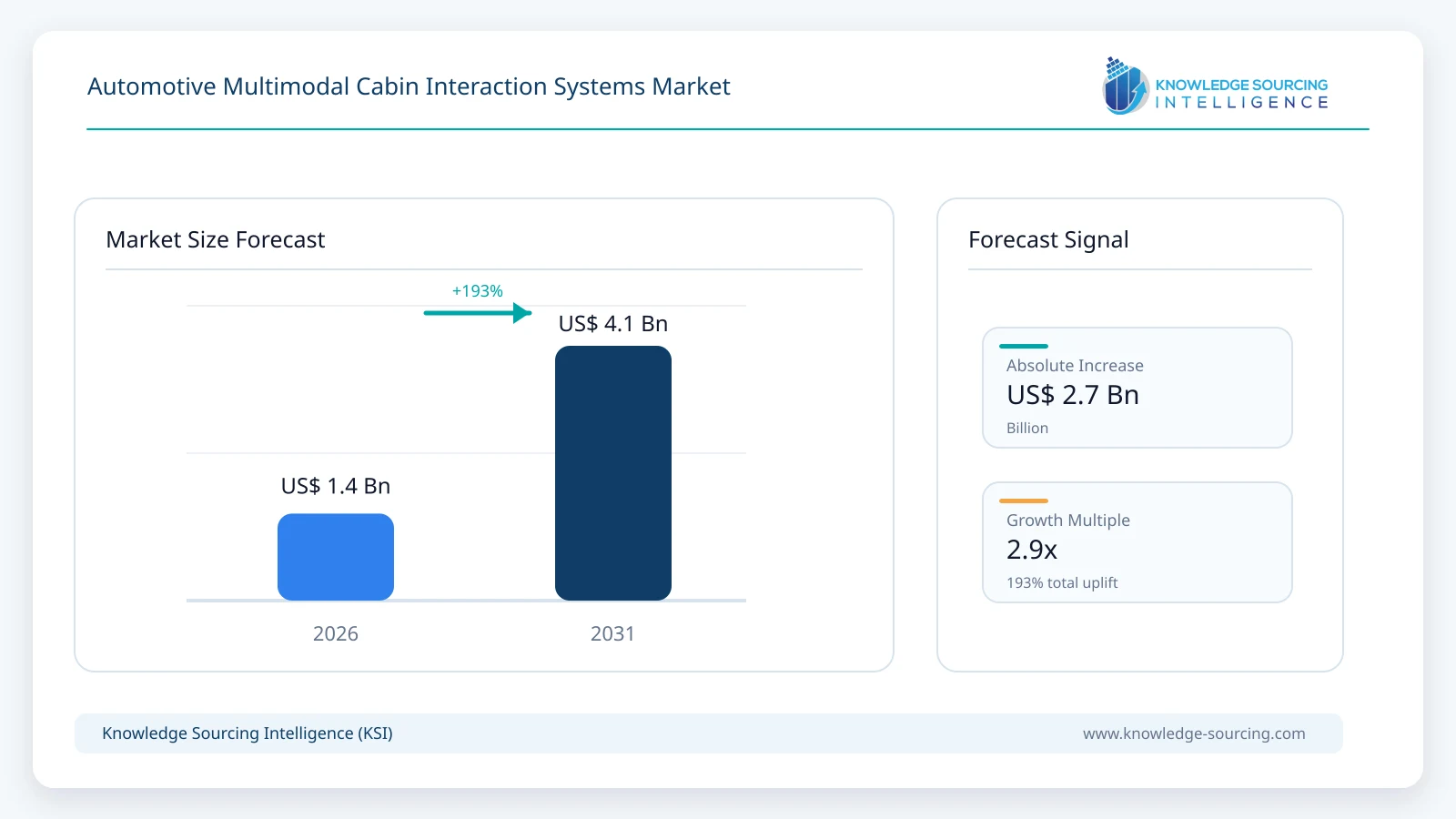
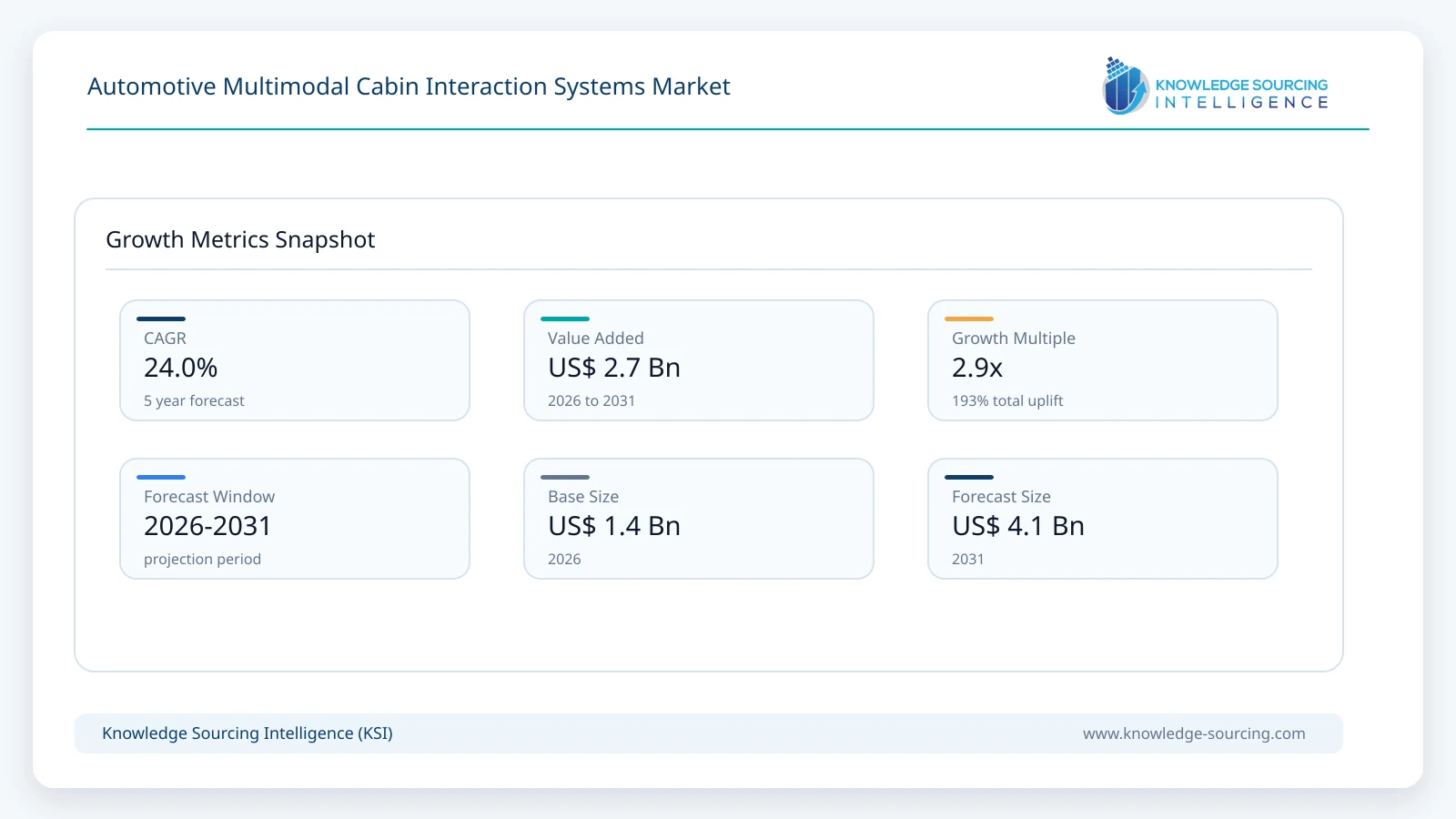
The Automotive Multimodal Cabin Interaction Systems Market is projected to expand at a CAGR of 24.0%, increasing from USD 1.40 billion in 2026 to USD 4.10 billion by 2031.
Highlights:
- 1Global market value is estimated at USD 1.40 billion in 2026 and USD 4.10 billion in 2031, with a forecast CAGR of approximately 24.0%.
- 2Voice-touch continuity and coordinated feedback account for the largest share of 2026 value; seat-aware and context-adaptive functions gain share through 2031.
- 3Embedded software and interaction coordination represent the main revenue pool, while targeted sensing hardware and system integration support delivery.
- 4Passenger vehicles generate the majority of demand because multi-screen infotainment, personalized comfort and conversational interfaces are most widely deployed in cars and SUVs.
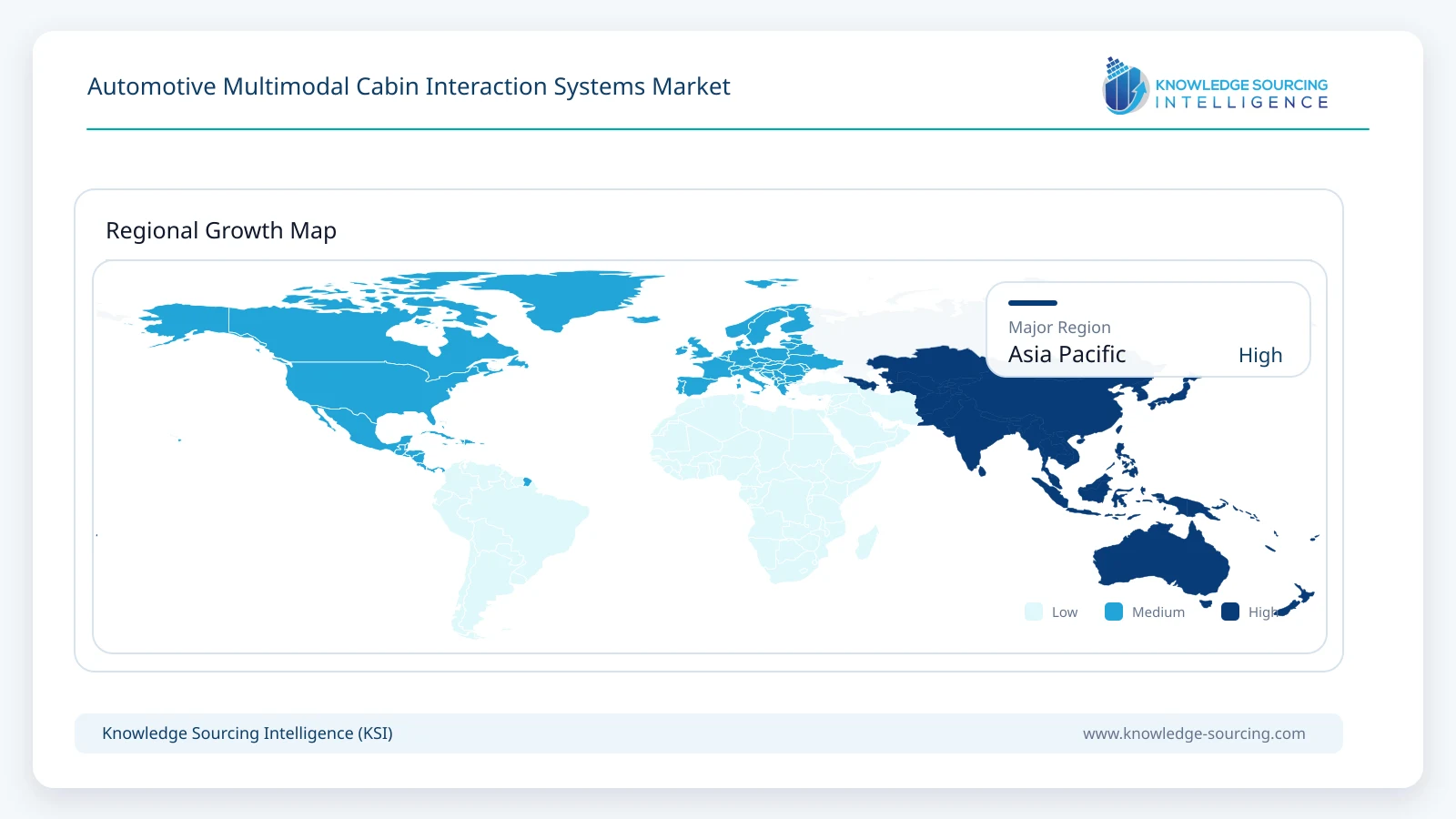
- 5Asia Pacific holds the largest regional market, supported by Chinese smart-cockpit programs and electronics production across China, Japan and South Korea.
- 6Human-factors testing, control availability, multi-seat privacy and reliable vehicle-domain execution remain important requirements for supplier selection.
These systems coordinate two or more interaction methods while identifying which occupant is making a request, which part of the cabin the request concerns, and how the vehicle should confirm its response. Software that links existing microphones, displays, steering-wheel controls and cabin sensing is becoming commercially important as manufacturers move beyond separate voice and touchscreen functions.
A well-designed cabin interface must recognize a spoken request, interpret a gesture or touch in its immediate context and deliver feedback in a way that suits the current driving task. BMW Panoramic iDrive links voice, touch, steering-wheel haptics and several visual surfaces, while Cerence and Visteon are developing automotive AI software that connects speech with other vehicle and cabin signals. Deployment requires engineering work around audio zones, response times, user permissions, diagnostics, and reliable integration with vehicle controls.
Market Overview
A multimodal cabin interaction system allows a driver or passenger to complete a vehicle task through coordinated voice, touch, haptic controls, gaze or gesture rather than treating each input method as a separate command path. The cabin system maintains the request and its context as the user changes interface. For example, a passenger can identify a destination verbally and confirm it on a display, while a driver can accept a call using a steering-wheel button after receiving a visual prompt. The commercial value comes from consistent behavior across interfaces and occupants, not simply the installation of more screens or sensors.
Production systems combine an established graphical HMI with speech processing, steering-wheel controls, audio zones and vehicle-state information. BMW Panoramic iDrive illustrates the coordination of a central touchscreen, windshield information, haptic steering-wheel controls and voice operation; its placement on the BMW iX3 shows how this arrangement can reach a production vehicle. Cerence xUI supports multi-seat interaction and screen synchronization, while Visteon cognitoAI combines voice, camera and vehicle data for context-aware cockpit experiences. More advanced gaze or gesture interpretation is still program-dependent and should not be treated as standard equipment across the market.
Automakers purchase these systems from a combination of cockpit electronics suppliers, embedded software developers, speech specialists, and cabin-sensing vendors. The supplier delivering the interaction layer must coordinate with vehicle controls and privacy permissions while ensuring that essential functions remain accessible when voice recognition fails, or a sensor is obstructed. Euro NCAP's 2026 assessment of essential controls reinforces this practical requirement. Competition is therefore shifting toward demonstrable usability, validated integration and update support over the vehicle life, rather than the number of possible interaction modes alone.
Market Trends
Interaction is moving from separate commands to shared task context
Cabin HMI software increasingly retains the context of a task when an occupant switches between voice, touch and physical controls. A route request can begin with speech and finish with a map selection, without requiring the user to restart the process. BMW has designed Panoramic iDrive around coordinated visual surfaces and steering-wheel controls, providing a practical example of how information and actions move between interfaces.
Common state management matters most when several displays or seats share vehicle functions. It requires consistent confirmation messages, predictable fallback controls and software testing across user journeys. Suppliers able to reuse the same interaction logic on multiple cockpit configurations should have an advantage over single-function interface providers.
Seat-aware audio and passenger interaction are gaining value
Multi-seat voice technology is becoming more useful as passengers gain independent displays, media controls and comfort settings. Directional microphones and software-based speaker-zone identification can help determine whether a request concerns the driver, the front passenger or a rear-seat occupant. Cerence demonstrated parallel multi-seat interaction and synchronized screens with its xUI platform at Auto Shanghai 2025.
Automakers must also prevent a passenger command from changing a safety-relevant driver setting without permission.
Gaze and gesture are being connected to contextual information
Interior camera information can help an interface interpret where an occupant is looking or what a gesture refers to, especially when a display contains several actionable objects. LG presented a CES 2026 vision-based cabin concept that combines gaze direction, gestures and occupant-state information to personalize visual content. The concept illustrates technology direction rather than establishing volume production of every demonstrated function.
Gesture and gaze need clear interaction limits because camera occlusion, lighting and unintended movements can create false commands. Suppliers are consequently focusing on confirmation rules and situations where touchless control has a specific advantage, rather than proposing gestures as a wholesale replacement for buttons.
Local processing is becoming important for dependable response
Core cabin commands need to operate with predictable latency, including in areas where network coverage is limited. Embedded speech processing, event detection and selected language-model functions can keep essential tasks responsive without depending on remote services. Cerence has demonstrated multimodal CaLLM Edge development with its semiconductor partners, while LG has described an on-device AI Cabin Platform built around automotive cockpit compute.
Cloud services remain useful for wider knowledge and feature updates, but OEMs must choose which data leave the cabin and which vehicle actions stay local. Edge capability therefore supports interaction quality and privacy, even where customers do not see the computing distinction directly.
Physical controls are being retained alongside digital functions
An increasing number of cockpit designs use a mix of touchscreen menus and tactile controls to avoid forcing every task through a display. Essential functions such as indicators, hazard lights and wipers benefit from reliable, easily located controls. BMW has retained physical and haptic controls for important driving functions while using touch and voice for media, navigation and personalization.
Euro NCAP's 2026 assessments place greater emphasis on the availability and usability of essential controls, including physical buttons for common tasks. This limits the commercial case for screen-only cabin architectures and favors suppliers whose interaction software can route commands across physical and digital channels without fragmenting the user experience.
Segment Analysis
By Interaction Coordination: Voice-Touch and Shared Context
Voice-touch continuity is estimated to represent approximately 35% of the market in 2026 because microphones and touchscreens are already present in many connected vehicles. Commercial value comes from preserving task context when the driver moves between the two channels, providing consistent visual or audio confirmation and connecting the request to authorized vehicle services. BMW's coordinated iDrive interaction illustrates this established use case.
Voice-touch continuity remains important, although seat-aware and context-adaptive capabilities gain value as passenger functions expand. Suppliers can reuse voice and touchscreen technology across vehicle classes, but they still need OEM-specific development to handle menu structures, languages, controls, and vehicle-state restrictions.
By Interaction Coordination: Occupant and Seat-Zone Fusion
Occupant and seat-zone fusion is expected to increase its share from approximately 24% in 2026 to 28% in 2031. Multi-zone audio, speaker separation and occupant identity provide a way to direct requests to the correct display or comfort setting. This is particularly valuable in SUVs, premium cars and vehicles with rear-seat entertainment, where several people may issue overlapping commands.
Commercial adoption depends on an accurate link between speech, seating position, and available vehicle permissions. Supplier differentiation will come from real-world performance in noisy cabins and a privacy-aware approach to recognizing passengers, not simply the maximum number of microphones installed.
By System Layer: Embedded Interaction Software
Embedded interaction software accounts for an estimated USD 0.73 billion in 2026 as automakers buy or develop coordination frameworks, recognition logic and vehicle-function interfaces around existing cockpit hardware. These functions organize multimodal requests and responses without requiring the full value of display panels, central processors or standalone driver-monitoring hardware to be counted as interaction system revenue.
The software share is expected to grow as feature reuse spreads across vehicle programs, although integration services remain necessary to validate behavior against each OEM's cabin layout and control policies. Suppliers with proven interface portability and lifecycle update support are positioned to capture more repeatable product revenue.
By Cabin Use Case: Driver Controls and Safety-Aware Feedback
Driver controls and safety-aware feedback are projected to increase their market share through 2031 as automotive HMI programs face closer review of driver attention and control accessibility. Multimodal software can present a warning visually, add a brief spoken prompt, or deliver haptic confirmation according to urgency and driver state.
Vehicle-domain interaction rules must prevent a generative assistant from executing safety-relevant actions without authorization. The commercial opportunity therefore lies in validated feedback selection and consistent vehicle-domain behavior rather than in uncontrolled autonomous action.
Market Drivers
Growing complexity of digital cockpit controls
Vehicle cockpits are accommodating more navigation, media, comfort and assistance features, which increases the effort required to locate functions across screens and menus. Multimodal control helps distribute those tasks among touch, voice, and physical interfaces according to how frequently they are used and how much attention they require. BMW's Panoramic iDrive illustrates how several interaction surfaces can operate within one cockpit concept.
OEMs are investing in integration to keep those control paths consistent as software changes after vehicle launch. Suppliers that can maintain one functional response across screen, steering-wheel and voice interfaces offer an increasingly useful solution to growing interface complexity.
Expansion of multi-seat cabin entertainment and comfort
Passenger displays, zoned audio and independently controlled comfort features create demand for systems that can identify which occupant is requesting a change. A command to adjust temperature or media needs an appropriate target seat and should not override another occupant's preferences. Cerence has demonstrated multi-seat dialogue and screen synchronization, showing a practical basis for these configurations.
Larger family vehicles and premium passenger cabins are the clearest early users, but component reuse can eventually support higher-volume vehicle platforms.
Better embedded speech and cabin sensing technology
Automotive speech engines, on-device AI processors and cabin cameras are improving the quality and range of inputs available to interaction software. Embedded processing can reduce response delays for common tasks, while seat-zone speech and gaze information may help resolve requests that are ambiguous by voice alone. Cerence, LG and Visteon have all published development work in these areas.
Recognition performance must hold up in real road noise, sunlight and mixed-occupant situations to create customer value. As computing and software foundations become more reusable, a larger number of OEM platforms can support context-aware interaction without wholly new electronics.
Demand for safer and more accessible control strategies
Control availability remains central to cabin design because touchscreens are not equally suitable for urgent or frequently repeated driving tasks. Euro NCAP's 2026 safe-driving assessments have increased attention to driver controls, distraction and essential physical interfaces. A coordinated cabin system can support speech, visual and tactile feedback while keeping direct controls available when attention must remain on the road.
Automakers need repeatable evidence from vehicle-level human-factors and interaction testing, beyond controlled demonstrations alone. This creates demand for suppliers that understand human factors, can verify safe fallback behavior and maintain predictable control mapping across software updates.
OEM pressure to reuse interaction software across models
Automakers operating several brands and vehicle segments seek HMI software that can be configured without redeveloping every interaction workflow. A common recognition and coordination layer can support different displays, microphones and steering-wheel designs while retaining manufacturer-specific appearance. Software platforms from specialist suppliers help reduce duplicated engineering between vehicle programs.
Reuse is particularly valuable as cockpit hardware generations change faster than vehicle development cycles. Suppliers that combine portable software with reliable validation and long-term support can secure program extensions beyond initial development and production launch.
Market Restraints
Unreliable recognition in noisy and changing cabin conditions
Road noise, overlapping passenger speech, open windows and different microphone positions can reduce recognition quality. Gaze and gesture systems introduce other difficulties, including varying light levels, sunglasses, blocked cameras and unintended hand movements. A cabin interaction platform must perform predictably under these conditions rather than only during controlled demonstrations.
False activations can quickly reduce customer trust, particularly when a command changes vehicle settings. OEMs must therefore invest in robust audio processing, sensor testing and clear cancellation or confirmation paths, increasing both cost and development time.
Long vehicle validation and human-factors approval cycles
Interaction software must be tested against vehicle functions, alerts and interface behavior over different driving states. Even a minor software revision can change the order of prompts or the way a driver reaches a common control. Automakers need regression testing to ensure changes do not create distraction or interfere with more important warnings.
Euro NCAP's assessment of essential controls reinforces the need to retain accessible paths for frequent functions. These development and approval requirements make deployment slower than in consumer electronics, particularly where several hardware suppliers share responsibility.
Cost of incremental sensors and multi-display integration
Advanced cabin interaction may require better microphone arrays, higher-performance processors, cameras or additional passenger displays. Those additions are difficult to justify in price-sensitive vehicles unless they serve several functions or improve the customer experience in a measurable way. The economic case is stronger when OEMs can reuse existing infotainment and monitoring hardware.
Supplier interfaces and the underlying electrical architecture also influence integration cost. Legacy electrical systems may not expose consistent controls and occupant data, limiting the speed at which multimodal features can be expanded across older platforms.
Privacy and occupant-permission requirements
Microphones, camera-based attention cues, and passenger profiles can involve sensitive cabin information. Manufacturers must decide which inputs are processed locally, whether occupant identity should be stored, and how passengers can control permissions. Cross-seat interactions also require rules that stop one person from changing another person's protected settings.
Cabin data protection and permission management can delay rollout even when sensors are technically mature. Clear consent, data minimization, secure updates, and reliable fallback modes are necessary for sustained customer adoption.
Fragmented software stacks and inconsistent interfaces
Cockpit applications, voice engines, domain controllers and cabin-sensing systems often come from different vendors. They may use incompatible message formats, have different update schedules, or interpret vehicle states in different ways. This fragmentation can prevent a request from moving cleanly between voice, display, touch, and haptic controls.
OEMs must maintain interface ownership and coordinate defect resolution across multiple suppliers. Without stable integration standards, the cost of testing combinations can offset the benefits of using modular components and reduce margins for system providers.
Regional Outlook
Asia Pacific
Asia Pacific is estimated to account for 42% of global value in 2026, supported by China's competitive smart-cockpit market and electronics expertise across Japan and South Korea. Chinese automakers are deploying speech-rich interfaces and passenger functions across a broad range of electric and connected vehicles, while regional suppliers provide microphones, displays, cameras and cockpit software. These capabilities create a strong base for coordinated interaction systems beyond isolated voice commands.
The region is projected to reach roughly 46% of global value by 2031 as context-aware and passenger-specific functions spread into more vehicle classes. Competitive performance will depend on low-cost integration, local language accuracy and the ability to adapt common software to different cabin layouts and regional services.
Europe
Europe is estimated to represent 27% of market value in 2026, with demand concentrated in premium OEM programs, specialist cockpit software and human-factors engineering. BMW's Panoramic iDrive combines touchscreen, voice, visual projection and haptic controls in a production-oriented architecture. Suppliers serving European OEMs must balance advanced digital interaction with continued access to tactile driving controls.
Euro NCAP's 2026 approach makes usable control layouts commercially relevant alongside cabin innovation. European platform development is expected to retain strong integration and validation value as manufacturers introduce new AI-enabled interfaces while meeting privacy, multilingual and functional-reliability requirements.
Competitive Landscape
The supplier base combines cockpit system integrators, conversational interface providers, cabin sensing developers and vehicle manufacturers with proprietary HMI software. BMW illustrates OEM-owned interaction design, while Cerence provides speech, multi-seat dialogue and multimodal assistant functions. Visteon, HARMAN and LG offer varying combinations of cockpit electronics, embedded AI, sensing and interface integration. These participants are not interchangeable suppliers: some sell enabling software, while others supply finished electronics or engineering around several components.
Competition is determined by production readiness, accuracy across seating zones, control-response latency, and the ability to maintain functions when a sensor or connection is unavailable. Multimodal systems also depend on OEM control maps and human-factors testing, creating an ongoing role for integration and validation services. As software becomes more reusable, purchasing decisions are likely to favor partners that support common interfaces, responsible data handling and vehicle-program lifecycle updates.
Recent Developments
12 October 2026: Euro NCAP highlighted 2026 test results showing the importance of accessible physical controls for essential driving tasks. The development supports multimodal systems that retain reliable tactile fallbacks rather than making all functions screen-dependent.
6 January 2026: Visteon introduced a flexible NVIDIA-based computing module and described cognitoAI software that combines camera, infotainment, vehicle and voice signals for contextual cockpit interaction. It remains a technology introduction rather than a disclosed shipment count.
18 December 2025: Cerence announced CES 2026 demonstrations of enhanced multimodal CaLLM Edge, xUI and multi-zone audio capabilities. The program highlights supplier development of local response and multi-occupant interaction.
17 December 2025: LG outlined CES 2026 cabin concepts combining gaze, gesture and driver-condition sensing with contextual displays and entertainment. The announcement is evidence of technology direction and does not establish mass production of all showcased features.
11 December 2025: LG described an on-device AI Cabin Platform using Qualcomm Snapdragon Cockpit Elite and integrating camera and vehicle context into responsive assistance. The system represents a supplier architecture proposal, not a complete market shipment data series.
23 April 2025: Cerence and MediaTek announced a multimodal CaLLM Edge reference design using NVIDIA technology and demonstrated multi-seat automotive interaction. It supports the case for embedded multimodal software but remains distinct from confirmed vehicle-wide production sales.
Market Outlook
Cabin interaction systems are expected to develop from voice and touchscreen coordination toward more capable handling of passenger location, gaze, gesture and contextual feedback. The market is forecast to reach USD 4.10 billion by 2031 as vehicle manufacturers reuse software foundations across different cockpit layouts and extend coordinated controls into rear seating and comfort functions. The largest near-term commercial opportunity remains systems that improve ordinary tasks without requiring major changes to vehicle hardware.
Asia Pacific should retain the largest regional value pool, while Europe remains important for premium implementations and user-interface validation. Suppliers that combine dependable voice-touch operation, robust multi-seat recognition, and clear physical-control fallbacks will be better positioned than providers that depend on novel gestures alone. Long-term competitiveness will rest on integration ownership, software maintenance and consistent performance throughout a vehicle platform's life.
Automotive Multimodal Cabin Interaction Systems Market Scope:
| Report Metric | Details |
|---|---|
| Total Market Size in 2026 | USD 1.40 billion |
| Total Market Size in 2031 | USD 4.10 billion |
| Forecast Unit | USD Billion |
| Growth Rate | 24.0% |
| Study Period | 2021 to 2031 |
| Historical Data | 2021 to 2024 |
| Base Year | 2025 |
| Forecast Period | 2026 – 2031 |
| Segmentation | Interaction Coordination, System Layer, Interaction Architecture, Primary Cabin Function |
| Companies |
|
Market Segmentation
By Interaction Coordination
Voice-Touch Continuity and Shared Context
Occupant and Seat-Zone Fusion
Gaze and Gesture Context
Haptic and Multi-Display Feedback
By System Layer
Embedded Interaction Software
Incremental Interaction Hardware
Integration, Validation and Lifecycle Services
By Interaction Architecture
Screen and Voice-Coordinated Systems
Occupant-Aware Multi-Seat Systems
AI-Context Adaptive Systems
By Primary Cabin Function
Media, Navigation and Infotainment
Comfort and Cabin Controls
Driver Support and Contextual Feedback
Passenger Personalization and Shared Services
By Vehicle Type
Passenger Vehicles
Light Commercial Vehicles
Medium and Heavy Commercial Vehicles and Buses
By Geography
North America
United States
Canada
Mexico
South America
Brazil
Argentina
Others
Europe
Germany
United Kingdom
France
Italy
Spain
Others
Middle East and Africa
Saudi Arabia
UAE
South Africa
Others
Asia Pacific
China
Japan
India
South Korea
Indonesia
Thailand
Australia
Others
Table of Contents
1. EXECUTIVE SUMMARY
2. MARKET SNAPSHOT
2.1. Market Overview
2.2. Market Definition
2.3. Scope and Segmentation
3. BUSINESS LANDSCAPE
3.1. Market Drivers
3.1.1. Growing complexity of digital cockpit controls
3.1.2. Expansion of multi-seat cabin entertainment and comfort
3.1.3. Better embedded speech and cabin sensing technology
3.1.4. Demand for safer and more accessible control strategies
3.1.5. OEM pressure to reuse interaction software across models
3.2. Market Restraints
3.2.1. Unreliable recognition in noisy and changing cabin conditions
3.2.2. Long vehicle validation and human-factors approval cycles
3.2.3. Cost of incremental sensors and multi-display integration
3.2.4. Privacy and occupant-permission requirements
3.2.5. Fragmented software stacks and inconsistent interfaces
3.3. Market Opportunities
3.4. Porter’s Five Forces Analysis
3.5. Industry Value Chain Analysis
3.6. Policies and Regulations
3.7. Strategic Recommendations
4. TECHNOLOGICAL OUTLOOK
4.1. Voice, Touch and Haptic Coordination
4.2. Multi-Seat Audio and Occupant Attribution
4.3. Camera, Gaze and Gesture Context
4.4. Embedded AI and Hybrid Processing
4.5. Interface Validation and Vehicle Control Integration
5. AUTOMOTIVE MULTIMODAL CABIN INTERACTION SYSTEMS MARKET BY INTERACTION COORDINATION
5.1. Voice-Touch Continuity and Shared Context
5.2. Occupant and Seat-Zone Fusion
5.3. Gaze and Gesture Context
5.4. Haptic and Multi-Display Feedback
6. AUTOMOTIVE MULTIMODAL CABIN INTERACTION SYSTEMS MARKET BY SYSTEM LAYER
6.1. Embedded Interaction Software
6.2. Incremental Interaction Hardware
6.3. Integration, Validation and Lifecycle Services
7. AUTOMOTIVE MULTIMODAL CABIN INTERACTION SYSTEMS MARKET BY INTERACTION ARCHITECTURE
7.1. Screen and Voice-Coordinated Systems
7.2. Occupant-Aware Multi-Seat Systems
7.3. AI-Context Adaptive Systems
8. AUTOMOTIVE MULTIMODAL CABIN INTERACTION SYSTEMS MARKET BY PRIMARY CABIN FUNCTION
8.1. Media, Navigation and Infotainment
8.2. Comfort and Cabin Controls
8.3. Driver Support and Contextual Feedback
8.4. Passenger Personalization and Shared Services
9. AUTOMOTIVE MULTIMODAL CABIN INTERACTION SYSTEMS MARKET BY VEHICLE TYPE
9.1. Passenger Vehicles
9.2. Light Commercial Vehicles
9.3. Medium and Heavy Commercial Vehicles and Buses
10. AUTOMOTIVE MULTIMODAL CABIN INTERACTION SYSTEMS MARKET BY GEOGRAPHY
10.1. North America
10.1.1. United States
10.1.2. Canada
10.1.3. Mexico
10.2. South America
10.2.1. Brazil
10.2.2. Argentina
10.2.3. Others
10.3. Europe
10.3.1. Germany
10.3.2. United Kingdom
10.3.3. France
10.3.4. Italy
10.3.5. Spain
10.3.6. Others
10.4. Middle East and Africa
10.4.1. Saudi Arabia
10.4.2. UAE
10.4.3. South Africa
10.4.4. Others
10.5. Asia Pacific
10.5.1. China
10.5.2. Japan
10.5.3. India
10.5.4. South Korea
10.5.5. Indonesia
10.5.6. Thailand
10.5.7. Australia
10.5.8. Others
11. COMPETITIVE ENVIRONMENT AND ANALYSIS
11.1. Major Players and Strategy Analysis
11.2. Market Share Analysis
11.3. OEM Program and Integration Benchmarking
11.4. Multimodal Interaction Capability Benchmarking
11.5. Partnerships, Product Development and Collaborations
11.6. Competitive Dashboard
12. COMPANY PROFILES
12.1. Cerence AI
12.2. Visteon Corporation
12.3. HARMAN International
12.4. LG Electronics
12.5. BMW Group
12.6. Qualcomm Technologies
12.7. Panasonic Automotive Systems
12.8. Elektrobit
12.9. FORVIA
12.10. AUMOVIO
12.11. Bosch
12.12. SoundHound AI
13. APPENDIX
13.1. Currency
13.2. Assumptions
13.3. Base and Forecast Years
13.4. Key Benefits for Stakeholders
13.5. Research Methodology
13.6. Abbreviations
Navigate
Trusted by the world's leading organizations











