
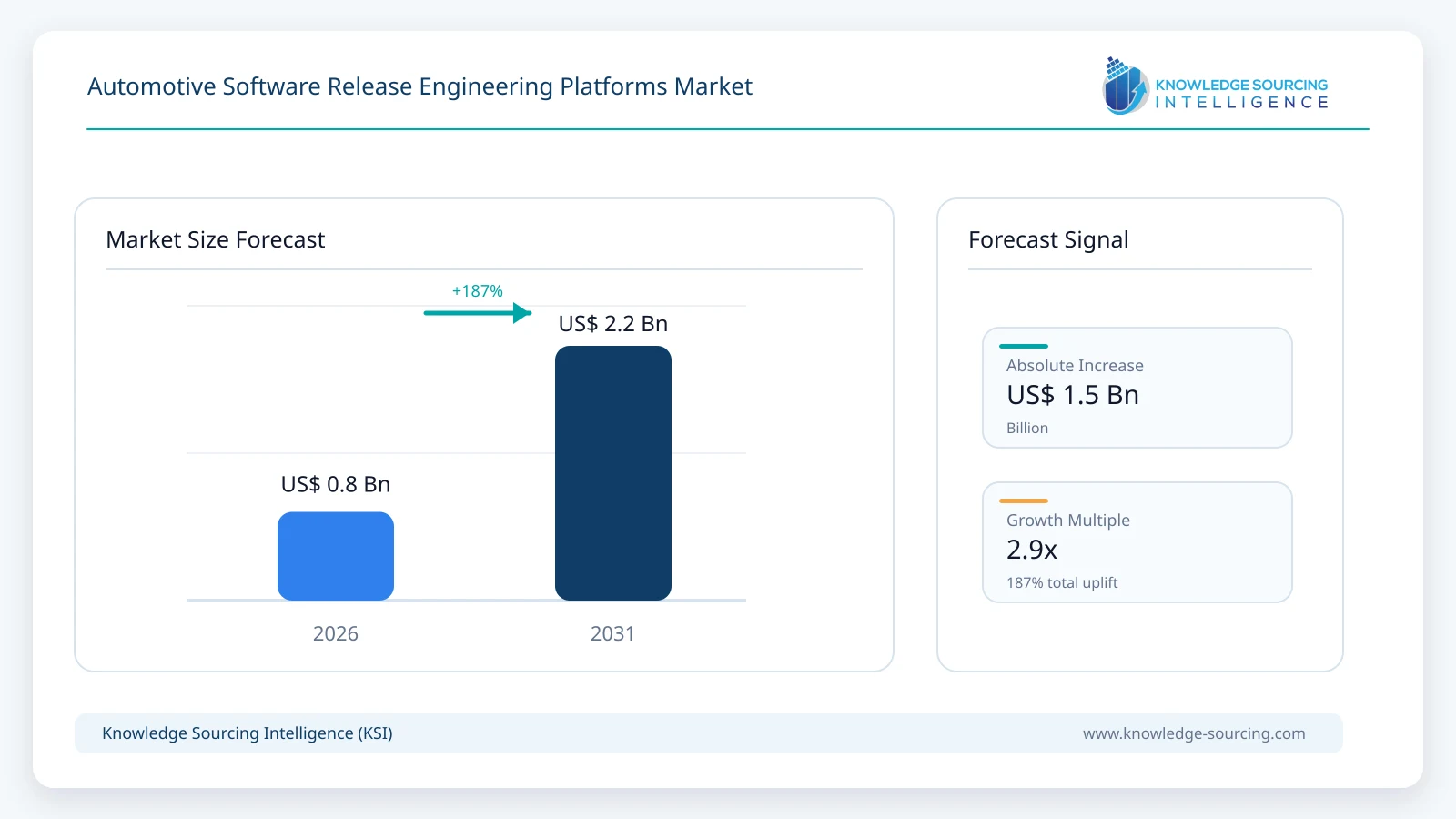
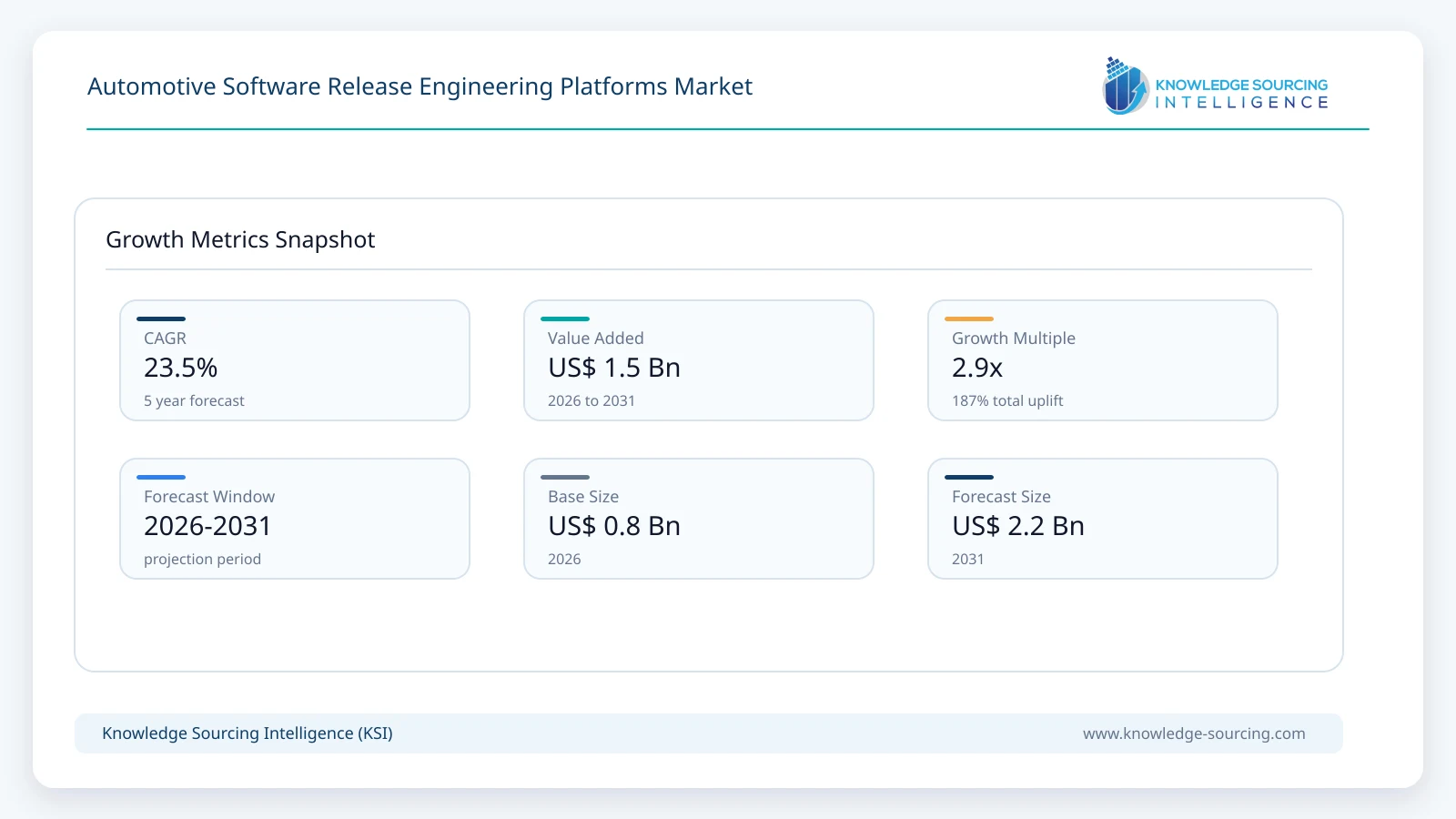
The Automotive Software Release Engineering Platforms Market is forecast to grow at a CAGR of 23.5%, reaching USD 2.24 billion in 2031 from USD 0.78 billion in 2026.
Highlights:
- 1Global revenue is estimated at USD 0.78 billion in 2026 and projected at USD 2.24 billion by 2031.
- 2Build and integration automation leads the platform-function view in 2026, while verification and release gating gains share.
- 3Hybrid engineering infrastructure is gaining importance as cloud-based software testing expands alongside physical validation.
- 4ADAS and automated-driving software is the largest engineering-domain use case in the working model.
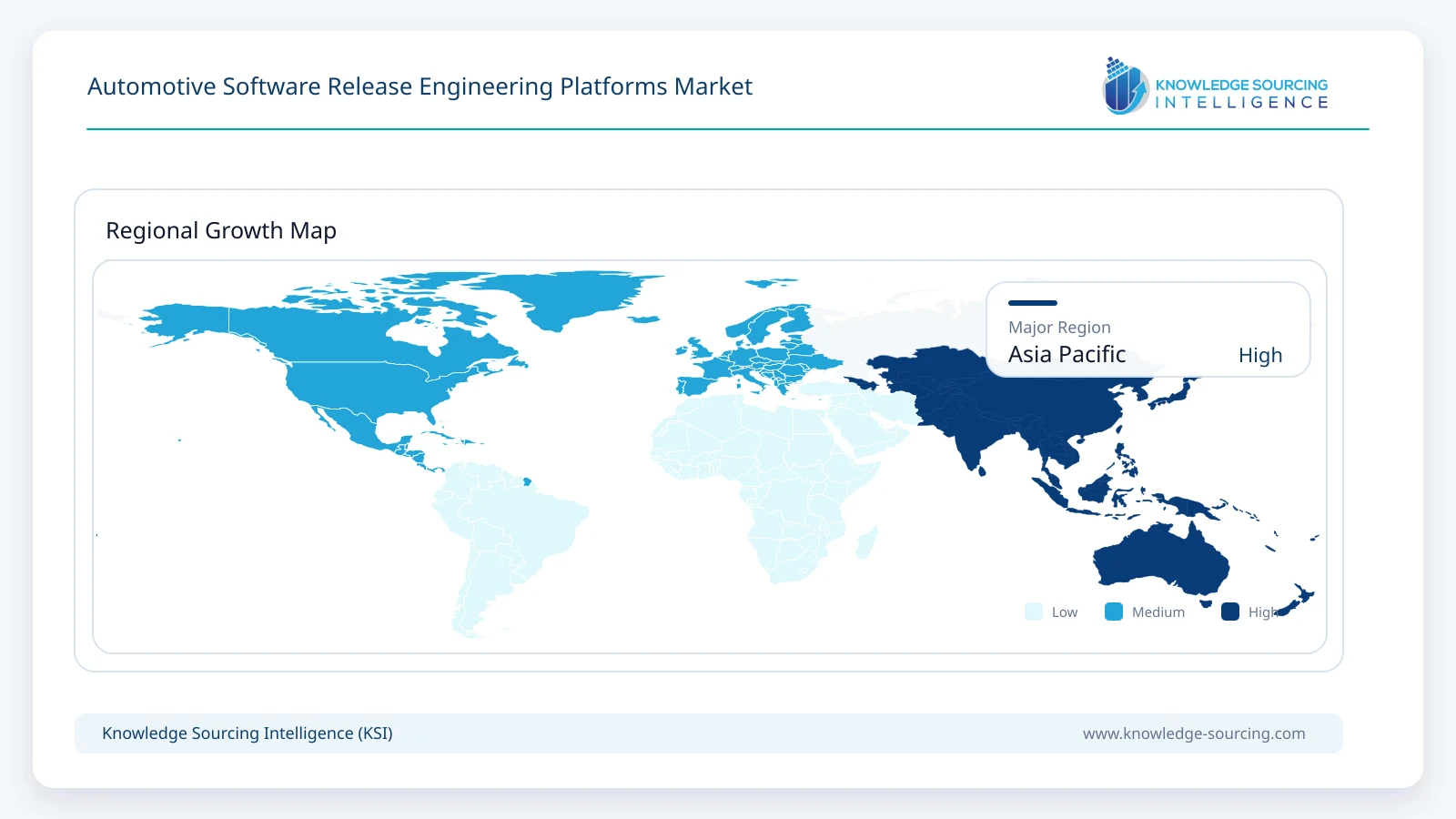
- 5Asia Pacific leads the regional value pool, with Europe retaining a strong position in safety-oriented engineering tools.
- 6Automotive release platforms compete through reproducibility, traceability, and integration with established OEM toolchains.
Vehicle software now incorporates more interfaces, processor configurations, and supplier-developed components, so compiling code is only one step in preparing a production release. Engineering teams must also confirm dependencies, run repeatable tests, track component versions and establish which validated software combinations can be delivered to each vehicle program.
Release engineering platforms bring these tasks into coordinated, auditable workflows. Vector provides an automotive Software Factory environment, while ETAS, Elektrobit, dSPACE and MathWorks contribute different tools for build integration, validation and engineering automation. Vehicle manufacturers purchase these capabilities as software subscriptions, toolchain services and project-specific integration, with the largest contracts linked to common vehicle architectures and multi-program reuse.
Market Overview
Automotive software releases must work across vehicle variants that differ by sensors, electronic controllers, propulsion systems, and regional requirements. A release engineering platform converts tested software components into a controlled package, links it to the evidence behind approval, and records the configuration for which it is valid. Automated builds, test execution and artifact tracking reduce the chances that a late software change reaches production without its dependencies or required checks. The commercial benefit comes from reusing one release process across vehicle programs rather than recreating it for every model.
Vector's Software Factory is designed to standardize automotive development and delivery workflows, while ETAS combines an open vehicle software foundation with integration and continuous integration services. Elektrobit works with automakers to integrate its own and third-party software using ongoing CI/CD processes. These examples reflect different supplier positions in the same workflow: development infrastructure, software-platform integration, and evidence generation for production release. BMW's software factory on AWS illustrates how automakers can coordinate large engineering teams through shared build infrastructure instead of relying only on local project tools.
Release accountability remains with the automaker even when software components are developed by suppliers or build tools run in the cloud. Production programs must maintain approved configuration baselines, document testing, control third-party changes, and preserve records when software affects regulated vehicle systems. UNECE Regulation No. 156 concerns software-update management rather than prescribing a particular release engineering product, but its traceability and compatibility requirements increase the importance of disciplined release records. Providers compete on toolchain interoperability, automotive verification coverage, secure artifact management, and the amount of work needed to introduce a common process across different teams.
Market Trends
Software factories are replacing isolated project pipelines
Automakers with multiple software programs need developers and suppliers to use repeatable rules for building, testing, and approving code. A common release pipeline makes it easier to trace whether a changed component has passed the correct tests and belongs to an approved vehicle configuration. BMW's software factory on AWS already supports a large engineering workforce, demonstrating the operating scale of shared infrastructure. Such programs create recurring requirements for build orchestration, artifact records, access controls and integration support rather than a single tool purchase.
Virtual validation is becoming part of release approval
Software-in-the-loop testing allows teams to check ECU and application behavior before the corresponding hardware is available for every test. dSPACE describes virtual ECUs as components in modern validation workflows, while its CES 2026 demonstration included automated generation of virtual ECUs for SIL testing. Virtual environments can absorb frequent developer changes without occupying expensive benches, but production releases still require tests matched to the system's safety and performance requirements.
The practical shift is toward using simulation results as structured release evidence rather than keeping them in separate engineering files. Suppliers that can associate a build with its virtual and physical test results make late-stage release decisions faster to review. They also give customers more direct visibility into which defects block a release.
Vehicle variants are changing how software artifacts are managed
A software package for one controller configuration is not necessarily valid for another hardware revision or regional vehicle variant. Release platforms increasingly link binaries, interface versions, calibration files, and test outcomes to a precise configuration. AUTOSAR-based programs, supplier software deliveries and centralized computing introduce different dependency patterns, making version matching a major engineering task. Standardized artifact records reduce avoidable rebuilds and simplify investigations when a defect is found after release.
Open foundations are increasing the need for industrial release controls
Eclipse S-CORE and the ETAS Vehicle Software Platform Suite are intended to improve reuse across automotive software environments. ETAS presented an initial industrialized platform release in June 2026, emphasizing integration, validation, documentation, and support rather than treating an open code base as production-ready by itself. Using a common software foundation can reduce duplicated development work, but it also requires documented component ownership and dependable release processes.
Elektrobit and ETAS introduced an integrated ADAS software foundation in May 2026. Integration between independent software stacks gives OEMs more technology choices while expanding interface and change-control requirements. Release engineering platforms that show the exact software versions and test evidence for combined stacks should remain commercially relevant as open components become more widely used.
Compliance evidence is moving closer to everyday development
Safety and security reviews increasingly require evidence from code changes, automated tests, component records and release approvals. UN Regulation No. 156 calls for manufacturers to maintain relevant update and software identification processes for vehicle types within its scope. While the regulation does not mandate a specific engineering platform, it increases the cost of fragmented records when an OEM must explain what changed in a production vehicle.
Segment Analysis
By Platform Function: Build and Integration Automation
Build and integration automation represents approximately 33% of 2026 market value, as production programs need reproducible builds from software supplied by many teams. Common pipelines coordinate code changes, dependencies, compilation settings and integration checks before a candidate can proceed to broader testing. Vector's Software Factory and Elektrobit's integration services show how release-related engineering tools can be delivered through both configurable platforms and supplier-supported workflows. By 2031, this function remains important but its share moderates as test qualification and compliance functions grow faster.
By Platform Function: Verification and Release Gates
Automated verification and release gates account for around 27% of 2026 market value, including test orchestration, results collection, and defined approval checkpoints. Automotive teams cannot treat every successful software build as suitable for vehicle release, particularly where code changes affect driver assistance or propulsion controls. dSPACE virtual ECU testing and VectorCAST verification illustrate the specialized test methods that must feed the release decision. This segment is expected to gain share through 2031 as more vehicle software changes are checked against simulation and structured approval criteria.
By Deployment Environment: Hybrid Engineering Infrastructure
Hybrid deployment represents approximately 24% of 2026 market revenue and is expected to reach about 32% by 2031. Manufacturers want scalable cloud computation for frequent builds and simulation while retaining selected test assets, proprietary datasets and approval records in controlled local systems. BMW's cloud-supported software factory demonstrates that substantial build activity can be centralized, but testing of vehicle networks and target ECUs still creates reasons to connect cloud tools with physical labs. Hybrid providers must maintain consistent configurations and security controls across both environments.
By Vehicle Software Domain: ADAS and Automated Driving
ADAS and automated-driving software contributes around 32% of the 2026 release engineering market because perception, planning and safety-related functions require extensive testing before software can be approved. The Autoware Foundation's 2026 software releases provide a public example of controlled dependency changes, test workflows and versioned distributions, although open-source release activity is not itself commercial sales. Engineering suppliers gain revenue from testing frameworks, traceability and integration required to turn such development practices into production vehicle releases. This domain is expected to remain the largest by 2031.
Market Drivers
More software variants across shared vehicle platforms
Automakers increasingly reuse central computers, operating systems and embedded applications across vehicle lines while changing sensors, displays, batteries and regional functions. Every variation creates a different set of dependencies that must be tested before release. Common release engineering platforms help development teams identify exactly which combination of software and hardware has been approved, reducing duplicated manual checks across projects.
A software release that can be reproduced from approved source and configuration records is easier to maintain over a long production cycle. Suppliers gain demand for variant management, build automation and controlled release records rather than only initial setup work.
Growing use of shared automotive software factories
Traditional project-by-project build arrangements become difficult to manage when hundreds of engineers and suppliers contribute code to a common vehicle platform. BMW's published software factory case illustrates the scale at which an OEM can use centralized engineering infrastructure. Shared workflows can reduce integration delays and make it easier to see the progress of each release across development teams.
These programs need software tools that keep builds reproducible, enforce permissions, and preserve traceability from changes to approved release artifacts. Vector, ETAS, and engineering tool providers can participate through software subscriptions and integration services.
Earlier validation through virtual ECUs and simulation
Software teams can test a new ECU function virtually before enough hardware samples are available to run every regression test. dSPACE uses virtual ECU and SIL technology to support automotive validation, while MathWorks provides automated modeling and verification workflows.
Release platforms become more useful when virtual results are connected to a specific software revision and configuration. This link reduces the chance that evidence from one build is incorrectly reused for another. Customers consequently invest in test orchestration, results tracking and controlled promotion of software from development into approved release branches.
Software update traceability and regulatory obligations
Automakers need to preserve dependable records of the software installed in applicable vehicle types and the changes made during the vehicle's life. UNECE Regulation No. 156 requires software-update management practices that address such matters as software identification, update compatibility and assessment of affected functions. Those obligations do not require any single release engineering platform but can make fragmented evidence and manual approval workflows costly.
A controlled release process allows test evidence, component versions and approvals to be linked before software reaches production or an update campaign. Suppliers that help manufacturers maintain these records can capture platform and engineering revenue.
Long-term maintenance of common software foundations
Software-defined vehicle platforms are expected to support multiple hardware generations and receive changes over several years. ETAS's work with Eclipse S-CORE reflects the move toward shared software foundations, while Elektrobit's integration services address software from different suppliers. The release process must identify which platform versions can support a given application and how changes affect other components.
Repeated releases increase demand for version tracking, automated regression tests and component-level ownership information. This gives specialized engineering providers continuing service revenue in addition to initial tooling licenses.
Market Restraints
Difficult migration from existing OEM toolchains
Large vehicle programs already rely on established repositories, compilers, calibration systems and test benches. Replacing all of them is rarely practical when a vehicle launch schedule is fixed. A new release engineering platform must therefore work with different supplier systems and legacy tools, and the integration effort may approach the cost of the initial platform contract.
Customers may respond by adopting only a few shared release functions rather than a complete software factory. Suppliers with broad connectors and a measured migration process have an advantage over products that assume a uniform development environment.
High verification burden for safety-related releases
Passing automated unit tests does not establish that a safety-related vehicle function is ready for production. Integration, timing, environmental and functional-safety checks may still be needed for the final system configuration. Release platforms must capture these results and respect approval decisions rather than substitute automation for engineering judgement.
Providers also face responsibility for tool qualification and the integrity of generated records where customers rely on their software in controlled processes. This raises implementation costs and limits how far a generic DevOps product can be used without adaptation.
Supplier data ownership and access restrictions
A single vehicle software release can contain components developed by multiple Tier 1 suppliers that do not share all source code or test data with the automaker. Contractual restrictions and cybersecurity controls can prevent source repositories and proprietary models from being moved into one common environment. Release engineering platforms therefore need to exchange approved artifacts and evidence without exposing unnecessary intellectual property.
These boundaries complicate automated dependency checks and reduce the visibility of defects across the full software stack. Procurement and implementation can be slower when data-sharing agreements must be settled alongside technical integration.
Variable cloud costs and testing infrastructure needs
Frequent simulation and regression runs can use considerable computing capacity, particularly when builds include large ADAS datasets or extensive vehicle scenarios. Cloud infrastructure offers flexible capacity, but usage charges may be unpredictable without careful scheduling and test selection. Customers must also retain physical hardware benches for tests that cannot be reproduced accurately in software.
Vendors must show that automated pipelines use resources efficiently and produce reliable results across both virtual and hardware tests. Cost pressure may delay expansion from pilot programs to company-wide rollouts.
Limited visibility into standalone release-platform spending
Automotive software suppliers frequently combine release engineering tools with broader middleware, testing or engineering contracts. For buyers, that bundled commercial structure can make it difficult to compare licensing terms and identify the cost of recurring platform functions. The issue can also complicate decisions about which release activities to retain internally and which to purchase as managed services.
OEM purchasing teams may negotiate broad engineering arrangements rather than approve a separate platform budget. The commercial restraint is procurement bundling and switching cost, not a lack of visibility in market-research estimates.
Regional Outlook
Asia Pacific
Asia Pacific is the largest regional market in the 2026 model, supported by vehicle-software development across China, Japan, South Korea and India. Manufacturers in these countries manage a broad mix of infotainment, driver-assistance and electrified powertrain functions that require repeated testing across vehicle variants. Rapid product cycles in China's passenger-vehicle market and substantial electronics engineering operations in Japan and South Korea support demand for shared build infrastructure and integration tools.
ETAS's 2026 Auto China showcase included a vehicle software platform with continuous integration capabilities, illustrating the region's relevance to automotive software tooling. India contributes through OEM engineering operations and global software development service teams. Through 2031, demand is expected to broaden as more vehicle programs move from separate controller development toward coordinated release processes, although local procurement and data requirements will continue to affect delivery models.
Europe
European vehicle manufacturers and Tier 1 suppliers maintain substantial investment in embedded software architecture, functional safety and integration tooling. Large multi-brand groups need stable version control and release evidence across long vehicle development and approval cycles. Vector, ETAS, Elektrobit and dSPACE have significant automotive engineering capabilities in Europe, giving manufacturers access to specialist toolchains and local integration support.
UN Regulation No. 156 increases attention to software version records and update management for vehicle programs within its scope, reinforcing the need for traceable release approvals. European customers are expected to remain important buyers of hybrid toolchains that connect cloud-based development with physical test infrastructure. Procurement is likely to favor suppliers able to document safety-related processes and support established engineering systems without forcing abrupt replacements.
Competitive Landscape
The automotive software release engineering market is served by specialist automotive tool developers, embedded software suppliers, simulation companies, and cloud infrastructure partners. Vector focuses on integrated software factory workflows and verification tools; ETAS and Elektrobit combine platform software with development and integration services; dSPACE provides virtual and hardware-oriented validation; and MathWorks supports model-based development and automated verification. AWS, Microsoft and other infrastructure providers support build capacity but do not necessarily supply the automotive release process itself.
OEM-owned software factories are a substantial competitive factor because manufacturers often keep the workflow rules, security policies, and production release authority internally. External suppliers can still provide licensed tools, managed pipeline components, simulation environments, and engineering services. Future differentiation will depend on preserving complete release evidence across organizations while reducing the amount of customer-specific integration required for each new vehicle program.
Recent Developments
July 2026: The Autoware Foundation published its 1.9.0 software release with pinned repositories and CI workflow changes, offering an open-source example of controlled build and release maintenance.
June 2026: ETAS presented an initial available Vehicle Software Platform Suite release enabled by Eclipse S-CORE at Bosch Connected World.
May 2026: Elektrobit and ETAS announced an integrated ADAS software foundation for software-defined vehicle programs, increasing the relevance of joint integration and qualification workflows.
March 2026: ETAS outlined its Auto China 2026 Vehicle Software Platform Suite with Eclipse S-CORE distribution and an associated continuous integration pipeline.
March 2026: Vector introduced VectorCAST 2026 requirements-based test-creation capabilities, extending automation for embedded verification workflows.
December 2025: dSPACE announced a CES 2026 demonstration of AI-assisted virtual ECU generation for SIL testing, illustrating ongoing investment in release-related validation automation.
Market Outlook
Software release engineering spending is expected to grow as vehicle programs rely on more frequent software changes, shared computing architectures and reusable software components. Repeatable build pipelines and automated test evidence become more useful when a single component is maintained across many vehicle models. The forecast assumes a growing number of qualifying OEM and Tier 1 release programs rather than a direct link between every new vehicle produced and a platform license.
Cloud-based build and testing resources should gain value, but many OEMs will continue to keep selected labs, safety records, and proprietary development assets in controlled environments. Open software foundations can reduce duplicated coding while increasing the need for version control and coordinated integration. The supplier opportunity is likely to remain strongest in automotive-specific validation, traceability, and support around otherwise standardized DevOps tools.
By 2031, the market is estimated at USD 2.24 billion, with verification gates and hybrid/cloud engineering workflows increasing in importance. Progress will remain dependent on OEM procurement cycles, successful integration with existing systems, and the ability to demonstrate that automated release checks produce dependable results. Providers that connect software development speed with production accountability should remain well placed as release programs mature.
Automotive Software Release Engineering Platforms Market Scope:
| Report Metric | Details |
|---|---|
| Total Market Size in 2026 | USD 0.78 billion |
| Total Market Size in 2031 | USD 2.24 billion |
| Forecast Unit | USD Billion |
| Growth Rate | 23.5% |
| Study Period | 2021 to 2031 |
| Historical Data | 2021 to 2024 |
| Base Year | 2025 |
| Forecast Period | 2026 – 2031 |
| Segmentation | Platform Function, Revenue Component, Deployment Environment, Vehicle Software Domain |
| Companies |
|
Market Segmentation
By Platform Function
Build and Integration Automation
Verification and Release Gates
Artifact and Variant Management
Compliance Evidence and Release Approval
By Revenue Component
Software Platform and Tool Licensing
Integration and Engineering Services
Compliance and Lifecycle Support
By Deployment Environment
Cloud-Managed Engineering
On-Premises Engineering
Hybrid Engineering
By Vehicle Software Domain
ADAS and Automated Driving
Cabin and Infotainment
Powertrain and Energy Systems
Body and Cross-Domain Functions
By Vehicle Type
Passenger Vehicles
Light Commercial Vehicles
Medium and Heavy Commercial Vehicles
By Geography
North America
United States
Canada
Mexico
South America
Brazil
Argentina
Others
Europe
Germany
United Kingdom
France
Italy
Spain
Others
Middle East and Africa
Saudi Arabia
United Arab Emirates
South Africa
Israel
Others
Asia Pacific
China
Japan
India
South Korea
Indonesia
Thailand
Australia
Taiwan
Others
Table of Contents
1. EXECUTIVE SUMMARY
1.1. Market Opportunity and Key Findings
1.2. Global Market Size and Forecast
1.3. Segment and Regional Highlights
2. MARKET SNAPSHOT
2.1. Market Overview
2.2. Market Definition
2.3. Scope of the Study
2.4. Market Segmentation
3. BUSINESS LANDSCAPE
3.1. Market Drivers
3.1.1. More software variants across shared vehicle platforms
3.1.2. Growing use of shared automotive software factories
3.1.3. Earlier validation through virtual ECUs and simulation
3.1.4. Software update traceability and regulatory obligations
3.1.5. Long-term maintenance of common software foundations
3.2. Market Restraints
3.2.1. Difficult migration from existing OEM toolchains
3.2.2. High verification burden for safety-related releases
3.2.3. Supplier data ownership and access restrictions
3.2.4. Variable cloud costs and testing infrastructure needs
3.2.5. Limited visibility into standalone release-platform spending
3.3. Market Opportunities
3.4. Porter’s Five Forces Analysis
3.5. Industry Value Chain Analysis
3.6. Policies and Regulations
3.7. Strategic Recommendations
4. TECHNOLOGICAL OUTLOOK
4.1. Automated Build and Dependency Pipelines
4.2. Virtual ECU and Software-in-the-Loop Validation
4.3. Artifact Provenance and Release Manifest Management
4.4. Automated Release Gates and Traceability
4.5. Hybrid Engineering Software Factories
5. AUTOMOTIVE SOFTWARE RELEASE ENGINEERING PLATFORMS MARKET BY PLATFORM FUNCTION
5.1. Introduction
5.2. Build and Integration Automation
5.3. Verification and Release Gates
5.4. Artifact and Variant Management
5.5. Compliance Evidence and Release Approval
6. AUTOMOTIVE SOFTWARE RELEASE ENGINEERING PLATFORMS MARKET BY REVENUE COMPONENT
6.1. Introduction
6.2. Software Platform and Tool Licensing
6.3. Integration and Engineering Services
6.4. Compliance and Lifecycle Support
7. AUTOMOTIVE SOFTWARE RELEASE ENGINEERING PLATFORMS MARKET BY DEPLOYMENT ENVIRONMENT
7.1. Introduction
7.2. Cloud-Managed Engineering
7.3. On-Premises Engineering
7.4. Hybrid Engineering
8. AUTOMOTIVE SOFTWARE RELEASE ENGINEERING PLATFORMS MARKET BY VEHICLE SOFTWARE DOMAIN
8.1. Introduction
8.2. ADAS and Automated Driving
8.3. Cabin and Infotainment
8.4. Powertrain and Energy Systems
8.5. Body and Cross-Domain Functions
9. AUTOMOTIVE SOFTWARE RELEASE ENGINEERING PLATFORMS MARKET BY VEHICLE TYPE
9.1. Introduction
9.2. Passenger Vehicles
9.3. Light Commercial Vehicles
9.4. Medium and Heavy Commercial Vehicles
10. AUTOMOTIVE SOFTWARE RELEASE ENGINEERING PLATFORMS MARKET BY GEOGRAPHY
10.1. Introduction
10.2. North America
10.2.1. United States
10.2.2. Canada
10.2.3. Mexico
10.3. South America
10.3.1. Brazil
10.3.2. Argentina
10.3.3. Others
10.4. Europe
10.4.1. Germany
10.4.2. United Kingdom
10.4.3. France
10.4.4. Italy
10.4.5. Spain
10.4.6. Others
10.5. Middle East and Africa
10.5.1. Saudi Arabia
10.5.2. United Arab Emirates
10.5.3. South Africa
10.5.4. Israel
10.5.5. Others
10.6. Asia Pacific
10.6.1. China
10.6.2. Japan
10.6.3. India
10.6.4. South Korea
10.6.5. Indonesia
10.6.6. Thailand
10.6.7. Australia
10.6.8. Taiwan
10.6.9. Others
11. COMPETITIVE ENVIRONMENT AND ANALYSIS
11.1. Major Players and Strategy Analysis
11.2. Market Share Analysis
11.3. Mergers, Acquisitions, Agreements and Collaborations
11.4. Competitive Dashboard
12. COMPANY PROFILES
12.1. Vector Informatik GmbH
12.2. ETAS GmbH
12.3. Elektrobit Automotive GmbH
12.4. dSPACE GmbH
12.5. The MathWorks, Inc.
12.6. Aptiv PLC
12.7. Amazon Web Services, Inc.
12.8. KPIT Technologies Limited
12.9. Tata Elxsi Limited
12.10. Siemens Digital Industries Software
12.11. Synopsys, Inc.
12.12. Parasoft Corporation
13. APPENDIX
13.1. Currency
13.2. Assumptions
13.3. Base and Forecast Years Timeline
13.4. Key Benefits to Stakeholders
13.5. Research Methodology
13.6. Abbreviations
Navigate
Trusted by the world's leading organizations











