
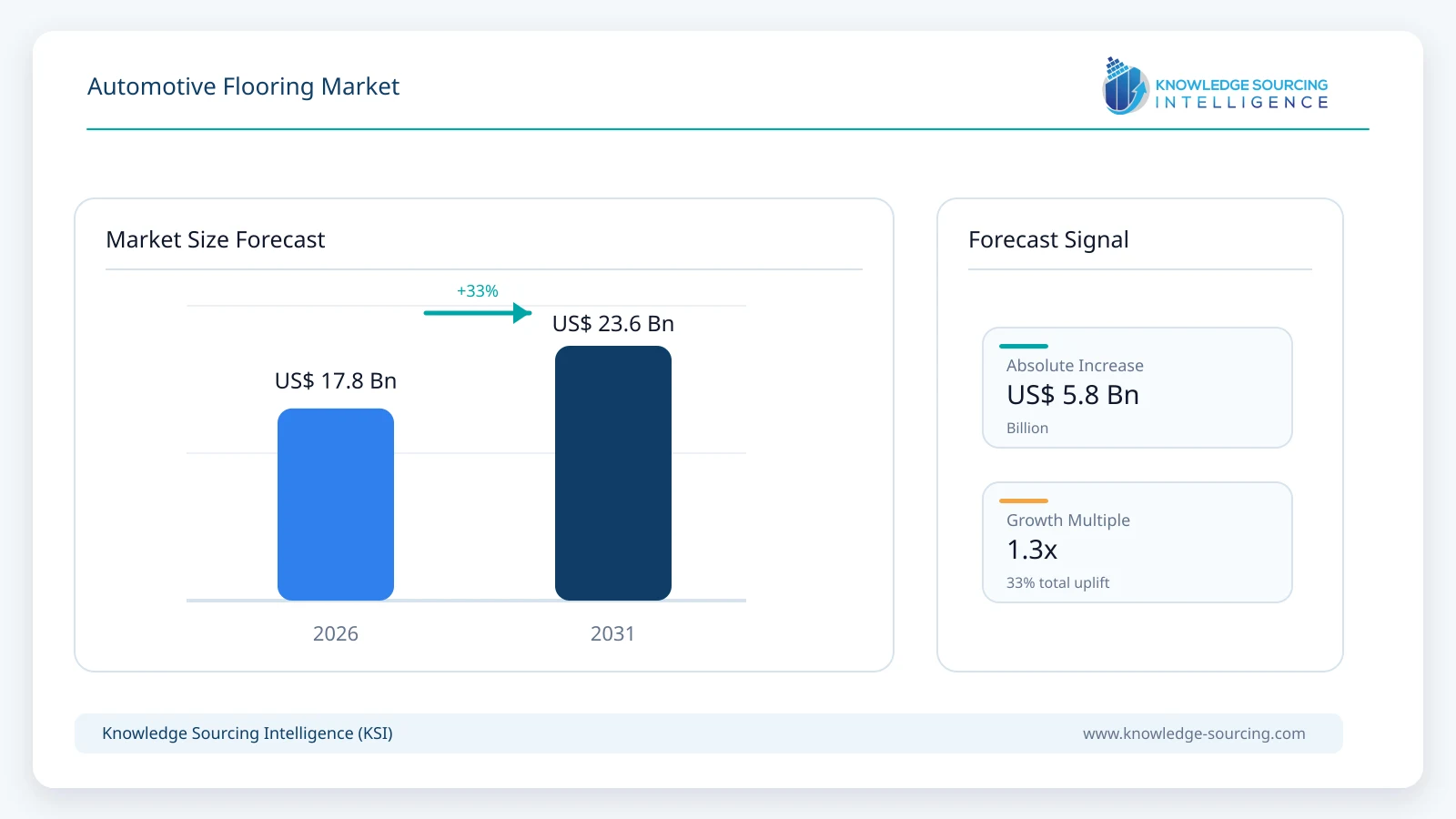
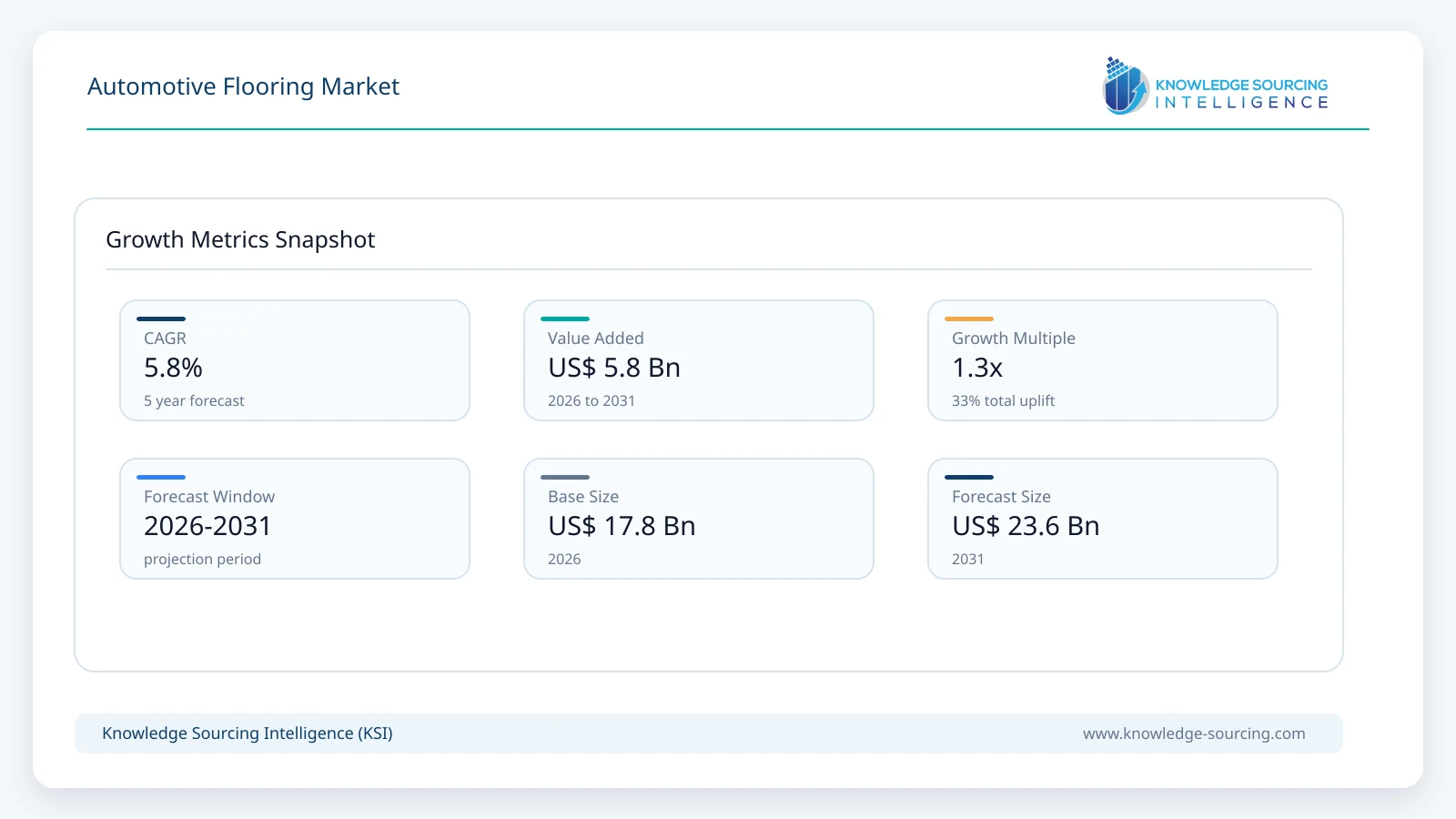
The automotive flooring market is estimated at approximately USD 17.8 billion in 2026 and is projected to reach about USD 23.6 billion by 2031, representing a CAGR of 5.8% during the forecast period.
Highlights:
- 1Molded floor carpets account for approximately 46% of global market value in 2026 because they form the primary visible floor surface and frequently integrate backing, reinforcement and acoustic functions.
- 2Needlepunched and other nonwoven constructions represent approximately 42% of 2026 market value by construction type, supported by cost efficiency, moldability, durability and extensive use in high-volume passenger vehicles.
- 3Polyester and PET-based flooring represents approximately 38% of 2026 market value and is gaining share due to recycled-content availability, lower mass and the ability to create mono-material carpet and insulation systems.
- 4Passenger vehicles account for approximately 89% of global market value in 2026 because fitted carpet, acoustic underlay and OEM mats are standard across cars, SUVs, crossovers and MPVs.
- 5OEM and Tier 1 supply accounts for approximately 86% of 2026 market value, reflecting the vehicle-specific tooling, acoustic tuning and fit requirements of molded floor systems.
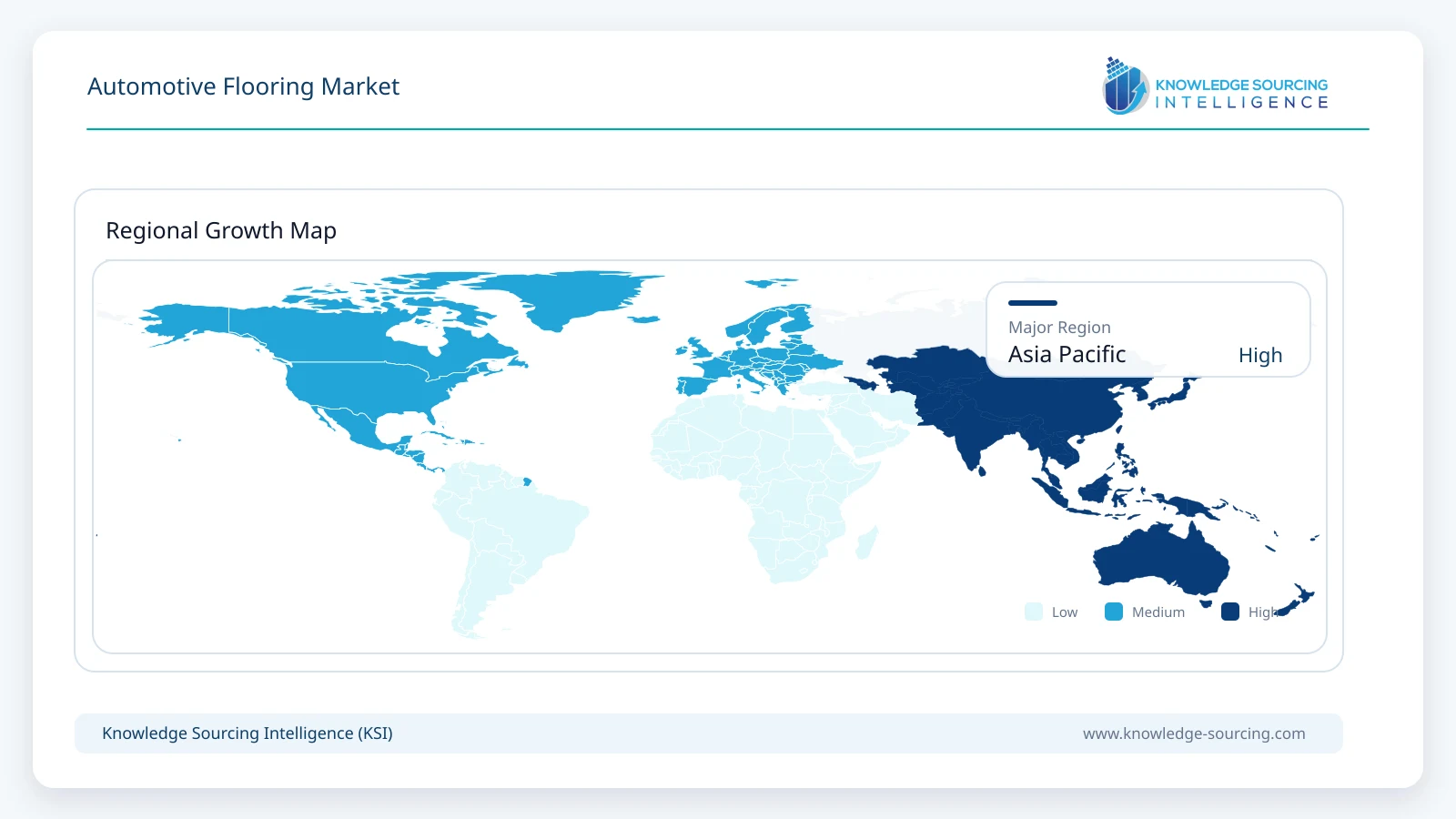
- 6Asia Pacific represents approximately 43% of global market value in 2026, supported by high vehicle production and extensive flooring manufacturing capacity in China, Japan, South Korea, India and Southeast Asia.
Molded textile carpet remains the largest value pool because it covers most of the passenger compartment and frequently integrates backing, local reinforcements, heel pads, insulation and attachment features within one vehicle-specific assembly. At the same time, conventional latex-backed carpets and heavy mass-barrier systems are being challenged by lightweight nonwovens, recycled polyester, thermoplastic backings and mono-material PET constructions as OEMs pursue lower mass and better end-of-life recovery.
The material transition is closely linked to changing acoustic requirements, particularly in battery-electric vehicles where tire, road and structure-borne noise become more perceptible as combustion powertrain noise disappears. Autoneum's N-Join1, Di-Light and Flexi-Light PET, Auria's Duralite, Adler Pelzer's MONO tex and HMP tex concepts, and Suminoe's low-density felt-backed acoustic carpet illustrate the move toward lighter, more circular floor systems. Suppliers with combined carpet, underlay, simulation and material capabilities are therefore positioned to optimize absorption and insulation locally rather than adding mass uniformly across the complete floor.
Market Overview
Automotive flooring is a layered vehicle-specific system rather than a single carpet, combining the visible surface with backing layers that provide shape retention, local stiffness, acoustic absorption, sound insulation, thermal management and contact with the stamped body floor. Needlepunched nonwovens, tufted textiles, dilour and utility thermoplastics are used at the surface, with heel pads, retention points, grommets and cut-outs added around pedals, seats, wiring and console interfaces. Construction varies by vehicle segment: tufted carpets are concentrated in higher-value passenger vehicles, needlepunched and dilour surfaces dominate many high-volume applications, and commercial, off-road and fleet vehicles increasingly use washable TPO, rubber or other technical surfaces where stain, mud and water resistance outweigh plushness.
Acoustic integration and cargo-area coverage add further system value beyond the visible passenger-compartment surface. Traditional under-carpet packages often relied on heavy barriers, whereas newer designs combine porous absorbers, decouplers and localized insulation to deliver comparable NVH performance at lower mass; Autoneum, Auria, Adler Pelzer and Trèves all position flooring as part of the vehicle acoustic package rather than as decoration alone. SUVs, crossovers and EVs also require trunk carpets, removable mats and lightweight load-floor structures that share materials and manufacturing processes with passenger-compartment flooring, allowing major suppliers to provide integrated floor-to-cargo programs.
Market Trends
Mono-Material PET Flooring Is Moving from Concept to Industrialization
Circularity is becoming the most important material trend in automotive flooring. Autoneum's N-Join1 joins carpet surface and substrate without latex or conventional adhesives, allowing a complete polyester-based floor carpet to be recycled more easily at end of life. Adler Pelzer similarly markets MONO tex carpet concepts, while Auria's Duralite nonwoven carpet is designed as a single-material recyclable system.
Mono-material flooring creates value beyond end-of-life recycling because eliminating latex and mixed-material backing can reduce water and energy consumption, simplify production-waste recovery and lower component mass. Broader adoption will still depend on whether these systems can consistently meet OEM requirements for abrasion, shaping, odor, sound insulation and long-term dimensional stability.
EV Acoustic Requirements Are Increasing the Importance of Floor Treatments
Battery-electric vehicles remove engine masking noise, making tire and road excitation more noticeable to occupants. The floor is a major transmission path for this noise, particularly around wheelhouses, seat cross-members and underbody structures. As a result, acoustic performance remains a major design criterion even as automakers seek to reduce interior mass.
EV-focused acoustic packages are increasingly using tuned porous absorbers and lightweight insulators instead of uniform heavy barriers so suppliers can control road and structure-borne noise without unnecessary mass. Autoneum's Flexi-Light PET and Hybrid-Acoustics, Auria's under-carpet absorbers and Trèves' acoustic floor solutions illustrate this move toward local performance tuning through simulation and tailored material combinations.
Integrated Carpet-and-Insulator Systems Are Reducing Part Count
Floor carpet and acoustic backing were historically produced as separate layers and combined later in the assembly process. One-shot and integrated systems now allow the visible carpet and insulation to be molded or joined in fewer manufacturing steps. Adler Pelzer's HMP tex is specifically designed as an integrated floor carpet with insulation backing, while other suppliers use thermoplastic bonding and molded felt technologies to reduce secondary assembly.
Integrated carpet-and-insulator systems can improve fit, reduce line handling and stabilize acoustic performance across vehicle variants while also simplifying material architecture when the surface and backing use compatible polymers. The trade-off is greater tooling intensity and stronger process dependence on each vehicle's specific floor geometry.
Washable Utility Flooring Is Expanding in SUVs, Pickups and Commercial Vehicles
Traditional textile carpet is not optimal for every use case. Off-road SUVs, pickups, commercial vehicles and lifestyle vehicles increasingly use TPO, rubberized or other technical flooring that resists mud, water, abrasion and chemicals and can be cleaned more aggressively than textile carpet. Auria's Armorlite system is one example of a marine-grade TPO floor designed for rugged vehicle applications.
Washable technical flooring creates a distinct automotive value pool because these systems must combine acceptable appearance with drainage, thermal insulation, scratch resistance and precise vehicle fit under harsher use conditions than conventional carpet. Growth is likely to remain strongest in North America and selected utility-oriented vehicle segments.
Recycled Content Is Increasing across Carpet, Underlay and Mat Systems
Recycled PET is increasingly used in carpet face fibers, felt underlays and acoustic absorbers. Autoneum's Di-Light can use very high recycled PET content, Flexi-Light PET contains up to 90% recycled content, and Freudenberg offers molded carpet nonwovens based on recycled polyester without latex binders.
Higher recycled-fiber content can materially reduce flooring carbon footprint, but OEM qualification still depends on stable color, odor, abrasion and processing behavior across large production volumes. Suppliers with closed-loop recovery of production cut-offs and consistent recycled-fiber sourcing are therefore better positioned to scale these materials than companies relying on spot-market recycled feedstock.
Segment Analysis
By Product Type: Molded Floor Carpets
Molded floor carpets are the largest product segment because they cover the full passenger-compartment floor and combine visible finish with vehicle-specific shape, cut-outs, reinforcements and attachment points. Needlepunched carpet dominates many high-volume programs, while tufted carpet is used where OEMs prioritize deeper pile, tactile quality and premium appearance.
Molded floor carpets represent approximately USD 8.19 billion of market value in 2026 and could approach USD 10.6 billion by 2031. Growth will be driven primarily by higher recycled content, integrated acoustic backing and premium surface upgrades rather than by vehicle volume alone.
By Construction: Needlepunched and Nonwoven Flooring
Needlepunched and nonwoven constructions are the largest construction class because they provide strong dimensional stability, abrasion resistance, moldability and cost efficiency. They are particularly well suited to complex floor contours and can be paired with felt, thermoplastic or mass-layer backing depending on acoustic requirements.
Needlepunched and nonwoven flooring accounts for approximately USD 7.48 billion in 2026 and should retain a leading share through 2031 because of its cost, durability and moldability advantages. Technological value within the segment will increasingly shift toward lighter face weights, higher recycled PET content, latex-free bonding and more premium dilour or lofted surface structures.
By Material: Polyester and PET-Based Flooring
Polyester is becoming the most strategically important flooring material because it can be used in both the visible carpet surface and the acoustic backing, enabling mono-material systems. Recycled PET also has a well-established automotive supply chain and can provide strong abrasion, moisture and acoustic performance.
Polyester and PET-based flooring represents approximately USD 6.76 billion of market value in 2026. Its share is expected to increase through 2031 as mono-material carpets, PET felt insulators and closed-loop recycling move into more OEM programs.
By Vehicle Type: Passenger Vehicles
Passenger cars, SUVs, crossovers and MPVs dominate flooring demand because they use the largest amount of fitted carpet, acoustic underlay, trunk flooring and model-specific mats. SUVs are particularly important because larger floor areas and cargo spaces increase material consumption per vehicle.
Passenger vehicles account for approximately USD 15.84 billion in 2026 and could exceed USD 21 billion by 2031. Commercial vehicles will grow from a smaller base, with durable non-textile flooring and high-wear carpet systems providing the strongest opportunities.
By Sales Channel: OEM and Tier 1 Supply
OEM flooring dominates because molded carpet and underlay must match exact body geometry, seat locations, pedal zones, HVAC routing and retention points. Most full-floor systems are engineered years before vehicle launch and supplied through Tier 1 programs using dedicated tooling and localized production.
OEM and Tier 1 supply represents approximately USD 15.31 billion in 2026. The aftermarket remains important for removable mats and protective liners, but it does not carry the same level of acoustic, structural and vehicle-specific integration as the original floor system.
Market Drivers
Tighter Sustainability and Circularity Targets for Vehicle Interiors
Flooring contains a substantial amount of textile, felt, polymer backing and adhesive, making it a priority for OEM recycled-content and end-of-life strategies. Mono-material PET carpet systems directly address this issue by making the surface and backing more compatible with one recycling stream.
Sustainability pressure is changing flooring sourcing criteria as OEMs evaluate suppliers on recycled content, production waste, water use, carbon footprint and end-of-life recovery alongside traditional cost and acoustic performance. This moves circularity from a secondary material attribute into a program-level procurement consideration.
Growing Acoustic Requirements in Electric Vehicles
The absence of engine noise exposes tire, road and structure-borne sound that can otherwise be masked in combustion vehicles. The interior floor is one of the largest acoustic treatment areas in the cabin and therefore remains essential to perceived refinement.
Higher EV cabin-noise sensitivity increases demand for carpet-insulation packages that combine absorption and transmission-loss performance with low mass. Suppliers with material simulation and vehicle-level NVH capability can therefore capture more engineering value than companies supplying the visible carpet surface alone.
Vehicle Lightweighting and Range Efficiency
Floor systems cover a large area and can therefore contribute meaningful weight savings. Lightweight needlepunch carpets, low-density felt, PET absorbers and optimized local barriers can reduce kilograms from a vehicle without removing customer-visible functionality.
Floor-system lightweighting is relevant across all powertrains but carries greater value in EVs, where lower mass supports range and efficiency while also reducing the material intensity of the component. The same mass reduction can improve lifecycle emissions when it is achieved without compromising acoustic or durability performance.
SUV, Crossover and Utility Vehicle Demand
SUVs and crossovers increase flooring value because they typically have larger passenger floors and cargo areas than compact cars. Three-row vehicles add more carpeted surface and additional mat positions, while lifestyle SUVs and pickups support demand for washable technical flooring.
The shift toward larger SUVs, crossovers and utility vehicles supports two distinct flooring opportunities: higher-value textile and acoustic packages for premium models, and rugged TPO or rubberized systems for work-oriented applications. North America is particularly important for utility flooring, while China contributes through large premium electric SUVs and MPVs.
Higher Expectations for Cabin Cleanability and Durability
Consumers increasingly expect easy-to-clean surfaces, stain resistance and durable appearance across the life of the vehicle. This is driving innovation in carpet fiber geometry, repellency, removable mats and non-textile floor systems.
Fleet, ride-hailing and family-use vehicles amplify these requirements because interiors experience heavier soiling and cleaning cycles. Suppliers can create differentiation through water management, deodorizing, antimicrobial or soil-resistant functions where OEM specifications support them.
Market Restraints
Severe OEM Cost Pressure on High-Volume Flooring Programs
Automotive carpet is a mature high-volume product and remains subject to aggressive annual cost-down expectations. Fiber, resin, energy and labor costs can fluctuate significantly, while long OEM contracts make rapid price recovery difficult.
Suppliers must therefore balance sustainability upgrades with manufacturing economics. New recycled or mono-material systems need to deliver lifecycle benefits without creating a cost premium that cannot be absorbed in mainstream vehicle programs.
Complex Acoustic Trade-Off between Weight and Sound Insulation
Reducing floor-system mass can conflict with low-frequency noise insulation. Porous absorbers perform well at selected frequencies but do not always replace the transmission-loss performance of heavy barriers in every vehicle package.
The optimal solution depends on body structure, powertrain, wheel-tire package and cabin geometry. This increases engineering effort and limits the use of one universal lightweight carpet system across different platforms.
Tooling and Vehicle-Specific Geometry
Molded flooring requires large forming tools and precise cut-outs for seats, pedals, consoles, HVAC ducts and wiring. Geometry changes late in vehicle development can force tool modification and create expensive launch risk.
Vehicle-specific floor geometry also limits cross-platform reuse because molded carpets and underlays depend on exact seat, pedal, console, HVAC and wiring interfaces. Suppliers therefore need sufficient program volume or flexible manufacturing to recover tooling investment and maintain competitive economics.
Contamination and Recycling Challenges for End-of-Life Carpets
Even mono-material carpets can be contaminated by dirt, liquids, fasteners, heel pads, adhesives and other materials over a vehicle's life. Collection and sorting infrastructure for end-of-life automotive textiles is still less mature than for metals.
Design-for-recycling only creates full circularity value when it is paired with viable take-back, sorting and reprocessing infrastructure. Without downstream recovery capacity, technically recyclable carpets may still be downcycled or disposed of instead of returning to automotive applications.
Durability Requirements for Recycled and Lightweight Materials
Automotive floors experience abrasion, compression, temperature cycling, moisture and chemical exposure for many years. New low-density and high-recycled-content materials must meet the same appearance and dimensional requirements as conventional systems.
Qualification of lightweight and high-recycled-content flooring can extend across several development cycles when the carpet also contributes acoustic or structural performance. These validation requirements can slow adoption even where the sustainability advantages are strong.
Regional Outlook
Asia Pacific
Asia Pacific is the largest automotive flooring market, supported by vehicle-production scale in China, Japan, South Korea, India and Southeast Asia. Japan has a particularly mature automotive-textile supply base: Hayashi Telempu produces more than ten million floor carpets annually and states that it supplies more than half of the Japanese market, while SUMINOE and Toyota Boshoku maintain extensive floor-carpet capabilities.
China is increasingly important for lightweight and sustainable floor systems as EV production expands, while India is gaining local capacity. Hayashi Telempu's NDR HAYASHI AUTOMOTIVE INDIA joint venture began operations in January 2026 and is supplying floor carpet and other interior/NVH products to manufacturers including Suzuki, Toyota and Honda.
Asia Pacific growth through 2031 will be supported by both vehicle output and higher material value per program as premium EVs increase demand for tufted and acoustic flooring while high-volume cars continue to require cost-efficient needlepunch systems with rising recycled content.
North America
North America is a major flooring value pool because SUVs, pickups and large crossovers have high floor and cargo-area material content. The region also supports a differentiated utility-floor segment where durable, washable TPO and rubberized systems compete directly with traditional carpet in off-road and work-oriented vehicles.
Auria is one of the region's major flooring suppliers and offers tufted, nonwoven, technical and utility floor systems, including Duralite and Armorlite. UGN supplies floor carpet assemblies to Japanese automakers across the United States, Canada and Mexico, while SUMINOE reported contributions from new floor-carpet programs launched at its North and Central American bases.
North American flooring growth will be driven more by vehicle mix and content per vehicle than by unit production alone, particularly as SUVs and pickups sustain large floor areas and technical-use requirements. Recycled materials, premium acoustic packages and rugged utility flooring are therefore expected to increase average flooring value per vehicle.
Competitive Landscape
The automotive flooring market is led by suppliers with expertise in textiles, acoustic materials, molding and vehicle-specific integration. Autoneum, Adler Pelzer, Auria, Hayashi Telempu, SUMINOE and Trèves compete across complete floor-carpet and insulation programs, while Toyota Boshoku, UGN and regional suppliers provide significant platform-specific capacity.
Autoneum differentiates through its broad interior-floor technology portfolio, including needlepunch and tufted carpets, floor insulators and mono-material PET technologies. Adler Pelzer combines surface carpet, insulation and trunk systems with integrated manufacturing concepts. Auria competes across luxury carpet, lightweight nonwoven carpet, utility flooring and acoustic underlays.
Japanese suppliers retain strong positions in textile quality and OEM relationships. Hayashi Telempu, SUMINOE and Toyota Boshoku supply floor carpets across domestic and global platforms, while SUMINOE also participates in OEM accessory mats and functional carpets. Freudenberg Performance Materials and HS Hyosung Advanced Materials provide important upstream carpet and nonwoven technologies.
Future competitive advantage will increasingly depend on combining circular material architecture, lightweight acoustic performance and efficient vehicle-specific manufacturing. Suppliers able to use compatible materials across the carpet surface and underlay, reclaim production scrap and tune acoustic performance digitally are positioned to reduce both cost and lifecycle emissions.
Recent Developments
25 February 2026: Hayashi Telempu announced that NDR HAYASHI AUTOMOTIVE INDIA had commenced operations from January 2026. The joint venture will supply floor carpet and other interior and NVH products to automakers in India including Suzuki, Toyota and Honda.
29 January 2026: SUMINOE reported that newly launched floor-carpet programs at its North and Central American bases contributed to growth in its Automotive Textiles business during the first half of fiscal 2026.
12 November 2025: SUMINOE announced that its pile carpet had been selected for Sony Honda Mobility's AFEELA, with the product incorporating deodorizing functionality and design consideration for recycling.
8 July 2025: Autoneum introduced Flexi-Light PET, a lightweight polyester felt sound-insulation material containing up to 90% recycled PET and available globally as insulation for automotive carpets.
1 July 2025: Autoneum launched N-Join1, an adhesive-free mono-material carpet system designed to eliminate latex, enable waste-free production and improve end-of-life recyclability.
April 2025: Autoneum showcased its Renault Emblème material package, including the vehicle carpet, using high-recycled-content mono-material polyester technologies. Across the supplied fiber-based components, the company reported up to 25% weight reduction and an approximately 70% lower component carbon footprint.
Market Outlook
The automotive flooring market is expected to expand from approximately USD 17.800 billion in 2026 to about USD 23.597 billion by 2031. Molded floor carpet will remain the largest product category, while PET-based mono-material systems, lightweight acoustic insulators and utility flooring will grow faster than conventional multi-material constructions.
Automotive flooring will become more integrated at the system level rather than simply more decorative, with the carpet surface, acoustic backing, local reinforcement and recycling strategy increasingly engineered together. EV acoustic requirements will maintain the strategic importance of the floor even as suppliers reduce heavy barrier content and shift toward lighter localized treatments.
Asia Pacific will remain the largest regional market, while North America continues to generate high value through SUVs, pickups and technical utility flooring. Supplier success will depend on delivering durable appearance, acoustic performance and vehicle-specific fit at lower mass and with materially improved circularity.
Automotive Flooring Market Scope:
| Report Metric | Details |
|---|---|
| Total Market Size in 2026 | USD 17.8 billion |
| Total Market Size in 2031 | USD 23.6 billion |
| Forecast Unit | Billion |
| Growth Rate | 5.8% |
| Study Period | 2021 to 2031 |
| Historical Data | 2021 to 2024 |
| Base Year | 2025 |
| Forecast Period | 2026 – 2031 |
| Segmentation | Product Type, Construction, Material, Vehicle Type, Sales Channel, Geography |
| Companies |
|
Market Segmentation
By Product Type
Molded Floor Carpets
Floor Mats and Protective Liners
Acoustic Underlays and Floor Insulators
Trunk, Cargo and Load-Floor Systems
By Construction
Needlepunched and Nonwoven Flooring
Tufted Carpet Flooring
Molded Thermoplastic and Rubber Flooring
Integrated Multi-Layer Acoustic Flooring
By Material
Polyester and PET-Based Flooring
Polypropylene-Based Flooring
Nylon-Based Carpets and Mats
TPO, Rubber and Elastomeric Flooring
Natural-Fiber and Hybrid Materials
By Vehicle Type
Passenger Vehicles
Light Commercial Vehicles
Medium and Heavy Commercial Vehicles
Buses and Specialty Vehicles
By Sales Channel
OEM and Tier 1 Supply
Aftermarket Mats, Liners and Replacement Flooring
By Geography
North America
United States
Canada
Mexico
South America
Brazil
Argentina
Others
Europe
Germany
United Kingdom
France
Italy
Spain
Others
Middle East and Africa
Saudi Arabia
UAE
South Africa
Others
Asia Pacific
China
Japan
South Korea
India
Indonesia
Thailand
Others
Table of Contents
1. INTRODUCTION
1.1. Market Overview
1.2. Market Definition
1.3. Scope of the Study
1.4. Market Segmentation
1.5. Currency
1.6. Assumptions
1.7. Base and Forecast Years
1.8. Key Benefits to Stakeholders
2. RESEARCH METHODOLOGY
2.1. Research Design
2.2. Secondary Research
2.3. Primary Research
2.4. Market Estimation
2.5. Segment Modelling
2.6. Data Triangulation and Validation
3. EXECUTIVE SUMMARY
3.1. Key Findings
3.2. Automotive Flooring Market Size, 2026-2031
3.3. Product Type Outlook
3.4. Construction Outlook
3.5. Material Outlook
3.6. Vehicle Type Outlook
3.7. Sales Channel Outlook
3.8. Regional Opportunity Summary
4. MARKET DYNAMICS
4.1. Market Drivers
4.1.1. Tighter Sustainability and Circularity Targets for Vehicle Interiors
4.1.2. Growing Acoustic Requirements in Electric Vehicles
4.1.3. Vehicle Lightweighting and Range Efficiency
4.1.4. SUV, Crossover and Utility Vehicle Demand
4.1.5. Higher Expectations for Cabin Cleanability and Durability
4.2. Market Restraints
4.2.1. Severe OEM Cost Pressure on High-Volume Flooring Programs
4.2.2. Complex Acoustic Trade-Off between Weight and Sound Insulation
4.2.3. Tooling and Vehicle-Specific Geometry
4.2.4. Contamination and Recycling Challenges for End-of-Life Carpets
4.2.5. Durability Requirements for Recycled and Lightweight Materials
4.3. Market Opportunities
4.4. Porter's Five Forces Analysis
4.5. Industry Value Chain Analysis
4.6. Flooring System Cost, Weight and Acoustic Economics
4.7. Material, Flammability, VOC and Circularity Requirements
5. TECHNOLOGY OUTLOOK
5.1. Needlepunched Nonwoven Carpet Systems
5.2. Tufted and Premium Textile Carpets
5.3. Mono-Material PET Carpet Systems
5.4. Latex-Free and Adhesive-Free Backing Technologies
5.5. Lightweight Floor Insulators and Acoustic Decouplers
5.6. Integrated Carpet-and-Insulator Manufacturing
5.7. Recycled PET and Closed-Loop Fiber Technologies
5.8. TPO, Rubber and Washable Utility Flooring
5.9. Trunk and Cargo Floor Carpet Systems
5.10. Lightweight Load Floors and Sandwich Structures
5.11. Acoustic Simulation and Local Floor Tuning
5.12. Design-for-Recycling and End-of-Life Material Recovery
6. AUTOMOTIVE FLOORING MARKET BY PRODUCT TYPE
6.1. Introduction
6.2. Molded Floor Carpets
6.3. Floor Mats and Protective Liners
6.4. Acoustic Underlays and Floor Insulators
6.5. Trunk, Cargo and Load-Floor Systems
7. AUTOMOTIVE FLOORING MARKET BY CONSTRUCTION
7.1. Introduction
7.2. Needlepunched and Nonwoven Flooring
7.3. Tufted Carpet Flooring
7.4. Molded Thermoplastic and Rubber Flooring
7.5. Integrated Multi-Layer Acoustic Flooring
8. AUTOMOTIVE FLOORING MARKET BY MATERIAL
8.1. Introduction
8.2. Polyester and PET-Based Flooring
8.3. Polypropylene-Based Flooring
8.4. Nylon-Based Carpets and Mats
8.5. TPO, Rubber and Elastomeric Flooring
8.6. Natural-Fiber and Hybrid Materials
9. AUTOMOTIVE FLOORING MARKET BY VEHICLE TYPE
9.1. Introduction
9.2. Passenger Vehicles
9.3. Light Commercial Vehicles
9.4. Medium and Heavy Commercial Vehicles
9.5. Buses and Specialty Vehicles
10. AUTOMOTIVE FLOORING MARKET BY SALES CHANNEL
10.1. Introduction
10.2. OEM and Tier 1 Supply
10.3. Aftermarket Mats, Liners and Replacement Flooring
11. AUTOMOTIVE FLOORING MARKET BY GEOGRAPHY
11.1. North America
11.1.1. United States
11.1.2. Canada
11.1.3. Mexico
11.2. South America
11.2.1. Brazil
11.2.2. Argentina
11.2.3. Others
11.3. Europe
11.3.1. Germany
11.3.2. United Kingdom
11.3.3. France
11.3.4. Italy
11.3.5. Spain
11.3.6. Others
11.4. Middle East and Africa
11.4.1. Saudi Arabia
11.4.2. UAE
11.4.3. South Africa
11.4.4. Others
11.5. Asia Pacific
11.5.1. China
11.5.2. Japan
11.5.3. South Korea
11.5.4. India
11.5.5. Indonesia
11.5.6. Thailand
11.5.7. Others
12. COMPETITIVE ENVIRONMENT AND ANALYSIS
12.1. Major Players and Strategy Analysis
12.2. Market Share Analysis
12.3. Carpet Surface and Construction Benchmarking
12.4. Acoustic Underlay and Floor Insulation Benchmarking
12.5. Recycled Content and Mono-Material Circularity Benchmarking
12.6. Utility Flooring and Cargo System Benchmarking
12.7. OEM Programs, Manufacturing Footprint and Production Readiness
12.8. Competitive Dashboard
13. COMPANY PROFILES
13.1. Autoneum Holding AG
13.2. Adler Pelzer Group
13.3. Auria Solutions
13.4. Hayashi Telempu Corporation
13.5. SUMINOE Co., Ltd.
13.6. Toyota Boshoku Corporation
13.7. Trèves Group
13.8. UGN, Inc.
13.9. Freudenberg Performance Materials
13.10. HS HYOSUNG Advanced Materials
13.11. Hitkari Hitech Pvt. Ltd.
13.12. Bajaj Carpet Industries Ltd.
14. APPENDIX
14.1. Currency
14.2. Assumptions
14.3. Base and Forecast Years Timeline
14.4. Key Benefits for Stakeholders
14.5. Research Methodology
14.6. Abbreviations
14.7. Data Sources
Navigate
Trusted by the world's leading organizations











