
The automotive bio-based interior materials market is projected to expand at a CAGR of 13.6%, increasing from USD 6.20 billion in 2026 to USD 11.75 billion by 2031.
Highlights:
- 1Natural-fiber composites account for approximately 41% of global market value in 2026 because hemp, kenaf and flax reinforcement is already established across door trim, instrument-panel carriers and other molded cabin components.
- 2Door trim and side panels represent approximately 28% of 2026 demand, supported by broad use of natural-fiber substrates, bio-composites and alternative surface materials.
- 3Hemp, kenaf and flax collectively form the largest feedstock group, accounting for approximately 38% of market value in 2026, while plant-derived polyols, cellulose and agricultural-residue feedstocks are gaining share.
- 4Hybrid bio-composites combining renewable fibers with thermoplastic matrices remain the largest material architecture, while bio-based PU, leather alternatives and next-generation biofabricated surfaces grow faster.
- 5Passenger vehicles account for approximately 94% of global market value in 2026, reflecting their dominant production scale and stronger adoption of sustainability-led interior materials.
- 6Asia Pacific represents approximately 42% of global market value in 2026, while Europe records the highest bio-based material intensity per vehicle through natural-fiber composites, animal-free surfaces and low-carbon interior programs.
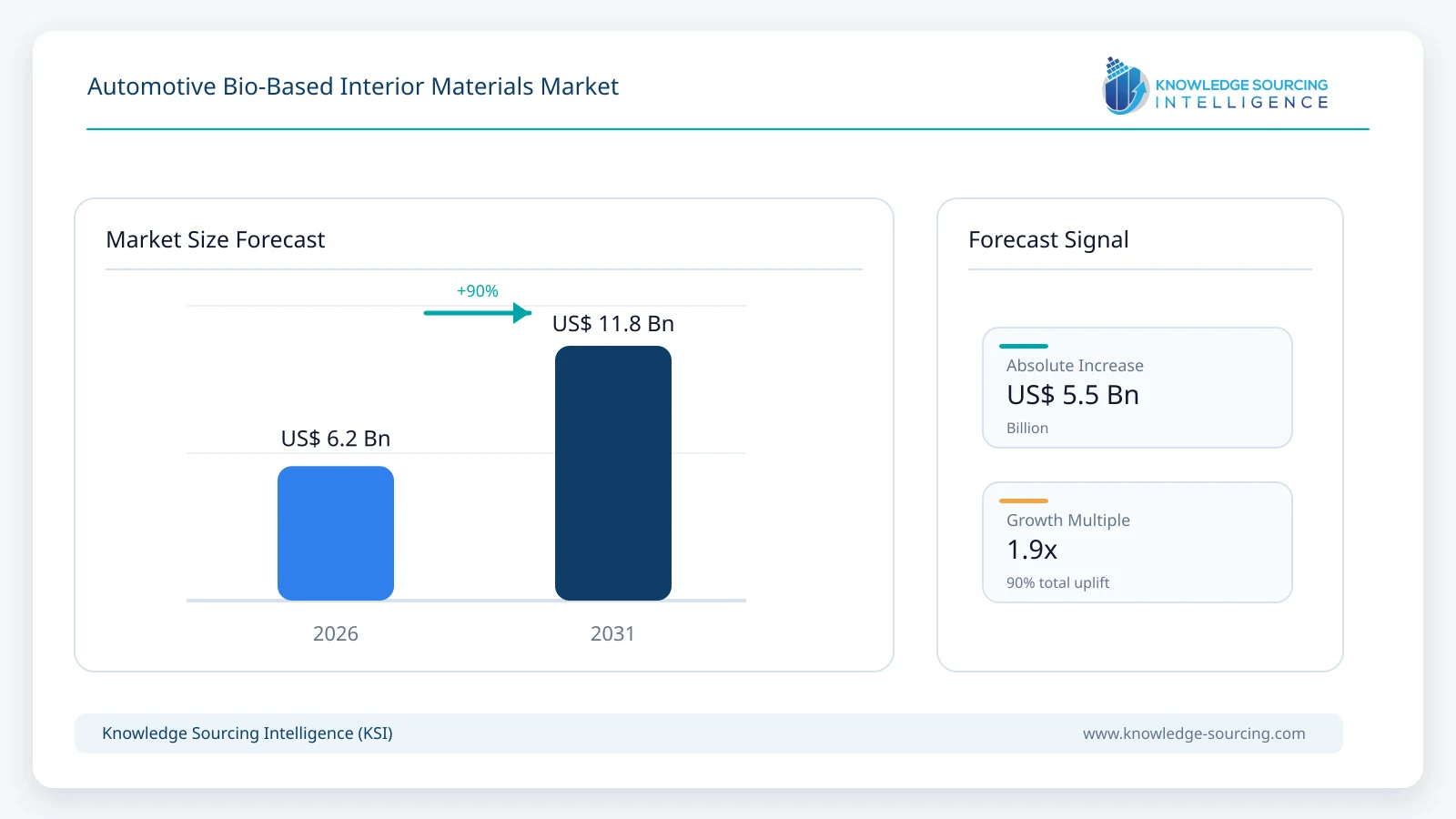
Bio-based materials are moving from small sustainability demonstrators into production interior programs as natural fibers, plant-derived polymers and alternative surface materials achieve better consistency, durability and processing performance.
Natural-fiber composites form the largest value pool because hemp, kenaf and flax can reinforce door panels, instrument-panel carriers and other molded interior structures while reducing density and replacing part of the petroleum-based material content. Bio-based surfaces and leather alternatives are expanding faster as OEMs seek lower-carbon, animal-free materials that remain suitable for visible premium applications.
The market measures the attributable value of engineered interior materials whose renewable biological feedstock forms a defined part of the material system. Conventional animal leather, ordinary decorative wood veneer, recycled petrochemical materials without bio-based content and the full value of finished seats, trim modules or cockpit assemblies are excluded unless the value can be attributed directly to the bio-based material.
Market Overview
Bio-based interior materials reduce dependence on fossil feedstocks by replacing part of the polymer, reinforcement or surface layer with material derived from plants, agricultural residues, forestry resources or other renewable biological sources. The technical route varies widely: kenaf or hemp can reinforce polypropylene, vegetable oils can replace part of the petrochemical feedstock in polyurethane, cellulose can be converted into textile fibers, and plant proteins or fungal structures can form the basis of leather-like surfaces.
Automotive use requires substantially more than renewable content. A material must retain dimensional stability, low odor and VOC emissions, abrasion resistance, color consistency, heat resistance and long-term durability across thousands of production parts, which explains why established natural-fiber composites have commercialized faster than many experimental biomaterials.
The strongest product architectures increasingly combine bio-based content with recyclability or recycled matrices. FORVIA's NAFILean-R, for example, combines natural hemp fibers with recycled polypropylene, illustrating how feedstock decarbonization and circularity can be designed into the same material even though the two market concepts remain analytically distinct.
Market Trends
Natural-Fiber Composites Are Moving into Visible Interior Surfaces
Hemp, kenaf and flax composites have traditionally been used in hidden door and trim substrates, but improved surface quality is allowing biomass to become part of the visible design language. FORVIA's NAFILean Vision combines recycled plastics with renewable fillers such as hemp, wood, reed and vine shoots while intentionally retaining the visual character of the biomass.
Visible natural content gives OEMs a stronger sustainability story, but it also raises requirements for color control, grain consistency and premium perceived quality because material variation is no longer hidden beneath a decorative skin.
Bio-Based Polyurethane Is Expanding beyond Experimental Seat Concepts
Vegetable-oil and biomass-balance feedstocks are increasingly being introduced into polyurethane chemistry used for seating, soft-touch surfaces and foam applications. BASF's 2026 commercial production of biomass-balance polyether polyols for automotive applications provides a drop-in route for reducing fossil feedstock without changing established polyurethane processing.
Drop-in chemistry can accelerate adoption because seat and interior suppliers can preserve existing molds, formulations and production infrastructure while lowering the fossil-derived share of the material system.
Plant-Based Leather Alternatives Are Becoming More Technically Credible
Automotive alternatives to animal leather are moving beyond conventional petroleum-based synthetic leather toward materials that use grain proteins, plant oils, pineapple fibers and other biological feedstocks. Hyundai CRADLE's work with UNCAGED Innovations uses grain proteins and other plant-based elements to create an automotive leather alternative designed to retain texture, durability and premium appearance.
The opportunity is strongest where bio-based content can reduce environmental impact without creating the durability or cleaning limitations that have restricted some early plant-based surface materials.
Agricultural Residues Are Becoming Design Feedstocks
Material developers are increasingly evaluating crop residues and food-industry byproducts as fillers or surface ingredients rather than relying only on purpose-grown fiber crops. Pineapple fibers, vine shoots, grain byproducts and other biomass can provide distinctive texture while reducing the need for virgin petrochemical or mineral fillers.
Commercial scaling will depend on stable regional supply, standardized preprocessing and the ability to keep biological variation within automotive production tolerances.
Biofabrication Is Emerging as a Longer-Term Interior Material Platform
Mycelium, algae-derived polymers and other biologically engineered materials are moving into OEM research portfolios as potential replacements for fossil-based foams, leather-like surfaces and selected trim materials. Kia's current sustainable-design strategy explicitly includes mycelium-based material development alongside bio-based polyurethane containing plant-derived components such as corn and eucalyptus.
These technologies remain smaller than established natural-fiber composites, but their ability to create low-mass, animal-free and potentially lower-carbon materials gives them meaningful long-term potential in premium interior surfaces.
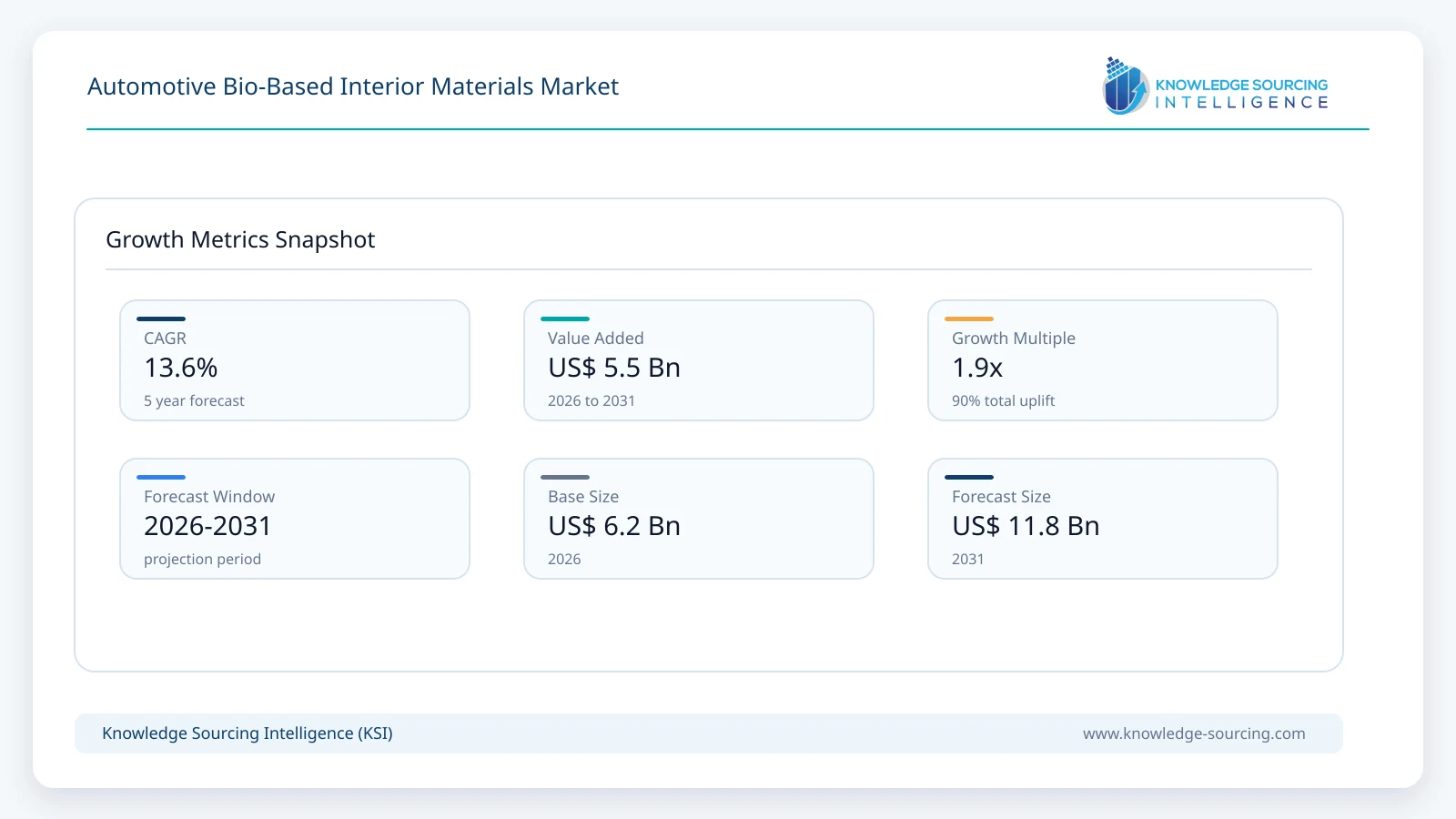
Segment Analysis
By Material Type: Natural-Fiber Composites
Natural-fiber composites lead the market because hemp, kenaf and flax can replace part of the glass fiber or polymer content in molded interior structures while reducing density and providing a renewable reinforcement source. Door trim, instrument-panel carriers and luggage-area panels already provide proven high-volume applications.
Natural-fiber composites account for approximately USD 2.54 billion in 2026 and are projected to reach about USD 4.45 billion by 2031. Their absolute value will continue to rise, although bio-based surfaces, foams and alternative leather materials are expected to grow faster.
By Feedstock: Hemp, Kenaf and Flax
Hemp, kenaf and flax form the largest feedstock group because their long fibers provide useful reinforcement at relatively low density and can be processed within established automotive composite systems. Kenaf has a long production history in Japanese interior components, while hemp and flax are increasingly used in European bio-composites and visible natural-fiber finishes.
The feedstock group represents approximately USD 2.36 billion in 2026 and could reach about USD 4.24 billion by 2031. Cellulose, plant-derived polyols and agricultural-residue feedstocks will gain share as the market expands beyond structural composite applications.
By Application: Door Trim and Side Panels
Door panels offer the largest application base because they combine large molded substrates, decorative surfaces and relatively favorable structural requirements for natural-fiber composites. The same component can use a bio-composite carrier, plant-based surface and lower-density reinforcement without changing the broader vehicle architecture.
Door trim and side-panel materials account for approximately USD 1.74 billion in 2026 and are projected to approach USD 3.22 billion by 2031. Seat and upholstery applications will grow faster as bio-based foams and leather alternatives mature.
By Material Architecture: Hybrid Bio-Composite Systems
Hybrid systems combine renewable fibers or fillers with thermoplastic or thermoset matrices to balance bio-based content with impact resistance, moisture stability and automotive processing requirements. The approach allows OEMs to introduce renewable content without relying on a fully bio-based polymer for every performance requirement.
Hybrid bio-composites account for approximately USD 3.35 billion in 2026 and are projected to reach about USD 5.73 billion by 2031. Their share gradually declines as higher-bio-content polymers, foams and surface materials expand.
By Vehicle Type: Passenger Vehicles
Passenger cars, SUVs and MPVs dominate demand because visible interior materials play a stronger role in brand positioning, premiumization and sustainability communication than in most commercial vehicles. EV programs are particularly important because manufacturers often use alternative materials to reinforce the broader low-carbon identity of the vehicle.
Passenger vehicles account for approximately USD 5.83 billion in 2026 and are projected to reach about USD 10.93 billion by 2031. Commercial vehicles remain a smaller segment but provide opportunities for natural-fiber panels, durable bio-based foams and lower-carbon seat materials.
Market Drivers
OEM Lifecycle-Carbon Targets Are Increasing Demand for Renewable Feedstocks
Material production contributes a significant share of the embedded carbon associated with vehicle interiors, making polymer and surface substitution an important lever before the vehicle enters the use phase. Replacing part of a fossil-based material with renewable feedstock can reduce exposure to primary petrochemical inputs while supporting broader supply-chain decarbonization.
OEM sourcing decisions are therefore increasingly influenced by verified product-carbon data, not only by the physical performance and purchase price of the material.
Natural-Fiber Composites Offer Both Weight and Feedstock Benefits
Hemp, flax and kenaf reinforcement can reduce material density while maintaining the stiffness required for many non-structural and semi-structural interior parts. Lower component mass supports vehicle efficiency, while the renewable fiber portion reduces dependence on mineral or fossil-derived reinforcement.
The combination makes natural-fiber composites commercially attractive because the sustainability benefit is accompanied by a conventional engineering advantage rather than relying only on environmental positioning.
Animal-Free Interior Strategies Are Creating Demand for Bio-Based Surfaces
Several automakers are reducing conventional leather use and looking for alternatives that retain a premium tactile character without depending entirely on petroleum-based synthetic surfaces. Plant-derived polyurethane, grain-protein leather alternatives, pineapple-fiber surfaces and other biomaterials address this gap.
Demand is strongest when the material combines high bio-content with automotive abrasion, UV, cleaning and aging performance, allowing it to replace leather or conventional PU without creating a perceived quality penalty.
Advances in Polymer Chemistry Are Improving Drop-In Adoption
Bio-attributed and biomass-balance feedstocks can be introduced upstream in polymer production while preserving the chemical characteristics required by existing automotive processes. This is particularly valuable for polyurethane, where changing foam behavior can require costly requalification of seat comfort, durability and manufacturing parameters.
Drop-in solutions allow suppliers to increase renewable content more quickly than technologies that require entirely new tooling or component designs.
EV Premiumization Is Increasing the Visibility of Sustainable Materials
Electric-vehicle interiors increasingly use material choice as part of the customer-facing sustainability story, giving natural fibers and bio-based surfaces greater design importance. Visible biomass, animal-free upholstery and lower-carbon textiles can differentiate the cabin in ways that are immediately recognizable to the occupant.
The trend also encourages suppliers to improve aesthetic quality because renewable content must meet the same tactile and visual expectations as conventional premium materials.
Market Restraints
Biological Feedstocks Introduce Greater Material Variability
Fiber dimensions, moisture content, color and composition can vary with crop type, region and growing conditions, creating more feedstock variability than tightly controlled petrochemical inputs. Automotive production requires consistent molding behavior and finished appearance across large volumes.
Suppliers therefore need preprocessing, blending and quality-control systems that stabilize renewable feedstocks before they enter high-volume compound or textile production.
Moisture and Thermal Stability Can Restrict Application Range
Natural fibers and some bio-based polymers are more sensitive to moisture, temperature or hydrolysis than conventional automotive plastics. Door panels, dashboards and roof components can experience high heat and humidity over long service periods, requiring careful material treatment and validation.
Performance limitations do not prevent adoption, but they can reduce the maximum renewable-content level or require hybrid formulations that retain some conventional polymer content.
Premium Surface Quality Remains Difficult for Some Bio-Based Materials
Natural variation may be desirable when biomass is intentionally visible, but many premium interior programs still require highly consistent grain, color and gloss. Plant-based leather alternatives must also resist abrasion, staining, sunscreen, cleaning chemicals and repeated flexing.
Additional coatings or backing layers can improve performance but may reduce the bio-based share and complicate end-of-life recyclability.
Feedstock Availability and Regional Supply Chains Are Uneven
Hemp, kenaf, flax, plant oils and agricultural residues are not produced at the same scale or quality in every automotive manufacturing region. Long transport distances can weaken both the economics and carbon advantage of using a renewable feedstock.
Regional sourcing and flexible formulations will therefore be important for suppliers that want to scale one material platform across global OEM programs.
Higher Cost Can Limit Adoption below Premium Segments
Advanced bio-based polymers, specialty fibers and emerging leather alternatives can cost more than mature petrochemical materials, particularly before production volumes reach automotive scale. Additional testing and feedstock traceability can further raise the near-term cost.
Mainstream penetration will depend on manufacturing scale, simplified processing and applications where lower weight or reduced finishing requirements offset part of the material premium.
Regional Outlook
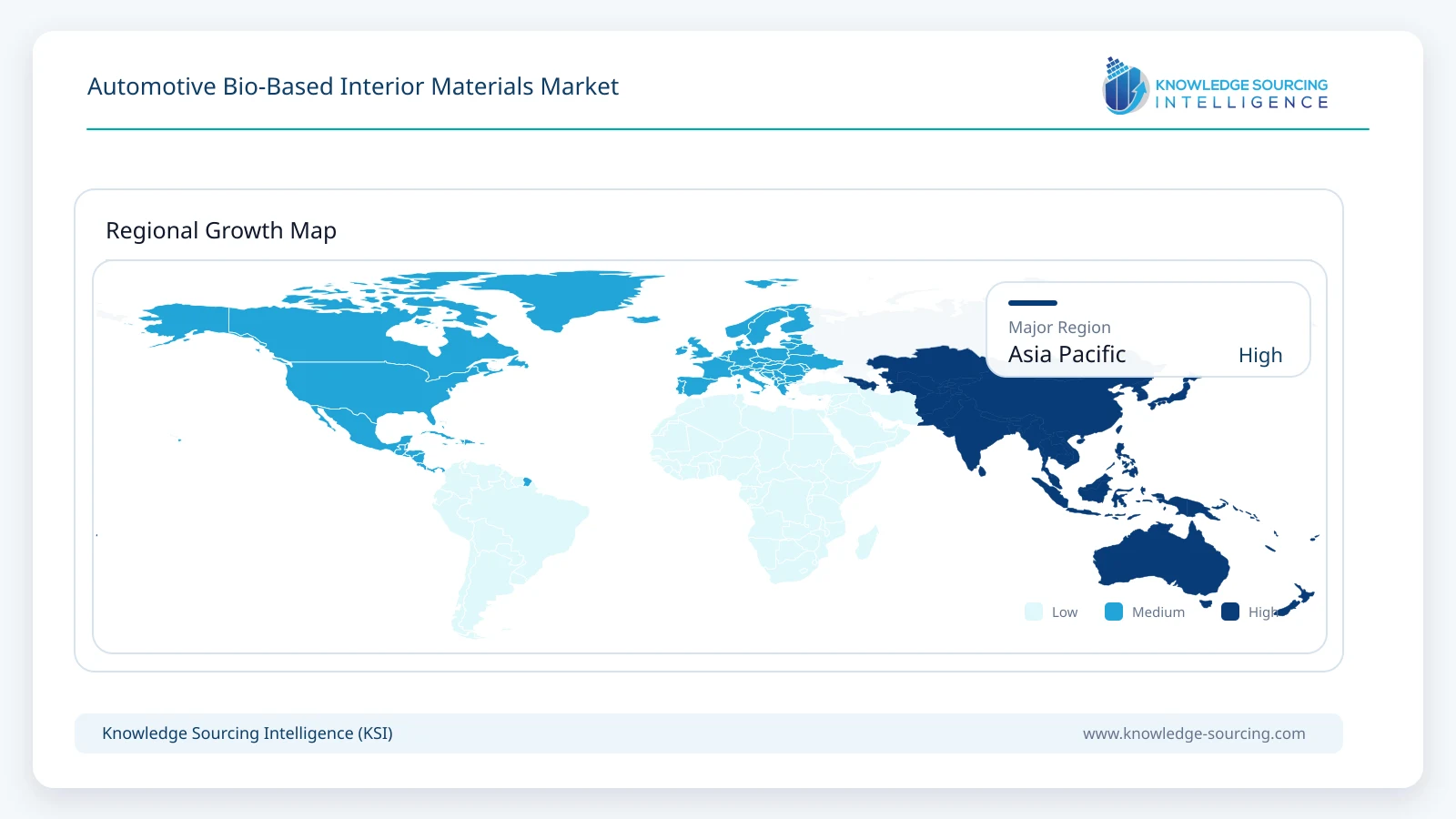
Asia Pacific
Asia Pacific is the largest regional market because it combines the highest global vehicle-production volume with established use of kenaf, plant-derived plastics and increasingly sophisticated sustainable interiors in Japan, South Korea and China. Toyota Boshoku has long used kenaf in automotive interior components, while Kia is expanding bio-based polyurethane and exploring mycelium-based materials within its future material strategy.
China's rapid EV product cycle is also creating a large addressable market for animal-free surfaces and low-carbon interior materials as local brands use cabin materials to differentiate technology-focused vehicles. Regional growth will depend on scaling consistent bio-based feedstocks without compromising odor, durability and cost requirements.
Europe
Europe records the highest bio-based material intensity per vehicle because natural-fiber composites, low-carbon surfaces and animal-free interior strategies are already embedded in premium and mainstream development programs. FORVIA's hemp-reinforced NAFILean materials, visible bio-composites and pineapple-fiber surface concepts demonstrate the region's broad commercialization pipeline.
European growth through 2031 will be supported by stronger lifecycle-carbon requirements and closer integration between material developers, recyclers and interior Tier 1 suppliers. The leading solutions are likely to combine renewable feedstock with recyclability, recycled matrices or lower finishing requirements rather than pursuing bio-based content in isolation.
Competitive Landscape
Competition spans interior Tier 1 suppliers, polymer producers, textile companies and biomaterial specialists because bio-based content can enter the cabin through structural composites, foams, fabrics, coatings or alternative leather surfaces. FORVIA's MATERI'ACT business has one of the most mature automotive bio-composite portfolios, while Toyota Boshoku brings long experience in kenaf-based interior parts.
BASF and other chemical suppliers compete through bio-attributed or biomass-balance polymer feedstocks that can enter established polyurethane and plastics processes, while Continental, Antolin, Yanfeng, Lear and Adient integrate lower-carbon surfaces and materials into finished interior systems. Specialist biomaterial companies are also becoming more relevant as OEMs explore grain-protein, mycelium and other next-generation leather alternatives.
Supplier advantage will depend on automotive-grade durability, verified bio-based content, stable feedstock sourcing, product-carbon performance and the ability to process renewable materials within existing high-volume manufacturing. Commercial success is more likely when bio-based content provides a second engineering benefit such as lower weight, simpler finishing or improved material circularity.
Recent Developments
8 October 2026: Kia expanded its sustainable-material design strategy around bio-based polyurethane made partly from plant-derived inputs such as corn and eucalyptus, while continuing development of mycelium-based materials for future vehicle interiors.
10 March 2026: BASF began commercial production of biomass-balance polyether polyols in North America for automotive and other polyurethane applications, using certified renewable and bio-circular feedstocks while retaining conventional processing characteristics.
29 January 2026: FORVIA announced new business with a major European automaker covering instrument and door panels, with natural-fiber materials specified for the door-panel program.
30 October 2025: FORVIA reported that its hemp-based NAFILean bio-composite had been integrated across ten Stellantis programs and was already used in more than six million vehicles, demonstrating established series-production scale for renewable-fiber interior materials.
21 August 2025: Hyundai CRADLE and UNCAGED Innovations announced a partnership to develop automotive leather alternatives using grain proteins and other plant-based elements, targeting premium interior performance with substantially lower resource intensity.
19 June 2025: MATERI'ACT introduced NAFILean Vision, a visible bio-composite family combining recycled polymer matrices with renewable biomass such as hemp, wood, reed and vine shoots for decorative automotive applications.
Market Outlook
Wider commercialization of natural-fiber composites, bio-based polyurethane and animal-free premium surfaces is expected to expand the automotive bio-based interior materials market. Natural-fiber composites will remain the largest material class, while bio-based foams, surface materials and next-generation leather alternatives record faster growth.
The market will gradually move from simply adding renewable fibers to redesigning complete material systems around lower fossil-feedstock content. Hybrid architectures are likely to remain important because they allow suppliers to raise bio-based content while preserving the thermal, moisture and impact performance required for long vehicle service life.
Asia Pacific is expected to retain the largest regional market by volume, while Europe continues to lead high-content commercialization and visible bio-based design. Long-term supplier success will depend on consistent renewable feedstock, automotive-grade performance, credible carbon accounting, stable global sourcing and clear economic value beyond the sustainability claim itself.
Automotive Bio-Based Interior Materials Market Scope
| Report Metric | Details |
|---|---|
| Total Market Size in 2026 | USD 6.20 billion |
| Total Market Size in 2031 | USD 11.75 billion |
| Forecast Unit | Billion |
| Growth Rate | 13.6% |
| Study Period | 2021 to 2031 |
| Historical Data | 2021 to 2024 |
| Base Year | 2025 |
| Forecast Period | 2026 – 2031 |
| Segmentation | Material Type, Feedstock, Application, Material Architecture, Vehicle Type, Geography |
| Companies |
|
Market Segmentation
By Material Type
Natural-Fiber Composites
Bio-Based Polymers and Resins
Bio-Based Foams and Polyurethanes
Bio-Based Textiles and Cellulosic Materials
Plant-Based Leather Alternatives and Surface Materials
Other Emerging Biomaterials
By Feedstock
Hemp, Kenaf and Flax
Cellulose, Wood and Cork
Vegetable Oils, Sugar and Plant-Derived Polymer Feedstocks
Agricultural Residues and Grain Proteins
Fungi, Algae and Other Biological Feedstocks
By Application
Door Trim and Side Panels
Seats and Upholstery
Instrument Panel and Center Console
Headliner and Pillar Trim
Carpets, Floor and Luggage Areas
Other Interior Applications
By Material Architecture
Hybrid Bio-Composite Systems
High-Bio-Content Polymer Systems
Bio-Based Soft Surfaces and Coated Materials
Bio-Foam and Cellular Structures
Biofabricated and Next-Generation Materials
By Vehicle Type
Passenger Vehicles
Light Commercial Vehicles
Medium and Heavy Commercial Vehicles and Buses
By Geography
North America
United States
Canada
Mexico
South America
Brazil
Argentina
Others
Europe
Germany
United Kingdom
France
Italy
Spain
Others
Middle East and Africa
Saudi Arabia
UAE
South Africa
Others
Asia Pacific
China
Japan
South Korea
India
Indonesia
Thailand
Others
Table of Contents
1. INTRODUCTION
1.1. Market Overview
1.2. Market Definition
1.3. Scope of the Study
1.4. Market Segmentation
1.5. Currency
1.6. Assumptions
1.7. Base and Forecast Years
1.8. Key Benefits to Stakeholders
2. RESEARCH METHODOLOGY
2.1. Research Design
2.2. Secondary Research
2.3. Primary Research
2.4. Market Estimation
2.5. Segment Modelling
2.6. Data Triangulation and Validation
3. EXECUTIVE SUMMARY
3.1. Key Findings
3.2. Automotive Bio-Based Interior Materials Market Size, 2026-2031
3.3. Material Type Outlook
3.4. Feedstock Outlook
3.5. Application Outlook
3.6. Material Architecture Outlook
3.7. Vehicle Type Outlook
3.8. Regional Opportunity Summary
4. MARKET DYNAMICS
4.1. Market Drivers
4.1.1. OEM Lifecycle-Carbon Targets Are Increasing Demand for Renewable Feedstocks
4.1.2. Natural-Fiber Composites Offer Both Weight and Feedstock Benefits
4.1.3. Animal-Free Interior Strategies Are Creating Demand for Bio-Based Surfaces
4.1.4. Advances in Polymer Chemistry Are Improving Drop-In Adoption
4.1.5. EV Premiumization Is Increasing the Visibility of Sustainable Materials
4.2. Market Restraints
4.2.1. Biological Feedstocks Introduce Greater Material Variability
4.2.2. Moisture and Thermal Stability Can Restrict Application Range
4.2.3. Premium Surface Quality Remains Difficult for Some Bio-Based Materials
4.2.4. Feedstock Availability and Regional Supply Chains Are Uneven
4.2.5. Higher Cost Can Limit Adoption below Premium Segments
4.3. Market Opportunities
4.4. Porter's Five Forces Analysis
4.5. Industry Value Chain Analysis
4.6. Feedstock, Material and Processing Economics
4.7. Bio-Based Content, VOC, Durability and Material-Traceability Requirements
5. TECHNOLOGY OUTLOOK
5.1. Hemp-Reinforced Bio-Composites
5.2. Kenaf-Reinforced Interior Materials
5.3. Flax Fiber Composites
5.4. Bio-Based Polypropylene and Polyamide Systems
5.5. Plant-Derived Polyurethane and Seat Foams
5.6. Cellulose and Wood-Derived Materials
5.7. Cork and Agricultural-Residue Materials
5.8. Plant-Based and Grain-Protein Leather Alternatives
5.9. Pineapple-Fiber and Other Bio-Based Surface Materials
5.10. Mycelium and Fungal Biomaterials
5.11. Algae-Derived Polymers and Emerging Biofabrication
5.12. Biomass-Balance and Bio-Attributed Polymer Feedstocks
6. AUTOMOTIVE BIO-BASED INTERIOR MATERIALS MARKET BY MATERIAL TYPE
6.1. Introduction
6.2. Natural-Fiber Composites
6.3. Bio-Based Polymers and Resins
6.4. Bio-Based Foams and Polyurethanes
6.5. Bio-Based Textiles and Cellulosic Materials
6.6. Plant-Based Leather Alternatives and Surface Materials
6.7. Other Emerging Biomaterials
7. AUTOMOTIVE BIO-BASED INTERIOR MATERIALS MARKET BY FEEDSTOCK
7.1. Introduction
7.2. Hemp, Kenaf and Flax
7.3. Cellulose, Wood and Cork
7.4. Vegetable Oils, Sugar and Plant-Derived Polymer Feedstocks
7.5. Agricultural Residues and Grain Proteins
7.6. Fungi, Algae and Other Biological Feedstocks
8. AUTOMOTIVE BIO-BASED INTERIOR MATERIALS MARKET BY APPLICATION
8.1. Introduction
8.2. Door Trim and Side Panels
8.3. Seats and Upholstery
8.4. Instrument Panel and Center Console
8.5. Headliner and Pillar Trim
8.6. Carpets, Floor and Luggage Areas
8.7. Other Interior Applications
9. AUTOMOTIVE BIO-BASED INTERIOR MATERIALS MARKET BY MATERIAL ARCHITECTURE
9.1. Introduction
9.2. Hybrid Bio-Composite Systems
9.3. High-Bio-Content Polymer Systems
9.4. Bio-Based Soft Surfaces and Coated Materials
9.5. Bio-Foam and Cellular Structures
9.6. Biofabricated and Next-Generation Materials
10. AUTOMOTIVE BIO-BASED INTERIOR MATERIALS MARKET BY VEHICLE TYPE
10.1. Introduction
10.2. Passenger Vehicles
10.3. Light Commercial Vehicles
10.4. Medium and Heavy Commercial Vehicles and Buses
11. AUTOMOTIVE BIO-BASED INTERIOR MATERIALS MARKET BY GEOGRAPHY
11.1. North America
11.1.1. United States
11.1.2. Canada
11.1.3. Mexico
11.2. South America
11.2.1. Brazil
11.2.2. Argentina
11.2.3. Others
11.3. Europe
11.3.1. Germany
11.3.2. United Kingdom
11.3.3. France
11.3.4. Italy
11.3.5. Spain
11.3.6. Others
11.4. Middle East and Africa
11.4.1. Saudi Arabia
11.4.2. UAE
11.4.3. South Africa
11.4.4. Others
11.5. Asia Pacific
11.5.1. China
11.5.2. Japan
11.5.3. South Korea
11.5.4. India
11.5.5. Indonesia
11.5.6. Thailand
11.5.7. Others
12. COMPETITIVE ENVIRONMENT AND ANALYSIS
12.1. Major Players and Strategy Analysis
12.2. Market Share Analysis
12.3. Natural-Fiber Composite Capability Benchmarking
12.4. Bio-Based Polymer and Foam Benchmarking
12.5. Bio-Based Surface and Leather-Alternative Benchmarking
12.6. Feedstock, Traceability and Carbon-Performance Benchmarking
12.7. OEM Program and Series-Production Readiness
12.8. Competitive Dashboard
13. COMPANY PROFILES
13.1. FORVIA
13.2. Toyota Boshoku Corporation
13.3. Continental Surface Solutions
13.4. Antolin
13.5. Yanfeng Automotive Interiors
13.6. BASF SE
13.7. Covestro AG
13.8. Lear Corporation
13.9. Adient plc
13.10. Hyundai Transys
14. APPENDIX
14.1. Currency
14.2. Assumptions
14.3. Base and Forecast Years Timeline
14.4. Key Benefits for Stakeholders
14.5. Research Methodology
14.6. Abbreviations
14.7. Data Sources
Navigate
Trusted by the world's leading organizations











