
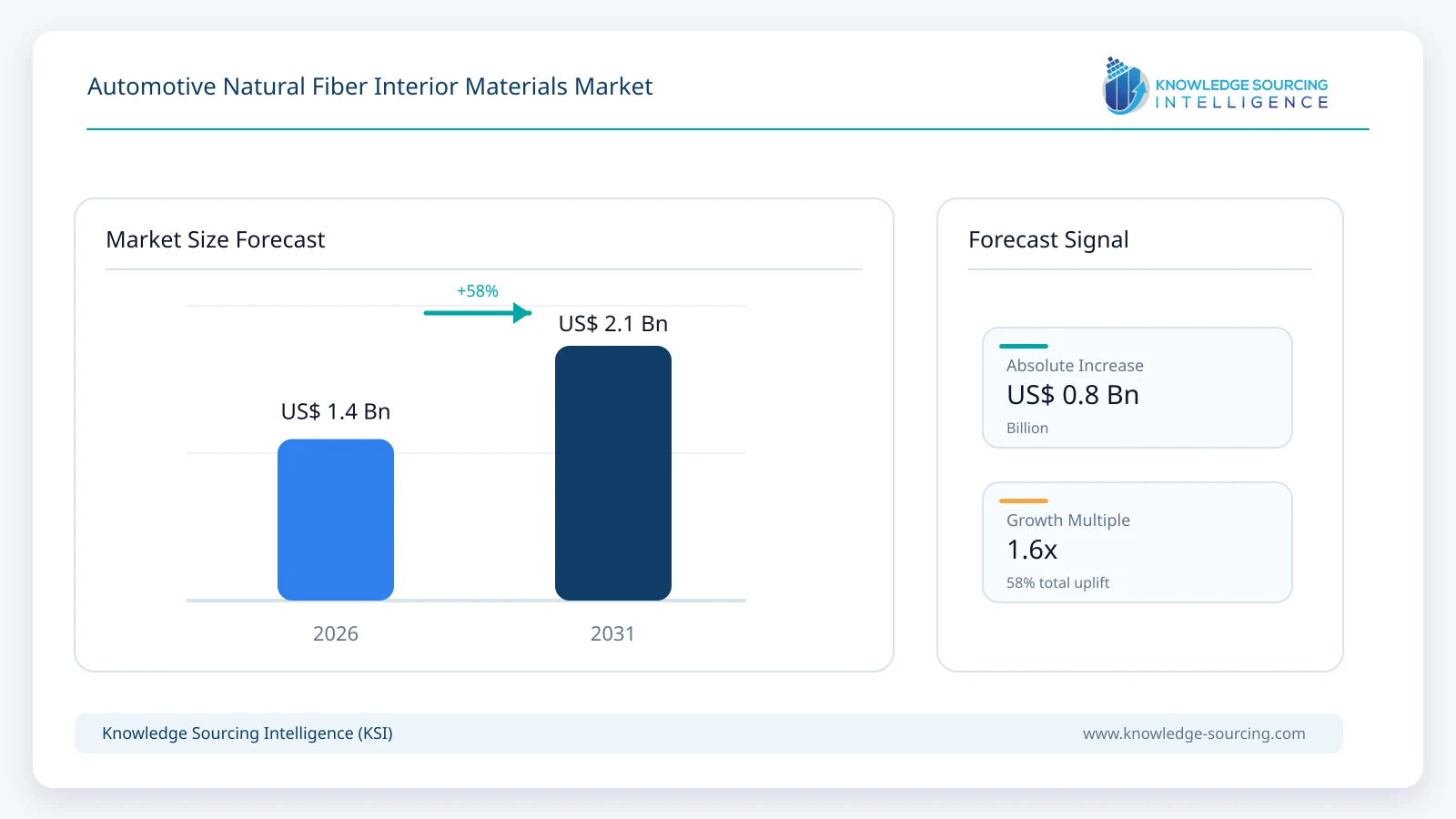
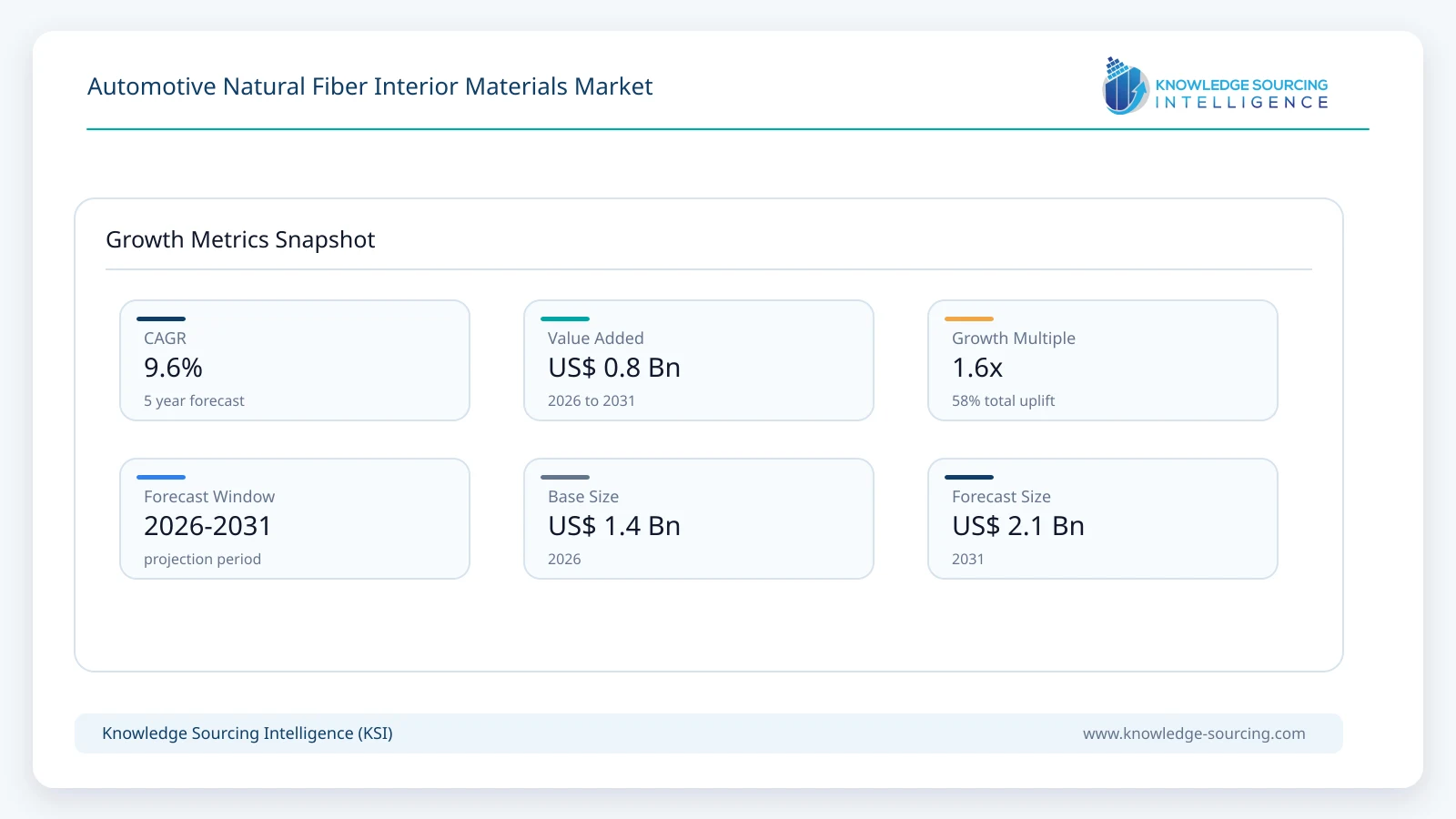
The automotive natural fiber interior materials market is estimated at approximately USD 1.35 billion in 2026 and is projected to reach USD 2.13 billion by 2031, representing a 9.6% CAGR during the forecast period.
Highlights:
- 1Molded natural-fiber polymer composites account for approximately 57% of estimated 2026 revenue, reflecting their established use in door and trim substrates.
- 2Door panels and trim contribute approximately 38% of 2026 demand and remain the most established application group.
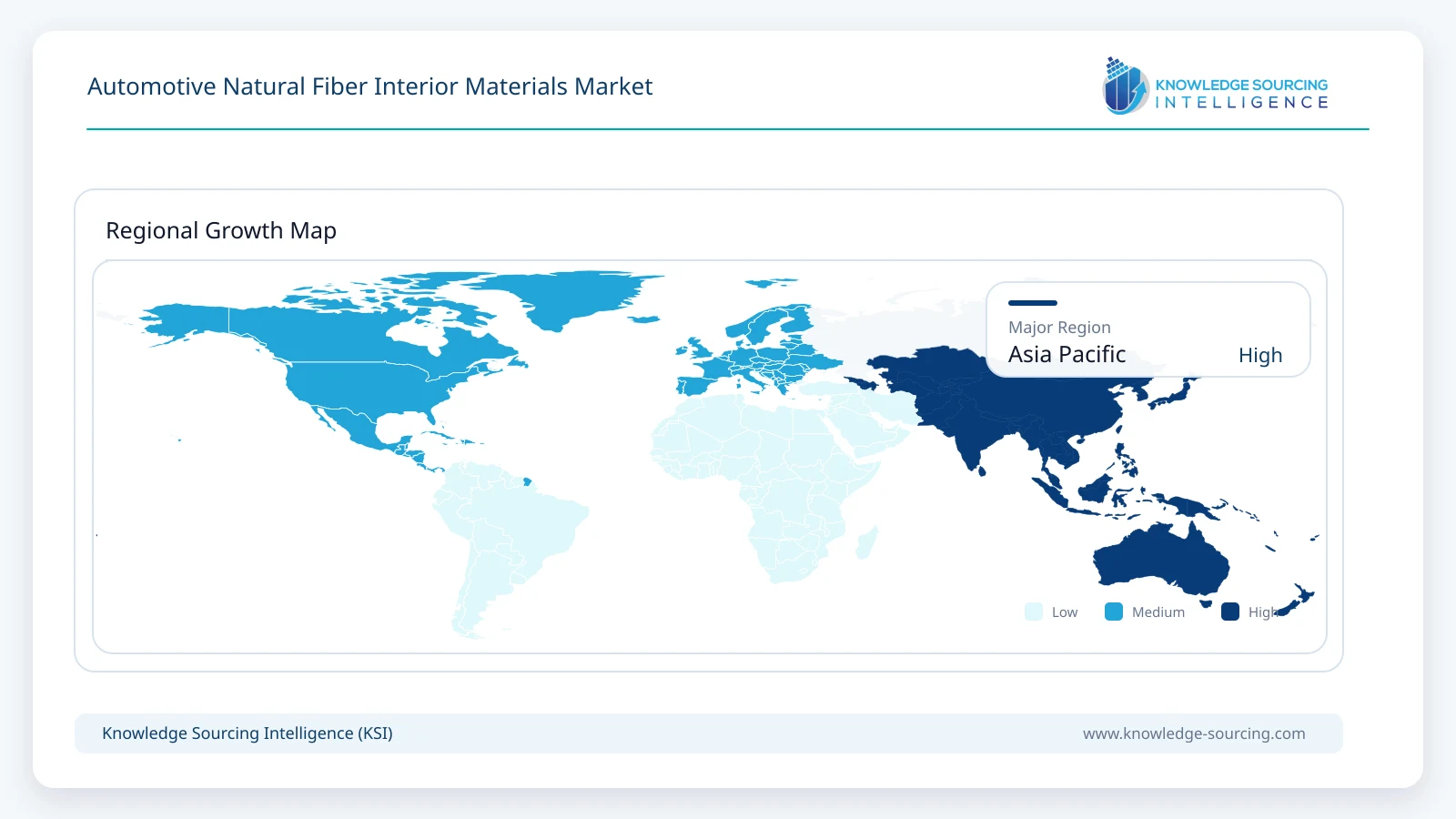
- 3Asia Pacific represents an estimated 43% of 2026 value, reflecting vehicle output and longstanding kenaf and other fiber-reinforced interior production.
- 4Flax and visible-fiber interior surfaces are expected to outgrow mature concealed trim applications as aesthetics and lower-carbon material selection converge.
- 5Revenue growth through 2031 will depend on actual program penetration and the material content of qualifying cabin parts, not vehicle production alone.
The estimate measures supplier-level value of qualifying natural-fiber-containing materials and semi-finished interior substrates, rather than the entire selling price of finished interior modules. It covers plant-derived reinforcement in molded panels, nonwovens, textiles and trim substrates for passenger and commercial vehicles.
Automotive applications already extend beyond isolated concept vehicles. Toyota Boshoku has longstanding kenaf door-trim production, FORVIA has commercialized hemp-containing NAFILean compounds, and BMW is advancing flax-reinforced components from motorsport qualification toward series programs. These applications differ in material price, fiber loading and manufacturing process, requiring a more discriminating assessment than applying a single bio-material adoption factor to global vehicle output.
Market Overview
Plant-based fiber reinforcement has a practical history in automotive interiors because non-load-bearing components can accommodate natural variability in fiber characteristics more readily than safety-critical structural parts. Fibers such as kenaf, hemp and flax offer low density and useful stiffness when combined with polymer binders. Suppliers employ compression molding, injection molding and hybrid nonwoven construction to achieve suitable surface finish, dimensional stability and production repeatability.
Door trim substrates remain a central production application. Toyota Boshoku reports using kenaf in door trim base materials since 2000 and has developed expanded kenaf structures and simultaneous back-injection methods. This indicates that natural fibers are already integrated into automotive quality and tooling systems, although use is specific to approved parts and vehicle programs rather than universal across OEM lineups.
FORVIA’s MATERI’ACT platform provides another commercialization route. Its NAFILean-R formulation includes 20% hemp reinforcement in recycled plastic, while NAFILean Vision extends the material concept into aesthetically visible interior parts. The company states that the broader NAFILean family has appeared in more than 10 million vehicles, supporting evidence of industrial-scale adoption without defining the global size of the entire natural-fiber materials market.
Higher-performance fiber architectures form a smaller but strategically important development area. BMW and Bcomp have validated flax-reinforced composites for visible interior and exterior parts. Their experience suggests potential in dashboards and center consoles as well as premium decorative trim, although the commercial ramp will depend on cost, automated processing and the ability to meet vehicle-specific requirements.
Market Trends
Visible Natural Fibers Are Moving Beyond Concealed Structural Substrates
Natural fibers have historically been embedded below decorative films or textiles, making their presence invisible to occupants. New composite grades instead use characteristic fiber texture as part of the interior design. FORVIA introduced NAFILean Vision in June 2025, combining recycled polymer feedstocks with hemp, wood and other biomass options for visible automotive components.
The shift can improve material differentiation in premium cabins, but producers must deliver consistent coloration, scratch resistance and UV performance. As a result, visible grades are likely to command more material value per part than bulk hidden trim substrates, even if their penetration remains lower.
Flax Reinforcement Is Progressing Toward Vehicle-Series Qualification
BMW stated in August 2025 that natural-fiber composites developed with Bcomp had achieved series-production maturity. Testing identified visible interior and exterior components as favorable applications. The announcement marked progress beyond motorsport, where Bcomp reinforcement is used across vehicle interior and exterior components.
A larger addressable pool depends on converting qualified fiber architecture into economical automotive-grade parts with reliable takt time, tooling yield, resin compatibility and repeatable durability. Near-term adoption should remain concentrated in selected vehicle platforms and higher-value interior applications.
Recycled Polymer and Natural Fiber Hybrids Are Becoming Commercially Attractive
A product can combine recycled polymers and virgin natural reinforcement, permitting simultaneous reduction in fossil-based feedstocks and utilization of secondary plastic streams. NAFILean-R demonstrates this architecture through its recycled-plastic base and 20% hemp fiber. Such hybrids compete against recycled-polymer-only solutions, so engineering performance and cost remain critical purchasing criteria.
Vehicle Circularity Rules Are Reshaping Material Selection
The European Union’s End-of-Life Vehicles Regulation entered into force in August 2026 and introduces stronger design-for-recycling requirements and future recycled-plastic content targets. These targets do not mandate natural-fiber content; however, the broader lifecycle evaluation encourages automakers and suppliers to scrutinize material origin, separability and recovery pathways.
Natural-fiber composites may reduce embedded fossil feedstocks but are not automatically recyclable when they use difficult-to-separate thermoset binders or mixed-material laminates. Compatibility with established recovery streams is therefore as important as renewable content in future program awards.
Segment Analysis
By Fiber Type: Hemp
Hemp represents approximately 27% of estimated 2026 market value, reflecting suitability for polypropylene-reinforced molded substrates and broader interior trim applications. Its combination of reinforcement efficiency and access to established biocomposite processing makes it commercially relevant to Tier 1 cabin suppliers. FORVIA’s NAFILean-R uses hemp in recycled-polymer blends, illustrating the practical integration of plant fibers into mass-production interior materials.
Hemp-containing materials are projected to reach approximately USD 603 million in 2031. Growth depends on broader incorporation in trim platforms, stable fiber preparation and qualification of surface and impact requirements. Competition from kenaf and flax will vary according to regional availability, component geometry and application value.
By Application: Door Panels and Trim
Door panels and interior trim account for an estimated 38% of 2026 market value because they offer substantial substrate area, established compression-molding routes and opportunities to replace higher-density conventional constructions. Materials must provide fastening strength, moisture durability, dimensional stability and clean surface integration with decorative skins or visible fiber layers.
This application is projected to generate around USD 781 million by 2031. Established kenaf substrates at Toyota Boshoku and commercial bio-composite compounds at FORVIA support continuing adoption. Growth is likely to come from further vehicle-platform nominations and higher-value formulations, rather than a sudden replacement of all existing plastics.
By Material Form: Molded Natural-Fiber Polymer Composites
Molded composites represent approximately 57% of 2026 value, combining chopped or mat-form plant fibers with polypropylene or other polymer systems. Compression-molded boards and injection-molded compounds are particularly relevant for door trims, instrument-panel supports and decorative trim parts where repeatable shaping and mechanical performance are required.
Molded natural-fiber polymer composites are projected to reach approximately USD 1.19 billion in 2031. Although visible textile surfaces may expand more rapidly from a smaller base, molded compounds retain the largest revenue contribution due to their wider set of qualified cabin components and the volume of existing production systems.
Market Drivers
Lower Material Weight and Lifecycle Emissions
Natural-fiber materials can reduce part mass or embodied emissions when an appropriate fiber-polymer architecture substitutes for heavier or more carbon-intensive materials. The economic benefit is application-dependent: weight reduction must coexist with comparable mechanical properties, manufacturing yields and vehicle service life. BMW has highlighted lower production-related emissions for flax-based composites in qualified applications, while FORVIA emphasizes lightweight natural-fiber trim solutions.
The strongest commercial cases occur when material substitutions achieve multiple objectives at once: reducing resin quantity, satisfying stiffness targets, retaining OEM assembly compatibility and improving lifecycle reporting. Claims derived from one component cannot be applied unmodified across the full automotive interior.
Supplier-Ready Composites and Existing Automotive Tooling
Natural-fiber adoption is facilitated by ready-to-use compounded materials and compression-molded substrates that can be integrated into established automotive production lines. Toyota Boshoku’s expanded kenaf base and FORVIA’s NAFILean range illustrate how material systems can be supplied with defined processing and performance characteristics.
Repeatable processing matters more than novelty. Program nominations usually require evidence on part consistency, dimensional tolerance, moisture behavior, impact response, flammability and long-term surface performance. Automotive-grade suppliers with process and application engineering capabilities are therefore better positioned to scale commercially.
Automotive OEM Decarbonization and Material Innovation
Automakers are extending environmental assessments beyond tailpipe emissions to manufacturing and purchased materials. Interior parts are attractive candidates because they are widely distributed across vehicle platforms and can be redesigned without changing primary safety structures. This encourages collaboration among fiber processors, compounders, Tier 1 suppliers and design teams at the development stage.
Procurement nonetheless prioritizes delivered part cost and proven qualification. Adoption gains will be uneven across mass-market and premium models, with distinct requirements for hidden substrates, visible trim and acoustic layers.
Scale of Global Automotive Manufacturing
OICA reported 96.4 million vehicles manufactured globally in 2025, up from 92.7 million in 2024. This provides a broad potential production base, but natural-fiber revenue depends on actual part nominations and fiber-containing value per vehicle rather than gross output alone.
Regional vehicle output helps explain supply opportunities, while differences in material sourcing, tooling, OEM specifications and interior content explain why natural-fiber penetration cannot be inferred from production volumes without application-level assumptions.
Acoustic Performance and Multi-Functional Cabin Parts
Natural-fiber composites can combine moderate stiffness, low mass and sound absorption within door linings, parcel shelves, headliners and luggage-compartment trims. FlexForm identifies acoustic absorption and vibration reduction among the characteristics of its natural-fiber composites, while its automotive applications include multiple cabin substrate types. Such multi-functional parts may reduce additional insulation or reinforcement requirements in selected designs, although each vehicle program must validate its acoustic performance.
Market Restraints
Moisture Uptake and Dimensional Variability
Plant fibers can absorb moisture, affecting swelling, bonding and dimensional control in composite structures. Variations in crop conditions, fiber length and surface treatment also create differences in production behavior. Tight automotive tolerances necessitate controlled drying, fiber specifications, coupling agents and process validation.
The additional preparation and qualification steps can narrow the cost advantage of relatively inexpensive agricultural feedstocks, especially for complex visible surfaces.
Fire, Odor and Long-Term Interior Performance Requirements
Automotive interior materials must satisfy flammability, fogging, odor, abrasion and thermal-aging specifications across different markets and OEMs. Natural-fiber composites are evaluated as complete formulations, not on the properties of the plant fibers alone. Resin chemistry, additives, coatings and fiber proportion influence compliance.
Meeting these requirements can increase additive loading or processing costs. Buyers also need evidence that interior materials maintain appearance and fit over prolonged humidity and temperature cycling.
Competition from Established Recycled and Conventional Polymers
Recycled polypropylene and polyester, along with conventional filled thermoplastics, benefit from broad availability and mature processing economics. Automotive suppliers can achieve lower product carbon footprints through high-recycled-content designs without adopting natural fiber reinforcement. This is particularly relevant where the performance uplift from natural fibers is marginal.
Natural-fiber solutions therefore need to demonstrate cost-competitive parts, mechanical or aesthetic differentiation, or a verified lifecycle advantage for the specific application.
Complex End-of-Life Recycling of Multi-Material Parts
Blending fibers with polymers can create durable lightweight components but may complicate separation and repeated processing, especially with thermoset matrices or composite skins. Natural origin does not by itself establish biodegradability or recyclability of the finished automotive part.
Design for disassembly, verified recycling routes and transparent material declarations will become increasingly relevant as automakers prepare for stricter vehicle circularity requirements.
Agricultural Supply and Price Consistency
Fiber supply may vary with weather, cultivation economics, regional harvesting systems and textile-sector demand. Industrial buyers need predictable length, moisture, cleanliness and mechanical properties at volumes suitable for multi-year vehicle programs.
Processors that secure traceable sourcing and standardized grading can reduce production risk, but these systems require investments that may increase input cost compared with established synthetic reinforcements.
Regional Outlook
Asia Pacific
Asia Pacific is the largest estimated regional market, supported by the region’s vehicle production scale, longstanding plant-fiber interior applications and the presence of automotive component manufacturers. OICA recorded approximately 59.2 million vehicles produced in Asia Pacific in 2025, more than 61% of global output, although this production share is not equivalent to the regional share of natural-fiber interior materials.
The market is projected to reach USD 935 million in 2031. Toyota Boshoku’s kenaf developments illustrate established technology capabilities, while China, Japan, India, South Korea and Southeast Asia provide differentiated automotive manufacturing and material sourcing opportunities. Regional growth will depend on how extensively qualifying fiber substrates are specified across vehicle programs.
Europe
Europe is a major development and commercialization center for natural-fiber composites, supported by automotive sustainability targets, specialty flax and hemp supply networks and several advanced material developers. FORVIA’s MATERI’ACT activities and BMW’s collaboration with Bcomp highlight investment in both mass-production bio-composite compounds and higher-performance visible-fiber interior structures.
Europe is projected at approximately USD 729 million in 2031. The region’s regulatory emphasis on circular design provides an indirect incentive for lower-impact material innovations, although recycled-content requirements apply to recycled materials and should not be presented as a mandate for natural-fiber use.
Competitive Landscape
Competition spans upstream fiber cultivation and processing, natural-fiber composite materials, automotive-grade compounds and Tier 1 interior modules. FORVIA and Toyota Boshoku have direct relevance through established automotive interior material systems. Bcomp focuses on higher-performance flax reinforcement, while Autoneum offers interior trim composites incorporating selectable natural fibers and recycled feedstocks.
FORVIA’s differentiation includes material formulation and integration with automotive interior design, especially through NAFILean materials. Toyota Boshoku benefits from extended kenaf processing experience and production application. Bcomp competes in architectural reinforcement that enables visibly distinctive lightweight parts, whereas suppliers of molded and nonwoven materials compete on application economics, processing repeatability and OEM qualification.
Company-specific market shares cannot be derived reliably from published disclosures for this narrow material category. Supplier comparisons therefore distinguish proven series programs, commercial material manufacture and application-specific development rather than assigning unsupported shares or rankings.
FlexForm and Procotex supply natural-fiber composite mats and engineered fiber blends, while Eco-Technilin manufactures natural-fiber reinforcement products and reports annual capacity exceeding 13,000 tonnes across its sites. SGL Carbon participates in higher-performance flax prepreg development. Different levels of production maturity and the absence of disclosed natural-fiber-specific sales make supplier revenue rankings unreliable.
Recent Developments
August 2026: The European Union’s revised End-of-Life Vehicles Regulation entered into force, strengthening the framework for circular vehicle design. It is not a mandate for natural-fiber incorporation, and most requirements will apply from 2028.
January 2026: FORVIA announced an interior-components program for a major European automaker’s North American operations, including natural-fiber door panels. The award signals future program demand rather than current shipment volumes.
October 2025: FORVIA said the hemp-based NAFILean family had been installed in more than six million Stellantis vehicles across ten programs. The cumulative adoption demonstrates production maturity in selected interior components.
August 2025: BMW Group reported that natural-fiber composites developed with Bcomp had reached series-production maturity, including suitability for visible vehicle interior components.
June 2025: FORVIA MATERI’ACT launched NAFILean Vision for visible automotive surfaces, extending its hemp-reinforced recycled-polymer work to decorative finishes.
Market Outlook
Natural-fiber interior materials are expected to extend their commercial presence through a combination of conventional molded trim substrates and more differentiated decorative fiber composites. Door panels remain the principal revenue base, while applications offering visible material identity or lightweight high-stiffness components can grow more quickly from a smaller starting point.
Asia Pacific should remain the largest regional source of demand, reflecting manufacturing scale and component supply. Europe will retain strategic importance for advanced material engineering and low-carbon interior programs. Across both regions, purchasing decisions will depend on proven part-level cost and durability rather than sustainability claims alone.
The most competitive materials will integrate well with existing processing and support repeatable product quality. Crop traceability, moisture control, fiber-matrix bonding, certification and end-of-life options will determine which solutions scale beyond a limited number of vehicle programs.
Automotive Natural Fiber Interior Materials Market Scope
| Report Metric | Details |
|---|---|
| Total Market Size in 2026 | USD 1.35 billion |
| Total Market Size in 2031 | USD 2.13 billion |
| Forecast Unit | Billion |
| Growth Rate | 9.6% |
| Study Period | 2021 to 2031 |
| Historical Data | 2021 to 2024 |
| Base Year | 2025 |
| Forecast Period | 2026 – 2031 |
| Segmentation | Fiber Type, Application, Material Form, Vehicle Type, Geography |
| Companies |
|
Market Segmentation
By Fiber Type
Hemp
Kenaf
Flax
Jute
Other Natural Fibers
By Application
Door Panels and Trim
Dashboards and Instrument Panels
Seat Backs and Interior Seat Structures
Headliners and Pillar Trims
Parcel Shelves and Luggage Trim
Other Interior and Acoustic Components
By Material Form
Molded Natural-Fiber Polymer Composites
Nonwoven and Felt-Based Materials
Visible Fibers, Textiles and Decorative Surfaces
By Vehicle Type
Passenger Vehicles
Commercial Vehicles
By Geography
North America
United States
Canada
Mexico
South America
Brazil
Argentina
Others
Europe
Germany
France
United Kingdom
Italy
Spain
Others
Middle East and Africa
Saudi Arabia
UAE
South Africa
Others
Asia Pacific
China
Japan
India
South Korea
Thailand
Indonesia
Others
Table of Contents
1. EXECUTIVE SUMMARY
1.1. Key Findings
1.2. Automotive Natural Fiber Interior Materials Market Size and Forecast, 2026–2031
1.3. Fiber Type, Application, Material Form and Vehicle Type Outlook
1.4. Regional Opportunity Summary
2. MARKET SNAPSHOT
2.1. Market Overview
2.2. Market Definition
2.3. Scope of the Study
2.4. Market Segmentation
3. BUSINESS LANDSCAPE
3.1. Market Drivers
3.1.1. Lightweighting and Lifecycle Emission Reduction
3.1.2. Supplier-Ready Composites and Automotive Processing Compatibility
3.1.3. Automotive OEM Decarbonization and Material Innovation
3.1.4. Global Automotive Manufacturing and Platform Adoption
3.1.5. Acoustic Performance and Multi-Functional Cabin Parts
3.2. Market Restraints
3.2.1. Moisture Uptake and Dimensional Variability
3.2.2. Fire, Odor and Long-Term Interior Performance Requirements
3.2.3. Competition from Recycled and Conventional Polymers
3.2.4. End-of-Life Recycling of Multi-Material Components
3.2.5. Agricultural Fiber Supply and Price Consistency
3.3. Market Opportunities
3.4. Porter’s Five Forces Analysis
3.5. Industry Value Chain Analysis
3.6. Policies and Regulations
3.7. Strategic Recommendations
4. TECHNOLOGICAL OUTLOOK
4.1. Natural-Fiber-Reinforced Thermoplastic Compounds
4.2. Compression-Molded Fiber Mats and Interior Substrates
4.3. Injection-Molded Natural-Fiber Compounds
4.4. Nonwoven, Felt and Acoustic Fiber Systems
4.5. Visible Flax and Hemp Composite Surfaces
4.6. Fiber Treatments and Coupling Agents
4.7. Recycling and End-of-Life Processing
5. AUTOMOTIVE NATURAL FIBER INTERIOR MATERIALS MARKET BY FIBER TYPE
5.1. Introduction
5.2. Hemp
5.3. Kenaf
5.4. Flax
5.5. Jute
5.6. Other Natural Fibers
6. AUTOMOTIVE NATURAL FIBER INTERIOR MATERIALS MARKET BY APPLICATION
6.1. Introduction
6.2. Door Panels and Trim
6.3. Dashboards and Instrument Panels
6.4. Seat Backs and Interior Seat Structures
6.5. Headliners and Pillar Trims
6.6. Parcel Shelves and Luggage Trim
6.7. Other Interior and Acoustic Components
7. AUTOMOTIVE NATURAL FIBER INTERIOR MATERIALS MARKET BY MATERIAL FORM
7.1. Introduction
7.2. Molded Natural-Fiber Polymer Composites
7.3. Nonwoven and Felt-Based Materials
7.4. Visible Fibers, Textiles and Decorative Surfaces
8. AUTOMOTIVE NATURAL FIBER INTERIOR MATERIALS MARKET BY VEHICLE TYPE
8.1. Introduction
8.2. Passenger Vehicles
8.3. Commercial Vehicles
9. AUTOMOTIVE NATURAL FIBER INTERIOR MATERIALS MARKET BY GEOGRAPHY
9.1. North America
9.1.1. United States
9.1.2. Canada
9.1.3. Mexico
9.2. South America
9.2.1. Brazil
9.2.2. Argentina
9.2.3. Others
9.3. Europe
9.3.1. Germany
9.3.2. France
9.3.3. United Kingdom
9.3.4. Italy
9.3.5. Spain
9.3.6. Others
9.4. Middle East and Africa
9.4.1. Saudi Arabia
9.4.2. UAE
9.4.3. South Africa
9.4.4. Others
9.5. Asia Pacific
9.5.1. China
9.5.2. Japan
9.5.3. India
9.5.4. South Korea
9.5.5. Thailand
9.5.6. Indonesia
9.5.7. Others
10. COMPETITIVE ENVIRONMENT AND ANALYSIS
10.1. Major Players and Strategy Analysis
10.2. Market Share Analysis
10.3. Mergers, Acquisitions, Agreements and Collaborations
10.4. Competitive Dashboard
11. COMPANY PROFILES
11.1. FORVIA SE
11.2. Toyota Boshoku Corporation
11.3. FlexForm Technologies LLC
11.4. Bcomp Ltd.
11.5. Procotex Corporation SA
11.6. Autoneum Holding AG
11.7. Eco-Technilin
11.8. SGL Carbon SE
11.9. Cobra Advanced Composites Co., Ltd.
11.10. TECNARO GmbH
11.11. UPM-Kymmene Corporation
12. APPENDIX
12.1. Currency
12.2. Assumptions
12.3. Base and Forecast Years Timeline
12.4. Key Benefits for Stakeholders
12.5. Research Methodology
12.6. Abbreviations
Navigate
Trusted by the world's leading organizations











