
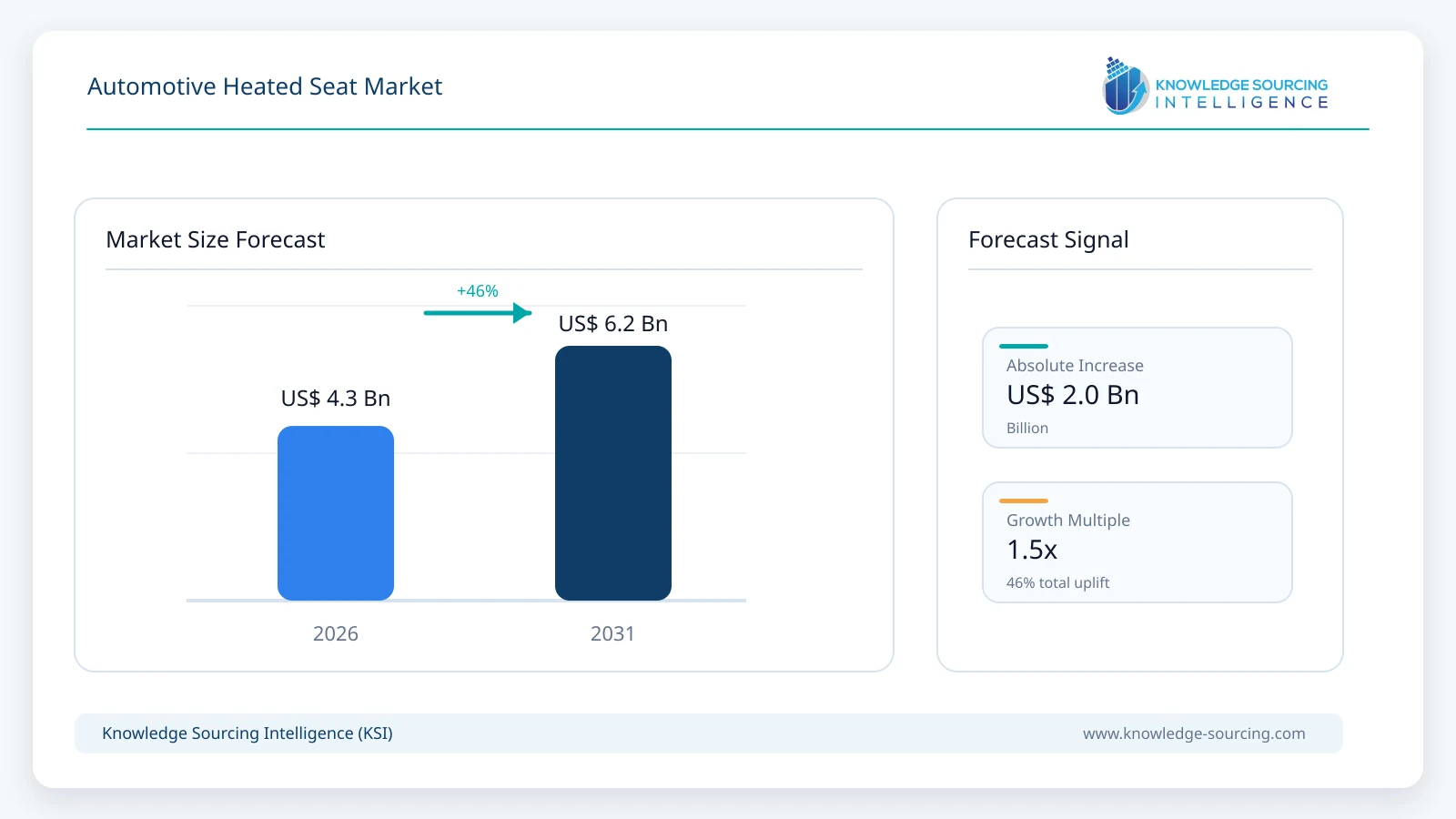
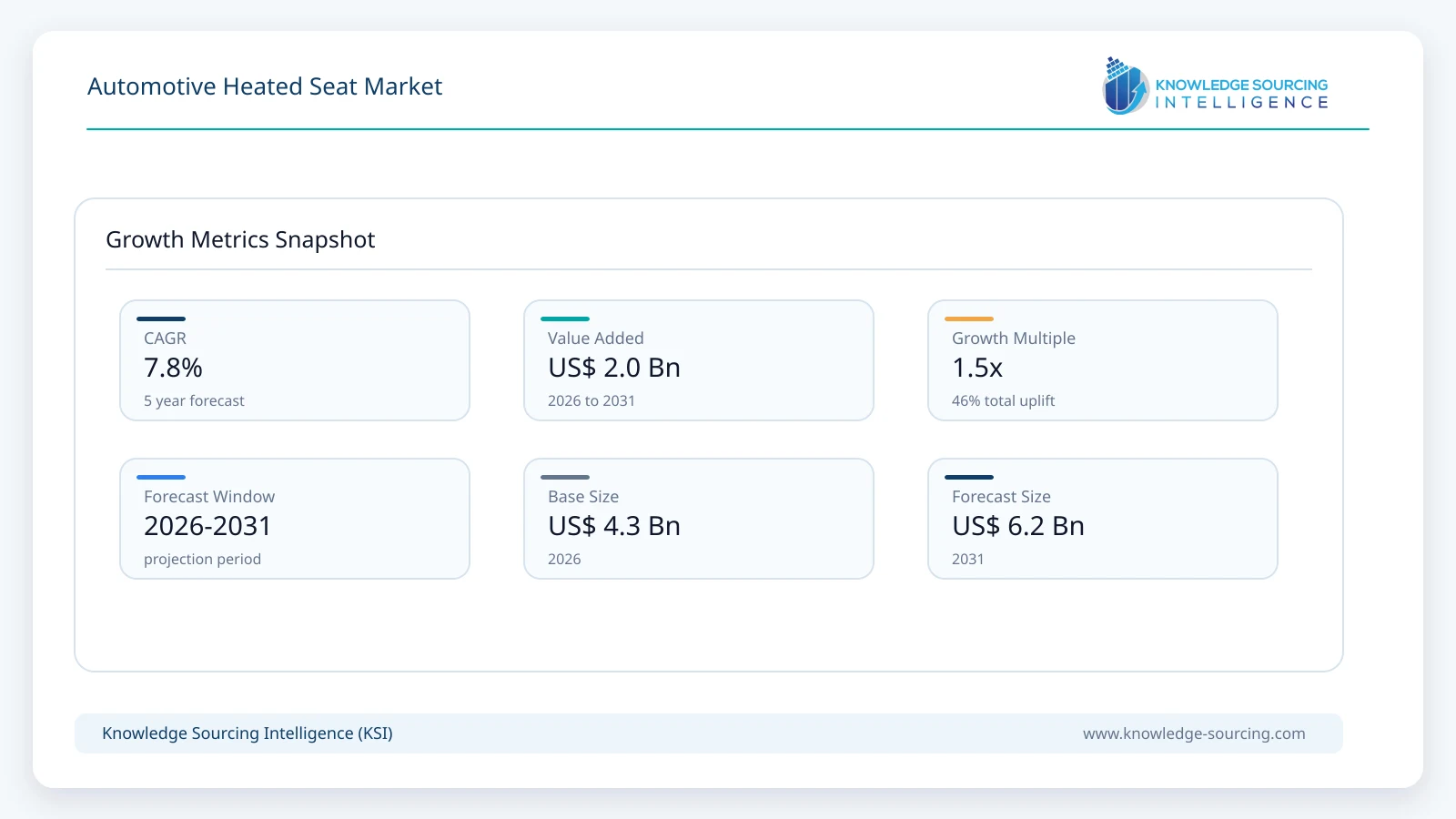
The automotive heated seat market is forecast to grow at a CAGR of 7.8%, reaching approximately USD 6.20 billion in 2031 from USD 4.25 billion in 2026.
Highlights:
- 1Conventional resistive wire heating systems account for approximately 62% of global market value in 2026, supported by broad OEM acceptance, durability and cost efficiency.
- 2Front-row applications represent approximately 79% of market value in 2026, although second-row heated-seat penetration continues to rise in SUVs, MPVs and premium vehicles.
- 3Passenger cars account for approximately 95% of global market value in 2026, led by sedans, SUVs, crossovers, MPVs and premium electric vehicles.
- 4Internal-combustion vehicles represent approximately 58% of market value in 2026, while battery electric vehicles are gaining share as localized heating supports cabin-energy efficiency.
- 5OEM installations account for approximately 98% of global market value in 2026 because seat heating is predominantly integrated during seat and vehicle assembly.
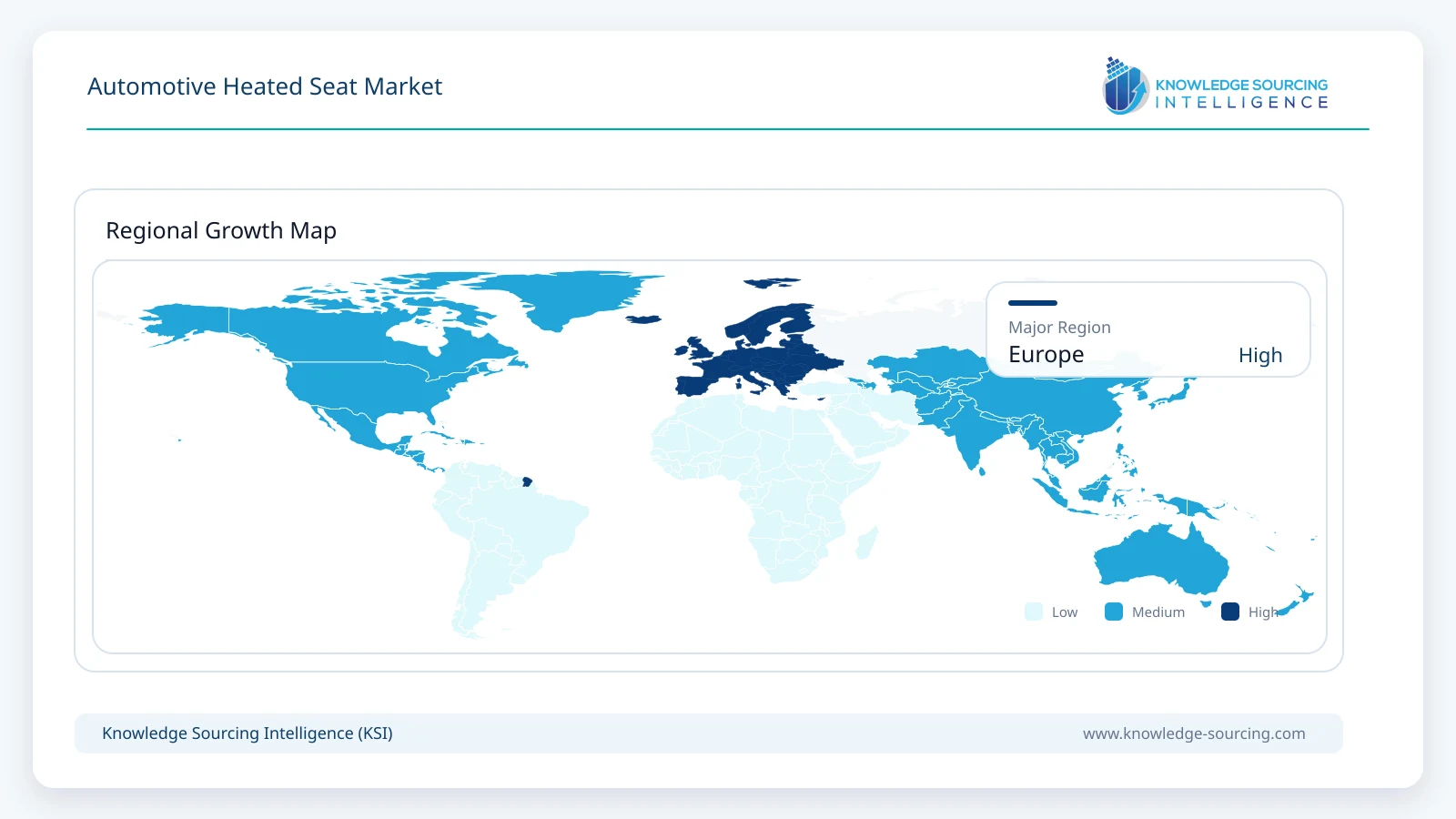
- 6Europe represents approximately 34% of global market value in 2026, supported by cold-weather demand, high feature penetration and strong premium-vehicle production.
Demand is being supported by broader availability of heated seats across mainstream trims, increasing installation in second-row seating and growing emphasis on localized thermal comfort in battery electric vehicles.
Modern systems typically use resistive wire, carbon-based or flexible conductive heating elements integrated into the seat cushion and backrest, combined with electronic temperature control and multiple user-selectable heat levels. Newer architectures add zonal heating, rapid power-boost modes and integration with ventilation, lumbar, massage and vehicle-level climate-control systems.
Gentherm remains a major technology supplier through its CCS Heat portfolio, including wire and carbon heating solutions, zonal heating and rapid warm-up functions. Lear is expanding modular thermal-comfort systems through ComfortFlex and ComfortMax Seat, while Toyota Boshoku is developing direct occupant thermal-comfort seating that combines seat heating with ventilation and pneumatic support to improve both comfort and vehicle energy efficiency.
Market Overview
Heated-seat systems use embedded electrical elements to raise the surface temperature of the seat cushion and backrest. The most common architectures use resistive wire or printed/flexible conductive materials positioned beneath the trim cover and above or within the foam layer. Electronic control modules regulate temperature and protect the system from overheating.
The technology has become increasingly sophisticated. Gentherm's CCS Heat platform uses zonal heating and power-boost functions to deliver faster warm-up while reducing energy use. Lear's thermal-comfort strategy integrates heating with ventilation, pneumatic support and modular trim-cover solutions, allowing multiple comfort features to share common architecture.
Toyota Boshoku is also advancing direct occupant heating as part of a wider thermal-comfort strategy. Its Thermal Comfort Seat combines a seat heater with ventilation, neck airflow and pneumatic support, reflecting the shift from whole-cabin heating toward localized occupant conditioning.
The electric-vehicle transition is increasing the strategic importance of seat heating because direct-contact heating can reduce reliance on high-load cabin HVAC in cold conditions. This improves perceived warmth quickly and can support better energy management during winter operation.
Market Trends
Zonal Heating Is Increasing Energy Efficiency
Seat-heating systems are becoming more targeted, with suppliers dividing the seat into independently controlled zones to concentrate heat where occupants perceive it most effectively. Gentherm's CCS Heat combines zonal heating with rapid power-boost functionality to shorten warm-up time and reduce unnecessary energy consumption.
Zonal control is particularly relevant in electric vehicles, where every reduction in auxiliary heating demand can help preserve driving range in cold weather.
Seat Heating Is Being Integrated into Modular Thermal Systems
Thermal comfort is shifting from separate heater, ventilation and lumbar components toward integrated modules. Lear's ComfortFlex platform combines multiple comfort functions in a common design, reducing parts, mass and assembly complexity while allowing OEMs to configure different feature combinations.
This integration supports faster program launches and makes it easier to offer heated seats across several trim levels without redesigning the entire seat system.
Rear-Seat Heating Is Moving Down-Market
Heated rear seats were historically concentrated in luxury sedans and premium SUVs, but fitment is widening across upper-mid and mainstream vehicles. Larger SUVs and MPVs increasingly offer second-row heating as part of winter, comfort or family-oriented packages.
The trend is raising thermal content per vehicle and expanding the market beyond the traditional driver and front-passenger applications.
Flexible Heating Elements Are Supporting Thinner Seat Designs
Carbon-based and printed conductive elements offer greater flexibility in element shape, heat distribution and integration with thinner foam and trim architectures. These technologies can support more uniform surface temperatures and easier packaging around ventilation perforations or complex seat contours.
As seats become thinner and more multifunctional, element flexibility and low profile are becoming increasingly important design criteria.
Electric Vehicles Are Increasing the Value of Localized Heating
Electric vehicles are accelerating interest in direct occupant thermal comfort because resistive cabin heating can materially increase winter energy consumption. Seat heating warms occupants directly and can reduce the need to raise the temperature of the entire cabin.
The IEA reported that electric cars accounted for one-quarter of global car sales in 2025 and expects their share to continue increasing, expanding the vehicle base for efficient localized heating.
Segment Analysis
By Heating Technology: Conventional Resistive Wire
Conventional resistive wire heating systems are projected to reach approximately USD 3.53 billion by 2031. Their continued leadership is supported by low cost, proven durability, broad manufacturing capacity and compatibility with a wide range of seat constructions. Improvements in wire routing, electronic control and zonal design are sustaining their relevance even as flexible conductive technologies expand.
By Seat Position: Front Row
Front-row heated-seat applications are projected to reach approximately USD 4.65 billion by 2031. Driver and front-passenger heating remains the most common configuration because these seats receive premium comfort features earlier than rear seating and are used across both mainstream and luxury vehicle segments.
By Vehicle Type: Passenger Cars
Passenger cars are projected to generate approximately USD 5.83 billion of heated-seat market value by 2031. Sedans, SUVs, crossovers and MPVs provide the largest installed base, with feature penetration continuing to increase across mainstream trims as heating becomes a widely expected comfort feature in colder markets.
By Propulsion: Battery Electric Vehicles
Battery electric vehicles are projected to generate approximately USD 2.23 billion of heated-seat market value by 2031. The value of localized heating is increasing because direct-contact warmth can improve occupant comfort with lower energy demand than whole-cabin heating, while EV makers continue to compete heavily on interior comfort.
By Sales Channel: OEM
OEM installations are projected to generate approximately USD 6.08 billion by 2031. Seat heating is typically integrated during seat assembly because heater mats, wiring, temperature sensing and control electronics must be packaged below the trim and validated with the complete seat structure.
By Geography: Europe
Europe is projected to reach approximately USD 1.98 billion by 2031. The region benefits from high heated-seat penetration, cold-weather demand, premium-vehicle production and strong fitment across German, Nordic and other northern European markets. Electrification is further increasing interest in energy-efficient localized heating.
Market Drivers
Broader Fitment Across Mid-Range Vehicles
Heated seats are increasingly available outside premium trims as component costs decline and consumers expect higher comfort content. This is increasing penetration across compact SUVs, crossovers and mainstream passenger cars.
Growth of Rear-Seat Comfort Features
Second-row heating is becoming more common in SUVs, MPVs and upper-mid vehicles. Wider rear-seat adoption increases thermal content per vehicle and supports market growth even in mature front-seat applications.
Electric-Vehicle Energy-Efficiency Requirements
Localized seat heating can provide rapid occupant warmth with lower total energy use than heating the complete cabin. This strengthens the business case for heated seats in battery electric vehicles, particularly in cold climates.
Integration with Multi-Function Thermal Comfort
Seat heating is increasingly packaged with ventilation, massage, lumbar support and electronic control. Integrated architectures allow automakers to offer differentiated comfort packages while sharing components and control systems.
Consumer Expectation for Rapid Thermal Comfort
Drivers increasingly expect seats to warm quickly after vehicle start. Faster warm-up, multiple heat levels and automatic temperature regulation are becoming important product attributes, especially in colder markets.
Market Restraints
High Penetration in Mature Markets
Front-seat heating is already widely available in Europe and North America, limiting incremental unit growth in some vehicle classes. Future expansion therefore depends more heavily on rear-seat fitment, emerging markets and higher content per system.
Cost Sensitivity in Entry-Level Vehicles
Although seat heaters are less expensive than many other comfort technologies, they still add heating elements, wiring, switches, controllers and validation cost. Entry-level models in warmer climates often omit the feature.
Thermal Durability and Safety Requirements
Heating elements must maintain consistent performance through repeated flexing, occupant loading and long vehicle life cycles. Localized hot spots, wiring damage or control failures require robust temperature sensing and protection.
Competition from Whole-Seat Climate Systems
In premium vehicles, basic heating is increasingly bundled into broader heating-and-ventilation or active climate systems. This can reduce the visibility of stand-alone heated-seat systems as a separate feature category.
Limited Demand in Hot-Climate Markets
Vehicle markets with persistently high ambient temperatures place greater emphasis on ventilation and cooling than heating. This constrains heated-seat penetration in parts of Southeast Asia, the Middle East and other warm-climate regions.
Regional Outlook
Europe
Europe is the largest regional market and is expected to remain a major demand centre through 2031. Heated seats have broad penetration across premium and mainstream vehicles in northern and central Europe, while German OEMs have long used multi-level heating as part of comfort packages across sedans, SUVs and electric vehicles.
The region's rapid electrification is increasing the importance of direct occupant heating. European EV sales increased strongly in 2025 and continued to expand in 2026, reinforcing demand for efficient thermal-comfort features that can reduce dependence on cabin HVAC.
Asia Pacific
Asia Pacific is expected to post the strongest expansion among major regions through 2031. China combines the world's largest vehicle-production base with rapid EV adoption and increasing comfort-feature penetration, while Japan and South Korea have established thermal-comfort engineering capabilities.
Regional suppliers are also developing more integrated heating systems. Toyota Boshoku's Thermal Comfort Seat combines whole-body seat heating with ventilation and pneumatic support, while Chinese and Korean OEMs are adding heated front and rear seats to a wider range of electric SUVs and MPVs.
Competitive Landscape
The automotive heated-seat market includes specialist thermal-comfort suppliers and complete-seat manufacturers with in-house or integrated heater capabilities. Gentherm, Lear, Toyota Boshoku, Adient, FORVIA and Hyundai Transys are directly involved in automotive seating or thermal-comfort systems that include heated-seat functionality.
Gentherm has a strong specialist position through CCS Heat, climate-controlled seats and associated electronics, with annual Climate Control Seats revenue approaching USD 0.8 billion in 2025. Lear is expanding modular thermal systems through ComfortFlex, ComfortMax Seat and dedicated seat-heat programs.
Toyota Boshoku is developing human-centered thermal seating that combines heater, ventilation and pneumatic functions. Adient, FORVIA and Hyundai Transys integrate heating within complete seating systems and premium comfort packages, supporting factory-level deployment across multiple vehicle platforms.
Recent Developments
July 2026: Lear reported new and conquest seating awards with Audi covering complete seats, ComfortFlex and FlexAir systems in Europe and North America, extending adoption of modular thermal-comfort technologies.
May 2026: Gentherm was named a 2025 General Motors Supplier of the Year, recognizing its continued role as a thermal and comfort technology supplier to GM.
May 2026: Lear announced new ComfortFlex awards with Audi and BMW and a ComfortMax Seat award with Geely, expanding modular seat-comfort deployment across Europe and China.
February 2026: Gentherm reported record 2025 annual revenue of USD 1.5 billion and USD 485 million of automotive new-business awards in the fourth quarter, supporting continued investment in thermal and pneumatic comfort.
December 2025: Gentherm detailed its latest CCS Heat architecture, including zonal heating, rapid power-boost warm-up and both wire and carbon heating solutions.
October 2025: Lear reported four new ComfortFlex program awards with Hyundai, BMW, Leapmotor and Seres, increasing the number of modular thermal-comfort applications across multiple regions.
May 2025: Toyota Boshoku showcased its Thermal Comfort Seat at Automotive Engineering Exposition 2025, combining whole-body seat heating, ventilation, neck airflow and pneumatic support to improve comfort and energy efficiency.
Market Outlook
The automotive heated-seat market is expected to expand steadily through 2031 as the feature becomes more common across mainstream vehicles and additional seat rows. The mature front-seat segment will continue to provide the largest revenue base, while rear-seat heating and integrated thermal-comfort packages provide the strongest incremental opportunities.
Technology development will increasingly focus on faster warm-up, better zonal control, thinner and more flexible heating elements, lower energy consumption and closer integration with ventilation and vehicle-level thermal management. EV adoption will strengthen the value of efficient direct occupant heating, particularly in cold-weather markets.
Europe is expected to remain the largest regional market, while Asia Pacific provides the strongest expansion opportunity. Competitive advantage will depend on heating uniformity, durability, low power consumption, packaging flexibility, electronics integration and the ability to scale common heater architectures across multiple seat and vehicle platforms.
Automotive Heated Seat Market Scope
| Report Metric | Details |
|---|---|
| Total Market Size in 2026 | USD 4.25 billion |
| Total Market Size in 2031 | USD 6.20 billion |
| Forecast Unit | Billion |
| Growth Rate | 7.8% |
| Study Period | 2021 to 2031 |
| Historical Data | 2021 to 2024 |
| Base Year | 2025 |
| Forecast Period | 2026 – 2031 |
| Segmentation | Heating Technology, Seat Position, Vehicle Type, Propulsion, Sales Channel, Geography |
| Companies |
|
Market Segmentation
By Heating Technology
Conventional Resistive Wire
Carbon and Flexible Conductive Elements
Integrated Zonal and Smart Heating
By Seat Position
Front Row
Rear and Second Row
By Vehicle Type
Passenger Cars
Light Commercial Vehicles
Medium and Heavy Commercial Vehicles
By Propulsion
Internal Combustion Engine Vehicles
Hybrid Electric Vehicles
Battery Electric Vehicles
By Sales Channel
OEM
Aftermarket
By Geography
North America
United States
Canada
Mexico
South America
Brazil
Argentina
Others
Europe
Germany
United Kingdom
France
Italy
Spain
Nordic Countries
Others
Middle East and Africa
Saudi Arabia
UAE
South Africa
Others
Asia Pacific
China
Japan
South Korea
India
Indonesia
Thailand
Others
Table of Contents
1. INTRODUCTION
1.1. Market Overview
1.2. Market Definition
1.3. Scope of the Study
1.4. Market Segmentation
1.5. Currency
1.6. Assumptions
1.7. Base and Forecast Years
1.8. Key Benefits to Stakeholders
2. RESEARCH METHODOLOGY
2.1. Research Design
2.2. Secondary Research
2.3. Primary Research
2.4. Market Estimation
2.5. Segment Modelling
2.6. Data Triangulation and Validation
3. EXECUTIVE SUMMARY
3.1. Key Findings
3.2. Automotive Heated Seat Market Size, 2026-2031
3.3. Heating Technology Outlook
3.4. Seat Position Outlook
3.5. Vehicle Type Outlook
3.6. Propulsion Outlook
3.7. Sales Channel Outlook
3.8. Regional Opportunity Summary
4. MARKET DYNAMICS
4.1. Market Drivers
4.1.1. Broader Fitment Across Mid-Range Vehicles
4.1.2. Growth of Rear-Seat Comfort Features
4.1.3. Electric-Vehicle Energy-Efficiency Requirements
4.1.4. Integration with Multi-Function Thermal Comfort
4.1.5. Consumer Expectation for Rapid Thermal Comfort
4.2. Market Restraints
4.2.1. High Penetration in Mature Markets
4.2.2. Cost Sensitivity in Entry-Level Vehicles
4.2.3. Thermal Durability and Safety Requirements
4.2.4. Competition from Whole-Seat Climate Systems
4.2.5. Limited Demand in Hot-Climate Markets
4.3. Market Opportunities
4.4. Porter's Five Forces Analysis
4.5. Industry Value Chain Analysis
4.6. Heated Seat System Economics
4.7. Safety and Electrical Requirements
5. TECHNOLOGY OUTLOOK
5.1. Resistive Wire Heating
5.2. Carbon and Flexible Conductive Heating
5.3. Printed Heating Elements
5.4. Zonal Heating
5.5. Rapid Warm-Up and Power-Boost Control
5.6. Temperature Sensors and Electronic Controllers
5.7. Integration with Seat Ventilation
5.8. Integration with Lumbar and Massage
5.9. Microclimate and Vehicle Thermal Management Integration
6. AUTOMOTIVE HEATED SEAT MARKET BY HEATING TECHNOLOGY
6.1. Introduction
6.2. Conventional Resistive Wire
6.3. Carbon and Flexible Conductive Elements
6.4. Integrated Zonal and Smart Heating
7. AUTOMOTIVE HEATED SEAT MARKET BY SEAT POSITION
7.1. Introduction
7.2. Front Row
7.3. Rear and Second Row
8. AUTOMOTIVE HEATED SEAT MARKET BY VEHICLE TYPE
8.1. Introduction
8.2. Passenger Cars
8.3. Light Commercial Vehicles
8.4. Medium and Heavy Commercial Vehicles
9. AUTOMOTIVE HEATED SEAT MARKET BY PROPULSION
9.1. Introduction
9.2. Internal Combustion Engine Vehicles
9.3. Hybrid Electric Vehicles
9.4. Battery Electric Vehicles
10. AUTOMOTIVE HEATED SEAT MARKET BY SALES CHANNEL
10.1. Introduction
10.2. OEM
10.3. Aftermarket
11. AUTOMOTIVE HEATED SEAT MARKET BY GEOGRAPHY
11.1. North America
11.1.1. United States
11.1.2. Canada
11.1.3. Mexico
11.2. South America
11.2.1. Brazil
11.2.2. Argentina
11.2.3. Others
11.3. Europe
11.3.1. Germany
11.3.2. United Kingdom
11.3.3. France
11.3.4. Italy
11.3.5. Spain
11.3.6. Nordic Countries
11.3.7. Others
11.4. Middle East and Africa
11.4.1. Saudi Arabia
11.4.2. UAE
11.4.3. South Africa
11.4.4. Others
11.5. Asia Pacific
11.5.1. China
11.5.2. Japan
11.5.3. South Korea
11.5.4. India
11.5.5. Indonesia
11.5.6. Thailand
11.5.7. Others
12. COMPETITIVE ENVIRONMENT AND ANALYSIS
12.1. Major Players and Strategy Analysis
12.2. Market Share Analysis
12.3. Product and Technology Benchmarking
12.4. Product Launches and New Business Awards
12.5. Competitive Dashboard
13. COMPANY PROFILES
13.1. Gentherm Incorporated
13.2. Lear Corporation
13.3. Toyota Boshoku Corporation
13.4. Adient plc
13.5. FORVIA
13.6. Hyundai Transys Inc.
14. APPENDIX
14.1. Currency
14.2. Assumptions
14.3. Base and Forecast Years Timeline
14.4. Key Benefits for Stakeholders
14.5. Research Methodology
14.6. Abbreviations
14.7. Data Sources
Navigate
Trusted by the world's leading organizations











