
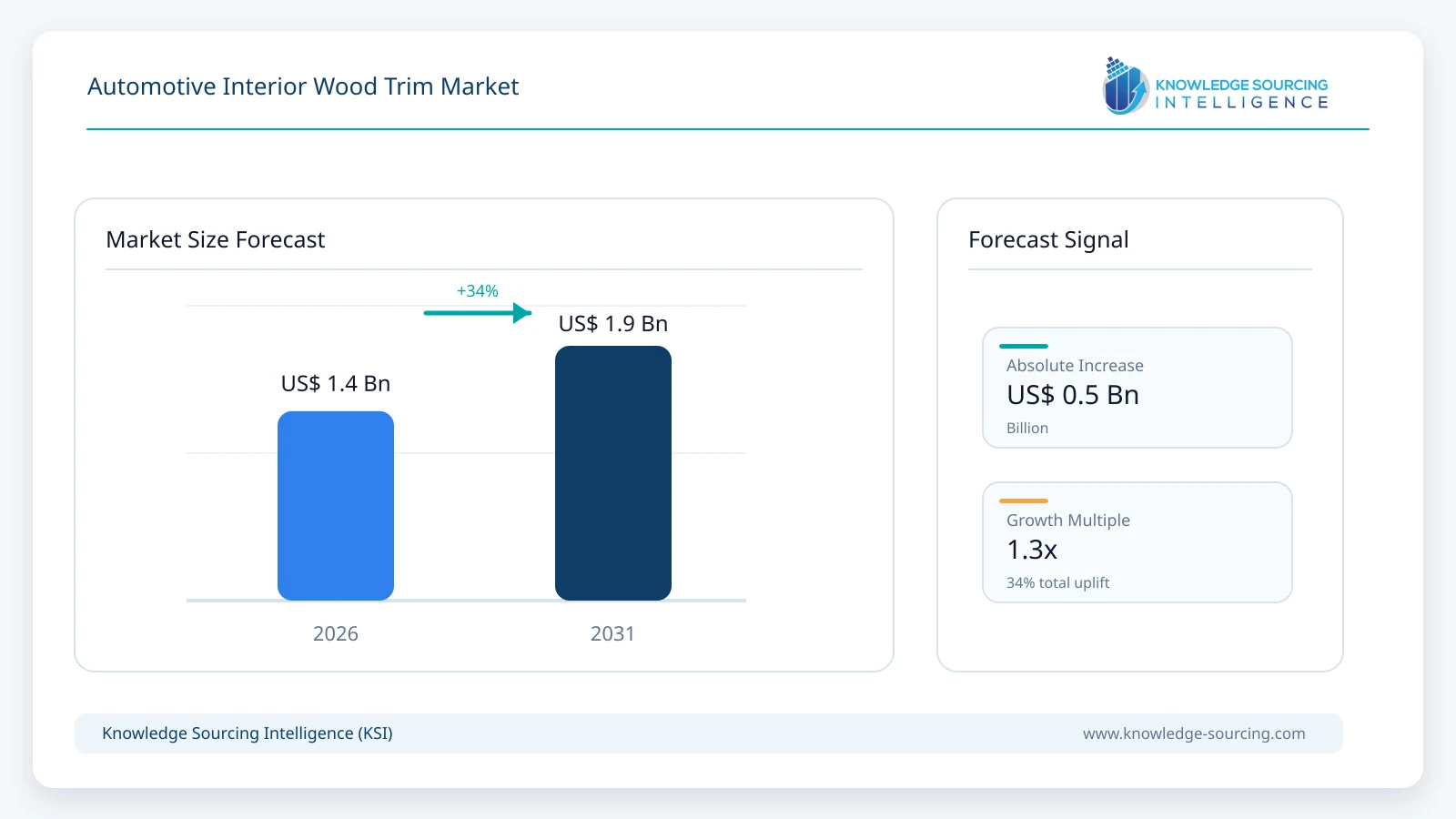
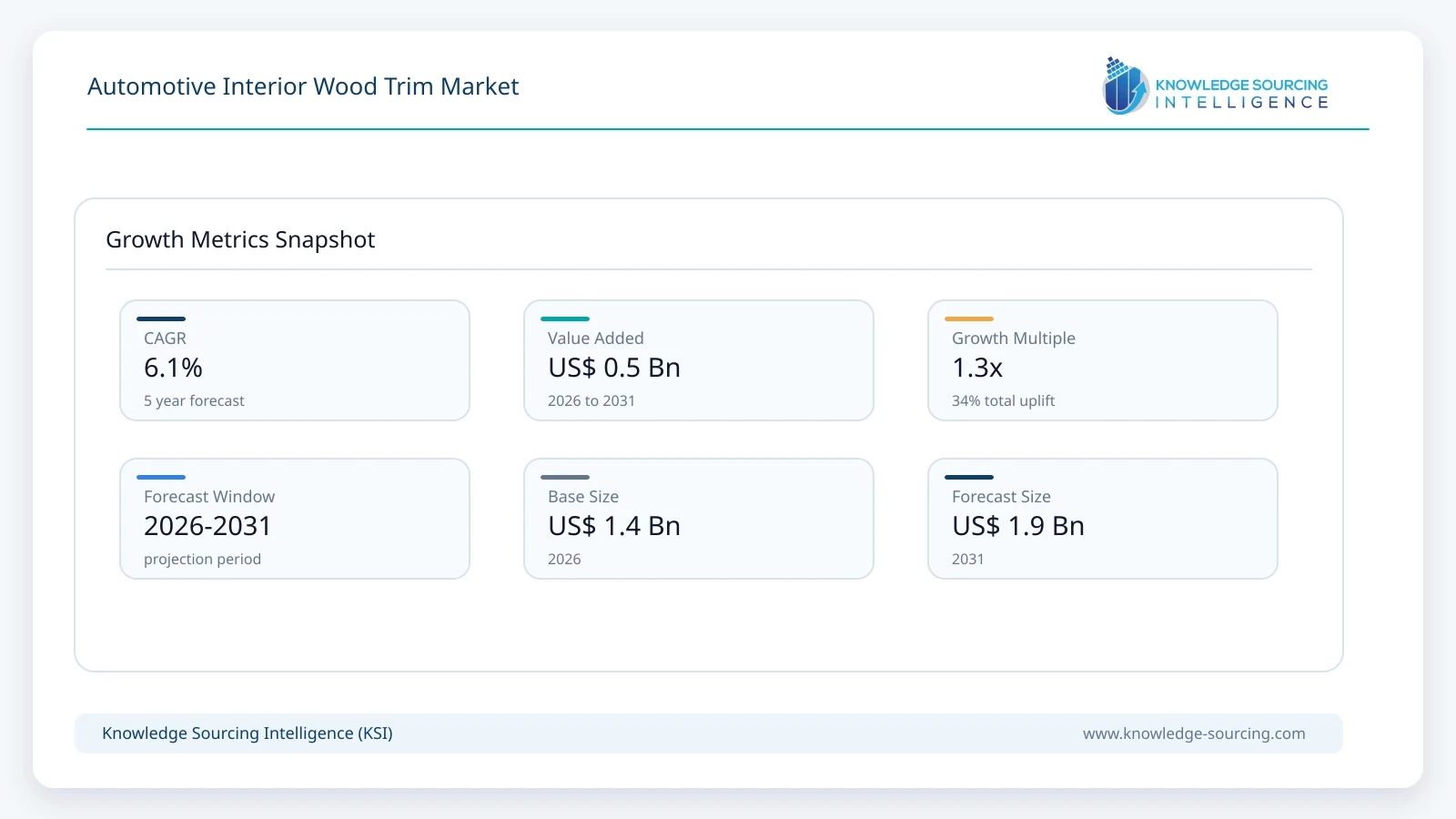
The automotive interior wood trim market is growing at a CAGR of 6.10%, from USD 1.45 billion in 2026 to USD 1.95 billion by 2031.
Highlights:
- 1Natural wood veneer bonded to automotive carriers accounts for an estimated 58% of 2026 wood-trim market value, ahead of engineered and reconstituted veneer solutions.
- 2Instrument-panel and dashboard accents account for approximately 44% of market value in 2026 because broad fascia surfaces are prominent areas for premium material specification.
- 3Open-pore and matte treatments hold an estimated 45% share in 2026 as automakers favor a tactile wood appearance over consistently high-gloss lacquer.
- 4Premium and luxury passenger vehicles generate about 72% of modeled 2026 demand, reflecting greater material content and higher specification rates.
- 5Europe represents an estimated 35% of 2026 market value, with Asia Pacific projected to become the largest regional market by 2031.
- 6Premium veneers increasingly combine precision cutting, three-dimensional forming and sustainable-feedstock documentation, but printed imitation wood remains a cost-effective competitive alternative.
Revenue comprises genuine wood-faced decorative inserts and qualified engineered wood trim components supplied for vehicle cabins, valued at the finished trim-component or first-conversion stage. The market includes veneered instrument-panel strips, door inserts, center-console surfaces and smaller genuine-wood decorative elements, without incorporating the value of complete cockpit or door modules.
Demand is supported by premium vehicle programs in Europe, North America and Asia Pacific. BMW’s refreshed 7 Series continues to specify open-pore and high-gloss wood treatments, while Mercedes-Benz retains wood inlays in the updated S-Class. Novem, NBHX and FORVIA offer genuine wood as one of several premium trim platforms, with specialist veneer suppliers such as Danzer contributing selected engineered-wood technologies. Automotive wood trim remains a concentrated application market rather than a universal material choice across global vehicle production.
Market Overview
Automotive wood trim normally uses thin natural-wood veneer bonded to a polymer, composite or lightweight metallic substrate. The veneer supplies the visible grain and tactile character, while the carrier controls dimensional stability and attachment to surrounding trim. Industrial manufacturing involves selecting veneer sheets, matching grains, forming, adhesive bonding, precision trimming, finishing and assembly. Component manufacturers must maintain consistent color and grain across dashboard, console and door surfaces while limiting material waste and surface defects.
Natural woods used in premium cabins include walnut, oak, ash, maple and other specialty species selected for consistent figure and finish compatibility. A single wood-specification program may offer open-pore matte treatments, satin finishes or highly polished lacquer, each requiring different coating and process control. Rolls-Royce describes matching veneer parts from the same tree and bonding thin sheets to engineered carriers, showing why visible wood-trim value extends well beyond the cost of the raw timber.
Novem reports revenue of EUR 510.9 million for FY2025/26 across genuine wood, aluminum, carbon and premium synthetic trim. NBHX Trim Group reports approximately EUR 600 million of annual business spanning wood, metals and synthetic materials. Neither disclosure provides wood-only revenue, but together the manufacturers establish the industrial scale of premium decorative surfaces. FORVIA’s Ligneos offering and Danzer’s shaped veneer platforms illustrate specialist participation at different points of the supply chain.
Commercial demand is concentrated in passenger vehicles whose customers assign value to authentic surface materials. Wood-look printed films meet similar aesthetic requirements on lower-cost programs, but the films do not have equivalent physical grain, natural variation or craftsmanship value. Automotive interior wood trim therefore competes through the quality and consistency of genuine material execution rather than through the surface area of all wood-patterned vehicle components.
Market Trends
Open-Pore Finishes Continue to Broaden Premium Design Choices
BMW’s 2026 7 Series specification offers Fineline Lime open-pore matte wood and additional oak and ash designs, reflecting continuing use of tactile wood surfaces in modern digital cockpits. Open-pore treatments reveal grain texture and offer an alternative to conventional mirror-finish lacquer. Surface suppliers must nevertheless control dirt retention, cleaning resistance and color consistency across production lots, making coating formulation and veneer selection important aspects of the trim specification.
Three-Dimensional Veneers Support More Complex Cabin Geometry
Automakers increasingly specify gently curved, uninterrupted trim surfaces around screens, air outlets and consoles. Danzer’s 3D-Veneer platform addresses contoured design requirements, while Rolls-Royce presented additional three-dimensional veneer craftsmanship in May 2026. These developments expand styling flexibility but do not eliminate the need for tight process tolerances and testing for delamination, cracking and thermal aging. Serial production economics remain more demanding than printed decorative films.
Hybrid Wood Surfaces Combine Craft and Modern Components
High-value wood trim increasingly incorporates metallic inlays, layered natural materials and coordinated illumination around the trim piece rather than replacing surrounding digital functions. The 2026 Mercedes-Benz S-Class pairs wood inlays with reworked console architecture, and Rolls-Royce Spectre Series II introduces a layered walnut-eucalyptus veneer. Hybrid designs preserve a recognizable natural surface while broadening the range of visual treatments available to premium vehicle brands.
Traceability and Material Utilization Influence Veneer Procurement
Automotive veneer production requires careful handling of wood species, grain patterns, dye uniformity and input yield. Danzer reports extensive global veneer operations, while Rolls-Royce describes selecting, matching and pressing sheets in controlled conditions. Manufacturers increasingly evaluate responsibly documented wood sources and usable veneer yield because a visually defective sheet can create disproportionate wastage after finishing. Specifying engineered veneers can improve repeatability where natural figure is variable.
Segment Analysis
By Material Construction: Natural Wood Veneer on Engineered Carriers
Natural wood veneer bonded to engineered carriers is estimated to account for 58% of market value in 2026. Premium instrument panels and door trims use the construction because a thin wood face provides genuine grain without requiring thick solid wood sections. Substrate and adhesive engineering improve stability across cabin temperature and humidity conditions. The segment remains the largest in 2031, even as reconstituted veneers gain share through tighter color consistency and more efficient processing.
By Finish Type: Open-Pore and Matte Wood
Open-pore and matte wood finishes represent approximately 45% of modeled revenue in 2026. BMW’s standard and optional 7 Series trims provide a current production example of how automakers position tactile, low-gloss wood within premium interiors. The segment benefits from a more contemporary cabin aesthetic and the contrast between natural materials and digital displays, although surface testing and cleaning durability limit the use of untreated wood textures.
By Application: Instrument Panels and Dashboard Inserts
Instrument-panel and dashboard inserts contribute about 44% of wood-trim revenue in 2026 because large, visually prominent surfaces carry substantial perceived-quality value. Dashboard veneer must meet tight fit, color and reflectivity requirements around display apertures and ambient lighting. Console trims and door inserts provide additional matching surfaces, creating demand for repeatable grain selection and supplier coordination across several component tools within the same vehicle program.
By Vehicle Segment: Premium and Luxury Passenger Vehicles
Premium and luxury passenger vehicles account for approximately 72% of the market in 2026. The strongest wood-trim penetration occurs in luxury sedans, premium SUVs and customized high-end vehicles where authentic material quality supports differentiation between equipment grades. Mainstream passenger vehicles participate mainly through selected upper trims, while commercial-vehicle installations remain limited to specialty cabins and premium conversions.
Market Drivers
Premium Cabin Specification and Perceived Material Quality
Premium models continue to use real wood alongside leather, metal and high-quality textiles to establish a distinctive cabin identity. BMW’s current 7 Series and Mercedes-Benz’s updated S-Class retain prominent wood surfaces despite greater dashboard display integration. Genuine wood trim supports higher option values and reinforces model differentiation where consumers can identify the difference between a natural veneer and a printed pattern.
Expansion of Premium Passenger Vehicles in Asia
China and other Asian premium-vehicle markets provide an increasingly important destination for high-value trim materials. International premium brands and regional luxury competitors use surface design to establish cabin differentiation across sedans and SUVs. Higher wood-trim penetration in selected Asian vehicle programs could increase the region’s share even where overall vehicle production expands more slowly.
Greater Availability of Open-Pore and Three-Dimensional Designs
Modern veneer forming, precision cutting and matte finishing allow suppliers to move beyond flat lacquered strips. Danzer develops shaped veneer applications and Rolls-Royce has introduced additional 3D wood techniques for bespoke vehicle surfaces. These processes broaden decorative design possibilities without replacing necessary qualification testing, supporting gradual growth in supplier value per wood-equipped vehicle.
Cabin Personalization and Higher-Value Bespoke Programs
A premium vehicle may be offered with several real-wood species and finishes, increasing the value of flexible supply and finish consistency. Rolls-Royce uses matched veneers and specialist marquetry techniques to execute individualized cabin surfaces, while BMW offers multiple wood treatment options. Bespoke volumes are small, but higher realization per component contributes disproportionately to premium decorative revenue.
Industrial Scale of Specialized Decorative Suppliers
Novem, NBHX and FORVIA maintain specialist production or product portfolios for high-quality decorative automotive components. Their industrial capabilities make veneer sourcing, pressing, painting and precision finishing available for multiple OEM programs rather than only hand-built luxury vehicles. Stable supplier qualification and international capacity help automakers preserve material continuity across geographically distributed assembly plants.
Market Restraints
Competition from Realistic Printed Wood-Effect Films
Decorative polymer films replicate many wood colors and grain patterns at lower process cost and with greater visual repeatability. Yanfeng offers in-mold decorative processes that support a wide range of wood-like surface appearances. Cost-sensitive vehicle programs often select film solutions rather than genuine veneer, limiting authentic wood penetration outside premium trims.
Wood Grain Variability and Limited Visual Yield
Natural veneer sheets differ in texture, knots and color even within the same species. Matching multiple cabin parts can require selective cutting and additional rejected material. Veneer variability increases cost and requires strict process control, particularly for large, uninterrupted dashboard and console surfaces.
Humidity, Temperature and Surface Durability Qualification
Thin natural wood requires stable bonding to carriers and consistent protective finishing to withstand cabin heat cycles, humidity and ultraviolet exposure. Manufacturers must control delamination, warpage and surface change over the vehicle’s service life. Automotive flammability and cabin-emissions requirements also affect adhesive and coating selection.
High Capital and Labor Intensity of Complex Veneer Finishing
Complex wood trim demands precision pressing, grain matching, multiple finishing operations and high cosmetic inspection standards. Smaller program volumes can make automated tooling and specialized labor expensive per vehicle. Manufacturers must balance premium presentation with program economics, particularly where production variants change frequently.
Pressure to Reduce Material Complexity and Improve Circularity
A wood-faced component typically combines veneer, adhesive, coating and a separate carrier material. Removing bonded material layers at end of life can be difficult, and alternative mono-material surfaces may offer simpler recycling routes. Automakers seeking greater disassembly and lower material complexity may restrict some wood-laminate applications unless suppliers improve design and material documentation.
Regional Outlook
Europe
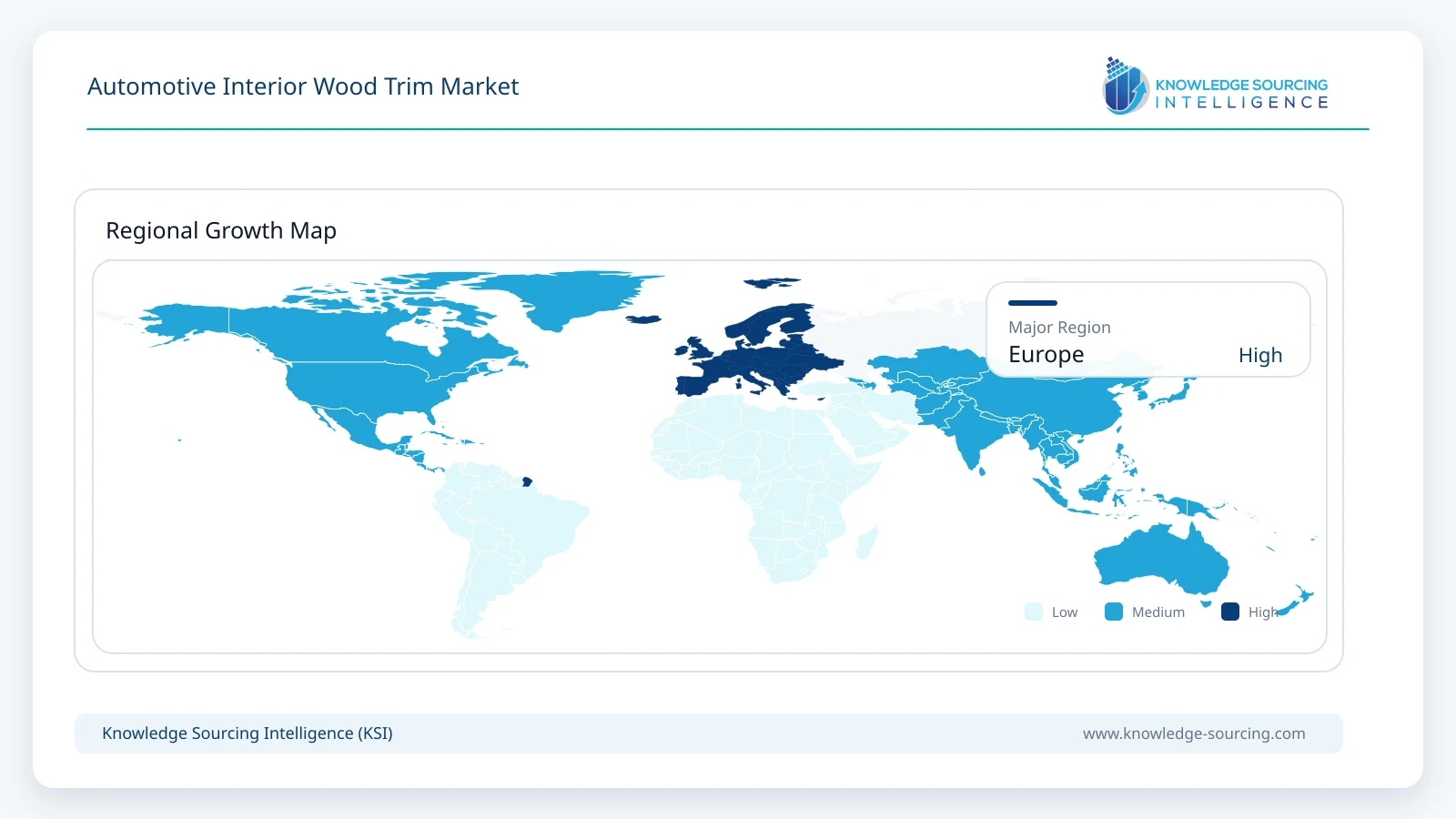
Europe is estimated to represent 35% of automotive interior wood trim market value in 2026, supported by the concentration of premium automotive design and manufacturing programs in Germany and neighboring countries. BMW, Mercedes-Benz and Rolls-Royce continue to specify genuine wood surfaces across luxury models, with distinct open-pore, high-gloss and bespoke treatments. The regional supply base includes Novem, Danzer, NBHX and FORVIA, connecting veneer processing with qualified decorative-part production. European demand should retain a premium value per equipped vehicle even as volume growth remains comparatively restrained.
Wood-trim suppliers in Europe face increasing pressure to reduce cosmetic defects, document raw material origins and control cabin emissions. The development of complex three-dimensional veneer surfaces offers higher-value opportunities, but qualification and automated finishing remain important to contain program costs. Europe is expected to remain a core design, tooling and technology center through 2031.
Asia Pacific
Asia Pacific accounts for an estimated 33% of 2026 wood-trim revenue and is projected to become the largest regional market by 2031. China is particularly important because premium sedans and SUVs combine substantial local vehicle production with a large consumer base for upper-trim specifications. Japan and South Korea contribute premium domestic models and established component manufacturing capabilities, while other Asian countries provide an additional, smaller installation base for imported and locally assembled premium vehicles.
Global decorative trim suppliers serve Asian OEM programs through regional manufacturing and international supply arrangements. Growth will depend more on the number of vehicles specified with authentic wood, and the value of each wood package, than on total regional vehicle production alone. Printed wood-effect materials will remain a major competitor on mainstream vehicles, limiting the pace of genuine veneer adoption.
Competitive Landscape
Automotive interior wood trim supply combines full-service premium decorative trim manufacturers, qualified interior Tier 1 suppliers and veneer specialists. Novem and NBHX supply finished decorative components across genuine wood and other materials; FORVIA markets Ligneos as a flexible real-wood surface solution. Danzer contributes shaped veneers, while Yanfeng and Antolin integrate decorative materials into broader interior systems. Supplier positions are defined by product fit, finish quality and OEM program nominations, not by total company revenue alone.
Wood-specific shares are not independently disclosed by the leading diversified trim suppliers. Novem’s EUR 510.9 million FY2025/26 revenue and NBHX’s approximately EUR 600 million disclosed annual turnover contain substantial non-wood activities, so direct attribution of those totals to wood trim would overstate the market. Competition centers on veneer sourcing, cosmetic yield, three-dimensional forming, durable low-emission finishes and reliable global deliveries. Specialist companies with consistent wood-processing expertise remain important alongside large interior module manufacturers.
Recent Developments
2 June 2026: Rolls-Royce introduced Spectre Series II with a Brindled Walnut veneer combining walnut from non-fruiting trees and residual eucalyptus fibers. The new layered finish illustrates how premium wood-trim design is adding material engineering and surface effects without relying solely on conventional veneer species.
8 May 2026: Rolls-Royce unveiled new bespoke craft techniques that include three-dimensional veneers. The presentation extends the design capabilities available to highly customized vehicle interiors, although the demonstration does not establish mass-market production volumes.
April 2026: BMW unveiled the updated 7 Series with open-pore Fineline Lime wood and additional oak and ash variants. The continued material options confirm genuine veneer as a current premium production specification alongside alternative decorative surfaces.
30 January 2026: Mercedes-Benz opened ordering for the updated S-Class, whose redesigned doors and center console feature wood inlays. The refresh preserves authentic wood as part of the brand’s flagship interior design.
25 June 2026: Novem reported audited FY2025/26 revenue of EUR 510.9 million, down 5.6% year on year. The results show the importance of supplier demand and model-cycle exposure; Novem’s diversified revenue should not be interpreted as a wood-only sales figure.
29 April 2025: Rolls-Royce presented a London Craft Week piece featuring precision-cut veneer marquetry and painted wood treatments. The exercise demonstrates complex veneer working and individualization capabilities relevant to ultra-premium interiors.
Market Outlook
The automotive interior wood trim market is projected to grow from approximately USD 1.45 billion in 2026 to USD 1.95 billion in 2031. Premium passenger vehicles and instrument-panel applications will continue to account for the largest revenue pools, while engineered veneers and open-pore finishes broaden design choices. Demand expansion is expected to reflect increasing wood-equipped vehicle penetration and higher finishing value rather than a universal shift away from synthetic trim.
Asia Pacific is expected to gain regional share through premium-vehicle adoption, while European suppliers retain a strong position in high-value veneer engineering and surface design. Competitive advantage will depend on consistent cosmetic quality, responsible material sourcing, manufacturing yield and stable OEM delivery. Printed wood-effect finishes will remain a persistent limit on penetration in price-sensitive models.
Automotive Interior Wood Trim Market Scope
| Report Metric | Details |
|---|---|
| Total Market Size in 2026 | USD 1.45 billion |
| Total Market Size in 2031 | USD 1.95 billion |
| Forecast Unit | Billion |
| Growth Rate | 6.10% |
| Study Period | 2021 to 2031 |
| Historical Data | 2021 to 2024 |
| Base Year | 2025 |
| Forecast Period | 2026 – 2031 |
| Segmentation | Wood Material Construction, Finish Type, Application, Vehicle Segment, Geography |
| Companies |
|
Market Segmentation
By Wood Material Construction
Natural Wood Veneer on Engineered Carrier
Engineered and Reconstituted Veneer
Solid Wood and Handcrafted Specialty Inserts
Hybrid Wood Decorative Laminates
By Finish Type
Open-Pore and Matte
High-Gloss Lacquered
Satin and Semi-Gloss
Specialty Textured and Mixed-Material Finishes
By Application
Instrument Panel and Dashboard Inserts
Center Console and Floor-Console Trim
Door and Side Trim Inserts
Steering Wheel, Controls and Other Inserts
By Vehicle Segment
Premium and Luxury Passenger Vehicles
Mainstream Passenger Vehicles
Commercial and Specialty Vehicles
By Geography
North America
United States
Canada
Mexico
South America
Brazil
Argentina
Others
Europe
Germany
United Kingdom
France
Italy
Spain
Others
Middle East and Africa
Saudi Arabia
UAE
South Africa
Others
Asia Pacific
China
Japan
South Korea
India
Indonesia
Thailand
Others
Table of Contents
1. EXECUTIVE SUMMARY
1.1. Key Findings
1.2. Market Size and Growth Outlook, 2026–2031
1.3. Premium Trim Opportunity Summary
2. MARKET SNAPSHOT
2.1. Market Overview
2.2. Market Definition
2.3. Scope of the Study
2.4. Market Segmentation
3. BUSINESS LANDSCAPE
3.1. Market Drivers
3.1.1. Premium Cabin Specification and Perceived Material Quality
3.1.2. Expansion of Premium Passenger Vehicles in Asia
3.1.3. Availability of Open-Pore and Three-Dimensional Designs
3.1.4. Cabin Personalization and Bespoke Programs
3.1.5. Specialized Decorative-Surface Supply Capabilities
3.2. Market Restraints
3.2.1. Competition from Printed Wood-Effect Films
3.2.2. Wood Grain Variability and Visual Yield
3.2.3. Humidity, Temperature and Surface Durability
3.2.4. High Capital and Labor Intensity
3.2.5. Material Complexity and Circularity
3.3. Market Opportunities
3.4. Porter’s Five Forces Analysis
3.5. Industry Value Chain Analysis
3.6. Policies and Regulations
3.7. Strategic Recommendations
4. TECHNOLOGICAL OUTLOOK
4.1. Natural Veneer Selection and Bookmatching
4.2. Engineered and Reconstituted Veneers
4.3. Three-Dimensional Forming and Pressing
4.4. Open-Pore and High-Gloss Coating Systems
4.5. Hybrid Wood and Decorative Inlays
4.6. Low-Emission Bonding and Quality Inspection
5. AUTOMOTIVE INTERIOR WOOD TRIM MARKET BY WOOD MATERIAL CONSTRUCTION
5.1. Introduction
5.2. Natural Wood Veneer on Engineered Carrier
5.3. Engineered and Reconstituted Veneer
5.4. Solid Wood and Handcrafted Specialty Inserts
5.5. Hybrid Wood Decorative Laminates
6. AUTOMOTIVE INTERIOR WOOD TRIM MARKET BY FINISH TYPE
6.1. Introduction
6.2. Open-Pore and Matte
6.3. High-Gloss Lacquered
6.4. Satin and Semi-Gloss
6.5. Specialty Textured and Mixed-Material Finishes
7. AUTOMOTIVE INTERIOR WOOD TRIM MARKET BY APPLICATION
7.1. Introduction
7.2. Instrument Panel and Dashboard Inserts
7.3. Center Console and Floor-Console Trim
7.4. Door and Side Trim Inserts
7.5. Steering Wheel, Controls and Other Inserts
8. AUTOMOTIVE INTERIOR WOOD TRIM MARKET BY VEHICLE SEGMENT
8.1. Introduction
8.2. Premium and Luxury Passenger Vehicles
8.3. Mainstream Passenger Vehicles
8.4. Commercial and Specialty Vehicles
9. AUTOMOTIVE INTERIOR WOOD TRIM MARKET BY GEOGRAPHY
9.1. North America
9.1.1. United States
9.1.2. Canada
9.1.3. Mexico
9.2. South America
9.2.1. Brazil
9.2.2. Argentina
9.2.3. Others
9.3. Europe
9.3.1. Germany
9.3.2. United Kingdom
9.3.3. France
9.3.4. Italy
9.3.5. Spain
9.3.6. Others
9.4. Middle East and Africa
9.4.1. Saudi Arabia
9.4.2. UAE
9.4.3. South Africa
9.4.4. Others
9.5. Asia Pacific
9.5.1. China
9.5.2. Japan
9.5.3. South Korea
9.5.4. India
9.5.5. Indonesia
9.5.6. Thailand
9.5.7. Others
10. COMPETITIVE ENVIRONMENT AND ANALYSIS
10.1. Major Players and Strategy Analysis
10.2. Market Share Analysis
10.3. Mergers, Acquisitions, Agreements and Collaborations
10.4. Competitive Dashboard
11. COMPANY PROFILES
11.1. Novem Group S.A.
11.2. NBHX Trim Group
11.3. FORVIA SE
11.4. Danzer Group
11.5. Yanfeng Automotive Interiors
11.6. Antolin
11.7. TABU S.p.A.
12. APPENDIX
12.1. Currency
12.2. Assumptions
12.3. Base and Forecast Years Timeline
12.4. Key Benefits for Stakeholders
12.5. Research Methodology
12.6. Abbreviations
Navigate
Trusted by the world's leading organizations











