
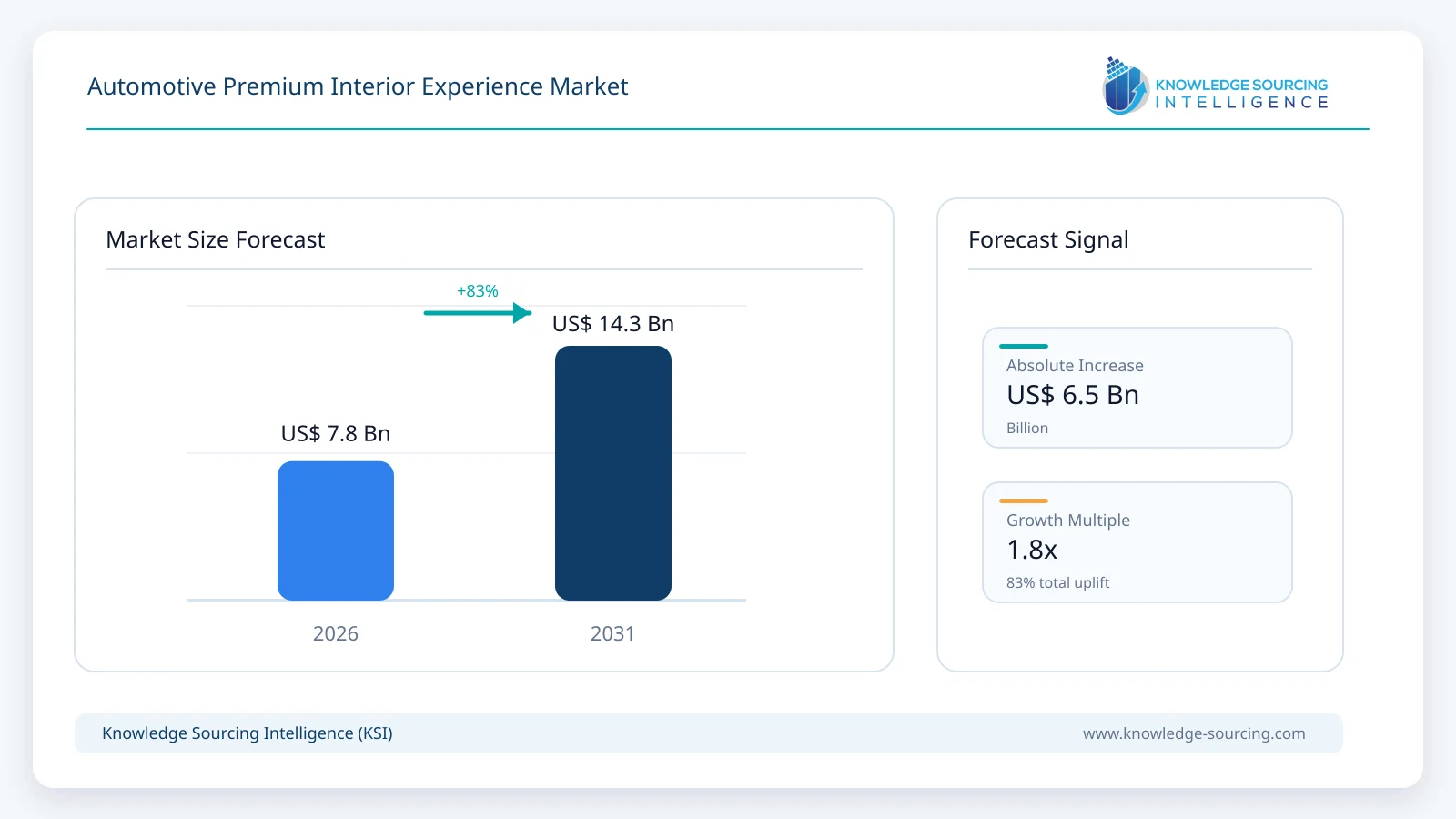
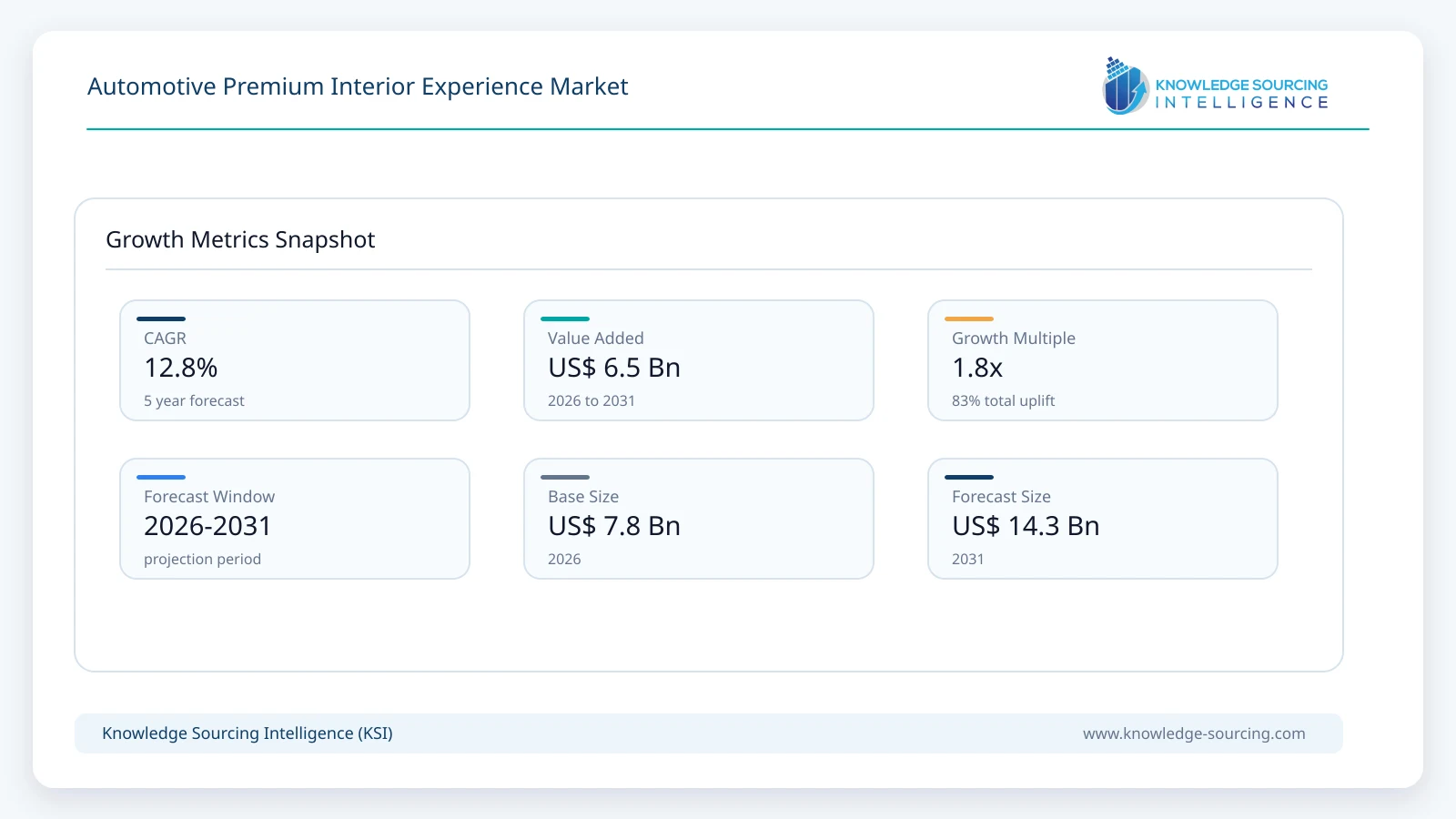
Automotive Premium Interior Experience Market revenue is estimated at USD 7.80 billion in 2026 and projected to reach approximately USD 14.25 billion in 2031, equivalent to a 12.8% CAGR during the forecast period.
Highlights:
- 1Advanced seating, ergonomic comfort and relaxation functions represent approximately 31% of qualifying market value in 2026; higher-content premium passenger experience systems account for an increasing share of new vehicle programs.
- 2Integrated factory-installed experience architectures account for an estimated 58% of 2026 value, increasing as OEMs coordinate several cabin features within shared electronic and software platforms.
- 3Premium passenger vehicles represent approximately 49% of 2026 revenue, while upper-mainstream high-content trims are projected to increase penetration through 2031.
- 4Battery electric vehicles account for an estimated 33% of qualifying premium interior experience value in 2026 and are expected to gain share as premium EV competition increases.
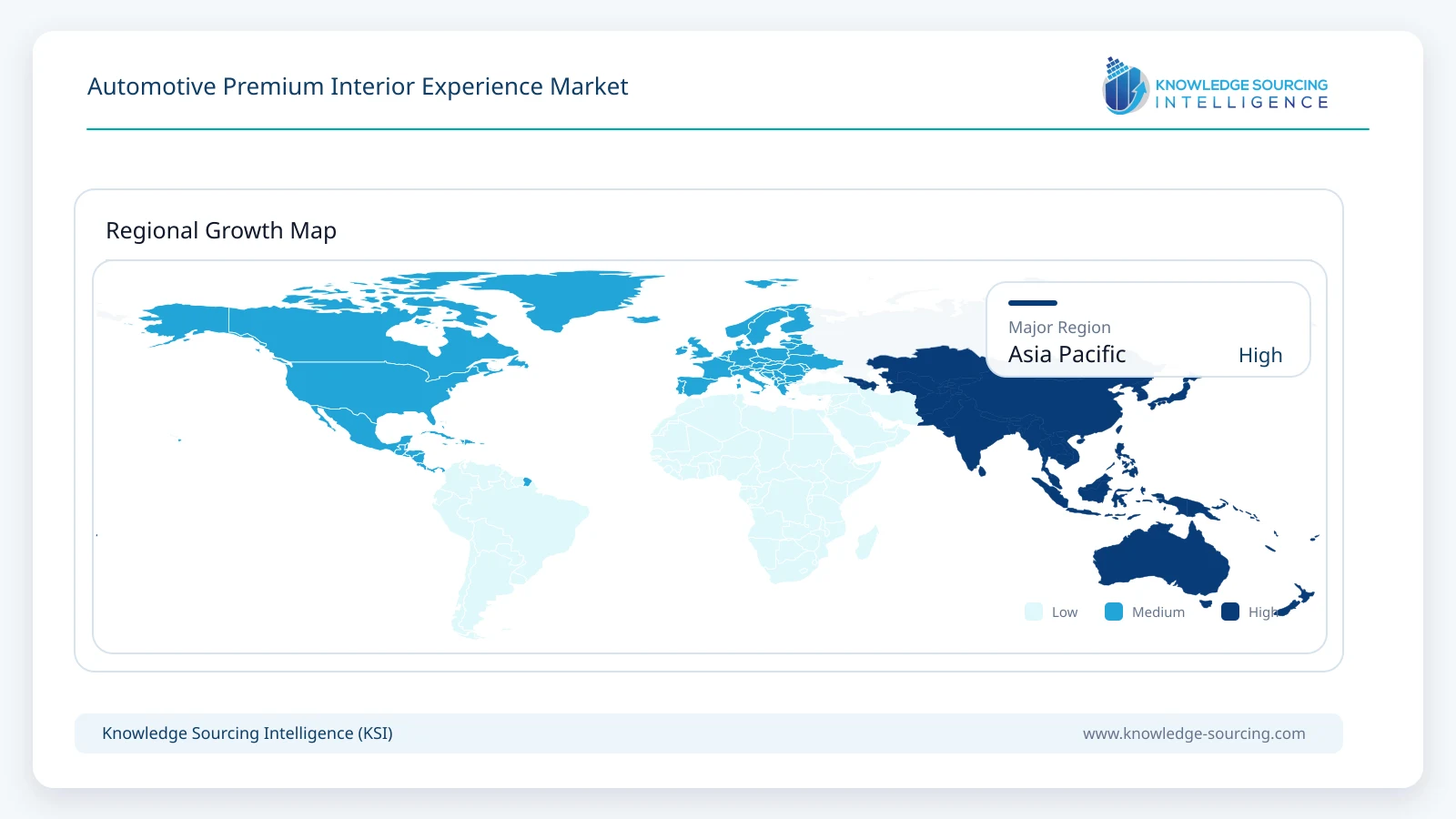
- 5Asia Pacific is the largest regional market at approximately 43% of estimated value in 2026, led by Chinese premium EVs and established Japanese and South Korean supply networks.
- 6Multi-function seating and comfort content has an observed commercial baseGentherm reported USD 72.6 million in second-quarter 2026 lumbar and massage revenue, up 38.2% year on year, although this product category is broader than the premium experience market alone.
The market represents attributable first-fit supplier value and specifically identifiable software or integration content in premium interior feature packages. Qualifying value includes premium seat comfort upgrades, advanced cabin ambience, passenger experience functions, selected tactile-surface upgrades and software coordination purchased as part of a premium experience specification. Complete seat frames, standard cockpit computers, baseline interior trim and vehicle retail option prices are not included at full value.
Premium experience specifications increasingly cross traditional supplier boundaries. A coordinated package may combine pneumatic massage, ventilated seats, adaptive lighting, differentiated sound, passenger screens and user profiles, while OEM procurement remains divided among seating, electronics, trim and software teams. The market therefore measures a cross-cutting feature-content category rather than a new revenue pool additional to every adjacent market. The physical components also appear in the Automotive Cabin Comfort, Smart Cockpit and Interior Trim markets when those reports are viewed independently.
Market Overview
Premium interior experience is defined by the coordinated quality of the cabin rather than the presence of any single expensive feature. Seating pressure distribution, contact-surface texture, acoustic refinement, visual composition and ease of interaction influence perceived quality throughout a journey. Luxury sedans remain important reference vehicles, but premium SUVs and electric crossovers increasingly carry packages combining these functions. Mercedes-Benz offers passenger entertainment and expanded rear-cabin comfort in its 2026 S-Class and GLS programs, illustrating the continued relevance of both chauffeur-oriented and family-oriented premium layouts.
Automotive suppliers are combining traditional interior engineering with software and electronics. Yanfeng’s XiM27 demonstration links adaptable seating, individualized climate, lighting, spatial audio and central electronic control; Toyota Boshoku’s LOUNZE+ concept coordinates seats, door trim and the console across passenger activities. Neither demonstration alone proves high-volume market revenue, but both show the integration direction for next-generation interior architectures. Production award activity provides a separate commercialization check: Lear cited major 2026 ComfortFlex and FlexAir seating awards for Audi in Europe and North America.
The premium feature portfolio is also expanding toward occupant-aware adjustments. HARMAN Ready Care supports personalized comfort interventions through occupant sensing, while BMW Panoramic iDrive coordinates information presentation, audio character and personalized display themes. These developments shift some premium experience value from mechanical differentiation toward software orchestration and human-machine interaction, although customers continue to judge seat comfort, finish quality and quietness as tangible parts of luxury.
Market Trends
Coordinated Multisensory Cabins Replace Isolated Premium Features
Automotive premium interior specifications increasingly combine several systems in coordinated modes. Yanfeng’s XiM27 links adaptive seating with climate, audio and responsive lighting, while BMW’s Neue Klasse software links displays, ambient lighting and sound experiences. The commercial shift increases the importance of integration software, validated system interfaces and common cabin control logic, even when the component suppliers remain separate.
High-Content Interiors Spread into Premium Electric SUVs
Electric SUVs offer automakers a visible platform for cabin differentiation because acceleration, range and display size alone are increasingly insufficient to establish premium positioning. Mercedes-Benz’s updated GLS and the BMW iX3 demonstrate different paths: one strengthens high-end multirow comfort and passenger entertainment, while the other combines a reduced physical dashboard with integrated digital interaction. Demand is therefore rising for scalable premium experience features that work across several vehicle architectures.
Rear Passenger Experience Receives Greater Attention
Luxury rear-cabin functions are expanding beyond long-wheelbase sedans into high-end SUVs and multipurpose vehicles. The Mercedes-Benz GLS Rear Comfort Package Plus and revised S-Class passenger features show the importance of seating posture, local controls, entertainment and connectivity for rear occupants. Rear-focused systems typically require additional actuator content, wiring, user controls and acoustic or display integration.
Premium Experience Differentiation Depends More on Software
Vehicle operating systems can personalize information, lighting and media themes, while occupant sensing can prompt selected comfort adjustments. Recurring services remain a smaller part of immediate supplier market value than hardware, however, and commercial revenue should not be inferred directly from a software demonstration or a planned AI feature release.
Segment Analysis
By Experience Function: Advanced Seating and Relaxation
Advanced seating, ergonomic comfort and relaxation account for approximately 31% of qualifying value in 2026. Premium seating adds incremental pneumatic supports, multiway adjustment, heating and cooling, massage and embedded comfort electronics above the base seat specification. Gentherm’s reported growth in lumbar and massage comfort revenue and Lear’s 2026 modular comfort awards indicate that comfort-intensive seating remains commercially active rather than merely a concept showcase. Through 2031, seating retains the largest function pool, although coordinated sensing and sensory technologies increase their relative weight.
By Integration Architecture: Factory-Integrated Experience Platforms
Factory-integrated experience architectures account for about 58% of market value in 2026 because premium cabin modes increasingly require common electronic control and cross-supplier validation. Coordinated systems can reduce the number of separate interfaces visible to occupants and help automakers maintain consistent brand behavior across several vehicle models. Integration value is higher in full-size premium cars and SUVs, while lower-cost modular experience upgrades continue to serve trims where one or two features justify the customer premium. The factory-integrated segment is projected to reach approximately USD 9.12 billion in 2031.
By Vehicle Grade: Premium Passenger Vehicles
Premium passenger vehicles represent around 49% of the market in 2026, with luxury flagship models accounting for another 36%. Premium-volume models distribute sophisticated comfort and digital content across a much larger production base than the flagship class, making modularity and reusable software especially important. Higher-content mainstream vehicles are expected to gain share as heated or ventilated seats, adaptive lighting and branded entertainment move into upper trims. The market remains focused on meaningful feature upgrades rather than ordinary basic upholstery or standard infotainment.
By Propulsion: Battery Electric Vehicles
Battery electric vehicles generate approximately 33% of qualifying premium interior experience value in 2026. Premium EV programs commonly introduce new dashboards, connected operating systems and occupant-centered comfort concepts, giving suppliers more opportunities to consolidate features during platform launches. The modeled BEV share rises to 43% by 2031 as electric SUVs and passenger cars absorb higher levels of software-defined cabin content. Internal-combustion luxury cars nevertheless remain commercially important, particularly in larger sedans and high-end utility vehicles.
Market Drivers
Premium Cabin Content as a Competitive Differentiator
High-value passenger vehicles increasingly compete on sustained interior comfort and the perceived quality of everyday interactions. Automakers consequently invest in seat articulation, cabin quietness, coordinated illumination, tactile materials and passenger-specific controls to justify premium positioning. Mercedes-Benz’s updated S-Class and GLS interiors illustrate how several functions are packaged together, increasing supplier content per qualified vehicle.
Growing Demand for Adaptive Seating and Thermal Comfort
Premium seating combines mechanical ergonomics with thermal conditioning, lumbar support and massage in a way occupants can experience directly. Gentherm reported a 38.2% increase in lumbar and massage revenue in the second quarter of 2026, while Lear disclosed ComfortFlex and FlexAir awards for Audi programs. Supplier revenues cover a wider market than premium experience packages, but the developments validate demand for the relevant functions. Growth in premium seat complexity raises the importance of compact actuators, low-noise pumps and reliable software control.
Expansion of Premium Electric Vehicle Programs
Automotive manufacturers launching electric passenger cars often redesign seating, cockpit surfaces, displays and thermal architecture together rather than transplanting every feature from older platforms. BMW’s Neue Klasse implementation combines a simplified cabin, Panoramic iDrive and personalized sound and visual modes in the iX3. Premium EV development creates opportunities for common controllers, integrated lighting and occupant-specific interfaces.
Integration of Passenger-Facing Entertainment and Ambience
Large passenger displays, dedicated rear-cabin controls, immersive audio and lighting modes are increasingly used to distinguish vehicle trims. Mercedes-Benz introduced upgraded passenger-screen experiences in the new S-Class and a standard MBUX Superscreen with rear comfort options in the updated GLS. These functions contribute incremental experience value when purchased as part of an upgraded interior specification.
Cabin Electronics and Software Standardization
Premium experience platforms become easier to deploy across vehicle ranges when software functions share common operating systems and electronic interfaces. BMW Operating System X provides a consistent basis for display behavior and personalization, while Yanfeng’s XiM27 illustrates centralized control of several occupant functions. Platform reuse can support lower integration cost per vehicle after initial validation, allowing high-end capabilities to spread to additional trims.
Market Restraints
High Incremental Hardware and Installation Cost
Premium interior specifications add motors, actuators, wiring, sensors, audio equipment, surface treatments and software validation on top of baseline cabin content. Automakers may restrict advanced functions to upper trims when end customers do not value the upgrade sufficiently. Cost sensitivity is especially important for premium-volume SUVs competing against lower-priced models with visually similar displays and ambient lighting.
Complex Multi-Supplier System Integration
Seat comfort, ambient lighting, digital interfaces, audio and electronic controls frequently come from different suppliers with different validation cycles. A single premium cabin mode may depend on actuators, sensors and vehicle-network messages operating correctly at the same time. Program execution therefore favors integrators with strong electronic architecture and test capabilities.
Packaging, Weight and Energy Constraints
Luxury rear-seat systems, larger displays, ventilation assemblies and acoustic components compete for limited interior space and power budgets. Electric vehicles face an additional tradeoff because thermal comfort and entertainment features consume energy that could otherwise support driving range. Lightweight mechanisms, localized conditioning and shared control electronics help reduce these constraints, but technical solutions can raise unit cost. Compact vehicles therefore cannot adopt every large-vehicle comfort feature without substantial redesign.
Reliability and Long-Term Surface Quality Requirements
Premium cabins face stringent customer expectations for low actuator noise, consistent stitching, durable decorative finishes and stable performance under temperature and humidity changes. Warranty costs may increase when multiple functions are integrated into a single replaceable module. Suppliers must therefore balance ambitious experience design with serviceability and proven component life.
Uncertain Monetization of Personalization Software
Automakers can advertise software-defined cabin features without necessarily receiving recurring payments from owners. Software income must also be separated from the electronics that run the application. Conservative market modeling should count disclosed or attributable integration value rather than assuming every premium function generates continuing software revenue.
Regional Outlook
Asia Pacific
Asia Pacific accounts for an estimated 43% of global premium interior experience value in 2026, supported by premium electric vehicle competition in China and established automotive interior technology supply chains in Japan and South Korea. Chinese manufacturers increasingly use passenger comfort, large digital interfaces, expressive ambient lighting and individualized cabin scenes as visible product differentiators. Yanfeng’s XiM27 provides an advanced integration reference, while Toyota Boshoku’s LOUNZE+ shows the emphasis on adaptable passenger spaces and coordinated trim and seating.
China drives much of the regional content expansion, but the forecast also reflects premium-vehicle production and technology suppliers across Japan, South Korea and Southeast Asia. Asia Pacific share is modeled to reach 48% in 2031 as experience features migrate into more mid-premium electric SUVs. Rapid adoption does not mean that every showcase feature enters mass production; premium content growth remains conditional on model launches, supplier awards and actual take rates.
Europe
Europe represents approximately 31% of premium interior experience value in 2026 because German and other European manufacturers sustain high supplier content per premium vehicle. Mercedes-Benz’s 2026 S-Class and GLS programs emphasize cabin refinement, passenger control and high-end comfort, while BMW’s Neue Klasse architecture links intuitive interaction with coordinated visual and audio design. European seating and thermal suppliers, including Lear, FORVIA and Gentherm, support specialized premium comfort content on domestic and global platforms.
European market value is expected to grow through 2031 despite modest regional vehicle-volume assumptions. Premium content gains are concentrated in adaptive seating, rear-occupant comfort, differentiated cabin surfaces and multi-function software integration. Europe remains important for engineering and launch programs, although the region’s share moderates as China and the broader Asia Pacific market scale faster.
Competitive Landscape
The automotive premium interior experience market draws participation from seating suppliers, full-interior integrators, smart-cabin electronics providers and specialists in occupant comfort. Yanfeng, FORVIA, Lear, Adient, Toyota Boshoku, Magna and Antolin participate through interior or seating systems, while Gentherm focuses on thermal and pneumatic comfort functions. HARMAN, Panasonic Automotive Systems and Hyundai Mobis contribute cockpit, audio, display or integration capabilities. Individual companies typically generate revenue across several related automotive markets, so total corporate or segment sales are not equivalent to premium-experience revenue.
Competitive differentiation depends on the ability to coordinate physical comfort and digital presentation while maintaining cabin reliability and scalable manufacturing. Yanfeng and Toyota Boshoku demonstrate integrated cabin concepts, Lear and Gentherm provide documented commercial comfort programs, and HARMAN contributes occupant-aware personalization and display technologies. Automakers remain the architects of the end-user experience, while Tier 1 suppliers capture value through component performance, system integration and production execution.
Recent Developments
23 July 2026: Gentherm reported USD 690 million of automotive new-business awards in the quarter and 14.1% year-on-year growth in Automotive Climate and Comfort Solutions sales. Lumbar and massage revenue grew 38.2%, supporting the commercial relevance of premium seating functions.
29 June 2026: Yanfeng unveiled XiM27, a drivable production-ready concept combining seating, individualized climate, lighting, spatial audio and centralized cabin electronics. The platform demonstrates system-integration capabilities; the announcement does not establish high-volume customer deliveries.
23 April 2026: Toyota Boshoku presented the LOUNZE+ cabin concept for Auto China, showing coordinated seats, door trim and console functions for activity-specific passenger environments. The concept illustrates a design trajectory rather than a confirmed production volume.
31 March 2026: Mercedes-Benz introduced the updated GLS with MBUX Superscreen and expanded rear comfort options. The changes provide a production-vehicle example of digital and physical luxury content offered together.
29 January 2026: Mercedes-Benz presented the updated S-Class with revised passenger entertainment, cabin ambience and rear-occupant comfort features. The production model demonstrates premium interior packages beyond a single hardware function.
13 January 2026: HARMAN expanded Ready Care and Ready Aware capabilities and introduced production-oriented displays. The announcements show continued investment in occupant-aware cabin software and higher-quality visual interfaces, with value attributable only to relevant premium functions.
Market Outlook
Automotive premium interior experience revenue is projected to increase from USD 7.80 billion in 2026 to USD 14.25 billion by 2031 as higher-content vehicles adopt more comfort, ambience and passenger experience features. Advanced seating remains the leading function, while integrated multisensory systems and software-linked personalization generate a growing share of incremental interior content. Premium-volume cars and SUVs provide the largest revenue base, with upper-mainstream trims contributing increasingly to incremental fitment.
Competitive development will increasingly connect the physical cabin with operating-system functions. Seat actuators, climate zones, acoustics, lighting and passenger interfaces will need consistent behavior across several modes and occupant profiles. Suppliers that can simplify validation, reduce energy use and maintain tactile quality can capture more integration value even as vehicle manufacturers standardize the underlying electronics.
Asia Pacific is expected to retain the largest regional market share, while Europe continues to support premium-vehicle engineering and high-content sourcing. Market figures should be interpreted as a cross-cutting supplier-content estimate: the same physical features can also be classified within comfort, cockpit, trim or personalization market reports and must not be added across those titles.
Automotive Premium Interior Experience Market Scope
| Report Metric | Details |
|---|---|
| Total Market Size in 2026 | USD 7.80 billion |
| Total Market Size in 2031 | USD 14.25 billion |
| Forecast Unit | Billion |
| Growth Rate | 12.8% |
| Study Period | 2021 to 2031 |
| Historical Data | 2021 to 2024 |
| Base Year | 2025 |
| Forecast Period | 2026 – 2031 |
| Segmentation | Experience Function, Integration Architecture, Vehicle Grade, Propulsion, Geography |
| Companies |
|
Market Segmentation
By Experience Function
Advanced Seating, Ergonomic Comfort and Relaxation
Lighting, Audio and Multisensory Ambience
Passenger Entertainment and Digital Interaction
Premium Surfaces and Tactile Upgrades
Experience Software, Wellness and Orchestration
By Integration Architecture
Factory-Integrated Multimodal Experience Packages
Modular Premium Feature Upgrades
Software-Enabled Experience and Services
By Vehicle Grade
Luxury and Flagship Passenger Vehicles
Premium Passenger Vehicles
High-Content Mainstream Vehicle Trims
By Propulsion
Battery Electric Vehicles
Hybrid and Plug-in Hybrid Vehicles
Internal Combustion Engine Vehicles
By Geography
North America
United States
Canada
Mexico
South America
Brazil
Argentina
Others
Europe
Germany
United Kingdom
France
Italy
Spain
Others
Middle East and Africa
Saudi Arabia
UAE
South Africa
Others
Asia Pacific
China
Japan
South Korea
India
Indonesia
Thailand
Others
Table of Contents
1. EXECUTIVE SUMMARY
2. MARKET SNAPSHOT
2.1. Market Overview
2.2. Market Definition
2.3. Scope of the Study
2.4. Market Segmentation
3. BUSINESS LANDSCAPE
3.1. Market Drivers
3.1.1. Premium Cabin Content as a Competitive Differentiator
3.1.2. Growing Demand for Adaptive Seating and Thermal Comfort
3.1.3. Expansion of Premium Electric Vehicle Programs
3.1.4. Integration of Passenger-Facing Entertainment and Ambience
3.1.5. Cabin Electronics and Software Standardization
3.2. Market Restraints
3.2.1. High Incremental Hardware and Installation Cost
3.2.2. Complex Multi-Supplier System Integration
3.2.3. Packaging, Weight and Energy Constraints
3.2.4. Reliability and Long-Term Surface Quality Requirements
3.2.5. Uncertain Monetization of Personalization Software
3.3. Market Opportunities
3.4. Porter’s Five Forces Analysis
3.5. Industry Value Chain Analysis
3.6. Policies and Regulations
3.7. Strategic Recommendations
4. TECHNOLOGICAL OUTLOOK
4.1. Adaptive Seat and Comfort Electronics
4.2. Integrated Lighting and Spatial Audio
4.3. Digital Passenger Experience Platforms
4.4. Occupant-Aware Experience Software
4.5. Cross-Domain Cabin Integration
5. AUTOMOTIVE PREMIUM INTERIOR EXPERIENCE MARKET BY EXPERIENCE FUNCTION
5.1. Introduction
5.2. Advanced Seating, Ergonomic Comfort and Relaxation
5.3. Lighting, Audio and Multisensory Ambience
5.4. Passenger Entertainment and Digital Interaction
5.5. Premium Surfaces and Tactile Upgrades
5.6. Experience Software, Wellness and Orchestration
6. AUTOMOTIVE PREMIUM INTERIOR EXPERIENCE MARKET BY INTEGRATION ARCHITECTURE
6.1. Introduction
6.2. Factory-Integrated Multimodal Experience Packages
6.3. Modular Premium Feature Upgrades
6.4. Software-Enabled Experience and Services
7. AUTOMOTIVE PREMIUM INTERIOR EXPERIENCE MARKET BY VEHICLE GRADE
7.1. Introduction
7.2. Luxury and Flagship Passenger Vehicles
7.3. Premium Passenger Vehicles
7.4. High-Content Mainstream Vehicle Trims
8. AUTOMOTIVE PREMIUM INTERIOR EXPERIENCE MARKET BY PROPULSION
8.1. Introduction
8.2. Battery Electric Vehicles
8.3. Hybrid and Plug-in Hybrid Vehicles
8.4. Internal Combustion Engine Vehicles
9. AUTOMOTIVE PREMIUM INTERIOR EXPERIENCE MARKET BY GEOGRAPHY
9.1. North America
9.1.1. United States
9.1.2. Canada
9.1.3. Mexico
9.2. South America
9.2.1. Brazil
9.2.2. Argentina
9.2.3. Others
9.3. Europe
9.3.1. Germany
9.3.2. United Kingdom
9.3.3. France
9.3.4. Italy
9.3.5. Spain
9.3.6. Others
9.4. Middle East and Africa
9.4.1. Saudi Arabia
9.4.2. UAE
9.4.3. South Africa
9.4.4. Others
9.5. Asia Pacific
9.5.1. China
9.5.2. Japan
9.5.3. South Korea
9.5.4. India
9.5.5. Indonesia
9.5.6. Thailand
9.5.7. Others
10. COMPETITIVE ENVIRONMENT AND ANALYSIS
10.1. Major Players and Strategy Analysis
10.2. Market Share Analysis
10.3. Mergers, Acquisitions, Agreements and Collaborations
10.4. Competitive Dashboard
11. COMPANY PROFILES
11.1. Yanfeng Automotive Interiors
11.2. FORVIA
11.3. Lear Corporation
11.4. Adient plc
11.5. Toyota Boshoku Corporation
11.6. Magna International Inc.
11.7. Gentherm Incorporated
11.8. HARMAN International
11.9. Antolin
11.10. Hyundai Mobis Co., Ltd.
11.11. Panasonic Automotive Systems Co., Ltd.
11.12. GRAMMER AG
12. APPENDIX
12.1. Currency
12.2. Assumptions
12.3. Base and Forecast Years Timeline
12.4. Key Benefits for Stakeholders
12.5. Research Methodology
12.6. Abbreviations
12.7. Selected Primary Sources
Navigate
Trusted by the world's leading organizations











