
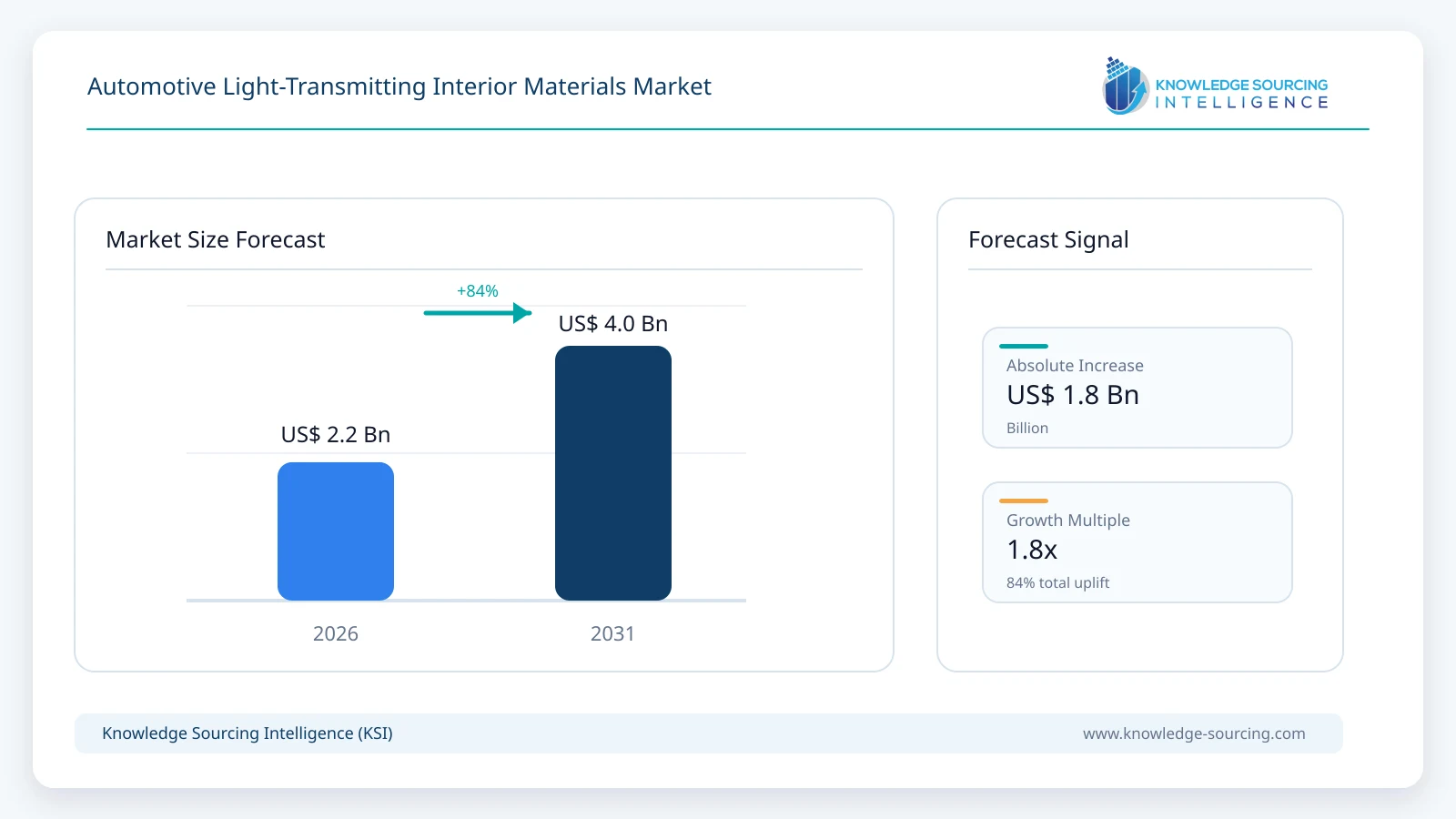
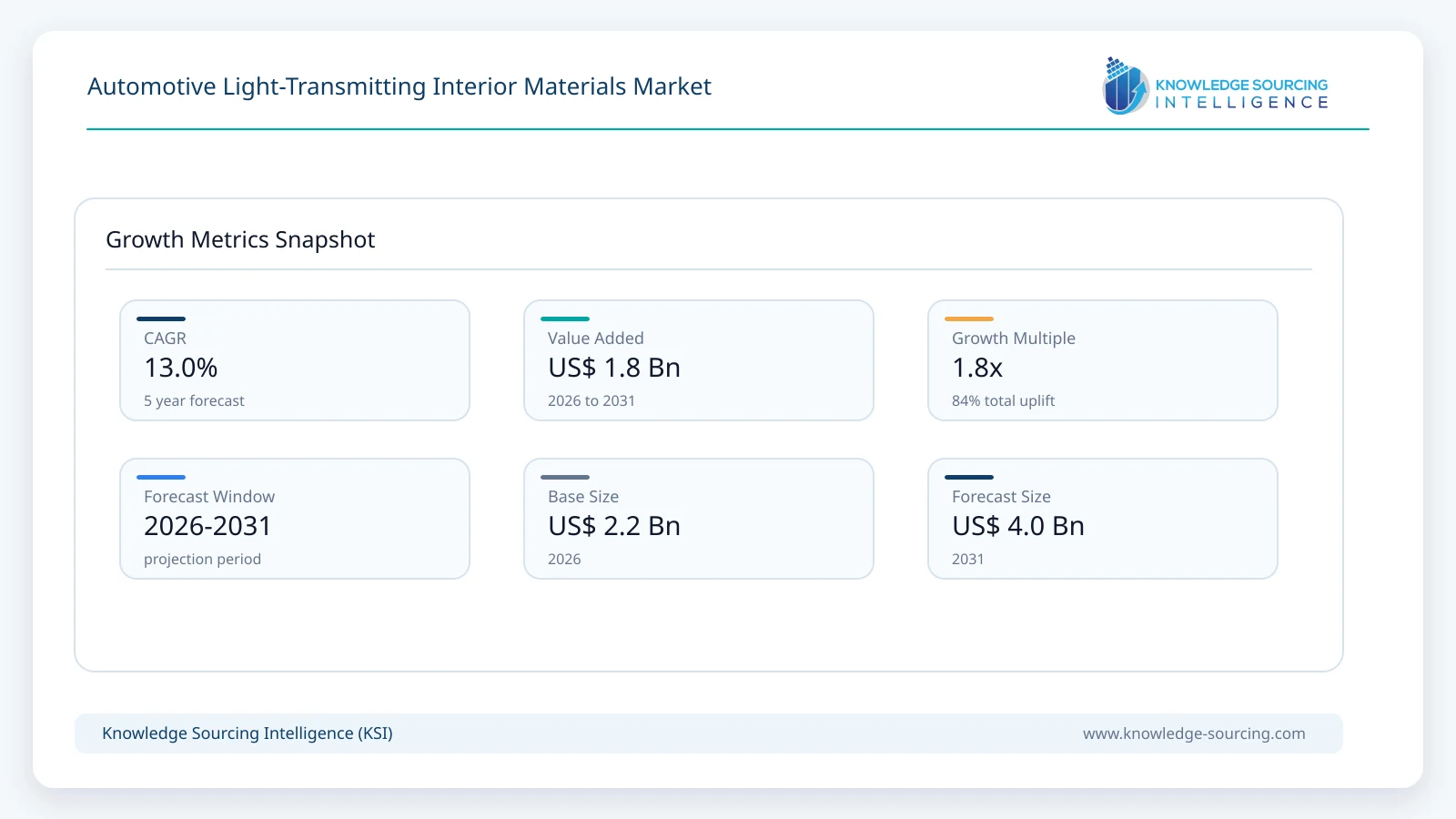
The automotive light-transmitting interior materials market is projected to expand at a CAGR of 13.0%, increasing from USD 2.20 billion in 2026 to USD 4.05 billion by 2031.
Highlights:
- 1Polycarbonate and PC-based materials account for approximately 38% of global market value in 2026 because they combine optical transmission, impact performance and high-volume moldability across illuminated trim and HMI applications.
- 2Resins and optical compounds represent approximately 57% of 2026 market value, while films, sheets and light-permeable surface layers gain share as hidden-until-lit functionality expands across larger cabin areas.
- 3High-transmission and transparent optical materials account for approximately 33% of market value in 2026, although translucent hidden-until-lit and diffusing materials are growing faster.
- 4Door and side-trim applications represent approximately 30% of 2026 demand as dynamic ambient lighting, warning functions and decorative illumination expand across broad door surfaces.
- 5Passenger vehicles account for approximately 94% of global market value in 2026 because advanced interior lighting and smart-surface technologies remain concentrated in passenger cars, SUVs and MPVs.
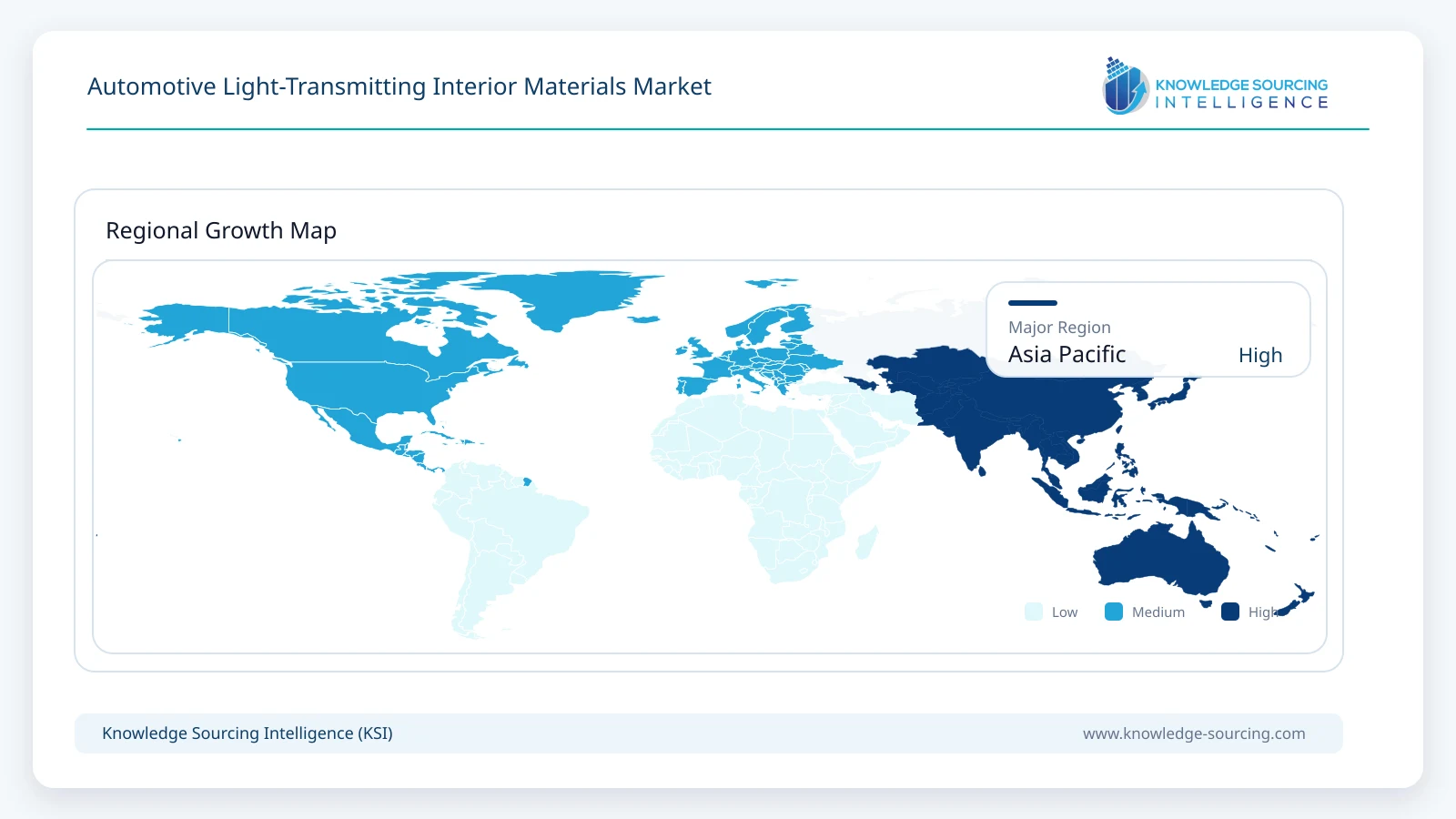
- 6Asia Pacific represents approximately 47% of global market value in 2026, supported by China's fast smart-cabin development cycle and the region's large automotive plastics, lighting and interior-systems supply base.
The value pool is driven by materials whose optical properties are intentionally engineered for interior illumination, information display or concealed functionality rather than by conventional decorative trim alone.
Polycarbonate and PC-based compounds form the largest material family because they combine high light transmission, impact resistance, colorability and compatibility with complex injection-molded geometries. PMMA remains important in high-optical-quality light guides and decorative elements, while flexible TPU/PU systems, translucent films and coated textiles are gaining share as lighting migrates from rigid switches into soft and curved cabin surfaces.
Demand increasingly comes from door panels, instrument panels, center consoles, hidden controls, illuminated symbols, accent-light channels, headliners and other trim surfaces where light must remain invisible when inactive or uniformly distributed when activated. The market excludes LEDs, light engines, wiring, controllers, displays and the full value of finished illuminated trim modules where the material itself is only one component.
Market Overview
Light-transmitting interior materials sit between the light source and the occupant-facing cabin surface. Their role is to control how light passes through a component, whether the design objective is crystal-clear transmission, uniform diffusion, a disappearing symbol, a soft illuminated textile or a continuous decorative light line. Optical performance therefore has to be engineered together with color, grain, gloss, haptics, scratch resistance and crash requirements.
The material stack varies by application. Rigid components may use clear or diffusing PC, PMMA or specialty polyamide in molded light guides, lenses and decorated inserts. Soft surfaces can use translucent PU skins, synthetic leather, coated textiles or perforated fabrics over diffusion layers. Films may provide graphics, color control, opacity when unlit and selective transmission when backlit.
The strongest commercial shift is from small illuminated buttons toward larger multifunctional surfaces. Door trim, consoles and instrument panels increasingly combine decoration, touch sensing, lighting and information in one area, raising material requirements for optical homogeneity, thin-wall processing, adhesion, chemical resistance and long-term color stability.
Market Trends
Hidden-Until-Lit Surfaces Are Expanding beyond Conventional Switchgear
Backlit symbols are moving from individual buttons into broad decorative surfaces that appear visually continuous when inactive. Translucent skins, films and molded resins can conceal graphics or controls until light is activated, helping OEMs reduce visible switch clutter.
This design direction increases demand for materials with tightly controlled transmission and hiding power so daytime appearance remains premium without weakening nighttime legibility.
Flexible Light Guides Are Opening New Interior Packaging Options
Traditional rigid PMMA and PC light guides remain important, but flexible optical materials are creating new opportunities around curved doors, consoles, seats and roof structures. BASF's 2026 work on transparent Elastollan TPU light guides illustrates the push toward optical materials that can tolerate bending, vibration and tight installation envelopes.
Flexible materials also help reduce squeak-and-rattle risk where illuminated elements interface with moving or soft trim surfaces.
Optics, Haptics and Surface Durability Are Being Engineered as One Stack
Material selection is no longer based on light transmission alone. An illuminated door or console surface may need a clear optical core, a decorated film, a structural backing and a scratch-resistant coating while still meeting crash, chemical and UV requirements.
Covestro and Yanfeng have demonstrated series-ready multi-material door-panel concepts combining transparent polycarbonate, structural PC/ABS, a translucent film insert and in-mold surface finishing.
Recycled and Lower-Carbon Optical Polymers Are Moving into Design Decisions
Optical applications historically favored virgin material because clarity, color consistency and surface quality are difficult to maintain with recycled feedstock. Suppliers are now extending circular material portfolios into transparent and decorative grades.
Röhm's PLEXIGLAS proTerra portfolio and broader industry work on circular PC and PMMA point toward lower-carbon light guides and decorative optical parts as recycled-content requirements strengthen.
Interior Lighting Is Becoming a Communication Layer
Light is increasingly used to communicate warnings, driving modes, charging status, navigation cues and occupant-specific information rather than only create ambience. This expands the role of diffusing and selectively transmitting materials in HMI design.
As software-defined cockpits coordinate lighting with sensors and vehicle state, material consistency becomes critical because the surface must reproduce the same color, brightness and icon definition across different functions.
Segment Analysis
By Material Type: Polycarbonate and PC-Based Materials
Polycarbonate and PC-based materials lead the market because they combine high optical transmission with impact resistance, dimensional stability and processability in complex interior parts. They are used in molded light guides, illuminated trim inserts, transparent carriers, backlit icons and multi-shot structures where PMMA may not provide sufficient toughness.
The material family accounts for approximately USD 0.84 billion in 2026 and could approach USD 1.46 billion by 2031. Its share is expected to ease modestly as flexible TPU/PU systems and translucent films expand, but PC remains central to high-volume rigid illuminated interior components.
By Material Form: Resins and Optical Compounds
Resins and optical compounds are the largest material form because injection molding is the primary route for light guides, transparent carriers, diffusing features and illuminated structural inserts. Automotive grades increasingly combine high flow, controlled diffusion, UV stability and color consistency.
This form represents approximately USD 1.25 billion in 2026. Films, sheets and coated surface layers are expected to gain share faster through 2031 as smart surfaces require thinner decorative and optical stacks over larger areas.
By Optical Function: High-Transmission and Transparent Materials
High-transmission materials remain the largest optical-function category because they maximize light efficiency in guides, lenses, clear carriers and deep-effect illuminated structures. PC, PMMA, specialty polyamide and TPU grades are selected according to heat, flexibility, impact and chemical requirements.
The category accounts for approximately USD 0.73 billion in 2026. Translucent hidden-until-lit and diffusion materials will grow faster as OEMs prioritize uniform large-area illumination over visibly clear optical parts.
By Application: Door and Side-Trim Surfaces
Door and side trim represents the largest application because these surfaces offer broad visual area and are increasingly used for ambient lighting, safety warnings, animated patterns and concealed controls. The application can combine molded optical features with translucent skins, decorative films and soft coverings.
Door and side-trim material demand is estimated at approximately USD 0.66 billion in 2026 and could exceed USD 1.20 billion by 2031 as dynamic lighting moves into higher-volume vehicle classes.
By Vehicle Type: Passenger Vehicles
Passenger vehicles dominate because interior lighting is used as a design, comfort and HMI differentiator across premium and increasingly mainstream cars, SUVs and MPVs. Chinese EV manufacturers have accelerated adoption of illuminated doors, consoles, dashboard surfaces and roof treatments.
Passenger vehicles account for approximately USD 2.07 billion in 2026. Commercial-vehicle applications remain smaller but are expanding in premium buses, vans and driver-cab interfaces.
Market Drivers
Expansion of Ambient and Functional Interior Lighting
Ambient lighting is moving from narrow accent strips to broader illuminated surfaces, animated patterns and configurable zones. Larger illuminated areas directly increase demand for diffusing resins, films, light guides and translucent coverings.
The shift is strongest in premium and EV platforms but is spreading downward as LED costs fall and common cockpit electronics support more lighting channels.
Smart-Surface HMI and Hidden Control Integration
OEMs are reducing visible mechanical controls and embedding icons, touch zones and information behind decorative surfaces. These architectures require materials that remain visually opaque or decorative when inactive but transmit defined light when needed.
The result is a higher-value material stack in doors, consoles and instrument panels, especially where light, touch sensing and haptic feedback share one surface.
EV-Led Cabin Differentiation and Premiumization
Electric vehicles give OEMs greater freedom to differentiate through the interior because powertrain layouts and brand signatures are changing simultaneously. Lighting, color animation and digital HMI have become visible ways to create a distinct cabin identity.
Chinese EV and premium global platforms are therefore important early adopters of large-area translucent materials and dynamic lighting effects.
Advances in Multi-Material Molding and Surface Processing
Multi-shot molding, in-mold decoration, direct coating, laser structuring and optical simulation make it easier to combine clear, diffusing, structural and decorative layers in one production part. These processes reduce fasteners, secondary finishing and tolerance chains.
Improved integration lowers the packaging penalty of illuminated surfaces and supports broader adoption across high-volume platforms.
Circularity and Lower-Carbon Material Requirements
Automotive recycled-content requirements are increasingly influencing transparent and decorative polymers, not only hidden structural plastics. Europe is moving toward binding recycled-plastic content for new vehicles, raising pressure on optical-grade suppliers to offer circular alternatives.
Materials that preserve clarity, diffusion and color consistency while incorporating recycled or certified renewable feedstock can capture a premium as OEMs reduce interior material footprints.
Market Restraints
Balancing Light Transmission with Daytime Surface Appearance
High transmission can make internal electronics, LEDs or structural features visible when the system is off, while excessive hiding power reduces nighttime brightness. Achieving the correct balance requires careful pigment, film and surface engineering.
This challenge becomes harder across large areas where minor thickness or color variations can create visible brightness differences.
Scratch, UV and Chemical Durability Requirements
Interior optical surfaces must retain appearance after repeated contact with cleaners, sunscreen, skin oils and abrasion while also tolerating sunlight and elevated cabin temperatures. Clear and high-gloss materials can reveal scratches more readily than conventional grained trim.
Coatings and hard-surface technologies improve durability but add cost and can complicate recycling.
Higher Material and Processing Cost
Optical-grade PC, PMMA, specialty TPU and decorated films generally cost more than standard interior polypropylene or ABS. Multi-shot molding, optical tooling and controlled surface finishing also increase process complexity.
Cost pressure can restrict large-area implementation to premium models unless suppliers combine lighting, HMI and decoration in a way that replaces separate parts.
Optical Hotspots and Thermal Management
Thin light guides and large backlit surfaces can develop hotspots, color shift or non-uniform brightness if LEDs, textures and diffusion are not carefully tuned. Heat from light sources and electronics can also change long-term optical performance.
Material selection therefore has to be validated with the full lighting architecture rather than as an isolated trim specification.
Recycling Complexity in Multi-Layer Decorative Systems
Many illuminated surfaces combine polymers, inks, coatings, textiles, adhesives and electronics. These stacks can be difficult to separate at end of life even when the individual optical polymer is recyclable.
Mono-material designs, compatible coatings and simplified film structures are gaining attention, but they must still meet premium appearance and optical-control requirements.
Regional Outlook
Asia Pacific
Asia Pacific is the largest regional market in 2026, supported by vehicle production scale and rapid smart-cabin adoption in China, Japan and South Korea. Chinese EV manufacturers in particular use ambient lighting, illuminated door trim and large digital surfaces as visible differentiation features, accelerating demand for optical PC, PMMA, films and translucent surface materials.
The region also benefits from a dense electronics, lighting, plastics and interior-systems supply chain. Growth through 2031 will come from higher content per vehicle and migration of illuminated-surface technology from premium EVs into broader price bands.
Europe
Europe remains a high-value market because premium interiors, strong design differentiation and stringent material sustainability requirements favor advanced optical polymers and recyclable translucent surfaces. German and other European OEMs are active users of hidden-until-lit controls, ambient lighting and decorative light guides.
The region will also influence material architecture through recycled-content policy and end-of-life requirements. Suppliers able to combine optical quality with lower-carbon PC, PMMA, TPU and surface films are positioned to benefit even if regional vehicle production grows slowly.
Competitive Landscape
The competitive landscape combines global polymer producers, specialty optical-material suppliers, surface-material companies and large interior-system integrators. Covestro, SABIC, Röhm and BASF compete through transparent and diffusing engineering polymers, while Continental's surface business adds translucent soft-surface materials for hidden functionality.
Yanfeng, FORVIA and Antolin influence material adoption through production-ready illuminated trim, smart surfaces and backlit hard- and soft-trim systems. Their ability to industrialize multi-material stacks creates an important bridge between resin suppliers and OEM design requirements.
Competitive advantage increasingly depends on optical consistency, surface durability, integration with decoration and touch technologies, recyclable material options and the ability to support vehicle-specific optical simulation and high-volume processing.
Recent Developments
17 September 2026: BASF announced transparent Elastollan TPU light-guide solutions for automotive interior and exterior lighting, highlighting flexible optical performance, durability and reduced squeak risk in integrated components.
13 August 2026: Röhm introduced its PLEXIGLAS proTerra mobility portfolio combining established PMMA optical performance with mechanically recycled or certified sustainable feedstock options for applications including light guides and decorative trim.
2 April 2026: Covestro, Marquardt and E Ink presented a design-integrated automotive door surface using a transparent waterborne PU coating over a dynamic e-paper element, demonstrating how functional visual content can remain embedded behind premium synthetic surface materials.
8 January 2026: Toyoda Gosei announced Dynamic Shadowy Illumination for the Lexus RZ, using controlled interior light projection to create moving patterns and reinforcing OEM demand for materials that support increasingly complex cabin-light distribution.
During 2025-2026: Yanfeng and Covestro demonstrated a series-production door panel using transparent Makrolon polycarbonate, Bayblend structural material and a translucent film insert for dynamic interior lighting; the component received first prize in the Electrical/Optical Parts category at the 2025 SPE Automotive Award.
In its 2025 integrated reporting cycle, SABIC highlighted new translucent polypropylene resins for automotive ambient-lighting applications alongside expanded polycarbonate and PMMA lighting materials.
Market Outlook
The automotive light-transmitting interior materials market is projected to experience significant growth during the forecast period. Polycarbonate and PC blends will remain the largest material family, while flexible TPU/PU optical materials, decorative films and light-permeable surface layers grow faster as lighting spreads across curved and soft cabin surfaces.
The most important structural shift will be from discrete illuminated components toward integrated surfaces that combine decoration, light diffusion, concealed graphics and HMI. This raises material value per application even when LED hardware becomes cheaper because optical performance is increasingly embedded in the trim material itself.
Asia Pacific will remain the largest regional market, with Europe maintaining a strong position in premium design and circular-material development. Supplier success will depend on optical homogeneity, thin-wall processing, long-term durability, color consistency and the ability to provide lower-carbon materials without compromising light transmission.
Automotive Light-Transmitting Interior Materials Market Scope
| Report Metric | Details |
|---|---|
| Total Market Size in 2026 | USD 2.20 billion |
| Total Market Size in 2031 | USD 4.05 billion |
| Forecast Unit | Billion |
| Growth Rate | 13.0% |
| Study Period | 2021 to 2031 |
| Historical Data | 2021 to 2024 |
| Base Year | 2025 |
| Forecast Period | 2026 – 2031 |
| Segmentation | Material Type, Material Form, Optical Function, Application, Vehicle Type, Geography |
| Companies |
|
Market Segmentation
By Material Type
Polycarbonate and PC-Based Materials
PMMA and Acrylic Materials
TPU, PU and Other Flexible Translucent Polymers
Light-Transmitting Films, Skins and Coated Textiles
Specialty Polyamides and Other Optical Materials
By Material Form
Resins and Optical Compounds
Films and Sheets
Coated Skins and Textiles
Specialty Light-Guide and Optical Elements
By Optical Function
High-Transmission and Transparent Materials
Light-Diffusing and Homogenizing Materials
Hidden-Until-Lit and Translucent Decorative Materials
Selective-Transmission and Specialty Optical Materials
By Application
Door and Side Trim
Instrument Panel and Center Console
Switches, Controls and Hidden HMI
Ambient and Functional Light Guides
Headliner, Seat and Other Interior Surfaces
By Vehicle Type
Passenger Vehicles
Light Commercial Vehicles
Medium and Heavy Commercial Vehicles and Buses
By Geography
North America
United States
Canada
Mexico
South America
Brazil
Argentina
Others
Europe
Germany
United Kingdom
France
Italy
Spain
Others
Middle East and Africa
Saudi Arabia
UAE
South Africa
Others
Asia Pacific
China
Japan
South Korea
India
Indonesia
Thailand
Others
Table of Contents
1. INTRODUCTION
1.1. Market Overview
1.2. Market Definition
1.3. Scope of the Study
1.4. Market Segmentation
1.5. Currency
1.6. Assumptions
1.7. Base and Forecast Years
1.8. Key Benefits to Stakeholders
2. RESEARCH METHODOLOGY
2.1. Research Design
2.2. Secondary Research
2.3. Primary Research
2.4. Market Estimation
2.5. Segment Modelling
2.6. Data Triangulation and Validation
3. EXECUTIVE SUMMARY
3.1. Key Findings
3.2. Automotive Light-Transmitting Interior Materials Market Size, 2026-2031
3.3. Material Type Outlook
3.4. Material Form Outlook
3.5. Optical Function Outlook
3.6. Application Outlook
3.7. Vehicle Type Outlook
3.8. Regional Opportunity Summary
4. MARKET DYNAMICS
4.1. Market Drivers
4.1.1. Expansion of Ambient and Functional Interior Lighting
4.1.2. Smart-Surface HMI and Hidden Control Integration
4.1.3. EV-Led Cabin Differentiation and Premiumization
4.1.4. Advances in Multi-Material Molding and Surface Processing
4.1.5. Circularity and Lower-Carbon Material Requirements
4.2. Market Restraints
4.2.1. Balancing Light Transmission with Daytime Surface Appearance
4.2.2. Scratch, UV and Chemical Durability Requirements
4.2.3. Higher Material and Processing Cost
4.2.4. Optical Hotspots and Thermal Management
4.2.5. Recycling Complexity in Multi-Layer Decorative Systems
4.3. Market Opportunities
4.4. Porter's Five Forces Analysis
4.5. Industry Value Chain Analysis
4.6. Optical Performance, Surface Quality and Cost Trade-Offs
4.7. Automotive Interior Emissions, Recycled Content and End-of-Life Requirements
5. TECHNOLOGY OUTLOOK
5.1. Optical-Grade Polycarbonate and PC Blends
5.2. PMMA and Acrylic Optical Materials
5.3. Transparent and Translucent TPU/PU Materials
5.4. Semi-Transparent Polyamide and Specialty Engineering Polymers
5.5. Light-Diffusing Additives and Optical Compounds
5.6. Translucent Decorative Films and Sheets
5.7. Light-Permeable Skins, Artificial Leather and Coated Textiles
5.8. Rigid and Flexible Light-Guide Materials
5.9. Hidden-Until-Lit and Selective-Transmission Surface Technologies
5.10. Multi-Shot Molding, In-Mold Decoration and Direct Coating
5.11. Laser Structuring, Perforation and Optical Patterning
5.12. Optical Simulation, Color Management and Surface Validation
6. AUTOMOTIVE LIGHT-TRANSMITTING INTERIOR MATERIALS MARKET BY MATERIAL TYPE
6.1. Introduction
6.2. Polycarbonate and PC-Based Materials
6.3. PMMA and Acrylic Materials
6.4. TPU, PU and Other Flexible Translucent Polymers
6.5. Light-Transmitting Films, Skins and Coated Textiles
6.6. Specialty Polyamides and Other Optical Materials
7. AUTOMOTIVE LIGHT-TRANSMITTING INTERIOR MATERIALS MARKET BY MATERIAL FORM
7.1. Introduction
7.2. Resins and Optical Compounds
7.3. Films and Sheets
7.4. Coated Skins and Textiles
7.5. Specialty Light-Guide and Optical Elements
8. AUTOMOTIVE LIGHT-TRANSMITTING INTERIOR MATERIALS MARKET BY OPTICAL FUNCTION
8.1. Introduction
8.2. High-Transmission and Transparent Materials
8.3. Light-Diffusing and Homogenizing Materials
8.4. Hidden-Until-Lit and Translucent Decorative Materials
8.5. Selective-Transmission and Specialty Optical Materials
9. AUTOMOTIVE LIGHT-TRANSMITTING INTERIOR MATERIALS MARKET BY APPLICATION
9.1. Introduction
9.2. Door and Side Trim
9.3. Instrument Panel and Center Console
9.4. Switches, Controls and Hidden HMI
9.5. Ambient and Functional Light Guides
9.6. Headliner, Seat and Other Interior Surfaces
10. AUTOMOTIVE LIGHT-TRANSMITTING INTERIOR MATERIALS MARKET BY VEHICLE TYPE
10.1. Introduction
10.2. Passenger Vehicles
10.3. Light Commercial Vehicles
10.4. Medium and Heavy Commercial Vehicles and Buses
11. AUTOMOTIVE LIGHT-TRANSMITTING INTERIOR MATERIALS MARKET BY GEOGRAPHY
11.1. North America
11.1.1. United States
11.1.2. Canada
11.1.3. Mexico
11.2. South America
11.2.1. Brazil
11.2.2. Argentina
11.2.3. Others
11.3. Europe
11.3.1. Germany
11.3.2. United Kingdom
11.3.3. France
11.3.4. Italy
11.3.5. Spain
11.3.6. Others
11.4. Middle East and Africa
11.4.1. Saudi Arabia
11.4.2. UAE
11.4.3. South Africa
11.4.4. Others
11.5. Asia Pacific
11.5.1. China
11.5.2. Japan
11.5.3. South Korea
11.5.4. India
11.5.5. Indonesia
11.5.6. Thailand
11.5.7. Others
12. COMPETITIVE ENVIRONMENT AND ANALYSIS
12.1. Major Players and Strategy Analysis
12.2. Market Share Analysis
12.3. Optical Material Portfolio Benchmarking
12.4. Transmission, Diffusion and Hidden-Until-Lit Performance Benchmarking
12.5. Material Durability and Processability Benchmarking
12.6. Circular and Lower-Carbon Optical Material Benchmarking
12.7. OEM Interior-Lighting and Smart-Surface Program Exposure
12.8. Competitive Dashboard
13. COMPANY PROFILES
13.1. Covestro AG
13.2. SABIC
13.3. Röhm GmbH
13.4. BASF SE
13.5. Continental AG
13.6. Yanfeng Automotive Interiors
13.7. FORVIA
13.8. Antolin
13.9. Toyoda Gosei Co., Ltd.
14. APPENDIX
14.1. Currency
14.2. Assumptions
14.3. Base and Forecast Years Timeline
14.4. Key Benefits for Stakeholders
14.5. Research Methodology
14.6. Abbreviations
14.7. Data Sources
Navigate
Trusted by the world's leading organizations











