
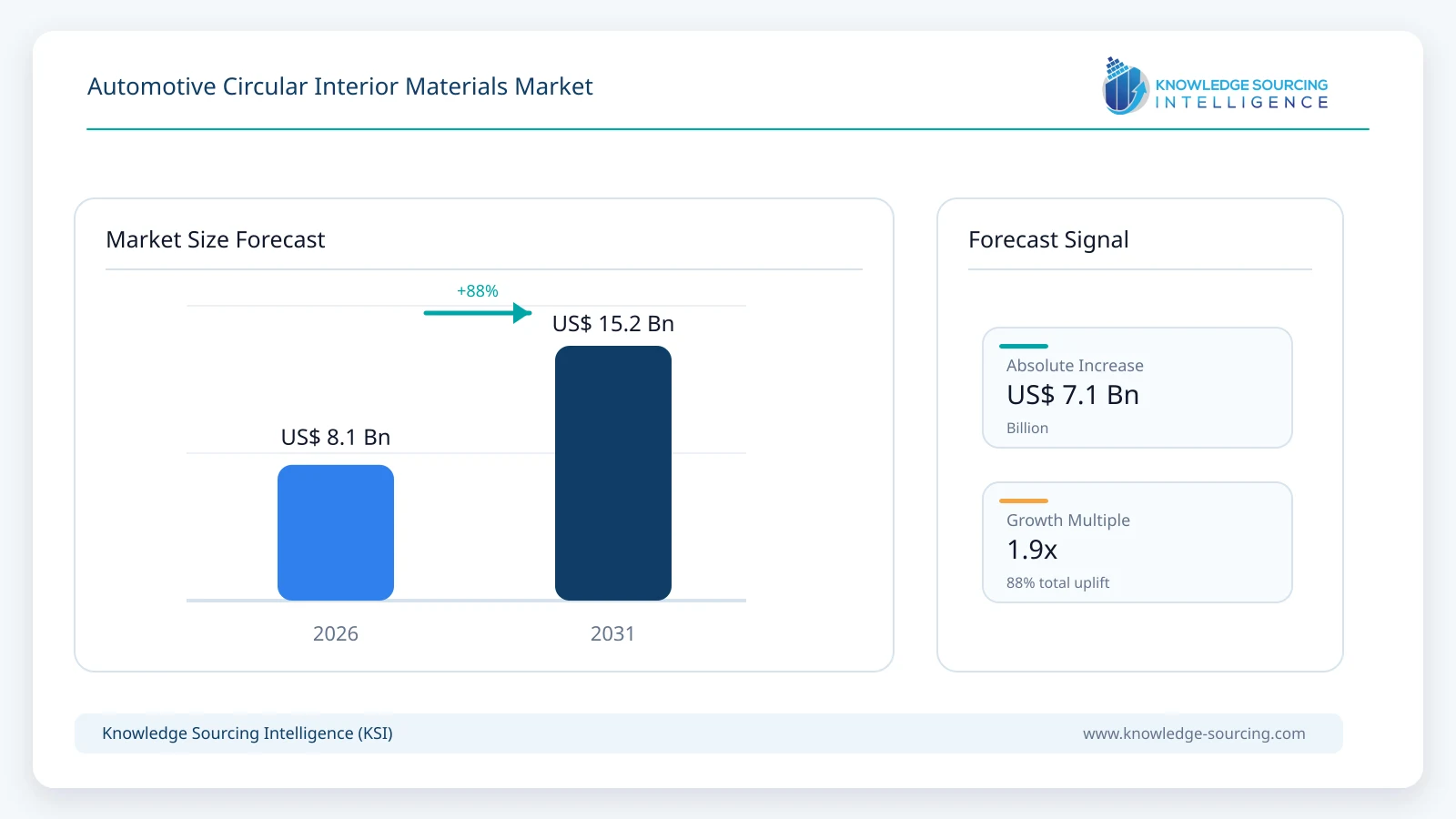
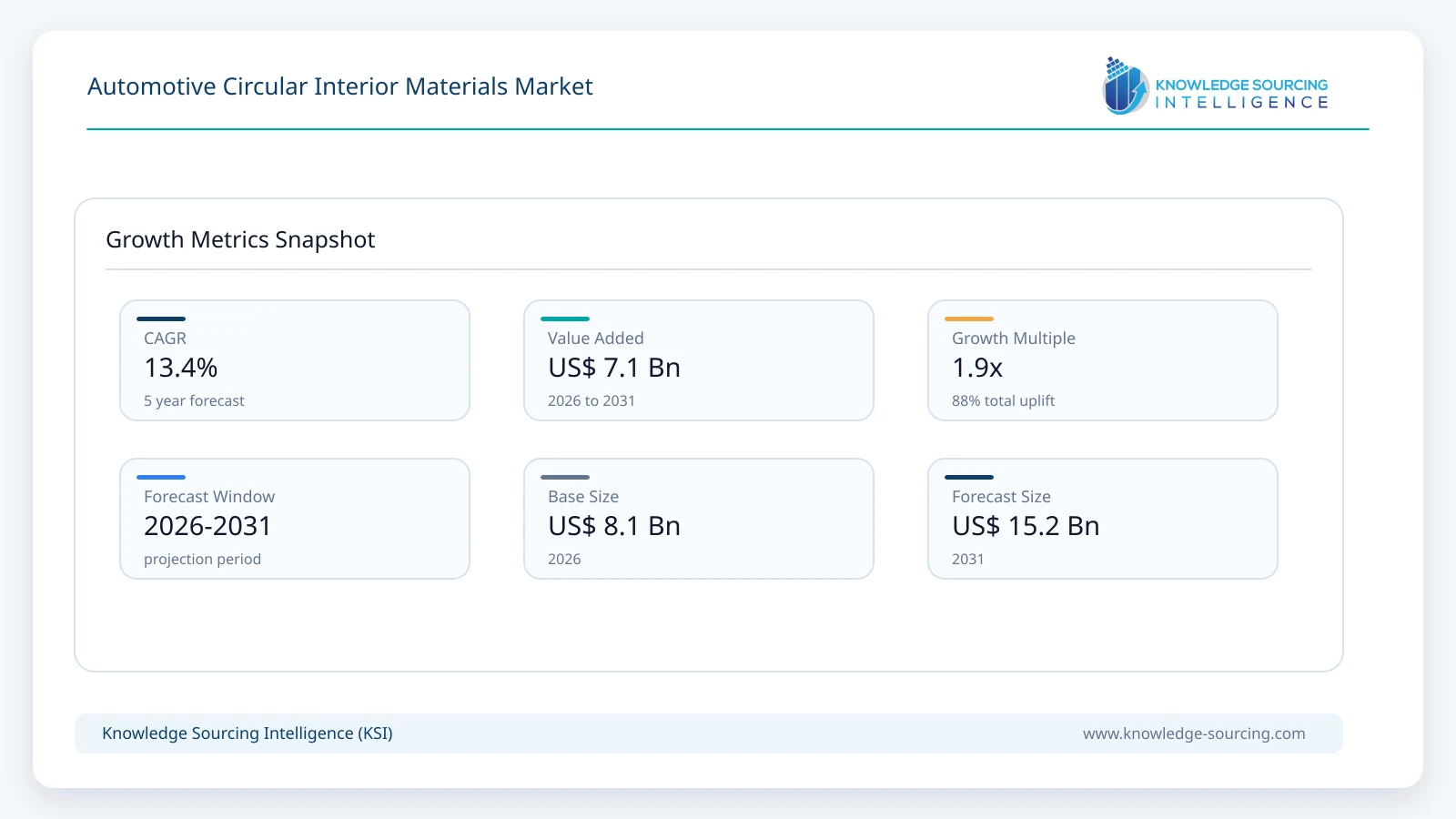
The Automotive Circular Interior Materials Market is forecast to grow at a CAGR of 13.4%, reaching USD 15.2 billion in 2031 from USD 8.1 billion in 2026.
Highlights:
- 1Recycled and secondary-content polymers account for approximately 38% of global market value in 2026 because thermoplastics represent a large share of interior substrates, carriers, decorative components and structural trim.
- 2Recycled-content substitution is the largest circularity approach, representing approximately 53% of 2026 market value, while mono-material design and closed-loop automotive recycling are growing faster.
- 3Seats and upholstery account for approximately 29% of 2026 demand because seat systems combine large volumes of textiles, foams, plastics and structural materials with significant opportunities for recycled content and easier disassembly.
- 4Door trim represents approximately 21% of market value in 2026, supported by recycled polypropylene, natural-fiber composites, recyclable skins, recycled fabrics and growing mono-material development.
- 5Passenger vehicles account for approximately 94% of global market value in 2026, reflecting their dominant production volume and the strongest OEM activity around low-carbon and circular cabin materials.
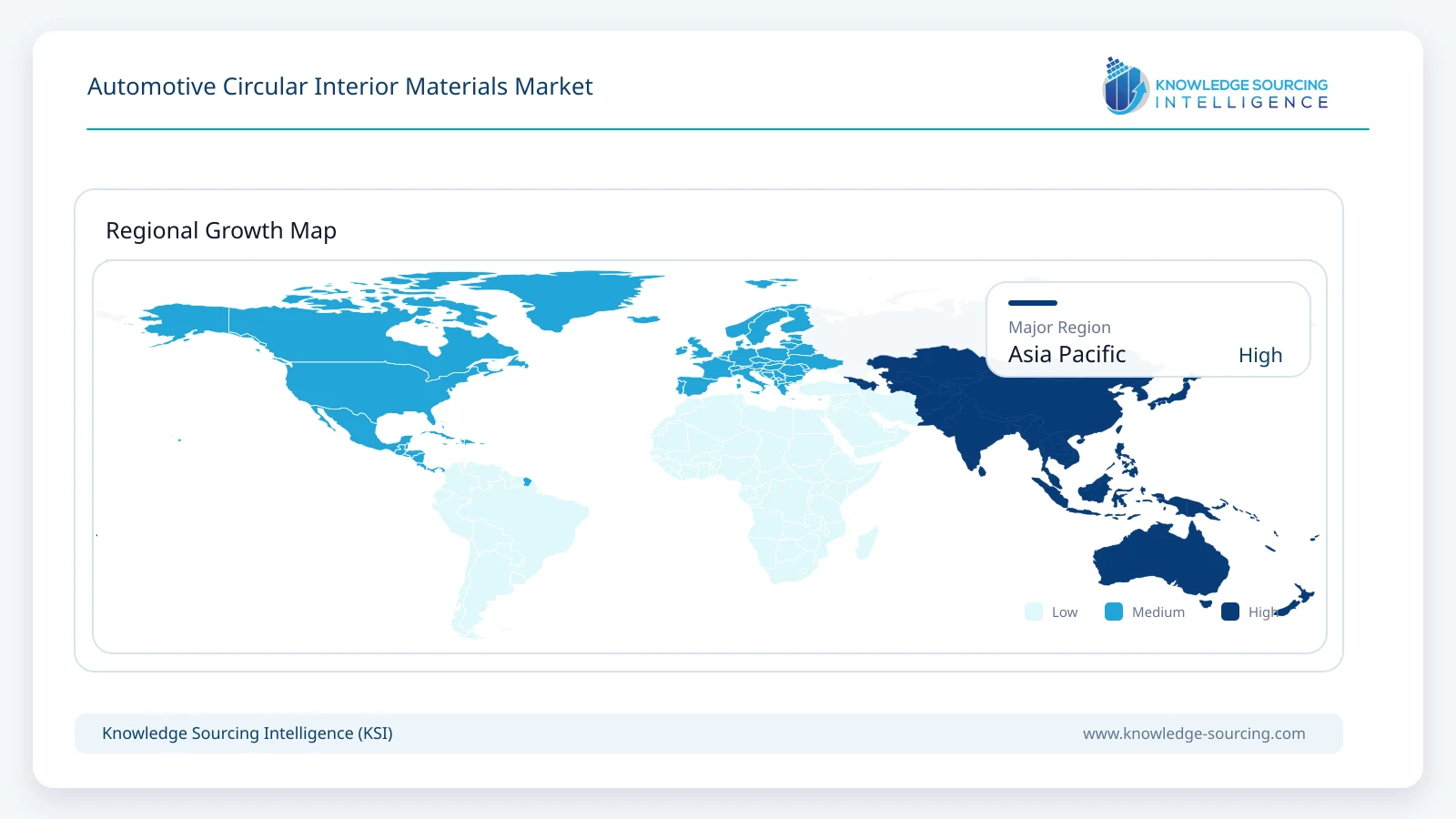
- 6Asia Pacific represents approximately 43% of global market value in 2026, while Europe generates the highest circular-material intensity per vehicle through recycled-content targets, design-for-circularity programs and advanced end-of-life regulation.
Circularity is changing automotive interior material selection from a simple question of cost, appearance and durability into a broader decision about feedstock origin, disassembly, recovery and second-life value.
Recycled thermoplastics form the largest material pool because polypropylene, PET, ABS, PC/ABS and related resins are widely used in trim carriers, decorative parts, consoles and interior structures. Recycled textiles and fibers are also expanding rapidly across seat covers, headliners, carpets and soft trim, while mono-material and easy-to-disassemble constructions are becoming more important as OEMs look beyond recycled content toward actual end-of-life recovery.
The market measures the attributable value of materials that provide a defined circularity benefit through recycled content, recyclability, material-loop closure, reuse or circular feedstock. The full value of finished seats, trim modules or cockpit assemblies is excluded, as are virgin low-carbon materials, certified wood and other sustainability-oriented materials that do not provide a clear circularity pathway.
Market Overview
| Report Metric | Details |
|---|---|
| Total Market Size in 2026 | USD 8.1 billion |
| Total Market Size in 2031 | USD 15.2 billion |
| Forecast Unit | USD Billion |
| Growth Rate | 13.4% |
| Study Period | 2021 to 2031 |
| Historical Data | 2021 to 2024 |
| Base Year | 2025 |
| Forecast Period | 2026 – 2031 |
| Segmentation | Material Source, Circularity Approach, Application, Material Type |
| Companies |
|
The interior is one of the more difficult areas of a vehicle to recycle because soft trim, foams, textiles, films, adhesives, coatings and multiple polymer families are often permanently combined to achieve comfort and appearance. These constructions perform well during vehicle use but can lose material value at end of life because shredding produces mixed streams that are difficult to return to high-quality automotive applications.
Circular material development is therefore moving along two parallel paths. The first replaces virgin feedstock with recycled polymers, recovered textiles or other secondary materials, while the second redesigns components so those materials can be separated and recovered more efficiently when the vehicle is dismantled.
The strongest circularity strategies combine both approaches. Mono-material door panels, modular seats, recyclable thermoplastic skins and chemically or mechanically recovered polymer streams can lower primary-resource demand during production while also creating a more credible route for the same material to re-enter future vehicle or industrial products.
Market Trends
Design for Disassembly Is Moving into Series-Production Interior Components
Interior suppliers are redesigning seats and trim so individual material blocks can be separated more quickly at end of life instead of entering mixed shredder residue. Toyota Boshoku's TBlocks seat, adopted on the new Lexus ES, uses a block structure that improves disassembly and separation while reducing urethane content.
This approach changes circularity from a material-purchasing decision into a product-architecture requirement, increasing the importance of fasteners, joining methods and material-family selection during the early design stage.
Mono-Material Interior Structures Are Reducing Separation Requirements
Using one polymer family across the carrier, surface and supporting layers can allow an interior component to enter recycling with less manual separation and lower contamination. Mercedes-Benz is developing polyolefin-family dashboard structures and recycled-PET mono-sandwich components, while Antolin has demonstrated polypropylene-based fully recyclable trim solutions.
The commercial challenge is preserving premium grain, softness, impact performance and acoustic behavior without returning to mixed-material stacks that are difficult to recover.
Post-Consumer Automotive Plastics Are Becoming More Viable Feedstock
Higher-quality sorting, solvent-based purification and improved compounding are expanding the range of secondary plastics that can meet automotive odor, VOC, color and mechanical requirements. Yanfeng has highlighted circular interior-material concepts that create additional second-life opportunities for mixed PC/ABS waste used in instrument panels, door panels and floor consoles.
Closed-loop feedstock remains more difficult than using clean industrial scrap, but OEM and recycler partnerships are increasing because end-of-life vehicles represent a strategically important future source of polymers.
Recycled Textiles Are Moving from Hidden Layers to Visible Surfaces
Recycled PET and other recovered fibers are increasingly used in seat fabrics, headliners, carpets, and decorative textiles where the material remains visible to the customer. The new BMW i3 uses recycled-material yarn for the headliner and A-pillar textile and offers recyclable Econeer seat covers with an upper fabric made from recycled PET.
Visible applications raise the quality threshold because circular textiles must match virgin materials in color stability, abrasion resistance, touch, odor, and perceived premium quality.
Circularity Is Shifting from Recycled Content toward Closed Material Loops
Purchasing recycled resin lowers virgin-resource demand, but it does not by itself ensure that the new component can be recovered again at the end of the vehicle's life. BMW's Car2Car work and OEM-recycler partnerships are therefore focusing increasingly on whether material from an end-of-life vehicle can return at sufficient quality for new automotive or other high-value applications.
This shift will favor traceable material streams, simpler polymer combinations and component designs that preserve material purity rather than relying only on headline recycled-content percentages.
Segment Analysis
By Material Source: Recycled and Secondary-Content Polymers
Polypropylene, PET, ABS, PC/ABS, polyamide and other thermoplastics are used across door carriers, dashboards, consoles, seat components, carpets and decorative trim, giving recycled polymers the widest addressable base. Mechanical recycling remains the most established route, while solvent purification and chemical recycling are expanding the quality range of usable feedstocks.
Recycled and secondary-content polymers account for approximately USD 3.08 billion in 2026 and are projected to reach about USD 5.47 billion by 2031. Their market share remains substantial even as recyclable textiles and mono-material structures grow faster.
By Circularity Approach: Recycled-Content Substitution
Replacing virgin resin or fiber with secondary feedstock remains the largest circularity route because it can often be introduced without redesigning the complete interior component. OEMs and Tier 1 suppliers are increasing recycled polypropylene, PET and engineering-plastic content where odor, mechanical and surface requirements can be maintained.
Recycled-content substitution represents approximately USD 4.29 billion in 2026 and is projected to reach about USD 7.30 billion by 2031. Its share gradually declines as design-for-recycling, closed-loop and reuse-oriented approaches expand from a smaller base.
By Application: Seats and Upholstery
Seats offer one of the largest circular-material opportunities because they contain significant textile, foam, resin and structural content but are traditionally difficult to dismantle. Recycled fabrics can be introduced relatively quickly, while modular structures and recyclable foam or resin systems address the more difficult end-of-life challenge.
Seats and upholstery account for approximately USD 2.35 billion in 2026 and are projected to approach USD 4.45 billion by 2031 as recycled textiles, easy-disassembly structures and lower-urethane architectures expand.
By Material Type: Thermoplastics and Thermoplastic Composites
Thermoplastics lead the material mix because they can be remelted, mechanically recycled and reformulated more readily than many thermoset or permanently bonded interior materials. Polypropylene is particularly important in door panels, consoles and trim carriers, while PET is expanding across textiles, carpets and mono-material composite concepts.
Thermoplastics and thermoplastic composites account for approximately USD 3.48 billion in 2026 and could reach about USD 6.23 billion by 2031. Recyclable textiles and fiber-based constructions will grow faster, but thermoplastics retain the broadest application coverage.
By Vehicle Type: Passenger Vehicles
Passenger cars, SUVs and MPVs dominate demand because they represent the majority of vehicle production and contain the widest mix of visible trim, seating, textiles and comfort materials. Premium EVs also provide an early commercialization path for recycled and bio-circular materials because interior sustainability is often positioned as part of the vehicle's brand identity.
Passenger vehicles account for approximately USD 7.61 billion in 2026 and are projected to reach about USD 14.14 billion by 2031. Commercial vehicles provide a smaller but relevant opportunity in seat fabrics, floor coverings, panels and durable recycled polymers.
Market Drivers
OEM Recycled-Content Targets Are Moving Circular Materials into Core Sourcing
Automakers are setting higher targets for secondary material use as lifecycle emissions and primary-resource consumption become more important procurement metrics. The result is a larger recurring demand base for recycled polymers and textiles rather than isolated sustainability editions.
Supplier capability increasingly needs to include feedstock traceability, material qualification and stable access to secondary raw materials because recycled content must be available at automotive scale for the full production life of a vehicle program.
End-of-Life Vehicle Policy Is Increasing Pressure for Better Material Recovery
Regulators are moving the automotive industry toward stronger circularity requirements that cover recycled content, component dismantling and recovery of materials from end-of-life vehicles. Interior plastics and textiles are receiving more attention because they have historically been more difficult to recycle than metals.
Policy pressure strengthens the business case for mono-material design, reversible joining and higher-quality polymer sorting even when those changes do not immediately reduce component cost.
Lifecycle Carbon Reduction Favors Secondary Feedstocks
Producing polymers, textiles and fibers from recovered material can avoid part of the energy and process emissions associated with virgin feedstock, giving circular materials a direct role in vehicle lifecycle decarbonization. The advantage becomes larger when the secondary material can be reused repeatedly without substantial loss of quality.
OEM carbon-accounting requirements are therefore increasing the value of verified recycled content and supplier-specific lifecycle data rather than treating circularity as a design narrative alone.
EV Interior Design Is Increasing Demand for Visible Sustainable Materials
Electric-vehicle manufacturers frequently use the cabin to communicate a broader sustainability position, making recycled textiles, natural fibers and visibly circular decorative materials part of the customer experience. This gives material innovation a commercial role in addition to its environmental value.
The strongest adoption occurs when recycled or circular materials deliver a distinctive texture or appearance without appearing lower quality than the virgin alternative.
Advances in Sorting, Compounding and Purification Are Improving Recyclate Quality
Mixed color, odor, VOC content and inconsistent mechanical performance have historically limited recycled plastics in visible automotive interiors. Improved sorting, deodorization, compatibilization and solvent-based purification are expanding the range of post-consumer materials that can satisfy vehicle-interior requirements.
Better material quality also supports higher recycled-content levels, allowing suppliers to move beyond hidden carriers and use secondary polymers in more demanding visible or structural applications.
Market Restraints
Recycled Feedstock Quality Remains Less Consistent than Virgin Material
Post-consumer polymers can vary in color, contamination, molecular weight, odor and mechanical performance depending on their source and prior use. Automotive interiors impose demanding requirements for VOCs, fogging, scratch resistance and long-term appearance, leaving limited tolerance for batch variation.
Suppliers often need additional sorting, compounding and testing to stabilize recovered material, which can reduce the apparent cost advantage of recycled feedstock.
Multi-Material Interior Components Remain Difficult to Separate
Soft-touch trim, seats and acoustic components frequently combine foams, textiles, films, adhesives and different polymer families to achieve comfort and premium appearance. Permanent bonding can make separation uneconomic even when each individual material is technically recyclable.
Design-for-disassembly can solve part of the problem, but changing joining methods or material stacks may require new tooling and extensive revalidation.
Closed-Loop Automotive Recyclates Are Not Yet Available at Full Scale
Using industrial scrap or recycled packaging material is easier than recovering interior polymers from end-of-life vehicles and returning them to new car production at stable quality. Dismantling infrastructure, sorting economics and contamination control remain uneven between regions.
Closed-loop automotive content will therefore grow from a smaller base even though it represents the strongest long-term circularity model.
Premium Surface Requirements Can Restrict Material Substitution
Visible interior surfaces must retain consistent grain, gloss, color, touch and aging performance for many years. Some recycled streams perform well structurally but remain difficult to use in high-appearance applications without additional coatings or virgin blending.
These constraints can lower the effective recycled share and create a trade-off between circularity, visual quality and process complexity.
Circular Materials Can Carry Higher Near-Term Cost
High-quality secondary feedstock, dedicated sorting, certification and small-volume advanced recycling processes can cost more than established virgin material supply chains. The economics are especially challenging when recycling infrastructure must be developed specifically for one component or polymer stream.
Cost parity should improve with scale and regulatory support, but OEMs will continue to prioritize circular materials that can be adopted without reducing manufacturing yield or increasing warranty risk.
Regional Outlook
Asia Pacific
Asia Pacific is the largest market by value because the region combines the world's largest vehicle-production base with large-scale manufacturing of seats, trim, textiles and polymer components. China, Japan and South Korea are increasing recycled-content use while also developing easier-to-disassemble seats, mono-material trim and circular PET applications.
Toyota Boshoku's TBlocks seat and PET circular-economy work demonstrate the shift toward product structures that improve recovery rather than relying only on recycled feedstock. China's rapid EV development cycle is also creating demand for recycled textiles, alternative skins and circular decorative materials that can be commercialized at high vehicle volumes.
Europe
Europe generates the highest circular-material intensity per vehicle because OEM sustainability targets, end-of-life regulation and premium material engineering are pushing recycled content and design-for-circularity into mainstream development programs. BMW, Mercedes-Benz, FORVIA and Antolin are advancing recyclable textiles, mono-material components, recycled polymers and easier-to-separate interior structures.
The region is also building closer links between automakers and recycling companies to recover higher-quality material from end-of-life vehicles. This gives Europe a strong position in closed-loop innovation even though its total vehicle-production volume remains below Asia Pacific.
Competitive Landscape
Competition spans interior Tier 1 suppliers, polymer and textile producers, recyclers and OEM material-development teams because circularity depends on both component design and feedstock availability. FORVIA, Antolin, Yanfeng and Toyota Boshoku compete through complete interior applications, while surface and material specialists support recycled polymers, recyclable skins, textile loops and natural-fiber composites.
The strongest differentiation is moving beyond a simple recycled-content percentage. Suppliers able to demonstrate mono-material design, reversible joining, closed-loop sourcing and stable automotive-grade recyclate quality are better positioned as OEMs measure circularity across the complete component lifecycle.
Long-term competitive advantage will depend on material traceability, disassembly speed, recycling yield, odor and VOC control, premium appearance and the ability to secure sufficient secondary feedstock for global vehicle programs. Partnerships with recyclers and waste-stream owners are therefore becoming strategically important alongside conventional material science.
Recent Developments
10 August 2026: BMW Group and its Car2Car consortium reported that high-quality material loops from end-of-life vehicles are technically feasible at industrial scale, providing a stronger basis for recovering automotive materials into higher-value secondary applications.
28 July 2026: Yanfeng released its 2025 ESG report, reporting a 35% increase in recycled plastic resin purchases and continuing work on circular automotive interior materials, recyclable surfaces and design-for-recycling.
11 June 2026: Toyota Boshoku announced series adoption of its TBlocks seat on the new Lexus ES, using a modular structure that improves disassembly and separation for recycling while reducing urethane usage.
14 May 2026: Toyota Boshoku presented TBlocks and its PET circular-economy initiatives for waste interior materials and components at the Automotive Engineering Exposition 2026 in Yokohama.
16 March 2026: BMW Group detailed the new BMW i3's Design for Circularity approach, including recyclable Econeer seat covers with recycled-PET upper fabric and recycled-material textile used for headliner and A-pillar applications.
13 November 2025: FORVIA announced that the Renault Clio 6 instrument panel and center console incorporate 40% recycled plastics while retaining automotive durability, surface quality and integrated interior functionality.
Market Outlook
Higher recycled-content targets, stricter end-of-life requirements and expanding design-for-disassembly practices are strengthening demand for circular interior materials across the automotive industry. Recycled polymers will remain the largest material category, while mono-material constructions, recyclable textiles and closed-loop vehicle-derived feedstocks gain traction. Automakers and material suppliers are increasingly prioritizing resource efficiency, waste reduction and improved material recovery throughout vehicle lifecycles. These developments are encouraging the adoption of sustainable interior components, including seating fabrics, door panels, dashboards and trim materials, while supporting the transition towards more recyclable and environmentally responsible automotive interior designs.
The market will gradually move from substituting virgin material toward designing components around future recovery. Seats, door trim and dashboards that can be dismantled quickly or processed within one polymer family are more likely to preserve material value than complex assemblies whose individual layers are technically recyclable but economically difficult to separate.
Asia Pacific is expected to remain the largest regional market by volume, while Europe continues to lead circular-material intensity and closed-loop development. Long-term supplier success will depend on stable recycled feedstock, automotive-grade material quality, low VOCs and odor, premium surface performance, traceability and credible evidence that the material can remain in productive use beyond a single vehicle lifecycle.
Market Segmentation
By Material Source
Recycled and Secondary-Content Polymers
Recycled Textiles and Fibers
Natural and Bio-Circular Materials
Recycled Foams and Fiber Composites
Other Circular Material Sources
By Circularity Approach
Recycled-Content Substitution
Mono-Material and Design-for-Recycling
Closed-Loop Automotive Recyclates
Bio-Circular Feedstocks
Reuse, Remanufacturing and Upcycling
By Application
Seats and Upholstery
Door Trim and Side Panels
Instrument Panel and Center Console
Headliner and Pillar Trim
Carpets, Floor Coverings and Luggage Areas
Other Interior Applications
By Material Type
Thermoplastics and Thermoplastic Composites
Textiles and Nonwoven Fibers
Foams and Fiber-Based Composites
Synthetic Leather and Alternative Surface Materials
Natural-Fiber and Other Circular Materials
By Vehicle Type
Passenger Vehicles
Light Commercial Vehicles
Medium and Heavy Commercial Vehicles and Buses
By Geography
North America
United States
Canada
Mexico
South America
Brazil
Argentina
Others
Europe
Germany
United Kingdom
France
Italy
Spain
Others
Middle East and Africa
Saudi Arabia
UAE
South Africa
Others
Asia Pacific
China
Japan
South Korea
India
Indonesia
Thailand
Others
Table of Contents
1. INTRODUCTION
1.1. Market Overview
1.2. Market Definition
1.3. Scope of the Study
1.4. Market Segmentation
1.5. Currency
1.6. Assumptions
1.7. Base and Forecast Years
1.8. Key Benefits to Stakeholders
2. RESEARCH METHODOLOGY
2.1. Research Design
2.2. Secondary Research
2.3. Primary Research
2.4. Market Estimation
2.5. Segment Modelling
2.6. Data Triangulation and Validation
3. EXECUTIVE SUMMARY
3.1. Key Findings
3.2. Automotive Circular Interior Materials Market Size, 2026-2031
3.3. Material Source Outlook
3.4. Circularity Approach Outlook
3.5. Application Outlook
3.6. Material Type Outlook
3.7. Vehicle Type Outlook
3.8. Regional Opportunity Summary
4. MARKET DYNAMICS
4.1. Market Drivers
4.1.1. OEM Recycled-Content Targets Are Moving Circular Materials into Core Sourcing
4.1.2. End-of-Life Vehicle Policy Is Increasing Pressure for Better Material Recovery
4.1.3. Lifecycle Carbon Reduction Favors Secondary Feedstocks
4.1.4. EV Interior Design Is Increasing Demand for Visible Sustainable Materials
4.1.5. Advances in Sorting, Compounding and Purification Are Improving Recyclate Quality
4.2. Market Restraints
4.2.1. Recycled Feedstock Quality Remains Less Consistent than Virgin Material
4.2.2. Multi-Material Interior Components Remain Difficult to Separate
4.2.3. Closed-Loop Automotive Recyclates Are Not Yet Available at Full Scale
4.2.4. Premium Surface Requirements Can Restrict Material Substitution
4.2.5. Circular Materials Can Carry Higher Near-Term Cost
4.3. Market Opportunities
4.4. Porter's Five Forces Analysis
4.5. Industry Value Chain Analysis
4.6. Circular Material Cost and Feedstock Economics
4.7. End-of-Life Vehicle, Recycled-Content and Material-Traceability Requirements
5. TECHNOLOGY OUTLOOK
5.1. Mechanical Polymer Recycling
5.2. Solvent-Based Polymer Purification
5.3. Chemical Recycling and Mass-Balance Feedstocks
5.4. Recycled PET and Textile Fiber Loops
5.5. Mono-Material Interior Structures
5.6. Easy-to-Disassemble Seats and Trim
5.7. Recyclable Thermoplastic Skins and Foams
5.8. Closed-Loop Automotive Plastic Recovery
5.9. Bio-Circular and Renewable-Carbon Materials
5.10. Natural-Fiber and Recyclable Composite Platforms
5.11. Material Identification, Traceability and Digital Product Data
5.12. Design for Repair, Reuse and Upcycling
6. AUTOMOTIVE CIRCULAR INTERIOR MATERIALS MARKET BY MATERIAL SOURCE
6.1. Introduction
6.2. Recycled and Secondary-Content Polymers
6.3. Recycled Textiles and Fibers
6.4. Natural and Bio-Circular Materials
6.5. Recycled Foams and Fiber Composites
6.6. Other Circular Material Sources
7. AUTOMOTIVE CIRCULAR INTERIOR MATERIALS MARKET BY CIRCULARITY APPROACH
7.1. Introduction
7.2. Recycled-Content Substitution
7.3. Mono-Material and Design-for-Recycling
7.4. Closed-Loop Automotive Recyclates
7.5. Bio-Circular Feedstocks
7.6. Reuse, Remanufacturing and Upcycling
8. AUTOMOTIVE CIRCULAR INTERIOR MATERIALS MARKET BY APPLICATION
8.1. Introduction
8.2. Seats and Upholstery
8.3. Door Trim and Side Panels
8.4. Instrument Panel and Center Console
8.5. Headliner and Pillar Trim
8.6. Carpets, Floor Coverings and Luggage Areas
8.7. Other Interior Applications
9. AUTOMOTIVE CIRCULAR INTERIOR MATERIALS MARKET BY MATERIAL TYPE
9.1. Introduction
9.2. Thermoplastics and Thermoplastic Composites
9.3. Textiles and Nonwoven Fibers
9.4. Foams and Fiber-Based Composites
9.5. Synthetic Leather and Alternative Surface Materials
9.6. Natural-Fiber and Other Circular Materials
10. AUTOMOTIVE CIRCULAR INTERIOR MATERIALS MARKET BY VEHICLE TYPE
10.1. Introduction
10.2. Passenger Vehicles
10.3. Light Commercial Vehicles
10.4. Medium and Heavy Commercial Vehicles and Buses
11. AUTOMOTIVE CIRCULAR INTERIOR MATERIALS MARKET BY GEOGRAPHY
11.1. North America
11.1.1. United States
11.1.2. Canada
11.1.3. Mexico
11.2. South America
11.2.1. Brazil
11.2.2. Argentina
11.2.3. Others
11.3. Europe
11.3.1. Germany
11.3.2. United Kingdom
11.3.3. France
11.3.4. Italy
11.3.5. Spain
11.3.6. Others
11.4. Middle East and Africa
11.4.1. Saudi Arabia
11.4.2. UAE
11.4.3. South Africa
11.4.4. Others
11.5. Asia Pacific
11.5.1. China
11.5.2. Japan
11.5.3. South Korea
11.5.4. India
11.5.5. Indonesia
11.5.6. Thailand
11.5.7. Others
12. COMPETITIVE ENVIRONMENT AND ANALYSIS
12.1. Major Players and Strategy Analysis
12.2. Market Share Analysis
12.3. Recycled Polymer Capability Benchmarking
12.4. Recycled Textile and Fiber Benchmarking
12.5. Mono-Material and Design-for-Disassembly Benchmarking
12.6. Closed-Loop and Feedstock Traceability Benchmarking
12.7. OEM Program and Series-Production Readiness
12.8. Competitive Dashboard
13. COMPANY PROFILES
13.1. FORVIA
13.2. Antolin
13.3. Yanfeng Automotive Interiors
13.4. Toyota Boshoku Corporation
13.5. Continental Surface Solutions
13.6. Motherson Group
13.7. International Automotive Components (IAC) Group
13.8. Adient plc
13.9. Lear Corporation
13.10. Autoneum Holding Ltd.
14. APPENDIX
14.1. Currency
14.2. Assumptions
14.3. Base and Forecast Years Timeline
14.4. Key Benefits for Stakeholders
14.5. Research Methodology
14.6. Abbreviations
14.7. Data Sources
Navigate
Trusted by the world's leading organizations











