
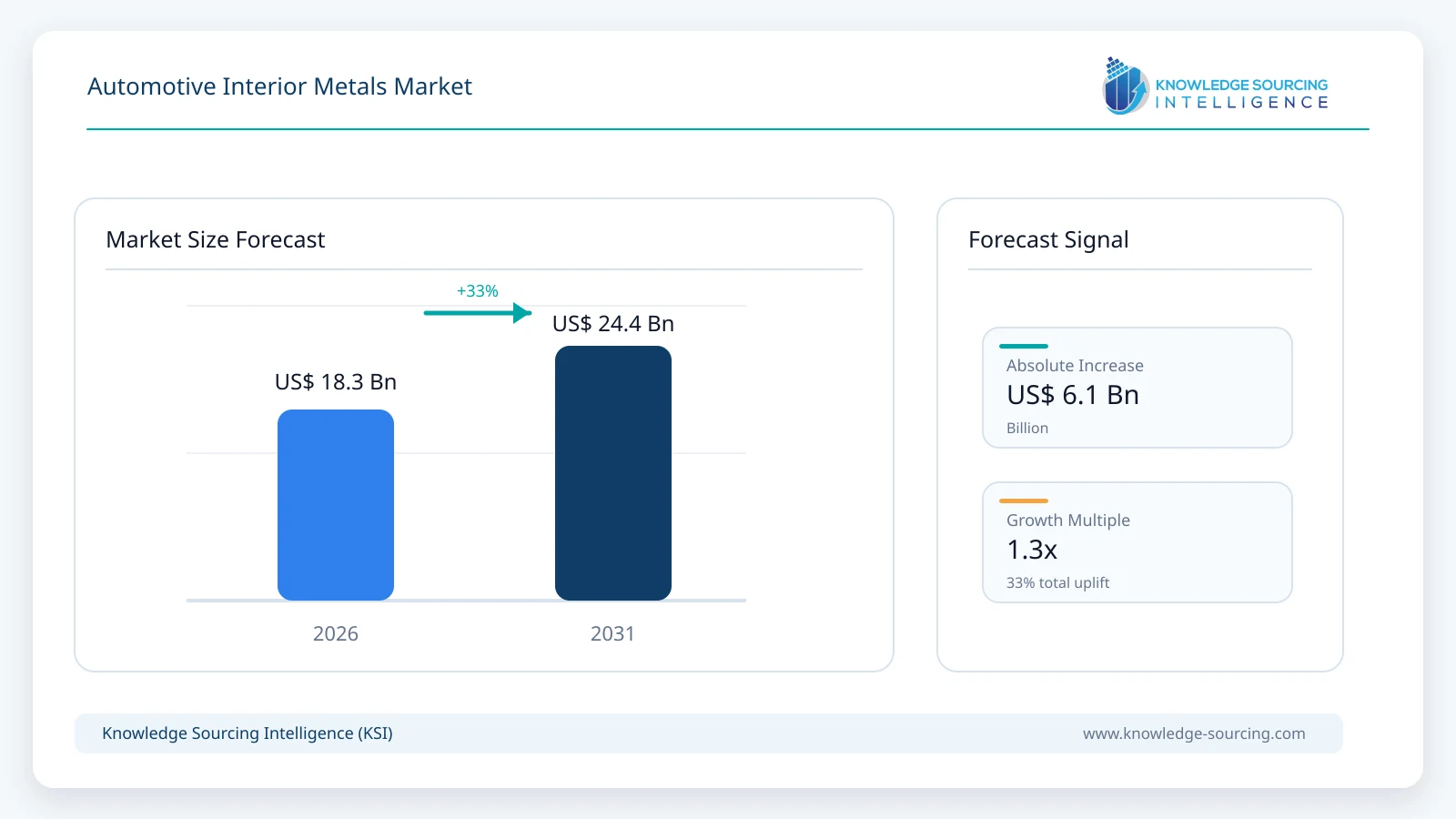
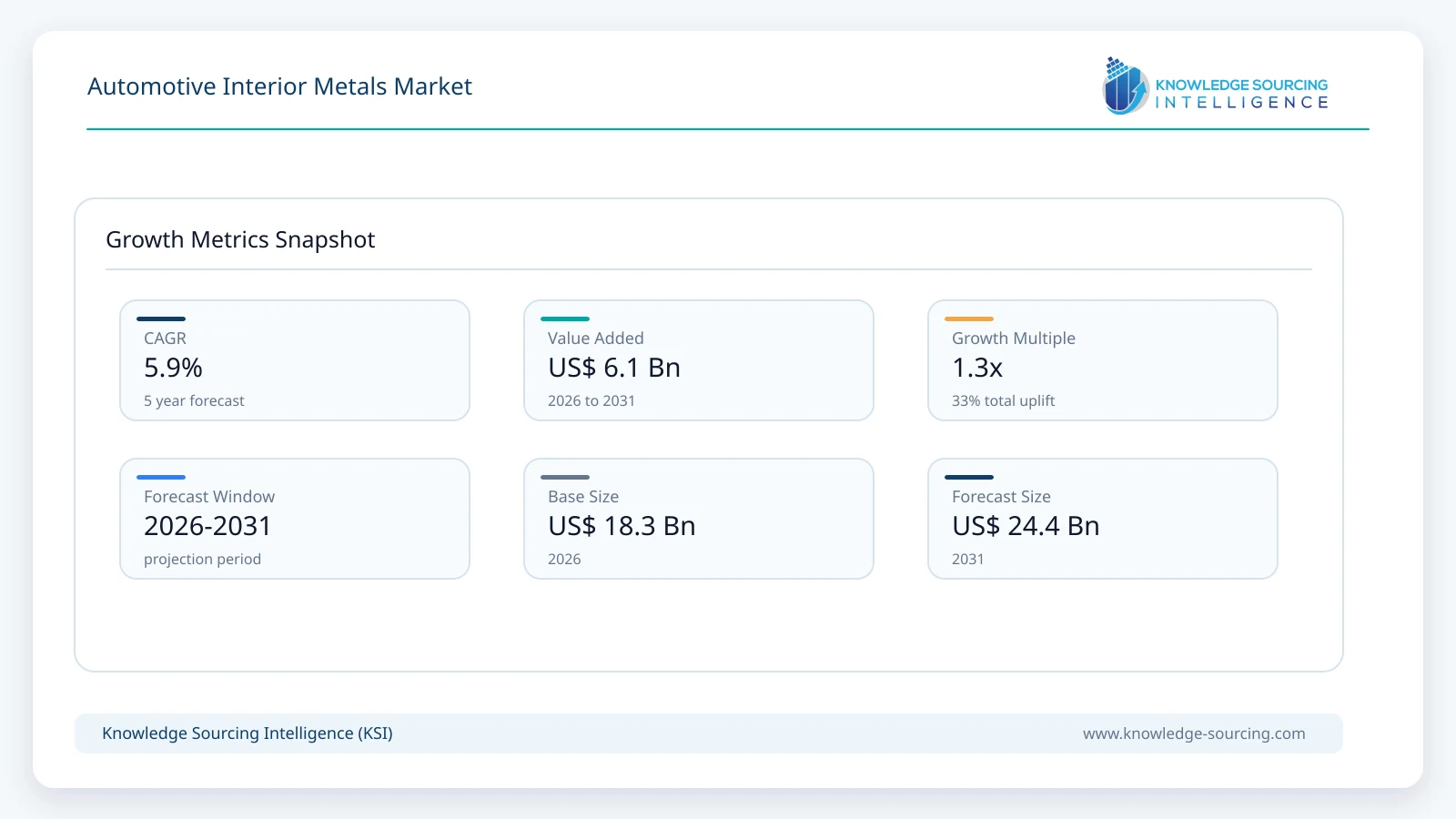
The Automotive Interior Metals Market is projected to expand at a CAGR of 5.9%, increasing from USD 18.3 billion in 2026 to USD 24.4 billion by 2031.
Highlights:
- 1Steel and high-strength steel products account for an estimated 69% of 2026 market value, supported by established stamping, forming, welding and seat-frame supply chains.
- 2Seat structures, tracks and adjustment mechanisms represent approximately 53% of the market in 2026; this remains the largest value pool through 2031.
- 3Aluminum and magnesium components collectively account for about 25% of 2026 value, with increasing use in selected lightweight structures.
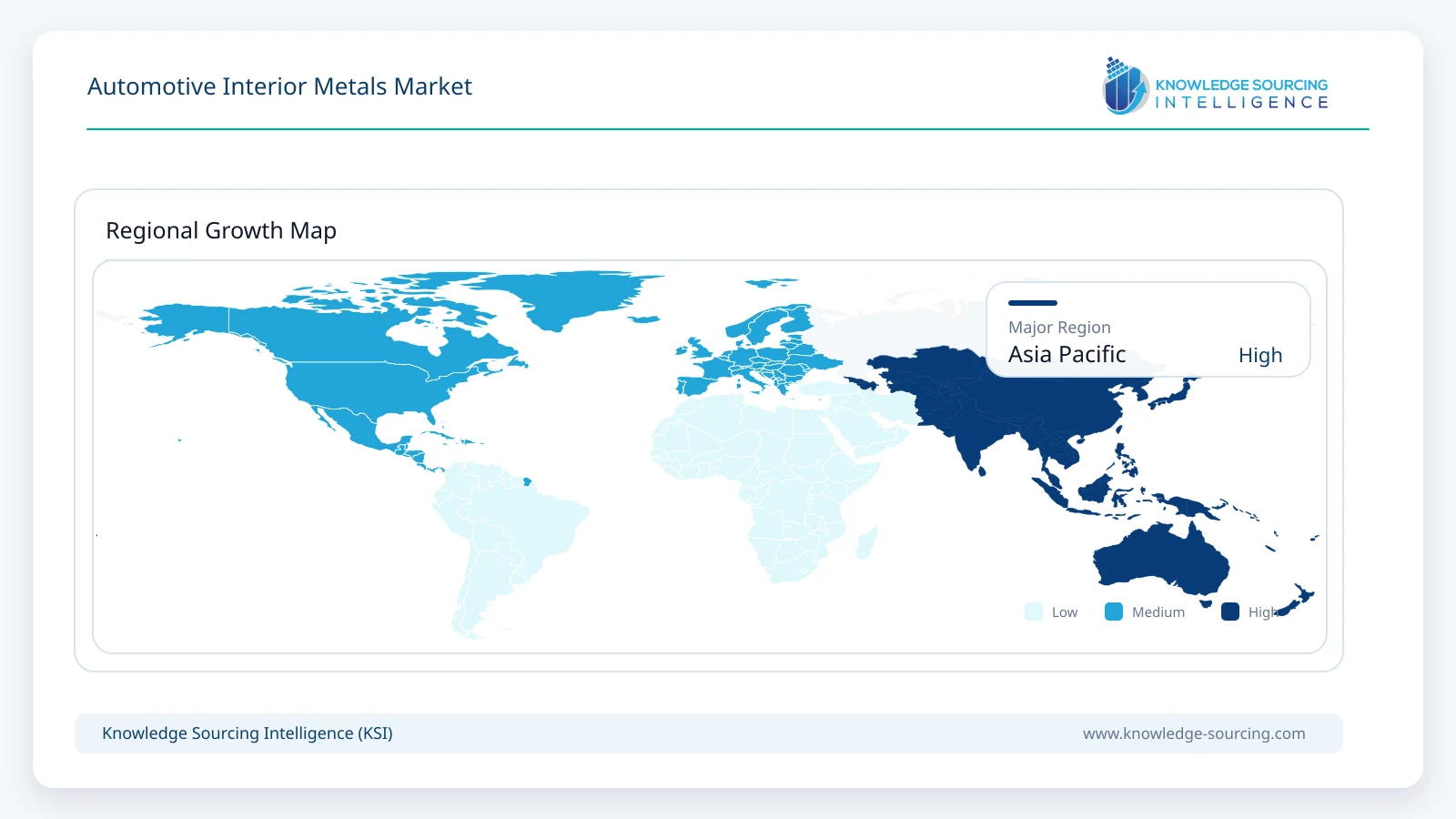
- 4Asia Pacific represents approximately 55% of market value in 2026, reflecting vehicle production and established supply chains.
- 5Genuine metallic decorative surfaces grow faster than conventional structural brackets, supported by premium cabin differentiation and higher-value surface finishing.
- 6The EU vehicle-circularity regulation adopted in July 2026 strengthens the commercial importance of material identification, recovery and recycled-content readiness without imposing an immediate steel quota.
The market covers manufactured metal structures, mechanisms and finished metal decorative components installed within vehicle cabins, including seat frames and tracks, cross-car beams, interior brackets, console and door hardware, and genuine metal surface accents. It measures component-supplier revenue attributable to the metal product rather than the selling price of an assembled seat, door module or cockpit.
Seating represents the largest demand pool because vehicle interiors contain several metal-supported occupant positions, with additional rails, recliners and adjustment hardware on premium trims. Adient identifies front and rear structures, tracks, recliners and height adjusters as core products, while Magna combines specialty seating hardware with swivel and long-rail systems. Cross-car beams provide another established metal application, supporting instrument panels, steering-column attachments and packaged cabin systems.
Market Overview
Vehicle seats rely on rigid metal structures to transfer occupant loads through the cushion and backrest to the body mounting points. Most volume applications continue to use formed and welded steel because manufacturing processes are established, fatigue behavior is well understood, and complex frame assemblies can be produced at automotive production rates. Adient markets hybrid designs capable of reducing structure and mechanism weight, and Brose operates high-volume stamped and welded seat-frame manufacturing with integrated adjustment systems.
Instrument-panel support beams, commonly called cross-car beams, carry significant structural and packaging requirements behind the dashboard. KIRCHHOFF Automotive supplies steel cross-members using formed, welded, and function-integrated designs, including open-shell concepts that accommodate wiring and reduce assembly interfaces. Some premium and weight-sensitive programs use aluminum or magnesium, but a material substitution must meet crash, steering-column stiffness, and joint-durability requirements as well as its mass target.
Cabin metal content also extends beyond large hidden structures. Interior door handles, latches, brackets, console movement hardware and precision components require dimensional stability and wear resistance, while aluminum and stainless-steel trim provide genuine metallic surfaces in selected premium vehicles. Novem processes aluminum as part of its automotive decorative portfolio, and CIE Automotive acquired Aludec to broaden its production of decorative plastic and metal components for vehicle interiors and exteriors.
Market Trends
Seat Architecture Is Raising the Value of Metal Mechanisms
New cabin layouts increase the complexity of metal tracks, recliners, pivots and locking devices even where seat structures become lighter. Magna offers long-rail, swivel and reconfigurable seating hardware, while Adient introduced its ModuGo modular seating concept in 2025 using a lightweight-frame foundation. These designs require robust moving joints and validated load paths, increasing engineering and manufacturing value in the metal subassembly without necessarily increasing the amount of metal used.
Mixed-Metal Cockpit Supports Are Becoming More Integrated
Steel cross-car beams remain widespread, but suppliers are redesigning their geometry to accommodate wiring, steering systems, airbag packaging and large electronic displays. KIRCHHOFF Automotive has developed an open-shell steel instrument-panel carrier that allows additional functional integration within the cross-member. Aluminum and magnesium can offer further mass reduction on selected programs, provided casting integrity, joint performance and corrosion protection satisfy OEM validation requirements.
Premium Cabin Surfaces Support Genuine Metal Finishes
Aluminum strips, precision-machined inserts and stainless-steel accents remain a distinct premium interior category because they differ visibly and tactually from plated plastic. Novem supplies high-end decorative interior components in aluminum alongside wood and premium synthetic materials. Its fiscal 2025/26 revenue of roughly EUR 511 million covers several material families, so it cannot be treated as a direct measure of automotive metal-trim sales.
CIE Automotive completed its acquisition of Aludec in March 2026 for an enterprise value of EUR 200 million. Aludec manufactures both plastic and metal decorative components for interior and exterior applications, giving CIE an additional channel into visible automotive surfaces. Premium decoration can therefore support component-value growth, although its addressable volume remains much smaller than that of structural steel seating parts.
Segment Analysis
By Metal Type: Steel and High-Strength Steel
Steel is estimated to represent 69% of 2026 market value, reflecting the importance of seat frames, adjustment tracks, cross-car beams and brackets. Cold-forming, high-strength sheet grades and robotic welding support competitive piece costs while maintaining fatigue resistance and crash-load performance. Specialized lower-carbon steel grades can improve upstream emissions profiles without forcing redesigns of every validated seating or cockpit structure.
Steel is expected to remain the dominant material through 2031, although its modeled share declines as aluminum and magnesium gain selected structural applications. Material substitution will be uneven: high-volume seats and rails are especially sensitive to cost, while lighter support beams and premium components allow greater engineering flexibility. Demand for steel therefore continues to increase in absolute terms even as the material mix becomes more diverse.
By Application: Seat Structures and Adjustment Hardware
Seat frames and associated metal mechanisms represent approximately 53% of the market in 2026. Every passenger vehicle uses metal-supported occupant positions, and adjustable front seats add rails, recliners, height mechanisms and reinforcement elements. Magna, Adient, Brose, Lear and other seating suppliers manufacture or integrate these components across global platforms, giving the category substantially broader demand than premium metal ornamentation.
The strongest incremental value comes from higher-function seats rather than additional frame weight. Swivel mechanisms, reconfigurable rows, long tracks and compact recliners add precision and validation requirements, while optimized high-strength steel and hybrid designs lower mass. Growth should therefore reflect rising metal-component functionality and manufacturing content per vehicle, even when lightweighting reduces kilograms per assembly.
By Manufacturing Process: Stamping, Forming and Welding
Stamping, forming and welding account for the largest estimated process group because steel remains the principal cabin structural material. Cold-formed frames, tubular members, spot- and laser-welded assemblies and stamped brackets can be manufactured in high volumes using mature tooling and process-control methods. Brose’s seat-frame plants illustrate the use of integrated stamping, welding and finishing operations in production-scale automotive supply.
Casting gains relative importance where aluminum or magnesium replaces more complex welded assemblies, while machined decorative metal and precision mechanism parts contribute higher-value work at lower unit volumes. The process mix changes more slowly than individual vehicle features because qualification costs and dedicated tooling discourage frequent manufacturing-route changes.
By Vehicle Type: Passenger Vehicles
Passenger vehicles account for an estimated 84.5% of 2026 market value, reflecting high global production, multiple seating positions and the greatest penetration of powered and premium cabin features. Light commercial vehicles use comparable seat and dashboard supports but generally have fewer decorative metal surfaces. Heavy commercial vehicles and coaches contain more substantial individual structures yet contribute lower aggregate revenue because their production volumes are smaller.
Market Drivers
Growth in Automotive Seat Adjustment and Reconfigurability
Seating suppliers are adding longer tracks, compact recliners, swivel mechanisms, and adaptable layouts to support varied cabin uses. Magna’s reconfigurable seating portfolio and Adient’s modular concepts show how mechanical systems are expanding beyond conventional fore-aft and backrest adjustment. The trend raises demand for precision metal interfaces, load-bearing pivots and locking hardware even as engineers remove unnecessary mass from frame structures.
Continued Demand for Crash-Qualified Cabin Structures
Seat frames and cockpit supports must transfer defined loads while maintaining stable attachments to restraint systems and surrounding vehicle structures. Steel offers an established combination of material strength, fatigue resistance, supply availability and cost-effective forming, which limits wholesale replacement by polymer components. As vehicle architectures evolve, suppliers continue to redesign these metal load paths rather than eliminate them.
Lightweighting and Higher-Value Alloy Engineering
Electric-vehicle range and overall vehicle-efficiency targets encourage manufacturers to reduce unnecessary cabin mass. Aluminum and magnesium can replace selected steel assemblies where part consolidation or lower density offsets material and joining costs. A 2025 technical review of magnesium cabin components identified steering-wheel frames, seat frames, cross-car beams and console frames as documented application areas, while also noting the remaining cost and joining barriers.
Premium Interior Design and Genuine Metal Decoration
Higher-specification vehicles continue to use brushed aluminum, stainless-steel accents and precision-finished metal details to distinguish visible cabin surfaces. Novem’s aluminum decorative capability and CIE Automotive’s acquisition of Aludec indicate an active supplier base for these products. Metal decoration adds comparatively modest vehicle weight but can carry higher value per component through finishing, surface consistency and tailored design.
Localized Cabin-Component Production and Industrial Automation
Seat and cockpit structures require reliable just-in-time deliveries, stable dimensional quality and close coordination with vehicle assembly plants. Magna, Brose and other established suppliers operate production footprints across major automotive regions, while Adient’s ModuTec approach focuses on modular construction and automation. Localized manufacturing helps reduce launch and logistics risk and supports more consistent cost performance for metal-intensive cabin assemblies.
Market Restraints
Cost Premiums for Lightweight Alloys and Specialized Joining
Aluminum and magnesium often cost more than commodity sheet steel on a delivered-component basis and can require additional casting, machining or joining steps. Lightweighting must create enough value through mass reduction or part consolidation to offset these expenses. Price-sensitive vehicle programs therefore continue to favor optimized steel structures where the engineering and tooling base is already mature.
Dissimilar-Metal Corrosion and Durability Requirements
Joining magnesium or aluminum to adjacent steel parts can introduce galvanic-corrosion risks if surfaces and fasteners are not properly isolated. Seat structures also experience repeated adjustment, vibration, and long-term occupant loads, increasing the importance of fatigue validation. These requirements raise qualification and warranty costs for new material combinations and can delay wider adoption of otherwise attractive alloys.
Vehicle-Program Qualification and Tooling Lock-In
Automotive interior frames and mechanisms are commonly designed around model-specific mounting points, restraint-system loads, and tight packaging constraints. Changes in the base material or fabrication route can affect crash testing, dimensional stack-ups, and supplier tooling. Since OEMs usually retain approved architectures over multiyear production cycles, adoption of new alloys or component designs proceeds mainly with major platform updates.
Price Volatility and Supply Constraints in Metal Inputs
Sheet steel, aluminum alloys, and magnesium face different exposure to energy costs, scrap quality, trade conditions, and regional processing capacity. The final cabin part includes conversion and engineering value, but metal-input volatility can still pressure supplier margins under fixed program pricing. Long-term supply agreements and hedging help manage risk without removing exposure to changes in quality and availability.
Competition from Polymers and Multi-Material Substitution
A growing range of interior brackets, carriers and decorative elements can be manufactured in reinforced thermoplastics or composite materials instead of solid metal. These alternatives are especially competitive where the component does not carry major crash loads or where a metallic appearance can be achieved through surface treatment. Metals retain advantages in fatigue-critical and highly loaded applications, but continued substitution limits growth in lower-load brackets and decorative pieces.
Regional Outlook
Asia Pacific
Asia Pacific is estimated to account for 55% of automotive interior metals market value in 2026, supported by vehicle production and an extensive supply chain for seat frames, mechanisms and cross-car beams. China is the largest manufacturing base, while Japan and South Korea combine established seating suppliers with sophisticated metal-forming and material-engineering capabilities. India and Southeast Asia are increasing localized automotive-component manufacturing as passenger-vehicle and commercial-vehicle production expands.
Regional demand extends from cost-optimized stamped steel frames to premium reconfigurable mechanisms, with Chinese electric-vehicle programs particularly active in developing varied cabin layouts. Brose’s seat-frame production in China and Adient’s reported seating programs with Chinese OEMs demonstrate substantial domestic manufacturing capabilities. Asia Pacific should remain the largest regional market through 2031, although component value per vehicle differs markedly across countries and vehicle classes.
Europe
Europe remains an important value center for engineered seating mechanisms, cross-car beams, lightweight alloys and genuine metallic interior decoration. Magna, Brose, KIRCHHOFF Automotive, Novem and CIE Automotive maintain relevant manufacturing or engineering operations serving European vehicle platforms. Mature passenger-vehicle output is offset partly by premium specifications, technical differentiation and high demands for structural validation and surface quality.
The EU’s 2026 vehicle-circularity regulation adds longer-term importance to material traceability, recoverability and the design of recyclable components, although proposed recycled-metal targets are not equivalent to an immediate requirement for a specified percentage of recycled steel or aluminum in new cars. European suppliers are likely to focus on low-carbon metals, controlled alloy content and efficient component conversion while retaining proven structural performance. Growth through 2031 should be driven more by value per vehicle than by rapid increases in unit production.
Competitive Landscape
The market comprises seating-system manufacturers with substantial metal-structure capabilities, specialized stamped and formed component suppliers, and decorative-interior companies. Adient, Magna, Brose Sitech, Lear, FORVIA and Toyota Boshoku participate through seat structures or mechanism integration, while KIRCHHOFF Automotive and selected metal-forming specialists supply cockpit cross-members and supports. Novem and CIE Automotive participate through genuine metal decorative surfaces and related finishing capabilities.
Competition differs by application. High-volume seat-frame contracts depend on global program execution, tooling control, automated welding and reliable just-in-time supply; lighter structural castings depend on alloy expertise, joint design and process capability; and premium decorative parts depend on finish consistency and visible quality. Public financial disclosures rarely isolate metal-only interior sales, limiting confidence in supplier market-share rankings.
Recent Developments
March 2026: CIE Automotive completed the EUR 200 million acquisition of Aludec, a manufacturer of plastic and metal decorative components for interior and exterior applications. The transaction expands CIE’s relevant decorative-material and finishing capabilities.
January 2026: Adient introduced ModuTec, a modular seat-manufacturing architecture designed to improve automation and reduce final assembly time. The program affects manufacturing economics for metal-intensive seat structures and mechanisms.
September 2025: Adient presented its Pure Ergonomics seating concept, incorporating optimized metal structures and an estimated 5–10% seat-weight reduction against its stated comparator, illustrating material-efficient cabin engineering.
August 2025: Adient announced its ModuGo modular seat concept based on its Ultrathin and lightweight-frame technologies. The design enables customized seating functions while retaining a common structure.
April 2025: Magna highlighted reconfigurable seating solutions at Auto Shanghai, indicating ongoing supplier development of long-rail and flexible seating mechanisms for China’s vehicle programs.
Market Outlook
The automotive interior metals market is projected to reach approximately USD 24.40 billion by 2031 as growth in mechanical seat functionality and premium cabin design adds value to established steel-based structures. Conventional seat frames and cockpit supports will continue to represent the majority of revenue, while reconfigurable seating hardware, lightweight-alloy supports and genuine metal decoration contribute faster-growing applications. Steel should remain the largest metal category in absolute value despite a gradual increase in aluminum and magnesium penetration.
Asia Pacific will retain the leading regional position, with China central to both volume production and the development of more adaptable cabin features. Europe should remain important for precision structures, premium finishes and low-carbon material qualification. Supplier performance will depend on meeting safety and durability requirements while controlling conversion costs, tooling investment and material exposure across model cycles.
Automotive Interior Metals Market Scope:
| Report Metric | Details |
|---|---|
| Total Market Size in 2026 | USD 18.3 billion |
| Total Market Size in 2031 | USD 24.4 billion |
| Forecast Unit | USD Billion |
| Growth Rate | 5.9% |
| Study Period | 2021 to 2031 |
| Historical Data | 2021 to 2024 |
| Base Year | 2025 |
| Forecast Period | 2026 – 2031 |
| Segmentation | Metal Type, Application, Primary Manufacturing Process, Vehicle Type |
| Companies |
|
Market Segmentation
By Metal Type
Steel and High-Strength Steel
Aluminum and Aluminum Alloys
Magnesium Alloys
Stainless Steel and Other Metal Alloys
By Application
Seat Structures, Rails and Adjustment Mechanisms
Instrument Panel and Cockpit Cross-Car Supports
Door and Console Metal Hardware
Genuine Metallic Decorative Trim
Other Cabin Brackets and Metal Components
By Primary Manufacturing Process
Stamping, Forming and Welding
Metal Casting and Die Casting
Extrusion and Roll Forming
Machining, Precision Fabrication and Finishing
By Vehicle Type
Passenger Vehicles
Light Commercial Vehicles
Medium and Heavy Commercial Vehicles
Buses and Specialty Vehicles
By Geography
North America
United States
Canada
Mexico
South America
Brazil
Argentina
Others
Europe
Germany
United Kingdom
France
Italy
Spain
Others
Middle East and Africa
Saudi Arabia
UAE
South Africa
Others
Asia Pacific
China
Japan
South Korea
India
Indonesia
Thailand
Others
Table of Contents
1. EXECUTIVE SUMMARY
1.1. Key Findings
1.2. Automotive Interior Metals Market Size and Forecast, 2026–2031
1.3. Metal Type and Application Outlook
1.4. Regional Opportunity Summary
2. MARKET SNAPSHOT
2.1. Market Overview
2.2. Market Definition
2.3. Scope of the Study
2.4. Market Segmentation
3. BUSINESS LANDSCAPE
3.1. Market Drivers
3.1.1. Growth in Automotive Seat Adjustment and Reconfigurability
3.1.2. Continued Demand for Crash-Qualified Cabin Structures
3.1.3. Lightweighting and Higher-Value Alloy Engineering
3.1.4. Premium Interior Design and Genuine Metal Decoration
3.1.5. Localized Cabin-Component Production and Industrial Automation
3.2. Market Restraints
3.2.1. Cost Premiums for Lightweight Alloys and Specialized Joining
3.2.2. Dissimilar-Metal Corrosion and Durability Requirements
3.2.3. Vehicle-Program Qualification and Tooling Lock-In
3.2.4. Price Volatility and Supply Constraints in Metal Inputs
3.2.5. Competition from Polymers and Multi-Material Substitution
3.3. Market Opportunities
3.4. Porter’s Five Forces Analysis
3.5. Industry Value Chain Analysis
3.6. Policies and Regulations
3.7. Strategic Recommendations
4. TECHNOLOGICAL OUTLOOK
4.1. High-Strength Steel Forming and Hydroforming
4.2. Laser Welding and Automated Structural Assembly
4.3. Aluminum and Magnesium Die Casting
4.4. Multi-Material Joining and Corrosion Protection
4.5. Precision Seat Mechanisms and Reconfigurable Hardware
4.6. Metallic Decorative Finishing and Surface Treatments
5. AUTOMOTIVE INTERIOR METALS MARKET BY METAL TYPE
5.1. Introduction
5.2. Steel and High-Strength Steel
5.3. Aluminum and Aluminum Alloys
5.4. Magnesium Alloys
5.5. Stainless Steel and Other Metal Alloys
6. AUTOMOTIVE INTERIOR METALS MARKET BY APPLICATION
6.1. Introduction
6.2. Seat Structures, Rails and Adjustment Mechanisms
6.3. Instrument Panel and Cockpit Cross-Car Supports
6.4. Door and Console Metal Hardware
6.5. Genuine Metallic Decorative Trim
6.6. Other Cabin Brackets and Metal Components
7. AUTOMOTIVE INTERIOR METALS MARKET BY PRIMARY MANUFACTURING PROCESS
7.1. Introduction
7.2. Stamping, Forming and Welding
7.3. Metal Casting and Die Casting
7.4. Extrusion and Roll Forming
7.5. Machining, Precision Fabrication and Finishing
8. AUTOMOTIVE INTERIOR METALS MARKET BY VEHICLE TYPE
8.1. Introduction
8.2. Passenger Vehicles
8.3. Light Commercial Vehicles
8.4. Medium and Heavy Commercial Vehicles
8.5. Buses and Specialty Vehicles
9. AUTOMOTIVE INTERIOR METALS MARKET BY GEOGRAPHY
9.1. North America
9.1.1. United States
9.1.2. Canada
9.1.3. Mexico
9.2. South America
9.2.1. Brazil
9.2.2. Argentina
9.2.3. Others
9.3. Europe
9.3.1. Germany
9.3.2. United Kingdom
9.3.3. France
9.3.4. Italy
9.3.5. Spain
9.3.6. Others
9.4. Middle East and Africa
9.4.1. Saudi Arabia
9.4.2. UAE
9.4.3. South Africa
9.4.4. Others
9.5. Asia Pacific
9.5.1. China
9.5.2. Japan
9.5.3. South Korea
9.5.4. India
9.5.5. Indonesia
9.5.6. Thailand
9.5.7. Others
10. COMPETITIVE ENVIRONMENT AND ANALYSIS
10.1. Major Players and Strategy Analysis
10.2. Market Share Analysis
10.3. Mergers, Acquisitions, Agreements and Collaborations
10.4. Competitive Dashboard
11. COMPANY PROFILES
11.1. Adient plc
11.2. Magna International Inc.
11.3. Lear Corporation
11.4. FORVIA SE
11.5. Brose Sitech GmbH
11.6. KIRCHHOFF Automotive GmbH
11.7. CIE Automotive, S.A.
11.8. Novem Group S.A.
11.9. Toyota Boshoku Corporation
11.10. NHK Spring Co., Ltd.
11.11. voestalpine AG
12. APPENDIX
12.1. Currency
12.2. Assumptions
12.3. Base and Forecast Years Timeline
12.4. Key Benefits for Stakeholders
12.5. Research Methodology
12.6. Abbreviations
Navigate
Trusted by the world's leading organizations











